State of Michigan Withholding Tax: A Business Owner's Guide
Navigate State of Michigan withholding tax with our 2026 guide. Learn employer duties, rates, filing schedules, and how to fix errors to avoid penalties.

In this article
- Your First Step as a Michigan Employer
- Why this matters immediately
- The first decision you need to make
- Who Must Withhold Michigan Income Tax
- The easy cases and the risky cases
- Start with the worker classification
- Remote and nonresident employees
- Registration and Calculating Withholding Amounts
- Register before the first messy payroll
- The calculation rule
- Where businesses slip
- Payment Schedules and Filing Through MTO
- Why timing risk is a separate risk
- 2026 Michigan withholding filing frequencies and due dates
- What MTO should be doing for you
- Common Withholding Mistakes and Steep Penalties
- Mistakes that trigger trouble
- Why these errors become expensive
- What to do instead
- How to Correct Errors and Handle an Audit
- Start with the records, not the explanation
- The outdated flow-through entity trap
- If Treasury audits the account
- When to Get Professional Help for Tax Debt
- Red flags that mean stop handling it casually
- What a tax attorney actually does here
You hired someone. Payroll starts Friday. Then you realize Michigan doesn't just expect you to pay wages. It expects you to withhold tax, remit it on the right schedule, keep your records straight, and reconcile the account on time.
That's where many business owners get into trouble. Not because Michigan withholding tax is mathematically complicated, but because the practical rules are easy to underestimate. A wrong worker classification, a stale payroll setup, or a missed filing date can turn a routine payroll task into a tax debt problem.
The state of Michigan withholding tax is straightforward at the surface and messy in real life. The flat rate makes people think the whole system is simple. It isn't. The hard part is figuring out who you must withhold for, when you must remit, and how to fix mistakes before Treasury fixes them for you.
Your First Step as a Michigan Employer
A common version of this starts with a small business owner who finally makes a first hire. They've spent months chasing sales, signing a lease, buying software, and trying to keep cash moving. Payroll feels like one more admin task to push through quickly.
That's a mistake.
When you become an employer, you take on a tax collection role for the state. Michigan expects you to withhold income tax from wages, hold that money properly, and send it in under the rules Treasury assigns. If you treat withholding like a bookkeeping detail, you create risk for the business and often for yourself.

Why this matters immediately
Michigan withholding isn't optional because the employee “knows they'll owe taxes anyway.” It isn't something you clean up at year-end if you're busy. The system assumes the withholding happens during the year and gets remitted on the assigned timetable.
If you're still learning the basics of payroll tax administration generally, this guide on small business payroll taxes is a useful companion. Michigan withholding fits into that larger payroll framework, but it has its own state-specific traps.
Practical rule: If you have wages and a Michigan withholding duty, the safest approach is to treat every payroll run as both a compensation event and a tax compliance event.
The first decision you need to make
Ask one question before you run payroll: Is this worker an employee for withholding purposes? If the answer is yes, you need a compliant process from the first check.
That means:
- Registering properly: Don't wait until a notice arrives.
- Collecting the right forms: Your withholding amount depends on employee information.
- Using current payroll settings: Old assumptions create repeat errors.
- Matching payment timing to Treasury's schedule: Good calculations won't save you from late remittance problems.
Business owners often focus on rate calculations because that feels concrete. In practice, the bigger danger is operational sloppiness. Michigan withholding problems usually grow because nobody owned the process from day one.
Who Must Withhold Michigan Income Tax
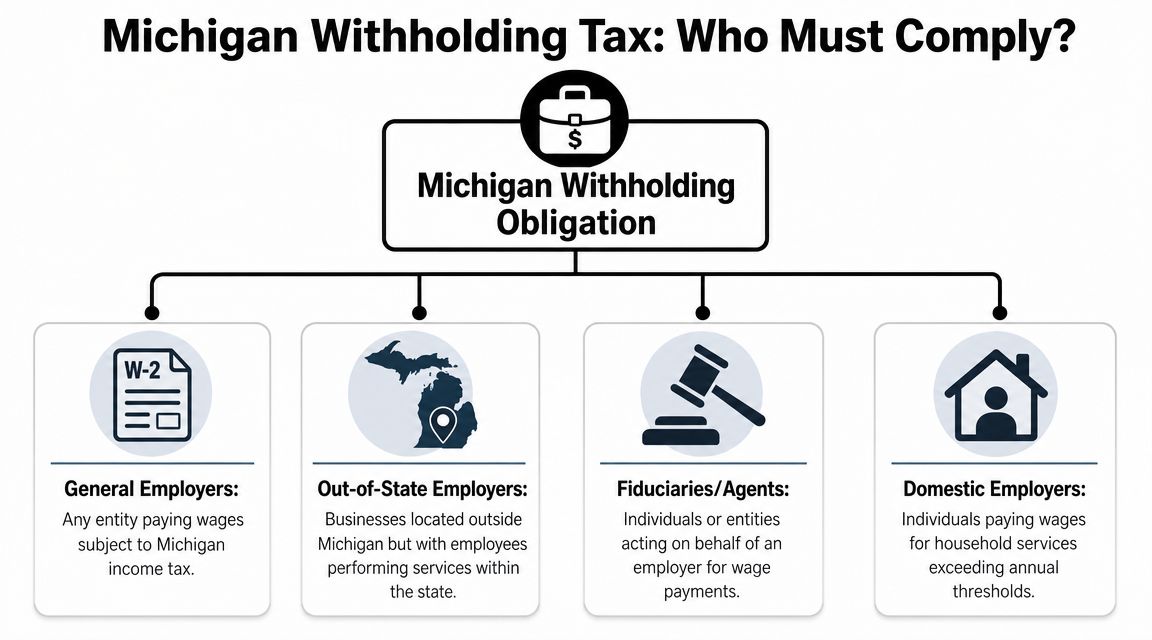
The broad rule is simple. Michigan says that any employer required to withhold federal income tax must also register for and withhold Michigan income tax, according to the state's withholding tax FAQs.
That broad rule is where most articles stop. It's not where your risk stops.
The easy cases and the risky cases
If you're a Michigan employer with Michigan-based employees performing services in the state, your withholding duty is usually obvious.
The trouble starts in edge cases:
- An employee lives in Ohio and works in Michigan
- An employee lives in Michigan and works remotely elsewhere
- You're based outside Michigan but have someone performing services in Michigan
- You've labeled someone a contractor because that was easier administratively
- A worker claims some kind of exemption and nobody reviews the documentation
Michigan's own FAQ is broad. It doesn't fully answer how withholding applies when workers live in one state and work in another, or when treaty-based or other exemption-based situations are involved. That's exactly why these cases create audit risk.
Start with the worker classification
Don't use withholding rules to decide whether someone is an employee or contractor. Decide classification first. Then apply the withholding rules that follow from that status.
A lot of business owners reverse that logic. They want flexibility, so they call the worker an independent contractor and move on. That approach can collapse fast in an audit. If the worker is really an employee, the state can look back at wages that should have had Michigan withholding attached to them.
Use a practical checklist:
- Who controls the work? If you direct how, when, and where the person works, that points toward employee status.
- Who bears business risk? Contractors usually carry more independent financial risk.
- How integrated is the role? A person doing core ongoing work inside your operation often looks more like an employee.
- What documents do you have? Good records won't fix a bad classification, but missing records make your defense weaker.
The state of Michigan withholding tax gets messy when businesses use casual labels instead of documented employment decisions.
Remote and nonresident employees
For remote and multi-state arrangements, don't guess. Build a file for each worker that shows where the employee lives, where services are performed, what your payroll system assumes, and why.
That file should include:
- Residence information: Employee address and any updates
- Work-location record: Where services are performed
- Payroll setup notes: Why Michigan withholding is on, off, or allocated in a specific way
- Exemption support: Any forms or documents tied to special treatment
If you operate in more than one state, Michigan withholding should never be handled by habit. It should be handled by written decision rules. That's how you reduce disputes later.
Registration and Calculating Withholding Amounts
Michigan withholding administration has two moving parts. First, you get registered and operational. Second, you calculate withholding correctly every pay period.
Most payroll problems start when a business skips one of those steps. They either delay registration because payroll is “temporary,” or they run payroll with generic software defaults and never verify the Michigan settings.
Register before the first messy payroll
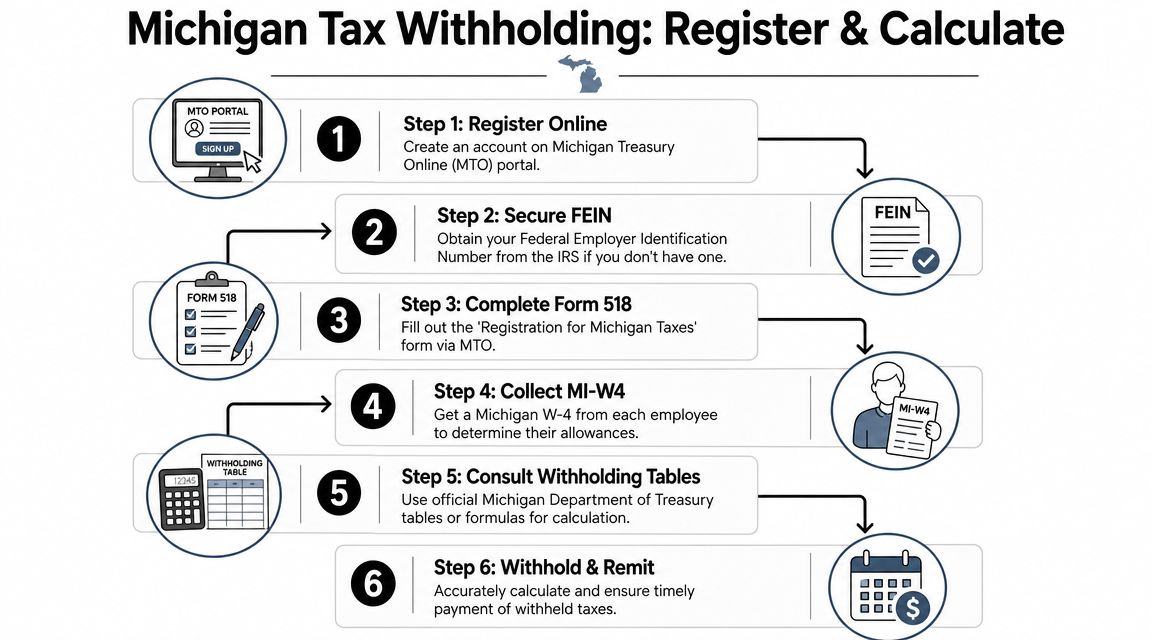
Use Michigan Treasury Online and get the withholding account in place before you're trying to fix a late filing. If you're already dealing with state online account issues, this note on the new and improved business tax account helps explain the account-management side.
Once you're set up, collect the employee's MI-W4 and make sure payroll uses it. A form in a folder doesn't change withholding. The payroll system has to reflect it.
The calculation rule
For calendar year 2026, Michigan uses a flat 4.25% withholding rate, applied to compensation after deducting the personal and dependency exemption allowance, and the 2026 personal exemption amount is $5,900, as shown in the Michigan Department of Treasury's 2026 withholding guide.
That tells you the structure:
- Start with the employee's compensation.
- Account for the employee's applicable personal and dependency exemption allowance.
- Apply the Michigan withholding formula using the flat rate.
- Make sure the result is carried into the payroll run and reporting process.
Michigan's system is simple in one sense. It doesn't require you to work through a ladder of changing rates. But don't confuse a flat rate with “nothing can go wrong.” The exemption information matters.
Where businesses slip
Two employees with the same gross pay can have different withholding because their MI-W4 information differs. That means your payroll software needs current Michigan settings and current employee form data.
If you also pay relocation packages, bonuses, or make-whole payments, gross-up planning can affect the wage amount that enters payroll. For that narrow issue, Paradigm International's tax gross up insights are a useful conceptual reference before you decide how the payment should be structured.
Good payroll administration is repetitive on purpose. The fewer manual “one-time exceptions” you create, the fewer withholding mistakes you'll need to unwind later.
Payment Schedules and Filing Through MTO
Correct withholding is only half the job. Remittance timing is where many Michigan accounts go off track.
The Department of Treasury assigns employers a filing frequency. You don't pick the schedule because it's convenient. Treasury assigns it, and you need to follow it exactly. According to Michigan's withholding tax guidance, returns and payments may be due monthly, quarterly, or annually, all filers must submit an annual return by February 28, monthly filers pay by the 20th of the following month, quarterly filers pay by the 20th after quarter-end, and Treasury also notes an accelerated EFT category that requires a pre-payment by the 20th of the current month and a reconciliation payment by the 20th of the next month.
Why timing risk is a separate risk
Business owners often think, “We withheld the money, so we're fine.” You're not fine if the money sits too long, the filing goes missing, or the annual reconciliation doesn't match the payment history.
Treasury treats remittance and filing as separate compliance duties. A payroll system can calculate every check perfectly and you can still rack up problems if someone misses the deposit schedule or forgets the year-end reconciliation.
2026 Michigan withholding filing frequencies and due dates
| Filing Frequency | Payment Due Date | Annual Reconciliation Due |
|---|---|---|
| Monthly | By the 20th of the following month | By February 28 |
| Quarterly | By the 20th after quarter-end | By February 28 |
| Annual | As assigned by Treasury under annual filing treatment | By February 28 |
| Accelerated EFT | Pre-payment by the 20th of the current month, reconciliation by the 20th of the next month | By February 28 |
What MTO should be doing for you
Michigan Treasury Online shouldn't be a place you log into only after a notice shows up. Use it as the operating hub for the account.
At a minimum, someone in your business should monitor:
- Assigned filing frequency: Confirm what Treasury currently expects
- Payment confirmations: Keep proof of every submission
- Annual reconciliation status: Don't assume year-end closed correctly
- Notice activity: Respond fast to mismatches or missing-return allegations
If you delegate payroll, keep oversight anyway. Treasury won't excuse the business because a processor, bookkeeper, or office manager dropped the ball.
Common Withholding Mistakes and Steep Penalties
Most Michigan withholding problems don't start with fraud. They start with ordinary sloppiness that repeats through multiple payroll cycles.
One classic example is leaving the withholding rate alone and assuming that's enough. It isn't. The federal National Finance Center's Michigan tax map explains that for 2025 the annual exemption allowance increased from $5,600 to $5,800, and withholding is computed by subtracting exempt amounts from annualized wages before applying the 4.25% rate, which means payroll systems must be updated when exemption values change or they can produce systemic under-withholding. That's laid out in the NFC's Michigan tax map guidance.
Mistakes that trigger trouble
Here are the errors I see most often in the state of Michigan withholding tax context:
- Using outdated payroll settings: The rate may look stable, but stale exemption values create subtle withholding distortions.
- Treating contractors like a workaround: Misclassification often surfaces only after a worker dispute, unemployment issue, or audit.
- Missing the remittance cycle: A correct payroll run still becomes a tax problem if the payment goes in late.
- Ignoring annual reconciliation: Year-end mismatches invite notices and force you into cleanup mode.
- Letting nobody own the account: Payroll by committee is a liability generator.
Why these errors become expensive
Under-withholding creates year-end tax exposure for employees and compliance exposure for the employer. Late deposits and incomplete filings trigger the kind of notices that consume time, cash, and management attention.
And if you think the liability stays neatly inside the company, don't assume that. Issues involving payroll taxes can expose individuals connected to the business, which is why this discussion of liability for payroll taxes not being limited to the business matters.
The steepest withholding problems usually aren't one dramatic mistake. They're dozens of small payroll errors repeated long enough to become a tax debt file.
What to do instead
Run a simple control process every quarter:
- Compare payroll settings to current Michigan requirements.
- Confirm employee forms are current and entered.
- Match payments made to returns filed.
- Reconcile wage records before year-end, not after notices arrive.
That discipline is boring. It's also what keeps routine payroll from turning into controversy work.
How to Correct Errors and Handle an Audit
If you discover a Michigan withholding problem, fix it directly. Don't wait for Treasury to tell you what you already know.
The most common correction scenarios are familiar. You may have under-withheld because payroll used the wrong setup. You may have over-withheld and need to reconcile records carefully. You may have filed some periods and missed others. Or you may have followed outdated advice on entity-level withholding and now need to unwind old assumptions.
Start with the records, not the explanation
Before you call anyone or respond to a notice, gather the file:
- Payroll registers
- Employee MI-W4 records
- Payment confirmations
- Prior returns
- Internal notes showing when the error started
- Entity documents if the issue involves owner or pass-through treatment
Then identify whether the problem is a calculation issue, a filing issue, a payment timing issue, or a legal classification issue. Businesses lose their advantage when they treat all of those as the same problem.
The outdated flow-through entity trap
Michigan eliminated withholding requirements for partnerships and S corporations on nonresident owners for tax years beginning on or after July 1, 2016, as discussed in Plante Moran's summary of Michigan's elimination of flow-through entity withholding requirements.
That old rule still causes confusion. Some businesses still operate from stale checklists or recycled online articles and assume “Michigan withholding” includes nonresident owner withholding by the entity. In many cases today, the primary issue is estimated tax compliance, residency, apportionment, or prior filings that need correction.
If Treasury audits the account
An audit isn't the time to improvise. Respond in an organized way, with a timeline, records, and a clear legal position. If you've never dealt with one, this overview on how to navigate a state tax audit gives a practical picture of the process and mindset.
When Treasury reviews a withholding account, expect close attention to worker classification, payment timing, missing returns, and any mismatch between payroll records and reported amounts. If your records are scattered, the audit gets harder immediately.
A calm, documented response beats a defensive one. Audits usually worsen when the business argues first and reconstructs facts later.
Correcting the problem early often produces a better outcome than waiting for a formal assessment. Treasury tends to be much easier to deal with when you've already done the reconstruction work.
When to Get Professional Help for Tax Debt
Some withholding issues are routine cleanup. Others are legal problems wearing an accounting costume.
If your business missed a return, used the wrong exemption setup, or needs a narrow reconciliation, you may be able to fix it internally with good records and disciplined follow-through. But once Michigan starts asserting larger liability, pursuing collection, or examining who inside the business was responsible, you need more than payroll software and optimism.

Red flags that mean stop handling it casually
Get professional help when any of these show up:
- Multiple delinquent periods: That usually means the account problem is systemic, not isolated.
- A notice of assessment or collection pressure: The matter has moved beyond bookkeeping.
- Worker classification disputes: Those can expand into wage, unemployment, and tax issues at the same time.
- Potential personal exposure: Payroll tax matters can migrate from business liability to individual liability.
- Old pass-through confusion: Prior filings based on outdated Michigan withholding assumptions may need legal review.
One reason professionals matter here is that Michigan's withholding rate has been stable for several years at 4.25%, but the personal exemption amount changes, including $5,800 in 2025 and $5,900 in 2026, as shown on Michigan Treasury's calendar-year withholding information. Those details sound small. In payroll administration, small recurring details create large recurring errors.
What a tax attorney actually does here
A tax attorney doesn't just “talk to the state.” Instead, their work involves diagnosing the legal posture of the account, deciding what should be corrected first, and reducing the risk that your response creates a worse problem.
That may include:
- reconstructing missing periods,
- responding to assessments,
- evaluating who may be personally exposed,
- negotiating collection alternatives, or
- reviewing compromise options such as those discussed in this note on Michigan back taxes and the state's Offer in Compromise.
If you need that kind of help, a tax debt resolution attorney is one option. Attorney Stephen A. Weisberg handles state and IRS tax controversy matters for businesses and individuals, including payroll-related tax debt cases.
The key point is simple. Once the issue is bigger than a return correction, you should treat it like a legal and financial risk management problem. Because that's what it is.
If your business is dealing with Michigan withholding tax errors, late filings, payroll tax notices, or growing state tax debt, contact Attorney Stephen A Weisberg for a free tax debt analysis. He works with business owners, individuals, and professionals whose clients need real help resolving state and IRS tax problems before they get worse.


