State of Hawaii Excise Tax: A Lawyer's Guide to Compliance
Confused by the State of Hawaii excise tax? Our lawyer-led guide explains GET rates, filing, audits, and how to avoid costly penalties. Get clarity now.

In this article
- Your Introduction to Hawaii's Unique Excise Tax
- Understanding the GET A Gross Receipts Tax Not a Sales Tax
- Why the distinction matters
- GET applies throughout the transaction chain
- Who owes the tax
- What works in practice
- Calculating Your Liability Current GET Rates and Surcharges
- The rate structure in practice
- Hawaii GET rates by business activity
- The pass-through mistake that drains margin
- Where businesses miscalculate
- A better workflow
- Meeting Your Obligations Registration and Filing
- Who needs to pay attention to nexus
- The filing cycle that catches owners off guard
- A workable compliance routine
- What works for remote sellers and contractors
- Legally Reducing Your Tax Bill Exemptions and Credits
- The first place to look
- Healthcare is the clearest example of why details matter
- What works and what fails
- Navigating Audits Penalties and Personal Liability
- Where audits usually start
- Penalties turn a reporting problem into a collection problem
- Personal liability is the risk owners miss
- What actually helps during an audit or collection case
- What makes the case worse
- A Practical Checklist for GET Compliance
- Registration and setup
- Ongoing process
- Annual and risk review
- When to Engage a Tax Controversy Attorney
A lot of Hawaii business owners first meet the state of hawaii excise tax when something has already gone wrong. A contractor gets a notice after treating GET like a mainland sales tax. A physician realizes the billing software handled pass-through incorrectly. An online seller reaches Hawaii customers for months before learning the state may expect registration and returns. By then, the issue isn't academic. It's cash flow, penalties, and exposure.
That’s why this topic needs more than a basic tax primer. Business owners need to know where GET mistakes surface, what the Department of Taxation tends to examine, and which problems can still be fixed before they become much more expensive.
Your Introduction to Hawaii's Unique Excise Tax
A common version of the problem looks like this. A new Hawaii business starts making sales, charges customers something labeled “tax,” and assumes the setup is fine because that’s how it worked on the mainland. Then a letter arrives asking about filings, classifications, or missing returns. The owner isn’t trying to evade anything. They just misunderstood the system from the beginning.
That misunderstanding is easy to make because Hawaii’s GET doesn’t behave like a standard retail sales tax. It reaches much more broadly into business activity, and the legal consequences fall on the business. If you're reviewing pricing, entity structure, books, or platform records, it helps to pair Hawaii-specific rules with broader general tax considerations that affect reporting discipline, documentation, and cash management.
From a tax controversy lawyer’s perspective, the issue isn’t just whether a business knows the definition of GET. It’s whether the business has built operations around that definition. If it hasn’t, problems tend to show up in a few predictable ways:
- Pricing errors: The business under-collects and pays the difference from its own margin.
- Classification mistakes: Revenue gets reported at the wrong rate.
- Filing gaps: Returns are missed because the owner didn’t realize a license and periodic filings were required.
- Audit friction: Records don’t line up with forms, bank deposits, invoices, or imported purchases.
Businesses usually don't get into the most trouble because the rules are hidden. They get into trouble because the rules are different from what they assumed.
A CPA can help with return preparation. A bookkeeper can help keep records clean. But when the state questions classifications, assesses tax and penalties, or looks past the entity toward the people running it, the analysis shifts from accounting to risk management and defense. That’s the lens that matters here.
Understanding the GET A Gross Receipts Tax Not a Sales Tax
A Honolulu consultant signs a fixed-fee contract, bills the client, and assumes tax works the same way it did on the mainland. Six months later, the books show the full contract amount as taxable gross receipts, the client agreement does not allow an added GET charge, and the tax has to come out of the firm’s margin. That fact pattern shows up often in audits and collection cases.
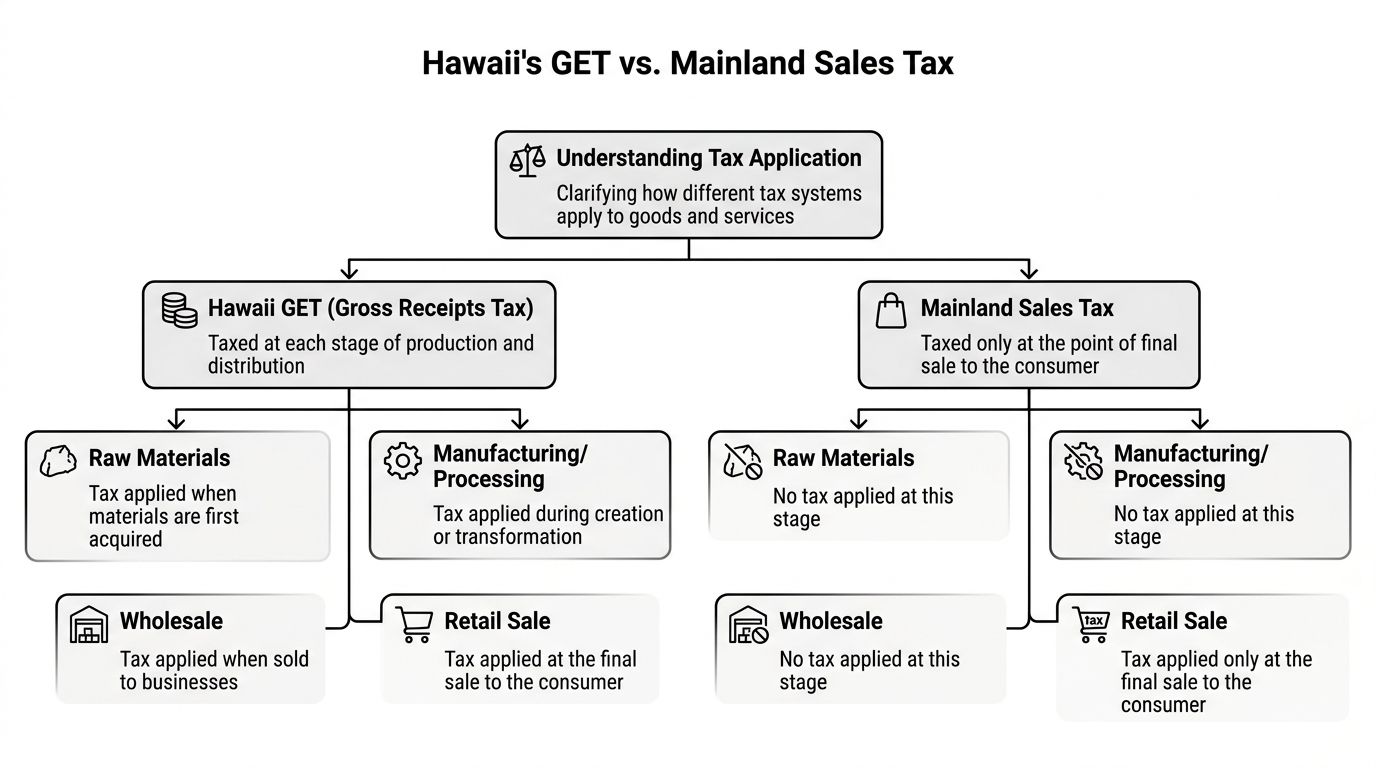
GET is a tax on gross income from doing business in Hawaii. It is imposed under HRS Chapter 237, and the legal structure is broader than a retail sales tax. Hawaii adopted that model as a tax on business activity across the economy, not just at the final sale, as described in the Hawaii Department of Taxation's General Excise Tax overview.
Why the distinction matters
Businesses get into trouble when they build systems around the phrase "sales tax" and stop there. Hawaii taxes many transactions that owners, bookkeepers, and software platforms would not treat as taxable in another state. Services, rents, commissions, contracting revenue, and other receipts can all be part of the GET base.
This broad application allows the statewide rate to be lower than a typical high-rate retail sales tax jurisdiction while still reaching a wide range of business activity.
From a controversy standpoint, that broad base creates predictable audit issues. Revenue gets booked to the wrong category. Contracts omit GET pass-through language. Marketplace or POS settings treat Hawaii like a destination-based retail sales tax state and produce bad reports. By the time the return is prepared, the accounting system is already pointing in the wrong direction.
GET applies throughout the transaction chain
In many states, the tax question becomes important at the final customer sale. In Hawaii, the question starts earlier. A manufacturer, wholesaler, service provider, landlord, and retailer may each have separate GET exposure tied to their own gross receipts.
That structure leads to what tax professionals call tax pyramiding. Tax can be built into pricing at multiple stages because the tax is imposed on business receipts along the chain, not only on the last retail transaction. Owners usually notice this first in margin pressure, bid pricing, or customer resistance to invoices that add GET after the fact.
For business planning, the practical point is simple. Pricing models that treat GET as a checkout issue usually understate the actual cost.
Who owes the tax
The business owes GET. A business can pass the cost to the customer if the contract and invoice are handled correctly, but the legal liability remains with the business.
That point matters in disputes. If a company under-collects, Hawaii still expects payment from the company. If the company uses the wrong rate, overclaims an exemption, or reports receipts in the wrong category, the assessment is issued against the business first. In some cases, the state may also look beyond the entity if filings are ignored or trust-type payment problems overlap with other tax accounts.
I often see owners rely on invoice language that says "tax added" without checking whether the underlying revenue was classified correctly. That is not a defense in an audit. Bad classification plus casual billing language is one of the fastest ways to turn a manageable filing issue into an assessment with penalties.
What works in practice
What works:
- Set up revenue buckets that match Hawaii tax categories: retail, services, wholesale, rents, commissions, contracting, and any specialized lines of business.
- Review client and vendor contracts before the first invoice goes out: especially where pricing is fixed or margins are tight.
- Test software settings manually: QuickBooks, Shopify, and other systems often reflect mainland sales tax logic, not Hawaii GET rules.
- Reconcile returns to source records: bank deposits, invoices, merchant processor reports, and general ledger detail should tell the same story.
What does not work:
- Using one generic sales tax code for all Hawaii receipts.
- Assuming customer-paid amounts eliminate exposure for the business.
- Waiting until year-end to sort out classification issues that were created at the contract or invoicing stage.
GET is manageable for businesses that treat it as a tax on gross receipts and build their books, pricing, and contracts around that rule. Businesses that treat it like an ordinary sales tax tend to discover the difference during an audit, after the margin is already gone.
Calculating Your Liability Current GET Rates and Surcharges
A common audit fact pattern looks like this. The business charges customers 4.5% on Oahu, books that amount to a tax payable account, and assumes the return will tie out. Months later, the owner learns the business under-collected because Hawaii taxes the gross receipts, including the amount collected for GET reimbursement. That gap is small on one invoice and expensive over a year.
The rate question has two parts. First, which activity rate applies to the receipt. Second, does a county surcharge apply to that receipt based on where the income is sourced. In controversy work, I see businesses get into trouble when they answer the first question by habit and the second by billing address.
The rate structure in practice
Hawaii does not use one universal GET rate. Retail sales, services, contracting, commissions, rent, and interest generally fall into the higher-rate bucket. Wholesaling, manufacturing, producing, and some intermediary transactions can qualify for a reduced rate. Insurance commissions have their own rate.
County surcharges add another layer. For receipts taxed at the standard 4% rate, Honolulu, Hawaii, and Kauai Counties generally impose a 0.5% surcharge, while Maui generally does not. Reduced-rate categories do not automatically follow the same surcharge rule across the board. That is why the classification decision matters before the first invoice is sent.
Hawaii GET rates by business activity
| Business Activity | Base GET Rate | Applicable County Surcharge | Total Rate (Example: Honolulu) | Common Example |
|---|---|---|---|---|
| Retail sales | 4% | 0.5% in Honolulu, Hawaii, and Kauai Counties | 4.5% | Store sale to final customer |
| Services | 4% | 0.5% in Honolulu, Hawaii, and Kauai Counties | 4.5% | Consultant, designer, therapist |
| Contracting | 4% | 0.5% in Honolulu, Hawaii, and Kauai Counties | 4.5% | Construction or repair contract |
| Commissions | 4% | 0.5% in Honolulu, Hawaii, and Kauai Counties | 4.5% | Sales commissions |
| Rent and interest | 4% | 0.5% in Honolulu, Hawaii, and Kauai Counties | 4.5% | Commercial rent receipts |
| Wholesaling | 0.5% | Generally not subject to the 0.5% county surcharge described for retail-style activity | 0.5% | Sale for resale |
| Manufacturing and producing | 0.5% | Generally not subject to the 0.5% county surcharge described for retail-style activity | 0.5% | Manufacturer selling into distribution |
| Insurance commissions | 0.15% | Not described as subject to the retail-style county surcharge in earlier Hawaii tax guidance | 0.15% | Insurance commission income |
The pass-through mistake that drains margin
The pass-through issue catches experienced operators as often as new ones. If the transaction is subject to a 4.5% GET rate, charging the customer 4.5% does not fully reimburse the business for the tax due. Hawaii taxes the full amount received.
The practical result is straightforward. On a $100 sale in a surcharge county, adding $4.50 produces gross receipts of $104.50, and the tax due is higher than $4.50. To recover the tax exactly, the billing calculation has to use the tax-inclusive reimbursement rate rather than the stated GET rate.
Contracts matter. If your agreement says the customer will pay "GET reimbursement" or "tax in addition to fees," the invoicing system still has to calculate that reimbursement correctly. Loose wording helps very little in an audit if the math was wrong from the start.
Where businesses miscalculate
The recurring problems are predictable:
- One tax code for everything. Service revenue, wholesale transactions, rent, and commissions get pushed through the same setting.
- Wrong sourcing assumptions. Staff use the customer mailing address or the office location without checking the rule that applies to the receipt.
- Reduced-rate overreach. A business reports receipts at 0.5% because the transaction sounds wholesale, but the records do not support that treatment.
- Marketplace and software errors. The platform is configured for mainland sales tax logic and does not account for tax-on-tax treatment.
- Fixed-price contract losses. The quote was accepted before anyone confirmed whether GET was built into the price or added correctly on top.
Several of these errors also create timing problems. If the business discovers the issue after multiple filing periods, cleanup may involve amended returns, refund issues with customers, and missed deadlines. It helps to review your quarterly tax payment deadlines and filing calendar before the problem spreads across periods.
A better workflow
Businesses usually get better results with a simple control process.
- Assign each revenue stream to a GET category before billing starts.
- Set county rules by transaction type instead of relying on one default location.
- Test invoice calculations with sample transactions, especially where the contract says GET will be passed on to the customer.
- Tie billed amounts back to return positions using invoices, deposits, and general ledger detail.
- Review reduced-rate positions separately because those are frequent audit targets.
The trade-off is administrative effort up front versus a harder cleanup later. A business with thin margins can absorb the setup time. Many cannot absorb a year of under-collected GET, a failed wholesale classification, and penalties layered on top of both.
Meeting Your Obligations Registration and Filing
A common Hawaii GET problem starts with a business that is already making money. The owner has Hawaii customers, invoices are going out, and nobody has decided whether the company needed to register before that first dollar was collected. By the time the question comes up, the issue is no longer clerical. It is a liability problem, and in some cases an audit problem.

Who needs to pay attention to nexus
For a Hawaii business, registration is usually part of startup compliance. The harder calls involve mainland companies, remote service providers, marketplace sellers, and contractors who assume GET only applies if they have people or property in the state.
That assumption gets expensive.
Hawaii can impose GET filing obligations on out-of-state businesses based on their Hawaii activity, including economic presence. The practical problem is not just whether nexus exists. It is whether the business tracked the facts early enough to register on time, file on the right periods, and charge customers correctly if the tax was meant to be passed through. In controversy work, I often see the same pattern: the company focused on income tax nexus, ignored GET, and then discovered the exposure only after several filing periods had closed.
The filing cycle that catches owners off guard
Registration is only step one. A registered business may need periodic GET returns on Form G-45 and an annual reconciliation on Form G-49. Filing frequency depends on expected liability, and businesses get into trouble when they assume one return a year is enough or let a bookkeeper file intermittently without confirming the assigned cycle.
Those mistakes matter because Hawaii measures compliance by period. If returns are missing, the state does not care that the business intended to catch up later. Late registration can also force a reconstruction project using invoices, bank deposits, merchant processor reports, and general ledger detail. That is tedious when done proactively. It is much worse after a notice arrives.
Businesses managing multiple tax obligations need a separate filing calendar for Hawaii returns and owner-level estimated payments. A practical reference is this guide to quarterly tax payment deadlines, especially for owners who tend to group business filings and personal estimates together.
A workable compliance routine
The best filing systems are boring. That is a compliment.
- Register before Hawaii revenue becomes recurring: Delayed registration often turns a routine filing issue into back-period exposure.
- Control the Hawaii Tax Online account internally: Outside preparers can assist, but the business should keep login access, notices, and submission records.
- Prepare returns from closed books: G-45 filings based on rough estimates create avoidable amendments and credibility issues in an examination.
- Reconcile the annual return to the periodic returns: G-49 should match what was reported during the year, not function as a guess at cleanup.
- Save support by filing period: If the Department asks questions, businesses need to show how invoices, deposits, exemptions, and classifications tie to each return.
If a business cannot trace a number from the return back to its books and source documents, an auditor will usually find the break in the chain quickly.
What works for remote sellers and contractors
Remote businesses need a documented process, not assumptions. Review Hawaii receipts, transaction volume, customer location, contract terms, and the character of the work being performed. Then make a filing decision and preserve the analysis.
The trade-off is straightforward. Early review takes time, but late cleanup usually costs more in professional fees, internal labor, penalties, and disputed tax. For businesses with uncertain Hawaii exposure, that is often the point where legal review helps. The goal is not only to file. It is to file in a way that can be defended later if the Department asks why registration started when it did, how receipts were sourced, and whether earlier periods were omitted.
Legally Reducing Your Tax Bill Exemptions and Credits
The state of hawaii excise tax is broad, but broad doesn’t mean absolute. Businesses can overpay GET when they fail to identify lower-rate treatment, statutory exemptions, or industry-specific rules that change how receipts should be reported.

The first place to look
Some reductions are structural. Sales for resale are not treated the same way as final consumer sales. The lower wholesale-style rate can matter significantly when the documentation supports it. Certain federal government sales may also qualify for exemption treatment under Hawaii law, and those issues can become important in assessments and negotiations.
The key point is legal proof. A business doesn't reduce GET liability by calling a transaction exempt. It reduces liability by matching the facts, documentation, and reporting code to the rule that applies.
Healthcare is the clearest example of why details matter
A major change is arriving for healthcare providers. A new GET exemption for services paid by Medicare, Medicaid, and TRICARE becomes effective January 1, 2026, but available guidance leaves substantial uncertainty about mixed-payment situations involving patient deductibles, copays, and coinsurance, according to this University of Hawaii JABSOM notice discussing the new exemption and unresolved questions. That same source states that Hawaii is the only state that taxes these services.
That creates a very practical problem for physicians, therapists, sole practitioners, and small medical groups. A claim can involve government reimbursement and patient-paid amounts in the same episode of care. If the exemption applies only in part, coding and reporting become more complicated than many office systems are prepared to handle.
The businesses that benefit most from exemptions are often the ones most likely to lose them through weak documentation.
What works and what fails
For exemption review, businesses usually do better when they focus on process:
- Keep transaction support at the invoice level: Customer type, contract language, and payment source often determine treatment.
- Separate exempt, reduced-rate, and standard-rate receipts in bookkeeping: If everything lands in one income bucket, the legal analysis gets weaker.
- Review industry-specific changes before they go live: Healthcare providers, in particular, shouldn't wait until year-end to decide how mixed payments will be treated.
- Coordinate billing and tax reporting: An exemption that exists in legal theory can be lost in practice if the billing system and tax return logic don’t match.
What fails is broad labeling. “Medical revenue,” “government work,” or “resale” isn’t enough. The state will want to know which receipts, why they qualify, and whether the business can prove it.
For referring professionals, a lot of value is provided. CPAs, bookkeepers, and attorneys serving shared clients should identify exemption-sensitive revenue early, because once an audit begins, the discussion shifts from planning to defense.
Navigating Audits Penalties and Personal Liability
A Hawaii business can run for years with decent books and still get into serious GET trouble after one ordinary breakdown. The billing system applies the wrong rate. Imported purchases never make it to the tax workpapers. A few late returns pile up during a cash crunch. By the time the Department of Taxation asks questions, the issue is no longer just whether tax was underreported. It is whether the state now sees a pattern of noncompliance, and whether people behind the company can be pursued individually.
Where audits usually start
In practice, GET audits often begin with simple mismatches, not dramatic misconduct. The return does not match the books. Bank deposits exceed reported receipts. Merchant processor totals are higher than taxable sales on the G-45. A company claims too much income at a reduced rate without contracts or resale support to back it up.
Use tax is another common entry point. Hawaii auditors do not limit their review to what a business sold. They also look at what came into the business, especially inventory, equipment, software, contractor charges, and other purchases from out-of-state vendors. If procurement records, import documents, and return positions do not line up, the audit expands quickly.
Late or missing filings also change the tone of the case. Once filing gaps appear, the state often broadens the review period and asks harder questions about recordkeeping, officer involvement, and whether the reported classifications were ever tested internally.
Penalties turn a reporting problem into a collection problem
Business owners often underestimate how fast a manageable GET issue becomes expensive. Penalties for late filing and late payment can stack with interest. If the state concludes the business used the wrong rate, failed to file, or reported incomplete gross receipts across several periods, the balance can grow far beyond the underlying tax.
The first strategic decision matters. Filing accurate delinquent returns with support usually puts a business in a better position than sending in estimates just to stop notices. I have seen rough filings create a second dispute because the taxpayer solved the delinquency problem but handed the auditor new inconsistencies to examine.
Good cleanup work starts with records, not guesswork.
If the accounting file is incomplete, source reconstruction becomes the job. Bank statements, processor reports, invoices, shipping records, and purchase histories often tell the actual story better than an unreconciled ledger. Tools such as DigiParser’s Tax Statement Parser can help organize large volumes of statements before amended filings or audit responses are prepared.
Personal liability is the risk owners miss
The hardest GET cases are usually not about tax calculation alone. They are about control.
Many owners assume the entity absorbs the problem. That assumption can fail where the state believes a responsible person knew taxes were due and chose to pay other obligations first. Titles matter less than conduct. Auditors look at who signed checks, who approved return filings, who controlled cash, and who decided that landlords, vendors, or payroll would be paid before the tax debt.
That is why internal emails, signature authority, and cash management records matter so much in controversy work. A nominal manager with no payment authority may have a better defense than an owner who never signed a return but directed every significant disbursement.
For a useful comparison to federal collection concepts, see this discussion of trust fund penalty abatement. The doctrines are not identical, but the practical lesson is the same. Personal exposure cases should be addressed early, with a controlled factual presentation.
Responsible person cases usually turn on control, knowledge, and payment decisions under financial pressure.
What actually helps during an audit or collection case
Businesses improve their position when they get disciplined fast:
- Rebuild the tax story from primary records. Start with invoices, deposits, contracts, purchase records, and import support.
- Separate reporting issues from collection issues. The strategy for fixing returns is different from the strategy for resolving an assessed balance.
- Challenge unsupported assumptions. Auditors may infer retail treatment, deny a reduced rate, or overstate taxable imports if the file is incomplete.
- Control written explanations. Casual emails and rushed phone calls often create admissions that are hard to walk back.
- Identify who is exposed personally before the state does. That affects how the response should be framed and who should communicate with the auditor.
What makes the case worse
A few mistakes show up repeatedly in bad outcomes:
- Making partial payments without understanding the assessment
- Producing disorganized records that invite broader audit requests
- Treating use tax as minor because the business does not sell physical goods
- Assuming a bankruptcy filing will erase a GET problem tied to responsible person exposure
- Letting the bookkeeper, owner, and outside preparer give inconsistent explanations
GET disputes are often defensible, but only if the response is deliberate. Once a notice arrives, speed matters less than accuracy, consistency, and protecting the facts that will matter if the case shifts from audit to collection.
A Practical Checklist for GET Compliance
A good GET system should be easy to test. If a business can’t answer basic operational questions quickly, the process needs work.
Registration and setup
- Confirm nexus early: Hawaii activity, remote sales, and contractor work should be reviewed before receipts pile up.
- Map every revenue type: Don’t put services, resale transactions, rents, and commissions into one generic income account.
- Program billing correctly: Your invoicing or POS setup should reflect Hawaii logic, not a generic mainland sales tax template.
Ongoing process
- Close books before filing: Prepare returns from reconciled records, not estimates.
- Match forms to the ledger: G-45 reporting should tie back to categorized receipts.
- Track imported purchases: Use tax issues often start where procurement and accounting don't communicate.
For firms that process large volumes of statements and tax records, tools that automate extraction can improve consistency. A workflow like DigiParser’s Tax Statement Parser can help organize source documents before reconciliation and controversy review.
Annual and risk review
- Reconcile G-45 filings to G-49: Annual review should confirm what was reported during the year matches the final return.
- Review exemption support: If you used a lower rate or exemption, make sure the file shows why.
- Stress-test owner exposure: If the business has unpaid liabilities, evaluate control, payment history, and internal decision-making now.
- Use a repeatable review list: A broader small business tax checklist can help catch issues that sit next to GET problems, including recordkeeping and payment discipline.
The businesses that handle GET best usually don’t rely on memory. They rely on systems.
When to Engage a Tax Controversy Attorney
Some GET issues are still compliance projects. Others have crossed into legal risk. That line matters.
You should strongly consider tax controversy counsel when the Hawaii Department of Taxation has opened an audit, proposed an assessment that includes meaningful penalties, alleged multiple years of unfiled returns, or started asking questions that point toward personal liability. Those cases require more than preparing forms. They require legal positioning, record development, and careful communication.
A regular CPA is often the right person for bookkeeping cleanup, return preparation, and ordinary reporting support. A tax controversy attorney steps in when the dispute involves exposure, negotiation, representation, or possible litigation. The skills are different. So are the stakes.
The same is true for related professionals. Bankruptcy attorneys, divorce counsel, lenders, and financial advisors often discover that unresolved GET liabilities block larger goals. A deal won’t close. A divorce can’t settle cleanly. A bankruptcy filing doesn’t produce the expected relief. In those moments, self-help usually costs more than it saves.
If you're deciding whether a problem has reached that point, a useful starting reference is this discussion of when to hire a tax attorney. The right time is usually earlier than business owners think, especially when notices are stacking up and nobody has tested the state’s numbers yet.
If you're dealing with Hawaii GET issues, audit notices, unfiled returns, or personal liability concerns, Attorney Stephen A Weisberg offers a free Tax Debt Analysis to determine whether he can help and what resolution path makes sense before charging you to move forward.


