SS4 Federal Tax ID Application: A Complete Guide (2026)
A complete guide to the SS4 federal tax id application. Learn how to apply for an EIN online, by fax, or mail, and avoid common errors with expert legal tips.
In this article
- Your Essential Guide to the Federal Tax ID Application
- Why this step matters more than most owners expect
- The practical approach
- Determining If You Need a Federal Tax ID Number
- Situations where an EIN is generally required
- Situations where it may be optional, but still smart
- A simple way to think about it
- Preparing Your SS-4 Information Accurately
- Start with the legal identity of the business
- The responsible party issue causes a surprising number of delays
- Entity type is not a box-checking exercise
- Dates and employee projections need real thought
- Gather this before you start
- Choosing Your SS-4 Application Method
- A side-by-side view
- Online application
- Fax application
- Mail application
- Phone application for international applicants
- Which method usually works best
- Navigating Special SS-4 Application Scenarios
- The non-U.S. founder without an SSN or ITIN
- The trust or estate fiduciary
- The owner planning an S corporation election
- The sole proprietor who wants to look more formal
- The business with prior tax issues
- You Have Your EIN What Happens Next?
- Your first checklist after approval
- Common post-EIN problems
- A cleaner operating posture from day one
- When a Tax Attorney Should Handle Your EIN Application
- Clear red flags
You formed the LLC or corporation. The state accepted the filing. Then the bank asks for a federal tax ID, payroll setup stalls, and someone tells you to “just get an EIN.”
At that moment, many business owners make their first IRS mistake.
The ss4 federal tax id application looks simple because the form itself is short. The risk is not the page count. The risk is that Form SS-4 creates the IRS record for your business from day one. If the name, entity type, responsible party, or filing reason is wrong, that bad information can follow you into payroll problems, IRS notices, rejected filings, and avoidable cleanup work later.
I have seen that pattern repeatedly in tax controversy work. The trouble often did not start with an audit. It started with a rushed setup decision.
Your Essential Guide to the Federal Tax ID Application
A Federal Tax ID usually means your Employer Identification Number, or EIN. It is the business equivalent of an identifying tax number, and the IRS issues it through Form SS-4.

The EIN is a 9-digit number. It is essential for tax filing, hiring employees, opening business bank accounts, and IRS reporting. The IRS notes that Form SS-4 is the official application for that number, and that the online EIN system launched in 2001. That online system can issue an EIN immediately for eligible U.S.-based applicants, compared with 4 business days by fax and 4-5 weeks by mail, according to the IRS instructions for Form SS-4.
Treat the SS-4 as the first tax compliance document for your business, not as a quick administrative task.
That distinction matters. If you are a sole proprietor, single-member LLC owner, multi-member LLC member, S corporation owner, or founder starting payroll for the first time, this application does more than generate a number. It establishes how the IRS sees your business.
Why this step matters more than most owners expect
Business owners usually focus on speed. That makes sense. You want to open the account, sign with the payment processor, hire people, and move forward.
But speed without accuracy is expensive.
The SS-4 asks for details that affect later filings, including:
- Legal name: It must match formation and tax records.
- Responsible party: The IRS wants the individual who controls the entity.
- Entity classification: This choice affects how the business is treated for tax purposes.
- Start date and employee plans: These answers affect payroll and filing expectations.
A rushed answer can create a mismatch between state records, IRS records, payroll records, and bank documents. That is exactly the kind of inconsistency that turns a clean startup file into a notice problem.
The practical approach
Before you submit anything, gather your records and decide what the business is doing now, not what you may do later. If payroll is coming soon, answer with that in mind. If an S corporation election is part of the plan, sequence the steps correctly. If you are a sole proprietor using your personal name in some places and a trade name in others, reconcile that before the application goes in.
A good starting point is a broader small business tax checklist so your EIN application lines up with the rest of your tax setup.
Determining If You Need a Federal Tax ID Number
Some owners clearly need an EIN. Others technically may not, but should get one anyway.
The cleanest way to decide is to look at the event that triggered the question. In practice, an EIN need usually starts with one of three things: you formed a separate entity, you are paying workers, or a bank or business partner refuses to use your personal Social Security number.
Situations where an EIN is generally required
If any of these apply, the answer is usually straightforward:
- You formed a partnership: Partnerships need an EIN for tax filing and reporting.
- You formed a corporation: Corporations use an EIN even if the owner is the only person involved.
- You plan to hire employees: Payroll reporting requires the business to be set up properly with the IRS.
- You need to file business tax forms tied to the entity: The IRS uses the EIN to track those filings.
- You are opening a business bank account and the bank requires it: That happens often in the world of business, even when an owner hoped to use a personal number.
Situations where it may be optional, but still smart
Many sole proprietors and single-member LLC owners often get tripped up regarding this point.
You may not always be legally forced to get an EIN on day one if you have no employees and no separate filing requirement yet. But that does not mean using your Social Security number is the best move.
A practical reason to get an EIN anyway:
- Banking separation: Banks often want a business tax ID.
- Vendor paperwork: You may prefer not to place your Social Security number on a W-9.
- Growth planning: If payroll or entity changes are coming, handling the EIN early avoids a second scramble later.
- Cleaner records: The sooner your business activity is tied to one business identifier, the easier bookkeeping and compliance become.
For sole proprietors weighing that decision, this guide on sole proprietor tax deductions pairs well with the EIN question because deductions, recordkeeping, and entity setup usually collide at the same time.
A simple way to think about it
Ask two questions.
First, is the IRS or a third party requiring a business identifier right now? Second, will using my personal Social Security number create more friction than it solves?
If the answer to either is yes, filing the ss4 federal tax id application usually makes sense.
If your business is trying to look and operate like a separate business, your tax setup should match that reality.
The mistake I see most often is the owner who waits because the EIN feels optional, then discovers it is urgently needed for banking, payroll, or tax filing. Urgency leads to rushed answers. Rushed answers lead to corrections. Corrections invite delay.
Preparing Your SS-4 Information Accurately
Most SS-4 problems happen before the form is ever submitted. The owner starts entering information without resolving basic questions first.
That is backwards. Preparation is what makes the application work.
The online method is often the smoothest path when the applicant qualifies, but the key variable is still accuracy. According to this step-by-step guide to completing IRS Form SS-4, common pitfalls include online session timeouts with a 35% failure rate, invalid or missing responsible party TINs causing 15-25% of rejections, and entity type errors. The same source states that 95% of first-time online applications succeed when information is prepared in advance, compared with 70% for fax or mail due to human error.
Start with the legal identity of the business
Your business name on the SS-4 should match the formation document or the legal owner structure behind the application.
If the LLC is “North Ridge Consulting LLC,” do not casually shorten it to “North Ridge Consulting” because that is what you put on your website. If you use a trade name or DBA, treat it as separate from the legal name and enter it where appropriate.
The mailing address matters too. IRS correspondence goes somewhere. If that address is unstable, old, or borrowed without a plan to monitor it, you are creating future notice problems.
The responsible party issue causes a surprising number of delays
This is the field I would slow down on every single time.
The responsible party is not just whoever is available to fill out the form. It is the person who owns or controls the entity. The IRS requires a valid SSN, ITIN, or EIN for that person, and missing or invalid information in that field is one of the most common reasons applications run into trouble.
Common mistakes include:
- Listing an assistant or organizer: Convenience is not the test.
- Using outdated owner information: This often happens after ownership changes.
- Using a tax preparer as the party in interest: A preparer can help. The preparer is not usually the responsible party.
- Entering a TIN that does not match IRS records: Even a small mismatch can stop the process.
If the responsible party field is wrong, the IRS may still contact you, but now you are fixing a preventable issue while other startup tasks are waiting.
Entity type is not a box-checking exercise
Owners often treat the entity section as administrative. It is not. This involves the interaction of legal structure and tax treatment.
A single-member LLC, multi-member LLC, corporation, and partnership are not interchangeable descriptions. If you choose the wrong classification, later filings can conflict with what the IRS expects. That can affect income tax reporting, payroll filings, and whether later elections make sense.
If you are still undecided about tax treatment, stop and resolve that first. The SS-4 should reflect a deliberate decision, not a guess.
Dates and employee projections need real thought
The start date should line up with what happened. That might be formation, acquisition, or the beginning of operations, depending on the facts.
The employee questions also deserve attention. The form asks about the highest number of employees expected and, if applicable, when wages will first be paid. If payroll is likely soon, answer carefully. If payroll is not part of the plan, do not casually indicate otherwise.
The Form 944 question can also matter for low-liability employers. The IRS instructions allow businesses with annual employment tax liability of $1,000 or less to indicate eligibility for Form 944, which can mean annual rather than quarterly employment tax filing under the rules described in the IRS instructions discussed earlier.
Gather this before you start
A practical file for the ss4 federal tax id application should include:
- Formation documents
- Exact legal name and any DBA
- Mailing address you actively monitor
- Responsible party full legal name and valid TIN
- Entity classification decision
- Business start or acquisition date
- Expected hiring timeline
- Brief description of business activity
That preparation is what turns the form from a gamble into a clean filing.
Choosing Your SS-4 Application Method
The IRS gives you more than one way to apply. That does not mean every method is equally good for every business.
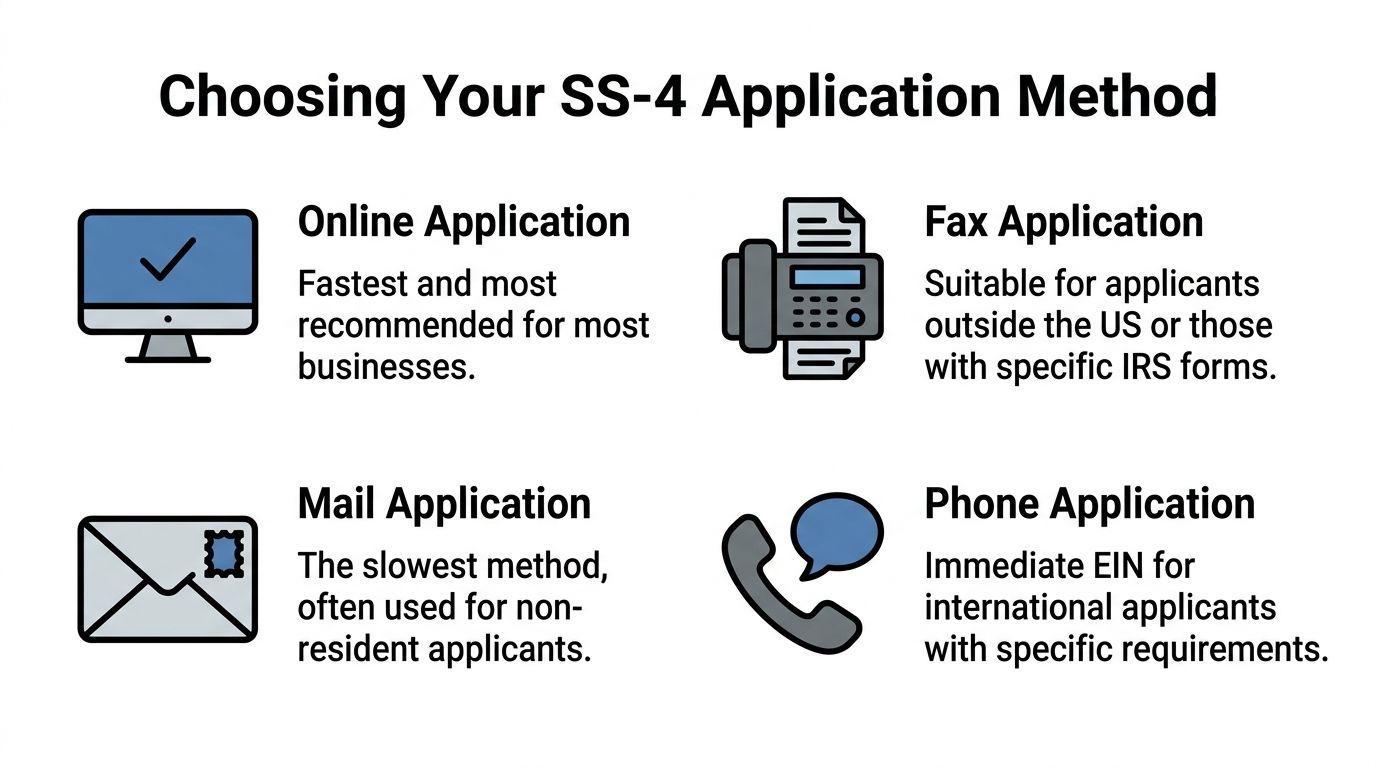
With over 5 million new business applications annually in the U.S., the IRS offers multiple processing routes. The online portal provides instant EIN issuance, fax processing is standardized at about 4 business days, mail can take up to 4 weeks, and applicants can check status through the IRS Business & Specialty Tax Line at 800-829-4933, according to SurePayroll’s overview of Form SS-4 processing.
A side-by-side view
| Method | Best for | Main advantage | Main trade-off |
|---|---|---|---|
| Online | Eligible U.S.-based applicants | Fastest result | Requires complete readiness and eligibility |
| Fax | Applicants who cannot use online or prefer paper review | Faster than mail | More room for handwriting and transmission errors |
| Applicants who need a paper trail and are not in a rush | Traditional submission route | Slowest practical option | |
| Phone | International applicants in the right circumstances | Immediate handling for qualifying international cases | Narrow use case |
Online application
For most eligible U.S.-based applicants, this is the best option.
The practical upside is obvious. You complete the application and, if all goes well, receive the EIN right away. That speed is useful when the bank, payroll company, or licensing process is already waiting.
But online filing rewards preparation and punishes hesitation. The session expires after inactivity. If you start looking for formation documents halfway through, the process can fall apart.
Use the online method when:
- You are eligible to use the IRS online system.
- Your responsible party information is settled.
- The entity type is already confirmed.
- You need the EIN quickly for banking or payroll.
Avoid it when:
- You are still unsure who the responsible party should be.
- The legal name or address may still change.
- You are rushing through unresolved entity classification questions.
Fax application
Fax is often the middle path. It is slower than online, but usually faster than mail.
I tend to view fax as the option for applicants who need a paper form reviewed before submission or who are not eligible for the online route. It can also work well when a nonresident or more complex filer is assembling a careful package and wants a written submission trail.
The weakness is avoidable technical error. Illegible entries, missing signatures, missing return fax information, and simple transcription mistakes can waste time.
Fax works best when:
- You want to review the whole SS-4 on paper before sending it.
- Online filing is not available for your situation.
- You can produce a clean, complete submission.
Mail application
Mail is the slowest method in ordinary practice.
That does not make it useless. Some owners and advisors prefer physical submission when the facts are unusual, the address is international, or the business needs careful documentation. Mail also gives you a simple paper record of exactly what was sent.
The trade-off is patience. If a bank account, payroll setup, or contract closing depends on the EIN, mail is usually the wrong choice unless there is no better option.
Mail is most sensible when:
- Time is not the priority.
- The applicant prefers or requires paper filing.
- The case involves facts that call for extra caution and document retention.
Do not choose a slow method for a fast-moving business launch unless there is a specific reason the faster option will not work.
Phone application for international applicants
This method is narrower and often misunderstood.
International applicants may be able to apply by phone in the right circumstances. That can be valuable because it allows an immediate result when the applicant qualifies and has the right information ready. It is not the standard route for most domestic startups.
If you are outside the usual U.S.-based eligibility for the online system, this can be worth considering. But the same rule still applies. Preparation matters more than the channel.
Which method usually works best
If the business is domestic, the facts are straightforward, and the information is ready, online usually wins.
If the applicant is international or ineligible for online filing, fax or phone can make more sense. If the facts are unusual and speed is not critical, mail may be acceptable.
The right method is the one that matches your eligibility, timeline, and complexity. The wrong method is the one chosen out of habit while basic facts are still unresolved.
Navigating Special SS-4 Application Scenarios
The standard SS-4 process works fine for ordinary cases. Trouble starts when owners assume their case is ordinary when it is not.

The non-U.S. founder without an SSN or ITIN
A common scenario is the foreign owner who forms a U.S. entity and then discovers the online route is not available in the same way as it is for a domestic founder.
In that situation, the owner usually needs to apply through Form SS-4 using the channels available for non-U.S. applicants. The key practical issue is not just submission method. It is making sure the correct responsible party and ownership information are internally consistent from the start.
The owner often has three business pressures at once:
- opening a U.S. bank account,
- establishing the IRS tax account,
- and preparing to receive U.S. income or make U.S. payments.
A sloppy SS-4 slows all three.
The trust or estate fiduciary
Trusts and estates often confuse people because the filer is acting in a representative role.
The mistake here is using personal information as if the fiduciary personally were the taxpayer. In reality, the form needs to reflect the entity that requires the EIN and the person acting with authority for it.
If you are the trustee, executor, or administrator, answer from that role. Keep the entity record, the governing documents, and the SS-4 aligned. If they do not match, the IRS may question who is authorized to act.
The owner planning an S corporation election
This scenario causes expensive timing errors.
The owner forms an LLC or corporation, gets an EIN in a hurry, and only later starts thinking about S corporation status. Sometimes the owner also tells payroll to proceed before the tax election timing and owner-compensation plan are sorted out.
That is not an EIN problem alone. It is a sequencing problem.
If the business intends to elect S corporation status, the EIN application should fit into the broader tax plan. The legal entity, tax classification, payroll setup, and election timing should make sense together. They should not be assembled in random order.
The sole proprietor who wants to look more formal
This owner may not be legally required to get an EIN immediately, but wants to stop using a personal Social Security number for business paperwork and open a proper business account.
That is usually a reasonable move. The key is making sure the owner understands what the EIN does and does not change. It does not automatically create a new legal entity. It does not convert a sole proprietorship into a corporation. It does not replace the need for clean books and payroll compliance if workers are hired later.
For owners moving toward hiring, this overview of small business payroll taxes is useful because the EIN often becomes the handoff point into payroll obligations.
Special cases usually fail for ordinary reasons. Wrong party, wrong classification, wrong sequence, or wrong expectation.
The business with prior tax issues
Another special case is the founder who already has IRS problems from an earlier business or from unpaid payroll or income taxes.
In that setting, I would be cautious about assuming the new EIN application is purely clerical. The business setup may affect how future filings are tracked and how prior compliance problems are managed. Accuracy matters even more because any inconsistency can complicate later dealings with the IRS.
You Have Your EIN What Happens Next?
Getting the EIN is the start of operations, not the finish line.
Your first checklist after approval
Once the EIN is issued, do these things promptly:
- Save the confirmation: Keep the IRS confirmation with your permanent records.
- Match all business records: Make sure the legal name, address, and EIN match your bank, payroll provider, and internal records.
- Open the bank account: Use the EIN consistently for business banking.
- Set up tax workflows: Decide who handles bookkeeping, payroll, tax filings, and mail from the IRS.
- Control access: Limit who can use the EIN and where it is stored.
A good next step for any employer is reviewing a practical guide to payroll compliance so the move from EIN issuance to payroll reporting happens cleanly.
Common post-EIN problems
You realize the application included a mistake
Do not ignore it and hope the error never matters.
If the mistake involves the business name, responsible party, or address, deal with it promptly. The exact correction path depends on the nature of the error, but the important point is to fix the IRS record before that bad information spreads into tax returns, bank documents, and payroll accounts.
The business changed after the EIN was issued
Businesses evolve. Owners move. Names change. Structures change.
Not every change requires a new EIN, but many changes do require notice to the IRS or updates across related systems. Keep your records synchronized. The IRS, payroll provider, and bank should not all be working from different versions of the business identity.
You received the EIN, but payroll is still not ready
This happens often. The owner gets the number and assumes payroll can be turned on instantly.
It usually cannot. Payroll requires registration, setup decisions, withholding processes, calendar discipline, and someone responsible for deposit and filing deadlines. If that structure is missing, the EIN alone will not protect you from payroll tax trouble.
A cleaner operating posture from day one
The businesses that avoid early IRS friction usually do three things well:
- They keep the EIN notice and formation records together.
- They make one person accountable for IRS mail and deadlines.
- They treat payroll and tax filings as compliance systems, not errands.
That posture matters. Many future tax controversies begin with simple startup sloppiness that no one corrected when it was still easy.
When a Tax Attorney Should Handle Your EIN Application
Some EIN applications are simple enough for a careful owner to handle alone. Some are not.
The line is not intelligence. It is risk.
You should strongly consider legal help when the EIN application sits inside a bigger tax problem or a more complex structure. Examples include a business with foreign ownership, layered entities, disputed ownership, prior payroll tax issues, prior IRS debt, or a planned restructuring where one wrong answer can create downstream filing conflicts.
Clear red flags
A do-it-yourself filing becomes risky when:
- You are unsure who the responsible party should be
- The entity structure involves more than one business or owner tier
- A foreign owner, partner, or investor is involved
- The business already has tax debt or unresolved IRS notices
- You need to correct an earlier SS-4 that was substantially incorrect
- The EIN application must line up with an S corporation plan, payroll launch, or other immediate tax decision
In those situations, the EIN is not just an identifier. It is part of the compliance architecture.
If you are comparing who should help, it can be useful to understand the difference between routine return preparation and controversy-sensitive work. A directory of Tax Accountants may help you identify accounting support, but businesses with structural or IRS-risk issues often need legal analysis as well. If you are weighing that question, this article on how to find a good tax attorney is a practical place to start.
A clean EIN application is cheap. Cleaning up a bad foundation after payroll, notices, or an audit starts is not.
If you want experienced help with an EIN application that also fits your larger tax situation, Attorney Stephen A Weisberg offers a practical, controversy-informed approach through a FREE Tax Debt Analysis at Weisberg.tax. When an SS-4 filing intersects with IRS debt, payroll exposure, audits, or entity planning, getting it right at the start can prevent a much harder fight later.


