South Carolina Taxes: A Lawyer's 2026 Guide
Navigate South Carolina taxes with confidence. Our 2026 guide covers individual, business, and property tax rules, rates, and debt resolution options.
In this article
- Your Guide to Navigating the South Carolina Tax System
- Where people get stuck
- The Five Pillars of South Carolina Taxation
- Individual income tax
- Corporate income tax
- Sales and use tax
- Payroll and withholding taxes
- Property and other state taxes
- Current Tax Rates and Filing Requirements for 2026
- Filing posture for residents and nonresidents
- Quick reference table
- Common Penalties and SCDOR Audit Triggers
- What usually triggers scrutiny
- Correspondence versus field review
- Penalties are legal issues, not just accounting issues
- How to Resolve Tax Debt with the SCDOR
- Step one is diagnosis
- Installment agreements
- Penalty relief and account correction
- Offer in compromise and harder cases
- What doesn't work
- Practical Steps for Taxpayers and Professionals
- What taxpayers should do now
- What professionals should watch for
- A frequent 2026 planning mistake
- When legal help makes sense
- Take Control of Your South Carolina Tax Situation
A South Carolina Department of Revenue notice usually lands at the worst time. You are closing the month, trying to make payroll, catching up on bookkeeping, and then a letter shows up that raises three immediate questions. What is this about, how serious is it, and what do I do next?
Most taxpayers don't panic because the tax issue is impossible. They panic because South Carolina taxes sit at the intersection of filing rules, sourcing rules, payroll obligations, sales tax collection, and state collection procedures. If you own a business, the problem often isn't one bad decision. It's a stack of small misses that turned into a state balance, a withholding problem, or an audit request.
Your Guide to Navigating the South Carolina Tax System
A business owner calls after getting an SCDOR notice and usually says some version of the same thing: "I thought my CPA handled this," or "I filed something, but I don't know if it was the right return." That reaction is normal. Tax notices are written for enforcement, not comfort.
South Carolina's tax system didn't appear overnight. It developed unevenly over time, and even the historical record reflects that. FamilySearch notes that aside from a single tax list from 1733 and a few lists of tax collectors, no colonial South Carolina tax records survived; a fairly complete series begins in 1824, and county tax lists become much more complete and consistent after 1865 for tracing property and business obligations (FamilySearch on South Carolina taxation).
That uneven history still shows up in modern practice. Some parts of south carolina taxes are straightforward. Others are technical, especially when a taxpayer has multistate income, pass-through business income, payroll exposure, or old unfiled periods.
Where people get stuck
Most tax problems fall into one of these buckets:
- A filing problem that started with a missed return, an incorrect return, or a federal change that flowed into the state return.
- A payment problem where the return was filed, but the balance couldn't be paid.
- A classification problem involving residency, source income, workers, or entity treatment.
- A record problem where the taxpayer can't prove what was reported, collected, or paid.
A notice doesn't tell you which bucket matters most. You have to reconstruct the issue from the assessment, filing history, account transcripts, and business records.
South Carolina tax problems are usually solved in stages. First determine whether the state is right. Then determine what can be fixed. Then choose the resolution path that causes the least long-term damage.
For business owners, that means looking past the headline amount on the notice. A sales tax issue can affect cash flow and audit exposure. A withholding issue can create personal exposure for owners or responsible parties. An income tax issue may be less urgent operationally, but still expensive if ignored.
If you want ongoing context on state income tax developments generally, these state income tax updates are a useful starting point.
The Five Pillars of South Carolina Taxation
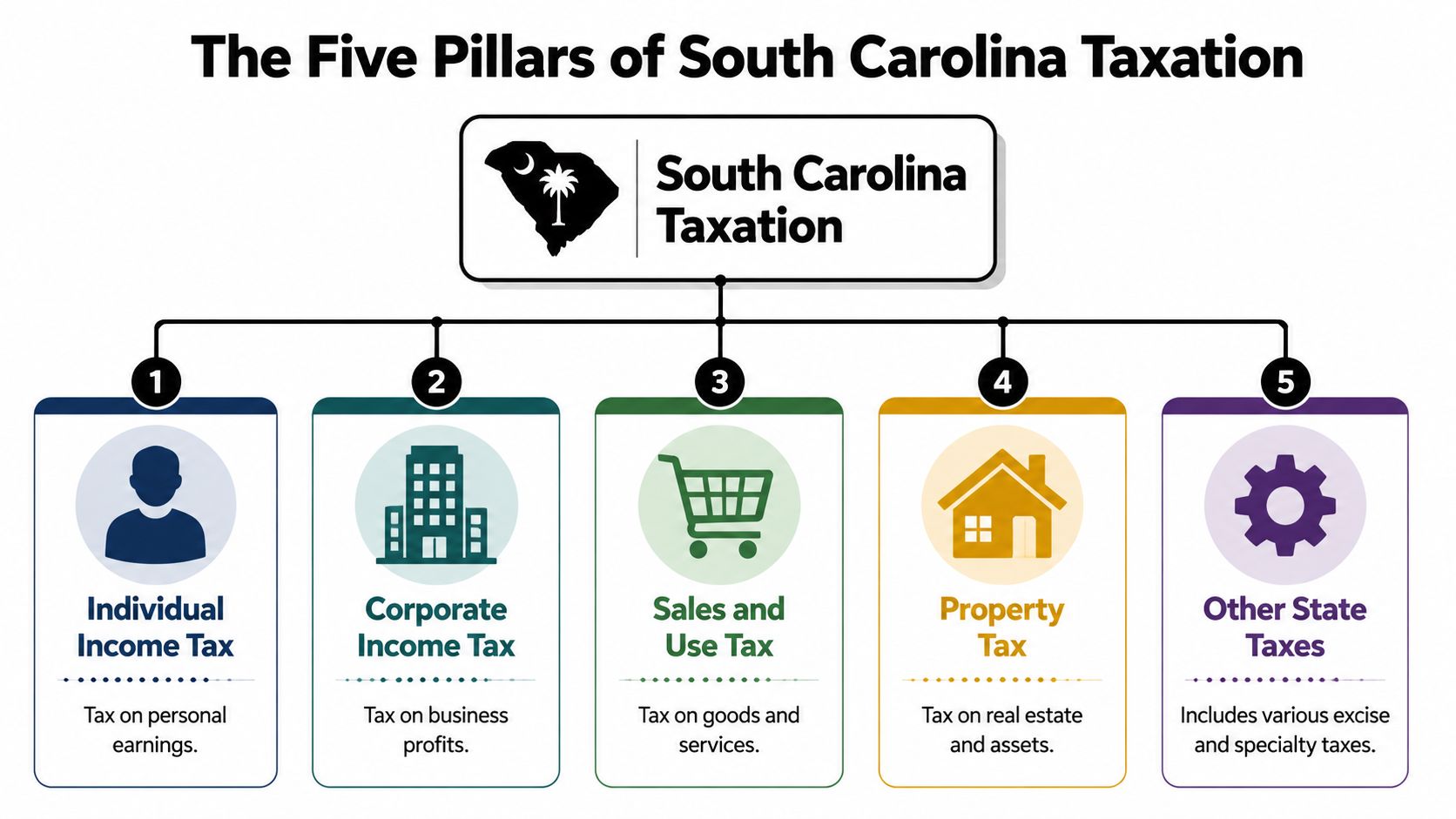
You don't need a treatise on state tax law to manage risk. You need a working map. In practice, most south carolina taxes that matter to individuals and small businesses fit into five buckets.
Before the modern system, South Carolina imposed the capitation, or "head," tax on free people of African descent, introduced in 1756. The state later adopted its individual income tax in 1921 and added a sales and use tax in 1951, moving away from heavier reliance on property taxes (Charleston Time Machine history of South Carolina tax development).
Individual income tax
This is often the first tax that comes to mind, but business owners often underestimate how much it matters to the business itself. Sole proprietors report business activity on their individual return. S corporation shareholders and many LLC owners also feel the state tax burden personally.
The practical point is simple. If the owner's return is wrong, the business problem doesn't stay neatly inside the business.
Corporate income tax
This applies to businesses taxed as corporations and to companies that have South Carolina filing obligations because of how they operate in the state. The key issue isn't just profit. It's whether the business has a filing duty, whether the return is complete, and whether the state agrees with how income was reported.
Corporate problems tend to become expensive because they often involve multiple years, apportionment questions, and linked federal adjustments.
Sales and use tax
Sales tax isn't your money. You collect it from customers and hold it for the state. That is why sales tax cases get serious quickly.
Use tax is the companion concept. It often shows up when a business bought taxable items without proper tax collection at purchase. Businesses get into trouble here when they treat sales tax as a rough estimate rather than a precise compliance obligation.
Payroll and withholding taxes
If sales tax is trust-type money from customers, withholding is trust-type money from employees. Employers act as the collection point.
This category gets dangerous because the state takes a hard view of missed deposits, unfiled returns, and payroll records that don't match wage reporting. In real life, payroll issues also overlap with worker classification disputes and cash flow stress.
Property and other state taxes
Property tax operates differently from income and sales tax, but it still matters to businesses because it affects operating cost, real estate holdings, and equipment-related exposure depending on the situation. Then there are specialty taxes and industry-specific obligations that don't affect everyone, but can affect the wrong business at exactly the wrong time.
Think of these pillars as separate doors into the same problem. A taxpayer may walk in through sales tax, but the state often ends up reviewing income reporting, payroll records, and business structure too.
If you're a business owner trying to get organized before problems start, this small business tax checklist is a practical companion to that map.
Current Tax Rates and Filing Requirements for 2026
A common problem lands on my desk early each filing season. A South Carolina taxpayer hears that rates changed, assumes the new law controls the return in front of them, files on that assumption, and creates a preventable notice. For 2026, the first job is getting the year right.
For 2025, South Carolina individual income tax still starts with federal taxable income, then applies state modifications and inflation-adjusted brackets. The South Carolina Department of Revenue says the top marginal rate is 6.0% for 2025, and the dependent exemption is $4,930 per eligible dependent (South Carolina individual income tax guidance).
For tax year 2026, South Carolina has adopted a different structure. The state has announced headline brackets of 1.99% and 5.21%, a South Carolina Income Adjusted Deduction in place of the federal standard and itemized deduction approach for state purposes, and an EITC cap of $200. The practical point is simple. A lower published rate does not always mean a lower South Carolina bill.
That is where planning mistakes start.
Taxpayers who usually focus on the rate often miss the base. If the deduction rules change, the state can collect less from one filer and more from another, even when both read the same headline about a rate cut. I see that issue most often with pass-through owners, self-employed taxpayers, and households that have historically itemized on the federal side.
A clean 2026 review should answer three questions:
- What is federal taxable income?
- What South Carolina modifications apply?
- Does the new deduction structure increase or reduce the state tax base for this taxpayer?
If those questions are not answered before filing, the return is being prepared backward.
Filing posture for residents and nonresidents
South Carolina taxes residents on all income regardless of where earned, while nonresidents file only on South Carolina-source income. The Department of Revenue's South Carolina moving and filing guide is the right starting point for residency and sourcing questions.
Those rules matter most in cases that look ordinary on the surface:
- A South Carolina resident works in another state
- A business owner has operations, customers, or payroll in more than one state
- The taxpayer moved into or out of South Carolina during the year
- An employee works remotely for an out-of-state employer
- A partner or shareholder receives pass-through income sourced both inside and outside South Carolina
The mistake is usually not math. It is classification. Taxpayers often assume the business address settles the issue, when the proper analysis turns on residency, source rules, and the character of the income. If that setup is wrong, the return may still process, but it often fails later when records are compared across filings. A separate review of what tends to trigger a South Carolina tax audit helps explain why those mismatches get attention.
Quick reference table
| Tax Type | Rate / Brackets | Standard Filing Deadline |
|---|---|---|
| Individual income tax for 2025 | Top marginal rate 6.0% | Follows the annual individual return filing cycle |
| Individual income tax for 2026 | Headline brackets 1.99% and 5.21% under the new law | Follows the annual individual return filing cycle |
| Dependent exemption for 2025 | $4,930 per eligible dependent | Claimed on the annual individual return |
| EITC cap for 2026 | $200 | Claimed on the annual individual return |
| Resident filing posture | Taxed on all income regardless of where earned | Depends on return type and filing status |
| Nonresident filing posture | Taxed on South Carolina-source income | Depends on return type and filing status |
The table is narrow on purpose. Return deadlines, extension rules, and payment timing depend on the taxpayer and the form involved. Before filing, confirm the exact due date and keep the supporting records long enough to defend the return. For many businesses, that starts with understanding record keeping compliance: understanding record keeping compliance.
One practical rule applies across the board. If the federal return changes, review the South Carolina return immediately. Because South Carolina begins with the federal taxable income framework, an amended federal return, revised K-1, or reclassified expense can create a state balance, refund issue, or filing obligation that should be addressed before the SCDOR does it for you.
Common Penalties and SCDOR Audit Triggers
Most penalties don't come from dramatic fraud scenarios. They come from ordinary business disorder. Books aren't closed on time, payroll doesn't reconcile, a return is filed from incomplete records, or a business collects tax but uses the cash to cover operating expenses.
South Carolina audits and assessments often begin with mismatch and inconsistency. A state agency compares what you reported against what was reported elsewhere, what was withheld, what was paid, and what your business activity appears to show. If those records don't line up, the state asks questions.
What usually triggers scrutiny
Some patterns show up repeatedly:
- Missing returns: The state expects a filing and doesn't receive one.
- Late payment with repeated delinquency: One bad quarter can happen. Repeated late payment looks like a control problem.
- Sales tax that doesn't match business activity: Retail-heavy businesses draw attention when reported collections and revenue patterns don't fit.
- Payroll records that don't reconcile: Wage reporting, withholding returns, and payments need to agree.
- Federal changes with no state follow-up: If the IRS adjustment changes the starting point for state tax, South Carolina may expect a corresponding correction.
Good documentation doesn't guarantee you avoid an audit. It does change the outcome. If you want a plain-English review of understanding record keeping compliance, that resource is useful because most penalty cases become document cases.
Correspondence versus field review
Not every audit looks the same. Some begin by mail and stay narrow. Others expand into records requests, interviews, and on-site review.
A correspondence audit usually targets a specific discrepancy. A field audit tends to test systems, books, and internal practices. In the second scenario, sloppy recordkeeping becomes its own problem because the state may reconstruct numbers from bank records, invoices, and third-party information.
If you can't prove the number on the return, the state may replace your number with its own.
That is why taxpayers should avoid the reflex to "just send something in" without a plan. The first response can frame the entire case.
Penalties are legal issues, not just accounting issues
A mistake isn't always negligence. An omission isn't always fraud. But those distinctions matter only if the taxpayer can explain what happened and support it with records.
When I evaluate an SCDOR case, I want to know:
- Was the return wrong, or just incomplete?
- Did the taxpayer rely on a preparer, payroll company, or bad records?
- Is this a one-year event or a pattern across periods?
- Can the taxpayer produce contemporaneous support?
- Does the case involve trust-type taxes, where the state takes a harder line?
For a broader look at red flags that lead tax agencies to ask questions, this piece on what triggers tax audits is worth reviewing.
How to Resolve Tax Debt with the SCDOR
When South Carolina tax debt exists, the right first move is not always payment. Sometimes the correct move is to challenge the assessment. Sometimes it is to file missing returns before negotiating. Sometimes it is to stop collection pressure before discussing long-term terms.
The strategy depends on what kind of debt you have. A self-assessed balance from a filed return is different from an estimated assessment. A sales tax debt is different from an individual income tax balance. A payroll problem may involve personal exposure that requires faster action.
Step one is diagnosis
Before choosing a resolution path, determine:
- What periods are at issue
- Whether all required returns were filed
- Whether the balances are based on filed returns, estimated assessments, or audit findings
- Whether collection has started
- Whether the state may hold an owner or responsible person personally liable
A taxpayer who skips this stage often chooses the wrong fix. I've seen people request payment terms on balances that should have been reduced first. I've also seen taxpayers argue over liability when the immediate danger was levy or garnishment activity.
Installment agreements
An installment agreement is often the most realistic option when the liability is correct and the taxpayer has future cash flow but not immediate full payment capacity. This works best when the taxpayer is filing current returns on time and can keep new debt from piling up.
Installment agreements do not solve a broken compliance system. If payroll deposits remain late or sales tax returns remain inaccurate, the agreement becomes a temporary pause, not a solution.
Good candidates usually have these features:
- Current filing compliance
- Predictable income or receivables
- A tax debt amount that can be supported over time
- Business controls that prevent default
Penalty relief and account correction
Penalty relief can matter when the taxpayer's main problem is not the underlying tax, but the added cost created by noncompliance. The strongest cases usually involve credible facts, corrected filings, and records showing the issue was not simple disregard.
Account correction is equally important. If South Carolina assessed tax from substitute numbers, incomplete reporting, or unreported federal changes, the case may require amended returns, supporting schedules, or a protest posture before any collection discussion makes sense.
The fastest resolution is not always the cheapest one. Paying first can lock in numbers that should have been challenged.
Offer in compromise and harder cases
In some cases, settlement is the realistic path. Whether that is viable depends on collectibility, the strength of the state's assessment, the taxpayer's assets, and the taxpayer's ability to remain compliant going forward.
The mistake people make is treating compromise as a form letter. It isn't. A serious compromise package has to tell a coherent story about liability, assets, income, expenses, and why the state should accept less than full payment.
This is also where legal representation tends to matter more. If the case involves disputed ownership, trust-type taxes, related business entities, pending divorce, estate issues, or bankruptcy overlap, the tax debt can't be analyzed in isolation. One option among others is getting a case-level review from a state tax resolution attorney or a firm that handles these disputes, such as Attorney Stephen A Weisberg's South Carolina and state tax debt work, particularly when garnishment or aggressive collection is already in motion.
What doesn't work
Some approaches reliably fail:
- Ignoring notices: This turns manageable debt into enforced collection.
- Sending incomplete responses: Half-answers often invite broader inquiry.
- Waiting for business to improve before filing: Unfiled returns usually worsen the financial position.
- Borrowing blindly to pay tax debt: That can convert a tax problem into a tax problem plus private debt.
- Assuming the IRS solution and state solution are identical: They often are not.
A good SCDOR resolution plan addresses both liability and future compliance. If it only addresses one, the problem tends to return.
Practical Steps for Taxpayers and Professionals
A South Carolina tax problem usually starts small. A return goes out with unreconciled numbers. A business uses sales tax collections to cover payroll for a month. An owner assumes a federal change will flow through the same way on the state side. By the time the notice arrives, the underlying issue is no longer preparation. It is control.

The taxpayers who manage South Carolina taxes well usually have one advantage. They know their records, their filing history, and who is responsible for each task before the SCDOR asks questions. That matters even more with the 2026 law changes discussed earlier. Lower published rates do not guarantee a lower state bill. The return has to be modeled.
What taxpayers should do now
Start with record control. That sounds basic, but many South Carolina disputes come from timing problems, classification errors, or missing support that could have been fixed before filing.
For individuals and business owners, the practical steps are:
- Confirm the filing history first: Make sure every required South Carolina return was filed, even if payment could not be made at the time.
- Reconcile books before signing the return: Cleanup after filing often creates amended return issues, notice responses, or audit exposure.
- Separate collected taxes from operating cash: Sales tax and employee withholding create risk that can follow owners and officers, not just the business.
- Review federal changes for state effect: An amended federal return, depreciation change, entity election, or residency shift can change the South Carolina result.
- Document multistate facts while they are current: Work location, domicile, source income, and business activity are easier to prove now than a year into an audit.
- Run a state projection early for 2026: Itemizers, pass-through owners, and higher-complexity households should not assume the rate cut tells the whole story.
One missed step can set the tone for the entire case.
What professionals should watch for
Advisors often see the warning signs before the client does. The key judgment call is deciding when the matter is still a compliance project and when it has become a controversy file that needs a different approach.
Escalate sooner if you see:
- Several years of unfiled South Carolina returns
- Sales tax balances tied to a business with weak cash flow
- Payroll tax issues that may create individual exposure
- An audit that starts asking broader legal or ownership questions
- Tax debt interfering with lending, divorce, probate, or bankruptcy decisions
- A pending asset sale or business shutdown with unresolved state liabilities
At that point, the work is less about preparing forms and more about protecting the client from avoidable admissions, bad sequencing, and agreements that create new problems.
A frequent 2026 planning mistake
The common error is assuming a headline tax cut settles the analysis.
For South Carolina residents with rental real estate, pass-through income, or a return built around deductions that do not fit neatly into the new framework, 2026 requires a second look. I would not wait until filing season to test the state result. Landlords in particular should check how rental activity is reported and supported. For a practical refresher on that reporting piece, this landlord rental income tax guide is a useful reference.
When legal help makes sense
A preparer can solve many state tax issues. A tax attorney becomes useful when the matter involves legal exposure, privileged communications, parallel disputes, or negotiation strategy with consequences outside the return itself.
| Situation | Why legal help matters |
|---|---|
| Audit with disputed facts or characterization issues | The outcome may depend on legal position, documentation strategy, and how the record is developed |
| Sales tax or payroll liability | The issue may reach owners, officers, or other responsible parties |
| Garnishment, levy, or bank attachment risk | Fast procedural action may be needed to stop collection and preserve options |
| Divorce, probate, or bankruptcy overlap | Tax claims have to be timed, classified, and coordinated with the larger case |
| Business closure, restructuring, or asset sale | State tax liability can affect deal terms, successor risk, and personal exposure |
The best results usually come from getting the right people involved before the taxpayer gives an answer that narrows the available options.
Take Control of Your South Carolina Tax Situation
Most South Carolina tax problems are survivable. What makes them expensive is delay, guesswork, and poor sequencing. A taxpayer gets a notice, assumes the amount must be right, sends an incomplete response, misses another deadline, and then ends up dealing with collections instead of a manageable compliance problem.
The better approach is disciplined. Identify the tax type. Confirm the filing history. Determine whether the balance is correct. Separate immediate enforcement risk from long-term resolution. Then choose the option that fits the facts, whether that means correction, protest, payment terms, penalty relief, or compromise.
That is the practical reality of south carolina taxes. They are technical, but they are not mysterious. The rules can be worked through. The agency can be dealt with. The problem usually becomes manageable once the taxpayer stops reacting to each notice and starts working from a plan.
If you're a business owner, self-employed taxpayer, advisor, or attorney with a client facing South Carolina tax debt, the key question isn't "How bad is this?" The better question is "What is the next correct move?" That shift in thinking changes outcomes.
If the issue involves multiple tax periods, payroll, sales tax, multistate income, or state collection pressure, don't wait for another notice to answer it for you.
Attorney Stephen A Weisberg offers a free Tax Debt Analysis for individuals, business owners, and professionals who need to understand a tax debt problem before deciding on a resolution path. The goal is simple: determine whether he can help, how the issue should be approached, and what strategy makes sense before you pay for full representation.


