Your Guide to Small Business Tax Relief in 2026
Learn how to navigate small business tax relief options in 2026. This guide explains how to resolve IRS debt, reduce your tax burden, and secure your finances.

In this article
- Your Starting Point for Small Business Tax Relief
- Moving From Reactive to Proactive
- Federal Small Business Tax Relief at a Glance
- 1. Offer In Compromise (OIC): The Debt Settlement
- 2. Installment Agreement (IA): The Structured Payment Plan
- 3. Currently Not Collectible (CNC): The Temporary Hardship Pause
- How New Laws Can Supercharge Your Proactive Tax Savings
- Unlock Major Savings with the Enhanced QBI Deduction
- Leverage the Expanded SALT Deduction Cap
- State Relief Programs: A Unique Landscape
- The Federal and State Connection
- Real-World Scenarios for Payroll and Income Tax Debt
- Scenario 1: The Payroll Tax Crisis and the TFRP
- Scenario 2: The Sole Proprietor's Income Tax Struggle
- The Critical Red Flags
- The Unique Advantage of Attorney-Client Privilege
- Your Small Business Tax Relief Questions, Answered
- Can I Get Tax Relief if My Business is Still Operating?
- Will Seeking Tax Relief Hurt My Business Credit?
- What Is the Difference Between a Tax Attorney and a Large Resolution Firm?
Feeling buried under a mountain of tax debt is an all-too-common reality for small business owners. If that’s you, know this: you’re not alone, and there’s a way out. Small business tax relief isn't just a vague hope; it's a set of real, established programs designed to help you regain your financial footing.
Your Starting Point for Small Business Tax Relief
When you're staring down a massive tax bill, it’s easy to feel paralyzed. The key is to trade that panic for a plan. You can't just jump into a solution without understanding the problem.
Think of it this way: a doctor wouldn't prescribe treatment without a diagnosis. In the same way, you can’t fix a tax problem without first getting your financial house in order. That foundation starts with solid bookkeeping. Getting a handle on fundamental practices, like a proper double entry bookkeeping system, is the first real step toward managing your taxes effectively. Everything else is built on that.
Moving From Reactive to Proactive
Once your books are in order, you can start exploring your options. We’ll break down the complex world of tax relief into clear, actionable strategies.
- Offer in Compromise (OIC): This is your chance to settle your tax debt with the IRS for less than the full amount you owe. It’s a powerful tool, but it’s reserved for taxpayers who genuinely can't pay their entire liability.
- Installment Agreement (IA): This is exactly what it sounds like—a formal payment plan. It lets you pay off your tax debt in manageable monthly chunks over an extended period.
- Proactive Tax Planning: We'll also get into how you can lower your tax bill from the get-go. With new rules for things like the Qualified Business Income (QBI) deduction and changes to State and Local Tax (SALT) workarounds, you can find significant savings before a problem even starts.
The biggest mistake you can make is rushing into a solution. The right approach always begins with a thorough diagnosis of your specific financial situation before you commit a single dollar or minute to a strategy.
This analysis-first mindset ensures you're pursuing the path of least resistance. It helps you avoid costly mistakes and puts you on the fastest track back to financial health.
As we go, you’ll get a complete picture of the relief options available to you. To get a head start on gathering your documents, our https://www.weisberg.tax/articles/small-business-tax-checklist is the perfect resource. A methodical approach is what brings clarity and gives you the confidence to take back control of your business's finances.
When your business gets hit with a tax bill that feels impossible to pay, it’s easy to think there’s no way out. But the IRS actually has several well-established programs designed to help. These aren't secret loopholes; they are formal relief options for businesses in tough financial spots.
The trick is figuring out which tool is right for your specific situation. You wouldn't use a hammer to fix a leaky faucet, and the same logic applies here. The best path forward depends on your business's cash flow, its assets, and the total amount of tax you owe.
This chart gives you a bird's-eye view of the decision-making process. It helps you see how to start untangling the problem.
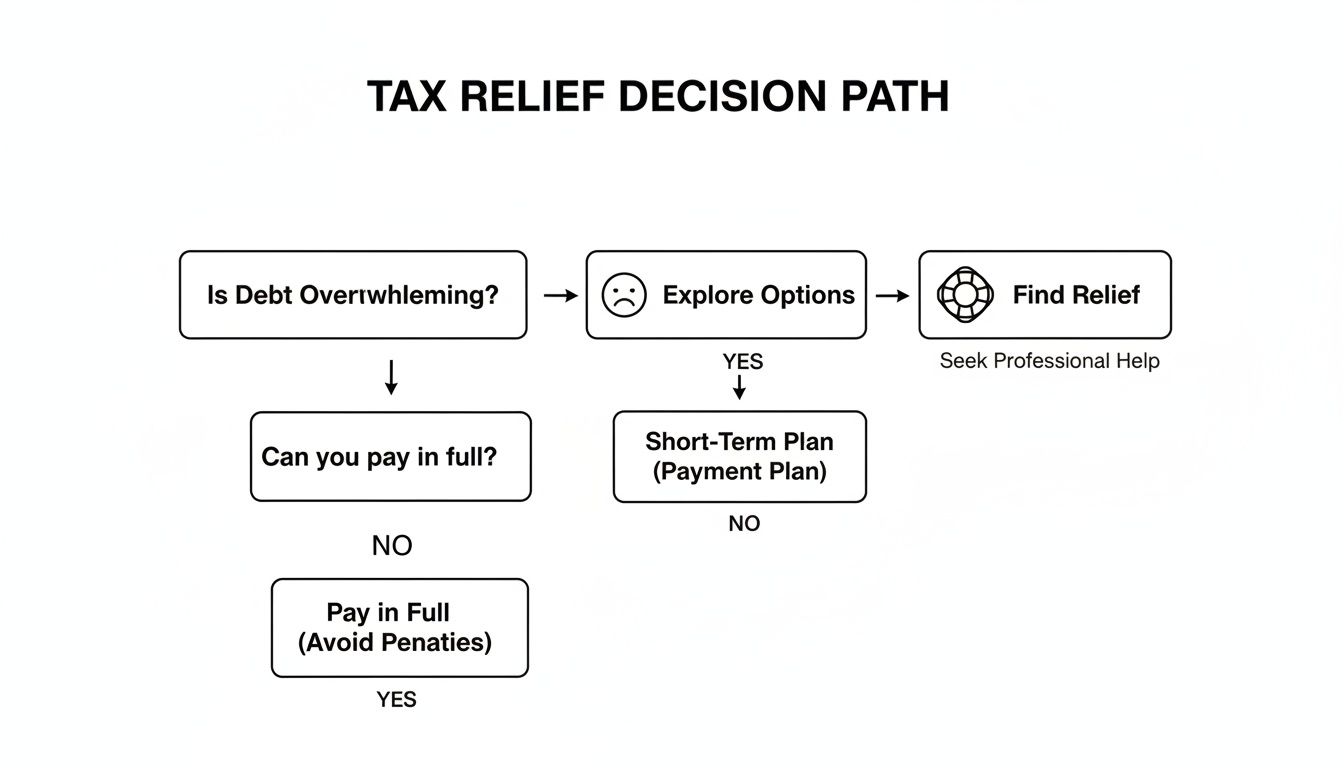
Feeling overwhelmed is the signal to start exploring these paths, not to shut down. The key takeaway is that a solution is almost always available if you know where to look.
To give you a clearer picture, here's a quick breakdown of the main federal tax relief options.
Federal Small Business Tax Relief at a Glance
| Relief Option | What It Is | Best For | Key Consideration |
|---|---|---|---|
| Offer in Compromise (OIC) | An agreement to settle your tax debt for less than the full amount owed. | Businesses with significant debt but very limited income and assets to pay it back. | Strict eligibility and a very intensive financial review process. |
| Installment Agreement (IA) | A monthly payment plan to pay your full tax debt over time, typically up to 72 months. | Businesses that have steady income but can't pay the full debt in one lump sum. | Interest and penalties continue to accrue until the debt is paid in full. |
| Currently Not Collectible (CNC) | A temporary pause on all IRS collection activities due to severe financial hardship. | Businesses facing a major crisis (like loss of all income) with no ability to make payments. | The debt doesn't disappear; it continues to grow with penalties and interest. |
These programs are the core of the IRS's resolution framework. Let's dig into how each one works in the real world.
1. Offer In Compromise (OIC): The Debt Settlement
The Offer in Compromise (OIC) is the one everyone's heard about, but it's also the most misunderstood. An OIC allows a struggling business to resolve its tax liability for less than the total amount owed.
Let's say your business owes the IRS $50,000. After a deep dive into your finances, it's clear the most you could ever hope to pay is $10,000 without going under completely. The OIC is the formal process for proposing that $10,000 settlement to the IRS.
An OIC isn’t a back-room negotiation. It’s a cold, hard calculation. The IRS uses a strict formula to determine your Reasonable Collection Potential (RCP) by scrutinizing your income, expenses, and asset equity. They'll only accept your offer if they agree it’s the most they could ever hope to collect.
This is a lifeline for businesses buried under a mountain of debt with very few assets and unstable income. It offers a genuine fresh start, but getting approved is tough. We walk you through the entire process in our complete guide to getting an IRS Offer in Compromise.
2. Installment Agreement (IA): The Structured Payment Plan
If your business is generally profitable but just doesn't have the cash on hand to pay a large tax bill at once, an Installment Agreement (IA) is your most reliable option. This is a formal agreement to make monthly payments for up to 72 months.
Think of it as a payment plan for your tax debt. You work with the IRS to set a monthly payment amount your business can actually afford. This gets you compliant and, most importantly, stops aggressive collection actions like bank levies or asset seizures, as long as you stick to the plan.
An IA is a perfect fit for a fundamentally sound business that hit a temporary rough patch. The benefits are straightforward:
- Stops Collections: Once your IA is approved, the threatening letters and phone calls stop.
- Predictable Budgeting: You have a fixed monthly payment, making it easier to manage cash flow.
- A Clear Path: It gives you a structured runway to clear your tax debt and keep your doors open.
3. Currently Not Collectible (CNC): The Temporary Hardship Pause
But what if your business is in such dire straits that you can't afford any payment right now? For these situations, the IRS can place your account in Currently Not Collectible (CNC) status.
This is a temporary timeout, not a get-out-of-jail-free card. CNC status means the IRS agrees to pause all collection efforts because they recognize you have no ability to pay.
This status is reserved for businesses facing a true financial crisis—a complete loss of revenue, a natural disaster, or another severe downturn. The IRS will revisit your case every year or two to see if your financial situation has improved enough to start paying. While CNC provides immediate relief from collections, the tax debt itself keeps growing as interest and penalties pile up. It’s a temporary reprieve, not a final resolution.
How New Laws Can Supercharge Your Proactive Tax Savings
Fixing a tax problem is one thing, but what if you could sidestep it entirely? The smartest way to manage your tax burden is to get ahead of it. This isn't about finding loopholes; it's about using the tax code, as written, to your full advantage.
Fortunately, some recent changes in the law have opened up powerful new avenues for small businesses to do just that. Getting a handle on these updates for 2026 is crucial for legally shrinking your taxable income and keeping more of your hard-earned money where it belongs—in your business.
Unlock Major Savings with the Enhanced QBI Deduction
One of the best tools in the arsenal for most small businesses—sole proprietorships, S Corps, and LLCs—is the Qualified Business Income (QBI) deduction. Think of it as a straight-up discount on your taxes, simply for being a business owner. You get to subtract a chunk of your business income right off the top.
Here's the great news: The One Big Beautiful Bill Act (OBBBA), which became law on July 4, 2025, didn't just make this deduction permanent; it gave it a serious boost. For 2026, the QBI deduction is now a massive 23%.
If your business has $120,000 in qualified income, that’s a $27,600 deduction. That's $3,600 more in savings than you would have seen in previous years.
The real beauty of the QBI deduction is that it lowers your Adjusted Gross Income (AGI). This doesn't just reduce your tax bill; it can also help you qualify for other credits and deductions that have AGI-based limitations, creating a powerful ripple effect of savings.
Let's see how this plays out for a real business owner.
Scenario: A Sole Proprietor's QBI Savings
- Meet Maria, a freelance graphic designer operating as a sole proprietor.
- Her net business income for 2026 is $90,000.
- Her new QBI deduction is 23% of that, which comes out to $20,700.
Just like that, Maria gets to subtract $20,700 from her income before calculating her tax bill. That's a direct, immediate boost to her bottom line, preventing a potential tax debt before it even starts.
Leverage the Expanded SALT Deduction Cap
Another game-changer from the OBBBA is the long-awaited increase to the State and Local Tax (SALT) deduction. The old $10,000 cap was a real thorn in the side for business owners in states with higher income and property taxes.
For 2026, that cap has been raised to $40,400 for many taxpayers. This is a huge win, especially for pass-through businesses where the owner pays state taxes on the business's profits via their personal return.
Of course, to take full advantage, you have to be diligent. Every dollar counts, so meticulously tracking every eligible expense is non-negotiable. For instance, knowing how to properly track business mileage for maximum tax deductions is fundamental to making sure you're not leaving money on the table.
Here’s what the new SALT cap can do.
Scenario: A Pass-Through Entity’s SALT Savings
- Let’s look at an S Corp owner in a high-tax state.
- They paid $35,000 in state income tax and $8,000 in local property taxes, for a total of $43,000.
Under the new 2026 rules, they can deduct the full cap of $40,400 on their federal return. Compared to the old $10,000 limit, that’s an extra $30,400 in deductions. If they're in the 24% tax bracket, this one change could put over $7,300 directly back into their pocket. This is what smart, proactive financial management looks like.
It’s easy to get tunnel vision on the IRS. But when you’re facing tax debt, focusing only on the federal side is like boarding up your windows for a hurricane but leaving the back door wide open.
Your state’s department of revenue has its own rulebook, its own deadlines, and its own powerful collection tactics. Ignoring a state tax bill is a critical error—one that can lead to sudden bank levies or property liens, even if you think you’re in the clear with the IRS.
The good news? States offer their own small business tax relief programs, too. The challenge? They don't just copy and paste the federal system. Think of it like this: the federal and state tax codes are two different languages. They might share a few words, but the grammar and local slang are completely different.
State Relief Programs: A Unique Landscape
Many states, including major economic hubs like California and New York, have their own versions of an Offer in Compromise or an Installment Agreement. But here’s where so many business owners get tripped up: the eligibility rules can be dramatically different from what the IRS requires.
- Some states are much stricter. They might demand a bigger down payment for a settlement offer or give you a much shorter runway to pay off the debt.
- Others can be more flexible. I’ve seen cases where a state will quickly approve a payment plan for a small business, especially if it helps keep a local employer from going under.
The bottom line is you can't assume a strategy that worked with the IRS will fly with your state. Each debt requires a separate, carefully planned approach. You have to treat your state tax problem with the same level of seriousness as your federal one.
The Federal and State Connection
Your federal and state tax filings are more connected than you might think. A change on one level almost always sends ripples through the other. A perfect example is the State and Local Tax (SALT) deduction, which lets you deduct a certain amount of the state and local taxes you pay from your federal income.
A recent legislative overhaul, the One Big Beautiful Bill Act (OBBBA), completely changed the game here. In 2025, it rocketed the SALT deduction limit to $40,000—a massive 300% increase! That limit continues to climb by 1% annually through 2029, bringing it to $40,400 for the 2026 tax year.
Let’s see how that works for a business owner. Say you paid $50,000 in state income tax and another $5,000 in property tax. Instead of being stuck with the old $10,000 cap, you can now deduct the full $40,400. Depending on your tax bracket, that could translate to $6,000-$14,800 in real federal tax savings. You can find more detail on this tax rate change at NationalFunding.com.
This SALT cap increase offers a powerful dose of federal relief, especially for businesses in high-tax states. It lowers your federal taxable income, which frees up cash you can immediately redirect to solving your state tax problem.
This is exactly why a comprehensive strategy is non-negotiable. By taking advantage of a federal tax break, you create the financial breathing room needed to tackle a state-level issue. A complete resolution plan has to look at your entire tax picture, federal and state, to ensure there are no nasty surprises waiting for you down the road.
Real-World Scenarios for Payroll and Income Tax Debt

Theory is one thing, but what does a tax crisis actually look like on the ground? For small businesses, tax trouble usually boils down to two distinct culprits: payroll tax and income tax.
Let's move past the hypotheticals and look at two stories I see all the time. These examples show just how quickly things can go wrong—and how a smart strategy can bring a business back from the brink.
Scenario 1: The Payroll Tax Crisis and the TFRP
Meet David, who owns a growing construction company, an S Corp. He hit a rough patch after a couple of projects went south, and his cash flow dried up. He made a classic, and dangerous, mistake: he used the money he’d withheld from his employees' paychecks to pay suppliers, promising himself he'd make it right on the next deposit.
He never caught up. Soon, he was $60,000 behind on payroll taxes.
Here's the thing about payroll tax: the IRS considers it sacred. That money—the "trust fund" portion—was never the business's property to begin with. The business was just holding it for the government. So when David got a notice about the Trust Fund Recovery Penalty (TFRP), it was serious.
This penalty is the IRS's nuclear option. It gives them the power to go right through the S Corp's legal protection and hold individuals personally liable. Suddenly, David’s own assets—his home, his car, his savings—were at risk.
David's Path to Resolution:
Instead of panicking, David hired a tax attorney. The first step was immediate: get on the phone with the IRS to show they were taking this seriously. After a thorough review of the business's books and David's personal finances, a clear picture emerged. The business was still viable but couldn't possibly pay the $60,000 back all at once.
The solution was a Partial Payment Installment Agreement. The business agreed to a manageable monthly payment, while David personally agreed to a separate, smaller payment plan for the TFRP portion. This kept the IRS from levying his personal bank accounts and allowed the company breathing room to get back on its feet.
(For a deeper dive, check out our complete guide on navigating payroll tax debt.)
Scenario 2: The Sole Proprietor's Income Tax Struggle
Now, let’s talk about Sarah. She’s a freelance marketing consultant and a sole proprietor. Business was booming, but her income was erratic—big checks one month, nothing the next. She got behind on her quarterly estimated tax payments. By the time she filed her return, she was staring at a $45,000 income tax bill she simply couldn't pay.
For a sole proprietor, there's no distinction between business and personal. That $45,000 debt was her debt, and the IRS notices piling up made the threat of a bank levy feel very real.
For many self-employed individuals, fluctuating income is the primary cause of tax debt. It’s a common pitfall that can quickly spiral out of control without a clear plan for managing quarterly tax obligations.
Sarah needed a solution that recognized her reality: she just didn't have the money.
Sarah's Path to Resolution:
After a careful analysis of her income, living expenses, and assets, it was obvious a standard payment plan wasn't going to work. The numbers showed the IRS was unlikely to ever collect the full amount. The best strategy was an Offer in Compromise (OIC).
An OIC is essentially a deal with the IRS to settle your tax debt for less than you owe. With professional guidance, Sarah put together a compelling offer.
- The Offer: She proposed to settle her $45,000 liability for $8,000, a figure calculated using the IRS's own complex formula based on her ability to pay.
- The Proof: The offer was backed by extensive financial records—bank statements, P&L reports, and personal expense sheets—proving this was the most the IRS could reasonably hope to collect.
- The Result: The IRS reviewed the file and accepted.
Sarah paid the $8,000, and the remaining $37,000 in tax debt was completely wiped away. It gave her a fresh start and a powerful lesson in managing her quarterly payments to avoid ever ending up in that position again.
Let's be frank: trying to fix a serious tax problem on your own is like trying to perform your own dental surgery. While you might handle a minor issue with a quick phone call, there are very clear signs that you're out of your depth and it's time to bring in a legal specialist.
Knowing when to make that call can be the single most important decision you make for the future of your business. It can mean the difference between a manageable resolution and a complete financial disaster.
There are certain situations where having anyone but a tax attorney in your corner is just too risky. A great CPA or Enrolled Agent is indispensable for accounting and preparation, but they simply don't have the legal training or protections to represent you when the stakes get this high, especially in Tax Court.
The Critical Red Flags
Think of these as the flashing red lights and blaring sirens you can't ignore. When the IRS sends certain notices or takes specific actions, it's no longer a routine collection matter. It’s an escalation that requires a legal strategy, not just an accounting one.
You need to pick up the phone and call an attorney, period, if any of these happen:
- You get a notice about the Trust Fund Recovery Penalty (TFRP). We've talked about this, but it bears repeating: this is the IRS officially stating its intent to hold you personally responsible for unpaid payroll taxes. Your home, your savings, your personal assets are now in the crosshairs.
- Your business owes more than $25,000 in payroll taxes. The IRS pursues payroll tax debt with a vengeance. Once the debt hits this threshold, the collection efforts become exponentially more aggressive.
- A Revenue Officer gets aggressive. If an agent shows up at your business unannounced, starts calling your home, or gets intensely demanding on the phone, the situation is no longer routine. This is a clear sign that you need a legal buffer between you and the agent.
- You are under criminal investigation by the IRS. This is the ultimate red flag. If IRS-CI (Criminal Investigation) contacts you, you are facing potential criminal charges, not just a civil debt. Only a tax attorney can protect your constitutional rights in this scenario.
- You need to negotiate a complex Offer in Compromise (OIC). While it's technically possible to file an OIC yourself, a rejection can be a massive setback. An attorney knows how to frame the legal arguments and financial picture to give you the best possible shot at getting the IRS to say "yes."
The Unique Advantage of Attorney-Client Privilege
Here's the one thing a tax attorney brings to the table that no one else can: attorney-client privilege. This is a powerful legal shield that makes your conversations completely confidential. You can—and should—be brutally honest about every detail of your situation, knowing that nothing you say can be forced out of your attorney and used against you.
Attorney-client privilege is a legal protection that does not extend to communications with CPAs or EAs. This means that if the IRS questions your accountant, they could be compelled to share details of your conversations, potentially harming your case.
This protection is absolutely vital, especially if you're dealing with years of unfiled returns or have concerns about potential fraud. It gives your attorney the full picture without putting you at risk, which is the only way to build the strongest defense for your small business tax relief.
If you're seeing any of these red flags, your next step is clear. Learning how to find a good tax attorney is the most critical action you can take. Making the right hire, early on, is often the move that saves the business.
Your Small Business Tax Relief Questions, Answered
Once you start digging into tax relief options, the practical questions quickly follow. It's one thing to understand the concepts, but it's another to know how they’ll affect your business in the real world. Let's tackle some of the most common questions I hear from business owners every day.
Can I Get Tax Relief if My Business is Still Operating?
Yes, absolutely. In fact, you pretty much have to be. Most IRS relief programs are built for businesses that are still up and running.
Think of it from the IRS’s perspective: they want to see a viable path to getting paid. An active business with cash flow is the best proof you can offer that you’ll be able to hold up your end of the bargain. Whether you're aiming for an Installment Agreement or an Offer in Compromise, showing you're operational is a huge point in your favor. A good tax attorney knows how to use your ongoing operations to frame a winning proposal.
Will Seeking Tax Relief Hurt My Business Credit?
This is a big worry, and the answer isn't a simple yes or no. The act of entering an IRS payment plan, like an Installment Agreement, won't directly ding your business credit score.
The real culprit is the federal tax lien the IRS likely filed against your business when the debt became delinquent. A tax lien is public, acting like a giant red flag for any potential lenders, and it can definitely make it harder to get a loan.
Here's the bottom line: Ignoring the debt is what truly damages your financial standing. The best move is always to face it head-on. Once you have a formal resolution in place and are making payments, you can often petition the IRS to withdraw the lien, which is a major step toward rebuilding your business's creditworthiness.
What Is the Difference Between a Tax Attorney and a Large Resolution Firm?
The difference comes down to personal expertise, legal protection, and the business model itself. Many of the big, national "tax resolution" companies you see advertised are essentially sales operations. They often take large fees upfront—sometimes before anyone has even done a serious analysis of your financials—and you may never actually speak with a licensed attorney.
Working directly with a specialized tax attorney is a completely different experience. Your case begins with a thorough, personal review to find the right strategy for your specific situation. More importantly, you get the protection of attorney-client privilege. This is a critical legal shield that CPAs and other tax preparers cannot provide. It means you can be completely honest and open about your situation, knowing that our conversations are confidential and cannot be used against you by the IRS.
Don't let tax debt dictate the future of your business. The first step toward taking back control is a clear, honest assessment of where you stand. At Attorney Stephen A Weisberg, we always start with an in-depth analysis. Get your FREE Tax Debt Analysis today to understand your options and map out the best path forward.


