Small Business Tax Help: A Guide to Solving IRS Problems
Facing IRS debt? Get practical small business tax help with our step-by-step guide on assessing problems, finding relief, and when to hire an expert.

In this article
- That IRS Notice Arrived Now What
- What the notice usually means
- Don't make these early mistakes
- Immediate Steps for Damage Control
- Your first 48-hour checklist
- What not to do
- Make controlled contact, not emotional contact
- Triage the risk level
- Assembling Your Documents for a Clear Diagnosis
- What to gather first
- Why these documents matter
- Review old returns for missed deductions
- Build a clean package
- Decoding Your IRS Relief and Resolution Options
- Offer in Compromise
- Installment Agreement
- Currently Not Collectible status
- Penalty abatement
- Comparing IRS tax relief options
- The option people underestimate
- When and How to Build Your Professional Support Team
- Know who does what
- When a tax attorney is not optional
- How professionals should work together
- Start with diagnosis, not a giant retainer
- Creating Your Path to Long-Term Financial Health
- The habits that keep you out of trouble
- Use tax law proactively, not defensively
- Build a boring, reliable process
- Common Questions About Business Tax Debt
- Can the IRS take my bank account or business assets
- Will business tax debt ruin my credit
- How long does it take to resolve a tax case
- Can I fix this if I already feel behind and overwhelmed
You open the mail, see the IRS logo, and your stomach drops. Maybe it's about payroll taxes. Maybe it's an old income tax balance you thought would sort itself out. Maybe your bookkeeper quit, your cash flow got tight, and now the problem has a case number attached to it.
Take a breath. This is fixable.
Tax trouble doesn't mean you're irresponsible, and it doesn't mean your business is doomed. It usually means something got missed, piled up, or snowballed while you were busy keeping the doors open. I've seen that happen to otherwise smart, hardworking business owners over and over. The worst move is panic. The second worst is pretending the notice isn't real. What you need now is small business tax help that deals with the problem in the order the IRS deals with it: identify it, contain it, document it, and resolve it.
Most generic tax articles spend their time telling you how to avoid problems in the future. That's fine, but it doesn't help much when the notice is already in your hand. What matters now is what to do next, what not to say, what papers to gather, and which resolution path matches your facts.
That IRS Notice Arrived Now What
The first rule is simple. Open every notice and read it carefully. Don't let it sit on your desk for a week because you're afraid it says something bad. Unopened IRS mail causes more damage than bad bookkeeping.
Most notices are not the end of the world. They're the start of a process. The IRS is telling you one of a few things: it thinks you owe money, it thinks a return is missing, it wants supporting information, or it's warning you that collection action may be coming. Those are serious issues. They're also manageable when you respond early.
What the notice usually means
Start by looking for three things:
- The tax type. Is this about business income tax, personal income tax tied to your business, or payroll tax?
- The tax period. Which year or quarter is involved?
- The deadline. IRS letters usually give you a response date. Missing it limits your options.
If the letter is confusing, that's normal. IRS notices are written for the agency, not for stressed business owners. If you need a plain-English explanation of the notice codes and what they often mean, review these IRS letters and notices explained in simple terms.
Practical rule: The notice is not your verdict. It's your warning label.
Don't make these early mistakes
Business owners usually hurt themselves in one of four ways right away.
- Ignoring the letter because they're scared.
- Calling the IRS without records in front of them and making loose statements that create bigger problems.
- Sending partial paperwork that doesn't answer the actual issue.
- Assuming their CPA handles controversy work when the CPA may be excellent at returns and not built for collection defense or payroll tax disputes.
If you remember one thing, remember this: having a tax problem and solving a tax problem are two different stages. Right now, your job is not to fix everything in one frantic afternoon. Your job is to stop the bleeding and get a clear diagnosis.
A good first conversation with a professional should feel calm and structured. It should not feel like a pressure pitch. You need someone to tell you what the IRS is asking, what documents matter, whether the debt is accurate, and what resolution programs are even on the table. That's the work. Everything else is noise.
Immediate Steps for Damage Control
The first two days matter. You do not need to become a tax expert in that time. You do need to get organized and stop the problem from getting worse.

Your first 48-hour checklist
Do these in order.
Create one file for this issue
Use a paper folder, a digital folder, or both. Put every notice, prior return, payment record, and IRS letter in one place. Tax problems become much easier when everything lives in one file instead of six inboxes and a glove compartment.Identify exactly what the IRS says is wrong
Look for the notice number, the tax period, and the balance or issue described. If it's payroll related, treat it with extra urgency. Payroll tax cases can turn into personal exposure for owners and other responsible people.Check whether all returns were filed
You can't negotiate effectively if required returns are still missing. If returns were filed, confirm the IRS processed them. Businesses often assume a return was filed because it was prepared. Those are not the same thing.Stop adding fresh noncompliance
If you're behind on current deposits or estimated payments, get current as fast as you can. The IRS is far more willing to discuss relief when you're no longer digging the hole deeper.
What not to do
A lot of bad outcomes start with bad improvisation.
- Don't throw away envelopes. The mailing date matters.
- Don't mix business and personal explanations casually. If you're a sole proprietor or single-member LLC, the line may already be blurry. Don't blur it more.
- Don't promise a payment you can't make just to get off the phone.
- Don't assume a levy is far away if the notices mention collection.
If you're worried about a bank levy, wage garnishment, or other collection pressure, read this overview of IRS levy and garnishment issues. The goal is to recognize escalation early enough to head it off.
Call attention to the issue before the IRS escalates it. Silence never helps you.
Make controlled contact, not emotional contact
Sometimes the smartest move is to contact the IRS or have a representative do it, to confirm what the case is, what is missing, and whether active collection is pending. The point is not to tell your life story. The point is to gather facts and avoid avoidable escalation.
When you call, have these in front of you:
- The notice itself
- Your EIN or SSN
- A list of the periods involved
- Basic notes on whether returns were filed and whether current taxes are being paid
Keep your conversation narrow. Ask what the IRS says is missing, what the current status is, and what the next deadline is. Write down the date, time, and name or ID number of the person you speak with if available.
Triage the risk level
Not every tax problem is equally dangerous. A return discrepancy is different from a payroll tax case. An old balance with no active enforcement is different from a Final Notice situation.
Use this quick triage:
| Issue type | Risk level | Immediate priority |
|---|---|---|
| Missing return notice | Moderate | Confirm filing status and get returns prepared if needed |
| Balance due notice | Moderate to high | Verify amount, stop default, evaluate payment options |
| Payroll tax notice | High | Review deposits, quarters, and possible personal exposure |
| Collection warning | High | Respond quickly and assess levy risk |
Small business tax help should feel practical, not theatrical. You don't need scare tactics. You need a sequence.
Assembling Your Documents for a Clear Diagnosis
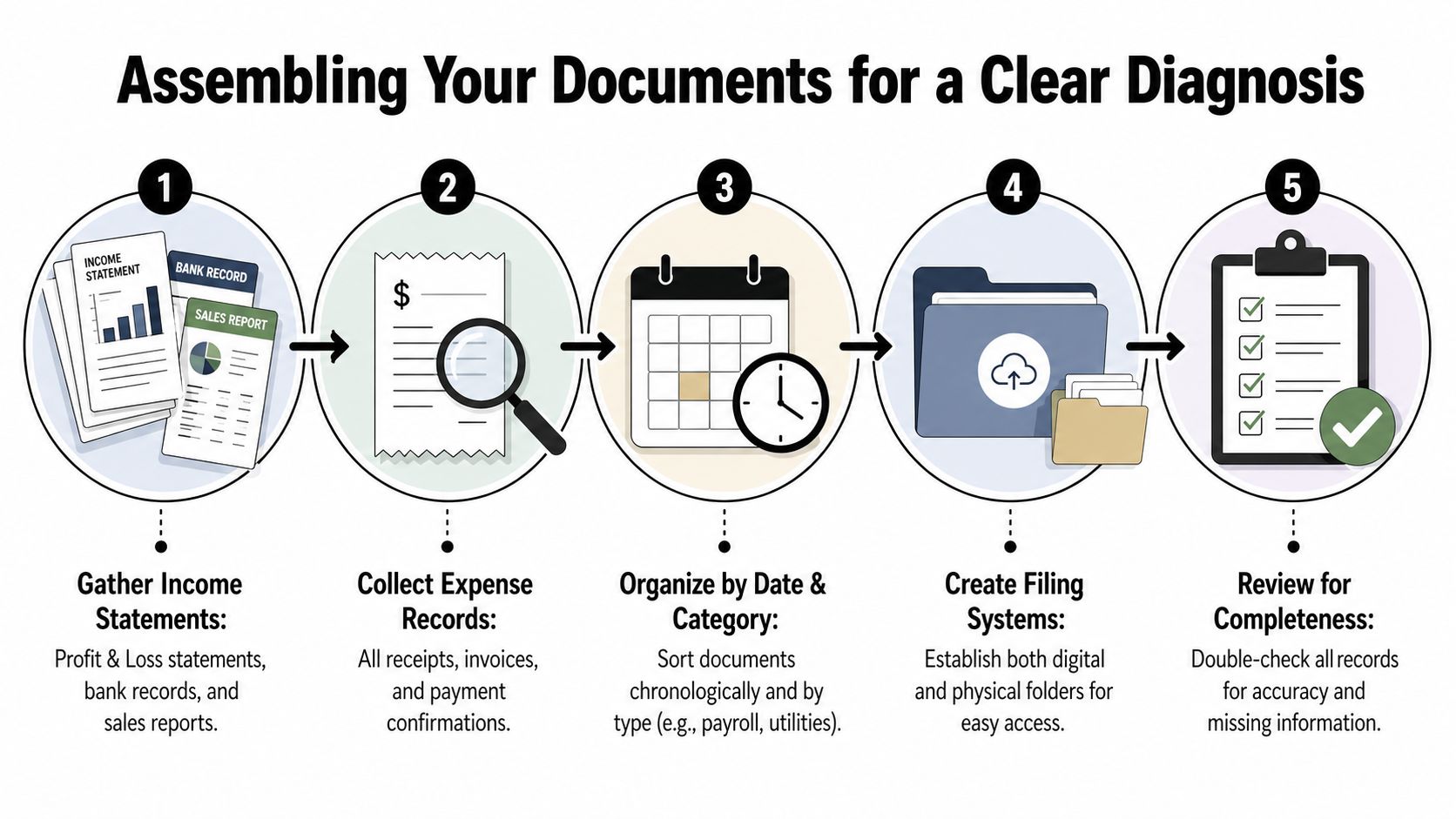
You can't solve what you haven't documented. The IRS makes decisions based on paperwork, filing status, and financial disclosure. That means the fastest way to a solution is usually the least glamorous one. Gather the documents.
Think of this as a diagnosis, not busywork. A doctor can't prescribe treatment without tests. A tax professional can't recommend the right resolution without returns, notices, and a clear financial picture.
What to gather first
Start with the items that define the scope of the problem.
- All IRS and state notices you can find. Every page matters.
- Three years of tax returns if available, including business and personal returns when the business is a pass-through.
- IRS transcripts obtained through Form 4506-T if you don't trust your records or think filings or payments may be missing from your file.
- Current profit and loss statements
- Recent business bank statements
- Payroll records if the issue involves employees
- Loan statements and major asset information if you may need to disclose finances for a resolution program
If you're missing returns, say so early. Missing returns don't make the case impossible. They just change the order of operations.
Why these documents matter
Each category tells a different part of the story.
Returns show what was reported. Notices show what the IRS thinks happened. Bank records and P&Ls show whether you can pay in full, need time, or may qualify for a settlement or hardship status. Payroll records show whether the problem belongs to the business only or may reach individuals the IRS considers responsible.
For many businesses, financial disclosure happens through Form 433-A or Form 433-B. Think of those forms as your financial snapshot. They list income, expenses, assets, debts, and cash flow. The IRS uses that information to evaluate Reasonable Collection Potential, which is central to programs like an Offer in Compromise.
The more organized your records are, the less room there is for the IRS to make assumptions that hurt you.
Review old returns for missed deductions
Many owners are unpleasantly surprised to discover that the tax debt may not be just a collection problem. It may also be a preparation problem.
The Tax Cuts and Jobs Act of 2017 created the Qualified Business Income deduction, allowing eligible businesses to deduct up to 20% of qualified business income, according to the NFIB summary of the QBI deduction. If prior returns missed that deduction where it applied, the debt itself may be overstated.
That doesn't mean every old return should be amended. It means old returns deserve review before you accept the balance as gospel.
Build a clean package
When you hand documents to a professional, don't send a box of loose paper and a text that says "it's all in there." Build a usable package.
- One folder for notices
- One folder for filed returns
- One folder for unfiled years or quarters
- One folder for financial statements and bank records
- One running timeline of what happened and when
That timeline matters. "Bookkeeper left in spring, notices started in summer, cash flow collapsed in fall, we stopped making deposits in winter" is useful. "It's been a mess" is not.
If you're doing this for a consultation or a free tax debt analysis, this organization shortens the path to actual advice. It also tells the professional you are ready to solve the problem, not just talk about it.
Decoding Your IRS Relief and Resolution Options
Once the facts are clear, the question becomes simple. What is the right resolution vehicle for this case? Not the most famous one. Not the one you saw in an ad. The one that fits your numbers, your filing status, and your current ability to pay.
The IRS has several main paths. They are not interchangeable.
Offer in Compromise
An Offer in Compromise, or OIC, is a settlement program. It can make sense when your business or personal financial condition shows you cannot realistically pay the full debt within the collection period.
This is not magic. It is math and documentation.
The IRS looks closely at your income, allowable expenses, asset equity, and future ability to pay. If your earning power has permanently dropped, your business changed, or your cash flow won't support full payment, an OIC may be worth evaluating. But sloppy filings kill good cases. OIC acceptance rates hover around 25% to 40%, and incomplete documentation is a primary reason for rejection in 60% of cases, as noted in this QuickBooks summary of common tax resolution pitfalls.
That number should tell you two things. First, some offers do get accepted. Second, this is not a do-it-yourself paperwork project if your records are messy.
Installment Agreement
An Installment Agreement is exactly what it sounds like. You owe the tax, you can't pay it all today, and you need a payment structure.
This is often the right path for businesses that are viable but cash-strapped. Revenue is coming in. The owner can keep the business compliant going forward. The debt just can't be absorbed in one lump sum without sinking operations.
The mistake owners make here is offering a number based on hope instead of budget reality. If you agree to a payment you can't sustain, you'll default and end up in a worse position. A good agreement fits your actual cash flow and leaves enough room to stay current on new taxes.
Currently Not Collectible status
Currently Not Collectible, or CNC, is for hardship cases. It does not erase the debt. It tells the IRS that collection isn't realistic right now because paying would prevent you from covering necessary living or operating expenses.
This can be appropriate when the business is barely surviving or the owner is dealing with a severe personal financial crisis. CNC is a breathing-space tool. It is not a long-term business strategy. But for the right case, it can stop active collection and create room to stabilize.
If paying the IRS this month means you can't keep the lights on or cover basic living costs, the answer may not be "pay anyway."
Penalty abatement
Sometimes the biggest number in the balance isn't tax. It's penalties piled on top of tax. In those situations, penalty abatement can matter more than people think.
If you have a solid compliance history and meet the criteria, First-Time Abate may be available. Other cases rely on reasonable cause arguments. Illness, records loss, business disruption, or other serious circumstances may support relief, but the argument has to be documented and framed correctly.
Penalty work is often overlooked because owners fixate on the total balance and assume every dollar is untouchable. It isn't.
Comparing IRS tax relief options
Here is the clean comparison most business owners need:
| Relief Program | Best For... | Key Requirement | Potential Downside |
|---|---|---|---|
| Offer in Compromise | Businesses or owners who can't realistically pay the full debt | Full financial disclosure and strong documentation | Rejection risk is real, especially with incomplete paperwork |
| Installment Agreement | Businesses that can pay over time but not all at once | Ability to make sustainable monthly payments and stay current | Default if the payment is set too high or compliance slips |
| Currently Not Collectible | Severe hardship cases | Proof that collection would create financial hardship | Debt remains, and the IRS may review status later |
| Penalty Abatement | Cases where penalties inflated the balance | Good compliance history or documented reasonable cause | Doesn't usually eliminate the underlying tax |
If you want a plain-English overview of the broader menu, this guide to IRS tax debt relief options is a useful starting point.
The option people underestimate
For business owners with payroll tax issues, the core issue isn't always the company balance alone. It's whether the IRS is moving toward personal assessment through the Trust Fund Recovery Penalty. That's where generic tax prep advice stops being enough. If payroll taxes are involved, resolution strategy has to account for who may be exposed personally, how the business is operating now, and whether interviews or assessments are coming.
That is legal controversy work. Treat it that way.
When and How to Build Your Professional Support Team
You can handle some tax matters alone. This is not one of the categories where pride usually pays off.
If your issue is a simple filing question, a good CPA may be all you need. If your issue is a debt case, an audit with real exposure, payroll tax problems, or possible Trust Fund Recovery Penalty assessment, your support team needs to be more deliberate.

Know who does what
Not all tax professionals do the same job.
CPAs are often strongest on bookkeeping cleanup, return preparation, financial statements, and identifying whether prior filings need correction.
Enrolled Agents can represent taxpayers before the IRS and are often very effective in collection and compliance matters.
Tax attorneys become especially important when the matter involves legal exposure, contested IRS positions, payroll tax investigations, potential personal assessment, negotiation strategy, or coordination with other legal matters like bankruptcy or divorce.
That distinction matters because a major gap in small business tax help is guidance on IRS controversy resolution, especially for payroll tax debt and the Trust Fund Recovery Penalty, as discussed in this Third Way analysis of support gaps for small businesses. General tax advice often doesn't address those high-stakes disputes well.
When a tax attorney is not optional
Get legal controversy help quickly if any of these are true:
- Payroll tax notices are involved
- An IRS revenue officer is assigned
- You are being asked questions about who controlled payroll or payments
- A business sale, refinance, divorce, or bankruptcy is being blocked by tax debt
- Your current advisor says, "I don't really handle collections or TFRP matters"
This isn't about ego. It's about fit.
A return preparer prepares returns. A controversy lawyer manages risk, strategy, and negotiation when the IRS is trying to collect.
How professionals should work together
The best results usually come from collaboration, not turf wars. Your CPA may know the books. Your lawyer may know procedure and negotiation. Your payroll provider may hold records nobody else has. If a deal is on the line, your realtor, lender, or family law attorney may need tax clarity to move the matter forward.
I regularly see closings and settlements stall because nobody owns the tax problem. Everyone is waiting for someone else to "handle it." That delay is expensive.
If you're also cleaning up your financial infrastructure, it helps to be intentional about finding an accounting partner in NYC or in your local market who can support the compliance side while controversy work proceeds on a separate track.
Start with diagnosis, not a giant retainer
Often, business owners are taken advantage of. Large tax resolution shops love fear. They want the panicked call and the big upfront payment before anyone has even confirmed whether relief is realistic.
I think that's backward.
A better first move is a free tax debt analysis that answers basic but critical questions: Do you qualify for a program? Are all returns filed? Is the IRS balance even correct? Is the case really about tax debt, or is it a payroll controversy case with personal exposure? Attorney Stephen A Weisberg at The W Tax Group offers that kind of initial analysis as part of his tax debt and IRS controversy practice.
If a professional can't explain your likely path in plain English after reviewing your records, don't hire them yet.
"Before you pay anyone to resolve a tax case, you should know whether there's a real path to relief and what that path probably is."
If you're evaluating counsel, this piece on how to find a good tax attorney will help you ask better questions and avoid the wrong kind of firm.
Creating Your Path to Long-Term Financial Health
Getting out of tax trouble is only half the job. The other half is making sure you don't end up back here next year with a different notice and the same headache.
That requires systems. Not heroic effort. Systems.

The habits that keep you out of trouble
Start with the basics that owners ignore when life gets busy.
- Separate business and personal finances so income and deductions are traceable.
- Stay current on payroll deposits if you have employees. This is the category that becomes dangerous fastest.
- Set money aside for quarterly obligations if you're self-employed or in a pass-through structure.
- Review your books monthly, not at tax time.
- Talk to your tax advisor before year-end, while options still exist.
This isn't glamorous. It works.
Use tax law proactively, not defensively
Future planning matters because the tax code still gives small businesses meaningful tools when they use them correctly. Looking ahead, the One Big Beautiful Bill Act of 2025 permanently restores 100% bonus depreciation and increases Section 179 expensing to $2.5 million for qualifying property, according to this overview of OBBBA small business tax changes. Used properly, those deductions can help manage future tax liability instead of leaving you with another surprise balance.
Financing decisions matter too. If you're borrowing for equipment, expansion, or working capital, understand the tax consequences before you sign. This guide to tax-efficient business funding is a practical companion when you're thinking about how debt, cash flow, and deductions fit together.
Build a boring, reliable process
The healthiest businesses usually have a boring tax process. That's a compliment.
They know who handles books, who handles filings, who reviews payroll, and who gets called if an IRS letter shows up. There is a calendar. There is a folder. There is a person responsible. That structure is what turns tax compliance from a recurring crisis into routine maintenance.
Common Questions About Business Tax Debt
Can the IRS take my bank account or business assets
Yes, the IRS can use collection tools if a case goes unresolved long enough. That said, collection usually follows a notice trail. Owners who respond early have far more room to work out a solution before matters reach that point.
Will business tax debt ruin my credit
Tax debt can affect financing, closings, and lender confidence, especially when liens, unresolved balances, or missing returns are part of the picture. The practical problem is often less about a credit score and more about blocked transactions.
How long does it take to resolve a tax case
It depends on the issue. A simple payment arrangement can move faster than a contested payroll tax matter or a fully documented settlement request. The biggest delay is usually incomplete records, missing returns, or a business owner waiting too long to act.
Can I fix this if I already feel behind and overwhelmed
Yes. Start smaller than your fear is telling you to start. Open the notices, gather the records, get the facts, and have the case reviewed by someone who does controversy work. Tax problems get solved one step at a time, not all at once.
If you're dealing with IRS or state tax problems and want a calm, practical assessment of your options, Attorney Stephen A Weisberg helps individuals, business owners, and professional referral partners evaluate tax debt, audits, payroll tax issues, and other controversy matters. The right first step is not panic. It's getting a clear diagnosis and a workable plan.


