A Clear Guide to Single Member LLC Tax Forms
Tired of confusing tax rules? Unpack the essential single member LLC tax forms, from Schedule C to estimated payments, in this clear, step-by-step guide.
In this article
- Understanding Your Single-Member LLC Tax Obligations
- The Pass-Through Concept in Action
- A High-Level Roadmap of Key Forms
- The Core Tax Forms You'll Get to Know
- Your Business's Financial Story: Schedule C
- The Self-Employment Tax: Schedule SE
- Paying as You Go: Form 1040-ES
- What Happens When Your Business Has a Team?
- Hiring Employees: Your Payroll Tax Forms
- Working with Independent Contractors
- The Critical Distinction: Employee vs. Contractor
- Choosing a Different Tax Path for Your LLC
- The Popular S Corporation Election
- How an S Corp Can Save You Money
- Default LLC vs S Corp Election: A Scenario
- The Less Common C Corporation Election
- Navigating Your State and Local Tax Forms
- State Income and Franchise Taxes
- The World of Sales Tax and Nexus
- Common Tax Mistakes and When to Get Help
- The Dangers of Mishandling Payroll Taxes
- Knowing When to Call a Professional
- A Few Common Questions About LLC Tax Forms
- Do I Really Need a Separate Bank Account?
- Can I File My Own LLC Taxes?
- What Happens If I Miss an Estimated Payment?
When you form a single-member LLC, one of the first questions you'll have is, "How do I handle the taxes?" The answer is simpler than you might think. For most, the essential tax forms are Schedule C (Profit or Loss from Business) and Schedule SE (Self-Employment Tax), which you'll file right alongside your personal Form 1040.
Because the IRS considers your LLC a "disregarded entity" by default, it doesn't file its own separate business tax return. Instead, all of your business's financial activity flows directly onto your individual tax filing.
Understanding Your Single-Member LLC Tax Obligations
Let's cut through the jargon. For federal tax purposes, the IRS generally sees no real difference between you and your single-member LLC. This "disregarded entity" status is actually designed to make your life easier.
Think of your LLC as a strong legal shield protecting your personal assets (like your house and car) from business debts. But when tax season rolls around, the IRS looks right through that legal shield and sees you, the individual taxpayer.
This means the financial story of your business—all your income and expenses—is told on your personal tax return. You won't be wrestling with a complex corporate form. Instead, you'll report everything on your good old Form 1040, using a couple of specific attachments to detail your business's performance.
The Pass-Through Concept in Action
The core principle here is called pass-through taxation. Your LLC's profits (or losses) "pass through" the business entity directly to you, the owner. You then pay personal income tax and self-employment taxes on whatever net profit the business earned.
The IRS defaults to treating single-member LLCs this way, which is why owners report their business finances on Schedule C. In fact, the form's official title is 'Profit or Loss from Business (Sole Proprietorship),' which tells you exactly how the IRS views your LLC for tax purposes.
This simple decision tree shows how an LLC's tax status is determined by the number of members it has.
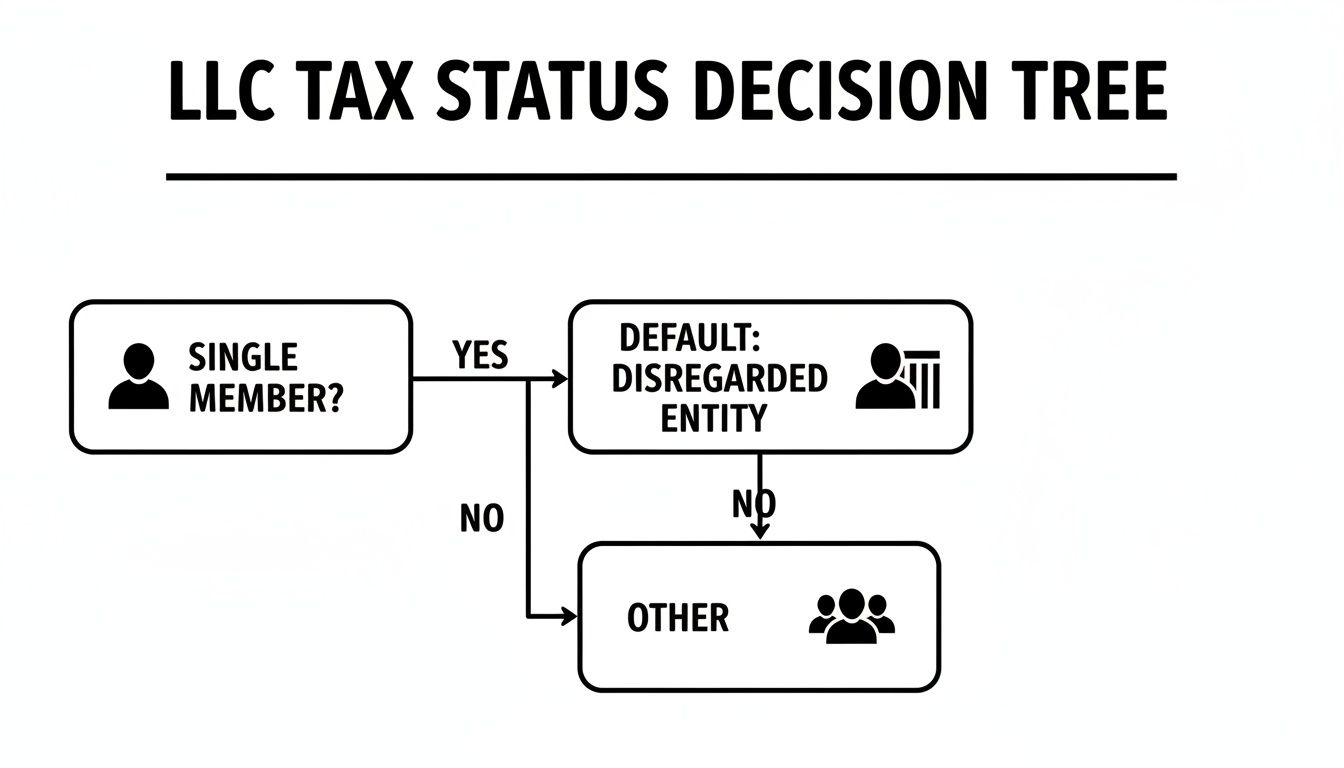
As you can see, the path for a single-member LLC leads straight to the "disregarded entity" status by default—the most straightforward tax scenario available.
A High-Level Roadmap of Key Forms
Before we dive into the nitty-gritty of each form, it helps to have a quick overview. This little roadmap will help you see how each piece fits into the bigger picture of your annual tax filing.
To give you a bird's-eye view, here's a quick summary of the main federal forms you'll likely be dealing with.
| Tax Form | Purpose | Filed With | Typical Due Date |
|---|---|---|---|
| Schedule C | Reports your business's income and expenses to calculate net profit or loss. | Form 1040 | April 15 |
| Schedule SE | Calculates the self-employment tax (Social Security & Medicare) you owe on your business profit. | Form 1040 | April 15 |
| Form 1040 | Your personal income tax return. Your business profit from Schedule C gets added here. | IRS | April 15 |
| Form 1040-ES | Used to pay estimated taxes on your income (including business profit) throughout the year. | IRS | Quarterly (Apr, Jun, Sep, Jan) |
This table covers the basics, but keep in mind other forms might apply if you have employees or elect a different tax status.
To make tax season less of a headache, I always recommend using a good Small Business Tax Preparation Checklist specifically designed for business owners like you. Getting your documents organized ahead of time is half the battle. For a more detailed guide, our article on how to file LLC taxes offers a valuable step-by-step walkthrough. A little preparation goes a long way in making sure you complete these forms correctly and on time.
The Core Tax Forms You'll Get to Know
Once you realize your single-member LLC’s money is just an extension of your own personal finances in the eyes of the IRS, the paperwork becomes a lot less scary. It’s all about connecting the dots from your business's bank account to your final tax bill. I like to think of it as a simple, three-part journey.
First, you'll tally up how your business did for the year. Then, you'll figure out the special taxes that come with being self-employed. Finally, you’ll roll it all together into your personal tax return.

Let's walk through the key players in this process.
Your Business's Financial Story: Schedule C
The first and most important form on your list is Schedule C, Profit or Loss from Business. This is where you tell the IRS your business's financial story for the year. You'll start with your gross income—every dollar your business brought in—and then subtract all your legitimate business expenses.
These deductions can be anything from advertising costs and office supplies to business-related travel and professional development fees. The number at the very bottom, your net profit (or loss), is the headline. It’s the single most important figure because it drives everything else.
Key Takeaway: Your net profit on Schedule C is the launchpad for your entire tax calculation. It dictates not only how much income tax you'll owe but also the amount you'll pay in self-employment taxes.
Getting your expenses right is crucial for keeping your tax bill as low as legally possible. To make sure you're not missing anything, check out our deep dive into the ultimate single-member LLC tax deductions.
The Self-Employment Tax: Schedule SE
That net profit figure from Schedule C gets passed directly to the next form: Schedule SE, Self-Employment Tax. Since you don't have an employer withholding Social Security and Medicare taxes from a regular paycheck, this form is how you calculate and pay those taxes yourself.
Frankly, this is the tax that often catches new business owners by surprise. Self-employment tax is a flat 15.3% on your net business earnings, which can be a significant hit. It’s made up of two parts: 12.4% for Social Security (on earnings up to the annual limit) and 2.9% for Medicare (on all your net earnings).
The final number from your Schedule SE gets added to your total tax bill on your personal Form 1040. There is a small consolation prize, though: you get to deduct one-half of what you pay in self-employment tax, which helps slightly reduce your overall taxable income.
Paying as You Go: Form 1040-ES
The IRS operates on a "pay-as-you-go" system. Waiting until Tax Day in April to settle up for the entire year is a sure-fire way to face a staggering bill and potential penalties. This is where Form 1040-ES, Estimated Tax for Individuals, comes in.
Using this form, you'll make quarterly payments throughout the year to cover both your income tax and your self-employment tax. The idea is to estimate your total annual profit, figure out the tax you'll likely owe, and then divide that amount into four payments.
The deadlines are generally the same each year:
- April 15 (for Jan 1 - Mar 31 income)
- June 15 (for Apr 1 - May 31 income)
- September 15 (for Jun 1 - Aug 31 income)
- January 15 of the following year (for Sep 1 - Dec 31 income)
Staying on top of these payments keeps you in good standing with the IRS and saves you from a nasty surprise in the spring. To help manage the calculations and deadlines for these forms, many small business owners turn to modern cloud-based tax software to keep things organized.
What Happens When Your Business Has a Team?
The moment you go from a one-person show to a business with a team, your tax world gets a lot more complicated. Whether you bring on your first employee or just hire a freelancer for a project, you're suddenly dealing with a whole new stack of single-member LLC tax forms. It's a huge step for your business, but one that demands you pay close attention to the details.
Once you have people working for you, you’re not just managing your own taxes anymore. You become responsible for withholding, reporting, and sending tax money to the government on behalf of others. This is a serious legal duty, and the IRS has a specific set of forms to make sure you get it right.

Hiring Employees: Your Payroll Tax Forms
The second you hire an employee, the IRS sees you as an employer. Your first, non-negotiable task is to get an Employer Identification Number (EIN) from the IRS. Even if you already have one for banking, you need one specifically for payroll. This number is your key to all things payroll tax.
With your EIN in hand and an employee on board, you'll get to know these forms well:
- Form 941, Employer's QUARTERLY Federal Tax Return: This will become your new best friend (or worst enemy). Every three months, you'll use it to report the federal income tax you withheld from your employees' pay, plus both your share and their share of Social Security and Medicare taxes.
- Form 940, Employer's Annual Federal Unemployment (FUTA) Tax Return: This one is filed once a year. It’s for the federal unemployment tax, which is paid entirely by you, the employer. It's what funds the system that helps workers who have lost their jobs.
- Forms W-2 and W-3: At year-end, you need to give each employee a Form W-2. It’s a summary of everything they earned and all the taxes you withheld for them. You then send copies of all those W-2s, along with a master summary sheet called a W-3, to the Social Security Administration.
A Word of Warning: That money you withhold from an employee’s paycheck for taxes? It’s not yours. Not even for a little while. The IRS calls these "trust fund taxes" for a reason—you're holding them in trust for the government. Failing to pay them is one of the biggest mistakes a business owner can make, and it can even lead to you being held personally responsible for the debt.
Working with Independent Contractors
Maybe you don't need a full-time employee, but you need a graphic designer for a new logo or a consultant for a six-week project. These folks are usually independent contractors, and that changes your tax responsibilities completely.
The good news? You generally don't have to withhold any taxes from their pay. Your primary job is simply to report what you paid them.
The key form here is Form 1099-NEC, Nonemployee Compensation. If you paid any single contractor $600 or more for the year, you have to file one. You send a copy to the contractor and another to the IRS. This tells the government how much income that contractor needs to report on their own tax return.
The Critical Distinction: Employee vs. Contractor
Messing this up is a classic—and costly—business mistake. Misclassifying someone who is truly an employee as an independent contractor can land you in hot water with the IRS.
It really boils down to control. If you tell the worker when, where, and how to do their job, they're almost certainly an employee. If they have their own business, use their own tools, and have other clients, they're likely a contractor.
If the IRS reclassifies your "contractor" as an employee, you could be on the hook for all the back employment taxes you should have paid, plus hefty penalties and interest. Understanding this distinction is absolutely essential. The rules can get tricky, and our deep dive into small business payroll taxes can give you more clarity on these critical employer responsibilities.
Choosing a Different Tax Path for Your LLC
The default "disregarded entity" status for a single-member LLC is beautifully simple, but it isn't your only play. One of the best features of an LLC is its flexibility—you have the power to choose how the IRS taxes your business. As your company becomes more profitable, making a strategic switch can lead to some serious tax savings.
Instead of being treated like a sole proprietorship, you can file a form with the IRS and ask them to tax your LLC like a corporation. This is purely a tax move; it doesn't change your legal structure as an LLC. Your two main options are the S Corporation or, much less common for a single owner, the C Corporation.
The Popular S Corporation Election
For most successful single-member LLCs, the go-to alternative is electing to be taxed as an S Corporation. Why make the switch? The biggest reason is to minimize the bite of that 15.3% self-employment tax we covered earlier.
Making this happen isn't automatic. You have to formally request it by filing Form 2553, Election by a Small Business Corporation. The IRS is strict about the timing here, so you need to plan ahead. Generally, you have to file it within the first two months and 15 days of the tax year you want the change to kick in.
Once the IRS gives you the green light, how you get paid from your business changes completely. You're no longer just an owner taking draws. You now wear two hats: you're both an owner and an employee of your own company.
How an S Corp Can Save You Money
The real genius of the S Corp election is how it lets you split your business profits into two different pots: a reasonable salary and shareholder distributions.
Reasonable Salary: First, you have to pay yourself a formal salary through a real payroll system, just like you would for any other employee. This salary is hit with standard payroll taxes (Social Security and Medicare), which are basically the corporate equivalent of self-employment taxes. The key here is that the IRS insists this salary must be "reasonable" for the work you do.
Shareholder Distributions: Here's the game-changer. Any company profit left over after paying your salary and other expenses can be paid out to you as a distribution. These distributions are not subject to self-employment taxes.
This separation is where the savings come from. Your salary is taxed, but the rest of the profits aren't. For a business bringing in solid profits, this can easily save you thousands of dollars a year.
To see this in action, let's look at a simple scenario.
Default LLC vs S Corp Election: A Scenario
Imagine an LLC nets $100,000 for the year. The owner decides a "reasonable salary" for their industry and workload is $60,000. Here's how the self-employment (SE) tax bill compares.
| Metric | Default LLC (Schedule C) | LLC as S Corp |
|---|---|---|
| Total Business Profit | $100,000 | $100,000 |
| Owner's Reasonable Salary | N/A | $60,000 |
| Shareholder Distribution | N/A | $40,000 |
| Income Subject to SE/Payroll Tax | $100,000 | $60,000 (the salary) |
| Self-Employment/Payroll Tax Owed | ~$15,300 | ~$9,180 |
| Potential Yearly Tax Savings | $0 | ~$6,120 |
As you can see, the S Corp election in this example puts over $6,000 back into the owner's pocket. It’s a powerful strategy, but it does come with more administrative work.
Opting for S Corp status introduces new single-member LLC tax forms, most notably Form 1120-S, the U.S. Income Tax Return for an S Corporation. You’ll also have to manage the whole suite of payroll forms, like Form 941 and W-2s, for yourself. For a complete walkthrough of this process, you can learn more about how to convert an LLC to an S Corp in our detailed guide.
The Less Common C Corporation Election
There is one other path: electing to be taxed as a C Corporation by filing Form 8832, Entity Classification Election. Honestly, this is pretty rare for single-member LLCs because it creates what's known as "double taxation."
Here's how that works:
- First, the corporation pays corporate income tax on its profits (filed on Form 1120).
- Then, when those after-tax profits are paid out to you as dividends, you have to pay personal income tax on them again.
That double hit makes the C Corp a tough sell for most small business owners. It really only comes into play in very specific scenarios, like if a business needs to keep a huge amount of cash in the company for reinvestment or wants to attract venture capital investors, who often prefer the C Corp structure. This is a complex move that you should never make without talking to a seasoned tax professional first.
Navigating Your State and Local Tax Forms
Once you’ve wrestled your federal tax forms into submission, you might feel like the hard part is over. But your work isn't quite done. Think of your federal return as the main course; now you have to deal with the often-confusing side dishes of state and local taxes.
Every state plays by its own set of rules, and what works in one state can be completely wrong just a few miles away. Ignoring these obligations is a huge mistake—the penalties and interest can be just as punishing as anything the IRS can throw at you.
State Income and Franchise Taxes
For the most part, states tend to follow the federal government's lead on how they see single-member LLCs. If you have a state income tax, your LLC is typically treated as a "disregarded entity," just like it is with the IRS. This means the profit from your business simply flows through to your personal state tax return, usually based on the numbers from your federal Schedule C.
But here’s where a lot of new business owners get tripped up: many states also require annual reports and franchise taxes. These are essentially fees you pay for the privilege of doing business and keeping your LLC active.
- Annual Reports: This is usually a simple yearly filing to keep the state updated on your business basics, like your address or registered agent. It almost always comes with a fee.
- Franchise Taxes: States like California, Texas, and Delaware levy a franchise tax. This isn't necessarily based on your profit—it could be a flat fee or calculated from your revenue. The kicker? It’s often due even if your LLC didn't make a dime.
California, for instance, hits every LLC with a minimum $800 annual franchise tax, no matter what. If you forget to pay it, the state can suspend your LLC, which completely torpedoes the liability protection you set it up for in the first place.
The World of Sales Tax and Nexus
If your business sells products or even certain types of services, you've got a whole other area to manage: sales tax. Whether or not you have to collect it all comes down to a concept called "nexus."
Nexus is just a legal term for having a strong enough connection to a state that it can require you to collect tax on its behalf. When you have nexus, you essentially become a tax collector for that state government.
It used to be simple—nexus meant having a physical footprint, like an office, a warehouse, or an employee in the state. Not anymore. The game changed with "economic nexus," which is triggered by your sales volume. Even with no physical presence, you can establish nexus if you sell enough into a state. A common threshold many states use is $100,000 in sales or 200 separate transactions in a year.
Once you have nexus in a state, a few things have to happen, and fast:
- Register: You must get a sales tax permit from that state's tax agency.
- Collect: You're responsible for charging the correct sales tax on every taxable sale, which can get tricky with combined state, county, and city rates.
- File & Pay: You need to file regular sales tax returns (these can be monthly, quarterly, or annually) and hand over all the tax money you've collected.
Your first and best resource for this is your state's Department of Revenue website. It's the official rulebook for rates, deadlines, and what's taxable, so make it your go-to source to stay out of trouble.
Common Tax Mistakes and When to Get Help
Getting a handle on all the single‑member LLC tax forms is a huge step, but filing your first return is just the beginning. I've seen countless business owners get tripped up by a few common—and costly—mistakes. Knowing what these pitfalls are before you run into them is the best defense for both your business and your personal bank account.
One of the biggest financial shocks for new entrepreneurs is the self-employment tax. It’s a whopping 15.3%, and it catches so many people by surprise. You see that healthy profit number and forget that a big chunk of it is already spoken for by Social Security and Medicare. If you don't consistently set cash aside for this, you're setting yourself up for a nasty tax bill in April that can wreck your budget.
Another major landmine, especially if you bring on employees, involves payroll taxes.
The Dangers of Mishandling Payroll Taxes
Let’s be crystal clear: when you withhold taxes from an employee’s paycheck, that money is not yours. The IRS views you as a temporary custodian holding those funds in trust for the government.
Failing to hand over these "trust fund taxes" is one of the gravest errors you can make. The IRS comes down hard on this, and they can and will hold you personally liable for the debt by assessing a Trust Fund Recovery Penalty. This penalty slices right through your LLC’s liability protection, putting your home, car, and personal savings at risk.
Beyond those two big ones, here are a few other common slip-ups:
- Messy Bookkeeping: Mixing business and personal accounts is a classic mistake. It not only makes filing an accurate return nearly impossible but also means you’re probably missing out on valuable deductions.
- Misunderstanding S Corp Rules: Making an S Corp election is a great strategy, but only if you follow the rules. Failing to pay yourself a "reasonable salary" is a massive red flag for the IRS that can wipe out all your tax savings.
- Ignoring State and Local Filings: It's easy to focus on the IRS and forget about your state. Missing a state franchise tax payment or an annual report filing can lead to your LLC being suspended, which means you lose all its legal protections.
Knowing When to Call a Professional
Doing your own taxes feels like a smart way to save a few bucks, but it can easily become the most expensive decision you ever make. You have to know when you're out of your depth.
Reaching out for professional help isn't admitting defeat; it's making a strategic business decision to protect what you've built. A good tax pro often saves you far more in taxes and penalties than their fee ever costs.
You should seriously think about getting an expert involved if any of this sounds familiar:
- You're constantly behind on your quarterly estimated tax payments.
- An audit notice or a bill for back taxes from the IRS has landed in your mailbox.
- You need to clean up old tax issues to get approved for a business loan or a mortgage.
- Your business is taking off, and you’re thinking about an S Corp election or hiring your first employee.
- You're just plain overwhelmed and want the peace of mind that comes with knowing everything is being handled correctly.
The IRS requires you to file a tax return if your net earnings from self-employment hit $400 or more—a threshold that nearly every active business will cross. This low bar, combined with the sheer number of single‑member LLC tax forms, is precisely why seeking professional guidance is so common. If you're curious, you can find more details about average tax preparation costs on bpa.tax.
Don't wait for a small problem to snowball into a full-blown crisis. Getting proactive advice is one of the smartest investments you can make.
A Few Common Questions About LLC Tax Forms
When you're running a single-member LLC, a few key questions pop up time and time again. Let's tackle some of the most common ones I hear from business owners.
Do I Really Need a Separate Bank Account?
Yes. This is non-negotiable. While the IRS might see your LLC as a “disregarded entity” for tax filing, the legal system sees it very differently.
Mixing your business and personal money is called "commingling funds," and it can shatter the entire legal shield your LLC provides. If a lawsuit ever comes your way, a court could decide to “pierce the corporate veil,” making your personal assets—your home, car, and savings—fair game. A dedicated business bank account is your first and best line of defense.
Can I File My Own LLC Taxes?
You can, but the real question is, should you? If your business is incredibly simple, with just a handful of expenses and no employees, then sure, tax software might get the job done.
But the minute things get even a little more complex—you start carrying inventory, buy equipment that depreciates, hire your first employee, or think about an S Corp election—the potential for an expensive error goes through the roof. A good tax pro often pays for themselves by finding deductions you didn't know existed and helping you plan for the future. Think of it as an investment, not just a cost.
Remember, the IRS requires you to file a tax return if you have net self-employment earnings of just $400 or more. For most business owners, this threshold makes getting professional advice a smart move right from the start.
What Happens If I Miss an Estimated Payment?
If you miss a Form 1040-ES deadline, the IRS will likely hit you with an underpayment penalty. The penalty isn't a flat fee; it's calculated based on how much you underpaid and how long that money was overdue.
The best thing you can do is pay as much as you can, as soon as you realize your mistake. This will stop the clock on accumulating penalties and interest. Don't just ignore it—that only makes the problem bigger and more expensive.
If you're constantly falling behind on tax payments or have a stack of IRS notices you're not sure how to handle, that's a sign it's time to call in a professional. At Attorney Stephen A Weisberg, I start every case with a free Tax Debt Analysis to get to the root of the problem and map out a clear path forward. To see how I can help you get back on solid ground, visit me at weisberg.tax.


