8 Signs of Being Under Federal Investigation
Learn the 8 signs of being under federal investigation, what they may mean, immediate risks, and when to contact a tax attorney.
In this article
- 1. Unannounced IRS Agents Appearing at Your Business or Home
- Control the first conversation
- 2. Third-Party Summonses and Document Requests from the IRS
- Respond to the legal process, not the fear
- 3. An Examination Expanding Beyond Its Original Scope
- Track every change in scope
- 4. Involvement of IRS Criminal Investigation Agents
- Don't try to explain your way out
- 5. Unexplained Compliance Violations and a Pattern of Non-Filing
- Correcting the record requires sequencing
- 6. A Substantial Discrepancy Between Reported and Actual Income
- Reconcile before responding
- 7. A Referral to the DOJ or U.S. Attorney's Office
- Prepare for a prosecutorial decision
- 8. A Target Letter or Grand Jury Subpoena for Personal Appearance
- Never ignore compulsory process
- 8-Point Comparison: Signs of a Federal Investigation
- Know When to Stop Explaining and Get Counsel
- Use the right professional at the right stage
No single sign automatically proves an investigation, but a formal IRS summons can compel sworn testimony and may carry a fine of up to $1,000, imprisonment for up to one year, or both after conviction. Direct contact from IRS Criminal Investigation, a target letter, or a grand jury subpoena requires immediate consultation with a federal criminal tax attorney.
You may be dealing with what began as a routine audit, then notice that the questions have widened from one deduction to several years of returns, related entities, bank deposits, or customer payments. Perhaps an IRS agent has contacted your accountant, a bank has asked unusual questions, or federal agents have arrived at your business without warning. These developments can feel conclusive, but they aren't all equal.
A civil compliance issue and a criminal investigation follow different paths. An IRS summons can be used to determine or collect tax, and a third-party request may involve a bank, employer, customer, or return preparer without making that person the target. By contrast, contact from IRS Criminal Investigation, a prosecutor's evidence request, a grand jury subpoena, or a target letter signals a much more serious stage. IRS guidance explains that administrative summonses aren't used in grand-jury investigations, where the U.S. Attorney's Office obtains evidence through grand-jury subpoenas (IRS procedures on grand-jury investigations).
The progression matters. The early signs often involve discrepancies and expanding questions. Later signs involve compulsory process, criminal investigators, prosecutors, and pre-indictment notices. Throughout, preserve records, avoid unscripted explanations, and get advice before responding. If you're also researching how tax authorities investigate internationally, see this practical guide on how to avoid an HMRC tax investigation in 2026.
1. Unannounced IRS Agents Appearing at Your Business or Home
An unexpected visit from IRS Criminal Investigation agents is materially different from a standard examination letter. CI investigates alleged criminal violations of the tax code and related financial statutes, so its involvement means the government may be examining intent, conduct, and evidence rather than just correcting a return. It still doesn't establish guilt, and agents may be seeking information from a witness, employee, business partner, or record custodian.
For example, agents might arrive at a construction company asking about cash payments, visit a consultant regarding foreign income, or question an LLC member about payroll-tax handling. The important point isn't the particular business model. It's the combination of law-enforcement contact, unexpected questions, and a request for records or an interview.

Control the first conversation
Ask for identification, names, badge numbers, and contact details. Don't obstruct a lawful search or destroy anything, but don't volunteer explanations, consent to an expanded search, or hand over informal records before counsel reviews the situation. Employees should know whom to contact, and they shouldn't speculate about the owner, customers, payroll, or accounting practices.
Practical rule: Be courteous and preserve the status quo. Cooperation with lawful process doesn't require an improvised interview.
Write down the date, time, location, agents' identities, documents requested, and any stated deadline. Notify a lawyer immediately, preferably counsel experienced in criminal tax matters. A general explanation of what a revenue officer does won't substitute for advice when CI is involved, because a revenue officer's collection role and a CI agent's criminal-investigative role aren't the same.
2. Third-Party Summonses and Document Requests from the IRS
A summons sent to your bank, accountant, customer, employee, or business associate means the IRS is gathering information outside your own files. Under Internal Revenue Code §7602, the agency can compel testimony and production of books, papers, records, and other data relevant to determining or collecting federal tax. The authority can reach third parties with potentially relevant information, not just the taxpayer (IRS summons authority and procedures).
A bank might be asked for account records. A customer could receive a request for invoices and payment information, while a tax preparer might be asked about returns or work papers. Those events do not establish that you are the target. DOJ guidance distinguishes targets, subjects, and witnesses, and a person receiving a subpoena may be questioned about another taxpayer or a broader inquiry (DOJ grand-jury guidance).
Respond to the legal process, not the fear
Do not ask a bank employee to alter or “fix” a response, and do not coach a customer on what to say. Preserve the same records that may be requested. Ask relevant professionals to notify your counsel about government contact when permitted.
- Record the request: Save copies of notices, summonses, production demands, correspondence, and deadlines.
- Check the scope: Counsel can assess whether the demand is overbroad, privileged, procedurally defective, or suitable for a motion to quash or limit.
- Protect the timeline: A third-party summons generally gives the taxpayer a limited period, generally 20 days after notice, to begin a court action to quash it. The IRS generally cannot examine the records during the 23-day notice period, subject to exceptions or waiver (IRS third-party summons procedures).
- Preserve before reviewing: Keep emails, accounting files, payroll records, bank statements, devices, and communications intact. Do not delete or overwrite potentially relevant material.
Outside financial records can show how reported income, deposits, payments, and business activity fit together. This explanation of whether the IRS can see your bank account provides general context, but a formal summons calls for individualized advice. Tax counsel becomes urgent when records span multiple entities or years, a response deadline is near, or the request appears connected to a criminal inquiry.
3. An Examination Expanding Beyond Its Original Scope
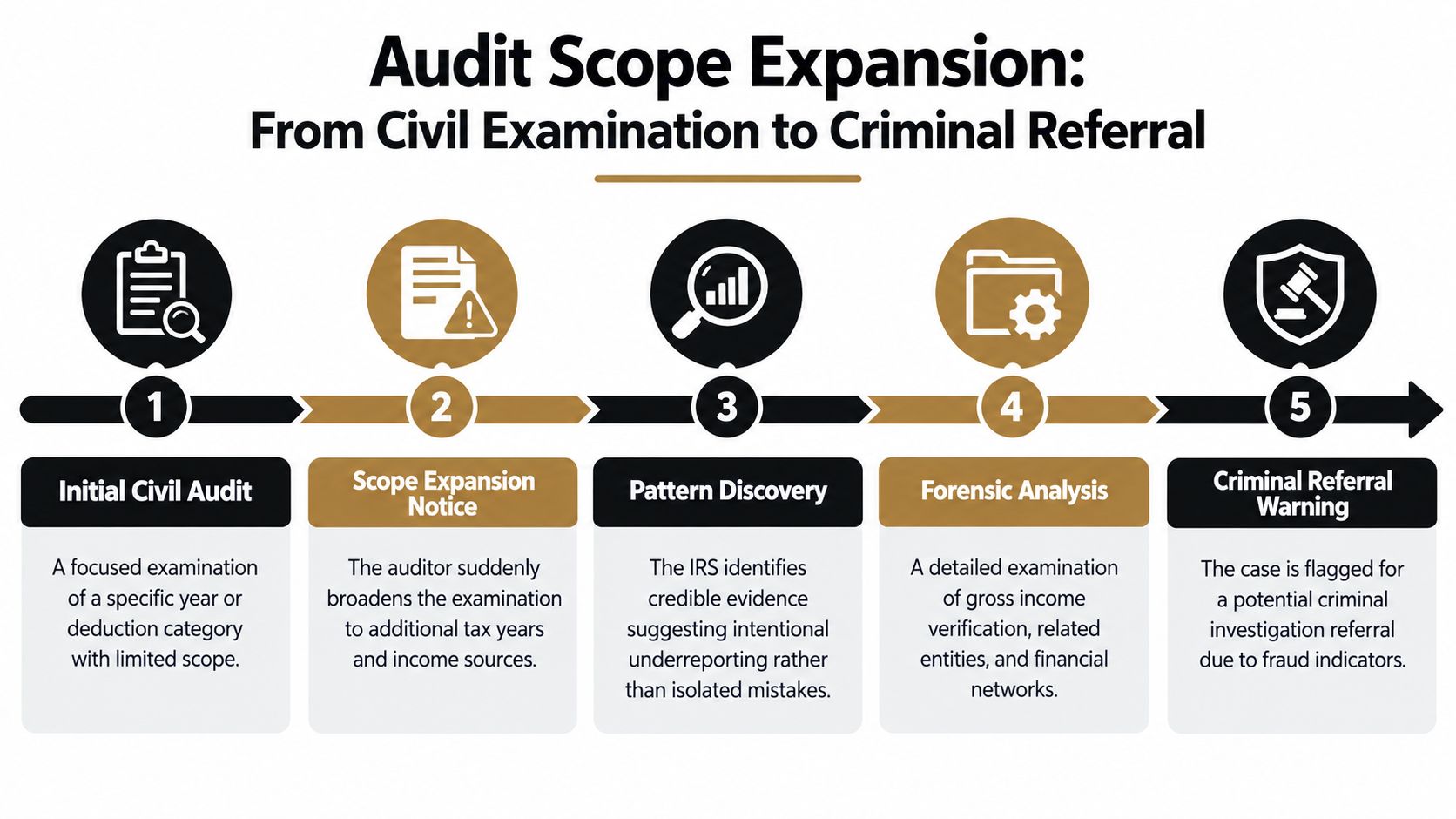
An audit that starts with one issue can broaden quickly. A notice focused on vehicle expenses may lead to questions about gross receipts, bank deposits, owner draws, payroll, related entities, or other tax years. The change may result from routine follow-up, a discrepancy found during the examination, or concern that the original issue reflects a wider pattern.
For example, a sole proprietor may face an income review across several returns after the IRS began by testing deductions. A business examination involving a married couple may expand to their individual returns. These developments do not establish fraud, but they widen the factual and legal exposure. An informal answer can affect issues that were absent from the original notice.

Track every change in scope
Ask the revenue agent to identify new subjects in writing whenever possible. Keep a scope log that records each request, the material supplied, the person who supplied it, and the response date. Counsel can then distinguish a focused examination from an inquiry that is steadily widening.
Do not volunteer unrelated records to demonstrate cooperation. Provide accurate material that you are legally required to provide, while having counsel assess whether an answer could create an admission, waive a protection, or prompt further questions. Taxpayers may have representation during an examination, and IRS interview procedures recognize that a non-summons interview generally must pause when the taxpayer clearly asks to consult an attorney, certified public accountant, enrolled agent, or another authorized representative.
Specialized tax counsel becomes urgent when questions address intent, cash handling, false invoices, altered books, undisclosed accounts, or another person's conduct. Counsel may slow informal cooperation, but uncontrolled explanations can create a record that is difficult to correct. Preserve the scope log and route substantive responses through counsel before the examination reaches those subjects.
4. Involvement of IRS Criminal Investigation Agents
IRS Criminal Investigation involvement is one of the clearest signs that a tax matter may have moved from civil examination toward criminal investigation. CI investigates alleged criminal violations of the tax code and related financial statutes that can lead to prosecution, fines, or imprisonment. The agency may investigate unreported income, false deductions, payroll-tax diversion, or coordinated activity involving related entities.
A business owner questioned about cash receipts, a professional asked about inflated deductions, or a payroll executive questioned about trust-fund taxes should treat the contact as serious. So should a financial adviser asked about transactions involving several clients. Yet even here, the contact doesn't necessarily tell you whether you're a target, subject, or witness.
Don't try to explain your way out
Decline an interview until a qualified criminal tax attorney has advised you. You have the right to remain silent, and counsel can determine whether to provide a response, negotiate the form of an interview, assert a privilege, or communicate through the attorney. Don't contact employees or colleagues to coordinate stories, and don't ask anyone to alter, backdate, or “clean up” records.
The distinction between tax fraud and tax evasion can be legally significant, but internet definitions won't determine how investigators view your particular records or intent. Give counsel the complete facts, including unfavorable ones, so the lawyer can evaluate exposure before deciding how to respond.
A civil tax practitioner may remain valuable for reconstructing books and preparing accurate schedules. When CI is involved, however, that role should be coordinated with criminal tax counsel. The accounting work can establish what happened, while counsel manages interviews, privilege, production strategy, and communications with investigators.
5. Unexplained Compliance Violations and a Pattern of Non-Filing
One missed return can have an explanation. Repeated non-filing, failure to pay required estimated taxes, ignored notices, or continued business activity without correcting compliance problems creates a pattern investigators may examine for willfulness. The risk increases when the records show substantial income, personal distributions, payroll activity, or repeated opportunities to correct the problem.
A contractor who hasn't filed for several years, an owner who files business returns but not personal returns, or an independent worker who ignores repeated notices may attract more scrutiny than someone who made an isolated clerical mistake. The pattern doesn't prove criminal intent. Health problems, a business collapse, reliance on an incompetent preparer, or other circumstances may be relevant, but they should be documented and evaluated rather than improvised into a response.
Correcting the record requires sequencing
Don't rush to file amended or delinquent returns solely to make a discrepancy disappear. A filing can correct a real tax problem, but an inaccurate submission or a rushed explanation can create additional issues. Counsel should evaluate whether a voluntary correction is available, whether an investigation has already begun, and whether communications are privileged. A CPA can help reconstruct returns, while a tax attorney can assess disclosure strategy and criminal exposure.
The IRS reported completing 2,850 investigations in FY2025, including 1,085 legal-source tax-crime cases, 1,195 illegal-source financial-crime cases, and 570 narcotics-related financial-crime cases. The agency also reported that nearly 64% of investigative time was devoted to tax crimes and that cyber-related cases involved approximately 2.35 petabytes of seized digital data (IRS Criminal Investigation compliance presence data). These are agency-wide figures, not a prediction of any individual taxpayer's likelihood of investigation.
Take practical steps without destroying context:
- Collect the history: Locate notices, prior returns, payment records, preparer communications, and explanations for missed filings.
- Separate correction from concealment: Never backdate records or submit a return designed to hide a discrepancy.
- Build future controls: Use filing calendars, payroll reconciliations, tax-payment procedures, and review responsibility.
- Get counsel early: A pattern of non-filing deserves specialized advice before you speak with investigators.
6. A Substantial Discrepancy Between Reported and Actual Income
Income discrepancies become serious when reported figures don't reconcile with independent records. The relevant comparison may involve Forms 1099, W-2 records, merchant statements, bank deposits, payroll filings, books, owner draws, or transfers between related parties. Investigators can compare those sources to identify omitted receipts, duplicated deductions, personal expenses treated as business costs, or deposits that have no documented explanation.
A sole proprietor may report one amount while deposits reflect a different level of activity. A contractor's Forms 1099 may exceed the income shown on a return. A restaurant or service business may have merchant-processor records that don't match its books. Those facts require analysis, not panic. Bank deposits can also include loans, transfers, capital contributions, inheritances, or other non-income items, but the taxpayer needs contemporaneous documentation to establish that explanation.
Reconcile before responding
Create a transaction-level reconciliation with the help of a qualified CPA and counsel. Match sales invoices to deposits, merchant statements to books, payroll filings to wage expense, and related-party transfers to written agreements. Keep the original records and preserve the method used to prepare any reconstruction.
Do not call every unexplained deposit income, and don't call every discrepancy an IRS error. Trace it.
Separate business and personal accounts going forward, but don't move funds merely to make them harder to follow. Document loans, reimbursements, capital contributions, and distributions. If the records are incomplete, say so to counsel rather than creating replacement documents that look contemporaneous.
The practical trade-off is between speed and reliability. A quick spreadsheet may help identify the problem, but it shouldn't become the final explanation without source documents and a defensible methodology. If investigators have already requested records, don't provide a polished narrative before counsel reviews both the narrative and its supporting files. A discrepancy may be innocent, civilly correctable, or evidence in a criminal case. Only a complete reconstruction can help distinguish those possibilities.
7. A Referral to the DOJ or U.S. Attorney's Office
A referral from IRS Criminal Investigation to federal prosecutors marks a major escalation. It means prosecutors may be reviewing the evidence for potential charges, although a referral doesn't guarantee indictment or conviction. The government may still be evaluating whether the facts support prosecution, whether additional evidence is needed, and what resolution is appropriate.
You may learn about this stage through a prosecutor's request, a target letter, a grand jury process, or counsel's communication with the government. A business owner, preparer, executive, or adviser can become involved because of another person's conduct, so don't assume that every person named in the investigation has the same legal status.
Prepare for a prosecutorial decision
Stop treating the matter like an ordinary audit. Route communications through counsel, preserve defense evidence, and avoid public or internal statements that could later be misunderstood. Don't destroy unfavorable documents, pressure employees, contact potential witnesses about their expected testimony, or attempt to negotiate directly with a prosecutor without advice.
Counsel may evaluate whether a voluntary presentation, written response, cooperation, immunity discussion, negotiated resolution, or no response is appropriate. Each option has a cost. Cooperation can provide context and sometimes influence a charging decision, but it can also expose inconsistencies and give investigators additional material. Silence protects against improvised admissions, but it doesn't make a subpoena disappear.
This is also the time to gather mitigation material, such as medical or business records that explain conduct, evidence of reliance on professional advice, payment history, corrective actions, and information about family or community responsibilities. Don't manufacture a favorable story. Organize authentic evidence so counsel can assess what helps, what hurts, and what must be disclosed.
For people facing serious tax debt alongside possible criminal exposure, the question of whether you can be jailed for not paying taxes depends on the facts, conduct, and applicable law. A referral requires a federal criminal tax defense strategy, not just a payment plan discussion.
8. A Target Letter or Grand Jury Subpoena for Personal Appearance
A target letter signals that prosecutors believe substantial evidence connects the recipient to a possible crime. A grand jury subpoena for testimony or documents is also serious, although receiving one does not establish that the recipient is the target. DOJ guidance recognizes that a grand jury witness may be a target, subject, or witness. Specialized tax counsel should determine which status applies before any response.
The inquiry may involve tax evasion, payroll taxes, financial transactions, another business owner, or records held in a professional capacity. A self-employed person asked to testify about a client is not automatically accused of the client's conduct. Testimony under oath still creates significant exposure when answers are inaccurate, incomplete, or inconsistent with records. The same concern applies to documents that appear to contradict earlier explanations.
Never ignore compulsory process
A target letter does not guarantee an indictment, and a witness subpoena is not harmless. Do not appear before a grand jury, produce records, or answer a prosecutor's questions before consulting specialized counsel. Counsel can assess the demand's scope, objections, privilege, immunity issues, and whether seeking a motion to quash or a negotiated modification makes sense. Early advice may limit unnecessary disclosure, but delaying a response can create separate problems.
A formal summons also carries legal consequences. Under IRC §7210, failure to appear or testify after being summoned can result, upon conviction, in a fine of up to $1,000, imprisonment for up to one year, or both, plus prosecution costs (IRS summons enforcement guidance). The penalty does not require blind compliance. Respond through counsel, meet applicable deadlines, and preserve every available legal objection.
Prepare a factual timeline and collect requested records without altering them. Mark facts you do not remember instead of guessing, and let counsel reconcile testimony with the documentary record. Counsel may discuss asserting the Fifth Amendment, seeking immunity, negotiating testimony, or preparing for a possible indictment. The practical objective is preventing a serious legal demand from becoming an uncontrolled personal interview, not making the document disappear.
8-Point Comparison: Signs of a Federal Investigation
| Sign / Indicator | Implementation Complexity 🔄 | Resource Requirements ⚡ | Expected Outcomes 📊 | Ideal Response / Use Case 💡 | Key Advantage ⭐ |
|---|---|---|---|---|---|
| Unannounced IRS Agents Appearing at Your Business or Home | 🔄 High, immediate, coordinated law‑enforcement action with little notice | ⚡ Very high, urgent criminal tax attorney, document control, staff management | 📊 Serious, criminal investigation likely; interviews, records seizure, reputational harm | 💡 When agents arrive unannounced: assert rights, request counsel, limit disclosures | ⭐ Early awareness; opportunity to secure counsel and control interview dynamics |
| Third‑Party Summonses and Document Requests from IRS | 🔄 Moderate, formal summons process involving third parties and subpoenas | ⚡ Moderate, legal coordination with banks, CPAs; possible motions to quash | 📊 Broad evidence collection; scope of inquiry may expand beyond taxpayer | 💡 When banks/CPAs receive notices: coordinate via attorney, preserve documents | ⭐ Potential advance notice and legal avenues to limit scope or challenge requests |
| Examination Expanding Beyond Original Scope | 🔄 Moderate→High, audit broadens to additional years/entities, more complexity | ⚡ Moderate, extended document retrieval, accounting review, counsel involvement | 📊 Increased exposure; higher likelihood of civil penalties and criminal referral | 💡 When audit scope changes: request written explanation, engage tax counsel | ⭐ Chance to identify and address issues early before criminal referral |
| Involvement of IRS Criminal Investigation (CI) Agents | 🔄 Very High, formal criminal procedures, possible arrests, Miranda warnings | ⚡ Very high, specialized criminal defense, forensic accounting, immediate action | 📊 Definitive criminal investigation; prosecution coordination likely | 💡 If CI is involved: do not speak without attorney; invoke Fifth Amendment | ⭐ Clear trigger to mobilize specialized criminal tax defense and strategy |
| Unexplained Tax Compliance Violations and Pattern of Non‑Filing | 🔄 High, multi‑year noncompliance evaluated for willfulness | ⚡ High, prepare delinquent returns, voluntary disclosure, legal mitigation | 📊 Significant civil penalties; elevated criminal risk if willful conduct found | 💡 When multiple years are unfiled: consider voluntary disclosure and counsel | ⭐ Voluntary remediation can mitigate exposure if taken promptly |
| Substantial Discrepancy Between Reported and Actual Income | 🔄 High, forensic financial analysis and transaction tracing expected | ⚡ High, forensic accounting, reconciliation documents, legal defense | 📊 Strong evidence for evasion; substantial tax liabilities, penalties, criminal exposure | 💡 When third‑party records mismatch returns: reconcile records and retain CPA/attorney | ⭐ Early documentation and reconciliation may resolve civilly or reduce severity |
| Referral to DOJ / U.S. Attorney's Office | 🔄 Very High, prosecutor review, grand jury involvement, indictment preparation | ⚡ Very high, federal criminal defense team, litigation readiness, mitigation prep | 📊 Near‑certain progression toward criminal prosecution and indictment | 💡 Upon referral: retain federal criminal tax counsel immediately; avoid statements | ⭐ Final pre‑indictment window to negotiate resolution or cooperation terms |
| Target Letter or Grand Jury Subpoena for Personal Appearance | 🔄 Extreme, grand jury process and compelled personal appearance risk | ⚡ Extreme, immediate specialized defense, preparation for testimony or plea | 📊 Imminent indictment risk; testimony can be used in prosecution; high exposure | 💡 Receipt of target letter/subpoena: do not appear without counsel; evaluate Fifth Amendment | ⭐ Definitive last‑stage warning allowing last‑chance defense strategy and negotiation |
Know When to Stop Explaining and Get Counsel
The safest response depends on the stage, but the first actions are consistent. Preserve emails, accounting files, payroll records, bank statements, devices, and communications. Don't delete, alter, backdate, conceal, or replace records. Record every contact, identify every deadline, and keep notices and envelopes together so counsel can reconstruct how and when the government acted.
Don't volunteer explanations just because an agent sounds informal. Don't consent to a search beyond the legal authority presented, and don't attend an interview without legal advice. A polite request to speak later is usually more useful than a rushed attempt to explain a discrepancy, especially when the government may compare your statement with records obtained from banks, customers, employees, preparers, or business partners.
Businesses need an internal communication plan. Tell employees and contractors to preserve records and direct government inquiries to the designated attorney or responsible contact. Don't coach witnesses or tell staff what their answers should be. A company can protect the process by limiting speculation, preserving data, and ensuring that no one casually deletes messages or changes accounting files.
Use the right professional at the right stage
A CPA or enrolled agent can help reconstruct books, reconcile income, prepare returns, and identify accounting errors. A tax controversy attorney can manage a civil audit, summons response, collection matter, or dispute over scope. When IRS Criminal Investigation is involved, a prosecutor has requested evidence, a grand jury subpoena arrives, or a target letter is delivered, specialized federal criminal tax counsel becomes urgent.
The distinction matters because the same discrepancy can have different consequences depending on timing and intent. A civil correction may be appropriate before a criminal referral, while a rushed amended return after an investigation begins can create new questions. A summons may be valid for civil tax administration, while a grand jury subpoena follows a different investigative pathway. A third-party contact may concern you, another taxpayer, or your role as a witness.
Tax Attorney Stephen A. Weisberg offers a free Tax Debt Analysis as a possible starting point for determining whether and how his practice can help. His practice represents individuals, businesses, and owners dealing with tax debt, audits, and other IRS or state tax problems, and it also addresses matters involving potential criminal charges or complex legal issues. No attorney can promise a particular outcome, but early review can help identify the right response before deadlines pass.
The central rule is simple. Preserve the evidence, limit unscripted communication, respect compulsory deadlines, and obtain advice before the government turns an information request into testimony. Recognizing the signs of being under federal investigation doesn't establish guilt. It gives you a chance to respond deliberately instead of allowing fear, haste, or an improvised explanation to shape the record.
Tax Attorney Stephen A. Weisberg provides a free Tax Debt Analysis and represents individuals, businesses, and professionals dealing with IRS audits, tax debt, and potential criminal tax issues. If you've received an expanding audit request, third-party summons, CI contact, target letter, or grand jury subpoena, visit Tax Attorney Stephen A Weisberg to discuss whether his practice can help and how to respond.


