Set Up Payment Plan Taxes with the IRS Your Guide
Feeling overwhelmed by a tax bill? Learn how to set up payment plan taxes with the IRS. This practical guide covers eligibility, applications, and management.
In this article
- Why an IRS Payment Plan Is a Lifeline
- Understanding Your Options
- IRS Payment Plan Options at a Glance
- Checking Your Eligibility for a Payment Plan
- Individual vs. Business Eligibility
- What Being "Current" Really Means
- Getting Your Documents in Order for a Smooth Application
- Your Essential Information Checklist
- Preparing Your Financial Details
- How to Apply for Your IRS Payment Plan
- Using the Online Payment Agreement Tool
- Applying by Phone or Mail
- Keeping Your Payment Plan on Track
- Don't Forget About Future Taxes
- What Happens If You Can't Make a Payment?
- A Few Common Questions About Tax Payment Plans
- What Happens If the IRS Rejects My Payment Plan Application?
- Do Interest and Penalties Still Add Up on a Payment Plan?
- Can I Set Up a Payment Plan for My State Taxes, Too?
Getting a big tax bill from the IRS can feel overwhelming, but it’s a problem with a solution. If you can't pay it all at once, you can apply to set up payment plan taxes through an IRS Installment Agreement. This is simply a formal arrangement to pay what you owe in manageable monthly chunks, giving you some much-needed breathing room and stopping more aggressive collection actions in their tracks.
Why an IRS Payment Plan Is a Lifeline
Believe me, you're not alone if you're facing a tax bill that seems impossible to pay. It’s a surprisingly common situation. In fact, during the 2023 fiscal year, more than 1.8 million taxpayers got themselves set up on an installment agreement to handle their federal tax debt.
And here’s the good news: the IRS is generally willing to work with you. The acceptance rate for these plans was about 95%, which shows that being proactive really pays off. You can see these numbers for yourself in the IRS 2023 Data Book.
An IRS payment plan is more than just a payment schedule; it's a formal agreement that signals to the IRS you're cooperating. This simple step can halt more severe collection actions like wage garnishments or bank levies, which is a huge relief.
Setting up a plan does a few key things for you:
- Creates a predictable budget: It takes that huge, scary number and breaks it down into monthly payments you can actually manage.
- Reduces stress: Having a concrete plan in place provides immense peace of mind. No more looking over your shoulder.
- Lowers penalties: Once your plan is approved, the IRS typically cuts the failure-to-pay penalty rate in half, from 0.5% down to 0.25% per month.
Understanding Your Options
The IRS isn't a one-size-fits-all agency when it comes to payment plans. They offer two main types, and the right one for you depends entirely on your financial situation. Let's break them down.
A Short-Term Payment Plan gives you up to 180 days to pay your entire balance. It’s a great option if you just need a little extra time to get the funds together.
If you need more time, a Long-Term Installment Agreement is the way to go. This can extend your repayment period for up to 72 months (six years), making the monthly payments much smaller and more sustainable.
To help you decide, here’s a quick comparison of the two main IRS payment plan options.
IRS Payment Plan Options at a Glance
| Feature | Short-Term Payment Plan (Up to 180 Days) | Long-Term Installment Agreement (Over 180 Days) |
|---|---|---|
| Best For | Needing a few extra months to pay in full. | Needing a longer-term, affordable monthly payment. |
| Total Debt | Usually up to $100,000 (combined tax, penalties, and interest). | Generally up to $50,000 for streamlined online applications. |
| Setup Fee | $0. There is no fee to set up this plan online. | Varies. Can be as low as $31 for online setup with direct debit. |
| How to Apply | Online, phone, or mail. The online option is fastest. | Online, phone, or mail. Online is recommended for fastest approval. |
| Benefit | No setup fee and quick resolution of the debt. | Lower, more manageable monthly payments spread over a longer period. |
Choosing the right plan is about being realistic with your budget. The online application is the easiest place to start for most people.
Here’s a look at the official IRS portal where you can begin the application for an Online Payment Agreement.

This screenshot shows you the front door to the Online Payment Agreement tool, which is hands-down the most efficient way to get your plan approved. While an installment agreement is a fantastic tool, keep in mind it’s just one of several ways to handle tax debt. For a complete picture, check out our guide on other tax debt relief options.
Checking Your Eligibility for a Payment Plan
Before you dive into setting up a payment plan, you need to make sure you actually qualify. The IRS has some clear-cut rules, and knowing them upfront can save you a world of frustration and prevent your application from getting rejected right out of the gate.
The biggest hurdle for most people is the total amount they owe. And I don't just mean the tax itself—the IRS looks at the grand total, including all the penalties and interest that have piled up.
To get the smoothest, quickest approval through their online system, that total debt generally needs to be $50,000 or less for a long-term plan. If your bill is higher than that, don't panic. It's still possible to get a plan, but the process gets more complicated. You'll likely have to provide a detailed financial statement, like Form 433-F, to show the IRS you truly can't pay it all off at once.
Another absolute deal-breaker is failing to file your taxes. You must have filed all your required tax returns from previous years. The IRS won't even consider a payment plan if you have unfiled returns hanging out there, even if you couldn't afford to pay what you owed on them.
Individual vs. Business Eligibility
The rules aren't exactly the same for everyone. The IRS has slightly different thresholds for individual taxpayers and businesses.
- For Individuals: If you need just a little more time, you can usually get a short-term plan (up to 180 days) as long as you owe less than $100,000. For a longer-term installment agreement, that $50,000 threshold is the magic number for an easy online application.
- For Businesses: The debt limit for an online agreement is significantly lower, capped at $25,000. If your business owes more, you’ll need to work with the IRS over the phone or by mail, and they'll ask for a lot more financial paperwork.
Key Takeaway: The IRS is all about compliance. Being caught up on filing all your old tax returns is just as critical as the amount you owe. An unfiled return is an immediate roadblock that will stop your application cold.
What Being "Current" Really Means
For most people with a regular W-2 job, being "current" simply means you’ve filed your annual Form 1040 on time.
But if you're a freelancer, consultant, or small business owner, it's a bit more involved. Being current also means you're up-to-date on your quarterly estimated tax payments. If you've been skipping those, it can put your eligibility for a payment plan on past debt in serious jeopardy.
Think of it from the IRS's perspective: a payment plan is a fresh start. They need to see you have a handle on your current obligations so you don't fall right back into the same hole. If your debt is substantial, it’s also a good idea to see if you can get some penalties waived. You can learn more in our guide to the IRS Fresh Start Program, which was designed to help taxpayers in your exact situation.
Getting Your Documents in Order for a Smooth Application
Think of this as your prep work. Before you ever pull up the IRS website or dial their number, taking a little time to gather your information is the single best thing you can do. It’s the difference between a quick, painless process and a frustrating cycle of delays and rejections.
Having everything you need sitting right in front of you transforms this from a stressful ordeal into a straightforward administrative task. Let's walk through exactly what you'll need.
Your Essential Information Checklist
The IRS needs to confirm it's really you and get a snapshot of your current tax situation. It's not just about proving you owe the money; it's about showing them you're organized and serious about paying it back.
Here’s the core information you’ll want on hand:
- Your Personal Details: This is your full name exactly as it appears on your tax return, a current address, and a valid email.
- Taxpayer ID: For most of us, this is your Social Security Number (SSN) or your Individual Taxpayer Identification Number (ITIN) if you have one.
- Date of Birth: A simple but crucial piece of verification info.
- Filing Status: Grab your last tax return and note the filing status you used (like Single or Married Filing Jointly).
- Any Recent IRS Notices: If you have a letter from the IRS, keep it handy. It has the exact balance you owe and specific notice numbers that can really speed things up.
Pro Tip: If your total tax debt is over $50,000, the IRS will want a much deeper look into your finances. You'll have to provide detailed information about your income, living expenses, and assets. You can get a huge head start by checking out our guide on https://www.weisberg.tax/articles/form-433-f-guide-resolving-irs-collection-case-yc4z6-kw2re-h8azc to see exactly what they're going to ask for.
Preparing Your Financial Details
Once the IRS confirms your identity, the next step is figuring out what you can realistically pay. For a simple online agreement, this part is pretty basic. For more complex situations or higher balances, being organized is absolutely critical.
Be ready with the following:
- A Proposed Monthly Payment: Think this through carefully. What can you genuinely afford to pay every single month without fail? The IRS generally expects the full balance to be paid off within 72 months, so keep that timeline in mind.
- Bank Account Information: If you choose a direct debit agreement—which I often recommend because it comes with a lower setup fee—you'll need your bank's routing and account numbers.
For larger balances where you need to submit lots of financial records, some people find that tools for Intelligent Document Processing can help get everything organized efficiently.
Ultimately, having these documents ready shows the IRS you're committed to getting this sorted out. It makes their job easier, which makes the whole process faster and smoother for you.
How to Apply for Your IRS Payment Plan
Once you’ve gathered your documents, you're ready to get the ball rolling and officially apply for a payment plan. The IRS offers three different ways to do this, and the best one for you really depends on your comfort level with technology and the specifics of your tax situation.
We’ll walk through each method, from the super-fast online portal to the more traditional phone and mail routes. My goal is to give you practical, real-world advice to make sure your application is a success, no matter which path you choose.
Using the Online Payment Agreement Tool
For most people, the quickest and easiest way to get an agreement in place is by using the IRS's Online Payment Agreement (OPA) tool. It's a slick, automated system that can give you an answer on the spot if you meet the standard eligibility criteria.
Before you jump in, you’ll need to verify your identity. The IRS uses a secure third-party service for this, typically ID.me. It’s a one-time setup that involves taking a picture of your photo ID with your smartphone or webcam. After you're verified, you can log in, see exactly what you owe, and propose a monthly payment.
To make the online process a breeze, have these details handy:
- Your IRS Notice Number: This is usually on the top right corner of the bill they sent you.
- Proposed Monthly Payment: The number you already calculated that you can comfortably afford each month.
- Bank Account Details: You'll need your routing and account number to set up direct debit payments.
The OPA tool walks you through the entire process. You'll confirm your tax debt and then plug in your proposed payment terms. If your offer is too low to clear the debt within the 72-month timeframe, the system will let you know immediately, so you can tweak the numbers right there. If you're having trouble finding a payment that fits, our IRS payment plan calculator guide is a great resource for modeling different payment scenarios before you even start the application.
This infographic breaks down the essential documents you’ll need, regardless of how you apply.
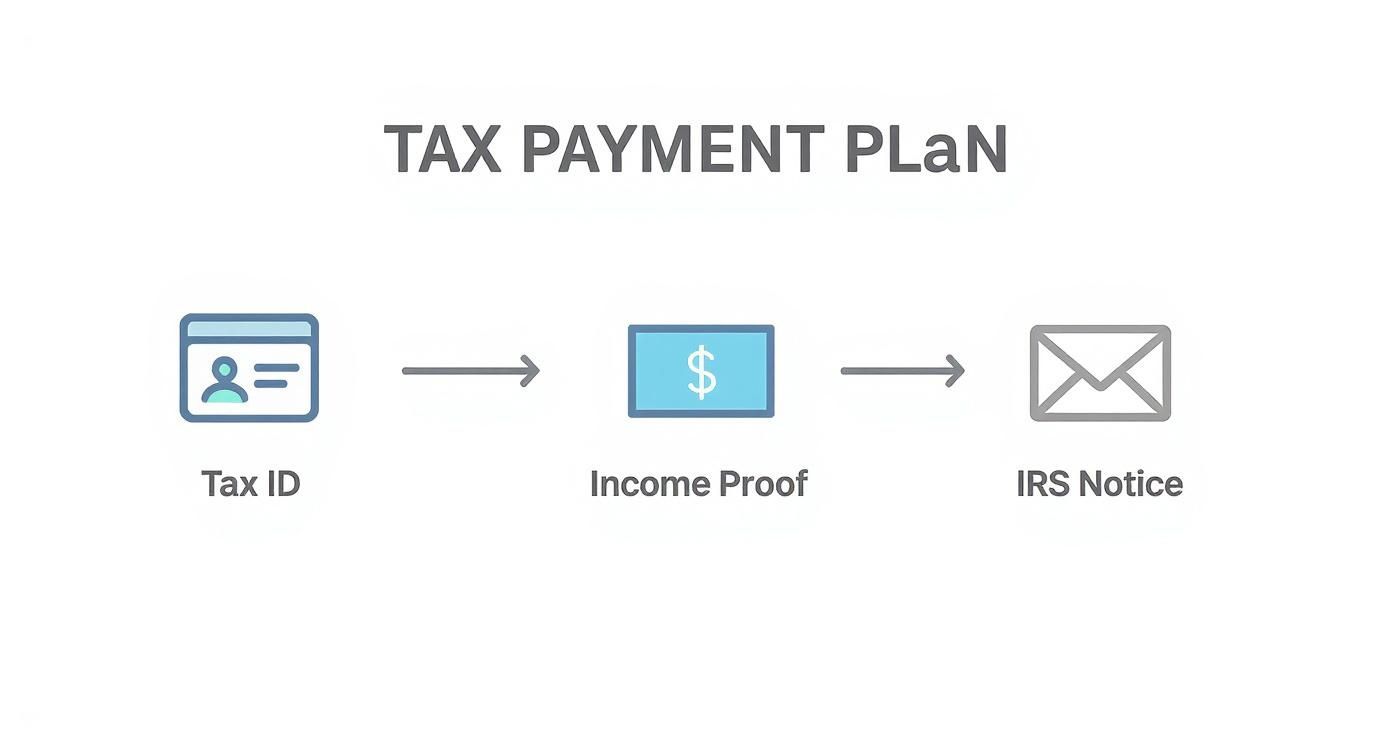
Think of it this way: your application is built on three pillars—proving who you are, showing your financial picture, and referencing the official IRS notice that details your tax debt.
Applying by Phone or Mail
While the online tool is fantastic for straightforward cases, some situations just need a human touch. You might find that applying by phone or mail is a better fit if:
- You owe more than $50,000 in combined tax, penalties, and interest as an individual.
- Your business owes more than $25,000.
- Your financial situation has some unique complexities that an automated system might not understand.
- You're just not comfortable with the online identity verification process.
Applying by Phone
To talk to someone directly, call the IRS at 800-829-1040 for personal tax issues or 800-829-4933 for business tax matters. Make sure you have all your paperwork laid out in front of you before you dial—it will make the call go much smoother. Patience is key here, as wait times can be long, but the upside is getting to speak with a real agent who can answer questions and listen to your story.
Expert Tip: When you get an agent on the line, be polite, clear, and get straight to the point. Tell them you want to set up an installment agreement and have your proposed monthly payment ready. This shows the agent you're prepared and serious about getting this resolved.
Applying by Mail
If you prefer the old-school approach, you can fill out and mail in Form 9465, Installment Agreement Request. You'll send this form along with a copy of your tax bill. Just be aware, this is by far the slowest method. It can take weeks, or sometimes even a couple of months, for the IRS to process a mailed request and get back to you.
The push toward digital isn't just an IRS thing; it's a global trend. The Australian Taxation Office (ATO), for instance, found that around 80% of payment plans were set up online with a massive 92% acceptance rate. This data shows that tax agencies everywhere are finding success in encouraging taxpayers to use these faster, more efficient digital options.
Keeping Your Payment Plan on Track

Getting your IRS installment agreement approved is a huge relief, but it’s really just the first step. The real work begins now: managing your payments month after month and staying on the right side of tax laws. Think of it as a financial commitment that needs consistent attention to finally clear that tax debt for good.
The easiest way to make this happen? Set up automatic payments.
The IRS offers a Direct Debit option, which automatically pulls your payment from your bank account on the same day each month. It's a true "set it and forget it" solution. Not only does this pretty much guarantee you'll never miss a payment, but the IRS often reduces the setup fee for people who choose this method. It's a win-win.
Don't Forget About Future Taxes
This is the number one rule, and it’s where a lot of people stumble. A core condition of any IRS payment plan is staying completely current on all your future tax obligations. The IRS is very strict about this.
So, what does that look like in the real world?
- File on Time: You have to file every future tax return by the deadline, even if you owe money for that year and can't pay it all at once.
- Pay New Tax Bills: Any new taxes you owe must be paid in full and on time. If you start falling behind on a new tax bill, the IRS can—and likely will—default your entire installment agreement.
A classic mistake is getting so hyper-focused on paying off the old debt that you let the current year's taxes slide. To the IRS, this looks like you haven't really changed your habits, and it can land you right back where you started, with collection actions looming.
What Happens If You Can't Make a Payment?
Life is unpredictable. A sudden job loss, a medical bill, or another emergency can pop up and make that monthly payment impossible. If you find yourself in this situation, the absolute worst thing you can do is nothing. Don't just skip the payment and hope they don't notice.
Instead, you need to be proactive. Call the IRS immediately.
Explain your situation. You might be able to get your plan modified, which could mean lowering your monthly payments for a while or even pausing them temporarily. It happens more often than you'd think. For example, tax authorities in the UK found that about 15% of their payment plans were adjusted due to financial changes, which in turn helped cut down on enforcement actions by 25%. You can see more on these trends in the official HMRC tax debt statistics.
By reaching out first, you show the IRS that you’re still serious about paying what you owe, even when things are tough. They are far more willing to work with you if you're open and honest. Staying compliant and communicating is how you successfully navigate your plan and finally close this chapter.
A Few Common Questions About Tax Payment Plans
Even with a clear plan, diving into a tax payment agreement can feel a little intimidating. Let's walk through some of the most common "what if" questions that pop up so you can move forward with a clear head.
What Happens If the IRS Rejects My Payment Plan Application?
Getting a rejection notice in the mail is a gut punch, but it's rarely the final word. The IRS will always send a letter explaining exactly why they said no, and it usually boils down to one of a few predictable issues.
Most of the time, rejections happen because:
- The debt is too high: If you're an individual who owes more than $50,000, you typically can't use the simple, streamlined online application.
- You have unfiled tax returns: This is a big one. The IRS won't even consider a payment plan until all your past-due returns are filed and on record. It's a non-starter for them.
- Something was missing: A simple typo, a missed signature, or incomplete financial information on the application can be enough to trigger an automatic denial.
Don't panic. Read the notice carefully and tackle the specific problem they pointed out. That might mean getting those old returns filed ASAP or pulling together the financial documents they need. From there, you can appeal the decision by filing a Form 9423, Collection Appeal Request, or simply call the number on your rejection letter to talk it through with an agent.
Do Interest and Penalties Still Add Up on a Payment Plan?
Yes, they do. This is a crucial detail to grasp. Getting into an installment agreement is fantastic for stopping more serious collection actions—like a levy on your bank account—but it doesn't hit the pause button on your balance.
Interest will continue to compound on your unpaid debt every single day. But there is some good news. Once your plan is officially in place, the IRS often slashes the failure-to-pay penalty rate in half, dropping it from 0.5% down to 0.25% per month.
My Two Cents: Think of your tax debt like a high-interest credit card. Just making the minimum payment keeps you out of trouble, but it will cost you way more in the long run. It is always, always a smart move to pay more than your minimum monthly payment whenever you can. Every extra dollar chips away at the principal, which saves you a bundle on interest over time.
Can I Set Up a Payment Plan for My State Taxes, Too?
You absolutely can, but you have to remember it's a totally separate ballgame. An IRS payment plan only covers what you owe the federal government. It does nothing for any back taxes you might owe to your state.
Nearly every state has its own version of an installment agreement, but the rules, fees, and application process will be completely different from the IRS. You’ll need to contact your state's department of revenue or taxation directly to sort that out.
Your best first step is to go to your state's official tax agency website. That's where you'll find their specific forms, online payment portals, and the right phone numbers to call to get the ball rolling on a separate plan for your state tax bill.
Trying to figure out tax debt on your own is overwhelming. At Attorney Stephen A Weisberg, I offer a FREE Tax Debt Analysis to see exactly how I can help you solve your problems with the IRS or your state. Get expert guidance and find the best path forward for your situation.


