Self Employed Tax Relief: 2026 Guide to Claims
Discover self employed tax relief programs, eligibility rules, and costly mistakes to avoid. Learn how to lower your tax bill and claim every deduction you
In this article
- What Self-Employment Tax Relief Means
- Start with the business structure
- How Self-Employment Tax Is Calculated
- The calculation, in order
- Deductions That Reduce Your Tax Bill Every Year
- Health insurance and retirement need separate checks
- Treat tip relief as a narrow income-tax provision
- Staying Ahead With Quarterly Estimated Payments
- Build a forecast from the business records
- Pitfalls and Traps That Drain Self-Employed Tax Relief
- Small compliance gaps can create larger problems
- Choosing the Right Entity Structure for Tax Relief
- Compare the tax result with the compliance burden
- Documentation, Checklists, and When to Bring in a Tax Attorney
- Assemble the records in a useful order
- Escalate when the problem is already active
- Putting It All Together for Your Best Tax Outcome
A freelance designer finishes a strong year, then opens a tax return and discovers that the money set aside for rent and payroll won't cover the bill. The income was real, the business expenses were legitimate, but quarterly payments fell behind and no one explained that self-employed taxpayers generally pay both sides of Social Security and Medicare taxes.
Self employed tax relief isn't one program or one magic deduction. It's a sequence: forecast what you'll owe, keep records that support your expenses, claim deductions you qualify for, and check that the return and payment plan match your business structure. This guide is for sole proprietors, independent contractors, single-member LLC owners, multi-member LLC members, and S-corp owners. It covers deductions, estimated payments, entity decisions, documentation, and what to consider if a tax balance or IRS problem already exists. The details differ by structure, and a deduction you can't substantiate may be worth less than the records you failed to keep.
What Self-Employment Tax Relief Means
A contractor finishes a profitable year, sees income reported on a Form 1099, and finds that no employer withheld federal taxes. An owner-operator may instead receive an IRS notice after estimated payments fell short of business income. In either case, identify what can still be corrected and what is already overdue before choosing a remedy.
Relief can describe different tax steps, and they do different jobs. Certain provisions reduce adjusted gross income or taxable income. Estimated payments help prevent an underpayment balance, while retirement and health-insurance deductions may reduce income tax if the taxpayer qualifies. If unpaid taxes have become a collection matter, options may include an installment agreement, an offer in compromise for eligible taxpayers, or a request for penalty abatement. Each has its own requirements. None applies automatically.
Start with the business structure
A sole proprietor and a single-member LLC owner generally report business activity on Schedule C. The LLC also provides a legal structure that can affect obligations beyond income tax reporting. A multi-member LLC generally follows partnership rules. An S-corp owner must handle payroll and distinguish wages from distributions. Those differences affect how income is reported, when payments are due, and what records support the return.
Practical rule: Identify how the income is reported, what tax is due, and which records support your position before looking for deductions.
Forecast, document, claim, then verify. That sequence helps expose problems early, but each business structure has its own pressure points. A sole proprietor may need to distinguish business costs from personal spending. A single-member LLC owner must not assume the LLC changes federal income tax reporting. An S-corp owner needs payroll records that support wages and distributions. A deduction claimed without adequate records can be challenged, even when the expense was legitimate.
Federal relief does not settle state or local tax obligations. Those may involve separate filings and balances. Keep records current whether you prepare the return yourself or hire a professional. If a balance is already overdue, determine whether it is a filing, payment, or collection issue before choosing a resolution. That distinction affects which remedies are available and what documentation you need.
How Self-Employment Tax Is Calculated
A sole proprietor with a strong year can still underestimate the tax bill by treating all net profit as the taxable base, or by counting the same deduction twice. Self-employment tax covers Social Security and Medicare for people with self-employment income. Employees and employers generally split payroll taxes; self-employed taxpayers account for both portions on their returns. The federal framework comes from the Self-Employment Contributions Act of 1954, and the tax supports Social Security and Medicare Part A. Congressional Research Service background on self-employment tax
The calculation generally starts with 92.35% of net profit, not the full amount. After calculating the tax, taxpayers can generally deduct half of the self-employment tax as an adjustment to income. That deduction affects income-tax calculations, not the self-employment-tax base.
The calculation, in order
- Determine net profit. A sole proprietor generally starts with business income minus deductible business costs, reported on Schedule C. Other structures can report income differently, so confirm which rules and forms apply to the business.
- Apply the 92.35% adjustment. This is the starting amount for the self-employment-tax calculation.
- Calculate self-employment tax. Apply the 12.4% Social Security rate up to the annual wage base and the 2.9% Medicare rate. The IRS Schedule SE instructions explain how these rates apply.
- Claim the half-tax deduction when calculating income. It generally reduces adjusted gross income, but doesn't reduce the self-employment-tax base.
Keep those calculations separate. Subtracting half the tax from projected income-tax calculations and then also reducing the self-employment-tax base by that amount understates the bill. The deduction provides income-tax relief; it does not erase the self-employment tax owed.
For example, with $100,000 of net profit, a sole proprietor's self-employment-tax calculation generally begins at $92,350. The taxpayer may then deduct half the calculated self-employment tax in determining adjusted gross income, without changing that starting amount. If the taxpayer expects to owe at least $1,000 after withholding and refundable credits, estimated federal payments generally apply. IRS Form 1040-ES Use the IRS Publication 17 guidance on estimated tax to check the payment rules.
For a comparison with another country's approach, the Everglow Prosperity tax guide covers sole traders. Use it as background only. Its rules do not apply to a U.S. return.
Deductions That Reduce Your Tax Bill Every Year
A deduction can lower income tax without lowering self-employment tax. Treat each one as a separate eligibility decision, then document it before claiming it. The half-self-employment-tax deduction, covered earlier, reduces adjusted gross income; it does not reduce the income used to calculate self-employment tax.
Health insurance and retirement need separate checks
The self-employed health-insurance deduction may cover qualifying premiums for you, your spouse, dependents, and certain qualifying children under age 27. It is generally limited by earned income from the business associated with the coverage. You cannot claim the deduction for any month you were eligible for employer-subsidized coverage through your own job or a spouse's job. Do not deduct the full premium just because you paid it.
Retirement contributions can also reduce taxable income, but the rules depend on the plan, business, employees, compensation, and limits for the tax year. SEP-IRAs, Solo 401(k)s, and SIMPLE plans each have different requirements. A Solo 401(k) is not a personal account with unlimited deductible deposits. Check employee eligibility and calculate contributions under the plan rules before contributing.
Business costs follow different rules from these deductions, yet they still need careful documentation. A home-office claim must meet applicable use and recordkeeping tests. Review the home office deduction requirements before including those costs on your return.
Treat tip relief as a narrow income-tax provision
For tax years 2025 through 2028, eligible employees and self-employed individuals may deduct up to $25,000 of qualified tips, subject to limits. The deduction cannot exceed net income from the business where the tips were earned. It phases out above modified adjusted gross income of $150,000 for single filers and $300,000 for joint filers, and excludes specified service trades or businesses under section 199A. See the IRS information on tax deductions for working Americans.
This is an income-tax deduction, not a cancellation of self-employment tax. Tipped sole proprietors, gig-platform workers, and people with mixed income should confirm their occupation qualifies and keep records of cash and reported tips. Check how business net income and filing status affect eligibility, and follow current IRS guidance on qualifying occupations and reporting transition relief.
Staying Ahead With Quarterly Estimated Payments
A profitable quarter can still leave you short at tax time if you have not set cash aside. Self-employed taxpayers generally must make estimated federal payments when they expect to owe at least $1,000 after withholding and refundable credits. Use the IRS rules on estimated payments and safe-harbor requirements to check whether estimated payments apply to you.
Build a forecast from the business records
Project business profit, not gross deposits. Calculate self-employment tax using the applicable worksheet, include the related deduction when estimating adjusted gross income, and estimate income tax separately. Add state and local estimates where required. The IRS Form 1040-ES worksheet helps taxpayers project income, deductions, credits, and payments.
You generally avoid the underpayment penalty if you pay at least 90% of the current year's tax or 100% of last year's tax (110% if your prior-year adjusted gross income exceeded $150,000), whichever is smaller. Count both withholding and estimated payments toward the applicable test. A spouse's W-2 withholding may also help meet the household payment target, so include it in your calculation rather than looking only at the self-employed taxpayer's estimates.
Don't use a strong year's final profit as your only guide. If income arrives unevenly, flat quarterly payments may not match when you earned it. Ask whether an annualized-income calculation fits your situation before choosing a payment amount.
Use the federal payment schedule and instructions for the current year. Revisit your forecast when contracts, expenses, or income change. A year-end refund does not prove your estimates were calculated correctly, and it is no reason to skip forecasting for next year.
For a practical guide to self-employed quarterly taxes, plan tax payments alongside business expenses. Sole proprietors and single-member LLC owners should base estimates on business profit; S-corp owners should account for both wages and business income when forecasting. Set aside cash as income comes in, then verify the projection during the year. Do not wait until your return is prepared to discover that the business earned more than you can readily pay.
Pitfalls and Traps That Drain Self-Employed Tax Relief
The biggest avoidable losses often come from records and assumptions, not a shortage of possible deductions. A legitimate business expense can be challenged if personal and business spending are mixed together and the taxpayer can't show what the purchase was for. Use a separate business account where practical, reconcile statements regularly, and keep receipts or other records that explain the business purpose.
A home-office deduction also requires more than a desk near the kitchen. The space must satisfy the applicable business-use tests, including exclusive and regular use where required. Record the space and how it's used before claiming related costs. The rules are not a reason to avoid a valid deduction, but they are a reason to document it.
Small compliance gaps can create larger problems
- Subcontractor reporting: Don't overlook information-reporting duties when you pay contractors. Reporting thresholds and exceptions depend on the payment and the current rules, so check the applicable IRS instructions rather than relying on an old rule of thumb.
- Sales tax: A federal income-tax filing doesn't settle state or local sales-tax obligations. If you sell products or taxable services, confirm where registration, collection, and filing are required.
- Extensions: Filing an extension generally gives additional time to file, not additional time to pay. Estimate and pay what you can by the original payment deadline, then reconcile the balance when the return is ready.
- Strong years: Don't stop making estimates just because you expect business to slow later. A forecast should use current income and applicable rules, not wishful thinking about next year.
S-corp owners face a separate danger when payroll taxes go unpaid. The IRS may assess the trust fund recovery penalty against a person it determines was responsible for collecting, accounting for, or paying trust-fund taxes and willfully failed to do so. Resolving a company's underlying balance doesn't automatically remove an individual penalty assessment. Get advice promptly if the IRS is investigating responsibility or has issued an assessment.
A deduction you can't support is not dependable relief. The value of a tax position depends on both eligibility and records that can withstand questions later.
Choosing the Right Entity Structure for Tax Relief
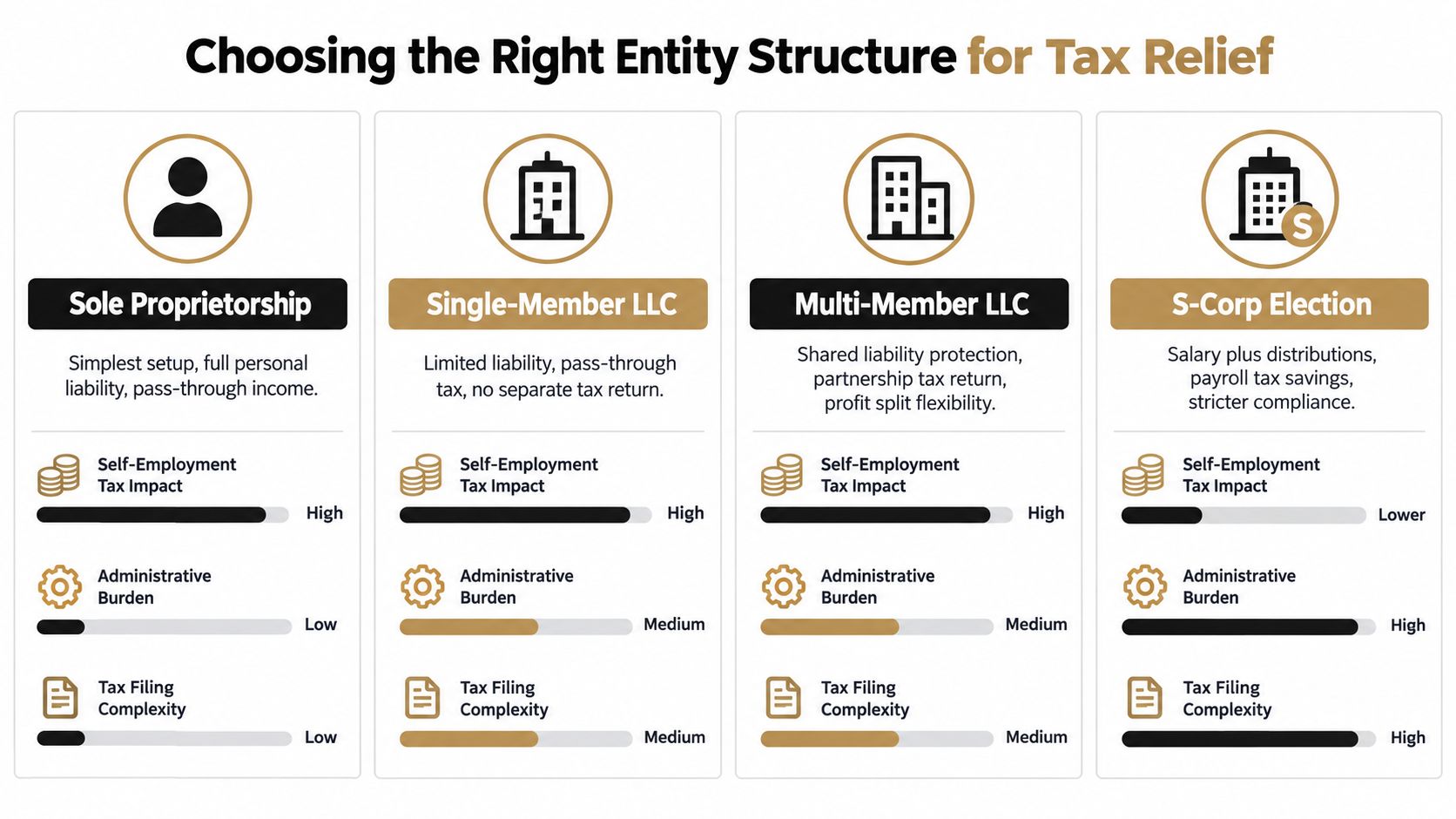
Entity choice affects how business income is reported, how payroll taxes are handled, and what records the owner must keep. It doesn't create a universal tax-saving result. Compare the structure's ongoing costs and compliance duties with the actual income and work the business produces.
| Structure | Typical federal treatment | Tax-relief consideration |
|---|---|---|
| Sole proprietorship | Business income is generally reported by the owner on Schedule C. | The owner generally pays self-employment tax on qualifying net earnings and may claim deductions when eligible. |
| Single-member LLC | Usually treated like a sole proprietorship for federal income-tax purposes unless an election changes its treatment. | The LLC alone doesn't erase self-employment tax; the owner's tax treatment generally resembles a sole proprietor's. |
| Multi-member LLC | Generally taxed as a partnership, with business results reported to members. | Members need to review how their share is reported and whether it is subject to self-employment tax. |
| S-corp election | The owner may receive wages and pass-through income, with payroll and corporate filing requirements. | Salary must be reasonable for the services performed. Distributions aren't a substitute for appropriate wages. |
Compare the tax result with the compliance burden
Use the same $100,000 net-profit illustration from the calculation discussion as a starting point for modeling, not as a promised savings estimate. A sole proprietor or default single-member LLC owner generally reports the business profit under the applicable individual-business rules. A multi-member LLC requires a partnership-level analysis and a member-level review. An S-corp calculation must account for reasonable wages, payroll taxes, expenses, and pass-through income before anyone can compare the after-tax result.
An S-corp election can change the way income is exposed to employment taxes, but it adds payroll, filings, and compliance responsibilities. If owner wages are set too low, the IRS may challenge the treatment and reclassify distributions. Don't elect S-corp status based on a rough calculation that ignores payroll costs and the owner's actual duties. A change in entity structure should be modeled against the full return, not just one tax line.
For owners considering a change in corporate status, the founder's 2026 entity switch guide offers context on a related conversion question. The right choice still depends on the business's own facts, election eligibility, and filing obligations. Review the situations when an S-corp may not be a good idea before treating the election as an automatic tax break.
Documentation, Checklists, and When to Bring in a Tax Attorney
Organize evidence before you prepare the return or respond to a notice. A clean file makes it easier to claim eligible deductions, explain differences between reported income and deposits, and identify what the IRS or state agency is asking you to do.
Assemble the records in a useful order
- Income: Gather Forms 1099-NEC and 1099-K, K-1s, invoices, payment-platform statements, and records of cash receipts. Reconcile reported income against your books and bank deposits.
- Expenses: Keep receipts, mileage logs, bank and credit-card statements, and notes explaining the business purpose of significant purchases. Mark personal charges separately rather than trying to reconstruct them later.
- Entity and payroll: Collect the operating agreement, S-corp election and acceptance records if applicable, payroll reports, payroll-tax filings, and wage records. Make sure the books agree with what was filed.
- Tax history: Include prior-year returns, payment confirmations, IRS and state notices, and correspondence about audits or collections.
For a broader record-gathering list, use this small-business tax checklist. It can help you spot missing records before filing, but it doesn't replace the rules that apply to your business or tax year.
| Relief Provision | What It Reduces | Key Eligibility Limit | Common Trap |
|---|---|---|---|
| Half-self-employment-tax deduction | Adjusted gross income for federal income-tax purposes | Generally tied to self-employment tax calculated on qualifying earnings | Treating it as a reduction of the self-employment-tax base |
| Self-employed health-insurance deduction | Income used to calculate federal income tax | Coverage, earned-income limits, and other eligibility rules apply | Claiming premiums without checking other coverage or business-income limits |
| Retirement-plan contributions | Taxable income, when plan rules permit a deduction | Plan-specific eligibility and contribution rules | Making a contribution without confirming the correct limit or employee eligibility |
| Qualified-tip deduction | Federal income-taxable income | Occupation, net-income, filing-status, and phaseout rules apply | Assuming it cancels self-employment tax or applies to every type of tip income |
| Payment or collection resolution | Collection terms or, if eligible, the amount owed | IRS approval and case-specific financial and compliance requirements | Applying for a resolution without addressing current filing and payment duties |
Escalate when the problem is already active
An open audit, payroll-tax balance, multi-state filing problem, or trust fund recovery penalty assessment is a strong reason to consult a tax controversy professional. A taxpayer facing a balance they can't pay under a realistic payment schedule should also get advice before responding to collection notices. Depending on the facts, tools may include audit representation, an installment agreement, penalty abatement, or an offer in compromise for taxpayers who meet the requirements. A currently-not-collectible status may be relevant in some cases, but it doesn't erase the debt.
A tax attorney can also assess whether reasonable-cause relief or another defense fits the circumstances. Don't assume that an offer in compromise is available just because the balance feels unaffordable, or that filing a request pauses every collection action. For anyone facing substantial exposure or a deadline, Tax Attorney Stephen A Weisberg offers a free Tax Debt Analysis to review the balance, the available facts, and whether professional representation is warranted. It's a practical first step when you don't yet know whether the right move is a payment plan, a dispute, or a clean do-it-yourself filing.
Putting It All Together for Your Best Tax Outcome
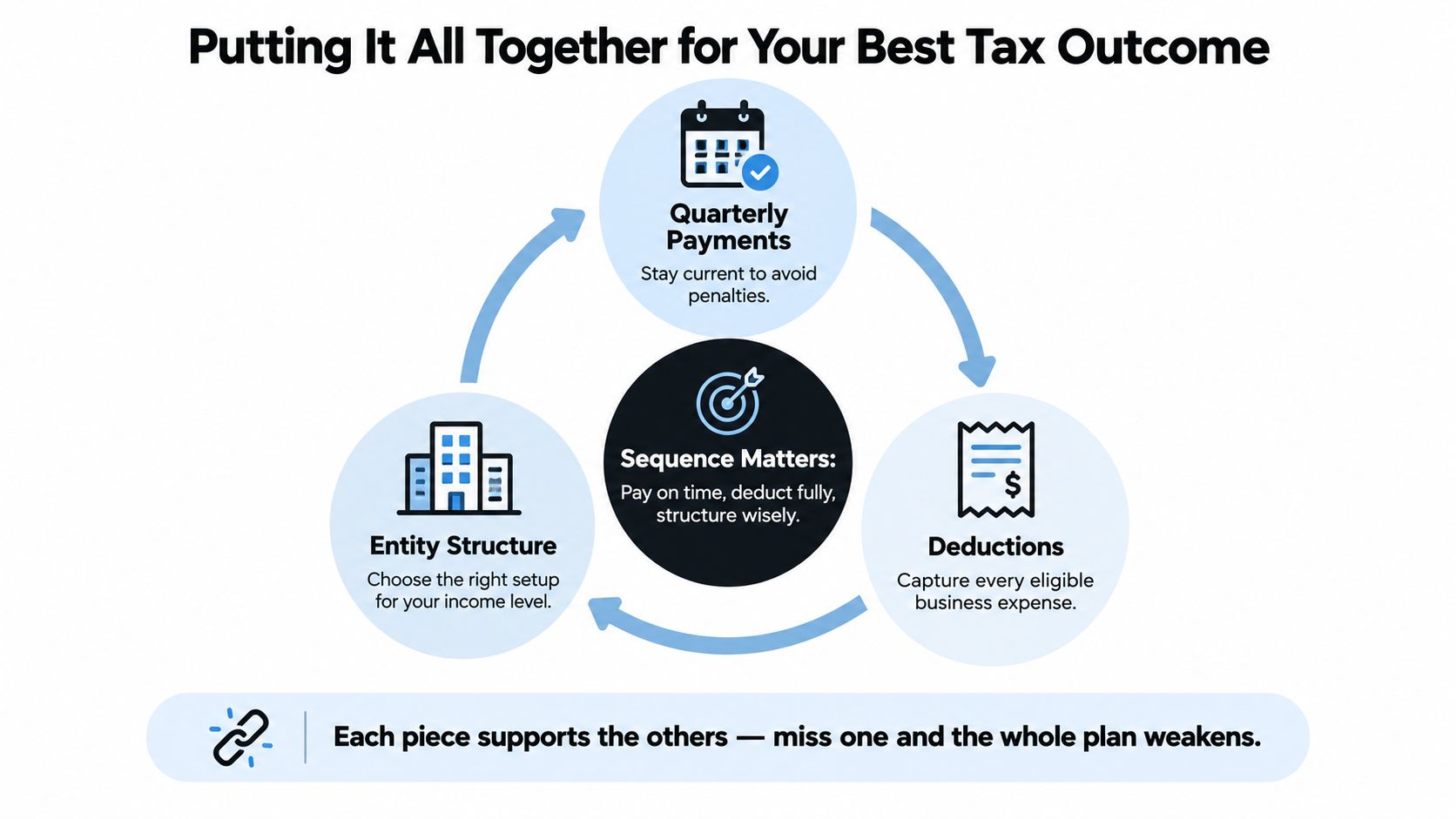
Good self employed tax relief follows a sequence: forecast payments, document income and expenses, claim deductions you qualify for, and verify the return and notices. The IRS administers the rules; it doesn't plan your cash flow or choose your entity for you. If an audit, payroll balance, or collection notice has made the next move unclear, request a free Tax Debt Analysis to determine whether representation can help or whether a well-documented filing is enough.
Tax Attorney Stephen A Weisberg represents individuals and business owners dealing with IRS and state tax debt, audits, and related disputes, and begins with a free Tax Debt Analysis to assess the situation before recommending paid representation. If you're facing a self-employed tax balance or aren't sure whether your deductions and payment plan are on solid ground, visit Tax Attorney Stephen A Weisberg to request an assessment.


