Seizures of Property: Your Complete Guide to Tax Levies
Understand seizures of property in tax cases. Learn what gets seized, how the process works, defenses available, and how to prevent or reverse an IRS seizure.

In this article
- Why a Seizure Is Rarely the First Serious Problem
- The earlier pressure points
- What Seizures of Property Actually Mean Under U.S. Tax Law
- What can be reached
- How the IRS Seizure and Sale Process Unfolds Step by Step
- The sequence matters
- Who Gets Hit and How the Scenarios Actually Look
- Three practical profiles
- Defenses and Remedies That Can Stop or Reverse a Seizure
- Match the tool to the moment
- Administrative relief versus litigation
- How to Prevent a Seizure Before It Ever Happens
- A working prevention checklist
- Your Client-Ready Seizure Prevention Checklist
- Immediate actions today
- Short-term steps within 30 to 90 days
- Emergency response if a notice arrives
The most popular advice about seizures of property starts in the wrong place. Taxpayers usually ask whether the IRS will take their home, car, or business equipment, but that physical seizure is rarely the first serious event. By the time the IRS is considering a forced sale, earlier collection tools may already have created significant damage, including liens, levies, blocked accounts, and pressure on business cash flow.
The right question isn't, “Will the IRS take my property tomorrow?” It's, “Where is my account in the collection process, and what action stops the next step?” That distinction matters for taxpayers, business owners, and CPAs trying to protect a client before a manageable tax debt becomes an enforcement crisis.
Why a Seizure Is Rarely the First Serious Problem
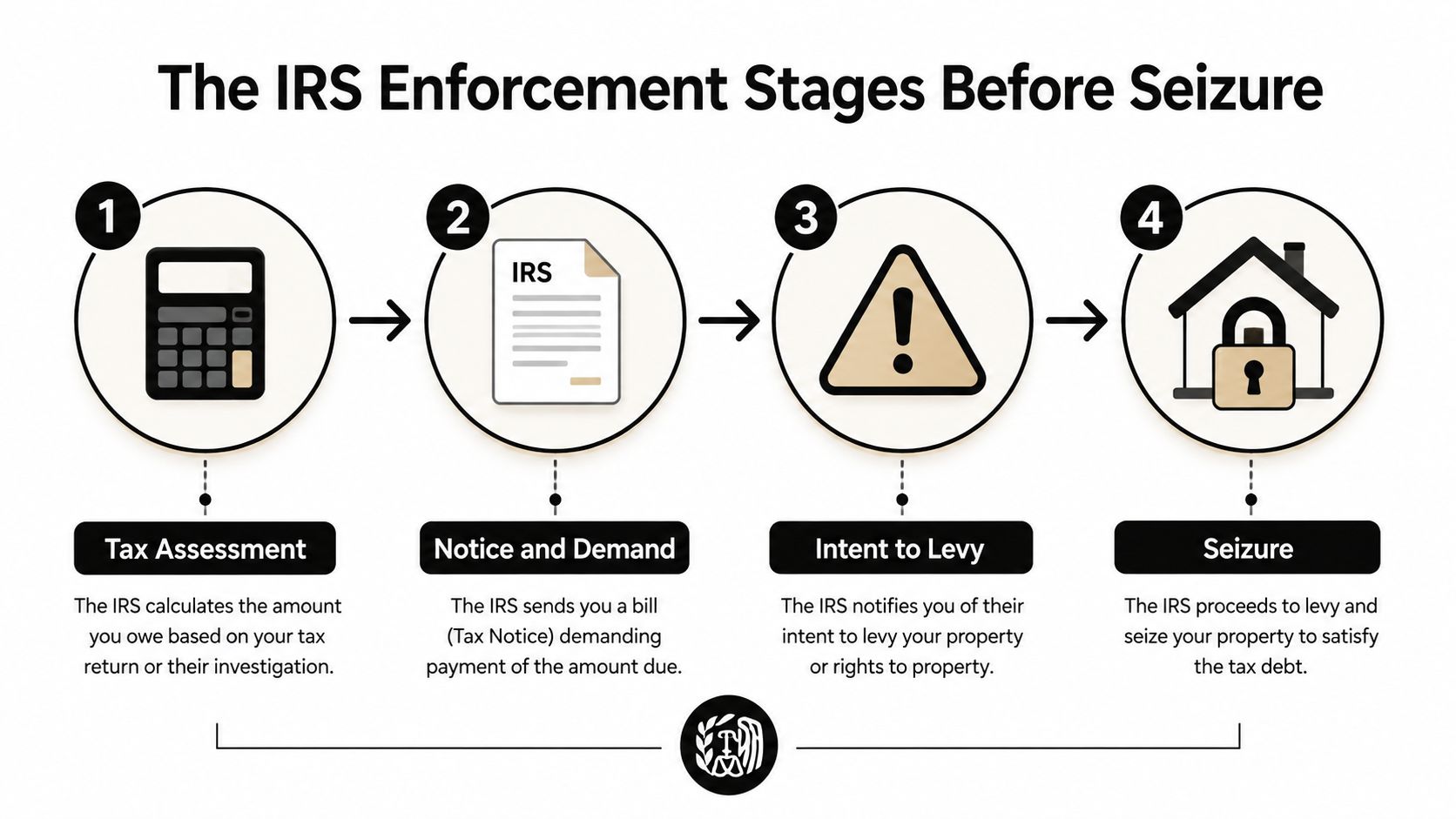
A tax debt rarely leads directly to an agent taking a vehicle or entering a home. The IRS usually proceeds through assessment, notices, a demand for payment, collection warnings, and an opportunity to challenge a proposed levy before it considers taking and selling property. State tax agencies often follow similar notice and demand procedures, but their deadlines, exemptions, and appeal rights differ.
The bigger danger is delay. A taxpayer may ignore several notices because no one has taken anything physically, while the government builds the legal and administrative basis for stronger collection action. A federal tax lien can complicate transactions and financing. A levy can reach money before a taxpayer ever sees an enforcement officer.
The earlier pressure points
For most taxpayers, the immediate risks are:
- Bank and receivables levies: The IRS can intercept funds held by a bank, customer, tenant, or another third party.
- Filing and payment problems: Missing returns, unpaid current taxes, or a defaulted installment agreement can make a resolution proposal harder to maintain.
- Notice deadlines: A Final Notice of Intent to Levy and Notice of Your Right to a Hearing can create a limited window to request a Collection Due Process hearing.
- Business disruption: A levy on operating cash can stop payroll, inventory purchases, rent payments, and ordinary expenses.
IRS collection data shows why physical seizures should not dominate the analysis. In fiscal year 2025, the IRS reported 50 physical seizures, compared with 214,099 federal tax lien notices and 339,137 levy notices, as summarized by Ledgerism's IRS collections enforcement report. Physical taking is a rare endpoint. Notices, liens, and levies create pressure much earlier.
Practical rule: Treat every collection notice as a deadline problem, not as ordinary correspondence.
Verify the balance, missing returns, notice history, active levies, and any proposed levy date first. If you advise a client, obtain transcripts and account records before recommending a payment plan or submitting financial information. The goal is to identify the next enforcement action while a practical way to stop it remains available.
What Seizures of Property Actually Mean Under U.S. Tax Law
A federal tax levy is the government's legal seizure of property or property rights to satisfy a tax debt. Under federal tax collection rules, the levy can reach wages, bank accounts, vehicles, real estate, and other personal property, as described by the Taxpayer Advocate Service guidance on levy and seizure of assets. The IRS isn't limited to items sitting in a taxpayer's home. It can pursue money or rights held by employers, banks, customers, tenants, and other third parties.
A levy also isn't the same thing as a lien. A lien generally secures the government's claim against property. A levy uses that claim to obtain property or its value. The taxpayer's ownership interest still matters, as do competing liens, exemptions, state-law rights, and claims from people who aren't responsible for the tax.
What can be reached
The IRS may pursue several categories of property:
- Income and cash: Wages, salaries, commissions, bank deposits, dividends, and securities can fall within the collection process.
- Business assets: Accounts receivable, inventory, equipment, and operating funds may be vulnerable when a business owes tax.
- Real and personal property: Vehicles, land, buildings, and other assets may be considered if they have meaningful equity and aren't protected by an applicable exemption.
- Rights held by others: A bank or employer may receive a levy notice and be required to hold or pay over property belonging to the taxpayer.
The legal analysis becomes more complicated when the taxpayer doesn't own the entire asset. Joint accounts, trust assets, retirement funds, protected benefits, and property titled to a third party require tracing and documentation. An exempt source can also become difficult to identify after funds are mixed with other money.
The Internal Revenue Code provisions on levy authority matter because a levy generally reaches property possessed, and obligations existing, at the time of levy. That means timing can affect what the IRS can collect from a particular account or payment stream. A professional should review title, source of funds, equity, and the taxpayer's actual legal interest before assuming that every asset is available.
For a plain-English explanation of the distinction between a lien and a levy, see what an IRS levy means. Calling something a “seizure” doesn't answer the central legal questions. It may describe a levy on money, a physical taking, or a later sale process, and each situation requires a different response.
How the IRS Seizure and Sale Process Unfolds Step by Step
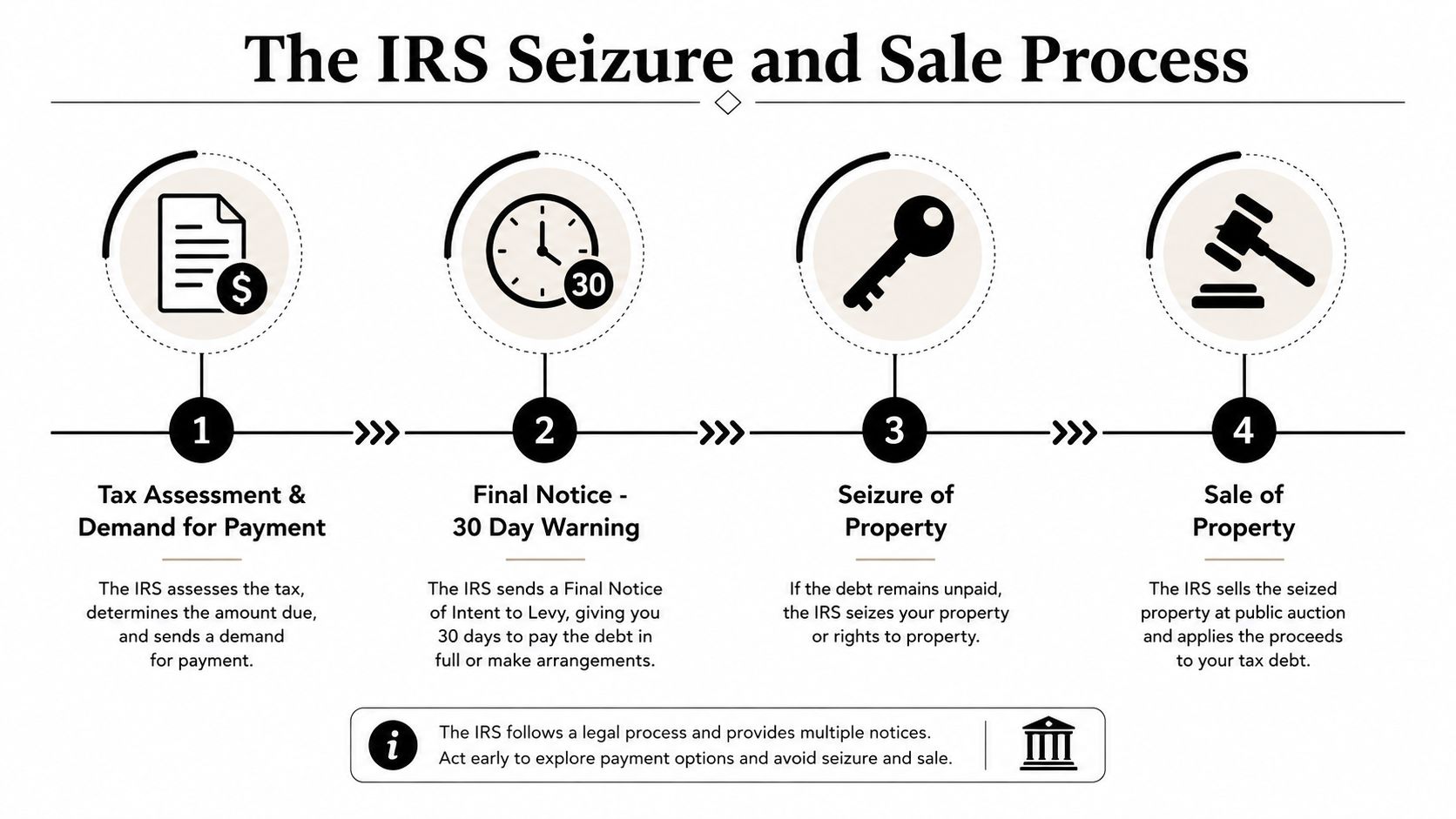
The IRS doesn't generally begin with an auction. The process usually starts with an assessed tax and a statutory notice and demand for payment. Treasury Regulation § 301.6331-2 explains that the IRS ordinarily waits at least 30 days after notice and demand before serving a levy, subject to exceptions.
Before a levy, the IRS generally sends a Final Notice of Intent to Levy and Notice of Your Right to a Hearing. That notice ordinarily provides at least 30 days before levy action, unless an exception applies. The taxpayer can request a Collection Due Process hearing, and a timely request can suspend levy activity while Appeals reviews collection alternatives and certain liability issues.
The sequence matters
- Assessment and demand: The IRS establishes the liability and sends a demand for payment.
- Final levy notice: The taxpayer receives a formal warning and hearing rights.
- Levy or seizure: The IRS identifies property or property rights and takes legal control.
- Sale and application of proceeds: The property may be sold, with proceeds applied to the tax debt and authorized costs.
A taxpayer may also pursue an installment agreement, an Offer in Compromise, innocent-spouse relief, or currently not collectible status. Those options don't automatically stop every levy, particularly when the account is legally ready for enforcement. The taxpayer must match the remedy to the notice and act before the deadline.
After seizure, the IRS may inventory and secure the property, arrange transportation, and issue a notice of sale. The federal sale regulation requires written notice to the owner as soon as practicable after seizure and publication in a county newspaper of general circulation. The regulation also addresses the sale notice period, including special treatment for property that can quickly decline in value.
Claims may be filed before sale. Administrative guidance states that after sale, the claim deadline is generally 2 years from the seizure notice date, as explained in the Taxpayer Advocate Service's guidance on recovering seized property. Because the same source has already been used above, treat this as a reminder of the deadline, not a new rule. Ownership, equity, third-party claims, and exemptions should be investigated before sale, when the available options are usually broader.
For the notice stage, taxpayers should review the IRS Notice of Intent to Levy process immediately. State procedures can differ, so identify the issuing agency before relying on federal timing.
Who Gets Hit and How the Scenarios Actually Look
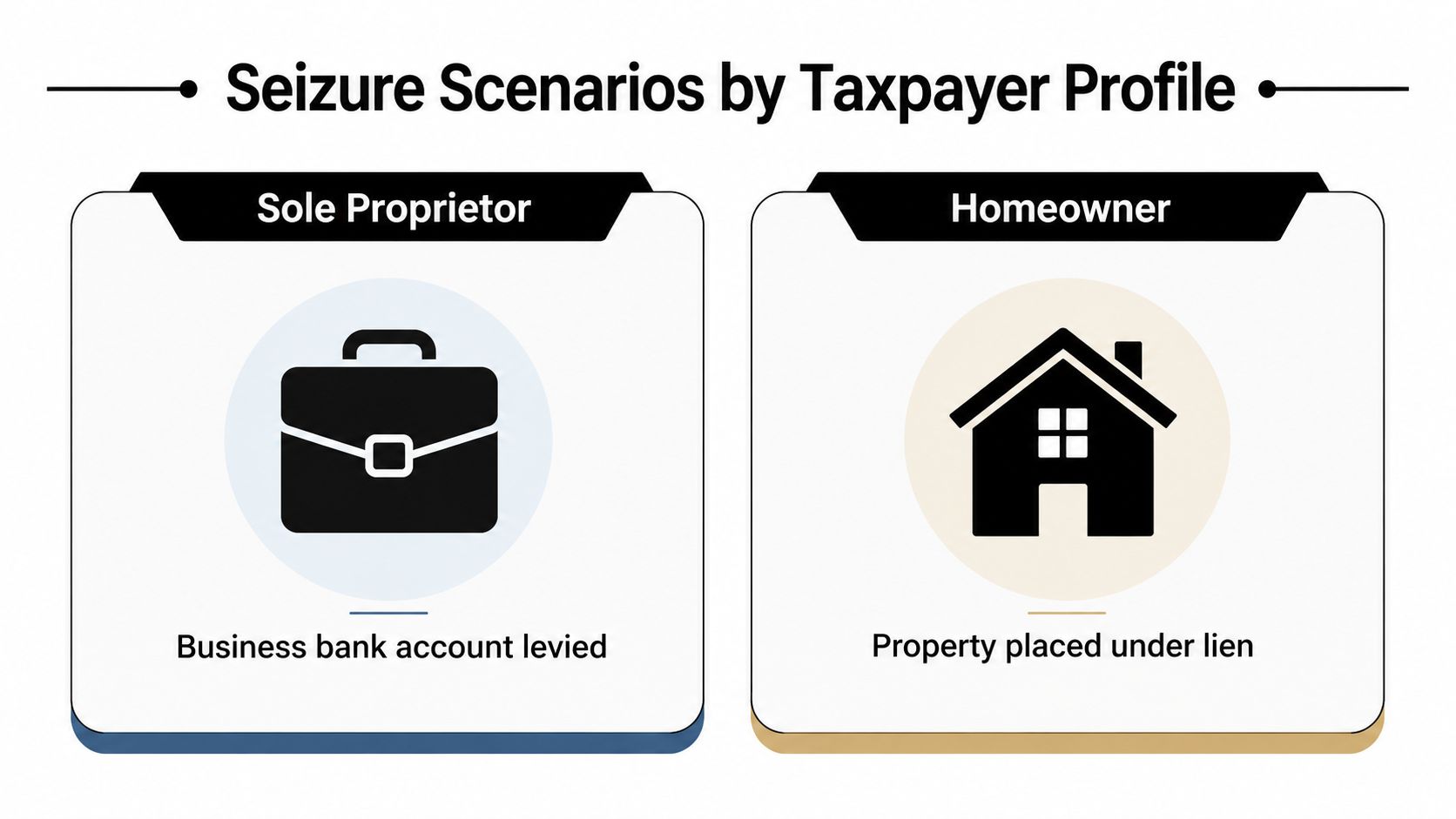
A sole proprietor can face a levy that looks nothing like the dramatic seizure people imagine. Suppose the owner operates through a personal bank account and falls behind on assessed taxes. The IRS may serve the bank, freeze available funds, and apply them under the levy rules. The business owner may still have tools available, but the immediate problem is operational cash, not a government truck removing equipment.
Three practical profiles
The sole proprietor: This taxpayer's personal and business finances often overlap. A bank account levy can interrupt ordinary operations, and a customer levy can redirect receivables. Separate accounts, accurate books, and prompt review of the levy notice can help establish which funds belong to the business, the taxpayer, or someone else. More detail appears in the guide to IRS levies on bank accounts.
The small business owner: The government may view accounts receivable, inventory, equipment, and vehicles as potential collection sources. A levy on receivables can force customers to pay the IRS instead of the business. Inventory and equipment become more vulnerable when the account remains unresolved, returns are missing, or prior agreements have failed.
The wage earner and homeowner: Regular wages may be levied before the IRS considers selling a home. If a residence or vehicle becomes the only meaningful non-exempt asset, the government may analyze equity, ownership, liens, and sale practicality. A lien against property isn't the same as an immediate sale, but it can complicate refinancing, closing, or transfer.
The selection process is not random. Liquid money and easily valued assets usually create more practical collection value than property that is expensive to maintain or difficult to sell. That's why a taxpayer should disclose all assets accurately while also documenting exemptions, ownership interests, existing liens, and the funds needed for basic living or business operations.
Defenses and Remedies That Can Stop or Reverse a Seizure
Speed matters more than elegant arguments. The best remedy is usually the one that prevents the levy or seizure from happening, not the one filed after property has been sold. A taxpayer should identify the notice, calculate the deadline, and choose a remedy based on urgency, eligibility, and the account's compliance status.
Match the tool to the moment
| Remedy | Typical Timeline | Best Use Case |
|---|---|---|
| Collection Due Process hearing | Before the levy deadline | A taxpayer needs to challenge the proposed action or present a collection alternative |
| IRS Appeals review | During or after administrative review | The taxpayer disputes the collection decision or wants independent administrative consideration |
| Installment agreement | Before or after collection pressure begins | The taxpayer can pay over time and remain current with filing and payment obligations |
| Offer in Compromise | Usually slower than an immediate levy response | The taxpayer may qualify to settle for less than the full liability based on the applicable financial and legal standards |
| Currently not collectible status | When payment would create financial hardship | The taxpayer lacks the ability to pay while preserving basic living needs |
| Innocent-spouse relief | When a joint liability should not fairly attach to one spouse | One spouse seeks relief from all or part of a joint tax liability |
| Bankruptcy stay | Depends on the bankruptcy filing and tax facts | A broader insolvency case may temporarily restrict collection, subject to important tax-law exceptions |
| Wrongful seizure claim or suit | After an improper seizure or unauthorized collection conduct | The taxpayer or an affected third party seeks administrative relief or damages where the statutory requirements are met |
A timely Collection Due Process request is often the strongest pre-seizure tool because it can pause levy activity while Appeals considers the case. It won't erase the liability, and the taxpayer still needs a credible proposal supported by accurate financial information.
Administrative relief versus litigation
An IRS appeal, payment agreement, or Offer in Compromise addresses collection through administrative channels. A Tax Court petition may be appropriate in specific circumstances, especially when the taxpayer receives a determination that creates a petition right. It isn't a universal substitute for responding to a levy notice.
After a sale, options narrow. A claim involving ownership or wrongful seizure may still exist, but the taxpayer shouldn't assume that a completed auction can be easily undone. The IRS levy release options provide a starting point for evaluating whether payment, an agreement, hardship, or procedural grounds support release.
Urgency beats volume: A short, well-supported request filed before the deadline is more useful than a long explanation submitted after property has been sold.
Bankruptcy attorneys, CPAs, and enrolled agents should coordinate carefully. A proposed solution that ignores unfiled returns, current payroll obligations, or inaccurate asset values can fail even when the taxpayer has a legitimate hardship.
How to Prevent a Seizure Before It Ever Happens
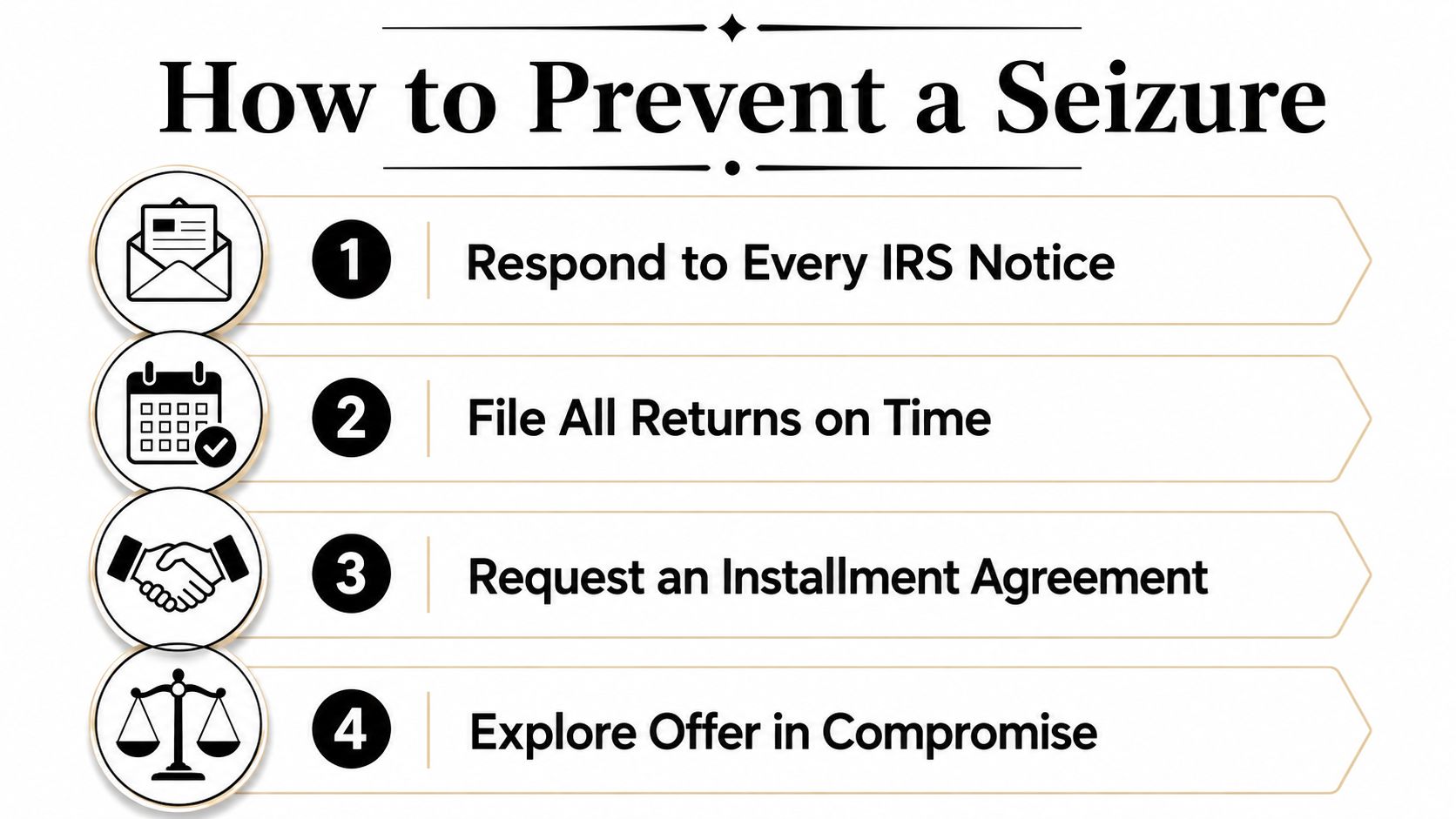
Prevention is cheaper and more effective than trying to recover property after a levy. The first step is simple, but taxpayers routinely skip it: open every IRS notice, identify the notice date, and record the response deadline. Don't rely on a voicemail, a vague online account message, or memory.
A working prevention checklist
- Bring filings current: File every required return, even if full payment isn't available. Unfiled returns make the balance uncertain and can block meaningful collection analysis.
- Verify the account: Compare IRS transcripts, filed returns, payments, penalties, and interest. Never negotiate from an assumed balance.
- Protect cash flow lawfully: Separate business and personal accounts, maintain clean bookkeeping, and document funds that belong to employees, partners, clients, or other third parties.
- Choose a realistic payment path: Evaluate an installment agreement, currently not collectible status, or an Offer in Compromise against the taxpayer's actual income, expenses, equity, and compliance record.
- Use hearing rights early: If a Notice of Intent to Levy arrives, calendar the Collection Due Process deadline immediately. Waiting until the proposed levy date can eliminate the most useful procedural advantages.
- Keep asset records: Maintain titles, loan statements, purchase records, trust documents, and evidence of exempt or third-party ownership. Tracing is far easier before accounts are frozen.
A payroll taxpayer should review withholding and estimated payments so a new liability doesn't replace the old one. A business owner should address payroll tax deposits first because ongoing noncompliance can undermine any collection proposal. A CPA should escalate the file when a client receives a Final Notice, not after the bank account has already been levied.
Don't transfer assets casually or hide money. That can create new legal problems and weaken credibility. Prevention means organized records, timely filings, a defensible proposal, and a professional response before the government reaches for a collection instrument.
Your Client-Ready Seizure Prevention Checklist
Use this as a working document with a client. Check each item, assign an owner, and put every deadline on a calendar.
Immediate actions today
- Open every notice: Record the notice number, tax periods, date issued, balance, and response deadline.
- Confirm filing status: List all filed returns, unfiled returns, extensions, and pending adjustments.
- Check collection activity: Determine whether a lien, bank levy, wage levy, or proposed levy is active.
- Preserve ownership records: Gather titles, loan statements, account statements, trust documents, and proof of third-party funds.
- Name the decision-maker: Record the taxpayer's phone number, CPA or enrolled agent, attorney, and authorized representative status.
Short-term steps within 30 to 90 days
- Clean up missing returns: File accurate returns and resolve discrepancies before proposing payment relief.
- Build the financial picture: Document income, necessary expenses, equity, debts, business cash flow, and available funds.
- Select the right resolution: Compare an installment agreement, currently not collectible status, Offer in Compromise, innocent-spouse relief, or another applicable remedy.
- Calendar hearing rights: If a Collection Due Process deadline applies, enter it in multiple calendars and prepare the request before the deadline.
- Prevent recurrence: Adjust withholding, estimated payments, payroll deposits, and bookkeeping procedures.
Emergency response if a notice arrives
- Do not ignore it: Call the issuing agency and obtain the account information, but don't assume a phone call extends a legal deadline.
- Stop avoidable transfers: Preserve records and avoid moving or selling property without legal advice.
- Protect operations: Identify payroll, essential expenses, trust funds, and third-party property that could be affected.
- Get legal review: Have a tax attorney analyze the notice, ownership issues, exemptions, and available release or hearing remedies before signing an agreement.
Act within the next 14 days, even if the notice appears routine. Request a Collection Due Process hearing on any applicable CP notice before its deadline, and consult a tax attorney before signing a seizure-related agreement or allowing a forced sale to proceed.
Tax Attorney Stephen A Weisberg represents individuals, businesses, and tax professionals dealing with IRS and state tax debt, including levy defense and seized-property issues. Visit Tax Attorney Stephen A Weisberg to request a free Tax Debt Analysis and determine what action fits your account before a rare physical seizure becomes the consequence of an earlier missed deadline.


