Mastering Section 481a Adjustment for Small Businesses
Learn how to navigate the section 481a adjustment for your small business in 2026. Get practical steps, calculations, and reporting advice for Form 3115.
In this article
- When a Section 481(a) Adjustment Actually Shows Up
- What a Section 481(a) Adjustment Really Is
- How the Adjustment Is Calculated in Practice
- Positive vs Negative Adjustments and the Four-Year Spread
- Filing Form 3115 and Reporting the Adjustment
- How the Adjustment Interacts With Other Tax Computations
- A Worked Example on a Small Cost-Segregation Case
- Planning Steps and When to Engage a Tax Attorney
A client usually notices the problem in the middle of a normal tax season, not in some dramatic IRS moment. The books look fine, the return is nearly ready, and then the method change comes up, maybe from a depreciation review, a switch from cash to accrual, or a cost segregation study that turns old assumptions upside down. That is where a Section 481(a) adjustment shows up, and it tends to matter less as a technical footnote than as a very real current-year tax bill.
The mistake many owners make is thinking the fix belongs in prior years. In practice, the method change is usually a year-of-change event, and the cash-flow effect hits the return you are filing now. If the adjustment is positive, the tax cost can stretch across multiple years. If it is negative, the benefit can land all at once. That difference changes planning, estimated tax payments, debt service, and sometimes the timing of other elections on the same return.
When a Section 481(a) Adjustment Actually Shows Up
A sole proprietor moves from cash to accrual because the business has outgrown a simple checkbook method. A landlord gets a cost segregation study and learns that a chunk of the building should have been depreciated faster. A small manufacturer realizes the inventory method no longer fits what the books are doing. In each case, the taxpayer is not just correcting a line item. The taxpayer is changing the way income or deductions are measured going forward, and that is what pulls Section 481(a) into the file.
The adjustment usually shows up when the return for the year of change is being prepared. It does not behave like a standard amended-return issue, because the whole point is to avoid reopening every closed year just to fix timing differences. The IRS uses the adjustment to catch the cumulative difference that would otherwise be duplicated or missed when the method changes.
The real question is not whether the method change is legitimate. It is whether the current-year return can absorb the timing hit without creating a cash problem.
That is why small businesses feel this rule so sharply. A taxpayer may think the change is administrative, but the IRS treats it as a current-year computation with downstream consequences. A positive adjustment can raise taxable income on the return being filed now. A negative adjustment can improve the current-year result. Either way, the impact lands where the business feels it, in the present.
For a useful refresher on how method changes are framed in accounting training, accounting standard training gives a helpful conceptual parallel, even though the tax rules are their own system.
What a Section 481(a) Adjustment Really Is
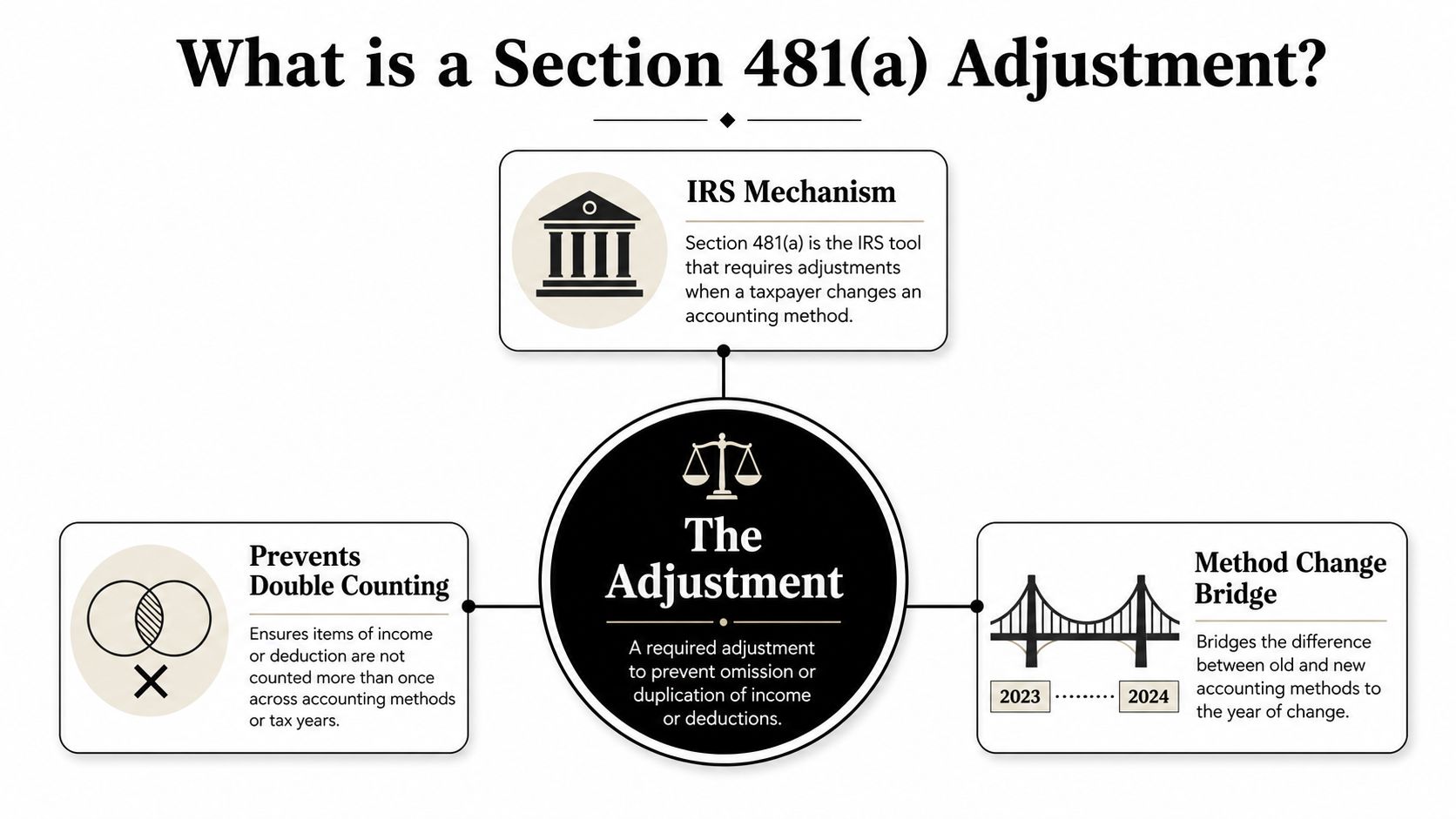
A Section 481(a) adjustment is the IRS mechanism that prevents income or deductions from being duplicated or omitted when a taxpayer changes accounting methods. The IRS describes it as the cumulative difference between the old method and the proposed method, measured without regard to the statute of limitations, which is why it reaches beyond the closed years that would normally be off limits for amendment. That is the key idea. The tax law is not trying to relitigate every prior return, it is trying to make the method change neutral on timing.
A simple way to think about it is like reconciling two ledgers when you change how you count sales. One ledger reflects the old method. The other reflects the new method. The adjustment is the gap between them at the date of change, so the taxpayer does not get taxed twice or skip tax entirely just because the bookkeeping rules changed.
The concept differs from an ordinary error correction. An error correction usually says the taxpayer did something wrong in a prior year and needs to fix that wrong item. A Section 481(a) adjustment says the method itself has changed, so the IRS wants a one-time cumulative catch-up calculation. That difference matters because the adjustment is built into the mechanics of the current-year filing.
The IRS rules also make the spread pattern important. The standard treatment is a net positive adjustment spread over four taxable years, or a net negative adjustment taken in the year of change. Revenue Procedure 2015-13 confirms that basic spread rule, unless a specific exception applies. The practical result is that the adjustment is not just a number, it is a timing bridge between the old method and the new one.
How the Adjustment Is Calculated in Practice
The computation starts with a snapshot date. You do not add up old and new numbers for every open year. Instead, you recompute the relevant tax items as if the new method had been used all along, then compare that result with what was reported. The difference is the cumulative adjustment at the date of change. That is why the work product is often a reconstructed schedule, not a one-line entry.
For depreciation changes, the records usually need to show which assets belong in the old bucket and which belong in the revised method. For inventory, the recomputation can involve cost flow and ending inventory values. For revenue recognition, the adjustment turns on timing, when income would have been recognized under the new method versus when it was reported under the old one. The same principle applies across the board. The method changed, so the historical timing gap has to be quantified.
Practitioners get into trouble when they treat the adjustment like a plug number. The IRS expects a supportable recomputation, not a guess dressed up as a form entry.
The statute of limitations does not block that recomputation, because the IRS is not reopening the prior year as a return audit. It is measuring the timing difference needed to transition to the new method. That is the reason Section 481(a) is so powerful and so unforgiving at the same time. It lets a taxpayer fix a method issue in one filing, but only if the underlying math is disciplined.
A good working habit is to build the calculation from source records, not from memory. Prior depreciation schedules, inventory workpapers, and revenue timing records should line up with the proposed method. If they do not, the adjustment calculation will usually be the first place that inconsistency shows up.
Positive vs Negative Adjustments and the Four-Year Spread
The easiest way to understand the spread rule is to separate the direction of the adjustment from the tax effect. A net negative Section 481(a) adjustment is generally taken entirely in the year of change. A net positive adjustment is generally spread over four taxable years, meaning the year of change plus the next three. That is the default rule, and it is the rule that most taxpayers need to model before filing.
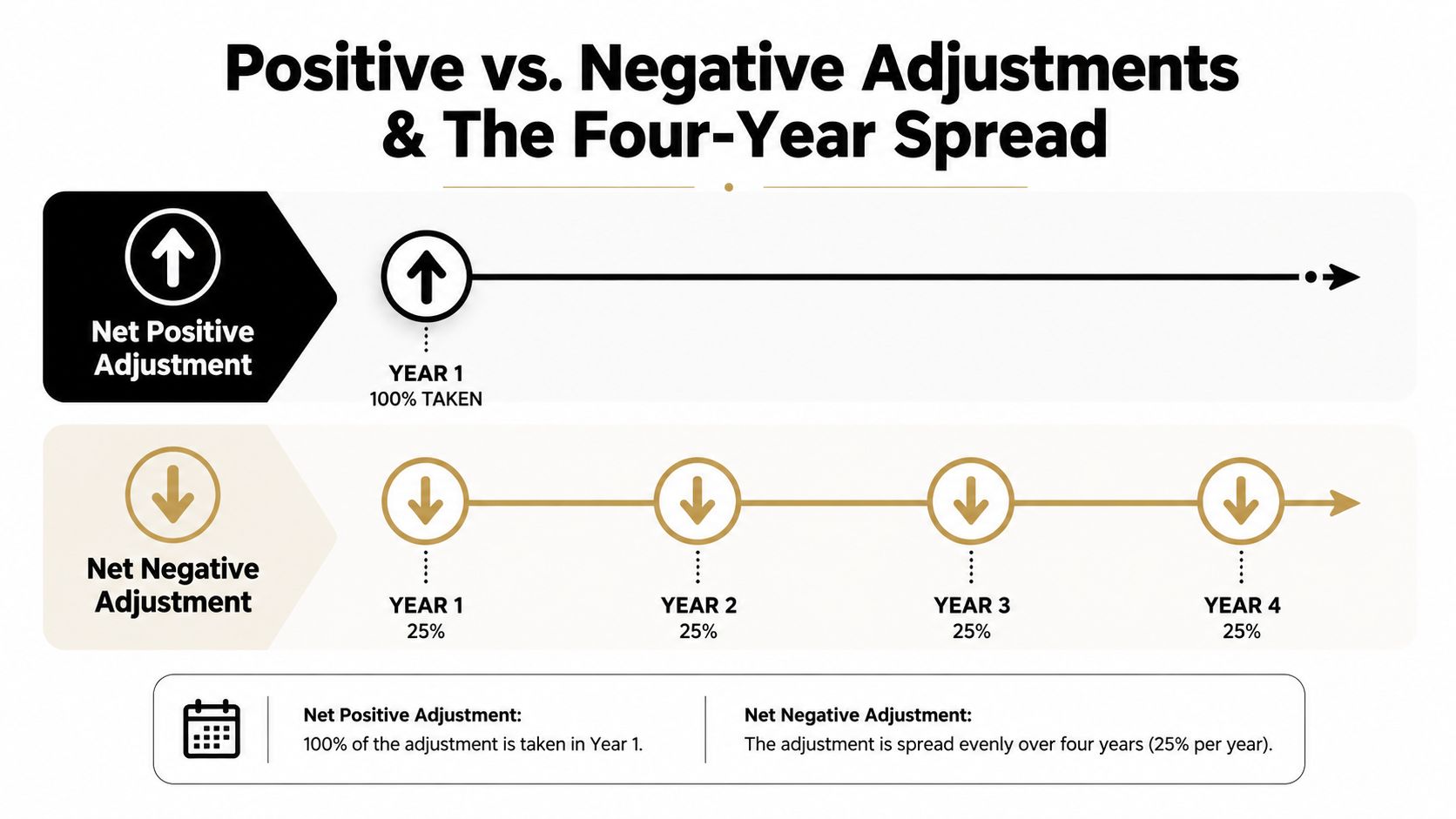
The cash-flow point is obvious once you map the spread to the return. A positive adjustment is not a single-year surprise if the taxpayer can plan for the installment pattern. But it is still a current-year tax event, because the year of change picks up the first slice. That makes estimated taxes, lender conversations, and year-end distributions more important than owners often expect.
There is also a statutory trigger that deserves attention. Under IRC 481(b)(1), if the adjustment increases taxable income for the year of change by more than $3,000, the tax attributable to the adjustment is computed under special IRS rules. That matters because the blending computation can change the effective result in the year of change, even when the spread is already known.
A practical way to model the issue is this:
- Check the direction first. Positive means future spread, negative means immediate recognition.
- Measure the year-of-change impact. The first-year slice affects cash flow right away.
- Test the special-rule threshold. If the income increase for the year of change crosses the statutory level, the tax computation may need extra care.
- Compare the spread to expected income. A positive adjustment hurts more when the taxpayer already has a strong income year.
The point is not just compliance. It is timing. The spread rule can either smooth a correction or magnify a current-year tax problem, depending on what else is happening on the return.
Filing Form 3115 and Reporting the Adjustment
Form 3115 is the paperwork that formalizes the method change. For many taxpayers, it is the filing that makes the accounting-method shift real in the IRS system and reports the related Section 481(a) adjustment on the current-year return. For automatic changes, Revenue Procedure 2015-13 confirms the standard spread rule, one year for a negative adjustment and four years for a positive adjustment, unless an exception applies.
The filing mechanics matter as much as the math. The taxpayer making the change generally files the form, and the form attaches to the return for the year of change. If the change is automatic, timing rules apply, and missing the filing window can turn a manageable method change into a procedural mess. If the change is non-automatic, the process is more formal and the IRS review path is different.
On the return itself, the adjustment typically shows up as a current-year timing item, often worked through Schedule M-1 or Schedule M-3 depending on the taxpayer's profile. The point is to reconcile tax reporting with book or method timing, not to refile every prior year. That is why amended returns usually are not the vehicle for the spread portion of the adjustment.
If you want a plain-English refresher on how prior-year corrections differ from method changes, this discussion of how far back tax returns can be amended is useful context. The answer often turns on whether the issue is an error, a timing change, or a method change, and those are not the same thing.
A clean filing package usually does three things well. It identifies the change correctly, supports the adjustment calculation, and reports the current-year tax effect without making the return look like a patchwork of unexplained numbers.
How the Adjustment Interacts With Other Tax Computations
The core planning work begins here. A Section 481(a) adjustment does not live alone. It can collide with business interest limitation calculations, partnership reporting, and reconciliation schedules on the same return. That is why experienced preparers model the downstream effects before the form is filed, not after.
For depreciation-related changes, the adjusted taxable income treatment changed for business interest purposes. The Tax Adviser reported that the addback of a Section 481(a) adjustment in the business interest limitation calculation was allowed only for tax years beginning before January 1, 2022. After that date, remaining positive balances are no longer included in adjusted taxable income for that purpose. In practice, that means a depreciation-related method correction can affect one tax computation but not another, depending on the year and the issue involved.
Partnerships need a separate layer of care. When a multi-year Section 481(a) item flows through a partnership, the year-one entry, the later-year income recognition, capital accounts, and outside basis all need to be tracked consistently. If the return shows the right tax number but the partner economics are off, the reporting still has a problem. That is especially true where distributions, guaranteed payments, or basis-limitation issues already exist.
Schedule M-1 and M-3 are another common collision point. The adjustment may be perfectly valid and still need a clear bridge between book and tax income. If the current-year reconciliation is sloppy, the IRS often sees an inconsistency before it sees the underlying method change.
A Section 481(a) item should be modeled next to the rest of the return, not in isolation. The tax result can change when ATI, basis, or M-1/M-3 timing is pulled into the same year.
For a practical walkthrough of tax computation sequencing, this step-by-step tax liability guide is a good companion piece. The main lesson here is simple. A method change can be valid and still create a bad return if the adjacent computations are ignored.
A Worked Example on a Small Cost-Segregation Case
A rental property owner commissions a cost segregation study after holding the building for several years. The study reclassifies some components into shorter-lived property, which means the prior depreciation method understated deductions that should have been taken sooner. The resulting Section 481(a) adjustment is net positive in this example, because the taxpayer is correcting a timing mismatch that would otherwise have produced more current deductions under the new method.
Here is a simplified illustration of how the spread looks on the return.
| Year | Addback Amount | Cumulative Adjustment | Notes |
|---|---|---|---|
| Year 1 | 25% of the positive adjustment | 25% recognized | Year of change |
| Year 2 | 25% of the positive adjustment | 50% recognized | Continued spread |
| Year 3 | 25% of the positive adjustment | 75% recognized | Continued spread |
| Year 4 | 25% of the positive adjustment | 100% recognized | Final year of spread |
That structure is exactly why cost segregation can be so useful for planning and so tricky for compliance. The taxpayer gets the benefit of recomputing depreciation under the corrected method, but the positive adjustment does not disappear. It becomes a four-year current-tax issue that has to be reflected on the return and in cash planning.
The Schedule M-1 impact is straightforward in concept. The tax depreciation no longer lines up with book treatment, so the reconciliation has to show the timing difference cleanly. If the year-of-change income increase is above the $3,000 threshold, the special computation rules under the statute become relevant, which is why the first year often needs more attention than the later spread years.
A landlord with properties in multiple jurisdictions also has to think beyond the federal return. For broader context on how property taxes and transaction taxes vary by location, understanding global property tax is a useful reference point for the planning mindset, even though the federal method-change rules are separate.
For the underlying depreciation mechanics that often drive these filings, the Form 4562 instructions are worth keeping nearby. The point of the example is not that every cost-segregation case looks the same. It is that the adjustment touches the current return, the spread years, and the surrounding tax computations all at once.
Planning Steps and When to Engage a Tax Attorney
The best time to deal with a Section 481(a) issue is before the form is filed, while the records are still easy to reconstruct. That usually means gathering prior returns, depreciation schedules, inventory support, revenue timing records, and, for pass-through entities, partnership agreements and capital-account workpapers. If the method change is tied to a taxpayer error, the paper trail matters even more.
A few situations should trigger a serious review rather than a quick filing:
- The old method is no longer permissible. The return needs a compliant fix, not a cosmetic tweak.
- The taxpayer wants a more accurate method. Accuracy can improve tax reporting, but it also changes the current-year result.
- A prior return may need analysis. That is where method change, correction, and amendment issues can blur together.
- An IRS audit or inquiry is already in motion. Filing strategy changes when the IRS is looking at the file.
- Business interest limits or partner allocations are in play. That is where downstream modeling matters most.

A tax attorney or qualified CPA is most useful when the adjustment is not just a number, but a decision with cash-flow and controversy risk attached. That is especially true when the taxpayer is already dealing with IRS notices, entity-level reporting issues, or a method change that could ripple into basis, distributions, or interest calculations. If you are sorting out who should handle that kind of work, how to find a good tax attorney is a practical place to start.
The right move is to model the return before the return is filed. Once the adjustment lands, the spread rules and reporting obligations follow from the method change itself, and fixing a weak filing later is usually more painful than doing the analysis up front.
Tax Attorney Stephen A Weisberg helps taxpayers sort out method changes, IRS controversies, and the cash-flow problems that come with a Section 481(a) adjustment. If your depreciation, inventory, or revenue recognition issue is colliding with a broader IRS problem, visit Tax Attorney Stephen A Weisberg to discuss the next step and get a focused analysis of your situation.


