Section 179 Carryover Explained for Business Owners
Understand the Section 179 carryover rules. Learn what causes a carryover, how to calculate it, and strategies to use it effectively for your business in 2026.
In this article
- Introduction The Unexpected Tax Bill
- Why this catches owners off guard
- What Is a Section 179 Carryover
- The legal rule behind it
- What usually causes it
- Why this matters beyond mechanics
- The Two Limits That Trigger a Carryover
- Business income limitation
- Annual deduction limit and phaseout
- How the two limits interact
- Why larger businesses still care
- Calculating and Reporting Your Carryover
- A two-year example
- Where it goes on the return
- The recordkeeping that makes this work
- Entity structure can complicate the picture
- Strategic Planning with Section 179 Carryovers
- Use the carryover as part of a multi-year plan
- Section 179 and bonus depreciation solve different problems
- State tax treatment can change the answer
- The real planning value is risk management
- Common Pitfalls and When to Seek Help
- The errors that show up most often
- When a DIY approach stops making sense
You bought equipment for the business, signed the financing papers, put the asset into service, and expected a full write-off. Then your return came back with a smaller Section 179 deduction than you thought you were getting.
That moment confuses a lot of business owners because it feels like part of the deduction vanished. Usually, it didn't. It moved.
A Section 179 carryover is the tax system's way of saying, “You made the election, but you can't use all of it yet.” If you understand that distinction, you stop treating the carryover like bad news and start using it as part of your planning.
Introduction The Unexpected Tax Bill
A common situation looks like this. A business owner buys a major piece of equipment for $75,000, fully expecting to expense the whole cost under Section 179. When the return is prepared, only $40,000 gets deducted. The missing $35,000 feels like a mistake, or worse, lost money.
Usually, it's neither.
That unused amount may become a Section 179 carryover, which means the deduction is deferred to a later year instead of disappearing. For a business owner who made a smart operating decision but had a weaker income year than expected, that distinction matters a lot.
The frustration comes from timing. You spent the money now. You need the tax benefit now. But Section 179 has limits, and one of the most important is that you generally can't use it beyond the amount your business income allows for that year. When the election is larger than what the rules let you deduct currently, the unused piece can move forward.
Why this catches owners off guard
Most owners focus on whether the property qualifies. That's important, but it's only half the question. The other half is whether your business can absorb the deduction this year.
That's why year-end equipment purchases deserve the same attention as payroll, estimated taxes, and bookkeeping. A strong small business tax checklist should include not just “Can I elect Section 179?” but also “Can I fully use it this year?”
A carryover isn't a failed deduction. It's a delayed one.
When you see it that way, the issue becomes less about disappointment and more about planning. The primary task is knowing when the carryover helps, when it creates risk, and how to keep it from slipping through the cracks on future returns.
What Is a Section 179 Carryover
A Section 179 carryover is the part of your elected Section 179 deduction that you could not use this year, but may be able to use in a later year.
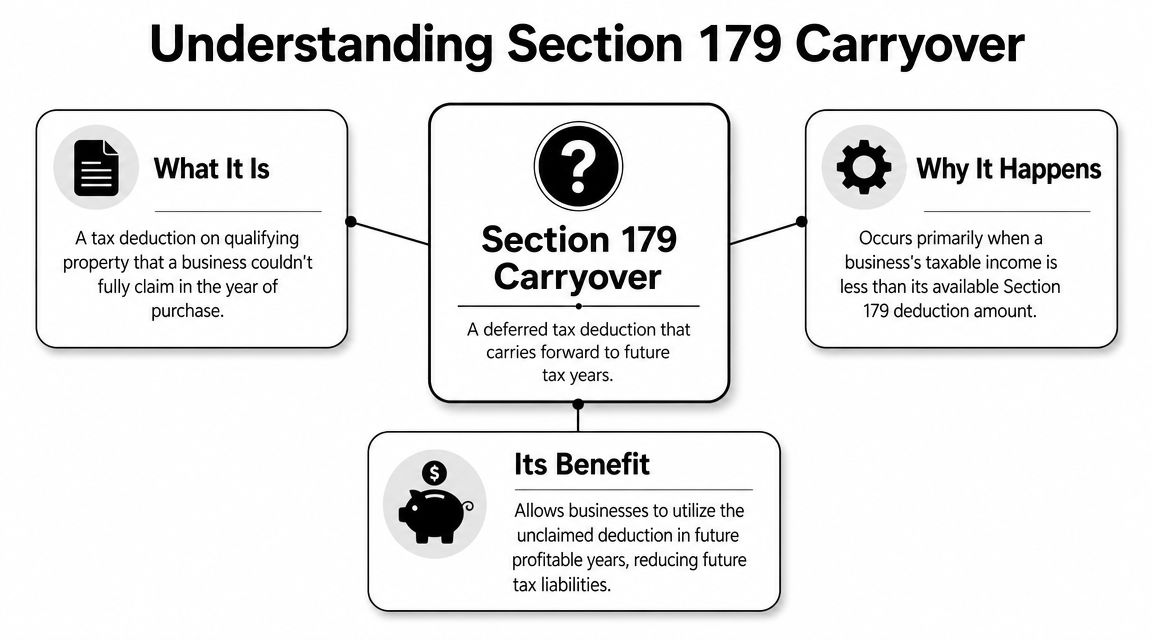
The cleanest way to understand it is to separate the purchase from the deduction. You bought and placed the equipment in service now. The tax law may still force part of the deduction to wait.
A prepaid expense works as a useful comparison. The money is already spent, but the tax benefit is recognized over the period the rules allow. Section 179 carryover follows a similar timing concept. The election is made in one year, yet some of the tax value can be pushed into a later year if current limits block full use.
The legal rule behind it
The carryover rule is part of the Section 179 framework itself. If a Section 179 amount is disallowed for the year, that amount does not vanish. It carries to a later year, and the later year determines how much of that deferred deduction you can claim.
That point matters because owners often hear "carryover" and assume "automatic deduction next year." It is not automatic in that sense. The deferred amount remains subject to what the later year allows.
Three practical ideas flow from that rule:
- The deduction is deferred, not forfeited. A denied current-year amount can survive into a future year.
- Future year capacity matters. The carryover is only useful to the extent a later year can absorb it.
- Timing risk becomes a planning issue. A deduction expected to reduce this year's tax bill may instead reduce a later year's bill, which affects cash flow and estimated tax planning.
What usually causes it
For many business owners, a carryover starts with a perfectly valid election made in a weaker income year.
A contractor might buy a truck and equipment in December, expecting a large write-off, then discover that lower-than-expected profits limit how much Section 179 can be used for that year. The unused amount does not vanish. It sits on the shelf, waiting for a later year with enough room to claim it.
That is why a carryover is not just a technical tax outcome. It is a business timing issue. If your financing, owner distributions, or estimated tax payments assumed a full current deduction, a carryover can change those decisions quickly.
Why this matters beyond mechanics
Section 179 carryovers are easy to underestimate because the name sounds simple. In practice, they affect basis, future-year return preparation, and transactions involving the property itself.
The rules also follow a discipline that owners should know about. Carryovers are used in the earliest year they can be used. If property tied to the carryover is later sold or transferred in certain nonrecognition transactions, the tax consequences can change in ways that surprise people who only focused on the original purchase year.
The broader lesson is strategic. A Section 179 carryover is not merely an accounting footnote. It is a reminder that tax elections should be matched to income forecasts, transaction plans, and recordkeeping systems. Standard explanations often stop at "you can use it later." The better question is whether deferring the deduction helps your business plan, hurts near-term cash flow, or creates a tracking problem that follows you into future returns.
The Two Limits That Trigger a Carryover
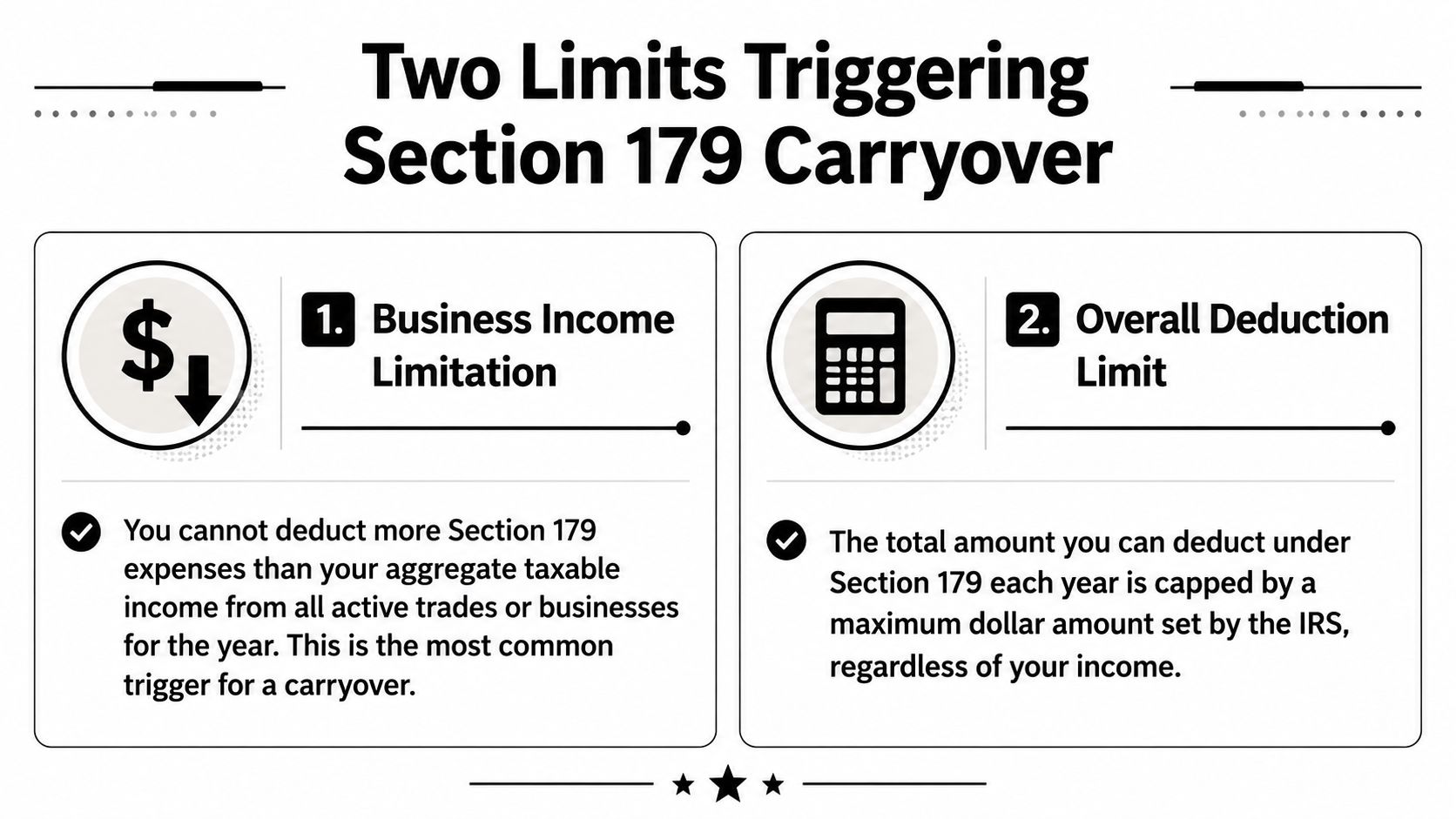
Most Section 179 carryovers start with one of two constraints. One is about your income. The other is about the system-wide cap on how much can be expensed.
Business income limitation
This is the limit that trips up most businesses.
Section 179 can't exceed your net taxable income from the business activity used for the calculation. Put plainly, Section 179 doesn't function as a tool to create or deepen a business loss. You can make the election, but the current-year deduction stops where your business income stops.
Here's a simple example using the same kind of fact pattern owners see every filing season:
| Item | Amount |
|---|---|
| Qualifying equipment placed in service | $75,000 |
| Intended Section 179 election | $75,000 |
| Business income available to absorb deduction | $40,000 |
| Current-year Section 179 allowed | $40,000 |
| Potential carryover | $35,000 |
Nothing is wrong with the election in that example. The problem is timing. The business wanted the full deduction in Year 1, but only part of it fit within the year's income limitation.
Annual deduction limit and phaseout
There's also an annual ceiling on Section 179 itself. For tax years beginning in 2026, businesses can elect to expense up to $2,560,000 of qualifying purchases, and that deduction phases out dollar-for-dollar once total qualifying property placed in service exceeds $4,090,000. It is fully phased out at $6,650,000, according to the 2026 Section 179 limits summary.
Those figures matter most for businesses making larger capital investments. Even when property qualifies, the annual framework can reduce or eliminate the amount available for immediate expensing.
How the two limits interact
These rules don't compete with each other. They stack.
A business may be under the annual cap and still face a carryover because current taxable income is too low. A larger business may also need to account for the annual limit and phaseout before even reaching the income limitation question.
That's why owners get confused when they hear, “The equipment qualifies.” Qualification is only the first gate.
Consider the sequence this way:
- The property must qualify
- The election must fit within the annual Section 179 framework
- The current-year deduction must fit within business income
If the election survives the first two but stalls at the third, the unused amount may become carryover.
The carryover is a continuity rule. It preserves a deduction you validly elected but couldn't fully use because the current year was too small to hold it.
Why larger businesses still care
It's easy to assume carryovers are only a small-business issue. They're not. The modern Section 179 limits are large enough that businesses with substantial equipment spending can still run into carryover issues if profits lag behind spending.
That often happens in expansion years. A company upgrades machinery, vehicles, software, or operational equipment to prepare for growth, but revenue takes longer to catch up. In that setting, the carryover acts less like a tax footnote and more like a bridge between an investment year and a stronger income year.
Calculating and Reporting Your Carryover
A Section 179 carryover is easy to lose track of because nothing about it looks dramatic on the return. You bought the equipment, made the election, and took what the current year allowed. The unused piece then has to be carried forward with discipline. That is where good tax planning starts to look a lot like inventory control. If you do not track what remains on the shelf, you cannot use it later.

A two-year example
A simple example makes the mechanics clearer.
Year 1
| Item | Amount |
|---|---|
| Qualifying purchase | $75,000 |
| Section 179 elected | $75,000 |
| Business income limitation | $40,000 |
| Deduction allowed in Year 1 | $40,000 |
| Carryover to next year | $35,000 |
The business elected to expense the full cost, but the current year had room for only part of it. The unused $35,000 does not vanish. It waits for a later year that has enough business income to absorb it.
Year 2
Assume the business has enough income in Year 2 and no other limit reduces the deduction.
| Item | Amount |
|---|---|
| Prior-year carryover | $35,000 |
| Amount deductible in Year 2, subject to Year 2 limits | Up to $35,000 |
If Year 2 can absorb the full amount, the business deducts the full carryover. If not, the remainder keeps rolling forward.
That rolling feature matters for planning. A carryover is not just leftover tax math. It is a deferred tax benefit that should be tracked the same way you would track a net operating loss or a suspended passive loss. Owners who treat it casually often miss deductions after a change in software, a new preparer, or a business restructuring.
Where it goes on the return
Reporting matters as much as calculation. The carryover is part of the Section 179 history reported through Form 4562, not a side note kept in someone's memory or a spreadsheet with no link to the return.
In practical terms, you are tracking three separate numbers over time: the amount elected, the amount allowed that year, and the amount still waiting to be used. If those numbers are not tied back to the return each year, errors spread unnoticed. One missed carryover can affect several later returns.
If you want a line-by-line explanation of how the form handles prior-year amounts, this walkthrough of Form 4562 instructions is a useful companion to the carryover analysis.
The recordkeeping that makes this work
Carryover problems usually begin with records, not with the statute.
Keep a schedule that shows:
- The property details: what you bought, when it was placed in service, and why it qualified
- The election amount: how much Section 179 you claimed on the original return
- The allowed deduction: how much was deducted for that year
- The disallowed amount: how much was suspended because of the business-income limit
- Later-year usage: how much of the carryover was used in each following year
That schedule should live outside the tax software as well. Software prepares a return for a given year. It does not reliably preserve the business logic behind the carryover, especially if files are migrated, entities change, or a new preparer takes over.
A good analogy is a loan amortization table. The tax return shows the annual payment. Your carryover schedule shows the remaining balance.
Entity structure can complicate the picture
Entity type changes how carefully you need to trace the deduction. A sole proprietor often sees the carryover more directly because the business activity and the individual return sit together. Partnerships and S corporations add more moving parts, and that raises the risk of losing the thread.
As noted earlier, the rules include examples showing that carryovers operate as specific dollar amounts, not as vague tax attributes. That point matters in practice. If ownership shifts, an entity reorganizes, or the business converts from one form to another, you need to know exactly what amount is still available and where it belongs.
Keep a carryover schedule outside the return file.
That single habit is risk management, not paperwork for its own sake. Section 179 carryovers often surface years after the original purchase, usually when profits improve and the deduction finally becomes useful. If the history is incomplete by then, the business may leave money on the table or claim the wrong amount and create an avoidable audit issue.
Strategic Planning with Section 179 Carryovers
A common mistake starts with a reasonable business decision. In October, you buy the equipment the business needs now. In March, your return shows that part of the expected Section 179 deduction cannot be used yet because taxable income came in lower than expected.
That result is not a planning failure. It is a planning fact. The carryover changes the timing of the tax benefit, and that timing difference should shape how you budget cash, evaluate purchases, and choose among depreciation methods.
Use the carryover as part of a multi-year plan
Section 179 works best when you treat it like a shelf for deductions that current-year income cannot hold all at once. The deduction is elected now, but some of the benefit may wait for a later year if income is too low. For businesses with uneven earnings, that can be useful.
The carryover often helps in situations such as:
- Expansion before revenue catches up: You buy machinery, vehicles, or technology before the added sales show up.
- Cyclical or seasonal income: One year is weak, the next is stronger.
- Operational urgency: The equipment is needed immediately even though the tax year is not ideal.
The strategic question is simple. Are you buying for business reasons first, while understanding when the tax benefit will arrive? Owners who answer that question clearly usually make better financing and cash reserve decisions.
Section 179 and bonus depreciation solve different problems
Business owners often group these rules together because both can speed up deductions. For planning, that shortcut causes trouble.
Section 179 is often the more precise tool because you can target specific property and its use is tied to taxable income. Bonus depreciation is often broader and may push more deduction into the current year than you want.
| Feature | Section 179 Deduction | Bonus Depreciation |
|---|---|---|
| Current-year taxable income limitation | Yes | No, in general terms |
| Can create or increase a loss | Generally no | Often yes |
| Ability to target specific assets | Usually more flexible | Often less selective in practical use |
| Carryover concept | Yes, if limited by income | Different rules apply |
That distinction matters in real life. If your priority is controlling the timing of deductions so you do not waste them in a low-income year, Section 179 may fit better. If your priority is accelerating deductions as fast as possible, bonus depreciation may point in a different direction. For broader context, see this guide to small business tax deductions.
State tax treatment can change the answer
Federal planning is only part of the job. State returns do not always follow the same rules, and that can turn a smart federal strategy into a state tax surprise.
A business may have a federal carryover that behaves one way while a state requires addbacks, uses different depreciation rules, or limits the election differently. The result can be higher state taxable income than the owner expected, even when the federal return looks favorable.
This issue deserves attention before the purchase, not after year-end. It matters even more if the business operates in more than one state or recently changed where it files.
The real planning value is risk management
Section 179 carryovers are often presented as a technical rule. For owners, they are also a forecasting tool.
Before a major equipment purchase, ask four practical questions:
- How much taxable business income do I realistically expect this year?
- If part of the deduction is delayed, will that affect loan covenants, owner distributions, or cash reserves?
- Would a different depreciation approach produce a better timing result?
- Will the federal result and the state result differ in a way that changes the economics of the purchase?
Those questions help separate a good tax result from a good business decision. That is the broader point many Section 179 discussions miss. The carryover is not just a leftover deduction. It is a reminder that tax elections should match the company's income pattern, financing needs, and tolerance for surprises.
Common Pitfalls and When to Seek Help
The biggest Section 179 carryover mistakes usually aren't dramatic. They're quiet. A number doesn't roll forward. A later preparer misses an old election. A business owner assumes the software handled it.
Then the deduction is gone in practical terms.
The errors that show up most often
A few problems come up repeatedly:
- Forgetting the carryover entirely: If nobody tracks the disallowed amount from the prior year, it may never get claimed.
- Mishandling a sale or transfer: Under the regulation discussed earlier, basis adjustments and transfer consequences can wipe out assumptions owners thought were safe.
- Poor documentation: If you can't show the election, the allowed amount, and the disallowed amount, reconstructing the carryover later becomes much harder.
- Ignoring entity complications: Partnerships, S corporations, and ownership changes can make a simple carryover much less simple.
- Assuming federal and state treatment match: That assumption causes trouble more often than it should.
When a DIY approach stops making sense
Some returns are straightforward enough for disciplined self-preparation or routine compliance help. Others aren't.
You should get professional tax help when:
| Situation | Why it matters |
|---|---|
| You sold the asset | Basis and carryover consequences may change the result |
| You transferred the business or property | Nonrecognition rules can affect whether the carryover survives |
| Your entity structure is layered | Pass-through issues can complicate tracking and usage |
| You operate across state lines | State conformity may differ from federal treatment |
| Prior returns were inconsistent | Carryover reconstruction may require technical review |
If the carryover touches a sale, a restructuring, or multiple returns, treat it as a legal-tax issue, not just a data-entry issue.
If your facts are getting more complicated, it may be time to talk with counsel. A practical starting point is knowing when to hire a tax attorney instead of assuming every depreciation question is just bookkeeping.
If you need help evaluating a Section 179 carryover, fixing a missed deduction, or sorting out how an equipment purchase affects your federal and state tax position, Attorney Stephen A Weisberg offers experienced guidance for business owners dealing with tax complexity, IRS issues, and high-stakes filing decisions.


