Schedule SE Forms Explained for Self-Employed Taxpayers
Learn how Schedule SE forms work, who must file, and how self-employment tax is calculated. Practical examples and planning tips for 2026 filers.

In this article
- What Schedule SE Actually Does for Your Tax Return
- Who Must File Schedule SE and the $400 Threshold Rule
- The 1099 confusion that causes real problems
- Who usually lands on this form
- How Self-Employment Tax Is Calculated Step by Step
- Start with net earnings, not gross income
- A straightforward example
- Where the result goes
- Handling Mixed W-2 Wages and Self-Employment Income
- Why your W-2 matters
- Two scenarios side by side
- When Schedule SE Does Not Apply to Your Business Income
- Entity type can remove Schedule SE entirely
- Changing roles during the year
- Common Filing Mistakes and Planning Strategies for Self-Employed Taxpayers
- The mistakes that cost money
- Practical planning strategies
You've got the 1099 in hand, the income looked manageable, and then the tax return starts asking about Schedule SE. That's where a lot of first-time freelancers get blindsided. The mistake is thinking self-employment tax is just another line item. It isn't. It's the IRS's way of collecting the Social Security and Medicare tax that an employer would normally split with you, and if you ignore it, the bill doesn't disappear.
Schedule SE is the form attached to Form 1040 that calculates self-employment tax. That tax is made up of 12.4% Social Security tax and 2.9% Medicare tax, for a combined 15.3% rate on net earnings from self-employment. If you've been comparing your side income to a W-2 paycheck, this is the missing piece. A wage earner sees FICA withheld automatically. A self-employed taxpayer has to calculate and pay the full amount through the return.
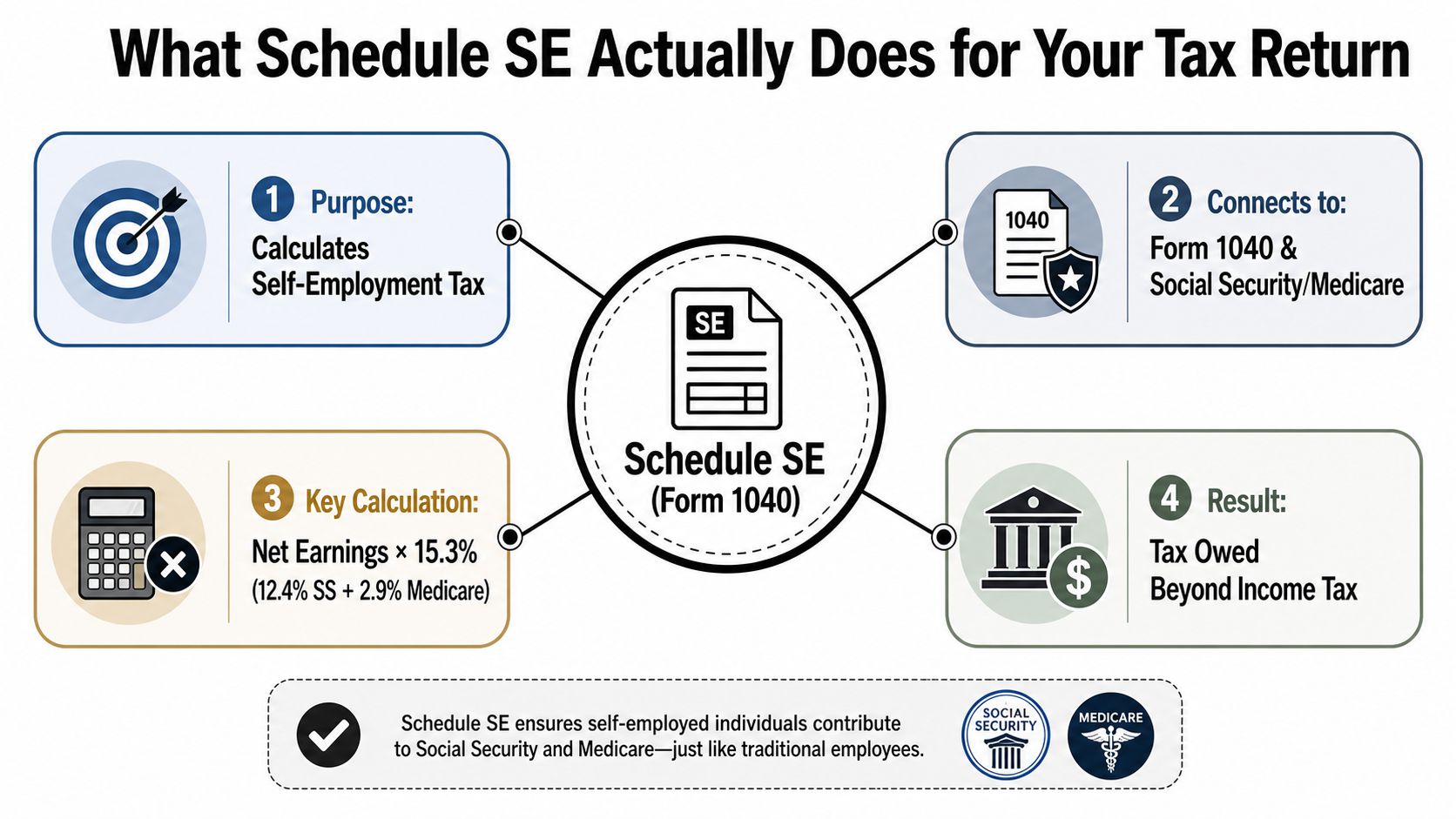
The right way to think about it is simple. Your business profit is one tax layer. Schedule SE is another. If you want a plain-English companion to the return, see this overview of self-employed tax forms, but don't overcomplicate the issue. If you have self-employment income, you need to know whether Schedule SE applies, how the cap works, and whether your entity structure changes the answer.
Practical rule: don't wait until the end of filing season to ask whether you owe self-employment tax. That question should be answered as soon as you know your net profit.
What Schedule SE Actually Does for Your Tax Return
The first shock for many taxpayers is that Schedule SE doesn't measure revenue. It measures the slice of your net earnings that the IRS treats as subject to self-employment tax. That's why a freelancer who invoiced plenty of clients can still owe a surprisingly large amount, even after deducting business expenses.
The form exists because employees and self-employed people are taxed differently. A W-2 employee sees payroll tax split with an employer. A self-employed person pays both sides through one schedule on the individual return. That's not a penalty, it's the structure Congress chose, and the IRS administers it through Schedule SE. The form is attached to Form 1040, so it directly feeds your return instead of sitting off to the side as a separate business tax.
The mechanics matter because the tax is not the same thing as income tax. You can owe income tax and not owe self-employment tax, or owe both. The business profit comes first, then Schedule SE determines the employment-tax-style layer that applies to that profit. For a freelancer filing for the first time, that distinction is usually the point where the return gets confusing.
The form also matters beyond the current year. The IRS says the reported amounts help determine future Social Security benefits, so mistakes can affect both your current liability and what gets credited to your earnings record. That's why I tell clients to treat Schedule SE as a reporting document, not a form you fill out casually at the end of the night.
Bottom line: if you're self-employed, Schedule SE is not optional paperwork. It's the mechanism that turns your net profit into Social Security and Medicare tax.
Who Must File Schedule SE and the $400 Threshold Rule
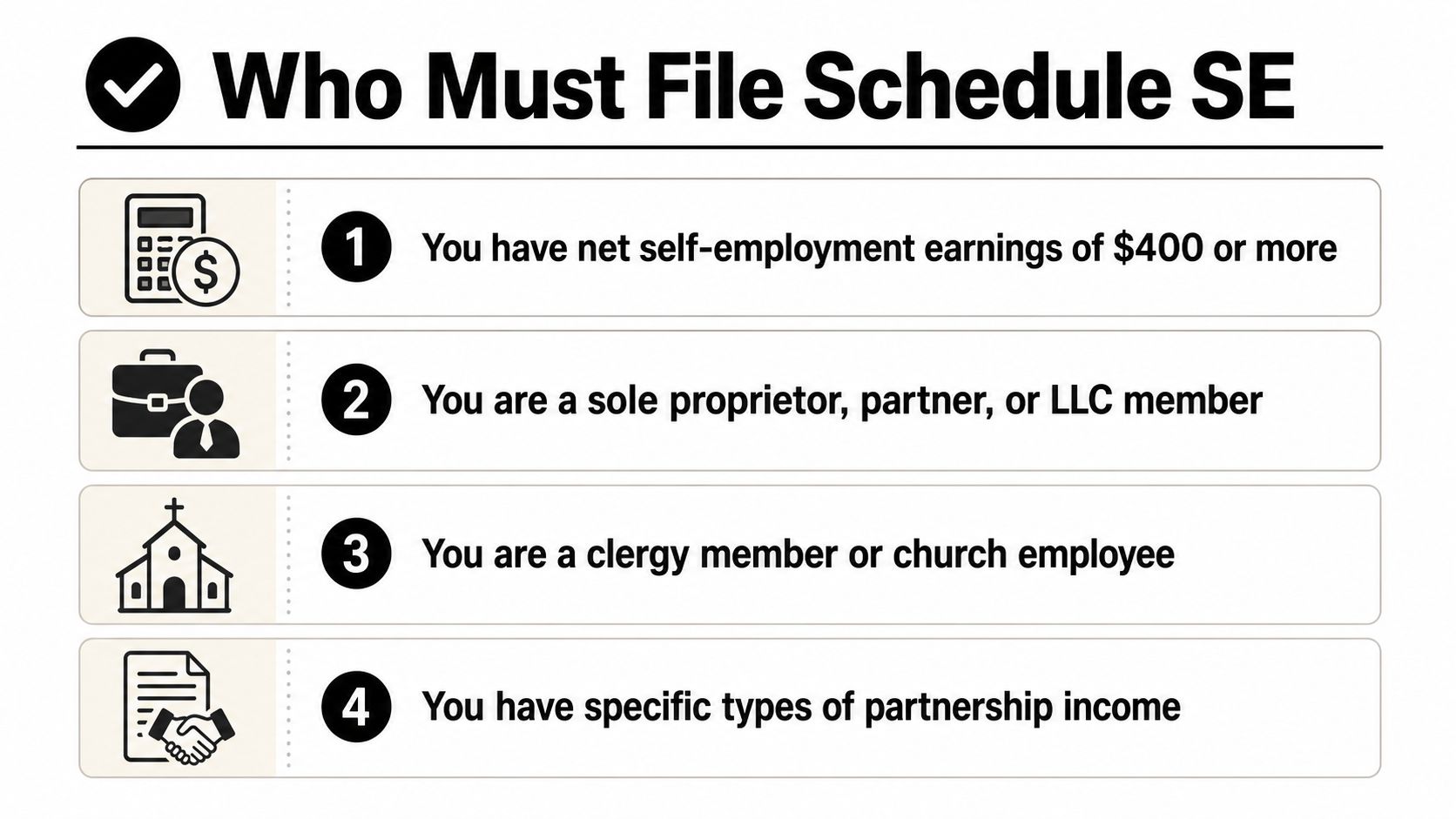
The threshold is where new freelancers get caught. You generally must file Schedule SE if your net earnings from self-employment are $400 or more. That rule is what pulls side hustles, consulting work, ride-share income, and small business profit into the self-employment tax system. If your business made a small profit, the IRS still wants the form.
The 1099 confusion that causes real problems
A lot of people think the 1099-NEC determines whether they owe self-employment tax. It doesn't. The 1099 reporting threshold and the Schedule SE filing threshold are separate. You can owe Schedule SE tax even if no 1099 arrived in your mailbox. That's the trap. The IRS cares about your net self-employment earnings, not whether a client happened to file a form.
Use the official IRS Schedule SE page and instructions if you want the source documents, especially if your income is close to the threshold or your facts are messy. For a practical walk-through of the filing trigger, this freelancer tax guide is useful for checking whether your income pattern lands you in Schedule SE territory.
Watch the threshold, not the form count: the absence of a 1099 doesn't save you from Schedule SE if your net earnings hit the filing floor.
Who usually lands on this form
The form commonly applies to sole proprietors, single-member LLC owners taxed as sole proprietors, partners with self-employment income, independent contractors, and certain church employees. The label on the business doesn't control the result by itself. What matters is whether the income is self-employment income under the IRS rules.
Here's the quick self-check I give clients:
- You had a profit, not a loss. If expenses beat income, the self-employment tax base usually disappears.
- Your net earnings reached the filing threshold. That's the key number that pushes you onto Schedule SE.
- You're looking at business income, not wages. W-2 wages are handled differently.
- You didn't assume a missing 1099 meant no filing. That assumption causes avoidable notices.
If you can answer yes to the first two items, stop guessing. You're probably in Schedule SE territory.
How Self-Employment Tax Is Calculated Step by Step
A freelance client can have the numbers in front of them and still get the Schedule SE math wrong. Start with net earnings, reduce that amount by the IRS factor, then apply the tax rate to the adjusted base. That sequence is the part people skip, and it distorts the result fast.
Start with net earnings, not gross income
Use net self-employment income after business expenses. The IRS then applies 0.9235 to that amount before the self-employment tax is calculated. That reduction reflects the portion of earnings subject to the tax, and it belongs in the computation whether you prepare the return yourself or hand it to a preparer.
For the Social Security piece, the IRS applies the 15.3% combined Schedule SE rate only up to the annual Social Security wage base limit published by the IRS. Earnings above that limit are still subject to the 2.9% Medicare portion. The form instructions also place the total on Schedule 2 and route the one-half deduction to Schedule 1.
If you want the tax flow spelled out line by line, use this step-by-step tax liability guide alongside the Schedule SE instructions.
A straightforward example
Take a freelancer with $85,000 in net self-employment income. First, reduce the income by the Schedule SE factor. Then apply the tax rate to the adjusted amount. That is the order clients should use before they file, because it shows the tax base before the Social Security cap and Medicare rules are layered in.
| Calculation Step | Formula | Result |
|---|---|---|
| Net self-employment income | Given amount | $85,000 |
| Adjusted taxable base | $85,000 × 0.9235 | $78,497.50 |
| Combined SE tax | $78,497.50 × 15.3% | Calculated under Schedule SE |
| Social Security portion | Applied only within the wage base limit | Included in SE tax |
| Medicare portion | Applied to the adjusted base | Included in SE tax |
| Half of SE tax deduction | One-half of total SE tax | Flows to Schedule 1 |
The practical wrinkle is expense planning. If you are still sorting through business expense write-offs for freelancers, fix that first, because every legitimate deduction lowers the net profit that feeds Schedule SE.
Where the result goes
The total self-employment tax goes onto Schedule 2 of Form 1040, and one-half of that tax is deductible on Schedule 1. That deduction does not erase the tax, but it does reduce adjusted gross income. I tell clients to treat that deduction as a partial offset, not a planning strategy. The better move is to reduce net profit before the Schedule SE calculation starts.
Handling Mixed W-2 Wages and Self-Employment Income
Basic guides usually fall apart here. If you had a salaried job and a side business in the same year, the question is not whether you owe self-employment tax at all. The question is how much of the Social Security portion still applies after your W-2 wages have already used part of the wage base. That distinction matters because people overpay when they assume Schedule SE always imposes a flat 15.3% on every dollar of business profit.
Why your W-2 matters
Your W-2 wages already count toward the Social Security cap. That means your freelance income doesn't always get hit with the full Social Security portion again. The Medicare portion still applies to self-employment earnings, but the Social Security piece can shrink once prior wages have filled part of the cap. That's the interaction most self-employed taxpayers never see explained clearly.
The IRS instructions explicitly require Schedule SE when net earnings are $400 or more and include special handling for people who have both wages and self-employment income. In plain English, the form is designed to stop you from paying the Social Security side twice on income that's already been taxed through payroll withholding.
Two scenarios side by side
A taxpayer with only self-employment income faces the full Schedule SE calculation on the taxable base, subject to the cap. A taxpayer with W-2 wages plus freelance profit has to account for the wages first, then measure how much self-employment income still sits under the remaining Social Security limit. That's the part that changes the bill.
Use the same discipline with deductions. If you're trying to reduce the self-employment tax base, keep a clean record of business expense write-offs for freelancers. Lower net profit is what lowers the tax. Sloppy bookkeeping does the opposite.
Do this before you file: verify your W-2 Social Security wages, because a mistake there can make you pay the Social Security portion on self-employment income you didn't actually owe.
If you keep only one planning idea from this section, keep this one. Mixed-income filers need to review the W-2 before they run Schedule SE, not after the return is already filed.
When Schedule SE Does Not Apply to Your Business Income
A lot of taxpayers make a bad assumption the first time they see business income on a return. They assume Schedule SE follows automatically. It does not. The entity type and your role in that entity decide whether the income belongs on Schedule SE, and a change in structure can remove the form entirely.
Entity type can remove Schedule SE entirely
The usual summary says Schedule SE applies to sole proprietors, partners, farmers, and some church employees. That is true, but it skips the part that causes the most confusion. If your pay comes through an S corporation salary/dividend mix rather than self-employment earnings, Schedule SE may not apply to that income at all. Under IRS rules, Schedule SE applies to net earnings from self-employment, not every dollar tied to a business.
That distinction matters the moment an owner moves from a sole proprietorship or partnership into an S corporation election. People often treat distributions, K-1 amounts, and owner draws as if they all work the same way. They do not. The tax result turns on whether the income counts as self-employment income under the IRS rules.
Changing roles during the year
Mid-year changes are where people get burned. A taxpayer can spend part of the year as a self-employed individual and the rest of the year operating through a different entity. In that situation, one slice of the year may belong on Schedule SE and the other may not. That is a tax result, not a bookkeeping footnote.
If you are considering a structure change, model the tax before you make the switch. An S corporation election does not erase tax. It changes how the income is classified and what gets hit with self-employment tax.
The same caution applies if your business model depends on cash flow timing. For owners who also manage cash flow strategies for inventory businesses, the entity choice can change how much income is exposed to Schedule SE and when that exposure shows up. For a broader framework on entity-level tax planning, this business tax planning resource is worth reading alongside your return review. If your facts involve an entity change, compensation decisions, or an IRS problem already in motion, Tax Attorney Stephen A Weisberg can review whether Schedule SE exposure exists before the mistake turns into a notice.
Common Filing Mistakes and Planning Strategies for Self-Employed Taxpayers
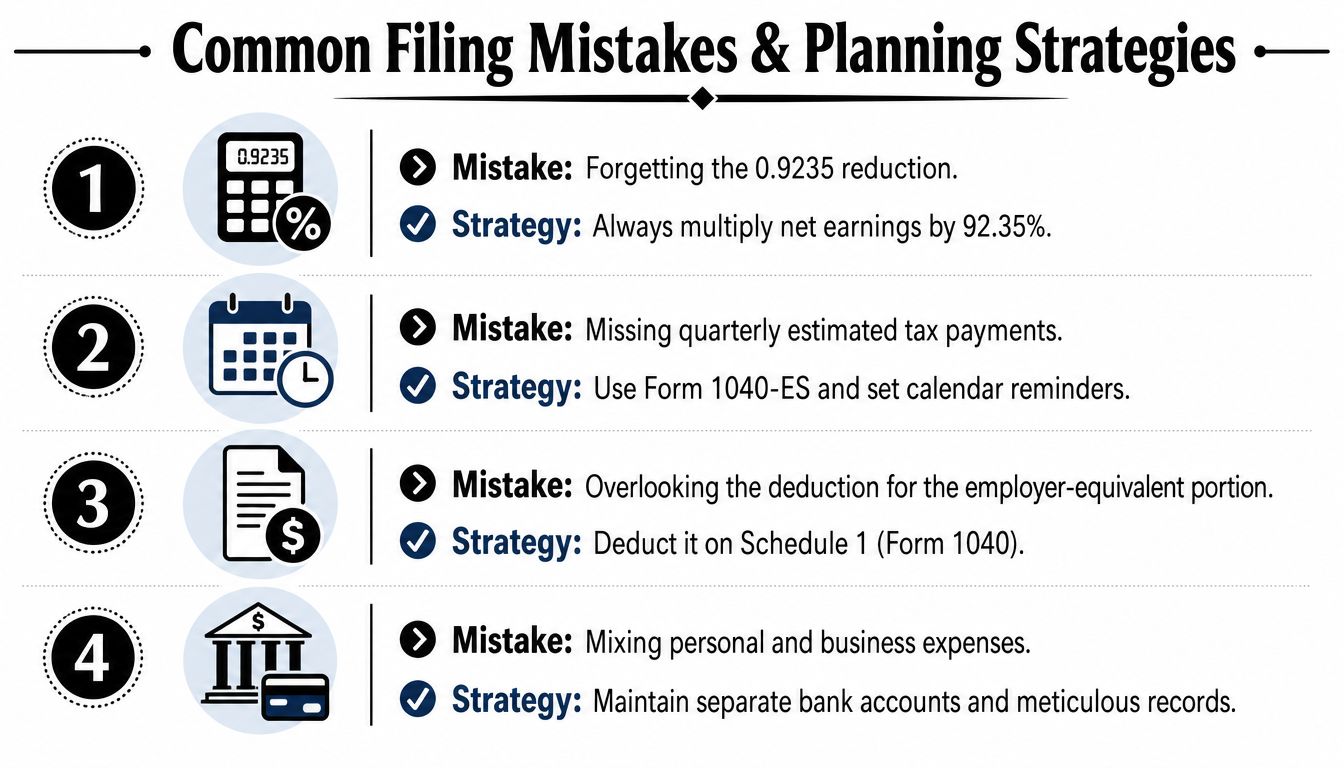
A freelancer can do the work, send the invoices, and still blow the return on a basic Schedule SE mistake. The usual problems are simple: skipping the 0.9235 reduction, missing the half-deduction, mixing gross receipts with net earnings, or assuming every dollar of income gets the same Social Security treatment. Those errors are avoidable if you slow down before filing.
The mistakes that cost money
One mistake is treating Schedule SE as a cleanup form instead of part of the return that drives tax. Another is failing to separate W-2 wages from self-employment income when the Social Security cap matters. A third is leaving out the deduction for one-half of the tax. A fourth is sloppy recordkeeping, which pushes net profit higher and creates a larger self-employment tax bill.
The IRS also uses what you report to help set future Social Security benefits, so bad entries can affect more than this year's bill. A wrong Schedule SE can distort your earnings record and create problems you do not see until later. That is why accuracy matters here, even when the dollar amount looks small.
New freelancers get caught by the $400 threshold because they assume a little side income is too small to matter. It is not. Once self-employment income clears that line, Schedule SE starts mattering fast, and people who have never filed it before usually learn that lesson the hard way.
Practical planning strategies
Good planning starts before year-end. If your profit will be meaningful, set cash aside as you earn it and keep your deductions clean so you do not inflate the SE tax base. That matters most when income rises and falls through the year.
W-2 wages need their own review. The Social Security tax cap already applies to wages, so self-employment income does not exist in a vacuum. If you have a job and a side business, separate the two correctly and do not assume the wage withholding solves the Schedule SE problem.
Entity changes can wipe out Schedule SE entirely for some income, but only if the change is real and the compensation structure matches it. An S corporation election changes how the income is taxed, it does not magically erase tax. Get that decision right before you switch, not after the return is filed.
For owners who also manage cash flow strategies for inventory businesses, preserving liquidity while making estimated payments is part of the tax plan, not a side issue. For a broader planning framework, this business tax planning guide belongs in your working file.
Keep your books boring. Separate accounts, clean categories, and honest profit numbers save more money than last-minute improvisation ever will.
If your return is simple, you can file Schedule SE yourself. If you have underpayment problems, an IRS notice, mixed W-2 and self-employment income, or more than one business entity, get help before the mistake spreads. Tax Attorney Stephen A Weisberg can review whether Schedule SE exposure exists before the IRS turns it into a notice.


