Mastering Sales Tax Overland Park KS for 2026
Get your complete 2026 guide to sales tax overland park ks. Learn the 9.36% rate, filing steps, exemptions, and how to avoid costly audits for your business.
In this article
- Decoding the Overland Park Sales Tax Rate
- The base rate is only the first question
- Taxability creates just as many mistakes as rate selection
- What usually prevents problems
- Determining Your Obligation to Collect Sales Tax
- Common nexus triggers business owners overlook
- Why the state pays attention
- A quick decision test
- Registering and Filing with the Kansas Department of Revenue
- What to gather before you register
- Filing is an accounting process first
- What works better than scrambling at deadline time
- Where owners usually get stuck
- Navigating Common Sales Tax Exemptions and Exceptions
- Exempt buyers are not the same as exempt sales
- Labor is where many service businesses get burned
- A practical way to sort transactions
- What works and what doesn’t
- Rules for Remote Sellers and Marketplace Sales
- Marketplace sales versus direct sales
- Use tax is the quiet problem
- Why platform reporting doesn’t end the discussion
- Audit Risks and Penalties for Non-Compliance
- A common audit trigger in Overland Park
- What auditors usually examine first
- Penalties are only part of the exposure
- The personal liability issue many owners miss
- How businesses actually reduce audit risk
- When You Need a Tax Attorney for Sales Tax Issues
- Situations where DIY usually stops working
- When legal strategy matters more than tax mechanics
- What professional help can change
You’re probably looking at one of three situations right now. You just opened a business in Overland Park and need to know what rate to charge. You’ve been collecting sales tax already, but you’re not fully confident the rate is right for every sale. Or you’ve realized Kansas sales tax isn’t just about selling products, and now you’re trying to sort out labor, district rates, marketplace sales, and filing before a mistake turns into a notice.
That concern is justified. Sales tax overland park ks issues look simple from a distance because the focus is often on one headline rate. In practice, Overland Park businesses run into trouble when they assume the rate is uniform, assume labor isn’t taxable, or assume their point-of-sale system is handling everything correctly without verification.
The safest approach is to treat sales tax as a system, not a line item. You need the right rate, the right sourcing, the right exemption handling, and the right filing process. If one piece is wrong, the rest doesn’t save you.
Decoding the Overland Park Sales Tax Rate
A new Overland Park retailer often starts with one simple question: “What rate do I charge?” In practice, that question has more than one right answer, and getting it wrong usually happens at the address level, not because an owner ignored the state rate.
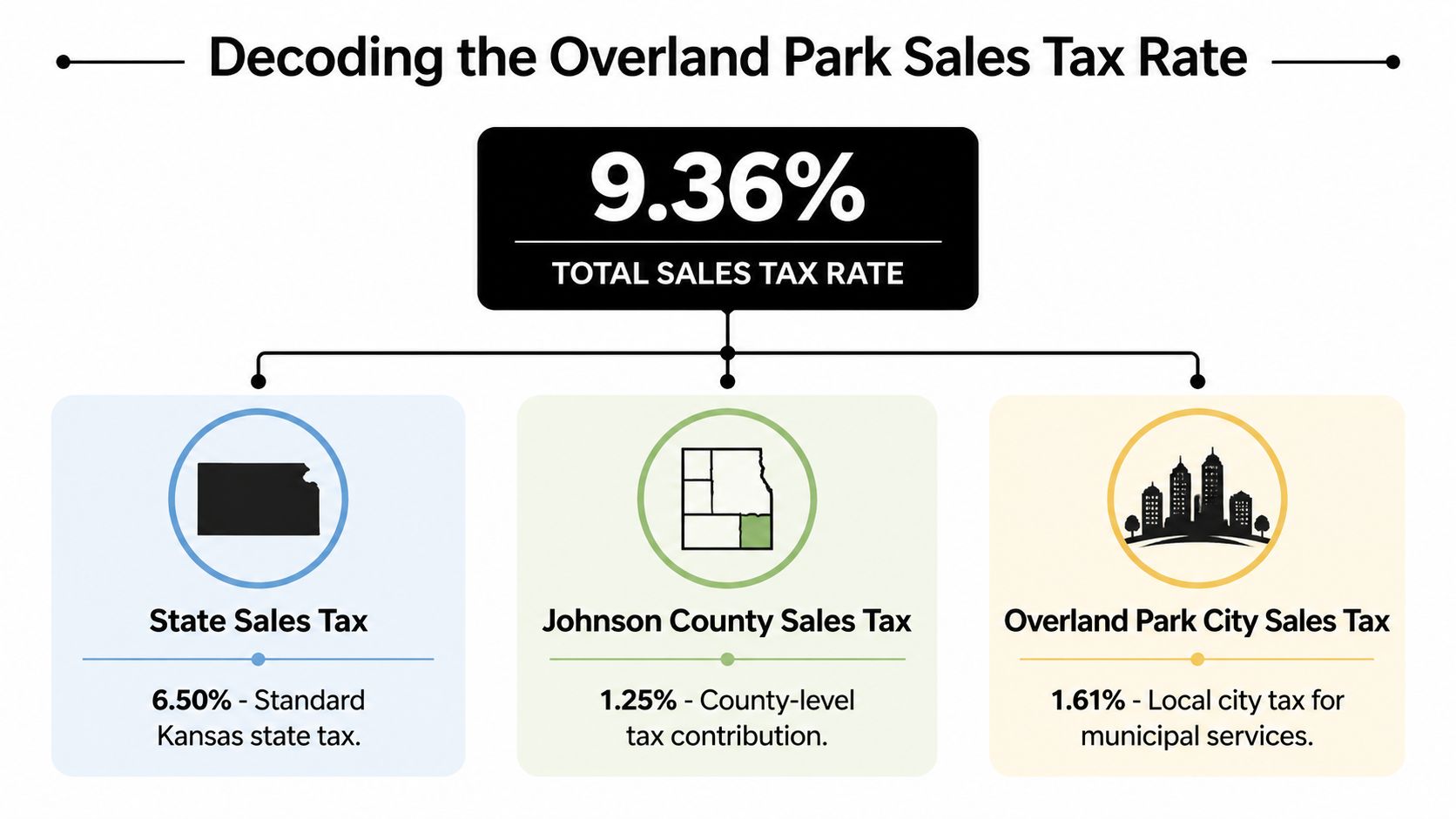
As Avalara’s Overland Park tax rate page notes, the base combined rate for Overland Park is 9.36% for 2026, built from 6.5% Kansas state sales tax, 1.48% Johnson County sales tax, and 1.38% city sales tax. Treat that as a starting point, not a citywide default you can apply everywhere without checking the location.
The problem is local district tax. A business inside a Community Improvement District or Transportation Development District may need to collect more than the base rate. That is a common miss for stores in shopping centers, mixed-use developments, and newer commercial projects. I regularly see owners rely on a POS default, a ZIP code, or a lease address summary, then learn later that the location sits inside a special district with a higher rate.
That error is expensive because Kansas will not excuse undercollection just because the software was set up incorrectly.
The base rate is only the first question
For many Overland Park sales, the base combined rate applies. Some locations do not stop there. Certain CIDs in Overland Park reach 10.35%, as noted in the same Avalara source above. If your business operates from a retail corridor or fulfills sales from more than one storefront, warehouse counter, kiosk, or temporary selling location, each site needs its own rate check.
A practical rule works better than a headline number. Use the exact sale location or delivery location that controls the transaction, then confirm whether a special district applies. Do not set tax by city name alone.
Owners who want a broader view of how local tax disputes turn into larger state tax problems should follow State and Local Tax updates. Local tax issues rarely stay local once an auditor starts asking for source documents.
Taxability creates just as many mistakes as rate selection
Rate is only half the job. Kansas also taxes categories differently, and businesses in Overland Park get into trouble when the register treats everything as ordinary retail merchandise.
Food is the clearest example. Kansas applies a reduced 4% rate on qualifying food items including groceries. A business that sells both grocery items and prepared food needs accurate product mapping, not a blanket food setting. Convenience stores, specialty markets, bakeries, and mixed retail concepts often discover too late that their item codes were never set up cleanly.
Certain products also carry separate excise tax obligations, including alcoholic beverages, cigarettes, and motor fuel. Those taxes do not replace sales tax collection. They sit alongside it, which means the bookkeeping and reporting need to match the product line.
This is also where owners should be realistic about systems. Good software helps, but software only follows the taxability rules and location data you give it. If you are reviewing vendors, this guide to sales tax compliance for businesses is a useful starting point. It does not replace legal review when your facts are messy.
What usually prevents problems
Businesses in Overland Park avoid most rate errors when they do three things early and repeat them after any change:
- Confirm the exact selling location. Check whether the address falls inside a CID or TDD before the first taxable sale.
- Map products and services correctly. Groceries, prepared foods, retail goods, and regulated products should not all sit in one tax category.
- Retest after changes. A move, second location, remodel, pop-up, or new delivery pattern can change the result.
The common mistake is simple. Owners use one “Overland Park rate” for every sale and assume the rest will sort itself out. In Kansas, that assumption is how small setup errors turn into assessment notices.
Determining Your Obligation to Collect Sales Tax
A lot of owners focus on rate questions before they answer the more basic one. Do you have to collect Kansas sales tax at all?
That answer turns on nexus, which is just a practical way of asking whether your business has enough connection to Kansas that the state can require you to register, collect, and file. If your business has a footprint in Kansas, you should assume this question matters immediately.

Common nexus triggers business owners overlook
A storefront in Overland Park is the obvious example. But it’s not the only one.
Businesses often create Kansas sales tax obligations through facts like these:
- A physical location: Retail shop, office, studio, warehouse, or service location in Kansas.
- People working in Kansas: Employees, managers, technicians, or sometimes remote staff performing business functions in the state.
- Inventory in Kansas: Goods stored locally, whether in your own space or through a third-party arrangement.
- Regular in-state selling activity: Sales calls, on-site service work, installations, or recurring in-person transactions tied to Kansas customers.
The legal analysis can get technical fast, especially if you sell in multiple states or use hybrid channels like in-person sales plus online orders plus marketplace listings. But for a new Overland Park business owner, the practical test is simpler. If your business operates in Kansas in a meaningful way, assume registration and collection need review.
Why the state pays attention
This isn’t a minor tax category for the city. Sales tax generated $100,255,940 in 2022 for Overland Park, exceeding property tax revenue of $56,645,806, according to the City of Overland Park annual financial report materials. That same city material notes that restaurants and food services are among the largest contributors to the sales tax base.
That matters because jurisdictions protect major revenue streams. When a tax funds local operations at that level, compliance becomes an enforcement priority, especially for businesses handling frequent taxable transactions.
Overland Park’s sales tax base is broad enough that businesses shouldn’t assume they’re too small or too routine to attract attention.
For owners building internal processes, a practical external reference on sales tax compliance for businesses can help frame the larger compliance workflow, especially if you’re comparing in-house handling versus software plus outside review.
A quick decision test
If any of the following sounds like your business, don’t leave nexus unanswered:
| Business situation | Why it matters |
|---|---|
| Local shop or service business | Physical presence usually creates collection responsibility |
| Contractor or repair business working on-site in Kansas | In-state activity can create sales tax duties |
| Online seller with Kansas operations | Digital sales don’t erase in-state obligations |
| Business with inventory or staff in Kansas | Operational presence often changes the analysis |
What doesn’t work is waiting for a notice before deciding whether nexus existed. By then, the issue is rarely just registration. It becomes back tax, filings, penalties, and record reconstruction.
Registering and Filing with the Kansas Department of Revenue
Once your business has a collection obligation, the next problem is procedural. Many owners know they should “get registered,” but they don’t know what information to assemble, what records to keep, or what makes filing go smoothly month after month.
That’s where simple discipline matters. A clean registration and filing setup prevents a lot of downstream trouble.

What to gather before you register
Kansas businesses generally need core formation and tax information ready before they start the registration process. In practice, that usually means your legal business name, entity type, federal identification information if applicable, business address, mailing address, ownership details, and a clear description of what you sell.
If the business has more than one activity, be precise. A retailer that also installs products, a restaurant that also sells packaged goods, or a contractor who both improves real property and repairs tangible personal property can create different tax treatment across revenue streams. If your registration description is sloppy, the filing setup often becomes sloppy too.
I also recommend matching your registration data to your bookkeeping records from the start. If the ownership name, address, and bank deposit trail don’t line up, the filing process gets harder later.
Filing is an accounting process first
Businesses tend to think filing problems are tax problems. Many are recordkeeping problems.
Your sales tax returns are only as good as the underlying sales records, exemption records, district coding, and deposit reconciliation. If your books are disorganized, cleaning them up before filing matters. For owners trying to reconstruct records from transaction history, this guide on tax accounting with bank statements can be useful when you’re tracing deposits and matching them to taxable sales activity.
A reliable process usually includes:
- Separate taxable and non-taxable sales clearly: Don’t leave this to memory at filing time.
- Reconcile gross sales to deposits: If the return doesn’t tie to the books, expect questions later.
- Track exempt sales with documents: A claimed exemption without support is often treated as taxable.
- Review district assignments periodically: Especially if you deliver, install, or operate at more than one address.
What works better than scrambling at deadline time
A short monthly close is better than a heroic quarterly cleanup. Businesses that close sales records consistently catch rate errors, exemption issues, and data-entry mistakes while they can still fix them.
Practice point: Sales tax compliance gets easier when you build it into your monthly bookkeeping close instead of treating it as a separate filing chore.
If you want a broader operational framework, this small business tax checklist is a good companion because sales tax problems often start where general tax admin breaks down.
Where owners usually get stuck
The hardest part usually isn’t the first filing. It’s staying consistent once real life intervenes. A new point-of-sale system, ownership change, seasonal spike, change in menu or product mix, or added delivery area can all break a filing routine that worked fine before.
When that happens, stop guessing from old returns. Review the underlying setup. Sales tax is unforgiving when a business keeps repeating the same filing mistake because “that’s how we did it last time.”
Navigating Common Sales Tax Exemptions and Exceptions
Most sales tax mistakes aren’t caused by charging too much tax. They’re caused by failing to collect tax on transactions the owner assumed were exempt.
Kansas exemptions are manageable if you sort them into the right buckets. The trouble starts when businesses mix up exempt buyers, exempt items, and exempt transactions, then assume the same logic applies across all three.
Exempt buyers are not the same as exempt sales
Some purchasers may be exempt in certain situations, but that doesn’t mean every transaction with that customer is automatically exempt. The business needs proper documentation, and it needs to keep that documentation organized.
If you accept an exemption claim casually and don’t keep the paperwork, you’ve shifted the risk to yourself. In an audit, unsupported exempt sales often get pulled back into taxable sales.
A good working rule is simple. If the file doesn’t contain the document, act as though the exemption doesn’t exist.
Labor is where many service businesses get burned
This is the point many businesses miss. In Kansas, labor isn’t automatically outside sales tax.
Kansas taxes labor for installing, repairing, or servicing tangible personal property, not just the materials involved. The example cited in this Kansas sales tax summary discussing KS-1525 is direct: a $1,000 auto repair with $600 in parts and $400 in labor is taxed on the full $1,000.
That rule catches a wide range of businesses by surprise:
- Auto repair shops: Labor to repair vehicles is part of the taxable charge.
- Appliance repair businesses: The service call may feel like “labor only,” but if it’s repairing tangible personal property, tax analysis changes.
- Installers and technicians: Assembly, setup, and service work connected to tangible personal property can create tax where owners expected none.
- Jewelry and specialty repair businesses: Small-ticket labor can still be taxable.
If your business touches a physical item the customer owns, don’t assume the labor is exempt just because you didn’t sell a large amount of parts.
A practical way to sort transactions
The easiest way to avoid overconfidence is to classify transactions before you invoice them.
| Transaction type | Practical concern |
|---|---|
| Sale of goods | Usually the most obvious taxable category |
| Sale to exempt buyer | Documentation controls the outcome |
| Labor on tangible personal property | Frequently taxable even when owners assume otherwise |
| Mixed invoice with taxable and non-taxable elements | Poor line-item detail can create audit problems |
This is why invoice design matters. A vague invoice that lumps together products, labor, and miscellaneous charges makes review harder for everyone, including your own bookkeeper.
What works and what doesn’t
What works is consistent documentation and category-based thinking. Ask what is being sold, who is buying it, and whether the labor is tied to tangible personal property.
What doesn’t work is relying on industry folklore. Contractors hear one thing from another contractor. Shop owners copy an invoice template from a competitor. A technician says, “We’ve never charged tax on labor.” None of that carries weight when the state reviews the records.
If your business has mixed sales, mixed invoices, or recurring exemption claims, it’s worth reviewing your transaction flow before the mistake becomes embedded in hundreds of invoices.
Rules for Remote Sellers and Marketplace Sales
E-commerce creates a different kind of confusion. Owners often assume that if a platform collects tax on some sales, their compliance problem is solved everywhere. It usually isn’t.
The key distinction is where the sale happens and who controls the collection process. Marketplace transactions and direct website transactions don’t always sit in the same compliance bucket.
Marketplace sales versus direct sales
If you sell through a marketplace platform, the platform may handle tax collection and remittance for sales made through that marketplace. That changes the seller’s day-to-day collection role for those specific transactions.
But it doesn’t necessarily eliminate everything else you have to do. Your own website sales, local direct invoices, in-person sales, custom orders, phone orders, or off-platform transactions may still require your business to collect and report tax properly.
That means a business can have two very different compliance tracks running at once:
| Sales channel | Common issue |
|---|---|
| Marketplace platform | Owners assume platform handling covers all sales |
| Own website | Seller often remains responsible for collection and records |
| Direct local sales | In-person activity still needs correct rate and documentation |
| Hybrid model | Reconciliation gets messy fast |
The accounting side is where errors appear. If marketplace deposits, direct sales revenue, and local point-of-sale records all land in the same books without clear separation, your returns can become inconsistent with your actual tax responsibility.
Use tax is the quiet problem
A second issue remote and digital-first businesses miss is use tax. If your business buys equipment, supplies, software, fixtures, or other items from an out-of-state seller and no Kansas sales tax is properly collected, the analysis may shift to use tax.
This matters for businesses that buy online constantly but only think about tax on the selling side. In practice, a company can be current on sales tax collection and still have exposure from untaxed business purchases.
The businesses most likely to miss this are usually the ones moving fast: growing online retailers, service firms ordering tools from multiple vendors, and owner-operated businesses buying through apps and vendor portals without a review process.
Remote selling doesn’t simplify tax. It just moves the pressure points from the cash register to the sales channel map and the purchasing process.
Why platform reporting doesn’t end the discussion
Marketplace reporting can be helpful, but it isn’t a substitute for understanding your own records. You still need to know what the platform collected, what you collected directly, and what business purchases may require separate tax attention.
For businesses also dealing with payment platform reporting confusion, this discussion of the 1099-K reporting mess and shifting IRS rules is useful background because information reporting and sales tax records often collide in messy ways.
The practical takeaway is simple. Don’t treat marketplace collection as a blanket compliance shield. Treat it as one piece of a broader recordkeeping and tax responsibility system.
Audit Risks and Penalties for Non-Compliance
A common Overland Park problem starts like this. A business uses one default rate in its point-of-sale system, assumes it covers the city, and later learns some transactions fell inside a CID or TDD with a higher combined rate. By then, the tax was undercollected, the returns were filed, and the owner is paying the difference out of pocket.
Sales tax problems get expensive fast because this is money the state expects you to collect, hold, and remit correctly. Kansas does not treat repeated sales tax errors as a small bookkeeping flaw. It treats them as a compliance failure, and auditors usually begin with the easiest inconsistencies to prove.

A common audit trigger in Overland Park
District-rate accuracy is one of the clearest local risk points. Yondatax’s Overland Park summary notes that businesses that fail to geocode sales correctly can undercollect in higher-rate CID areas, and that the exposure can include tax, penalties, interest, and possible trust-fund issues for responsible individuals.
That risk is higher than many owners expect. Overland Park is not just one clean citywide rate. If your business delivers goods, performs work at customer locations, or operates near special taxing districts, a default setting in your software can create a long trail of undercollection.
I see this most often in growing businesses. The owner gets the state registration done, starts filing, and assumes the hard part is over. A significant problem shows up later, when no one has tested whether the invoice address, taxability decision, and actual district rate line up.
What auditors usually examine first
Audits usually start with visible mismatches between your return, your invoices, and your books.
The first review often centers on issues like these:
- District mismatches: The sale location does not support the rate charged.
- Untaxed labor that should have been taxed: Service-heavy invoices are a recurring problem, especially when taxable and nontaxable work are mixed together.
- Exempt sales without records: The return shows exempt transactions, but the business cannot produce the certificate or supporting file.
- Bundled invoices: Charges are combined in a way that makes the taxable portion hard to verify.
- Book-to-return differences: Gross receipts, deposits, and taxable sales reported to Kansas do not reconcile.
Those are practical audit points, not technical trivia. They also explain why businesses that know the headline rate can still get into trouble. In Overland Park, the expensive mistakes are often hidden in district coding, invoice design, and labor classification.
Good records do not prevent every audit. They give you a shorter audit, a narrower dispute, and a better chance of limiting the assessment.
Penalties are only part of the exposure
The tax itself is usually just the starting number. Add penalties, interest, and the time required to reconstruct missing records, and a manageable filing issue can turn into a cash-flow problem.
Owners also underestimate how quickly an audit broadens. An examiner who finds one district-rate error may start looking at exemption support, labor charges, resale claims, and whether the returns match the accounting system. If the business used collected tax funds for operations, the issue gets more serious.
That is the point where many businesses need legal help, not just amended returns. If you are trying to judge whether the matter has crossed from cleanup into exposure management, this guide on when to hire a tax attorney for a tax dispute or audit problem will help you frame that decision.
The personal liability issue many owners miss
Sales tax can create personal exposure for the people who controlled collection and payment decisions. Owners often assume the liability stays with the company. That assumption can be dangerous.
If the business collected tax and failed to remit it, the state may look closely at who had authority over the funds, who signed returns, and who decided which bills got paid. For a business already dealing with tight cash flow, that can turn a tax problem into a personal-risk problem.
How businesses actually reduce audit risk
The businesses that handle this well usually rely on a few boring controls, applied consistently.
| Control | Why it helps |
|---|---|
| Address-level rate verification | Reduces CID and TDD errors |
| Invoice review | Catches taxable labor and bundled-charge problems |
| Exemption certificate process | Supports claimed exempt sales |
| Periodic return-to-book reconciliation | Finds reporting drift before an auditor does |
Small businesses are not invisible. Inconsistent data, missing exemption support, and wrong district rates are easy audit entry points. In practice, the businesses that avoid the worst outcomes are usually the ones that catch those problems internally before Kansas does.
When You Need a Tax Attorney for Sales Tax Issues
Some sales tax problems are manageable with better bookkeeping, better software setup, or a careful review by your CPA. Others have already crossed into legal-risk territory.
The hard part is recognizing that point early enough to preserve options.
Situations where DIY usually stops working
If you’ve received an audit notice, a demand for back returns, or a proposed assessment tied to district rates, exemptions, or uncollected tax, you’re no longer dealing with a simple setup issue. You’re dealing with exposure, response strategy, and record defense.
The same is true if you’ve discovered the problem yourself. Maybe your business charged the wrong rate for a long stretch. Maybe labor that should have been taxed wasn’t. Maybe marketplace and direct sales were blended together and the returns don’t reflect the true situation. Once the liability is material to your business, the question shifts from “How do I file this?” to “How do I limit damage and correct this without making it worse?”
Existing online resources often oversimplify Overland Park sales tax and fail to explain CID and TDD rate variation adequately, creating undercollection risk that can lead to assessments and penalties requiring professional intervention, as noted by the Overland Park Chamber tax resource page.
When legal strategy matters more than tax mechanics
There are several moments when legal guidance becomes especially important:
- You received a state audit or assessment notice: Deadlines, record production, and issue framing matter immediately.
- You may face responsible-person exposure: If collected tax wasn’t remitted, personal liability concerns become real.
- Your records are incomplete: Reconstructing the file is one task. Deciding how to present and defend it is another.
- You operate across multiple states or entities: Nexus, sourcing, and reporting positions can create overlapping risks.
- You need a resolution path, not just a corrected return: Payment problems, old periods, and cumulative liabilities require strategy.
A tax attorney isn’t just there to explain the law. The attorney’s role is to evaluate exposure, protect your position in communications, and shape how the issue is resolved.
Businesses often wait too long because they think hiring counsel means the issue is already out of control. In reality, early intervention usually preserves more options.
What professional help can change
The value of counsel isn’t theoretical. It shows up in decisions like these:
| Problem | Why legal help may matter |
|---|---|
| Audit notice | Response strategy affects scope and outcome |
| Past undercollection | Correction plans can create admissions if handled poorly |
| Personal exposure concerns | Responsible-person issues need careful handling |
| Large unresolved state debt | Negotiation and resolution become central |
For business owners trying to judge the right time, this article on when to hire a tax attorney gives a useful framework.
The practical standard is simple. If the issue could threaten cash flow, create personal exposure, disrupt a sale or financing event, or put years of returns under review, get legal advice before you start explaining the problem to the state in detail.
Sales tax is one of those areas where confident guessing causes expensive cleanup. If you’re still at the setup stage, build the system correctly. If you’re already in trouble, treat it like the legal and financial problem it is.
If you’re dealing with sales tax problems in Overland Park, Kansas, or broader state or IRS tax issues, Attorney Stephen A Weisberg offers a practical starting point. He has over 10 years of experience representing individuals, businesses, and business owners with tax debt issues, audits, and other state and IRS problems, and he begins with a FREE Tax Debt Analysis to determine whether he can help and what options may be available before charging for resolution work.


