Sales Tax Due Dates Texas 2026: Don't Miss Deadlines
Get all 2026 sales tax due dates texas. Avoid penalties! Understand monthly, quarterly, & annual deadlines to stay compliant.

In this article
- How Texas Determines Your Sales Tax Filing Frequency
- Why the state assigns different schedules
- What to review in your own account
- What works in the real world
- Your 2026 Texas Sales Tax Due Dates Calendar
- 2026 Texas sales tax filing due dates
- Three common real-world examples
- Why a simple calendar is not enough
- Understanding Weekend and Holiday Due Date Shifts
- Where owners get tripped up
- The prepayment wrinkle
- A practical calendar habit
- Penalties and Interest for Late Sales Tax Filings
- The bigger operational risk
- Relief exists, but timing matters
- What works when you're already behind
- Navigating Electronic Filing and Payment Mandates
- Webfile for ordinary filing
- TEXNET timing is different
- What actually works
- How to Request a Change in Your Filing Frequency
- When a change makes sense
- How to handle the request
- Filing a Zero Tax Due or Amended Return
- Zero returns still matter
- Amended returns need a reason and a paper trail
- The legal reason to fix mistakes quickly
- Official Resources and Next Steps for Texas Businesses
- The core resources to keep bookmarked
- Where owners often need help
- The practical next step
- Texas Sales Tax Due Date FAQs
- Does Texas franchise tax use the same deadline as sales tax
- Can I be personally liable for unpaid Texas sales tax
- What if my business has no tax due for the period
Texas sales tax returns are due on the 20th day of the month following the reporting period whether you file monthly, quarterly, or annually. If the 20th falls on a weekend or holiday, the deadline moves to the next business day.
If you're searching for sales tax due dates texas, you're probably not looking for theory. You're trying to answer a practical question: when do I need to file, when do I need to pay, and what happens if I miss it?
That urgency is warranted. Sales tax is trust-fund money. Your business collects it from customers, but the state expects it to be turned over on time and in the correct amount. When a business misses returns, files late, or pays late, the problem can grow from an administrative nuisance into penalties, interest, payment-plan negotiations, and in some cases loss of the sales tax permit that keeps the business operating legally.
A clean compliance system matters more than most owners think. The due date rule is simple. The consequences of getting it wrong aren't.
How Texas Determines Your Sales Tax Filing Frequency
A common problem looks like this. A Texas business starts small, files on one schedule, grows fast, and keeps following the old routine until the Comptroller notices the mismatch. By then, the owner is not just fixing a calendar issue. The owner is dealing with late-filed returns, interest, penalties, and sometimes a harder conversation about whether the business has been handling trust-fund tax properly.
Your filing frequency is the starting point. Texas does not let businesses pick the schedule that feels most convenient. The Comptroller assigns a filing frequency based largely on how much sales tax your business is collecting and remitting, and that assignment can change as the business changes.
In practice, businesses with higher average monthly sales tax liability are usually placed on a monthly filing schedule. Businesses with lower liability may qualify for quarterly or annual filing. The important point is not the label. The important point is that the state expects you to follow the filing frequency assigned to your permit account unless and until that assignment changes.
Why the state assigns different schedules
Texas wants tax money turned over closer to the time it is collected. If a business is collecting more tax, the state has a stronger interest in shorter reporting cycles. From an enforcement standpoint, that lowers the risk that collected tax gets absorbed into operating cash and becomes harder to pay later.
For a small business owner, that has a practical consequence. Filing frequency is an early warning sign of compliance risk. If revenue rises and your systems stay informal, sales tax problems often show up before the owner realizes the filing schedule should have changed.
What to review in your own account
Start with the state account, not your memory.
- Confirm your assigned frequency: Check whether your permit account shows monthly, quarterly, or annual filing.
- Compare it to current collections: If your taxable sales or tax due have changed materially, review whether your current filing pattern still makes sense.
- Watch growth tied to nexus: Remote sales, marketplace activity, and multi-state expansion can change the broader compliance picture quickly. If that issue is part of your business, read Jumpstart Partners' nexus guide.
- Separate sales tax from income tax deadlines: Owners regularly mix up Texas sales tax returns with federal estimated tax payments. They are different systems with different consequences. For the federal side, see this quarterly tax payment deadlines guide.
What works in the real world
Monthly reconciliation works. So does assigning one person to verify the Comptroller account, the return period, and the payment confirmation every filing cycle. If sales increase sharply, review your filing status before the state sends a notice.
What fails is a casual system. Bookkeepers change. POS settings drift. Owners get busy. I often see frequency problems start during growth periods, when tax compliance gets pushed behind payroll, inventory, and customer demand. That is why this issue matters. A filing-frequency mistake can turn a manageable tax duty into a debt problem that costs far more to fix than it would have cost to prevent.
Your 2026 Texas Sales Tax Due Dates Calendar
A common problem starts like this. A business owner knows Texas sales tax is due on the 20th, assumes that is simple enough, and then learns too late that the return period, payment timing, and internal close process were not aligned. The date itself is easy. Staying compliant is what takes discipline.
For 2026, Texas sales tax returns generally will be due on the 20th day of the month after the reporting period. Monthly filers will report each prior month. Quarterly filers will report each calendar quarter. Annual filers will report the full calendar year on a return due in January 2027. Use the calendar below as a planning tool, then build your bookkeeping and payment workflow around it.
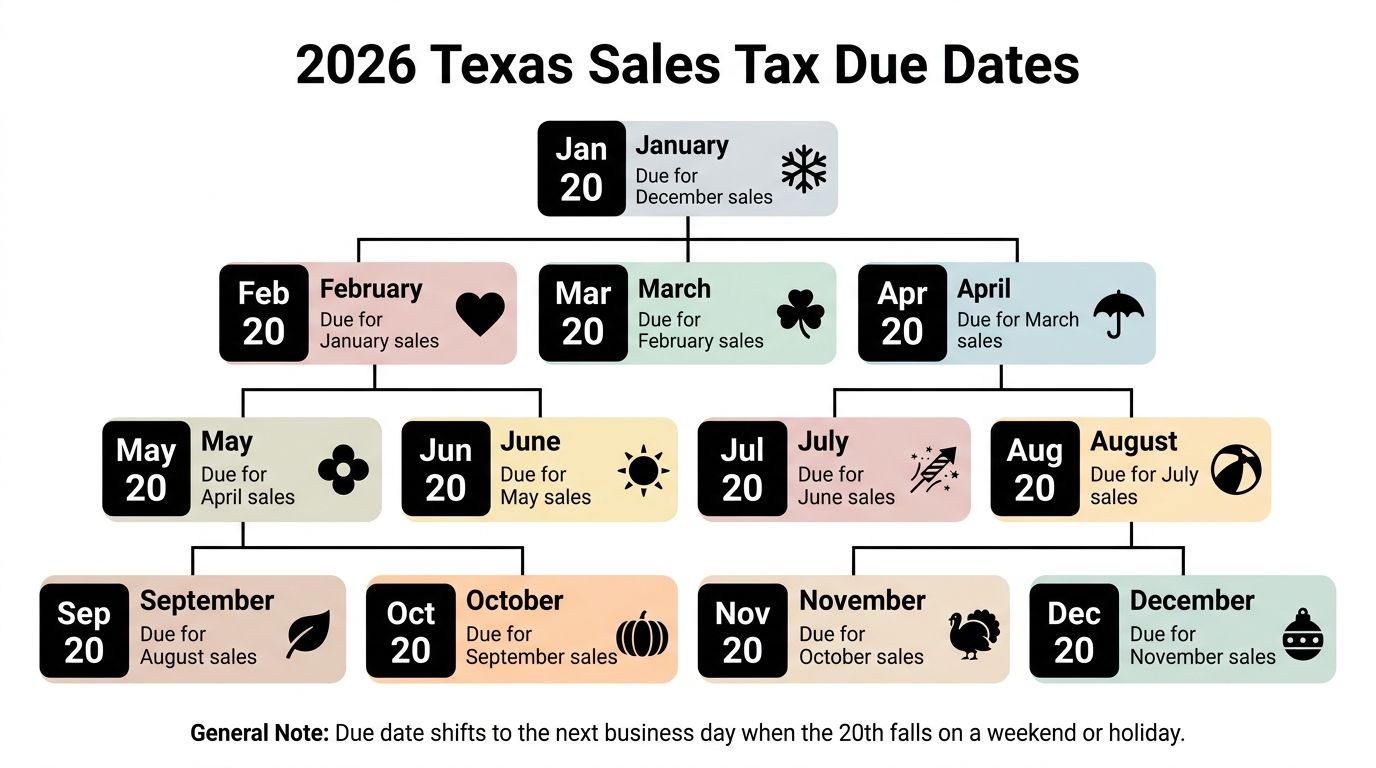
2026 Texas sales tax filing due dates
| Reporting Period | Monthly Filer Due Date | Quarterly Filer Due Date | Annual Filer Due Date |
|---|---|---|---|
| January 2026 | February 20, 2026 | Not applicable | Not applicable |
| February 2026 | March 20, 2026 | Not applicable | Not applicable |
| March 2026 | April 20, 2026 | April 20, 2026 for Q1 | Not applicable |
| April 2026 | May 20, 2026 | Not applicable | Not applicable |
| May 2026 | June 20, 2026 | Not applicable | Not applicable |
| June 2026 | July 20, 2026 | July 20, 2026 for Q2 | Not applicable |
| July 2026 | August 20, 2026 | Not applicable | Not applicable |
| August 2026 | September 20, 2026 | Not applicable | Not applicable |
| September 2026 | October 20, 2026 | October 20, 2026 for Q3 | Not applicable |
| October 2026 | November 20, 2026 | Not applicable | Not applicable |
| November 2026 | December 20, 2026 | Not applicable | Not applicable |
| December 2026 | January 20, 2027 | January 20, 2027 for Q4 | January 20, 2027 |
Three common real-world examples
A Houston restaurant that files monthly will report tax collected in August on a return due September 20, 2026. That schedule gives the owner less room for cleanup, but it also forces faster reconciliation and usually catches errors before they grow into a larger state balance.
An Austin consultant on quarterly filing will report the July through September period with a due date of October 20, 2026. That filing pattern reduces the number of returns, but it also increases the amount at stake if records are wrong or the business misses the deadline.
A small side business selling crafts online that remains on annual filing will report calendar-year activity on a return due January 20, 2027. Owners often treat annual filing as permission to wait. It is not. If exemption certificates, marketplace records, or taxable sales data are incomplete, year-end cleanup is harder and late-payment exposure is larger.
Put the filing deadline and the payment deadline on the same calendar reminder. Filing without payment can still create penalty and interest problems.
Why a simple calendar is not enough
A due date calendar helps, but it does not prevent tax debt by itself. Businesses still need time to close the books, verify taxable and nontaxable sales, confirm exemptions, and make sure the person filing has current Comptroller login access and correct bank information.
I see late filings come from process failures more often than from confusion about the 20th. A return sits waiting for sales data. The owner approves the filing but not the payment. A staff change leaves nobody with portal access. Those are ordinary administrative mistakes, but Texas can treat them as compliance failures with real financial consequences.
Understanding Weekend and Holiday Due Date Shifts
The rule sounds easy until the calendar interferes. When the 20th falls on a Saturday, Sunday, or holiday, Texas shifts the deadline to the next business day, and one cited example is that a Saturday June 20, 2026 deadline moves to Monday, June 22 according to TaxConnex's Texas sales tax discussion.
That sounds minor. It isn't.

Where owners get tripped up
Some businesses build a recurring workflow around "the 20th" and never revisit it. Then a weekend shift happens, a staff member assumes the original date still controls, and nobody checks whether payment timing changed along with the filing date.
That risk increases when the business has layered obligations, especially if it's also dealing with prepayments or changing filing frequency.
The prepayment wrinkle
The same source notes that prepayment deadlines on the 15th also shift, which creates a second timing issue. The filing deadline may move, but so can a prepayment date. Those shifts don't excuse a missed payment.
Calendar the legal due date, then calendar an internal deadline several business days earlier. That's the safer practice for any business with more than one person touching the process.
A practical calendar habit
Use a compliance calendar that flags all of these separately:
- Return preparation date: when bookkeeping must be complete
- Internal approval date: when the owner or controller signs off
- Payment release date: when the payment gets initiated
- Legal due date: the state deadline after applying any weekend or holiday shift
That structure works because it removes guesswork. What doesn't work is relying on memory or on a generic monthly reminder that says only "sales tax due."
Penalties and Interest for Late Sales Tax Filings
A missed Texas sales tax deadline rarely stays small. What starts as one late return can turn into penalties, interest, collection pressure, and in serious cases, problems with your sales tax permit.
Texas treats sales tax as trust money collected from customers for the state. That is why late filings draw a harder response than many owners expect. Once the account becomes delinquent, the balance usually grows, and the state may begin looking beyond the tax itself to whether the business is still handling its tax duties responsibly.

The bigger operational risk
The immediate cost is only part of the problem. A late account can also trigger collection action, consume management time, and create bank and cash flow issues at the worst possible moment. For a small business, that often matters more than the first penalty notice.
Repeated noncompliance raises a more serious concern. Texas can suspend or revoke a sales tax permit for continued delinquency. At that point, the issue is no longer limited to catching up on paperwork. The business may lose the legal ability to collect sales tax and continue normal operations, and owners or responsible parties can face personal exposure in some situations.
Relief exists, but timing matters
Owners usually have two practical options once they fall behind.
- Payment arrangements: If the balance is still manageable, contacting the Comptroller early may keep the account from getting worse while you bring filings current.
- Penalty relief: In the right case, some penalties may be reduced or removed. If that may apply, this guide to Texas tax penalty abatement options explains what usually helps and what does not.
Silence is expensive.
What works when you're already behind
File every missing return first, even if full payment is not available yet. Texas is more likely to work with a business that has made the account accurate and can show a realistic plan to stay current. I often tell owners to solve the filing problem before trying to solve the balance problem. That sequence gives you cleaner numbers, a stronger request for relief, and fewer surprises later.
Partial payments without complete filings usually do not fix much. They can leave older periods unresolved, keep notices coming, and make it harder to negotiate from a position of credibility.
The primary goal is not just getting through this month. It is stopping a late filing from becoming tax debt that follows the business for years.
Navigating Electronic Filing and Payment Mandates
Most Texas businesses handle sales tax through electronic systems, and that is usually where compliance succeeds or fails in practice. For many small businesses, the issue isn't the tax calculation. It's whether the return was submitted through the right portal and whether payment was initiated on time.
The standard workflow for many filers is Webfile. The danger zone for larger payments is TEXNET.

Webfile for ordinary filing
For most small and mid-sized businesses, Webfile is the normal place to submit the return and arrange payment. The best practice is to confirm login access, bank information, and user permissions before filing week. That sounds basic, but access issues are one of the most common reasons a timely intent turns into a late filing.
If you're managing several tax accounts, this overview of the Business Tax Account changes for business owners is a useful reference point.
TEXNET timing is different
For high-volume filers using TEXNET, payments over $1,000,000 must be initiated by 8 p.m. CT on the banking business day prior to the due date, while payments of $1,000,000 or less can be initiated by 10:00 a.m. CT on the due date itself, according to the Texas Comptroller sales tax page.
That distinction matters because a filer can submit a return on time and still have a late payment if TEXNET initiation happens after the applicable cutoff.
What actually works
A practical electronic filing routine looks like this:
- Confirm the filing platform early: Don't wait until the due date to learn whether the account uses Webfile or TEXNET.
- Test access before deadline week: Make sure the right person can log in and has authority to submit.
- Separate return completion from payment initiation: A finished return doesn't mean the payment was released correctly.
- Treat large-dollar months differently: A business that is usually below the TEXNET threshold can have an unexpectedly large month. Review the amount before assuming your normal routine still works.
The filing system is part of compliance. It isn't an afterthought.
How to Request a Change in Your Filing Frequency
A filing frequency that fit your business last year may be wrong now. Businesses grow, contract, change sales channels, and add locations. When that happens, your sales tax filing rhythm may need to change too.
The practical trigger is simple. If your current filing schedule no longer matches your actual tax liability pattern, review it with the Comptroller rather than continuing under a stale setup.
When a change makes sense
Common situations include:
- Sales have increased: A business that used to fit comfortably on a less frequent cycle may need more frequent reporting.
- Sales have dropped: If liability has stayed lower for a sustained period, a less burdensome schedule may be appropriate.
- The business model changed: Adding ecommerce, wholesale channels, or new locations can affect the account's reporting profile.
How to handle the request
Start by gathering a clean record of recent sales tax activity. Then compare that to the filing frequency currently assigned on your account. If the numbers and the assigned schedule don't line up, contact the Comptroller and ask what documentation is needed to review a frequency change.
Keep the request organized. Provide the periods at issue, explain why the current frequency no longer fits, and keep a copy of every communication. If the state changes your filing frequency, confirm the effective period in writing and update your calendar immediately.
What works is proactive communication. What doesn't work is assuming the state will automatically adjust your status at the exact moment your business changes.
Filing a Zero Tax Due or Amended Return
One of the most common mistakes in sales tax compliance is assuming no sales means no return. It doesn't. If your permit is active and a return is required for that period, you still need to file even when you owe zero tax due.
That rule catches side businesses, seasonal sellers, and owners who temporarily stop operating but never formally close the account.
Zero returns still matter
A zero return tells the state that the reporting period wasn't ignored. It closes the filing period and reduces the chance that the Comptroller treats the account as delinquent or estimates liability.
Use that discipline especially if your business has irregular sales. The months with little or no activity are often the months owners forget to file.
A zero-tax period is still a reporting period. File it and move on.
Amended returns need a reason and a paper trail
If you discover an error on a previously filed return, correct it promptly. Common examples include reporting the wrong sales figure, missing taxable transactions, or misclassifying exempt sales.
A sound amendment process usually looks like this:
- Identify the exact period: Don't make a general correction without tying it to the specific return.
- Rebuild the numbers: Pull the sales records, exemption support, and prior filing copy.
- Document why the original filing was wrong: The state may not ask immediately, but you should be prepared.
- Submit the correction in the proper format: If you need general guidance on correction mechanics, this article on how to amend a tax return is a useful starting point.
The legal reason to fix mistakes quickly
If an amended return shows additional tax due, delay makes the account harder to manage. If it shows an overpayment, poor records can slow your ability to support the correction. Either way, speed and documentation help.
What doesn't work is waiting for the state to point out the error first. Voluntary correction usually puts you in a better position than reactive cleanup.
Official Resources and Next Steps for Texas Businesses
A useful sales tax system depends on official tools, not screenshots from social media or half-remembered advice from another business owner. If you're handling compliance internally, build your process around the Comptroller's own resources.
Keep a small, reliable toolkit.
The core resources to keep bookmarked
Use these categories in your internal procedures:
- The main Texas sales tax information hub: This is the first place to confirm state guidance, account requirements, and filing logistics.
- The Webfile login and account access area: Whoever files should be able to reach it without scrambling for credentials.
- Relevant state forms and instructions: If a filing issue or account problem develops, you'll want the official form set, not a third-party summary.
- Your internal records folder: Save filed returns, payment confirmations, notices, and supporting workpapers together.
Where owners often need help
Businesses usually seek outside help at one of three moments. First, when notices start arriving and the owner isn't sure which problem matters most. Second, when multiple missed periods have to be reconstructed. Third, when personal exposure becomes a concern because the state is treating the tax as trust-fund money tied to responsible individuals.
For teams trying to improve operations before problems start, it can also help to review outside process guidance on how to streamline sales tax processes in a way that fits your current workflow.
The practical next step
If you're current, build a recurring compliance checklist and assign ownership. If you're behind, stop treating the issue like a calendar problem. At that point it becomes a debt, enforcement, and risk-management issue.
The businesses that recover fastest usually do one thing well. They replace guesswork with records, deadlines, and a responsible person who owns the task.
Texas Sales Tax Due Date FAQs
Does Texas franchise tax use the same deadline as sales tax
No. Texas franchise tax and Texas sales tax are separate state tax obligations, with different returns, different due dates, and different compliance risks.
Small business owners often mix them together because both run through the Comptroller's system. That creates missed deadlines. A sales tax return can be due monthly, quarterly, or annually based on your filing frequency, while franchise tax follows its own annual reporting cycle. Treating them as one task is how businesses stay current on one tax and fall behind on the other.
The practical rule is simple. Keep separate compliance calendars, separate workpapers, and separate responsibility for each filing.
Can I be personally liable for unpaid Texas sales tax
Yes, in some cases.
That risk gets ignored until the account is already in trouble. Texas treats sales tax collected from customers as money the business was supposed to hold and remit. If the state believes responsible individuals collected the tax and failed to send it in, the problem can move beyond the entity itself. For closely held businesses, that is where a missed due date can turn into a much larger exposure.
This is one reason I tell owners not to view late sales tax filings as a minor bookkeeping issue. Once unpaid collected tax starts stacking up, the matter shifts from routine compliance to debt, enforcement, and personal risk.
What if my business has no tax due for the period
You still file if the permit is active and the Comptroller expects a return for that period.
A zero-tax-due period does not cancel the filing requirement. It only changes the amount due. Businesses get assessed penalties because they assume no sales means no return. Texas does not treat it that way.
If the account is open, file the return unless the Comptroller has formally closed the permit or changed the reporting status.
If you're behind on Texas sales tax filings, facing penalties, or worried that a state sales tax issue may turn into a broader tax debt problem, Attorney Stephen A Weisberg offers a practical starting point. He has over 10 years of experience helping individuals, business owners, and professionals deal with tax debt, audits, and state and IRS issues, and he begins with a free Tax Debt Analysis to determine whether he can help and what path makes sense before charging for representation.