A Guide to Quarterly Self Employment Taxes
Master quarterly self employment taxes with our complete guide. Learn who pays, how to calculate, payment dates, and how to avoid costly IRS penalties.
In this article
- The "Pay As You Go" Mentality
- Who Actually Needs to Pay Quarterly?
- What Taxes Are You Paying?
- The Payment Schedule
- Calculating Your Quarterly Self-Employment Tax Payments
- Step 1: Figure Out Your Net Earnings
- Step 2: Calculate Your Self-Employment Tax
- Step 3: Estimate Your Federal Income Tax
- Step 4: Put It All Together and Divide by Four
- How to Pay the IRS Without Headaches
- Modern Digital Payment Options
- The Traditional Payment Method
- Avoiding Penalties and Understanding Safe Harbors
- The Two Primary Safe Harbor Rules
- Putting Safe Harbors into Practice
- How Your Business Structure Affects Your Taxes
- The Default: Sole Proprietor and LLC
- The S Corporation: A Strategic Choice with Trade-Offs
- Sole Proprietor vs. S Corporation Tax Treatment
- Got Questions About Quarterly Taxes? We’ve Got Answers.
- What Happens If I Miss a Quarterly Tax Payment?
- How Do I Estimate Taxes If My Income Is All Over the Place?
- Can I Just Pay Everything I Owe at the End of the Year?
- Do I Still Pay Quarterly Taxes If My Business Isn’t Making Money?
If you're self-employed, one of the biggest financial shifts you'll experience is taking over the role of your own payroll department. Instead of an employer withholding taxes from each paycheck, that responsibility now lands squarely on your shoulders. This is where quarterly estimated taxes come into the picture.
The "Pay As You Go" Mentality
The U.S. tax system operates on a "pay-as-you-go" basis. When you work for a company, your employer handles this by sending a piece of your pay to the IRS after every payroll run. But when you work for yourself, you have to do it manually.
Think of it this way: the IRS doesn't want to wait until next April to get its share of the income you're earning today. Quarterly payments are simply your way of keeping your tax account current throughout the year. This system helps you avoid a single, massive tax bill and ensures a more predictable cash flow for both you and the government. For a deeper dive into the theory, this comprehensive guide to the Pay As You Go (PAYG) system is a great resource.
Who Actually Needs to Pay Quarterly?
So, does every freelancer or small business owner need to bother with this? Not necessarily, but most do.
The IRS has a simple threshold: if you expect to owe at least $1,000 in tax for the year from your business income, you're required to pay estimated taxes. This is the magic number. If your business is profitable enough to create a tax liability over that amount (after factoring in any withholding from a W-2 job or credits), then you're on the hook for quarterly payments.
What Taxes Are You Paying?
These quarterly checks you send to the IRS aren't for some special, extra tax. They are simply pre-payments of two main taxes you'll owe on your business profits:
- Self-Employment Tax: This is the self-employed version of FICA taxes (Social Security and Medicare). It’s a flat 15.3% on your net business earnings (up to an annual limit for the Social Security portion).
- Federal Income Tax: This is the same income tax everyone pays. The amount depends on your total income, filing status, and which tax bracket you fall into.
The whole point of quarterly taxes is to mirror the withholding from a traditional paycheck. By paying as you go, you stay compliant with the IRS and avoid the sticker shock of a huge tax debt come filing season.
The Payment Schedule
You don't just pay whenever you feel like it; the IRS has a set schedule. These payments are due four times a year, but the deadlines aren't always perfectly spaced every three months, which can trip people up.
Here is a breakdown of the typical payment periods and their due dates.
Quarterly Estimated Tax Payment Deadlines
| Payment Period | Income Earned From | Payment Due Date |
|---|---|---|
| 1st Quarter | January 1 - March 31 | April 15 |
| 2nd Quarter | April 1 - May 31 | June 15 |
| 3rd Quarter | June 1 - August 31 | September 15 |
| 4th Quarter | September 1 - December 31 | January 15 (of the next year) |
Notice the odd date ranges for the 2nd and 3rd quarters? It’s a common source of confusion. Keeping a close eye on these dates is critical for avoiding late-payment penalties. For a full breakdown, check our detailed guide on quarterly tax payment deadlines.
Calculating Your Quarterly Self-Employment Tax Payments
Figuring out your quarterly tax payments can feel like a huge headache, but I promise it's a manageable process once you break it down. Think of it like a recipe: follow the steps in order, and you’ll get it right. Try to wing it, and you'll likely end up with a mess.
The basic idea is to estimate what you'll owe in taxes for the entire year and then chop that number into four equal payments. And don't forget, this is just an estimate. If your income suddenly jumps or drops, you can—and should—tweak your payments in the later quarters to match.
This simple diagram shows how the money you earn flows from you to the IRS when you're making these quarterly payments.
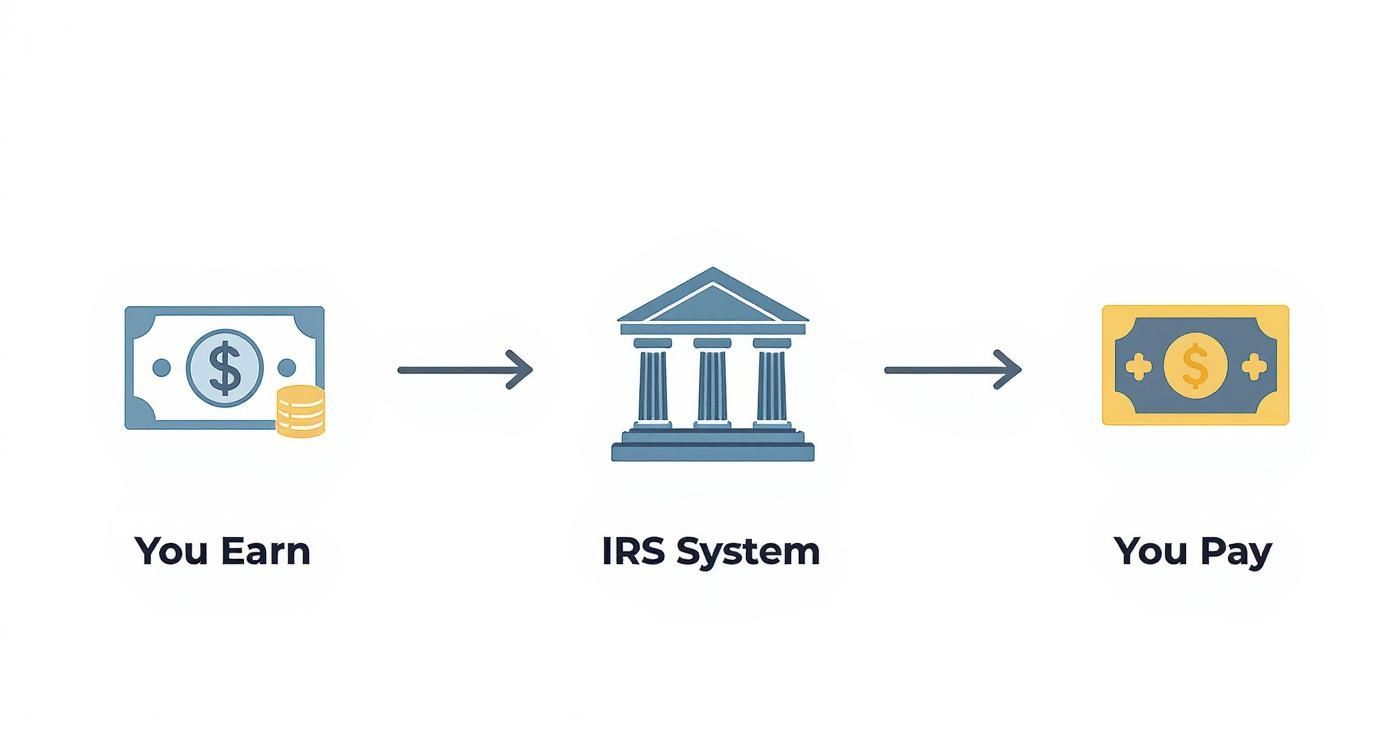
As you can see, the responsibility is on you to figure out what you owe and send it in on time to stay on the IRS's good side.
Step 1: Figure Out Your Net Earnings
First things first, you can't calculate any tax until you know your profit. Your net earnings are the bedrock of this whole calculation.
The formula is pretty straightforward: Gross Income - Business Expenses = Net Earnings.
- Gross Income is every dollar your business brings in.
- Business Expenses are all the "ordinary and necessary" costs of running your business. This is your software, marketing costs, supplies, a portion of your home office, and so on.
I can't stress this enough: keep clean, detailed records of your income and expenses. Good bookkeeping isn't just a best practice; it's what ensures you pay the right amount of tax and don't leave any valuable deductions on the table.
Step 2: Calculate Your Self-Employment Tax
Once you have your net earnings, it's time to tackle the self-employment (SE) tax. This is your version of FICA taxes, covering your contributions to Social Security and Medicare.
Here’s how it works. You only pay SE tax on 92.35% of your net earnings. Why the discount? It’s a small adjustment to level the playing field, since traditional employees don't pay FICA taxes on the half their employer contributes.
You'll then apply the 15.3% SE tax rate to that adjusted number. This rate is made up of two distinct parts:
- 12.4% for Social Security (this applies only up to an annual income limit).
- 2.9% for Medicare (this one has no income cap).
Here’s a crucial tax-saving tip: You get to deduct one-half of your self-employment tax from your income. This is an "above-the-line" deduction that lowers your adjusted gross income (AGI), which in turn lowers your income tax bill. It's a big deal.
Step 3: Estimate Your Federal Income Tax
Now we move on to federal income tax. For this part, you have to look at your entire financial picture, not just what your business made.
Start with your estimated net earnings for the year. From there, subtract all your business-related deductions, including that awesome one-half of SE tax deduction we just talked about. This gets you to your AGI. Next, subtract either the standard deduction for your filing status or your itemized deductions if they're higher.
What's left is your estimated taxable income. Now, you just apply the current year's tax brackets for your filing status (single, married, etc.) to get a rough idea of your income tax. Finally, be sure to subtract any tax credits you know you'll qualify for, as these reduce your tax bill dollar-for-dollar.
Step 4: Put It All Together and Divide by Four
You’re almost there. The last step is just simple addition and division.
- Add your total estimated self-employment tax (from Step 2) and your total estimated federal income tax (from Step 3). This is your estimated total tax for the whole year.
- Divide that total by four. That’s it! This is the amount you need to send in by each of the four quarterly deadlines.
Let's walk through a quick example.
Example: A Freelance Graphic Designer
Imagine a freelance designer expects to bring in $80,000 in gross income and has $20,000 in legitimate business expenses.
- Net Earnings: $80,000 - $20,000 = $60,000
- Taxable SE Income: $60,000 x 0.9235 = $55,410
- Self-Employment Tax: $55,410 x 0.153 = $8,477.73
- Deductible Portion of SE Tax: $8,477.73 / 2 = $4,238.87
From here, assuming the designer is single and takes the standard deduction, they would finish their federal income tax calculation. They'd add that to the $8,477.73 in SE tax and divide the grand total by four to get their quarterly payment.
Getting this calculation right is half the battle; the other half is paying on time. To make sure you're clear on the deadlines, check out our guide on the estimated tax payment schedule.
How to Pay the IRS Without Headaches
Figuring out what you owe is one thing, but actually getting the money to the IRS is another. Let's be honest, nobody enjoys this part, but the good news is that it's more straightforward than ever. Gone are the days when your only option was to find a stamp and mail a paper check.
The government has several simple payment methods, so you can pick whatever works best for you and get back to your business.

We'll walk through the most common ways to pay, from quick online options to the old-school mail-in method.
Modern Digital Payment Options
For pure speed and convenience, you can't beat paying online. The IRS systems are secure, give you an instant confirmation, and eliminate the risk of your check getting lost in the mail. It’s the modern way to handle your tax obligations.
Here are the best electronic payment routes:
- IRS Direct Pay: This is my go-to recommendation for most people. You can pay straight from your bank account for free without creating an account. All you need is some basic info from a previous tax return to prove it’s you. Simple and fast.
- Electronic Federal Tax Payment System (EFTPS): Think of this as the "power user" option. It's a free government service, but you have to enroll first. Once you're in, you can schedule payments up to 365 days in advance and see your full payment history. It's perfect if you like to plan ahead.
- Debit Card, Credit Card, or Digital Wallet: You can also pay using a card or a service like PayPal through a third-party processor. It’s quick, but there's a catch: these companies charge a processing fee.
The best part about paying online? You get an immediate electronic receipt. That digital proof is golden for your records and gives you peace of mind that the IRS got your money on time.
The Traditional Payment Method
While most people pay online now, sending a check through the mail is still perfectly fine. This is a solid choice if you're more comfortable with a paper trail or just prefer not to handle finances online.
If you’re going this route, you’ll need to mail two things:
- A check or money order: Make it payable to the "U.S. Treasury."
- Form 1040-ES: This is your payment voucher. Be careful here—you have to use the correct voucher for the specific quarter you're paying. The one for April is different from the one for June.
Send both the payment and the voucher to the IRS address listed in the Form 1040-ES instructions. Just make sure it’s postmarked by the due date.
If you ever need to set up a direct debit agreement, you’ll need your bank details. Sometimes, this requires a voided check. If you don't have a physical checkbook, you can easily generate a voided check online.
And if you ever find yourself unable to make a payment, don't panic. The worst thing you can do is ignore it. Understanding how an IRS payment plan calculator can help you explore solutions is the first step toward getting back on track without letting tax debt spiral.
Avoiding Penalties and Understanding Safe Harbors
Let's be honest: the biggest headache with quarterly taxes isn't just the paying part, it's the fear of getting it wrong and getting hit with a penalty. The good news is that the IRS isn't trying to trick you. They’ve laid out clear guidelines, known as safe harbors, to help you stay on track and avoid underpayment penalties.
Think of these safe harbors as your get-out-of-jail-free card. As long as you follow one of their simple rules, you’re protected from penalties—even if your business has a surprisingly good year. Knowing these rules turns tax planning from a stressful guessing game into a predictable strategy.

The Two Primary Safe Harbor Rules
The IRS gives you two main ways to penalty-proof your estimated tax payments. You only need to meet one of these to be in the clear.
Method 1: The 90% Rule
This is the most straightforward option. You won't face a penalty as long as you pay at least 90% of the tax you owe for the current year.
This approach works great if your income is steady and you can forecast your earnings with some confidence. The catch? You have to predict the future. If you land a huge project in November, you might discover you haven't paid enough to hit that 90% mark, leaving you exposed to a penalty.
Method 2: The 100% (or 110%) Prior-Year Rule
For most self-employed people, especially those with growing or unpredictable income, this is the golden ticket. This rule says you can avoid a penalty by simply paying 100% of the total tax you owed on your previous year's tax return.
There's one small caveat. If your Adjusted Gross Income (AGI) last year was over $150,000 (or $75,000 if you're married filing separately), you have to bump that up and pay 110% of last year's tax liability to qualify.
The prior-year method is a game-changer. It lets you base your payments on a number you already know—last year's tax bill—instead of an educated guess about the future. It completely removes the guesswork.
Putting Safe Harbors into Practice
So, how does this actually look in the real world? Let's walk through a quick example.
Example Scenario
You're a freelance graphic designer, and business is booming.
- 2023 Tax Bill: On your 2023 tax return, your total tax liability was $12,000. Your AGI was $85,000, which is safely under the $150,000 threshold.
- 2024 Income: Business is great in 2024, and you estimate your tax bill for the current year will jump to around $20,000.
Instead of trying to nail the 90% target on that projected $20,000, you decide to use the prior-year safe harbor. It’s simpler and safer.
- Your Safe Harbor Amount: 100% of your 2023 tax liability, which is $12,000.
- Your Quarterly Payment: You just divide that $12,000 by four, which comes out to $3,000 per quarter.
By paying $3,000 on time for each of the four deadlines, you'll have paid a total of $12,000 for the year. Sure, you'll still owe the remaining $8,000 when you file your return in April 2025, but you will be 100% protected from any underpayment penalties. This strategy gives you predictable, manageable payments and complete peace of mind.
How Your Business Structure Affects Your Taxes
Choosing how to structure your business might feel like just another piece of paperwork, but it dramatically changes how you pay your quarterly self employment taxes. The decision between running as a sole proprietor or forming an S Corporation is one of the biggest you'll make, and it directly controls how much of your profit gets hit with that 15.3% tax.
Think of your business structure as the bucket that holds your profits. Each type of bucket has different rules for how the IRS can reach in and take its cut for Social Security and Medicare. Getting these rules right is the foundation of smart tax planning.
The Default: Sole Proprietor and LLC
If you hang out your shingle and start working for yourself, you’re a sole proprietor by default. It's the simplest path. The same goes for a single-member LLC—unless you tell the IRS otherwise, they see you as a sole proprietor for tax purposes.
Under this setup, the math is brutally simple: 100% of your net business profit is subject to self-employment tax. If your business clears $80,000 in profit for the year, that entire amount is considered your income for self-employment tax purposes (after a small deduction).
- The upside is simplicity. You don’t file a separate business tax return; everything just goes on a Schedule C attached to your personal Form 1040.
- The downside is direct taxation. Every dollar of profit flows straight to you and gets taxed. As your business grows, this can lead to a hefty tax bill.
For a closer look at the tax obligations for this common structure, you can learn more about how LLC self employment taxes impact your business and the strategies available to you.
The S Corporation: A Strategic Choice with Trade-Offs
Now, this is where things get interesting. An S Corporation (or S Corp) isn't a type of company, but rather a tax status. You can have an LLC or a corporation and then elect to have it taxed under S Corp rules. This move completely changes the game for self-employment taxes.
As an S Corp owner who’s active in the business, you must pay yourself a "reasonable salary" through a proper payroll system. That salary is hit with FICA taxes (Social Security and Medicare), which are basically the employee-employer version of self-employment tax.
Here's the magic: any remaining profit can be paid to you as a distribution, and distributions are not subject to self-employment tax.
The big idea here is that an S Corp lets you shield a portion of your business profits from self-employment taxes. For a high-earning business, this can translate into thousands of dollars in savings.
Let's break down the key differences.
Sole Proprietor vs. S Corporation Tax Treatment
This table shows a side-by-side look at how your profits are handled under each structure, specifically for self-employment and payroll taxes.
| Feature | Sole Proprietor / Single-Member LLC | S Corporation |
|---|---|---|
| SE/FICA Tax | Applied to all net business profit. | Applied only to the owner's reasonable salary. |
| Profit Payout | All profit is considered an owner's draw. | Profit is split between salary and distributions. |
| Tax Forms | Schedule C on your personal 1040. | Separate business return (Form 1120-S), plus a W-2 for salary. |
| Complexity | Low. The administrative burden is minimal. | High. Requires payroll, formal meetings, and more complex accounting. |
Of course, this tax advantage doesn't come for free. Running an S Corp means more complexity and higher administrative costs. You have to manage payroll, file a separate business tax return, and follow corporate rules. That "reasonable salary" is also a major focus for the IRS—if you try to pay yourself an absurdly low salary to dodge taxes, you're inviting an audit.
Ultimately, the choice isn't about which one is "better" in a vacuum, but which is the right fit for your specific business. This is a decision that should always be made with a tax professional who can look at your income, your industry, and where you plan to take your business in the future.
Got Questions About Quarterly Taxes? We’ve Got Answers.
Let's be honest, the world of quarterly taxes is full of tricky "what-if" scenarios. This isn't just about following a guide; it's about knowing how to handle the curveballs that come with running your own business. Here are some of the most common questions we hear from freelancers and contractors, with straightforward answers to help you navigate those gray areas.
What Happens If I Miss a Quarterly Tax Payment?
First, don't panic. Missing a deadline is a common mistake, but the key is to act quickly.
If you realize you’ve missed a payment, pay it as soon as you possibly can. The worst thing you can do is wait until the next quarterly due date to try and "catch up." The IRS calculates underpayment penalties for each quarter independently, so the penalty for that missed payment starts racking up interest right away. Paying late is always, always better than not paying at all.
How Do I Estimate Taxes If My Income Is All Over the Place?
This is the classic freelancer dilemma. If your income swings wildly from month to month, simply dividing an annual guess by four is a recipe for disaster. You’ll either overpay during your slow months, straining your cash flow, or underpay after a great quarter and get hit with a penalty.
The solution is something called the annualized income installment method. It sounds complicated, but the concept is simple: you pay tax based on what you actually earned in that specific period.
Here’s how it works in a nutshell:
- At the end of each payment period, you figure out your real income and expenses for that chunk of the year.
- You then project what your full-year tax would be if you continued earning at that rate.
- You pay the required installment based on that fresh, more accurate projection.
This method takes more discipline and good bookkeeping, but it perfectly aligns your tax payments with your actual cash flow. It’s the go-to strategy for anyone with unpredictable revenue.
The Bottom Line: For irregular income, the annualized method is your best friend. It syncs your tax payments with your earnings, ensuring you pay the right amount at the right time.
Can I Just Pay Everything I Owe at the End of the Year?
Unfortunately, no. The U.S. operates on a "pay-as-you-go" tax system. The IRS expects you to pay taxes on your income as you earn it throughout the year, not in one lump sum when you file your annual return.
If you wait until April to settle your entire tax bill from the previous year, you're almost guaranteed to face an underpayment penalty. That penalty is calculated based on how much you were short each quarter and for how long that money was overdue. Paying in full on Tax Day clears your debt, but it won't erase the penalties you incurred for not paying on time.
Do I Still Pay Quarterly Taxes If My Business Isn’t Making Money?
Generally, no. If your business is operating at a net loss for the year, you won't have any net earnings from self-employment, which means you won't owe any self-employment tax. The rule of thumb is this: if you don’t expect to owe at least $1,000 in federal tax for the entire year (from all income sources), you aren't required to make quarterly estimated payments.
But a word of caution is needed here. If you have other income—say, from a part-time job or investments—you have to include that when figuring out your total tax picture. And if you think your business might turn a profit later in the year, you should be ready to start making payments for the quarter you expect to cross that $1,000 tax threshold.
Feeling overwhelmed by IRS rules and potential tax debt? At Attorney Stephen A Weisberg, we specialize in helping individuals and businesses resolve complex tax issues. We start with a free tax debt analysis to see exactly how we can help before you ever pay a fee. Visit us at weisberg.tax to take the first step toward tax peace of mind.


