Penalty Relief IRS: A Clear Path to penalty relief irs
Discover penalty relief irs options like First-Time Abatement and Reasonable Cause that can reduce or eliminate penalties. Learn how to qualify and save today.

In this article
- Why Does the IRS Even Offer Penalty Relief?
- The Penalties Most People Face
- IRS Penalty Relief Options at a Glance
- Using First-Time Abatement as Your One-Time Pass
- The Three Simple Rules of Eligibility
- A Real-World Example of FTA in Action
- Big News: The Future of First-Time Abatement Is Automatic
- Building Your Case for Reasonable Cause
- Core Arguments the IRS Actually Listens To
- The Power of Documentation: Your Story Needs Proof
- Choosing Your Best Relief Strategy
- How to Formally Request Penalty Relief from the IRS
- The Two Main Paths for Requesting Relief
- Crafting a Persuasive Penalty Abatement Letter
- Common Mistakes That Can Derail Your Request
- Missing Critical Deadlines
- Providing Incomplete Information or Documentation
- Making a Weak or Invalid Argument
- Your Right to an Appeal
- Navigating the Appeals Process
- Common Questions About IRS Penalty Relief
- How Long Does It Take to Hear Back from the IRS?
- If a Penalty Is Removed, Does That Also Remove the Interest?
- Can I Request Penalty Relief While I'm on a Payment Plan?
- What’s the Difference Between Penalty Abatement and Penalty Relief?
That IRS notice in your mailbox, heavy with penalties, can feel like a punch to the gut. It seems final, but for many taxpayers, it’s actually just the start of a conversation. IRS penalty relief is the formal process for asking the agency to remove—or "abate"—those penalties, and it exists because the IRS understands that life happens.
Why Does the IRS Even Offer Penalty Relief?

It’s easy to think penalties are just about punishment, but that's not the whole story. The real goal is to encourage voluntary compliance, which is the foundation of our entire tax system. The IRS much prefers that everyone files and pays on time without needing a nudge. Penalties are just the nudge.
Think of it like a library's late fee for a book. The library doesn't actually want your money; it just wants the book back so someone else can read it. The fee is simply a tool to get you to bring it back on time. In the same way, the IRS uses penalties to keep the system running, but it has built-in relief options for when you have a legitimate reason for a mistake or a solid track record of doing things right.
The Penalties Most People Face
The IRS has a long list of over 150 civil penalties, but the vast majority of people run into just a handful of them. Getting to know these is the first step in figuring out how to get them removed.
- Failure to File: This one hits when you don't file your tax return by the deadline (including any extensions). It can be particularly nasty, as it's calculated on the unpaid tax amount for every month you're late.
- Failure to Pay: This penalty applies when you file on time but don't pay what you owe by the due date. It adds up month after month on your outstanding balance.
- Failure to Deposit: This is aimed at employers. It kicks in if you don't make your payroll tax deposits on time, for the right amount, or in the right way.
These charges can snowball quickly, but here's the good news: a huge number of them get removed every single year. The scale is massive. In fiscal year 2022, the IRS assessed a staggering $73.6 billion in civil penalties. But it also abated $50.9 billion.
Let that sink in—more than two-thirds of the penalties were wiped away after the fact. This shows that asking for penalty relief irs isn't some desperate, long-shot attempt. It’s a standard, well-established administrative process.
To give you a clearer picture, here's a quick breakdown of common penalties and the relief options you can use to fight them.
IRS Penalty Relief Options at a Glance
| Penalty Type | What Triggers It | Primary Relief Options |
|---|---|---|
| Failure to File | Not filing your tax return by the due date (including extensions). | First-Time Abatement, Reasonable Cause |
| Failure to Pay | Not paying the tax you owe by the original deadline. | First-Time Abatement, Reasonable Cause, Offer in Compromise |
| Failure to Deposit | Employers not making payroll tax deposits correctly or on time. | First-Time Abatement, Reasonable Cause |
| Accuracy-Related | Understating tax due to negligence or substantial understatement. | Reasonable Cause, Statutory Exceptions |
The key is knowing which strategy fits your specific situation and how to build a compelling case. As total penalties owed by taxpayers continue to skyrocket, knowing your options is more important than ever. You can learn more about this troubling trend and what to do about it in our article about how taxpayers are owing more penalties in 2023 than ever before.
In the next sections, we'll dive into the specific strategies for getting relief, from the straightforward First-Time Abatement to making a strong case for Reasonable Cause.
Using First-Time Abatement as Your One-Time Pass

Think of First-Time Abatement (FTA) as the IRS's version of a "get out of jail free" card. It’s a powerful, common-sense form of penalty relief designed for taxpayers who almost always get it right but made one honest mistake.
If you have a solid track record, the IRS is often willing to forgive a single slip-up without putting you through a long, drawn-out battle. The program acknowledges that life happens—even the most organized person can miss a deadline or miscalculate a payment. For many, FTA is the simplest and quickest path to getting penalties for failure-to-file, failure-to-pay, and failure-to-deposit wiped clean.
The Three Simple Rules of Eligibility
To use this one-time pass, you just have to meet three straightforward criteria. The IRS isn't looking for a dramatic story here; they're simply looking at your history.
- A Clean Compliance History: You must have filed all required returns for the past three years and have no penalties on your record during that time. The IRS needs to see a consistent pattern of good behavior before they'll grant this relief.
- Be Current on All Filings: You must have filed all currently required tax returns or have a valid extension in place. You can't ask for a pass on a past mistake while you're still behind on your current obligations.
- Paid or Arranged to Pay: The underlying tax you owe must be paid, or you need to have a formal payment arrangement in place. This demonstrates to the IRS that you're committed to making things right.
If you can tick these three boxes, your chances of getting penalty relief irs through the FTA program are excellent. Of course, the best strategy is to not need it in the first place. You can learn more in our guide on how to avoid tax penalties with a comprehensive compliance playbook.
A Real-World Example of FTA in Action
Let’s look at a small business owner, Sarah. She runs a successful graphic design studio and, during an incredibly hectic quarter, was completely swamped with a massive client project. In the chaos, she missed the deadline for her quarterly estimated tax payment. A few weeks later, an IRS notice arrived with a failure-to-pay penalty for several thousand dollars.
Initially panicked, Sarah took a breath and reviewed her options. She quickly realized that for the past three years, she had always filed and paid everything on time, with no other penalties. She was up-to-date on all her other filings and immediately paid the underlying tax from the missed deadline.
Sarah was a perfect candidate for First-Time Abatement. Because she met the three core requirements—a clean three-year history, current filings, and payment of the tax due—she was able to call the IRS, explain her situation, and have the entire penalty amount removed from her account right there on the phone.
Big News: The Future of First-Time Abatement Is Automatic
The great news for taxpayers is that getting this relief is about to become even easier. In a major policy update, the IRS is moving to automate the FTA process, which will be a game-changer for many who qualify but simply don't know they need to ask.
Starting around the 2025 tax filing deadline, the IRS plans to automatically grant first-time abatement to an estimated 1 million eligible taxpayers. This proactive step is designed to help people who may not even be aware of the program, ensuring they receive the relief they're entitled to without the hassle of making a formal request. You can read more about this IRS move to automate penalty relief on journalofaccountancy.com.
Building Your Case for Reasonable Cause

If you don't qualify for First-Time Abatement, don't lose hope. Your next best option for getting penalties waived is arguing for Reasonable Cause. This is where you explain to the IRS that you acted with "ordinary business care and prudence" but, because of circumstances completely out of your control, you still couldn't file or pay your taxes on time.
Here's a simple way to think about it: First-Time Abatement is about your history—your track record. Reasonable Cause is about your story—what actually happened. It’s not a flimsy excuse for forgetting or being disorganized. It’s a legitimate reason grounded in a real-world, often unavoidable, event.
To win this argument, you have to prove your failure to comply wasn't due to willful neglect. You tried, but life got in the way.
Core Arguments the IRS Actually Listens To
Every person's situation is different, but the IRS tends to recognize a few key categories of events as legitimate grounds for Reasonable Cause. Knowing these will help you frame your case effectively.
Death, Serious Illness, or Unavoidable Absence: This covers a serious event affecting you, an immediate family member, or the one person who handles your taxes (like your CPA). A sudden hospitalization or the death of a spouse is a perfect example of a crisis that would make it impossible to focus on tax deadlines.
Fire, Casualty, or Natural Disaster: If a flood, hurricane, or fire destroyed your home, business, or the records you needed to file, the IRS gets it. This also includes major, federally declared disasters where the IRS often grants automatic relief to everyone in the affected zip codes.
Inability to Obtain Records: Sometimes, the problem is that you just can't get the necessary documents. Maybe your records were lost in a disaster, or a third party, like a former business partner or an ex-spouse, is refusing to provide information you need.
Erroneous Advice from a Tax Professional: You aren't always on the hook for bad advice. If you relied on a competent tax advisor who gave you the wrong information, you may have a case. The catch is you must prove the advisor was qualified and that you gave them all the correct information to work with.
The Power of Documentation: Your Story Needs Proof
A compelling story isn't enough for the IRS—you need to back it up with hard evidence. The single most crucial part of a successful Reasonable Cause claim is strong, credible documentation that supports every part of your explanation. You’re trying to build a clear timeline that shows the IRS exactly how the event prevented you from being compliant.
What kind of proof are we talking about?
- For Illness or Death: Think official documents. Hospital admission and discharge papers, a detailed letter from a doctor explaining the severity and dates of an illness, or a copy of a death certificate.
- For Natural Disasters: Gather any proof you can. Insurance claims, police or fire department reports, photos of the damage, and even news articles about the event in your area can help.
- For Incorrect Advice: You'll need a signed letter from the tax professional admitting their error, explaining the bad advice, and providing proof of their credentials (like their CPA license number).
Just saying, "I was sick" or "my records were lost" won't cut it. You have to provide official, third-party documentation that validates your claim and leaves no room for interpretation. The stronger your proof, the better your chances.
Crafting a persuasive argument is an art, as you need to connect the dots between your personal story and the IRS's legal standards. For a closer look at what it takes, check out our in-depth guide on the nuances of Reasonable Cause for penalty abatement.
Choosing Your Best Relief Strategy
So, should you argue for First-Time Abatement or Reasonable Cause? The answer depends entirely on your compliance history and what happened this year. This table should help you figure out which path makes the most sense.
| Criteria | First-Time Abatement (FTA) | Reasonable Cause |
|---|---|---|
| Core Requirement | A clean compliance history for the past 3 years. | A valid, uncontrollable reason for your non-compliance. |
| Type of Argument | Objective and fact-based (Did you meet the criteria?). | Subjective and story-based (Can you prove your case?). |
| Documentation Needed | Minimal; the IRS just checks your account history. | Extensive; requires proof like medical records, letters, etc. |
| Best For | A taxpayer with a great track record who made one mistake. | A taxpayer who ran into a significant life event or disaster. |
Ultimately, picking the right strategy is half the battle. FTA is a slam dunk if you qualify, but a well-documented Reasonable Cause argument can be just as powerful for erasing massive penalties when life throws you a curveball.
How to Formally Request Penalty Relief from the IRS
Once you've figured out the best strategy for your situation, it's time to make your case to the IRS. Formally requesting penalty relief isn't as scary as it sounds. Think of it as a structured conversation, and the key is knowing exactly how to start it.
The right approach depends entirely on the type of relief you're after. A straightforward First-Time Abatement might be settled with a single phone call. But a more involved Reasonable Cause argument? That will definitely require a formal, detailed written request.
The Two Main Paths for Requesting Relief
Getting those penalties removed typically starts down one of two paths. Each has its purpose, and picking the right one from the get-go can make the entire process much smoother.
By Phone: For a simple, clean First-Time Abatement request, picking up the phone is often the fastest way to get a resolution. Just call the toll-free number on your IRS notice. If you clearly hit all three FTA criteria, the agent on the line might grant the abatement right then and there. Just make sure you have your tax info and the notice handy before you dial.
In Writing: This is non-negotiable for all Reasonable Cause arguments and even for more complicated FTA cases. A formal letter gives you the space to lay out your argument logically and, crucially, attach all the supporting documents that prove your story.
Crafting a Persuasive Penalty Abatement Letter
Your written request is much more than just a letter—it’s your official argument. You're essentially building a case file for the IRS agent who will be making the decision. The goal is to make it incredibly easy for them to understand what happened and approve your request.
Your letter needs to be clear, professional, and to the point. It has to include all the key details to avoid unnecessary back-and-forth and show that you're taking this seriously.
A well-written abatement letter tells a clear story, connects that story to the IRS's own rules for relief, and backs everything up with undeniable proof. It removes any guesswork for the IRS agent and presents them with a complete, easy-to-approve package.
To make sure your request is airtight, run through this checklist and include every single one of these elements in your letter.
- Your Full Identifying Information: Start with the basics: your name, address, Social Security Number (or Employer Identification Number for a business), and the best phone number to reach you.
- The Specifics of the Penalty: Get precise. State the tax year (or period), the tax form number (like Form 1040 or Form 941), and the exact penalty amount you want removed. If you have the IRS notice, mention the notice number (e.g., CP22A).
- The Type of Relief You Are Requesting: Be direct. State clearly whether you're requesting relief based on First-Time Abatement or Reasonable Cause.
- A Clear and Honest Explanation: This is the core of your request. For FTA, a simple statement that you meet the criteria is enough. For Reasonable Cause, you need to explain the facts and circumstances that kept you from filing or paying on time. Be truthful, be specific, and don't ramble.
- Reference Your Supporting Documents: As you tell your story, refer to your proof. For example, "As you can see from the enclosed hospital records..." or "The attached letter from my accountant confirms..."
- Your Signature and Date: Don't forget to sign and date the letter. If you filed a joint return, both you and your spouse need to sign.
If you've hired a tax professional to represent you, they will handle all of this for you. This typically requires you to grant them authorization, and you can learn more about this by reviewing the detailed instructions for IRS Form 2848, which is the official Power of Attorney form. Submitting a complete, well-organized package is one of the best things you can do to boost your chances of success.
Common Mistakes That Can Derail Your Request
Requesting penalty relief from the IRS is a game of precision. I've seen countless well-meaning taxpayers have their requests denied simply because they stumbled into a few common, and entirely avoidable, traps. Knowing what not to do is just as important as knowing what to do. One wrong move can land you right back where you started, with the full penalty amount still due.
To get your request approved, you have to think like the IRS. They see thousands of these cases and have a strict playbook they follow. If your request doesn't tick their boxes, it gets tossed. The best way to build a winning case is to learn from the mistakes others have made.
Missing Critical Deadlines
The IRS lives and breathes by deadlines. When you get a notice in the mail, there will almost always be a "respond by" date printed on it. Ignoring that date is the quickest way to have your request thrown out before an agent even reads it.
Think of it like missing a court date—if you don't show up to make your case, you lose by default. By failing to respond on time, you're essentially telling the IRS you aren't serious about resolving the issue, and they'll move forward with collections.
Pro Tip: The moment you open an IRS notice, find the deadline and put it on your calendar. Treat it as non-negotiable and plan to send your request at least a week or two early to sidestep any mail delays.
Providing Incomplete Information or Documentation
A half-baked request just creates more work for the IRS agent, and their most likely response is a simple denial. Sending a letter that just says, "I was sick," without any doctor's notes or hospital records is a complete waste of time. Your story is only as credible as the evidence you provide.
Every single claim you make must be backed by solid proof. If you're claiming Reasonable Cause because your home was in a flood zone, you need to include FEMA reports, insurance claims, or news articles. In the eyes of the IRS, an argument without documentation isn't an argument at all.
This four-step process shows just how vital that preparation phase is.
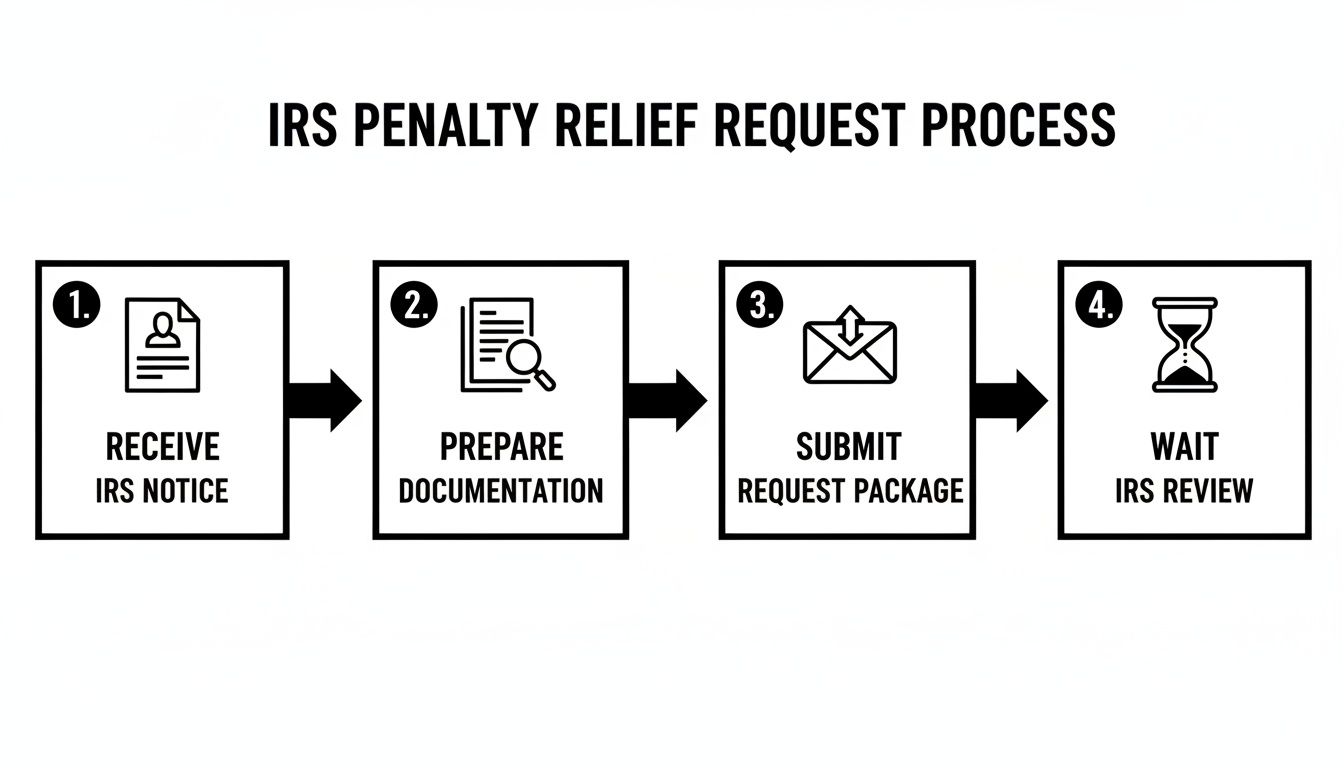
As you can see, gathering your documents happens long before you ever make contact with the IRS. It's the foundation of your entire case.
Making a Weak or Invalid Argument
Let's be blunt: some arguments are dead on arrival. The most common—and the least successful—is pleading ignorance of the law. "I didn't know I had to file" or "I didn't understand the tax code" will almost never be accepted as a valid excuse for Reasonable Cause.
The tax system works on the principle that you are responsible for understanding your obligations as a taxpayer. So instead of saying you didn't know, you need to focus on what prevented you from complying, even though you tried.
- Weak Argument: "I had no idea my quarterly estimated tax payment was due on April 15th." This just shows you weren't paying attention.
- Stronger Argument: "I was hospitalized for emergency surgery from April 10th through April 20th and was physically incapable of managing my finances. The attached medical records confirm this." This demonstrates a specific, uncontrollable event was the direct cause of the failure.
Pro Tip: Always frame your argument around events that were truly beyond your control. The IRS is looking for evidence that you acted with "ordinary business care and prudence" but were derailed by a verifiable situation you couldn't have prevented.
So you sent your penalty relief request to the IRS, and they sent you back a denial letter. It’s easy to feel like you’ve hit a dead end, but that’s rarely the case. The first rejection is just that—the first one. It’s not the final word.
Think of it as the opening round. The agent who handled your request made a call based on the file in front of them. If you believe they got it wrong, you have the right to get a fresh set of eyes on your situation from a completely independent part of the IRS.
Your Right to an Appeal
This is where the IRS Office of Appeals steps in. Their entire purpose is to settle tax disagreements fairly, without forcing taxpayers into court. They act as an impartial mediator between you and the rest of the IRS.
An Appeals Officer will review your entire case from scratch. They have the power to look at your arguments, consider the facts, and even overturn the original agent's decision. This isn’t just about sending the same forms and hoping for a better outcome. An appeal is your chance to really build a stronger argument—you can introduce new evidence, provide more detailed explanations, or clarify anything the first reviewer might have missed.
The key takeaway is that an initial denial is a roadblock, not a dead end. The appeals process is specifically designed to give you a fair second chance to make your case for penalty relief irs with a neutral party.
Navigating the Appeals Process
When it comes to filing an appeal, timing and procedure are everything. You can't just sit on that denial letter; a strict countdown begins the moment you receive it.
You generally have only 30 days from the date printed on the letter to file a formal appeal. If you miss that window, you almost always lose your right to this critical next step. Acting fast is non-negotiable.
The official first step is filing a protest. This is simply a written statement explaining why you disagree with the denial. In it, you'll need to clearly lay out the facts of your case, cite any relevant laws, and make a compelling argument for why you deserve penalty relief.
Building a solid appeal often involves similar logic, no matter which tax authority you're dealing with. For example, knowing the different strategies to appeal corporation tax penalties with HMRC can provide valuable insight into how these agencies think.
By understanding your rights and putting together a well-documented protest, you can effectively challenge the initial denial and give yourself a much better shot at getting those penalties removed.
Common Questions About IRS Penalty Relief
Facing down the IRS can bring up a lot of questions, especially when penalties are piling up. Getting straight answers is the first step to finding a solution. Here are some of the most frequent questions we hear from taxpayers about getting penalties removed.
How Long Does It Take to Hear Back from the IRS?
This is the classic "it depends" answer, but it's the truth. Patience is key when you're dealing with the IRS. For a straightforward First-Time Abatement request made over the phone, you might get an answer and resolution right on the spot. It could be over in minutes.
A written request based on Reasonable Cause, however, is a different beast entirely. That requires a human being at the IRS to review your story and your evidence, a process that can easily take several months. As a general rule, you should plan on waiting at least 60 to 120 days before you even think about following up. You can always keep an eye on your account by calling the IRS or checking your online portal.
If a Penalty Is Removed, Does That Also Remove the Interest?
Yes, for the most part. When the IRS agrees to abate a penalty, they will also automatically remove any interest that was charged on that specific penalty. Think of it this way: if the penalty never existed, there would be nothing for the interest to stick to.
But here’s the critical part: this only applies to the interest on the penalty. It does nothing to stop the interest accruing on your original tax bill. Even if every last penalty is wiped away, interest will keep growing on the underlying tax you owe until it’s paid off.
The Bottom Line: Getting a penalty abated is a great two-for-one deal because the interest on it disappears, too. Just remember, it won’t touch the interest growing on the main tax debt.
Can I Request Penalty Relief While I'm on a Payment Plan?
Absolutely. Being in an Installment Agreement doesn't disqualify you from asking for penalty relief. In fact, it can sometimes help your case, particularly for a First-Time Abatement claim.
Having a payment plan in place shows the IRS you're making a good-faith effort to get current. If they approve your request, the abated penalty amount is simply credited to your account. This will lower your overall balance and could even lead to a smaller monthly payment going forward.
What’s the Difference Between Penalty Abatement and Penalty Relief?
People often use these terms as if they mean the same thing, and in everyday conversation, they basically do. But there is a small technical distinction worth knowing.
- Penalty Relief is the big-picture concept. It’s the umbrella term for all the different ways the IRS allows penalties to be removed, like First-Time Abatement or showing Reasonable Cause.
- Penalty Abatement is the specific action. It’s what happens when the IRS officially takes the penalty off your account.
So, when you request penalty relief, you are asking the IRS to perform a penalty abatement.
Trying to navigate IRS penalties on your own can be a frustrating and confusing process. You don't have to go it alone. Attorney Stephen A. Weisberg and his team are here to guide you. We don't ask for a huge retainer upfront. Instead, we start every case with a FREE Tax Debt Analysis to map out the best strategy for your unique situation.


