Penalty Abatement Form: Your Complete Guide to IRS Relief
Learn how to file a penalty abatement form, qualify for first-time or reasonable cause relief, and respond to IRS denials
In this article
- When a Penalty Notice Shows Up in Your Mailbox
- The phone-versus-written fork
- The Three Grounds the IRS Will Actually Consider
- Reasonable cause
- First-time abatement
- Administrative or statutory relief
- How to Prepare and File Form 843 the Right Way
- Build the filing around the notice
- Make the evidence answer the question
- Submit it through the correct channel
- Where Abatement Opportunity Concentrates in 2026
- Sample Letters and Templates You Can Adapt
- Reasonable-cause request
- First-time abatement request
- Enclosure checklist
- Processing Times, Denials, and What to Do Next
- State Tax Penalties and How They Differ
- Final pre-action checklist
You open an IRS notice expecting an ordinary account update and find a balance swollen by failure-to-file and failure-to-pay penalties. The amount may be large enough to disrupt payroll, personal finances, or a pending business transaction. The notice is intimidating, but it isn't random. It identifies the tax period, the penalty type, and the amount the IRS has assessed.
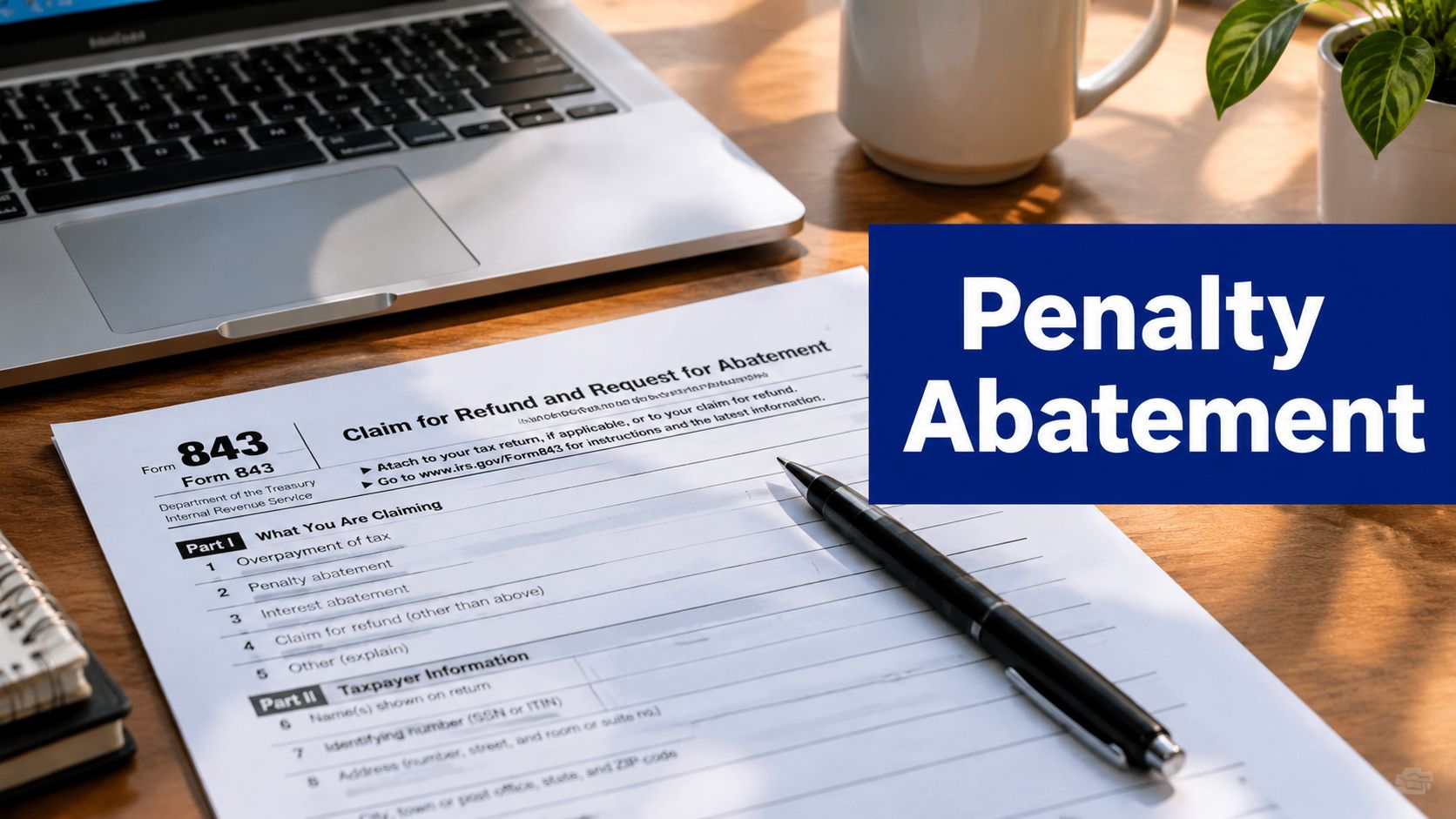
Your next decision matters. You can call the IRS and ask whether administrative relief is available, or you can prepare a formal written request using Form 843, Claim for Refund and Request for Abatement. The right path depends on the penalty, your compliance history, whether you already paid, and the facts supporting relief.
A penalty abatement form is a formal request asking the IRS to remove or reduce an assessed penalty under an applicable legal or administrative basis. It isn't an automatic waiver, and it isn't a substitute for filing the underlying return or paying the tax. The IRS's own guidance places Form 843 at the center of written requests involving certain penalties, interest, fees, and additions to tax, including the Trust Fund Recovery Penalty under section 6672 (IRS Form 843).
When a Penalty Notice Shows Up in Your Mailbox
A small business owner often sees the problem first in a notice, not in the accounting records. The letter may show a return filed late, a payment that arrived after the due date, or both. For a business with payroll obligations, the notice can also raise concerns about who the IRS considers responsible for unpaid trust fund taxes.
The notice gives you the facts needed to triage the case. Look for:
- Tax period: Confirm the year, quarter, or fee period. A request covering separate periods usually needs separate treatment.
- Penalty description: Identify whether the IRS assessed failure-to-file, failure-to-pay, accuracy-related, employment-tax, or another civil penalty.
- Assessment amount: Separate the penalty from the underlying tax, accrued interest, and other charges.
- Response instructions: The notice may provide a telephone number, mailing address, deadline, or appeal information.
The most common mistake is treating the notice as a bill that can be solved by sending money. Paying the penalty may affect whether you seek an abatement or a refund, but it doesn't explain why the penalty should be removed. Ignoring the notice is worse. IRS collection activity can continue while a request is pending, and a vague phone call rarely creates the evidentiary record needed for a difficult case.
Practical rule: Don't write a penalty-abatement request until you've matched every assertion to the notice, the tax transcript, and your supporting documents.
The phone-versus-written fork
The IRS offers a faster administrative route for some taxpayers. If the notice provides a toll-free number and the taxpayer qualifies for relief that the IRS can approve orally, a phone request may resolve a straightforward case. IRS guidance says that taxpayers who don't receive relief by phone can request it in writing with Form 843 (IRS penalty relief guidance).
That distinction changes how I approach the first contact. I don't automatically prepare a lengthy submission when the facts suggest a clean first-time case. I first determine whether the taxpayer can use the phone route, whether the IRS has already assessed the penalty correctly, and whether the taxpayer needs a written record because the case involves reasonable cause, several periods, a responsible-person assessment, or a refund.
Form 843 is generally used after the IRS has assessed the charge. If you already paid and are seeking money back, the request functions as a refund claim. If you haven't paid, the goal is abatement of the unpaid assessment. The form's current IRS revision is Rev. December 2024, and the IRS continues to identify it as the formal vehicle for covered written claims (current IRS Form 843 PDF).
Form 843 covers many common civil penalty matters, but it isn't universal. Estimated tax penalties have their own procedural framework, commonly associated with Form 2210, and a request must address the particular penalty the IRS assessed. Interest generally isn't removed merely because a penalty is abated, although narrow legal exceptions can exist.
| Factor | Phone Request | Form 843 |
|---|---|---|
| Best fit | Straightforward administrative relief, especially a possible first-time case | Reasonable cause, refund claims, complex facts, or penalties the IRS directs into a written process |
| Evidence | Information provided during the call, with limited opportunity to build a record | Written explanation, notice, legal basis, and supporting exhibits |
| Timing | Potentially faster if the IRS approves the request | Formal processing after mailing or another permitted submission method |
| Scope | Usually focused on the penalty discussed with the representative | Each tax period or fee year generally requires its own form |
| Main risk | A rushed call can miss the correct theory or fail to preserve facts | An incomplete form or unsupported narrative can produce a denial |
Before choosing, review the IRS instructions for about Form 843. The form's role isn't "send a letter to the IRS." You must identify the period, the charge, the statutory basis, and the facts that connect your conduct to the requested relief.
The Three Grounds the IRS Will Actually Consider
The IRS doesn't abate a penalty because the amount is painful or because the taxpayer is otherwise responsible. It looks for a recognized basis. In practice, most requests fall into reasonable cause, first-time abatement, or a narrower administrative waiver or statutory exception.
Reasonable cause
Reasonable cause is a facts-and-documents analysis. The taxpayer must show that they exercised ordinary business care and prudence but couldn't comply. Illness, death, theft, natural disaster, and reliance on incorrect professional advice can matter, but the label alone won't carry the request.
Build a chronology. Identify what happened, when it happened, what action you took, and why the event prevented timely filing or payment. Hospital records, death certificates, insurance records, disaster documentation, correspondence with an adviser, and proof of corrective action can turn a general explanation into a credible record. For more detail on developing the factual theory, review this guide to reasonable cause penalty help and the discussion of penalty abatement based on reasonable cause.
First-time abatement
First-time abatement is an IRS administrative waiver for taxpayers with an isolated compliance problem. The common standard requires a clean history for the prior 3 tax years, timely filing of required returns, and current payment arrangements or payment compliance where applicable (IRS administrative penalty relief).
This ground commonly applies to failure-to-file, failure-to-pay, and certain failure-to-deposit penalties. It doesn't excuse every type of charge, and it isn't a license to ignore later notices. Check whether the taxpayer has already used the waiver before requesting it.
Administrative or statutory relief
The third category covers narrower situations, such as erroneous IRS advice, a statutory exception, or federal disaster relief. The governing rule and documentation depend on the specific penalty. A taxpayer should not force a reasonable-cause narrative into a case that is really a statutory exception.
The IRS also says it may apply first-time abatement when a taxpayer asks for reasonable-cause relief but qualifies for the administrative waiver. That means a well-structured request can preserve both theories without presenting them as contradictory. State the facts accurately, identify the primary basis, and request any other relief the IRS determines applies.
How to Prepare and File Form 843 the Right Way
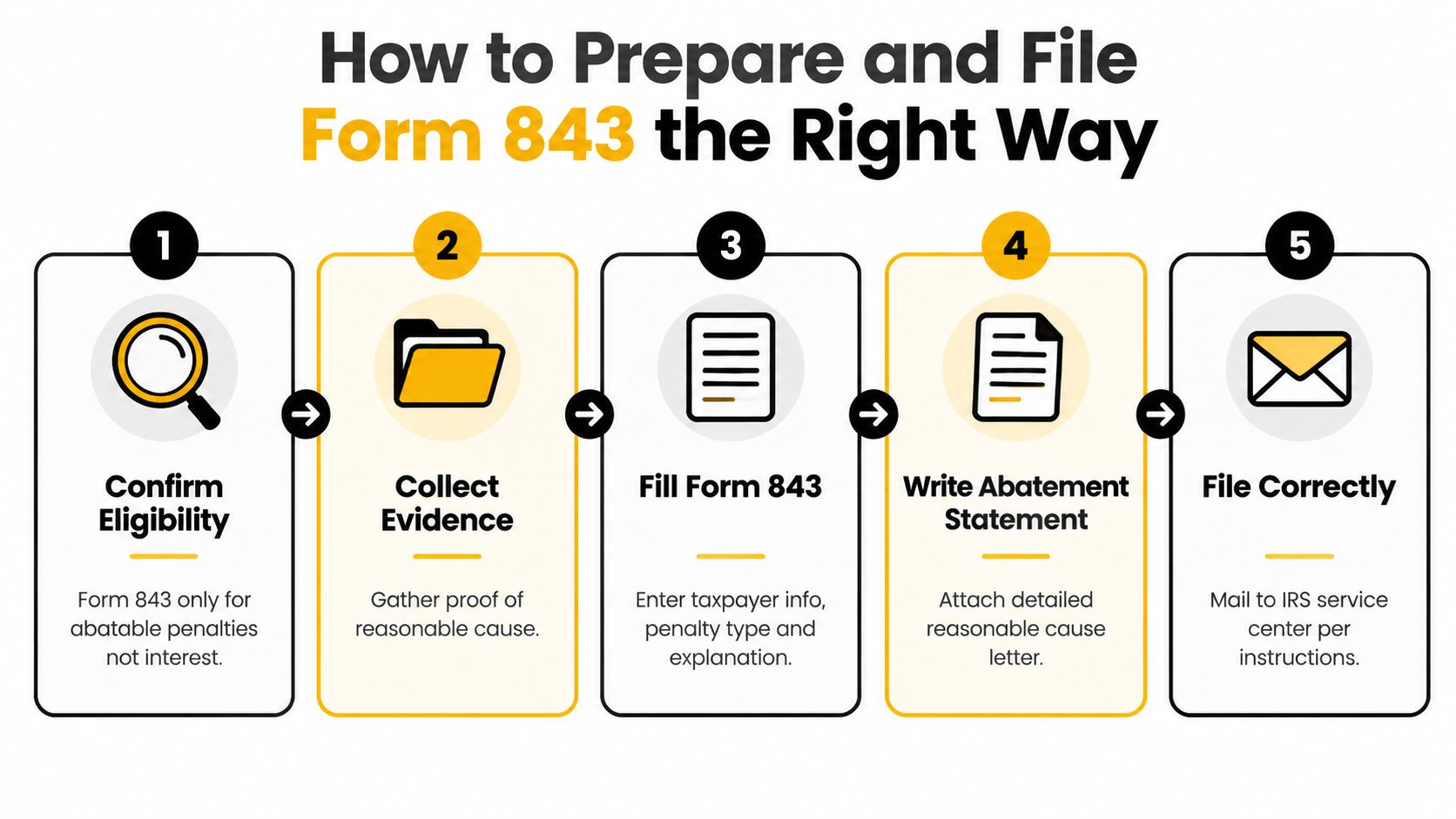
Start with eligibility, not drafting. Form 843 is for requesting abatement or refund of covered penalties and other specified charges. It isn't the form for changing income, deductions, credits, or the underlying tax liability, and interest usually requires a separate legal analysis.
Build the filing around the notice
Use one Form 843 for each tax period or fee year. Copy the taxpayer name, identification number, period, notice number, penalty description, and amount exactly as they appear in the IRS records. Small inconsistencies can delay matching or make the request look unrelated to the assessment.
On the form, identify the type of claim, the amount requested, and the statutory section connected to the penalty. For an assessed penalty, the IRS instructions require the taxpayer to enter the applicable Internal Revenue Code section and explain the claim in the designated narrative area (IRS Form 843 instructions and information).
Don't guess at the legal section. If the notice identifies it, use that information. If it doesn't, confirm the penalty through the IRS instructions, account transcript, or professional review before submitting.
Make the evidence answer the question
Your attachments should prove the reason the taxpayer couldn't comply, not merely repeat the conclusion.
- Medical event: Include records showing the condition and the relevant dates, while protecting unnecessary private information.
- Death or family emergency: Provide documentation and explain how the event affected filing, payment, or oversight.
- Natural disaster: Connect the event to the taxpayer's location, records, personnel, or ability to access funds and information.
- Professional reliance: Include engagement records, advice received, and the taxpayer's follow-up efforts.
- First-time relief: Provide evidence of filing and payment compliance for the prior required period and confirm whether prior administrative relief was used.
Write a separate statement if the form's narrative space isn't enough. Explain the sequence, address the specific penalty, and distinguish the penalty from interest. A useful filing is easy for an IRS employee to test against the notice and the exhibits.
Submit it through the correct channel
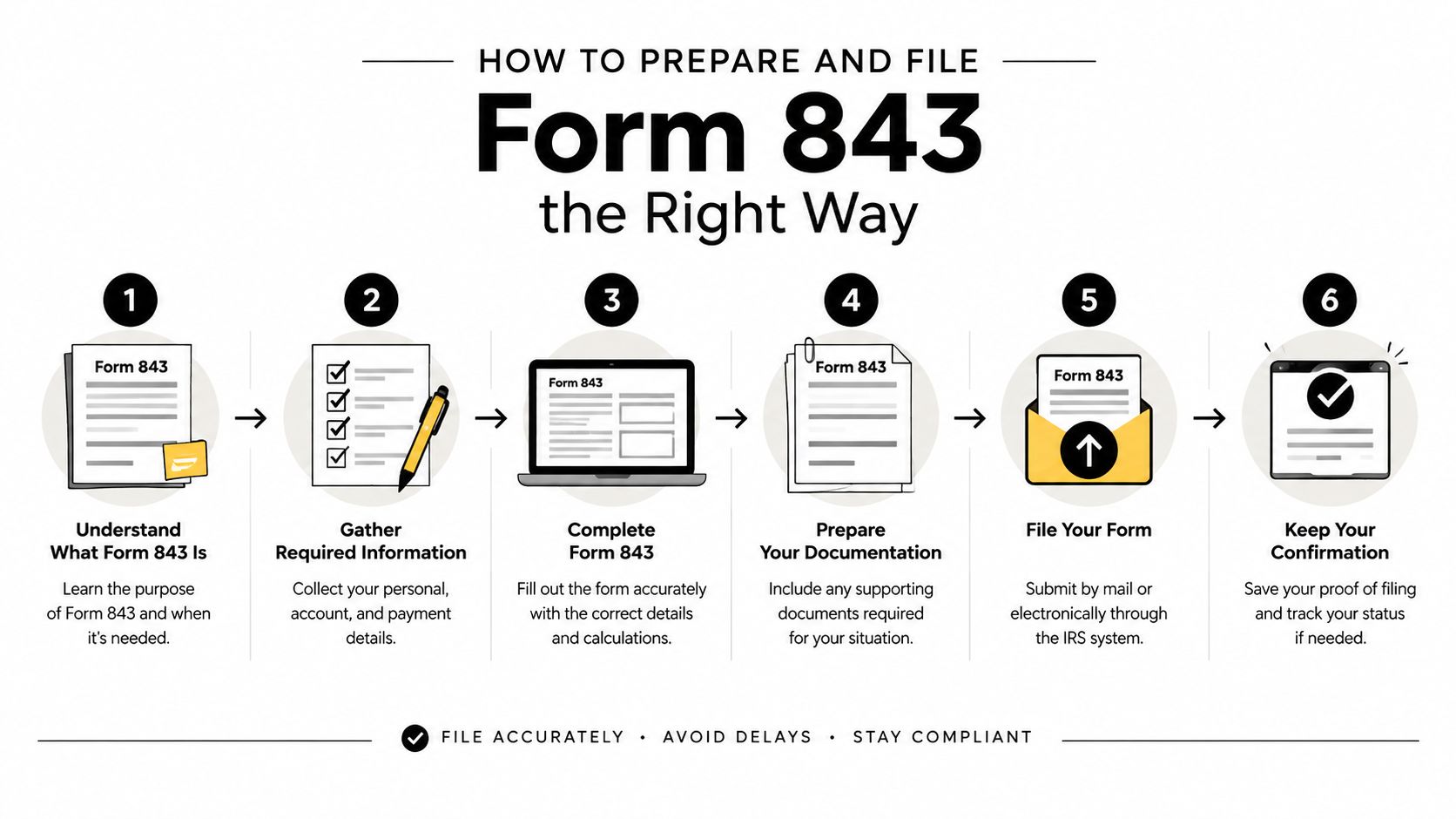
Form 843 generally isn't handled like an ordinary electronically filed return. Follow the address or submission instructions tied to the notice and the current form instructions. Keep a complete copy, include the notice, organize exhibits, and use a delivery method that documents submission when the stakes justify it.
The IRS may also offer specialized electronic options for particular claims and eligible taxpayers, so check current IRS instructions before mailing. For a practical overview of written IRS penalty relief, consult this penalty abatement resource, then verify the final submission instructions against the notice itself.
Where Abatement Opportunity Concentrates in 2026
Do not build every penalty abatement case around first-time relief. FY2025 IRS data recorded 46,748,796 individual civil penalty assessments and 3,884,049 abatements. The same category included $33.10 billion assessed and $7.51 billion abated, according to the IRS FY2025 penalty data.
Failure-to-pay penalties account for much of the activity, with 24,251,980 assessments and 3,149,546 abatements. Estimated tax penalties produced 15,734,656 assessments and 215,192 abatements. These totals do not predict an individual taxpayer's result. They do show why the first decision should be identifying the penalty, not copying a generic request.
| Penalty Type | FY2025 Assessment Count | Realistic Approval Rate | Best Theory to Cite |
|---|---|---|---|
| Failure to pay | 24,251,980 assessments (FY2025) | Case-specific, often tied to payment ability and reasonable cause | Reasonable cause, first-time relief where eligible, or payment-related administrative rules |
| Estimated tax | 15,734,656 assessments (FY2025) | Case-specific and generally more difficult than a clean first-time filing case | Statutory exception, annualized-income facts, or documented reasonable cause where available |
| Accuracy-related | Verified figures do not provide a FY2025 count | Usually fact-intensive and difficult | Reasonable-cause reliance, substantial-authority analysis, or Appeals |
| Trust Fund Recovery Penalty | No FY2025 volume is provided in the verified data | Depends on responsible-person and willfulness facts | Form 843 with a precise factual and statutory challenge |
The published totals do not provide a universal approval rate by penalty type. Do not promise one. A failure-to-pay request should address payment history and explain the event that prevented timely payment. An estimated-tax request should test every applicable exception and calculation. An accuracy-related case usually needs a technical defense, not a bare statement that the taxpayer made a mistake.
Penalty policy can also change. In October 2025, the IRS manual suspended automatic penalty assessment for certain Form 3520 Part IV late-filing cases. Check current IRS procedures before relying on an older article or a form downloaded years ago.
Sample Letters and Templates You Can Adapt
A strong letter doesn't dramatize the hardship. It gives the IRS a short, provable chronology and asks for a specific action. Use the following language as a starting point, then replace every bracketed item with facts supported by your records.
Reasonable-cause request
Internal Revenue Service
Re: Form 843 request for abatement
Taxpayer: [Legal name]
Identification number: [Number]
Tax period: [Period]
Notice number: [Notice number]I request abatement of the [penalty type] penalty assessed for [tax period] in the amount of [amount]. I am requesting removal of the penalty, not abatement of interest, under the applicable authority, including IRC section 6404 where applicable.
The return or payment was not timely because [specific event]. The event occurred on [date] and affected [the taxpayer, responsible employee, records, access to funds, or adviser]. Before and during the event, I took these steps: [chronological facts]. I filed or paid as soon as reasonably possible after [recovery date or corrective event].
The enclosed documents support this explanation: [list exhibits]. I have corrected the underlying compliance issue and request abatement of the identified penalty for the stated period. If the IRS determines that another administrative relief provision applies, please apply the relief supported by the account and these facts.
Sincerely, [Name and contact information]
Avoid saying that the business was “overwhelmed” unless you explain the event that caused the condition. The IRS needs causation, dates, corrective action, and evidence.
First-time abatement request
I request administrative first-time penalty relief for the [penalty type] assessed for [tax period]. I believe I maintained a clean compliance history for the prior 3 tax years, filed required returns, and addressed my payment obligations. I have not previously used first-time penalty abatement, to the best of my knowledge.
Please remove the penalty administratively. If the IRS determines that reasonable-cause relief is more appropriate based on the account and attached explanation, please consider that basis as well.
You can adapt the same substance for a phone call. State the notice number, tax period, penalty, and amount. Ask whether the account qualifies for first-time relief, confirm whether prior relief appears on the account, and request written confirmation of the result.
For a detailed discussion of this administrative route, see first-time penalty abatement.
Enclosure checklist
- Notice copy: Include the IRS notice and mark the relevant penalty.
- Account records: Attach transcripts or payment records that clarify the period and assessment.
- Event proof: Add medical, death, disaster, insurance, or professional-reliance documentation.
- Compliance proof: Include evidence supporting first-time eligibility.
- Corrective-action proof: Show when the return was filed or payment arrangement was made.
- Submission record: Keep the signed form, letter, exhibits, and delivery confirmation.

Processing Times, Denials, and What to Do Next
A phone decision can be immediate if the representative has authority and the account clearly qualifies. A written Form 843 request takes longer because the IRS must route, review, and match the submission to the taxpayer's account. A practical planning range is 90 days to 6 months, but the actual period depends on the case and IRS workload.
Don't treat silence as approval. Check the IRS Online Account, review account and payment history, and call the number associated with the notice when the response period has passed. Keep a written log of submission dates, calls, representative information, and documents requested.
| IRS Response | What It Means | Typical Timeframe | Recommended Next Action |
|---|---|---|---|
| Full abatement | The identified penalty was removed | Phone relief may be faster; written claims vary | Confirm the account balance and retain the notice |
| Partial abatement | Some penalty was removed, but a balance remains | Often follows review of only part of the request | Reconcile the calculation and supplement facts if needed |
| Denial | The IRS rejected the stated theory or evidence | Commonly follows written review | Read the explanation, correct deficiencies, and consider Appeals |
| No response | The request may be pending, misrouted, or unmatched | Follow up after a reasonable processing period | Confirm receipt and escalate the status inquiry |
A denial isn't the end of the case. First determine whether the IRS misunderstood the facts, lacked a document, or rejected the legal theory. Then send a focused supplement or request a conference with the IRS Independent Office of Appeals. Guidance on preparing that escalation is available through IRS tax appeals assistance.
Litigation may become relevant for a paid claim or a legal dispute that administrative review won't resolve. Tax Court jurisdiction, refund procedures, and deadlines are technical, so don't let an appeal period or refund limitation expire while you are informally negotiating.
State Tax Penalties and How They Differ
A federal Form 843 request doesn't automatically resolve a state penalty. States use their own notices, forms, standards, deadlines, and appeal procedures. Some states offer a recognizable reasonable-cause form, while others require a letter or an administrative hearing request.
Examples illustrate the problem:
| State | Form or Process | Grounds Available | Typical Submit Method |
|---|---|---|---|
| California | FTB Form 2917 | Reasonable cause and state-specific relief | Form submission or other method directed by the FTB notice |
| New York | Adjudication Bureau process | Informal hearing and penalty dispute grounds | Written request under the department's procedures |
| Texas | Written abatement letter to the Comptroller | Documented statutory or administrative grounds | Written submission tied to the state notice |
| Florida | DOR DR-835 adjustment process | State adjustment and penalty issues | Submission through Florida DOR procedures |
These examples aren't interchangeable. California's form, New York's hearing process, Texas's written correspondence, and Florida's adjustment procedure each require separate attention. Documentation standards also differ, and a state may offer an independent hearing officer or another review route that has no direct federal equivalent.
Run federal and state reviews in parallel when the same late filing or payment affected both returns. A natural disaster, bookkeeping failure, ownership change, or payroll event may support related explanations, but you still need to satisfy each agency's rules. One deadline missed at the state level can remain collectible even if the IRS grants relief.
Final pre-action checklist
- Identify the penalty: Read the notice and distinguish the penalty from tax and interest.
- Pull the periods: Confirm every tax year, quarter, or fee year involved.
- Choose the ground: Evaluate reasonable cause, first-time abatement, and statutory exceptions.
- Gather proof: Match every factual assertion to an exhibit.
- Choose the route: Decide whether to call first or prepare Form 843.
- Draft precisely: State the amount, penalty, period, legal basis, and requested action.
- Confirm submission: Use the address, fax, or eligible electronic process tied to the notice.
- Track the case: Save copies, proof of delivery, and follow-up dates.
- Review state exposure: Check whether a state department assessed a related penalty.
- Assess representation: Decide whether the amount, complexity, or risk justifies professional help.
If you're unsure whether the penalty is worth contesting, start with a case analysis before paying for full representation. Tax Attorney Stephen A Weisberg offers a free tax debt analysis to determine whether a penalty-abatement strategy is appropriate and what work the case may require.
Tax Attorney Stephen A Weisberg works with individuals, business owners, and professionals handling IRS and state tax problems, including penalty abatement requests and tax debt matters. Visit Tax Attorney Stephen A Weisberg to request a free tax debt analysis before paying for representation.


