Payroll Tax Debt Relief: A Practical Guide for 2026
Struggling with IRS payroll tax debt? Our guide explains payroll tax debt relief options, the TFRP, and how to protect your business and personal assets.

In this article
- The IRS Notice That Changes Everything
- What the notice usually means
- The first mistake to avoid
- Why Payroll Tax Debt Is Uniquely Dangerous
- Why the IRS views this differently
- The personal liability trap
- Who should take this seriously
- Your Available Payroll Tax Debt Relief Options
- The main options compared
- The streamlined option that gets overstated
- When a regular payment plan makes sense
- The option most advertised and least understood
- When temporary hardship relief matters
- A Step-by-Step Action Plan for Resolution
- Stop the bleeding first
- Gather the right records
- Match the facts to the right solution
- Prepare for the personal side if needed
- Submit carefully and monitor constantly
- Common Pitfalls and Misleading Promises
- The mistakes that keep businesses stuck
- The problem with quick-fix marketing
- What realistic relief usually looks like
- How an Experienced Attorney Can Secure Your Best Outcome
- Where legal representation changes the case
- Frequently Asked Questions About Payroll Tax Debt
- Can payroll tax debt be discharged in bankruptcy
- Can I go to jail for unpaid payroll taxes
- If my business closes, am I safe
- Why is payroll tax debt so hard for owners to manage alone
- Should I call a tax relief company right away
You open the mail, see the IRS logo, and your stomach drops.
Most business owners who contact me about payroll tax debt are not trying to game the system. They fell behind during a cash flow squeeze, trusted the wrong payroll process, missed a filing, or kept the business alive one quarter too long hoping revenue would catch up. Then the notices get sharper, the deadlines get shorter, and the risk becomes personal.
That last part is what catches people off guard. Payroll tax debt isn't just another business balance to negotiate later. It has its own rules, its own pressure points, and one especially dangerous trap that many owners don't understand until the IRS is already moving: personal liability for the trust fund portion of the tax.
Relief is possible. But real payroll tax debt relief usually looks like structured compliance, documented financial analysis, and careful communication with the IRS. It rarely looks like the ads promising instant settlements or “elimination” of the debt.
The IRS Notice That Changes Everything
A common pattern starts like this. A business owner gets a certified letter, opens it at the kitchen counter, and reads just enough to know two things: the IRS says payroll taxes are unpaid, and the situation feels urgent.
That reaction makes sense. Payroll tax notices often arrive after months of strain inside the business. Revenue may have been inconsistent. Payroll still had to run. Vendors needed to be paid. Rent was due. Somewhere in that pressure, the business withheld taxes from employee wages, owed its employer portion, and didn't fully remit what was due.
What the notice usually means
Payroll taxes include two different buckets that matter for strategy. One is the employee-withheld portion, often called the trust fund portion. The other is the employer share. That distinction drives nearly everything that follows, especially the personal liability issue discussed below.
The IRS pursues these cases aggressively because payroll taxes are central to federal revenue. In 2022, U.S. payroll taxes raised over $1.2 trillion and accounted for 23% of total federal receipts, and the IRS estimated the employment-tax portion of the tax gap at $127 billion, with $94 billion from underpayment, meaning tax reported on time but not paid on time, according to the Tax Policy Center's payroll tax overview.
That doesn't mean your situation is hopeless. It means the IRS treats payroll tax debt as a collection priority, so you need a serious response.
Practical rule: A payroll tax notice is not the moment to panic. It is the moment to stop improvising.
The first mistake to avoid
The biggest early error is treating the notice like a billing statement you'll “deal with next month.” If the IRS believes deposits are still being missed, the account can move from correspondence to enforcement quickly.
If you're trying to prevent future filing problems while you sort out old ones, a resource that can help you simplify Form 941 e-filing may be useful. Preventing new errors matters almost as much as resolving old debt.
Another point matters here. Not every IRS notice means the same thing. Some are informational. Some signal pending collection. If one of the letters in your stack is a final warning notice, it helps to understand what it really means before you respond. This explanation of the IRS CP504 notice is a good example of the kind of distinction that affects timing and strategy.
A payroll tax case becomes manageable when you separate emotion from process. Identify what tax periods are involved. Confirm whether returns were filed. Determine whether current deposits are being made. Then choose a resolution path that fits the actual facts, not the most optimistic sales pitch.
Why Payroll Tax Debt Is Uniquely Dangerous
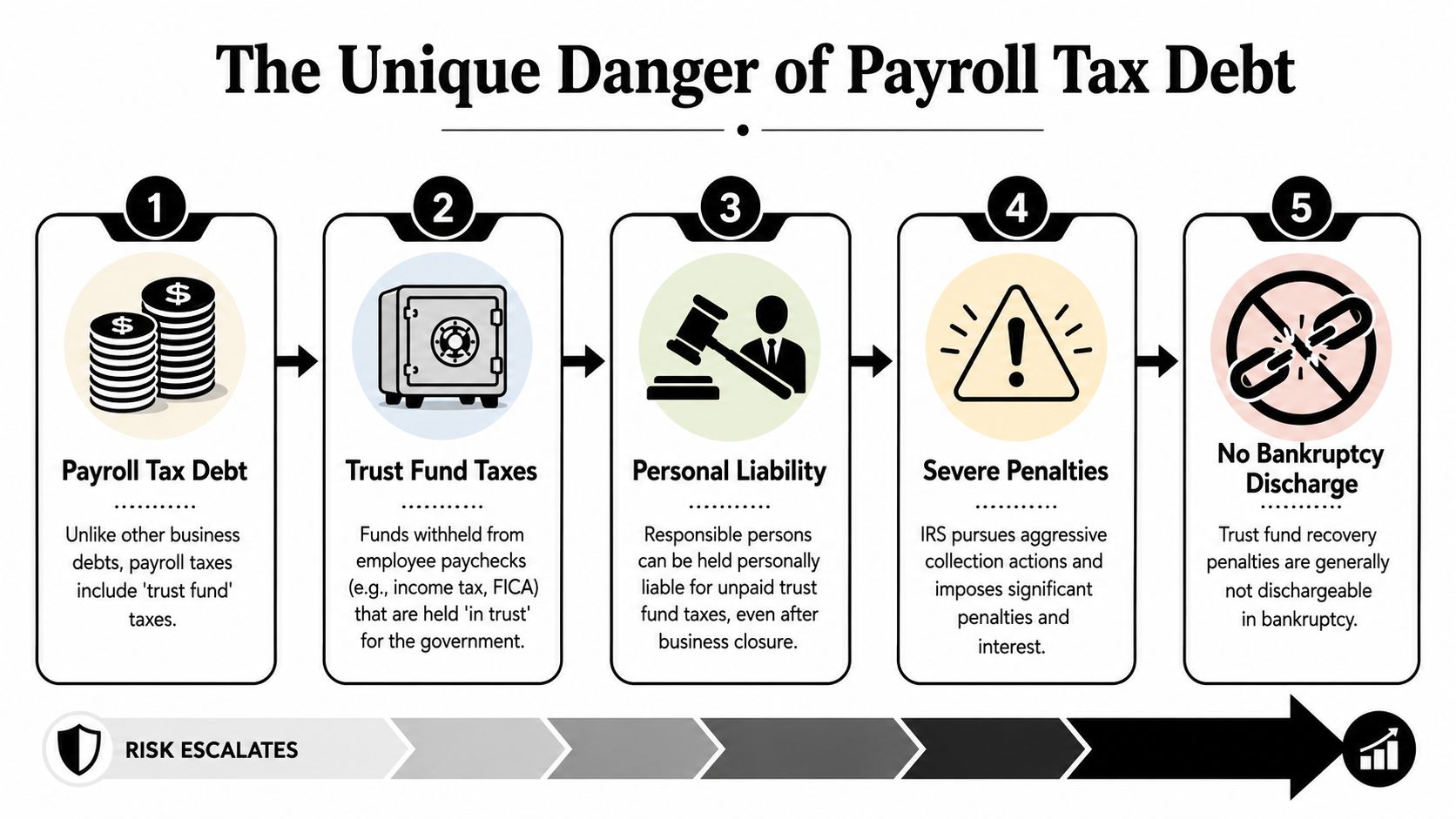
Most business debts stay with the business. Payroll tax debt can follow people.
That's because part of payroll tax isn't really the company's money in the first place. When you withhold federal income tax and the employee share of FICA from a paycheck, the business is acting as a temporary holder of funds that belong elsewhere. The IRS treats those withheld amounts as trust fund taxes.
Why the IRS views this differently
A simple analogy helps. If a friend gives you money to deliver to someone else, and you spend it on operating expenses instead, you haven't just failed to pay a bill. You used funds you were supposed to hold for another purpose.
That is why payroll tax debt is treated more harshly than ordinary vendor debt, lease arrears, or even some income tax problems. The IRS sees the unpaid trust fund portion as money collected from employees and not turned over.
The personal liability trap
The Trust Fund Recovery Penalty, or TFRP, is where many owners get blindsided. The IRS can assess the trust fund portion personally against a “responsible person.” That category is broader than commonly understood. It can include an owner, officer, or even a bookkeeper, and collection can continue even if the business is an LLC or has declared bankruptcy, as explained in this discussion of the Trust Fund Recovery Penalty and personal liability.
The underlying point is confirmed in a payroll tax relief analysis from Guardian Tax Law: the IRS can hold responsible persons personally liable for the trust fund portion of payroll taxes via the TFRP, including an owner, officer, or bookkeeper, even if the business is an LLC or has declared bankruptcy.
Here's where business owners often make a costly assumption:
- “My LLC protects me.” It may protect you from many business debts. It does not automatically protect you from TFRP exposure.
- “I didn't sign every check.” Signature authority matters, but it isn't the only factor. The IRS looks at actual authority, control, and decision-making.
- “The company is closed, so this is over.” Closing the doors may end operations. It doesn't necessarily end personal collection risk.
The business can fail. The payroll tax problem can survive it.
Who should take this seriously
If you had authority over payroll, signed returns, controlled bank accounts, decided which creditors got paid, or supervised the person who did, you should assume the IRS may examine your role closely. That doesn't mean personal liability is automatic. It means the issue has to be handled carefully from the start.
This is one reason payroll tax debt relief needs to be approached differently than ordinary tax resolution. The question isn't only how to pay. The question is also who may end up owing.
Your Available Payroll Tax Debt Relief Options
Once the immediate risk is clear, the next question is practical: what can be done?
The answer depends on the size of the balance, whether the business is still operating, whether all required returns are filed, whether current deposits are being made, and whether the IRS is looking only at the business or also at individuals for TFRP exposure. Most real solutions fall into a few recognizable categories.
The main options compared
| Relief Option | Best For | Key Requirement | Primary Challenge |
|---|---|---|---|
| Installment Agreement | Businesses that can pay over time | Current compliance and reliable cash flow | Payments must be realistic enough to avoid default |
| In-Business Trust Fund Express Installment Agreement | Smaller in-business trust fund balances | Liability must fit the program rules | Short payoff window creates pressure |
| Offer in Compromise | Cases where full collection is not realistic or liability is genuinely disputable | Detailed financial disclosure or strong liability position | Much harder than marketing makes it sound |
| Currently Not Collectible status | Businesses or individuals with severe financial strain | Proof that collection would create hardship | It delays collection pressure, but it doesn't solve the debt |
The streamlined option that gets overstated
For an operating business with payroll tax debt, the In-Business Trust Fund Express Installment Agreement can be useful, but only in a narrow set of cases. The IRS's simplified option is available only for liabilities of $25,000 or less, and the debt must be paid within 24 months or before the collection statute expires, whichever comes first, as described by TaxAudit's explanation of payroll tax settlement options.
That sounds straightforward until you do the math in real life. The business has to stay current on new payroll deposits while also paying down the old debt on an accelerated schedule. If operating margins are already thin, the agreement can fail unless the cash flow analysis is honest.
Some owners who owe a little more than the threshold can still use this path by paying the balance down enough to qualify. That can make sense in the right case. In the wrong case, it just burns cash and delays a better strategy.
When a regular payment plan makes sense
A standard installment agreement is often the most realistic form of payroll tax debt relief. Not glamorous. Not instant. But workable.
A sustainable agreement does three things:
- Protects the business from immediate escalation by getting a formal resolution in place.
- Fits actual operating cash flow instead of a hopeful projection.
- Leaves room for current compliance, because missing new deposits usually destroys the deal.
For some businesses, a partial payment installment agreement may become part of the discussion when full payment over time isn't realistic and financial disclosure supports a more limited monthly amount.
The option most advertised and least understood
An Offer in Compromise attracts attention because ads frame it as broad debt forgiveness. In payroll tax cases, that framing is usually misleading. Offers can be appropriate, but they require detailed financial support or a strong liability issue. They are not a shortcut around trust fund obligations.
Reality check: Most businesses with payroll tax debt need a payment structure first, not a miracle.
When temporary hardship relief matters
Currently Not Collectible status can be useful when collection activity would cause immediate hardship. It may buy time. It may reduce pressure. But it is not the same as cancellation, and it does not fix ongoing compliance problems.
That is the larger pattern in this area. Real solutions are usually structured, conditional, and tied to accurate financial disclosure. The right option is the one the business can complete, not the one that sounds best in an ad.
A Step-by-Step Action Plan for Resolution
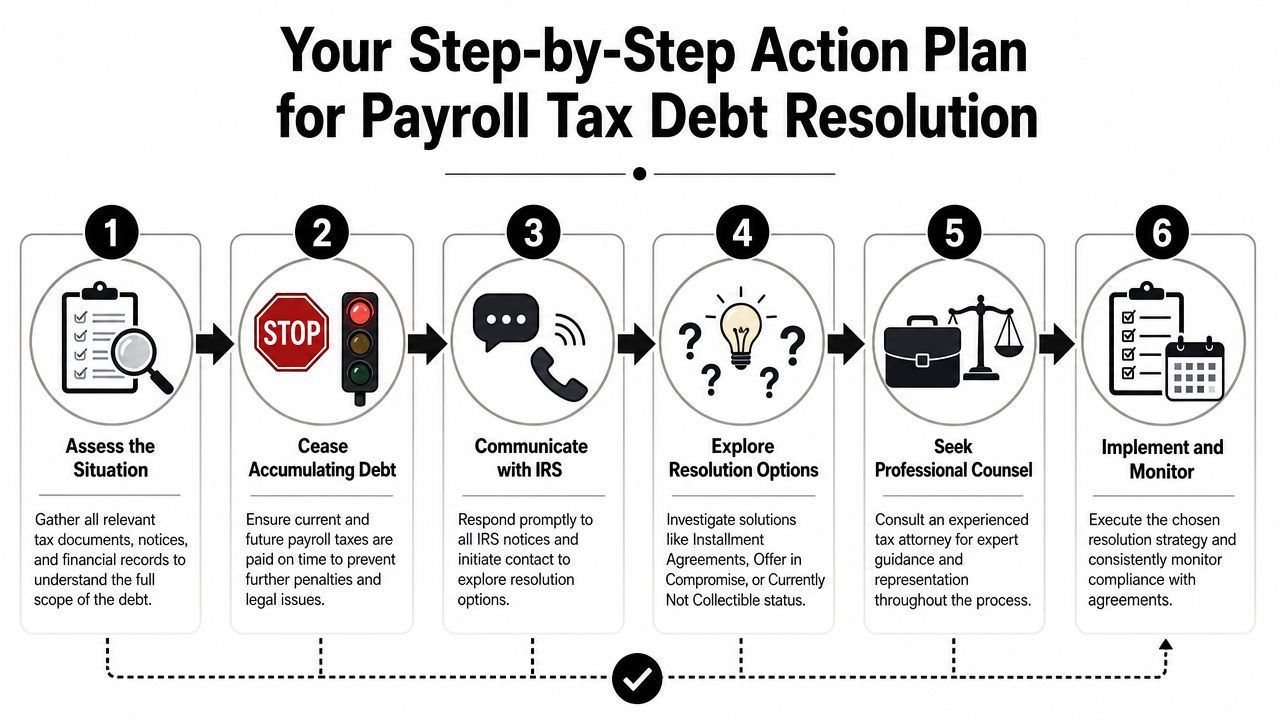
Once payroll tax debt exists, speed matters. So does order. If you do the right things in the wrong sequence, you can waste time, trigger more scrutiny, or propose a plan the IRS won't accept.
Stop the bleeding first
If the business is still operating, current compliance is the first priority. That means filing required payroll returns and making current deposits on time. The IRS is far less willing to discuss resolution when the debt is still growing.
Effective process changes are essential. If your payroll system helped create the problem, fix that system now. A practical resource like Benely's payroll guide can help owners think through service structure, oversight, and reporting controls before another quarter goes wrong.
Gather the right records
You can't negotiate from memory. You need a working file.
Start by collecting:
- IRS notices and transcripts so you know exactly which periods and balances are involved.
- Filed and unfiled payroll returns to confirm the compliance picture.
- Bank statements and proof of deposits to identify what has and has not been paid.
- Profit and loss statements and operating reports to show what the business can realistically afford.
- Ownership and authority records if TFRP exposure may be in play.
This part is less dramatic than a negotiation call, but it often determines the outcome. If the records are incomplete or inconsistent, the IRS assumes risk, and risk usually means stricter treatment.
Match the facts to the right solution
After the records are assembled, the strategy question becomes clearer. Is the business viable if the debt is spread over time? Is it barely surviving? Is the balance small enough for a simpler process? Is there a genuine dispute over who was responsible or what amount is owed?
A useful overview of this process appears in this guide to navigating payroll tax debt for business owners and tax professionals. The important point is that forms should follow strategy, not replace it.
Prepare for the personal side if needed
If the IRS is examining responsible person issues, treat that as a separate track. Do not assume that resolving the business account automatically resolves individual exposure. Statements about authority, payroll control, vendor payments, and decision-making can affect whether the IRS pursues TFRP assessments.
That means you should identify early:
- Who had actual control over payroll and disbursements.
- Who signed returns or checks and who could direct payments.
- Whether the business chose other creditors over payroll taxes when funds were limited.
- What records support your version of events.
The worst time to think about personal liability is after you've already made casual statements that the IRS can use against you.
Submit carefully and monitor constantly
Once the business is current and the financial picture is documented, the formal submission is only part of the job. The harder part is maintaining the agreement after it is approved.
That means watching every new deposit date, every filing deadline, and every IRS notice. A workable payroll tax debt relief plan is not a one-time event. It's an operating discipline.
In practice, strong cases usually follow a simple pattern. Get current. Get organized. Choose the right path. Stay compliant. The owners who do that consistently have options. The owners who wait for the pressure to pass usually lose them.
Common Pitfalls and Misleading Promises
Payroll tax debt cases often get worse before they get solved, not because no option exists, but because the owner follows bad advice or clings to a story that isn't true anymore.

The mistakes that keep businesses stuck
Some problems are procedural. Others are emotional. Both can be expensive.
- Ignoring notices: Silence usually narrows your options. The IRS doesn't interpret no response as a sign that things are improving.
- Pyramiding debt: Owners sometimes use current withholdings to cover old balances or urgent operating costs. That usually deepens the case and signals ongoing noncompliance.
- Defaulting on an agreement: A payment plan only helps if the business can maintain it while staying current on new obligations.
- Assuming bankruptcy ends the issue: In payroll tax cases, that assumption can be especially dangerous because of the personal liability issues discussed earlier.
The problem with quick-fix marketing
A lot of tax relief advertising trains business owners to ask the wrong question. They ask, “How little can I settle for?” before asking, “What resolution path can I realistically complete without defaulting or exposing myself personally?”
That matters because many companies over-promise what IRS programs really allow. As Andrin Tax Relief notes, IRS programs have strict limits, including the simplified in-business trust fund installment agreement cap of $25,000, and larger debts require more complex financial analysis rather than a one-size-fits-all application in its discussion of payroll tax debt relief limits.
That's the part many ads skip. They market forgiveness. The IRS usually requires structure.
If someone promises to “eliminate” payroll tax debt before reviewing filings, cash flow, and trust fund exposure, they are selling confidence, not analysis.
What realistic relief usually looks like
Real payroll tax debt relief often means one of the following:
- A disciplined payment arrangement based on actual operating capacity.
- A temporary hardship position while the business or owner stabilizes.
- A targeted challenge to liability, amount, or responsible-person status.
- A controlled wind-down strategy that addresses both business and personal exposure.
What it usually doesn't mean is a universal “pennies on the dollar” result handed out because the caller reached a sales line. Payroll tax cases are fact-heavy. The details drive everything.
How an Experienced Attorney Can Secure Your Best Outcome

A payroll tax case can split into two problems at once. The business owes the IRS, and the owner may be pulled into personal liability through the Trust Fund Recovery Penalty.
That split is where experienced legal counsel changes the outcome. A tax attorney does more than prepare forms or relay messages. Counsel controls what goes to the IRS, develops the factual record before it hardens, and keeps an owner from making loose statements about check-signing authority, hiring decisions, or bill payment priorities that later get used to support responsible-person status.
The stakes are practical, not theoretical. A Revenue Officer may be evaluating who had authority, who knew taxes were not being paid, and who chose other creditors first. Those facts can be interpreted in different ways. Good representation means presenting them with context, records, and a clear strategy instead of leaving the IRS to fill gaps on its own.
Where legal representation changes the case
The most valuable legal work usually happens before a resolution proposal is submitted:
- Separating the business case from the owner's personal exposure so a payment discussion for the company does not hand the IRS admissions that support a TFRP assessment.
- Preparing for IRS interviews and document requests so titles, duties, signature authority, and actual decision-making are described accurately and consistently.
- Reviewing cash flow before agreeing to terms so the business does not enter an installment plan it cannot keep.
- Testing the IRS file for weak assumptions or incomplete facts when the agency has overstated control, willfulness, or the amount at issue.
Owners often come in after hearing a sales pitch that promises a fast settlement. Payroll tax matters rarely work that way. The better approach is a structured analysis of filings, finances, business operations, and personal exposure before anyone picks a resolution path.
Attorney Stephen A. Weisberg offers a free Tax Debt Analysis through The W Tax Group. That first review serves a serious purpose. It helps determine whether the case is primarily a payment problem, a personal liability problem, or both, and it gives the owner a realistic starting point before paying for full representation.
Frequently Asked Questions About Payroll Tax Debt
Can payroll tax debt be discharged in bankruptcy
Sometimes parts of a tax problem can be addressed in bankruptcy, but the trust fund portion creates special trouble. If personal liability has been or may be assessed through the TFRP, bankruptcy often won't provide the clean reset owners expect. That's why bankruptcy counsel and tax counsel often need to coordinate rather than work in separate lanes.
Can I go to jail for unpaid payroll taxes
Simple nonpayment is usually handled as a civil collection matter, but cases involving willful evasion, false statements, or deliberate misuse of withheld funds can become much more serious. The practical takeaway is simple. Don't lie to the IRS, don't backfill records, and don't submit financial disclosures that you know are inaccurate.
If my business closes, am I safe
Not necessarily. Business closure may end payroll obligations going forward, but it doesn't automatically end past liability. If the IRS concludes that you were a responsible person for unpaid trust fund taxes, collection can continue against you personally even after the company is gone.
Why is payroll tax debt so hard for owners to manage alone
Because payroll tax compliance is operational, technical, and unforgiving at the same time. A projected 2026 payroll statistics review reported that 88% of small businesses consider tax laws too complex to manage their own payroll taxes, and the same review noted that the IRS collected $77.6 billion in federal taxes that were reported or assessed but not paid in FY 2024, according to Freedom Debt Relief's payroll tax discussion. That combination of complexity and enforcement is why owners often need guidance even when they understand their businesses well.
Should I call a tax relief company right away
Call someone if you need help, but make sure the first conversation is diagnostic, not a hard sell. You need a real assessment of current compliance, business viability, personal exposure, and available resolution paths. If the pitch starts with guaranteed outcomes and large upfront fees before anyone has reviewed the file, step back.
If you're dealing with payroll tax debt and need a responsible first step, contact Attorney Stephen A Weisberg for a free Tax Debt Analysis. That gives you a clear look at whether relief is possible, what risks need immediate attention, and what resolution path fits your facts before you commit to paid representation.


