Get a Payment Plan for GA State Taxes: A How-To Guide
Can't pay your Georgia tax bill? Learn how to set up a payment plan for GA state taxes. Our guide covers eligibility, online applications, and alternatives.
In this article
- That Unexpected Letter from the Georgia DOR
- What most taxpayers are dealing with
- Understanding Georgia's Installment Agreements
- What the agreement does
- The terms that matter most
- Who should treat this as a serious commitment
- Confirming Your Eligibility Before You Apply
- The first review I would do before filing anything
- Why these checks matter
- Mistakes that get applications denied or plans cancelled later
- How to Apply for Your GA Tax Payment Plan
- The online route
- The paper route with Form GA-9465
- How to decide what payment to propose
- What a stronger application looks like
- Managing Your Agreement and Avoiding Default
- What keeps a plan stable
- What default can trigger
- When a Payment Plan Isn't Your Best Option
- Signs you should pause before choosing a plan
The Georgia Department of Revenue letter usually lands on your kitchen counter at the worst possible time. You open it, see a balance due, and your first thought isn't legal strategy. It's simpler than that. How am I supposed to pay this right now?
That reaction is normal. I've spoken with plenty of Georgia taxpayers, including wage earners, self-employed people, and business owners, who weren't disputing that tax was owed. They just couldn't write one check for the full amount. In that situation, a payment plan for Georgia state taxes can be a practical tool, but only if it fits your finances and your case posture.
A lot of articles stop at “go online and apply.” That's not enough. The important questions are whether you qualify, what can get the request denied, and whether a payment plan is even the right answer compared with an Offer in Compromise or hardship-based relief. Those are the questions that usually matter most once the initial panic fades.
That Unexpected Letter from the Georgia DOR
The notice often creates two bad instincts at once. Some people freeze and do nothing. Others rush into the first payment arrangement they can find without thinking through whether they can keep it.
Neither approach helps.
If Georgia says you owe back taxes, the state is already in collection mode. That doesn't mean every case turns aggressive overnight, but it does mean you should treat the notice as a problem that needs a plan, not as something that will disappear on its own. For many taxpayers, the first realistic option is an Installment Agreement, which is Georgia's formal version of a tax payment plan.
What most taxpayers are dealing with
Usually, one of these situations is happening:
- A surprise balance after filing: You filed, but the amount due was larger than expected and cash flow wasn't there.
- Several unfiled years were just cleaned up: Once returns are filed, the total balance becomes real all at once.
- A business fell behind: This is especially stressful when the owner is juggling payroll, vendor pressure, and state tax notices at the same time.
- A prior temporary fix stopped working: Credit cards, borrowed money, or skipped bills only bought a little time.
Practical rule: Don't decide based only on what gets the DOR off your back this month. Decide based on what you can still afford several months from now.
That's where people often go wrong. A payment plan can work well when the debt is manageable over time and your filings are in order. It works poorly when the proposed monthly payment is unrealistic, when returns are still missing, or when a different resolution would address the problem more directly.
A calm, organized response usually gets better results than a rushed one. Before you apply, you need to understand what Georgia is offering and what the state expects in return.
Understanding Georgia's Installment Agreements
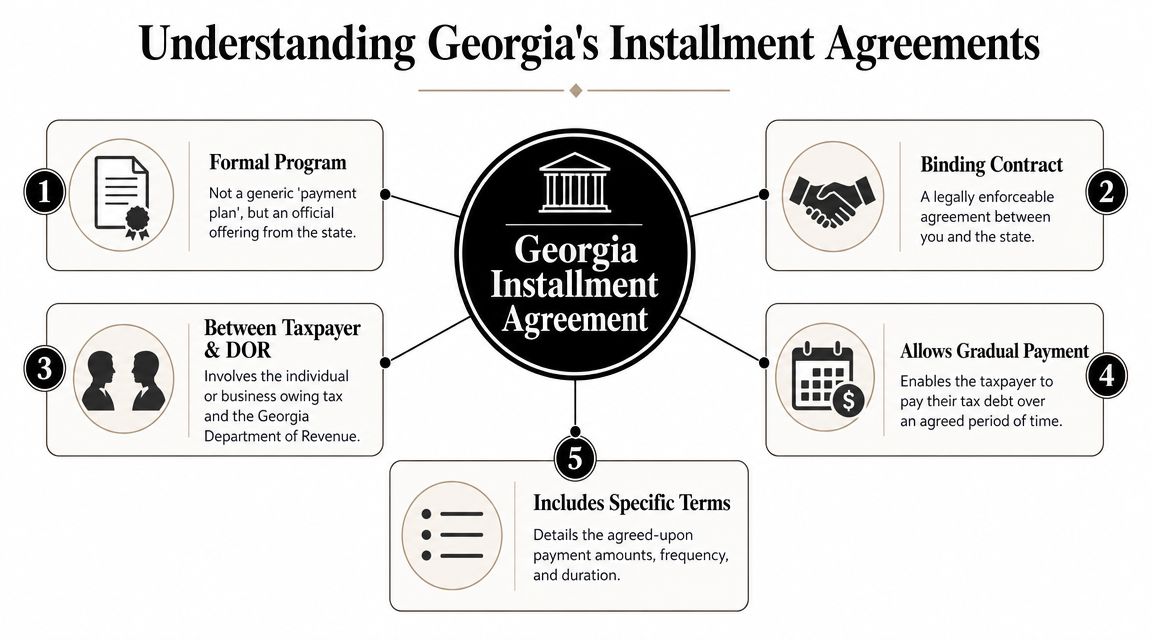
An Installment Agreement with Georgia is a formal payment arrangement, not a casual extension. It is available to individuals and businesses that cannot pay their state tax balance in full.
What the agreement does
The agreement sets the terms of repayment. That usually means a required monthly amount, a due date, and a fixed payment period. Georgia allows taxpayers to request a plan online through the Georgia Tax Center or by mail on Form GA-9465, as noted in the previously mentioned guidance.
That structure matters more than many taxpayers expect. Once a plan is in place, the state is not waiting to see what you can spare from month to month. It expects the agreed payment on time and continued compliance going forward.
If you are comparing state and federal collection options at the same time, it helps to review how a formal installment agreement works in practice. The legal systems are different, but the core issue is the same. The taxing authority wants a payment arrangement it can monitor and enforce.
The terms that matter most
Georgia's published rules give you a useful frame for deciding whether a plan is realistic. Plans can run as long as 60 months. The minimum monthly payment is $25. Setup fees are $50 for electronic funds transfer and $100 for paper checks, based on the previously mentioned guidance.
Here is what those terms mean in real life:
| Term | What it means for you |
|---|---|
| Up to 60 months | A longer term can lower the monthly payment, but interest and penalties may continue while the balance is being paid |
| $25 minimum monthly payment | The floor is low, but many balances will require more than the minimum to fit within the allowed term |
| $50 EFT setup fee | Electronic payments cost less to set up and are usually easier to keep current |
| $100 paper check setup fee | Paper payments cost more and create more chances for missed deadlines, mail delays, or posting problems |
This is one of the main judgment calls in a Georgia tax case. A payment plan can be the right tool when the balance is payable over time and future tax compliance is under control. It can be the wrong tool when the monthly number only looks affordable on paper, or when a taxpayer may qualify for a different resolution that addresses the debt more directly.
A Georgia payment plan gives you time to pay. It does not reduce the debt by itself.
Who should treat this as a serious commitment
For an individual with one tax year due, an installment agreement may be a clean solution. For a business, especially one with withholding or sales tax trouble, I usually look much harder at cash flow, filing history, and the risk of new debt before recommending a plan.
That is the part many basic guides miss. Getting approved is only half the problem. The better question is whether the agreement will still be workable after rent, payroll, estimated taxes, and ordinary life start competing for the same dollars.
Confirming Your Eligibility Before You Apply
A lot of Georgia taxpayers lose time here. They get the notice, rush to ask for a payment plan, and find out the Department of Revenue will not seriously consider the request until basic compliance problems are cleaned up.
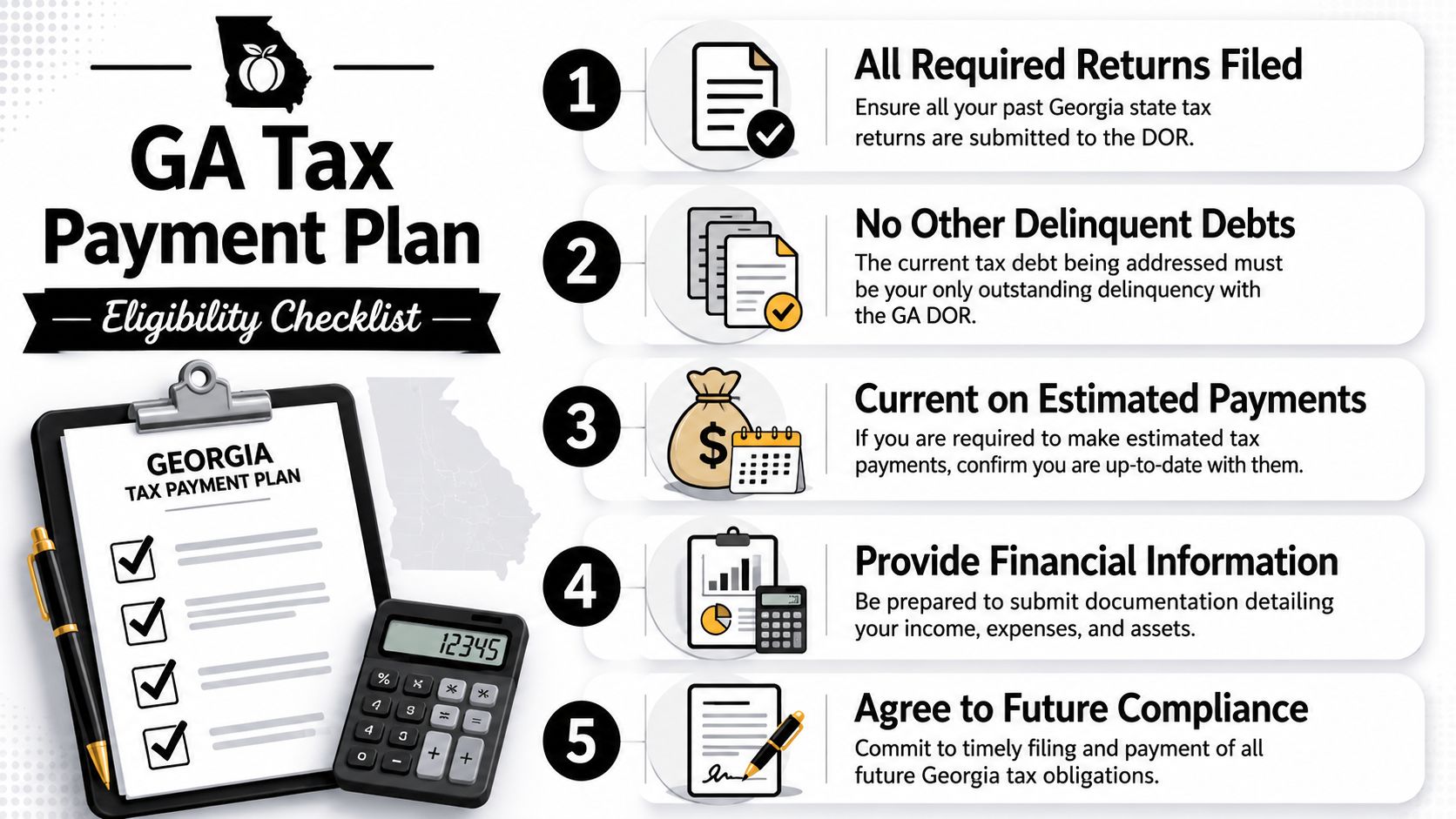
Georgia installment agreements are usually available only for taxpayers who are current enough for the state to work with them. Unfiled returns, an active bankruptcy case, a pending Offer in Compromise, or collection status that has already shifted elsewhere can all interfere with approval. In practice, I also look at something the state may not spell out on the front end. Will this taxpayer stay current after the agreement starts, or will new debt show up next month and sink the plan?
The first review I would do before filing anything
Before applying, answer these questions accurately:
- Are all required Georgia returns filed? If even one required return is missing, fix that first.
- Are you in an active bankruptcy? If yes, collection and payment-plan options usually need to be handled through bankruptcy counsel.
- Do you already have an Offer in Compromise pending? If so, an installment request may conflict with that strategy.
- Has the account been sent to a private collection agency or another collection channel? That can limit how the request needs to be made, or whether DOR will handle it directly.
- Can you keep future filings and payments current? A payment plan often fails because of new tax debt, not the old balance.
This is the point where judgment matters. A taxpayer may qualify on paper and still be a poor fit for an installment agreement. If cash flow is too tight to cover current taxes plus the back debt, it is usually better to identify that now than after a default notice arrives.
Why these checks matter
Georgia is screening for more than willingness to pay. The state wants to know whether the account is administratively ready for an agreement and whether the proposal has a reasonable chance of holding together.
That is why I do not treat eligibility as a box-checking exercise. It is a decision point. If the account has missing returns or legal barriers, the plan request is early. If the taxpayer can file everything, stay current, and afford the monthly amount, a payment plan may be the right tool. If not, this may be the stage where an Offer in Compromise or another resolution deserves a closer look.
For readers comparing state and federal payment options, our guide on how to set up a payment plan with the IRS explains how the federal process differs. For a second outside perspective, see Allied Tax Advisors on payment plans.
Mistakes that get applications denied or plans cancelled later
These are the problems I see most often:
- Applying before filing all returns. That is one of the fastest ways to stall the case.
- Ignoring the account's current collection status. If the file has already moved, the usual request path may not work.
- Using the payment plan as a substitute for a real strategy. A monthly agreement helps only if the debt can be paid over time.
- Guessing at an affordable payment. If the number does not survive rent, payroll, estimated taxes, and ordinary living costs, the plan is weak from the start.
Many articles stop at eligibility rules. The better question is whether approval would solve the problem. Sometimes it does. Sometimes it only delays a harder conversation about affordability and whether another option fits the case better.
How to Apply for Your GA Tax Payment Plan
A Georgia payment plan request is usually straightforward on paper. The harder part is choosing a proposal that will survive real life.
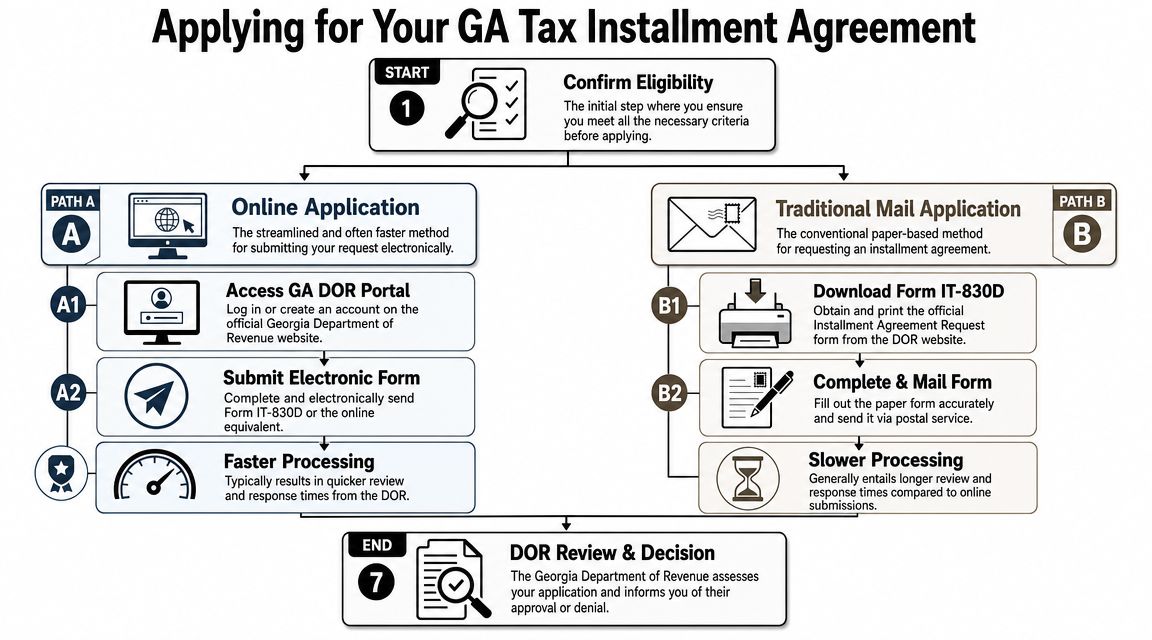
Georgia generally allows taxpayers to request an Installment Agreement either through the Georgia Tax Center or by mail on Form GA-9465, as noted earlier. The online option is often faster if the balance has posted correctly and you can access the account without problems. The paper form can be the better choice when you want a clean record of exactly what was submitted, or when the online account does not reflect the liability correctly.
The online route
If the account is accurate, start there.
Before you submit anything through the portal, confirm that the tax periods, balance due, and taxpayer identification details all match your records. A surprising amount of delay comes from small mismatches that could have been caught in five minutes. If I am reviewing a case, I also want to know whether all assessed periods are included, because a partial request can create confusion about what the state is being asked to resolve.
The online system is useful, but speed should not drive the decision. A rushed proposal with the wrong monthly payment does more harm than a slower, cleaner application.
The paper route with Form GA-9465
Mailing Form GA-9465 still makes sense in some cases. I usually consider it when there is a recordkeeping concern, when account access is unreliable, or when the taxpayer wants to control the supporting documents more carefully.
Accuracy matters here too. Names, account numbers, tax periods, and proposed terms should line up with the state's records as closely as possible. Small errors may not kill the request, but they often slow review or trigger follow-up questions you could have avoided.
Before mailing, check four things:
- The balance and periods are exact. Know what debt the request is meant to cover.
- The payment method fits the budget. Setup costs and processing practicalities can differ depending on how you pay, so choose the method you are most likely to maintain.
- The monthly amount is realistic. A proposal should work in an ordinary month, not a best-case month.
- Your file is complete. Keep a copy of the signed form, any attachments, and proof of mailing.
How to decide what payment to propose
Many Georgia taxpayers get into trouble by treating the payment amount like a negotiation tactic instead of a cash flow decision.
A weak proposal usually fails in one of two ways. The first is offering too little, which can leave the balance unresolved for too long or make the request less workable from the state's perspective. The second is offering too much because the taxpayer wants to look cooperative. That version often leads to a missed payment a few months later.
Use your real monthly numbers. For individuals, look at housing, transportation, insurance, food, and irregular expenses that show up every year whether you plan for them or not. For business owners, review net operating cash after payroll, rent, suppliers, and current tax obligations. Gross revenue is not the number that pays an installment agreement.
If you are comparing state and federal options at the same time, this guide on how to set up a payment plan with the IRS explains how the federal process differs. For another practical comparison, see Allied Tax Advisors on payment plans.
Don't submit a proposal based on what you hope next quarter looks like. Submit one based on what your account can handle if next quarter is ordinary.
What a stronger application looks like
The applications that hold up tend to share the same traits. The taxpayer has already cleaned up filing issues, the requested payment matches the budget, and the request fits the broader facts of the case.
That last point matters more than many guides admit. If the liability is large enough that even a careful monthly plan will leave you squeezed from the start, an installment agreement may not be the right answer. In that situation, it is better to recognize the problem now than to force a plan that is likely to fail.
Managing Your Agreement and Avoiding Default
Approval is not the finish line. It's the beginning of a routine you have to protect.
A Georgia Installment Agreement can be canceled if the terms aren't followed, and that's one of the most important realities to understand from the start. The agreement exists because the state is willing to collect over time. If payments stop or compliance breaks down, that flexibility can disappear.
What keeps a plan stable
The taxpayers who manage these agreements well usually do a few simple things consistently:
- They pay on time every month. One missed payment can create bigger problems than people expect.
- They keep current with new tax obligations. A payment plan doesn't excuse future filing or payment duties.
- They revisit the budget early if cash flow changes. Waiting until after a missed payment is usually too late.
- They use the agreement as a control tool. The point is to reduce uncertainty and prevent escalation.
Even outside the tax context, legal payment obligations can spiral when people ignore them until enforcement is underway. This legal analysis of celebrity finances is a reminder that public or private, the pattern is the same. Missed obligations tend to compound legal consequences.
What default can trigger
When a state tax agreement fails, you lose the benefit of structured payment. That can reopen the door to harder collection action. If you're already seeing pressure or want to understand where collection can go, this resource on how to stop state tax garnishment explains the stakes clearly.
A lot of taxpayers make the mistake of treating the minimum required payment as the target forever. If your finances improve, paying more can reduce how long the problem follows you. If your finances worsen, address that before the agreement breaks.
A payment plan only protects you while you honor it. Once it defaults, the account often gets less flexible, not more.
The best way to avoid default is boring but effective. Put the payment on a reliable schedule, keep future filings current, and don't assume silence from the DOR means everything is fine.
When a Payment Plan Isn't Your Best Option
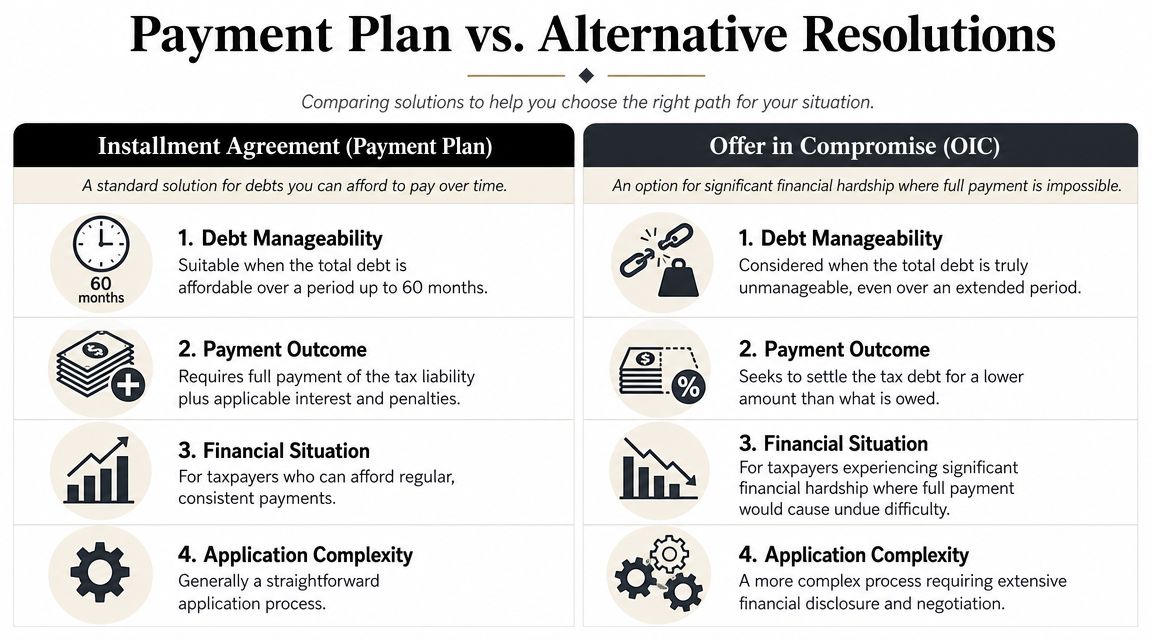
A payment plan solves one problem. It gives you time. It does not reduce the tax, and for some Georgia taxpayers, time is the one thing that makes the debt more expensive.
If full payment is realistic within a reasonable period, an installment agreement can be a good tool. If the monthly amount would strain your budget from the start, the plan may only postpone a default and add more interest and penalties while you try to keep up. That is the point where I usually tell clients to stop focusing on how to get approved and start asking a harder question. Is a payment plan the right fix?
Signs you should pause before choosing a plan
An installment agreement deserves a closer look if any of these apply:
- The proposed monthly payment still leaves you short on rent, payroll, or basic operating costs
- Your income changes month to month and you cannot count on making the same payment consistently
- You have little equity, limited disposable income, or other facts that may support a settlement
- A medical issue, job loss, or similar hardship makes collection relief a better fit
- The debt involves business taxes, especially payroll taxes, where the strategy needs more than a simple monthly payment
The key issue is collectibility. Georgia installment agreements work best for taxpayers who can pay the balance in full with some structure. They are a poor fit for taxpayers who cannot get to full payment without skipping current obligations or falling behind on future taxes.
That is why it helps to compare a plan against other relief before you apply. If you need a starting point, this explanation of what an Offer in Compromise is lays out how settlement-based relief differs from paying in full over time.
I have seen taxpayers choose a payment plan because it feels like the safest answer, only to realize six months later that the numbers never worked. A rejected Offer in Compromise can be frustrating, but an installment agreement that was doomed from the start often costs more and leaves fewer good options later.
If you're trying to decide between a payment plan, an Offer in Compromise, or another resolution path, Attorney Stephen A Weisberg offers a free tax debt analysis for individuals and businesses dealing with IRS and state tax problems. The goal is to determine whether he can help and what option fits before any engagement begins.


