Your 2026 Guide: How to pay yourself from llc
Master how to pay yourself from llc in 2026. This guide details owner's draws, S-corp salaries, and guaranteed payments for optimal tax compliance.

In this article
- Your LLC Made a Profit Now What
- The three choices most owners deal with
- Choosing Your LLC Payment Method
- Owner’s draw
- Guaranteed payments
- S-corp salary and distributions
- What each method does well, and where owners get into trouble
- LLC payment methods compared
- How to Implement Your Payment System
- Implementing owner’s draws
- Implementing guaranteed payments
- Implementing an S-corp salary system
- One system is better than year-end cleanup
- Essential Bookkeeping and IRS Filings
- What the books should show
- The filings owners usually need to track
- Estimated tax discipline matters
- Common LLC Payment Mistakes to Avoid
- Treating the business account like a personal wallet
- Using “salary” language without real payroll
- Setting an S-corp salary too low
- Paying personal expenses before saving for taxes
- Letting the books tell a different story than the bank account
- Ignoring the operating agreement or ownership rules
- Your LLC Payment Implementation Checklist
- Foundational setup
- Payment structure
- Ongoing compliance
- Risk control
Your first profitable month in an LLC often creates an odd mix of relief and anxiety. The money is finally in the business account. Rent is covered, invoices are paid, and now you want to move some of that money to your personal account without creating a mess you’ll regret at tax time.
That’s where many owners make their first expensive mistake. They assume “paying yourself” is just a transfer. Sometimes it is. Sometimes it absolutely is not.
As a tax debt resolution attorney, I usually meet people after the problem has already formed. They took random draws, skipped estimated taxes, mixed personal and business spending, or set up an S-corp election without handling payroll correctly. Months later, they’re dealing with IRS notices, penalties, missing records, or payroll tax exposure they never saw coming.
There are really three common paths when you pay yourself from llc income: owner’s draws, guaranteed payments, and, if the LLC elects S-corporation taxation, a W-2 salary plus distributions. Each can work. Each can also create avoidable tax trouble if you use it in the wrong structure or document it poorly.
The practical question isn’t just “How do I get money out of the LLC?” It’s “How do I get paid in a way that fits my tax status, preserves clean records, and reduces the chance that I’ll be fixing this with the IRS later?”
Your LLC Made a Profit Now What
A common scenario looks like this. A new single-member LLC owner finishes the quarter, checks the business bank balance, and sees more money than expected. The next thought is usually simple: “Can I just transfer some to myself?”
Yes, but the right answer depends on how the LLC is taxed. If you get that part wrong, you can create tax debt long before you realize it.
For many owners, the cleanest starting point is understanding that moving money and being taxed are not the same event. An LLC owner might take money out. The IRS might still tax income differently than the owner expects. That disconnect is where problems begin.
Practical rule: Before you take money out, decide what the payment actually is. A draw, a guaranteed payment, or wages through payroll are different categories with different tax consequences.
If you’re still setting up your systems, a small business compliance checklist helps. I’d start with a resource like this small business tax checklist, then match your payment method to your LLC’s tax treatment before you move funds.
The three choices most owners deal with
- Owner’s draw works for many single-member LLCs and for profit distributions in partnership-taxed LLCs.
- Guaranteed payment applies in multi-member LLCs when one member is being paid for services or management duties apart from profit sharing.
- S-corp salary and distribution comes into play only if the LLC has elected corporate tax treatment and is operating payroll correctly.
That choice affects bookkeeping, tax filings, cash flow, and audit risk. It also affects whether a mistake becomes a manageable cleanup or a tax controversy file later.
Choosing Your LLC Payment Method
A client usually calls after the first bad surprise. The business made money, cash moved to a personal account, and then tax season exposed that the owner had been paying themselves the wrong way for months. The cleanup is almost always more expensive than setting the method correctly at the start.
Your payment method should match your LLC’s tax treatment. Convenience is not the standard the IRS uses.
For a practical primer on understanding your LLC's tax classification, review how default LLC treatment differs from an S-corp election before you decide how money should leave the business.
Owner’s draw
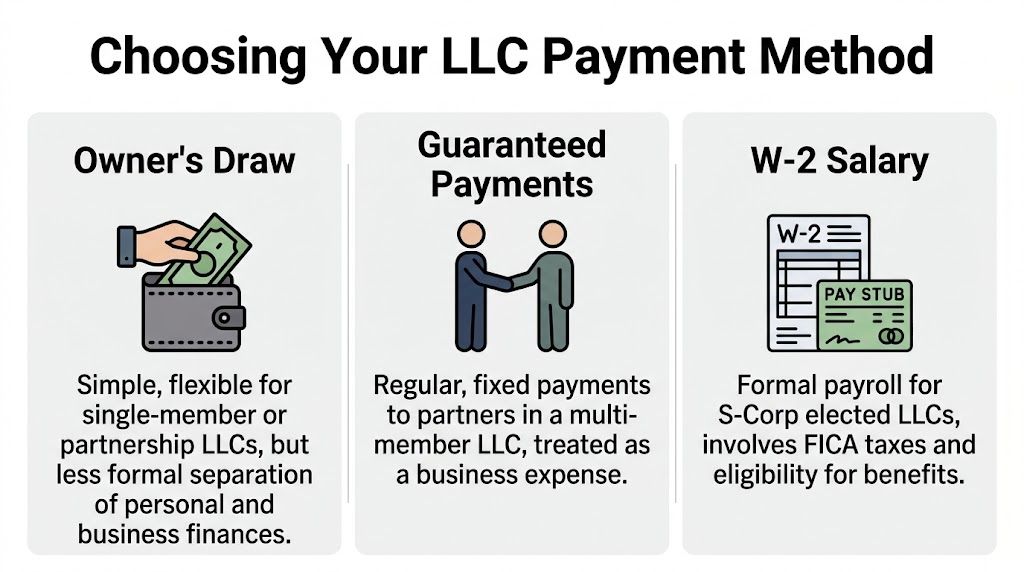
For a single-member LLC taxed by default, owner’s draw is usually the correct method. The IRS generally treats the entity as disregarded for federal income tax purposes, so the owner reports business activity on Schedule C and takes money out as draws rather than wages.
The expensive mistake is assuming tax follows the transfer. It does not.
If the business earns a profit, that profit is generally taxable to the owner whether the cash stays in the business account or gets transferred out. Owners who wait until they “pay themselves” before planning for taxes often end up short on estimated payments, and that is how underpayment notices start.
Owner’s draw is simple to use. It also leaves more responsibility on the owner. There is no withholding, no automatic payroll deposit, and no built-in reminder to reserve cash for federal tax, self-employment tax, and state obligations.
I like owner’s draw for new single-member LLCs with clean books and steady discipline. I do not like it for owners who treat the business account like a personal wallet. That pattern creates weak records first, then tax trouble.
Guaranteed payments
Guaranteed payments matter in multi-member LLCs taxed as partnerships. They are used when one member needs fixed compensation for services, management, or ongoing work, regardless of whether the LLC makes a formal profit distribution that month.
This is often the right answer when the ownership split and the work split are not the same. One member may own 50 percent but handle operations every day, while the other member contributes capital and stays out of the business. Guaranteed payments can address that imbalance without changing ownership percentages.
They also create drafting and reporting obligations. The operating agreement should say who gets paid, for what, how often, and how the payment interacts with profit allocations. If members handle this informally, the dispute usually shows up at year-end when one person thinks a payment was salary, another thinks it was an advance, and the tax preparer has to sort through incomplete records.
As described in Tailor Brands’ explanation of LLC payment methods, guaranteed payments are separate from a member’s distributive share of profits. That distinction matters because mislabeling member payments can distort the books and create avoidable filing problems.
S-corp salary and distributions
An LLC taxed as an S-corporation follows a different set of rules. An owner who performs services for the business usually needs to be paid reasonable compensation through payroll. Distributions can come after that, but they do not replace wages.
This method can reduce employment tax exposure in the right case. It can also create an audit issue if the salary is set too low or payroll is handled poorly. I see owners focus on the possible tax savings and ignore the compliance cost. That is backwards. If payroll filings, withholding deposits, and W-2 reporting are not handled correctly, the savings disappear fast.
S-corp treatment works best when the business has consistent profit, enough cash flow to support payroll, and records strong enough to support a reasonable compensation position. If you are considering that shift, review this guide on how to convert an LLC to an S-corp before changing how you pay yourself.
What each method does well, and where owners get into trouble
Each method solves a different problem.
- Owner’s draw fits default single-member LLC taxation and works well if you track equity properly and save for taxes throughout the year.
- Guaranteed payments fit partnership-taxed LLCs that need to compensate an active member on terms that are separate from pure profit sharing.
- S-corp salary and distributions fit LLCs that elected S-corp taxation and can support payroll, documentation, and reasonable compensation analysis.
The risk comes from mixing these methods without regard to tax status. A default single-member LLC should not call transfers “payroll” unless it is running payroll under a different tax election. A partnership-taxed LLC should not make side payments to members without clear treatment in the books and operating agreement. An S-corp should not skip wages and pay shareholder-employees only through distributions.
Those are the facts that tend to bring IRS attention. They also make audit defense harder because the paper trail does not match the legal form of the business.
LLC payment methods compared
| Attribute | Owner’s Draw | Guaranteed Payment | S-Corp Salary & Distribution |
|---|---|---|---|
| Best fit | Single-member LLCs by default, and partnership distributions | Multi-member LLCs compensating a member for services | LLCs that elected S-corp taxation |
| How money moves | Transfer from business account to owner | Payment under operating agreement terms | Payroll for salary, then separate owner distributions |
| Tax character | Draw itself is not wages | Ordinary income to recipient, separate from profit share | Salary through payroll, distributions separately tracked |
| Main advantage | Simple and flexible | Predictable compensation for active members | Potential tax planning benefit in the right setup |
| Main risk | Owners confuse draws with taxable income rules | Poor drafting creates allocation disputes | Low salary or bad payroll administration invites scrutiny |
| Recordkeeping need | Track draws in equity account | Track payment terms and K-1 reporting | Maintain payroll system, salary records, and distribution records |
| Best for IRS risk control | Owners with disciplined bookkeeping | Members with a clear operating agreement | Owners willing to handle formal compliance |
How to Implement Your Payment System
Friday afternoon is when many LLC owners create their first tax problem. The business account has money in it, a personal bill is due, and the transfer feels harmless. Six months later, the books are a mess, estimated taxes were missed, and the owner is trying to explain to a CPA or the IRS what each payment was supposed to be.
That pattern is common. The payment method usually is not the primary problem. Execution is.

Implementing owner’s draws
For a single-member LLC, an owner’s draw is simple to process. Move money from the business account to your personal account and book it to owner’s equity or draws. Do not run it through payroll. Do not code it as a business expense.
The mistake I see is treating simplicity as low risk. A draw is easy to move. It still has to match the tax reality of the business. If the LLC is taxed as a sole proprietorship, profit can create tax liability whether you transfer the cash or leave it in the account. That is why many owners need a separate routine for quarterly estimated taxes, not just a routine for paying themselves.
A clean draw system usually includes these steps:
Use one business bank account and one personal account
Pay yourself by transfer. Do not swipe the business card for groceries, rent, or family travel and call it an owner draw later.Create a dedicated equity account in the books
Label it owner’s draw or member draw. Every transfer to you should hit that account consistently.Set a schedule
Twice a month or once a month works well for many small LLCs. Regular withdrawals are easier to review than random transfers made whenever cash feels available.Hold back tax money before the draw goes out
Owners often look at the checking balance and assume the cash is free to take. It may already be spoken for by income taxes, sales tax, payroll deposits, or vendor obligations.Review the balance sheet, not just the bank balance
The account may look healthy while liabilities are building in the background.
One sentence can prevent a lot of cleanup later. A draw is a transfer to the owner. It is not proof that the business can afford the transfer.
Implementing guaranteed payments
Guaranteed payments need more planning on the front end. If a multi-member LLC wants to pay a member fixed compensation for services or use of capital, the operating agreement should say so clearly before money starts moving.
That means spelling out the amount or formula, payment timing, and how the payment interacts with profit allocations. If those terms stay vague, the dispute often appears at year-end when one member expects compensation and another thought the transfer was just an advance against profits.
Once the legal terms are clear, the mechanics are manageable:
Put the payment terms in writing
Review or amend the operating agreement so the basis for the payment is clear.Set up the bookkeeping treatment correctly
Guaranteed payments should not be mixed with ordinary member draws or employee wages.Run them on the agreed schedule
Irregular transfers create confusion, especially if members are trying to reconcile capital accounts later.Watch cash flow closely
A guaranteed payment can become a real strain in a seasonal business because the obligation may continue even during weaker months.Confirm the tax reporting path early
If the bookkeeper misclassifies the payments all year, tax season turns into a reconstruction project.
A practical example helps. If one member manages operations full time and is entitled to a fixed monthly payment under the operating agreement, each payment should be booked that way every month. Remaining profit allocations should be handled separately under the ownership percentages and allocation rules.
Implementing an S-corp salary system
An LLC taxed as an S corporation needs a payroll process, not a transfer habit. This is the point where owners create expensive problems by trying to keep things informal.
Start by choosing who is responsible for payroll compliance. It may be a payroll provider, a CPA, or an internal finance person. What matters is that someone is clearly responsible for wage calculations, withholding, payroll tax deposits, quarterly filings, and year-end forms. A useful starting point is this guide to small business payroll taxes.
Then build the system around the salary decision. The salary has to be supportable based on the work the owner performs. Owners get into trouble when they pick a number for tax savings first and look for justification later. From an audit defense standpoint, that is backward.
A workable setup usually includes:
A payroll platform with defined responsibilities
Software can process payroll. It cannot fix a bad compensation number or file forms that no one reviewed.A regular pay schedule
Monthly or semi-monthly is common. Consistency matters because irregular payroll often signals that wages are being treated as an afterthought.Clear separation between wages and distributions
Salary goes through payroll with withholding. Owner distributions should be recorded separately in equity.Written support for compensation
Keep notes on duties, time spent, industry comparisons, and how the final salary was chosen.Quarterly reconciliation
Payroll reports, bank withdrawals, tax deposits, and the general ledger should agree before the problem grows.
Often, IRS trouble begins when a business that calls itself an S corporation but pays the owner through random transfers looks disorganized on paper, and disorganized records are harder to defend.
One system is better than year-end cleanup
Some owners end up using three payment methods without meaning to. They run occasional payroll, take personal transfers in between, reimburse themselves without documentation, and ask the bookkeeper to sort it out at tax time. In practice, that usually means amended books, delayed returns, and avoidable exposure if the IRS asks questions.
Use one method that fits the tax status of the LLC, document it, and follow it the same way every month. If you are already behind, fix the classification issues while the records are still recoverable. Once notices arrive, the cost of cleanup usually goes up.
Essential Bookkeeping and IRS Filings
Clean records are what keep an LLC payment method from turning into a tax problem six months later. In my practice, many IRS notices start with a simple mismatch. The return says one thing, the payroll filings say another, and the bank activity suggests something else.

The IRS is increasing automated scrutiny of pass-through entities. That kind of review often catches inconsistent self-employment tax treatment, shareholder compensation problems, and owner payments that were booked one way but reported another. Good bookkeeping is not just about getting the return filed. It is part of how you reduce audit exposure and defend the position you took.
What the books should show
Each payment type needs its own paper trail and accounting treatment.
For an owner’s draw, the entry usually reduces owner equity. It should not be posted to wage expense or contractor expense.
For a guaranteed payment, the books should show that payment separately under the partnership arrangement so it is not confused with an ordinary distribution.
For an S corporation salary, wages belong in payroll expense, withholding accounts, and payroll tax liability accounts. Shareholder distributions belong in equity. Mixing those categories is one of the more common reasons I see clients paying for cleanup work after the fact.
If the books are wrong, the tax forms usually follow them in the same direction.
Good bookkeeping helps you file a return you can defend if the IRS asks questions two years later.
The filings owners usually need to track
The filing path depends on how the LLC is taxed, not just what the entity is called.
Single-member LLC by default
Business income usually flows through Schedule C on the owner’s Form 1040.Multi-member LLC taxed as partnership
The entity usually files Form 1065 and issues Schedule K-1s to the members.LLC taxed as S corporation
The entity usually files Form 1120-S. Owner-employees also have payroll filing duties, including Form 941 and year-end W-2 reporting.
Owners who want a more detailed filing roadmap can review this step-by-step guide to filing LLC taxes.
Estimated tax discipline matters
Default-taxed LLC owners often do not have withholding taken from each payment. That shifts the risk to estimated payments. Miss those deadlines and the IRS may assess underpayment penalties even if you pay the full balance with the return.
A practical explanation of quarterly estimated taxes can help owners set a payment routine before they fall behind.
The system that works best is usually simple:
- A separate tax savings account for federal and, if needed, state tax reserves
- Scheduled estimated tax reminders before each due date
- Monthly profit review so payment amounts are based on current numbers
- K-1 review before filing in multi-member LLCs to catch reporting mismatches early
Perfect books are rare. Current books are realistic, and current books are much easier to defend.
Common LLC Payment Mistakes to Avoid
A common pattern in my tax resolution work starts like this: the owner paid themselves however cash was available, kept weak records, missed one filing, and assumed it could be fixed at tax time. Then the IRS notices start, and the cleanup costs far more than setting up the payment system correctly in the first place.

The mistakes below create problems I see repeatedly in audits, collection cases, and payroll tax disputes.
Treating the business account like a personal wallet
Using the LLC account for groceries, rent, travel, or family bills creates a recordkeeping problem fast. It also creates a legal problem. IRS exams frequently uncover commingled funds, and once the paper trail is blurred, owners have a harder time defending deductions, proving what was a draw, and preserving the separation between the business and the owner.
Cleanups done months later are rarely clean. They usually rely on guesses, missing receipts, and reclassified entries that do not hold up well under review.
Using “salary” language without real payroll
Owners say they “take a salary” when they really mean they transfer a fixed amount to themselves every month. For a default-taxed single-member LLC, that is usually still an owner’s draw. For an LLC taxed as an S corporation, that language can expose a real compliance failure if payroll was never set up and no withholding or payroll returns were filed.
The IRS looks at what happened, not what the transfer was called in conversation.
Setting an S-corp salary too low
This is one of the most expensive judgment calls owners get wrong. S-corp status can reduce self-employment tax exposure, but only if the owner pays reasonable compensation for the work performed. If the owner runs operations, brings in revenue, manages staff, and works full time, a very low wage is difficult to defend.
In practice, low salaries often get attention only after the business has distributed substantial cash to the owner. That is a bad time to start building support for a number that should have been documented from the start.
Paying personal expenses before saving for taxes
Cash flow pressure pushes owners into short-term decisions. They take distributions first, plan to deal with taxes later, and end up short when estimates or payroll deposits come due. For default-taxed LLCs, that often means underpayment penalties. For S corporations with payroll, it can become much worse.
Unpaid payroll taxes are not ordinary business debt. The IRS can pursue responsible individuals personally for trust fund taxes that were withheld from employees and not remitted.
Letting the books tell a different story than the bank account
Owners sometimes take draws, guaranteed payments, reimbursements, and distributions without recording them correctly. By year-end, the tax preparer gets a bank statement, a rough profit number, and a set of transactions that do not match the legal structure of the LLC.
That mismatch causes amended books, late corrections, and returns that invite questions. Good tax positions are easier to defend when the bookkeeping matches what occurred during the year.
Ignoring the operating agreement or ownership rules
For multi-member LLCs, payment mistakes are not just tax mistakes. They can become member disputes. Uneven distributions, undocumented advances, or payments that conflict with the operating agreement can create both tax reporting issues and internal liability.
That problem often surfaces during a breakup, an audit, or a cash crunch. By then, every undocumented payment looks suspicious to someone.
Your LLC Payment Implementation Checklist
A workable system is usually boring. That’s a good sign. It means you’re not improvising with IRS-sensitive transactions.
Use this checklist before you start to pay yourself from llc profits, and again whenever your structure changes.
Foundational setup
- Open a dedicated business bank account and stop using it for personal spending.
- Confirm your tax treatment before moving money. Default single-member, partnership treatment, and S-corp election each require a different approach.
- Choose one bookkeeping system such as QuickBooks Online or Xero and use it consistently.
Payment structure
- Single-member LLC owners should classify transfers as owner’s draws if the LLC is still taxed by default.
- Multi-member LLC owners should review the operating agreement for distribution rules and any guaranteed payment terms.
- S-corp owners should set up payroll before taking compensation that is meant to be wages.
Ongoing compliance
- Record every payment clearly in the books when it happens, not months later.
- Keep draws, guaranteed payments, wages, and distributions separate so the general ledger reflects reality.
- Reserve funds for taxes as profit is earned, not just when a due date gets close.
- Review filings and year-end reporting so the books tie to the return.
Risk control
Properly documenting owner’s draws in accounting software and maintaining a separate business bank account are essential. IRS audits reveal a 20% to 30% failure rate among LLCs due to commingled funds, which can trigger penalties and even undermine liability protection, according to the guidance summarized from this YouTube explanation of LLC draw documentation.
The owners who avoid IRS problems usually aren’t doing anything fancy. They pick the right method once, document it well, and repeat it consistently.
If you’re unsure whether your current LLC payment method is setting you up for tax debt, payroll exposure, or audit trouble, Attorney Stephen A Weisberg offers a free Tax Debt Analysis through his tax law practice to determine whether he can help and what the next step should be.


