Oregon State Taxes: A Guide for Individuals & Businesses
Navigate Oregon state taxes with confidence. Our guide covers individual and business tax rates, payroll duties, audit defense, and how to resolve tax debt.

In this article
- Navigating Oregon Taxes A Guide for Individuals and Businesses
- Oregon Personal Income Tax Explained
- Who usually has to file
- What Oregon taxes and what it does not
- What usually keeps people out of trouble
- Key Tax Rules for Oregon Businesses
- Why payroll mistakes escalate fast
- The owners most at risk
- What works and what doesn't
- Costly Oregon Tax Mistakes to Avoid
- Missing estimated payments
- Treating payroll tax money like operating capital
- Worker classification and informal payroll
- Ignoring notices because the amount looks wrong
- What to Do When the DOR Contacts You
- First steps that actually help
- When the issue involves a special rule
- When representation becomes necessary
- How to Resolve Your Oregon Tax Debt
- The main options
- Strategy matters more than hope
- Oregon Tax Questions Answered
- If Oregon has no sales tax, why do many households still feel heavily taxed
- Do I have to file if I only lived in Oregon for part of the year
- What should I think about before moving my business to Oregon
- I got behind on Oregon taxes and can't pay in full. Should I still file
A lot of people move to Oregon, start a business in Oregon, or take on remote work there with one simple idea in mind: no sales tax must mean simpler taxes.
That's usually the first mistake.
Oregon's system is simple in one narrow sense. You won't spend much time worrying about a broad statewide sales tax. But the state makes up for that elsewhere, especially through personal income tax, employer withholding, and aggressive follow-up when returns or payments don't line up. For business owners, that often means the actual risk isn't the tax rate itself. It's payroll handling, estimated payments, residency mistakes, and notices that sit unopened too long.
I've seen the same pattern repeatedly in state tax matters. A taxpayer starts with a manageable issue, like a missed filing, a quarter of unpaid withholding, or confusion about part-year residency. Then penalties, enforced collection, and account freezes turn it into a crisis. Oregon tax problems usually don't begin as disasters. They become disasters when no one fixes them early.
Navigating Oregon Taxes A Guide for Individuals and Businesses
An Oregon taxpayer often sees the problem too late. A consultant starts earning more than expected, a new employer runs payroll without clean procedures, or a family moves into Oregon midyear and assumes the filing side will sort itself out at tax time. Then the letters arrive. The issue is no longer just how much tax is due. It is whether returns were filed correctly, whether withholding was handled on time, and whether penalties are about to turn a manageable balance into a collection case.
That is the practical reality of Oregon state taxes. The system catches people who focus only on rates and miss administration.
Oregon does not impose a broad statewide sales tax, so the pressure falls elsewhere. For individuals, that usually means income tax, estimated payments, and residency rules. For business owners, the risk often centers on payroll tax compliance, withholding, transit taxes where applicable, and the separate problem of using trust fund money to cover operating expenses. In my experience, that is the mistake that changes a cash flow problem into personal exposure.
The right way to approach Oregon taxes is to separate the issues early. First, determine what must be filed. Second, confirm what must be paid and when. Third, identify what can still be corrected before the Oregon Department of Revenue or another agency escalates the matter. Taxpayers who do this promptly usually have more options, fewer penalties, and a better chance of avoiding enforced collection.
A good starting point is to review current state income tax guidance and updates with the facts of your own situation in mind. Oregon tax problems usually stay solvable when they are addressed at the notice stage. They get expensive when missed filings, unpaid withholding, or residency errors sit for months and become enforcement cases.
Oregon Personal Income Tax Explained
A common Oregon tax problem starts after a move, a stock sale, or a year of self-employment income. The taxpayer assumes the state return will follow the federal return automatically, files late or not at all, and then learns Oregon applies its own residency and filing rules. By the time that notice arrives, the issue is no longer just the tax rate. It is penalties, interest, and a compressed timeline to fix the record.
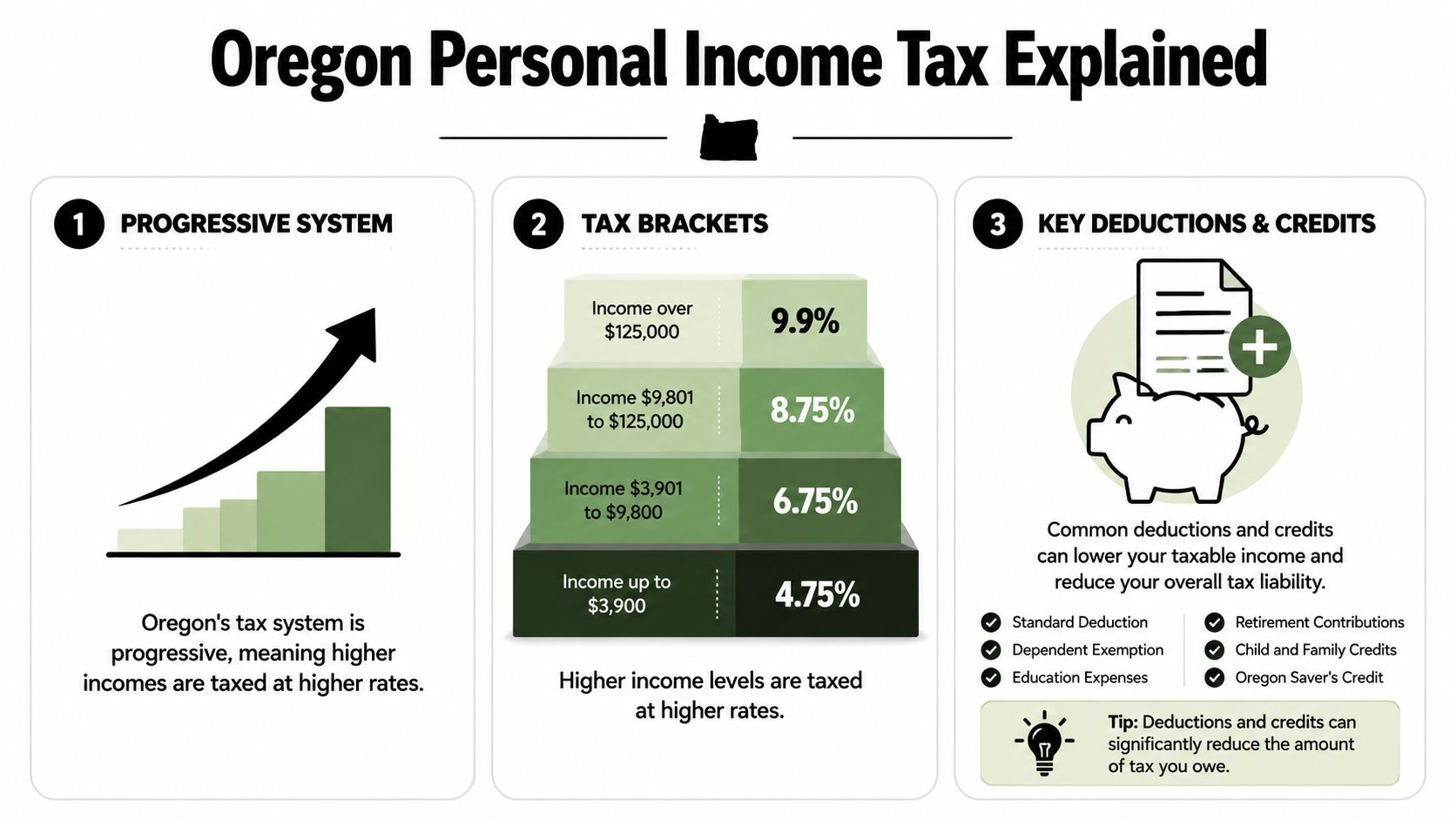
Oregon taxes individuals through a progressive rate system. Higher income is taxed in higher brackets, but only the income that falls within each bracket is taxed at that bracket's rate. For 2026, Oregon's personal income tax rates range from 4.75% to 9.90%, and the top bracket applies above $125,000 for single filers and $250,000 for married joint filers (Oregon income tax overview).
Who usually has to file
For many people, the question is not the rate. It is whether Oregon expects a return at all.
Oregon filing thresholds depend on filing status and the number of age or blindness boxes checked. A single filer generally must file once gross income exceeds $7,710 with 0 boxes checked, while a married filing jointly taxpayer's threshold runs from $15,425 to $19,425 as more boxes are checked. For part-year and nonresident filers, the thresholds are lower, which means a move into or out of Oregon can create a filing duty even when total annual income does not seem high (Oregon filing requirements summary).
That point matters more than many taxpayers expect. A person who moved midyear, worked remotely across state lines, or sold an asset while changing domicile can end up with an Oregon filing obligation even if the federal return feels straightforward. In practice, residency disputes and part-year allocations are often where preventable state tax debt begins.
For a broader view of recurring state income tax filing and residency issues, compare Oregon's rules against the facts of your own year, not your assumptions from the prior one.
What Oregon taxes and what it does not
Oregon taxes a broad range of income on the individual return. Wages, business income from pass-through entities, capital gains, dividends, and other taxable income generally flow into the state calculation. Oregon does not tax Social Security benefits.
That mix creates practical traps. Retirees sometimes focus on the Social Security exclusion and overlook taxable investment income. Business owners often track deductions at the entity level but fail to set aside cash for the personal tax on pass-through income. Employees who exercised stock options or sold concentrated positions can end up underwithheld because payroll did not cover the full state liability.
The legal issue is usually simple. The cash flow issue is not.
What usually keeps people out of trouble
A clean Oregon individual tax file usually comes from a few disciplined habits:
- Match residency to the facts. If you moved, keep lease documents, closing papers, voter registration changes, payroll records, and proof of where you lived and worked.
- Review withholding before year end. Oregon individual tax balances often grow from under-withholding, especially after bonuses, stock sales, or a second source of income.
- Treat self-employment income as a separate payment problem. No employer is sending in tax for you. If estimated payments are missed, the balance can build quickly.
- Check Oregon filing rules separately from federal rules. This is especially important for part-year residents, nonresidents, and taxpayers with mixed-state income.
In my experience, many Oregon income tax cases do not start with aggressive conduct. They start with a filing assumption that was never checked, then get worse because the notice sat unopened or unanswered.
Key Tax Rules for Oregon Businesses
Oregon business owners often ask the wrong first question. They ask, “Do I owe sales tax?” The better question is, “Which taxes am I collecting, reporting, or holding on the state's behalf?”
For many businesses, a significant risk sits in payroll. Income tax withholding is not house money. Once you withhold it from wages, the business is holding funds that were supposed to go to the government. If the company uses that cash to cover rent, inventory, or payroll itself, the state generally won't view that as a rough quarter. It will view it as noncompliance.
Why payroll mistakes escalate fast
Oregon's tax structure makes payroll compliance more important than many owners expect. As noted earlier, Oregon relies heavily on income tax, with $2,812 per person from personal income tax out of $6,938 in total per-capita taxes in the legislative report, which is why income and payroll tax compliance carry so much weight in practice (Oregon Public Finance Basic Facts 2025).
That matters because employers handle one of the state's most important revenue streams directly.
A business with employees usually has to do all of the following correctly and on time:
- Withhold state income tax from wages
- File payroll tax returns
- Remit withheld amounts when due
- Maintain payroll records that support wages, withholding, and worker classification
- Coordinate state payroll obligations with unemployment and other employer reporting requirements
If one piece fails, the others usually fail with it. A missed deposit often pairs with a late return. A late return often hides a worker classification issue. A classification issue often leads to back withholding exposure.
For a practical baseline, this small business tax checklist covers the kinds of compliance steps owners should have in place before problems start.
The owners most at risk
The highest-risk businesses aren't always large ones. In my experience, the common danger group includes:
| Business type | Typical risk point |
|---|---|
| Single-member LLC with first employee | No payroll system or weak separation between business and personal cash |
| Family business | Informal compensation and inconsistent records |
| Fast-growing service company | Hiring ahead of bookkeeping capacity |
| Struggling business with cash pressure | Using withheld taxes to keep operations running |
The legal problem is rarely just “we fell behind.” The problem is that the state may pursue the business first and then look closely at the people who made decisions, signed checks, directed payroll, or chose which creditors got paid.
What works and what doesn't
Some habits lower risk immediately.
- Use a real payroll system: If payroll is being run from a spreadsheet and online banking, the business is exposed.
- Separate tax funds from operating cash: Owners who keep withholding money in the main account often spend it when cash gets tight.
- Review notices as they arrive: Oregon notices are often the first sign that deposits, filings, or account coding don't match.
- Fix quarter by quarter: Waiting for year-end usually makes payroll cases harder, not easier.
What doesn't work is hoping that a profitable next month will cure a compliance failure from this month. Once withholding falls behind, the business needs a corrective plan, not optimism.
If your company can't afford to remit payroll taxes, it usually can't afford to keep pretending the problem is temporary.
Costly Oregon Tax Mistakes to Avoid
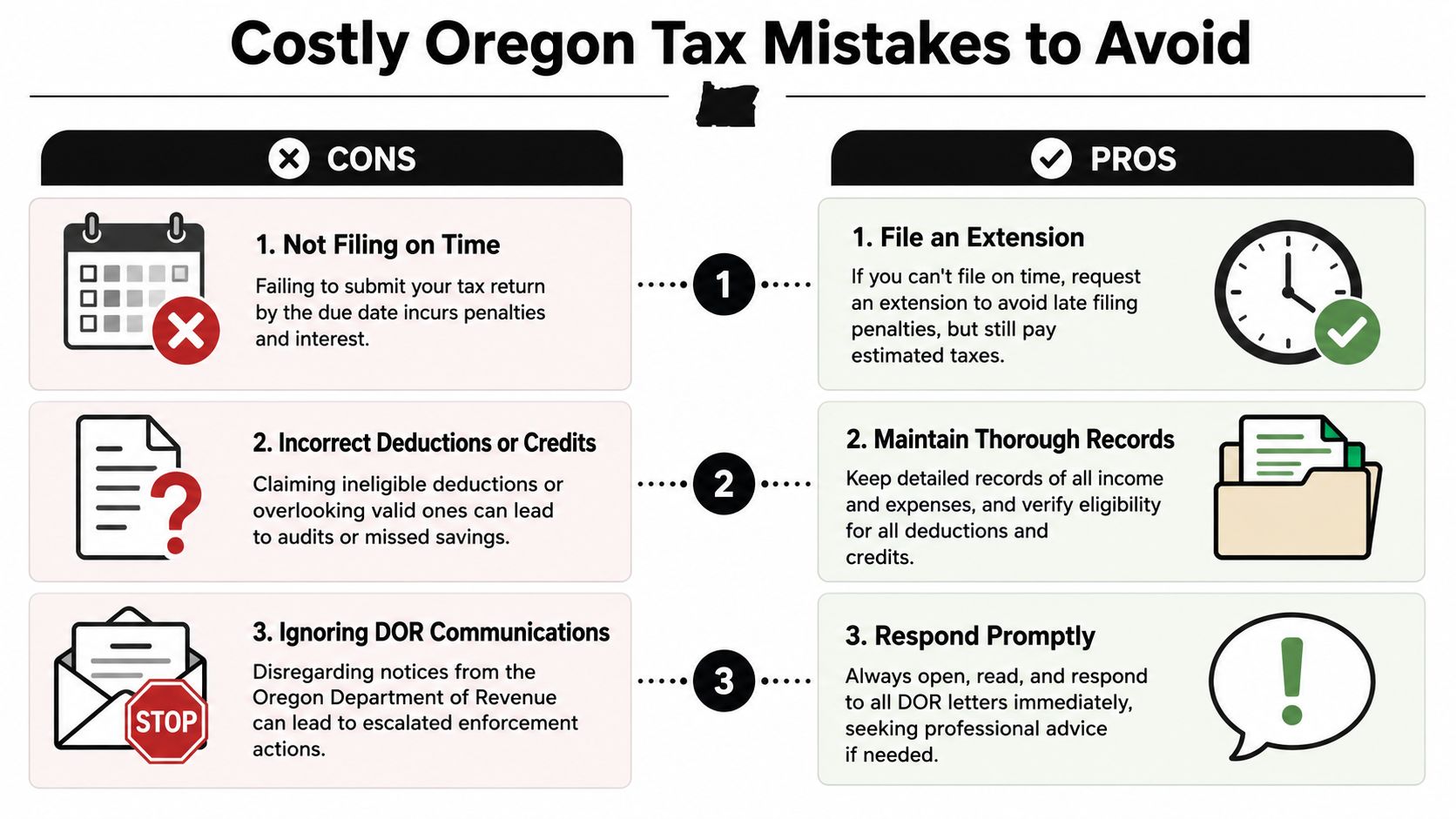
Most serious Oregon tax cases begin with ordinary mistakes. They don't start with fraud. They start with assumptions, delay, and bad triage.
The state's structure makes that especially costly for people with fluctuating income. The Oregon Center for Public Policy notes that the 8.75% bracket begins at $18,900 of taxable income for a single filer, which means middle-income households can face relatively high marginal rates sooner than many expect (Oregon tax system details).
Missing estimated payments
This is one of the most common problems for sole proprietors, independent contractors, partners, and S corporation owners.
A W-2 employee usually has state tax withheld during the year. A self-employed person has to build that system manually. When income rises unevenly, the taxpayer often pays too little for too long, then discovers the balance only when the return is prepared. By then, the issue isn't just the tax due. It's also penalties, interest, and cash flow strain.
Typical warning signs include:
- Income went up midyear: The taxpayer kept paying based on old assumptions.
- No one adjusted withholding elsewhere: A spouse's W-2 could have reduced the shortfall, but nobody coordinated it.
- The taxpayer waited for the return to “see what happens”: That's how manageable balances become collection cases.
Treating payroll tax money like operating capital
This is the business-owner mistake that causes the most personal stress later.
The company withholds tax from employees, cash gets tight, and the owner tells himself he'll catch up after receivables clear. Then rent comes due, the payroll processor pulls for the next cycle, a vendor threatens a shutoff, and the withheld tax money is gone. At that point, the state may look beyond the entity and focus on the individuals who were responsible for collecting and paying over those funds.
You asked for a guide that addresses trust fund consequences directly, so here's the practical version: if you controlled the money and chose not to remit payroll taxes, the liability may not stay inside the business.
Worker classification and informal payroll
Another expensive mistake is calling someone an independent contractor because it's easier administratively.
That choice affects withholding, unemployment issues, payroll reporting, and back-tax exposure. The risk gets worse when the business pays regular weekly amounts, controls the worker's schedule, provides the tools, and treats the worker like staff in every practical sense except tax reporting.
A clean fix often requires reviewing:
| Problem area | Why it matters |
|---|---|
| Worker classification | Can trigger back withholding and related state issues |
| Prior 1099 reporting | Creates a record the state can compare against wages |
| Payroll records | Often expose inconsistent treatment across workers |
Ignoring notices because the amount looks wrong
This mistake is common and understandable. Taxpayers receive a notice, believe it's inaccurate, and do nothing because they assume an obvious error will sort itself out.
It usually won't.
An incorrect notice still requires a response. If the state estimated income, misapplied a payment, or coded a return incorrectly, silence can turn a fixable account issue into a formal balance due with enforcement consequences.
The worst response to a bad notice is no response. A wrong assessment can still become collectible if the deadline passes.
What to Do When the DOR Contacts You
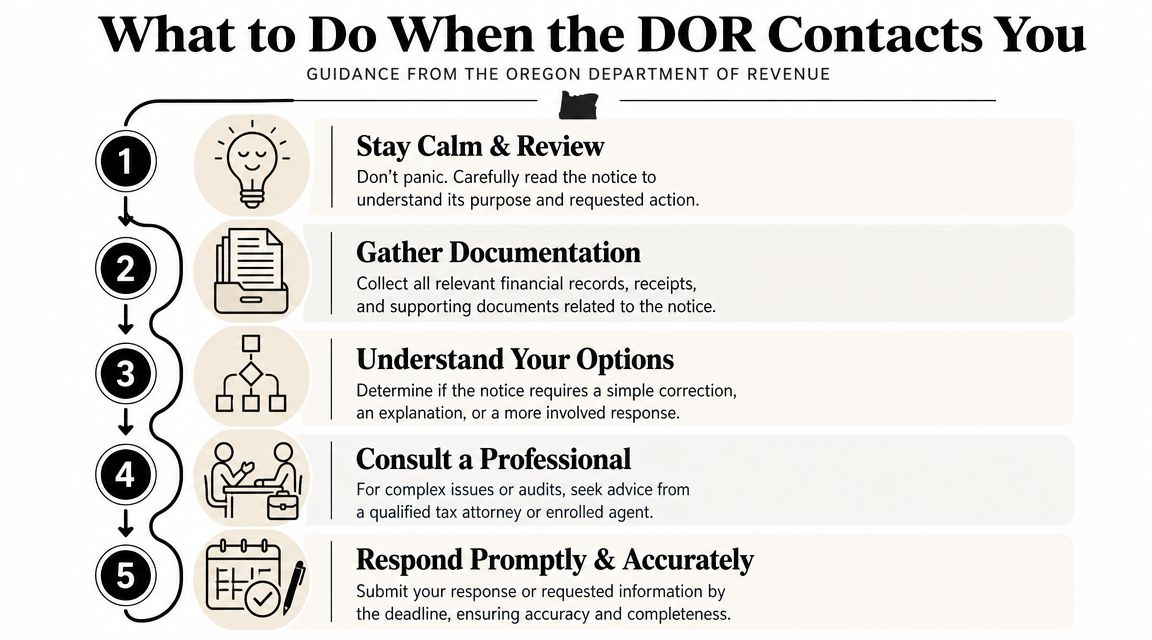
When the Oregon Department of Revenue sends a notice, the first job is emotional, not legal. Slow down and read it carefully.
Many taxpayers make the situation worse within the first day. They panic, call the wrong office without records in front of them, promise documents they don't have, or ignore the notice because they assume it's computer-generated noise. Some notices are simple. Others are the start of an audit or collection cycle. You can't tell which one you have until you read it line by line.
First steps that actually help
Start with documents, not arguments.
- Read the notice for the tax type and tax year. A payroll notice needs a different response than an individual income tax notice.
- Confirm the deadline. State tax deadlines are where options are won or lost.
- Pull the filed return, if one exists. You need to compare what was filed against what the state says is missing or wrong.
- Collect support before contacting the state. That might include W-2s, 1099s, payroll reports, proof of payment, bank records, or residency documents.
A good response is usually short, documented, and specific. A bad response is emotional, vague, and unsupported.
When the issue involves a special rule
Some notices arise because the taxpayer applied a rule correctly but can't yet prove it. Others arise because a narrow exemption was applied loosely.
A good example is the tribal-income exemption rule. Certain income earned by enrolled members of federally recognized tribes is exempt only if the member resides in Indian country in Oregon and the income is derived from sources within Indian country. If the person lives outside Indian country, ordinary resident or nonresident rules apply. The rule also states that an employee seeking exemption from withholding must furnish an extract from the tribal rolls to the employer (Oregon tribal income rule).
That kind of rule is exactly where audits start. The legal standard may be narrow, and the taxpayer's facts may be close but not close enough.
For taxpayers already dealing with collection pressure, this guide on how to stop state tax garnishment is a practical place to start.
When representation becomes necessary
You don't need a lawyer for every notice. You usually do need help when one or more of these are true:
- The notice involves payroll taxes or personal responsibility exposure
- The state is asking for records you can't organize quickly
- The account includes several tax years or multiple tax types
- Collection action is threatened or already underway
- You disagree with the state's position on residency, sourcing, or exemption rules
At that point, the actual value of representation is control. Someone needs to manage deadlines, narrow the issue, communicate with the agency, and stop the case from expanding while you're still figuring out what happened.
How to Resolve Your Oregon Tax Debt
Once Oregon tax debt exists, the goal isn't just “pay less.” Instead, the objective is to stop the account from getting worse while choosing the resolution path that fits the facts.
Taxpayers usually come in hoping for one dramatic fix. In practice, Oregon cases are often resolved through a mix of actions: getting missing returns filed, correcting bad assessments, reducing avoidable penalties where possible, setting payment terms, and limiting enforced collection while the account is being stabilized.

The main options
Here's how I usually frame the decision.
| Option | When it fits | Main trade-off |
|---|---|---|
| Installment arrangement | Tax is owed and the taxpayer can pay over time | Relief from immediate pressure, but the debt may continue to accrue |
| Penalty relief request | The balance grew because of circumstances and the taxpayer has support for waiver arguments | Useful in the right facts, but not a substitute for fixing the underlying tax |
| Compromise-style resolution | The full debt may not be realistically collectible | Demands strong financial disclosure and credible documentation |
| Account correction | The debt is inflated by unfiled returns, estimated assessments, or misapplied payments | Often the best first move, but it requires organized records |
A lot of people jump straight to compromise discussions when the first real need is reconstruction. If the state assessed a balance because returns weren't filed, then filing accurate returns may change the entire case before negotiation even begins.
Strategy matters more than hope
The strongest Oregon debt resolutions usually have three features.
- All required returns are current or being brought current fast
- The taxpayer can document present finances clearly
- The proposed resolution matches reality rather than wishful thinking
If you want a broader overview of the menu of relief paths, this summary of tax debt relief options is useful.
In some cases, taxpayers also ask whether bankruptcy is part of the analysis. That's not always the answer, and state tax debts require careful review before anyone assumes they can be wiped out. This article on can tax debts be discharged in bankruptcy gives a practical overview of the questions that have to be answered first.
One available option for Oregon matters is working through a representative under power of attorney who can deal directly with the agency, organize the financial presentation, and negotiate payment or resolution terms. Attorney Stephen A Weisberg provides that type of tax controversy and tax debt representation for state and IRS matters.
Good tax debt work is rarely about one magic form. It's about sequencing. Stop enforcement, correct the account, prove the numbers, then negotiate from facts.
Oregon Tax Questions Answered
If Oregon has no sales tax, why do many households still feel heavily taxed
Because the absence of sales tax doesn't mean the overall system feels light.
The Institute on Taxation and Economic Policy says Oregon has the 42nd most regressive state and local tax system in the country, and that low-income families often pay the highest effective tax rates as a share of their income (Oregon tax distribution analysis). That helps explain why “no sales tax” doesn't settle the fairness question. The lived burden depends on the full tax mix, not one headline feature.
Do I have to file if I only lived in Oregon for part of the year
Often, yes.
Part-year residency creates filing issues that many taxpayers miss because they focus on full-year income instead of Oregon-source income and Oregon filing mechanics. Moves in or out of the state, remote work, sale of assets during a move year, and business income earned across state lines all deserve special review. The mistake is assuming a partial year means a minor issue. Sometimes it's the year with the highest risk of error.
What should I think about before moving my business to Oregon
Start with owner taxation, payroll, and where the income will be reported.
For pass-through businesses, much of the tax impact lands on the owner's individual return. If you'll have employees, payroll setup should happen before the first wage payment, not after. If you're moving from a state with different filing habits, don't assume your old workflow transfers cleanly. Oregon rewards businesses that treat tax administration as part of setup, not cleanup.
I got behind on Oregon taxes and can't pay in full. Should I still file
Yes.
Filing and paying are separate issues. When taxpayers wait to file because they can't pay, they usually lose time, records, and their negotiating position. A filed but unpaid balance can often be addressed. An unfiled year gives the state more room to estimate, assess, and escalate.
If you're dealing with Oregon state taxes, especially unfiled returns, payroll problems, garnishments, or balances you can't resolve on your own, Attorney Stephen A Weisberg offers a free Tax Debt Analysis to determine whether he can help and what resolution path makes sense before charging for representation.


