A Complete Guide to Offsets on Taxes
Confused about offsets on taxes? Learn why your refund was taken, what your rights are, and how to resolve tax debt with our expert guide.

In this article
- Why Is Your Tax Refund Suddenly Gone
- What Debts Trigger an Offset
- Offsets vs Levies and Garnishments
- Tax Offsets vs Levies vs Garnishments at a Glance
- Understanding the Treasury Offset Program
- Who Are the Key Players in an Offset
- The Notice of Intent to Offset
- Common Reasons for a Tax Refund Offset
- Unpaid Federal and State Tax Debts
- Delinquent Non-Tax Government Debts
- The Role of Missed Credits and Deductions
- Your Rights and How to Dispute an Offset
- Step-by-Step Guide to Challenging an Offset
- Initiating a Debt Review
- The Injured Spouse Claim: A Lifeline for Joint Filers
- Proactive Strategies to Prevent Future Offsets
- Master Your Estimated Taxes
- Resolve Existing Debts Before They Escalate
- Maximize Your Deductions and Credits
- How to Get Professional Help With Your Tax Issues
- The First Step: A No-Commitment Analysis
- Why a Personalized Approach Makes All the Difference
- Frequently Asked Questions About Tax Offsets
- Can I Stop a Tax Offset That I Know Is Coming?
- Will I Always Get a Notice Before My Refund Is Offset?
- What Happens if the Offset Does Not Cover My Entire Debt?
It’s one of the most frustrating moments for any taxpayer: you file your return, expect a nice refund, and then... nothing. Or worse, you receive a notice that your refund is significantly smaller than you anticipated. If this has happened to you, it's likely not an IRS error. You’ve probably been hit by an offsets on taxes action.
This is a formal process where the federal government steps in and uses your tax refund to cover certain old debts you owe. Think of it as an automated collection tool, but one that can feel like a punch to the gut if you aren't expecting it.
Why Is Your Tax Refund Suddenly Gone

Here’s how it works behind the scenes. The Department of the Treasury runs a program through its Bureau of the Fiscal Service (BFS), known as the Treasury Offset Program (TOP). Before the IRS sends out your refund, it first checks with TOP to see if you have any outstanding debts registered with them. If there's a match, BFS intercepts your refund, pays the agency you owe, and sends you any leftover amount.
This isn't a rare occurrence. It catches millions of Americans by surprise every single year. For perspective, by May 2026, the IRS had issued $274.979 billion in refunds, with the average taxpayer getting back $2,939. For many, however, that refund never made it to their bank account because it was redirected to cover an old debt.
What Debts Trigger an Offset
Many people think an offset is only for old IRS tax bills, but the program’s reach is much wider. Your refund can be taken to satisfy a variety of government-related debts, including:
- Federal Tax Debts: This is the most obvious one—unpaid income taxes from prior years.
- Past-Due Child Support: A very common cause for an offset, where the government collects on behalf of a state child support agency.
- Other Federal Agency Debts: Debts like defaulted federal student loans or overdue Small Business Administration (SBA) loans fall into this category.
- State Income Tax Obligations: If you owe another state money for their income taxes, they can use this federal program to collect.
- State Unemployment Compensation Debts: This is used to claw back benefits you received but were later found to be ineligible for.
When you're facing these kinds of financial hurdles, it's natural to wonder about bigger solutions. For some, understanding if bankruptcy can clear tax debt can provide a path forward, but it's crucial to know which debts qualify.
Offsets vs Levies and Garnishments
The terms "offset," "levy," and "garnishment" are often used interchangeably, but they are three very different collection actions. Knowing which one you’re dealing with is the first step to resolving it because it tells you who to contact and what your rights are.
An offset is unique because it specifically targets federal payments before they are sent to you. A levy or garnishment, on the other hand, goes after money or assets you already have. With the government increasingly moving toward digital transactions, understanding how these payments are handled is more important than ever. In fact, you might be interested to learn about how the IRS plans to end paper refunds by 2026.
An offset is the government intercepting money it owes you (like a refund) to pay a debt you owe it (or another agency). It’s not the same as the IRS seizing money from your bank account (a levy) or a creditor taking funds from your paycheck (a garnishment).
To help clarify these distinctions, we've put together a simple comparison table.
Tax Offsets vs Levies vs Garnishments at a Glance
This table clarifies the key differences between three common methods used to collect debt, helping you identify which one affects you.
| Collection Method | What is Seized | Who Initiates It | Primary Target |
|---|---|---|---|
| Tax Refund Offset | Federal payments (primarily tax refunds) | Bureau of the Fiscal Service (BFS) | Debts owed to federal and state agencies |
| IRS Levy | Assets like bank accounts and property | The IRS directly | Past-due federal taxes |
| Wage Garnishment | A portion of your paycheck | A creditor, via a court order | Various debts (credit cards, personal loans, etc.) |
As you can see, each tool has a different source, initiator, and purpose. Recognizing that you're facing an offset from the BFS—not a levy from the IRS—is the key to finding the right solution.
Understanding the Treasury Offset Program

When your tax refund suddenly vanishes, the culprit is almost always a powerful government system known as the Treasury Offset Program (TOP). It's best to think of TOP as the federal government’s central hub for collecting overdue debts. It's run by the Bureau of the Fiscal Service (BFS), a separate agency from the IRS.
Here’s how it works: before the IRS can issue your refund, it must first check your name against the TOP database. If you have an outstanding debt with another government agency, TOP flags it and automatically reroutes your refund to pay that debt. It all happens behind the scenes, ensuring that what you owe the government gets paid first.
Understanding this automated process is the first step to resolving offsets on taxes. The program essentially acts as a financial checkpoint, making sure other federal and state obligations are settled before any Treasury money lands in your pocket.
Who Are the Key Players in an Offset
When your refund gets snagged, there are three main parties involved. Knowing who is responsible for what is absolutely critical—mixing them up is a common mistake that wastes precious time.
Here's a breakdown of who you'll be dealing with:
- The Creditor Agency: This is the government body that says you owe them money. It could be the Department of Education for a student loan, a state for back child support, or even the IRS for a past tax bill. This is the only agency that can negotiate or resolve the actual debt.
- The Bureau of the Fiscal Service (BFS): The BFS runs the TOP system and is the one that physically intercepts your refund. Think of them as the "matchmaker" connecting your refund to your debt. They are the ones who send the official offset notice explaining where your money went.
- The Internal Revenue Service (IRS): The IRS's job is simply to process your tax return and calculate your refund. Once that's done, they hand the payment over to the BFS, which carries out the offset. The IRS has no power to stop an offset for a non-tax debt.
The most critical thing to remember is this: You do not dispute the offset with the IRS or the BFS. You must contact the creditor agency—the one you owe money to—to challenge the validity or amount of the debt itself.
The Notice of Intent to Offset
An offset shouldn’t come as a complete surprise. By law, the creditor agency must mail you a "Notice of Intent to Offset" long before your debt ever gets submitted to TOP. This letter is your official warning and a crucial chance to take action.
The notice usually gives you 60 days to do one of the following:
- Pay the debt in full.
- Work out a payment plan with the agency.
- Show proof that the debt is wrong or doesn't belong to you.
- Request a formal review or hearing to dispute the claim.
Ignoring this notice is the quickest route to losing your refund. It's your one real opportunity to fight the debt before the government takes your money. This formal warning is a standard part of the government's collection playbook, much like how the IRS has recently reactivated its own collection tools like the Automated Federal Payment Levy Program.
If you moved and never got the letter, you might only discover the offset after your refund is gone. This is why it’s so important to keep your mailing address current with any agency you might owe, especially if you have known financial obligations.
Here is the rewritten section with a more human, natural tone:
Common Reasons for a Tax Refund Offset
It’s a gut-punch moment. You file your taxes, expecting a refund to hit your bank account, but instead, you get a letter saying your money was taken. Or, even worse, it simply vanishes. This isn't random bad luck; it’s a tax refund offset.
The agency behind this is the Treasury Offset Program (TOP). Think of it as the federal government's central collection agency. If you owe money to one government agency, another one (like the IRS) can be instructed to intercept payments to you—including your tax refund—to cover the debt. While many people think this only happens for old tax bills, the net is cast much wider.
Unpaid Federal and State Tax Debts
Let's start with the most straightforward reason: you owe the taxman. If you have an outstanding tax bill with the IRS from a previous year, they're not just going to send you a check. They will absolutely apply your current refund to that old debt first.
We see this hit a few groups of people particularly hard:
- Sole Proprietors and Independent Contractors: When you're your own boss, you're responsible for paying estimated taxes all year. It's incredibly easy to miscalculate or fall behind, leaving you with a surprise bill that turns into an offset the following year.
- Small Business Owners: For businesses with employees, the big danger is unpaid payroll taxes. The IRS takes this extremely seriously, sometimes leading to a Trust Fund Recovery Penalty. This is a stiff penalty that makes the business owner or other responsible person personally liable for the unpaid employee withholding taxes.
- Individuals with Past Filing Mistakes: A simple math error, a forgotten 1099, or an audit that didn't go your way can create a debt that lingers for years. The IRS has a long memory, and that old debt can suddenly come back to haunt you by snatching a future refund.
Delinquent Non-Tax Government Debts
This is where things get really confusing for taxpayers. The debt that triggers the offset often has nothing to do with the IRS at all. A whole host of other federal and state agencies use the TOP to collect what they're owed.
Some of the most common culprits we see are:
- Past-Due Child Support: This is a huge one. State child support agencies routinely report parents with arrears to the TOP, which then intercepts federal tax refunds to pay down what's owed.
- Defaulted Federal Student Loans: If you've defaulted on a federal student loan, the Department of Education can and will ask the Treasury to take your refund. This usually happens after you've been in default for a while.
- Overpaid State Unemployment Benefits: This became a massive issue for millions recently. If a state finds it overpaid you in unemployment benefits and you haven't settled the balance, they can request an offset of your federal refund to get their money back.
The key thing to remember is that the debt doesn't have to be recent. An old student loan you thought was forgotten or a child support disagreement from a decade ago can suddenly surface as a tax refund offset, catching you completely by surprise.
The Role of Missed Credits and Deductions
There's another angle to this, especially for business owners and freelancers. Unclaimed tax breaks can make a bad situation even worse. If you have a tax debt, failing to claim every single credit and deduction you're entitled to means your taxable income is artificially high. This inflates your tax bill, which in turn increases the debt that leads to an offset.
It's a bigger problem than most people realize. According to the IRS, only 11.4% of taxpayers itemized their deductions in a recent year, suggesting a huge number of people are leaving money on the table. For a business owner, missing out on these deductions not only makes an offset more likely but also increases the risk of penalties. You can find more details in the IRS credits and deductions gap analysis.
Once you figure out which specific debt triggered your offset, you can start taking the right steps. The crucial part is knowing you're not fighting the IRS—you have to go directly to the agency that originally reported the debt.
Your Rights and How to Dispute an Offset
Getting that letter saying your tax refund has been seized can feel like a punch to the gut. It's easy to assume the decision is final and there's nothing you can do. But that’s not the case. You have rights and clear ways to fight back against the debt that triggered the offset.
The most important thing to understand is this: you don’t argue with the IRS about the offset itself. The IRS and the Bureau of the Fiscal Service (BFS) are essentially just the messengers here.
Your dispute is with the creditor agency—the government entity that claims you owe them money. This could be a state agency for child support, the Department of Education for a student loan, or even the IRS for an old tax bill. That’s where you need to focus your energy.
Step-by-Step Guide to Challenging an Offset
Challenging a tax refund offset is all about taking methodical, deliberate action. The moment that BFS offset notice arrives in your mailbox, the clock starts ticking.
Your first step is to carefully read that notice. Think of it as your roadmap. It will tell you everything you need to know:
- The original refund amount you were expecting.
- The exact amount of the offset that was taken.
- The name of the agency that got your money and how to contact them.
Once you have this info, you’re ready to start. Don't waste time calling the IRS about offsets on taxes for non-tax debts—they have no authority to get involved and can't help you.
Initiating a Debt Review
Your primary mission is to formally challenge the debt with the creditor agency. You need to build a case that proves the debt is invalid, you've already paid it, the amount is wrong, or it isn't even your debt (which happens in cases of identity theft).
To do this, you need to become a detective and gather every shred of evidence you can find. Dig up anything that supports your claim, such as:
- Proof of Payment: Canceled checks, bank statements, or official receipts showing the debt was settled.
- Court Orders: Any legal documents that modify or cancel the debt, like a bankruptcy discharge or divorce decree.
- Official Correspondence: Past letters or notices you’ve received from the agency that contradict their current claim.
Contact the agency in writing to officially dispute the debt and ask for a formal review. I always recommend sending it via certified mail so you have a paper trail proving you took action. If you're unsure how to handle formal disputes, reviewing your IRS notices and collection appeal rights can give you a good overview of the process.
Remember, the burden of proof falls on you. A well-organized case with clear documentation is your best and only weapon. Simply saying "this isn't right" won't get you very far.
The Injured Spouse Claim: A Lifeline for Joint Filers
What happens when your joint tax refund is taken to pay for a debt that only belongs to your spouse? It's a frustratingly common scenario. Thankfully, the IRS has a specific solution called an Injured Spouse Claim.
Now, don't confuse this with an "innocent spouse" claim, which is used for tax debts caused by a spouse's mistakes on a joint return. An injured spouse claim is for when your share of a joint refund is snatched to cover your spouse's separate, non-tax debts, like:
- Past-due child support from a prior marriage.
- A federal student loan they defaulted on before you were married.
- An old state or federal tax debt they incurred while single.
To get your portion of the refund back, you need to file Form 8379, Injured Spouse Allocation. This form tells the IRS to calculate your share of the joint refund and issue it directly to you, separating it from the portion being used to pay the offset. You can file Form 8379 along with your joint tax return, or you can file it separately after you receive the offset notice.
Filing this form correctly is a powerful way to protect your money from being unfairly taken for a debt that isn't yours.
This decision tree shows the common reasons a refund might get intercepted in the first place.
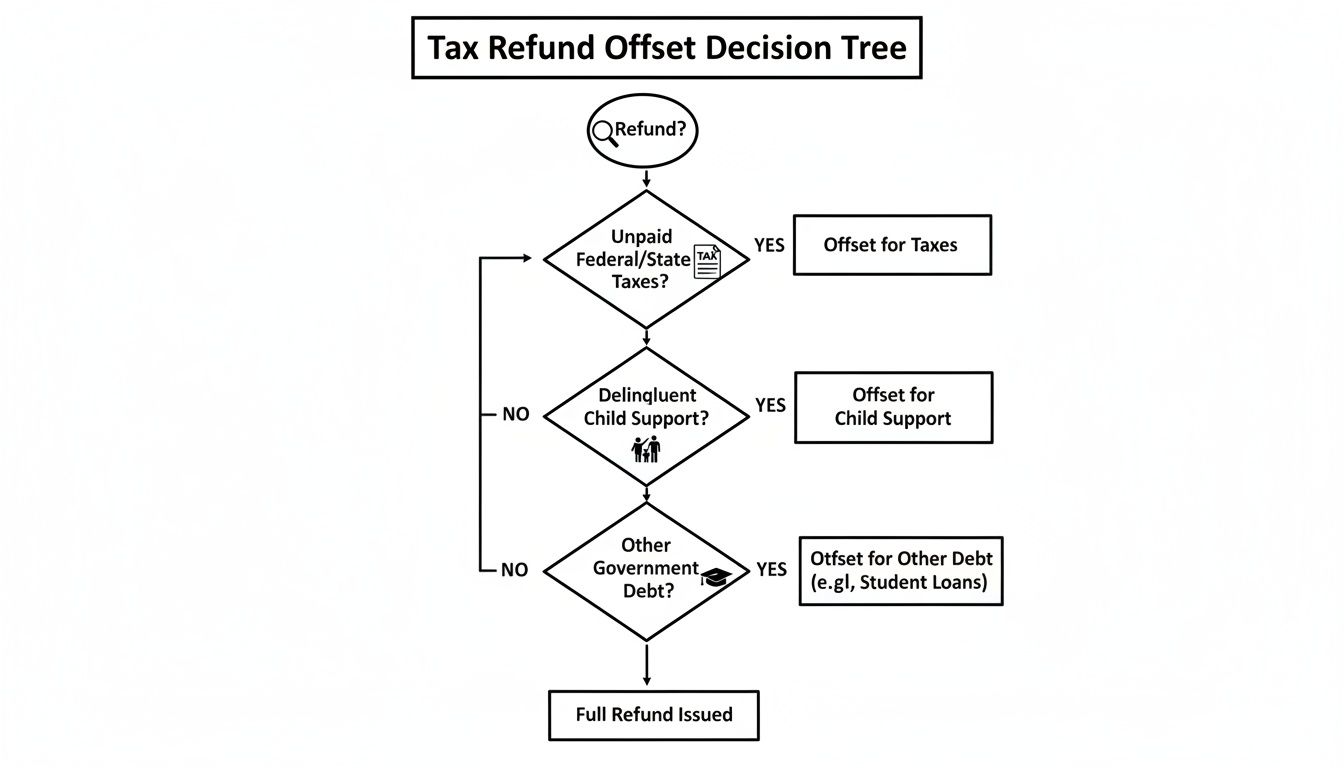
As you can see, while unpaid taxes are a direct trigger, many offsets come from government obligations that have nothing to do with the IRS.
Proactive Strategies to Prevent Future Offsets
When it comes to offsets on taxes, the best defense is a good offense. It's one thing to know how to fight an offset after the fact, but it’s far better to prevent one from ever happening in the first place. This all comes down to building smart, year-round financial habits to keep you in good standing with the government.
The core idea is simple: stay on top of your financial responsibilities. For most people, that means filing and paying your income taxes on time, every single year. If you're a small business owner, this also includes making timely payroll tax deposits and filing your quarterly reports without fail. Falling behind is the first domino to fall on the path toward a future offset.
Master Your Estimated Taxes
If you're self-employed, a freelancer, or a sole proprietor, estimated taxes are your first line of defense. You don't have an employer withholding taxes for you, so that job falls squarely on your shoulders. Underpaying your estimated taxes is a surefire way to rack up a tax debt that the IRS will happily collect through an offset.
To steer clear of this common trap, you need a plan:
- Project Your Income: Get a realistic handle on your annual earnings so you can accurately calculate what you'll owe.
- Set Aside Funds: Make it a non-negotiable habit to move a percentage of every single payment you receive into a separate savings account just for taxes.
- Pay Quarterly: Make your four estimated tax payments on time. This helps you avoid underpayment penalties and that gut-punch of a surprise bill at the end of the year.
This kind of discipline is exactly what stops a small tax issue from becoming the kind of debt that the Treasury Offset Program was built to collect.
Resolve Existing Debts Before They Escalate
If you're already carrying a debt—whether it's with the IRS or another government agency—the absolute worst thing you can do is ignore it. Taking action before that debt gets handed over to the Treasury Offset Program can save your refund. You have more power than you think to get back into compliance.
For federal tax debts, you can work directly with the IRS to find a solution. Many people are surprised to learn how flexible the IRS can be. Our guide on how to set up a payment plan with the IRS walks you through how an Installment Agreement lets you pay off your balance over time with manageable monthly payments.
Another powerful option is an Offer in Compromise (OIC), which allows certain taxpayers to settle their tax debt for less than the full amount owed. Both of these resolutions stop aggressive collection actions in their tracks, including future tax offsets.
The key is to be proactive. Reaching out to the creditor agency to address the debt head-on shows good faith and opens the door to solutions that will keep your future refunds safe.
Maximize Your Deductions and Credits
Finally, one of the most powerful preventative measures is to simply lower your tax bill from the start. This means meticulously tracking your expenses and claiming every single credit and deduction you are legally entitled to. When you reduce your taxable income, you lower the chances of owing taxes and creating a debt in the first place.
In 2026, tax breaks are expected to cost the federal government $2.2 trillion in revenue, with individual income tax breaks making up a whopping $2.0 trillion of that total. For individuals and small business owners, using these breaks strategically is a critical part of a healthy financial picture. A crucial first step is learning how to organize receipts for taxes so you have all the necessary documents ready to go.
How to Get Professional Help With Your Tax Issues
That letter in the mail—the one from the government talking about an offset on your taxes—can make your heart sink. It's confusing, intimidating, and it's easy to feel like you're completely on your own. While you can try to fight it yourself, navigating the maze of federal and state bureaucracy is a tough, uphill battle.
Fortunately, you don’t have to go it alone. But here’s something you need to know: not all tax help is created equal. Many big, national firms will try to scare you into a high-priced retainer before they’ve even looked at your case. A real professional, especially a team led by a tax attorney, works differently.
The First Step: A No-Commitment Analysis
The first conversation with a tax professional should never start with a demand for money. It should start with a deep dive into what’s actually going on. This is your chance to get a clear picture of the road ahead without spending a dime.
A legitimate firm will offer a free, comprehensive analysis of your tax situation. Think of it as a diagnostic check-up. An expert will get under the hood to find the real source of the offset, whether it’s an old payroll tax debt from a business you used to run or a student loan you’d long forgotten.
The point of this initial step is to give you honest answers. It involves:
- Pinpointing the Problem: Finding out exactly which agency wants your money and why.
- Scrutinizing the Paperwork: Reviewing every notice you’ve received from the Bureau of the Fiscal Service (BFS) and the agency claiming the debt.
- Laying Out Your Options: Clearly explaining the strategies that might work for you, from filing an Injured Spouse Claim to negotiating a manageable payment plan.
This free Tax Debt Analysis is the most critical first step. It gives you a professional game plan and a full understanding of your case, all with zero upfront cost or pressure.
Why a Personalized Approach Makes All the Difference
There's no one-size-fits-all solution for tax problems. The right strategy for an independent contractor with an old IRS debt is completely different from what a business owner needs when facing a Trust Fund Recovery Penalty. This is precisely where a hands-on, attorney-led team shines.
Your case isn't just another number in a queue; it's a unique situation that demands a tailored solution. Whether you're an individual blindsided by a tax refund seizure or a business trying to get back on solid ground, an expert can guide you through the system, protect your rights, and fight for the best possible outcome. Don't let a tax offset throw your finances into chaos—find out what your options are and get the help you deserve.
Frequently Asked Questions About Tax Offsets
It's completely normal to have a flood of questions when you hear the words "tax offset." Let's walk through some of the most common ones we get asked, so you know exactly where you stand.
Can I Stop a Tax Offset That I Know Is Coming?
Yes, but the clock is ticking. The moment you get a "Notice of Intent to Offset," your first and best move is to call the agency that sent it. You can often head off the offset entirely by paying what you owe or, more realistically, working out a repayment plan with them.
Once that debt gets passed along to the Treasury for collection, however, your options narrow dramatically. At that point, stopping the offset becomes a real uphill battle. Time is absolutely your most valuable resource here.
Will I Always Get a Notice Before My Refund Is Offset?
You should. By law, the creditor agency must send you a written warning that they plan to take your tax refund to cover the debt. This letter is critical—it outlines your rights, including the steps to dispute the debt or ask for a review of your case.
We see it all the time: the main reason people never see this notice is because they've moved and forgot to update their address with the agency. If you have any outstanding government debt, make sure your contact info is always current.
What Happens if the Offset Does Not Cover My Entire Debt?
If your tax refund isn't enough to pay off the entire debt, the Treasury Offset Program (TOP) will take 100% of it anyway. The remaining balance doesn't just go away.
This means the agency will keep coming after the rest of the money. They can—and likely will—request offsets from your federal payments in the following years until the debt is fully settled. It's crucial to get in touch with them to figure out a plan for the remaining balance.
An offset notice can feel like a gut punch, but you don't have to figure it out on your own. The W Tax Group offers a free, no-pressure Tax Debt Analysis to get to the bottom of your situation and lay out all your options. Get your free Tax Debt Analysis today and take the first real step toward putting this behind you.


