Offer in Compromise Forms: A Step-by-Step Guide
Navigate the complex IRS Offer in Compromise forms (656, 433-A/B) with an expert guide. Learn how to apply, avoid rejection, and settle your tax debt.
In this article
- Facing Tax Debt and Considering an Offer in Compromise
- What works and what usually fails
- First Steps Verifying Your OIC Eligibility
- The non-negotiable gates
- Use the IRS tool, but don't mistake it for approval
- The three grounds are not equally easy
- Decoding the Core Offer in Compromise Forms
- What each form actually does
- The mistake that gets business owners returned fast
- How the forms should work together
- Completing Your Financial Disclosure to Prove Your Case
- What Reasonable Collection Potential means in practice
- Where good cases get rejected
- Build the numbers from the documents up
- Accuracy is stronger than exaggeration
- When form preparation becomes legal analysis
- Submitting Your Package and Managing the Timeline
- What goes in the package
- What happens after submission
- The timeline is longer than many taxpayers expect
- When an OIC Isnt the Answer and When to Call an Attorney
- Signs an OIC may be the wrong tool
- Signs you should stop doing this yourself
The envelope from the IRS sits on the counter for a day, then a week. You already know what it says. The balance is real, the deadline is real, and the fear is real. For many taxpayers, that's the moment they start searching for an Offer in Compromise and hope it means the IRS will “settle” for less.
Sometimes it does. Often it doesn't.
An Offer in Compromise is a formal settlement program, not a hardship letter and not a request for mercy. The IRS reviews it like a collection case with evidence, forms, and financial proof. In Fiscal Year 2025, the IRS received 38,797 offers in compromise but accepted only 5,464, an acceptance rate of about 14.1%, according to IRS collections activity statistics. That single number should change how you approach the process.
If you're already worried about enforced collection, it also helps to understand the difference between notices, liens, and actual seizure activity. This overview of understanding a tax levy gives useful background on what can happen if a balance remains unresolved.
Most failed applications aren't denied because the taxpayer filled in the wrong box on one line. They fail because the case was never approvable in the first place, the wrong forms were used, the financial disclosures were sloppy, or the offer amount had no relationship to what the IRS believes it can collect.
That's why the right starting point isn't “Which form do I download?” It's “Do I have a fact pattern the IRS will accept?” If you need a broader overview before getting into the paperwork, this complete guide to IRS offer in compromise tax debt settlement is a useful companion.
Facing Tax Debt and Considering an Offer in Compromise
A taxpayer usually reaches this point after several smaller problems pile up. A bad year in business. Estimated taxes that weren't paid. Payroll tax issues. A divorce. A sale that fell through. What looks like one tax debt problem is often a records problem, a cash flow problem, and a strategy problem at the same time.
The first practical shift is mental. Stop treating the Offer in Compromise as a rescue button. Treat it as a submission package that must persuade an IRS reviewer that your offer is the most the government can reasonably expect to collect before the collection statute runs out.
A good Offer in Compromise case starts long before Form 656. It starts with compliance, records, and a believable financial story.
That's where many self-prepared filings break down. Taxpayers often choose an offer amount based on what they wish they could pay, not on what the IRS is likely to calculate from assets and future income. The IRS does not care whether the number feels fair. It cares whether the number meets its collection analysis.
What works and what usually fails
Some patterns show up again and again in practice.
- What works: A complete filing history, current compliance, organized bank statements, and financial disclosures that match supporting records.
- What fails: Missing returns, mixed personal and business liabilities in one application, unsupported expenses, and asset values that look guessed rather than documented.
- What helps: Filing only after you understand whether your facts fit the program.
- What hurts: Filing fast because a notice scared you.
The people most likely to waste time and money are often the ones in the middle. They aren't obviously collectible enough for an easy installment agreement, but they also aren't clearly unable to pay. That gray area requires careful analysis. If you submit weak offer in compromise forms in that situation, the IRS will usually see the weaknesses faster than you do.
First Steps Verifying Your OIC Eligibility
Before you fill out anything, confirm that the IRS can legally and administratively consider your case. If these threshold requirements aren't met, the forms don't matter.
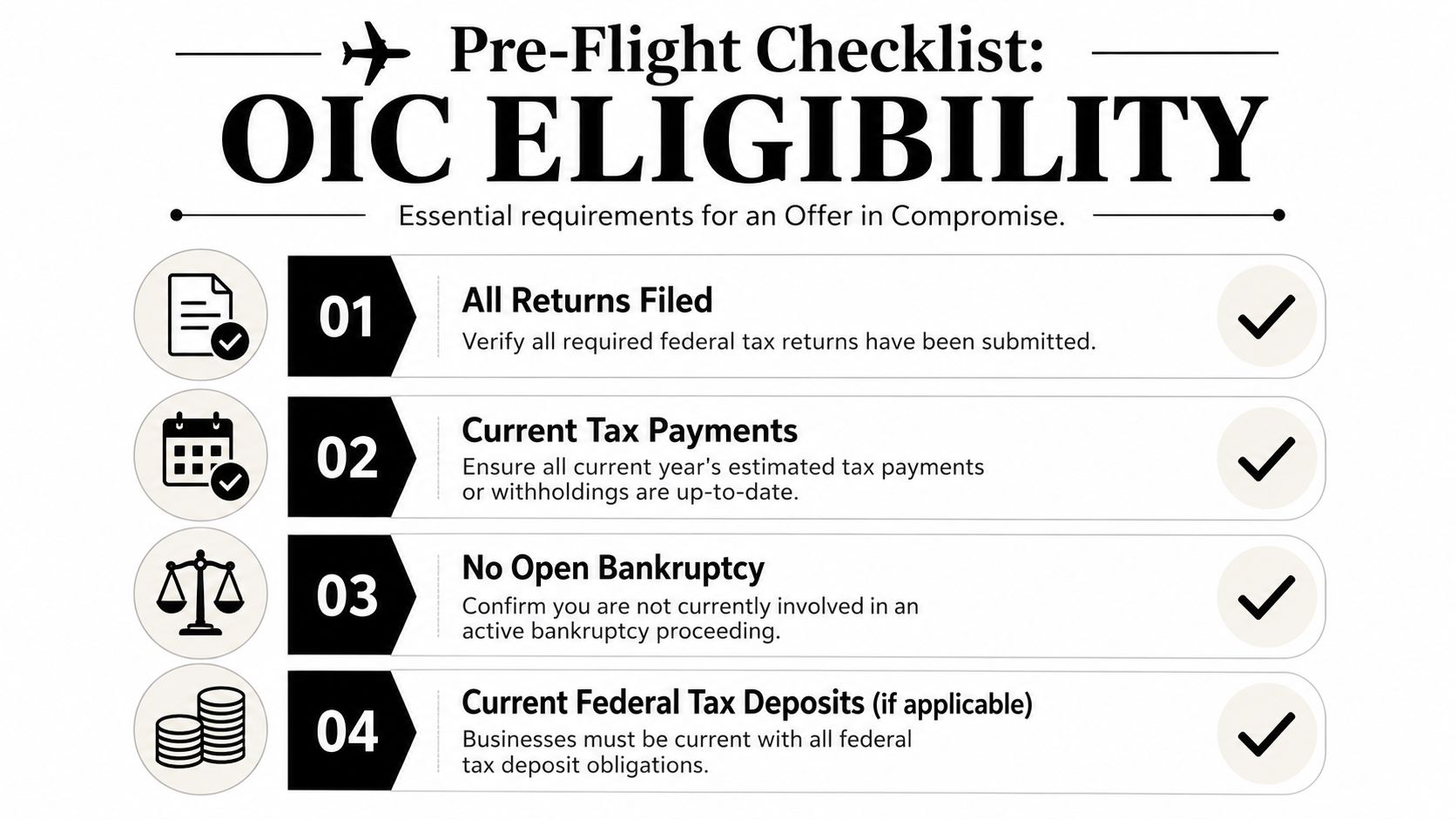
The IRS states in the Offer in Compromise Booklet Form 656-B that, to be eligible, you must have filed all required tax returns, received a bill for at least one tax debt included in the offer, and if you own a business with employees, made all required federal tax deposits for the current and two preceding quarters.
The non-negotiable gates
Run through these in order.
All required returns are filed.
If returns are missing, fix that first. An unfiled return tells the IRS you want settlement without basic compliance.You've received a bill for at least one tax period in the offer.
You can't compromise a balance that hasn't matured into an actual assessed collection case.Business deposit compliance is current if you have employees.
Many business owners often fail in this regard. The IRS won't negotiate old liabilities while new payroll obligations are still being missed.You need a valid legal basis for the offer.
The recognized categories include doubt as to collectibility, doubt as to liability, and hardship-based cases described in the IRS materials.
Use the IRS tool, but don't mistake it for approval
The IRS has an OIC Pre-Qualifier Tool. Use it. It can save you from filing an offer that was dead on arrival.
It is still only a screening tool. It doesn't verify the quality of your documentation, the defensibility of your expenses, or whether your asset values will survive examiner review. It also won't catch every practical problem that sinks real applications.
Practical rule: If the pre-qualifier suggests you're not eligible, stop and reassess. If it suggests you may be eligible, that only means it's worth deeper analysis.
The three grounds are not equally easy
A quick distinction matters here:
- Doubt as to collectibility is the lane most taxpayers are in. The issue is ability to pay.
- Doubt as to liability is different. You are saying the tax itself isn't legally owed, which is more complex and evidence-driven.
- Hardship-based cases depend on showing severe financial distress even where strict collection analysis may not tell the whole story.
Many people choose the wrong theory because it sounds more sympathetic. That's a mistake. Your theory has to match the facts and the records. If you want a more detailed eligibility breakdown before moving to the forms, review how to qualify for an Offer in Compromise.
Decoding the Core Offer in Compromise Forms
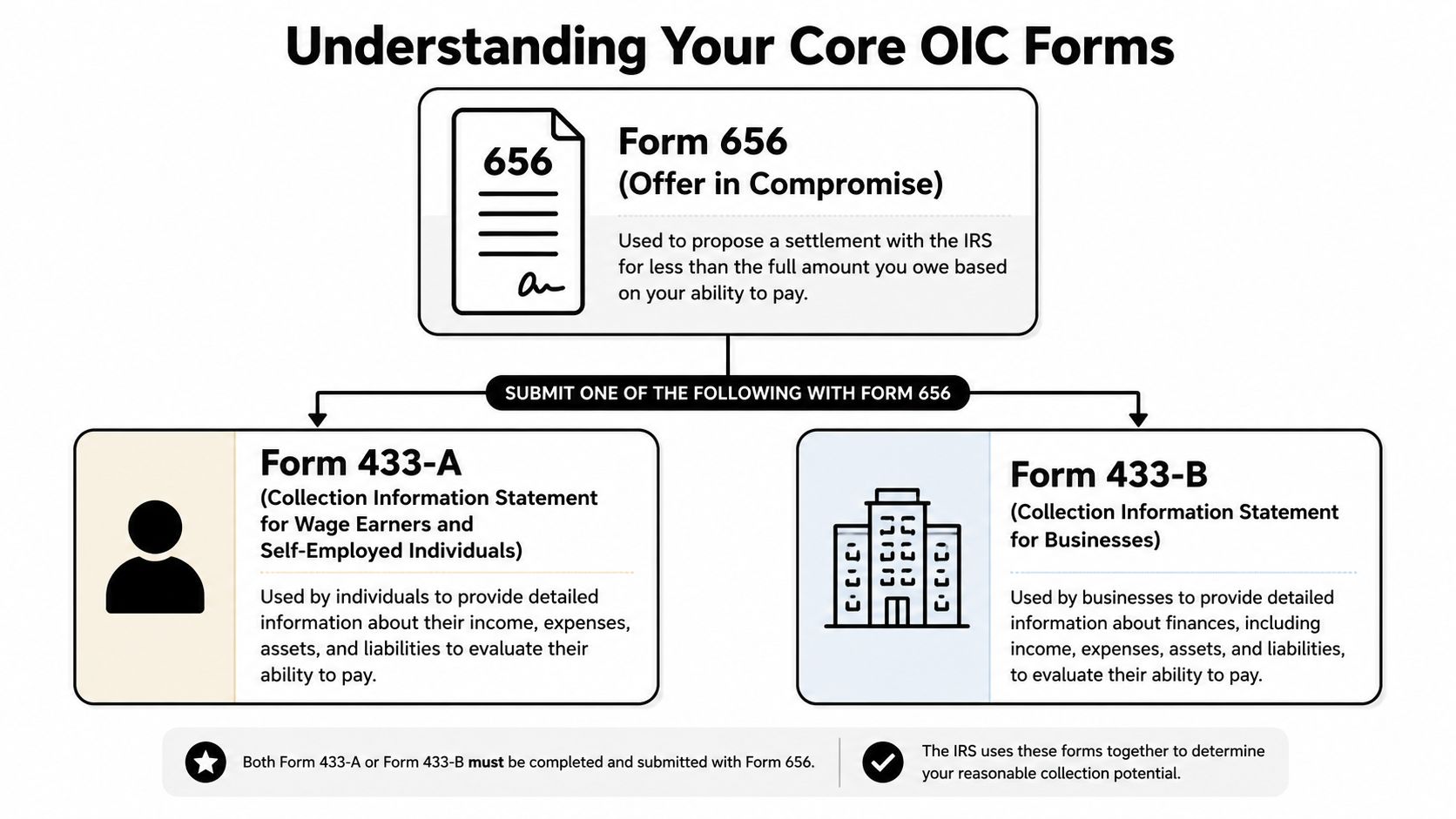
The core offer in compromise forms are straightforward on paper and easy to misuse in real life. The IRS generally expects a package built around Form 656 and a financial disclosure statement. For individuals, that's usually Form 433-A (OIC). For businesses, that's usually Form 433-B (OIC).
What each form actually does
Here is the practical breakdown:
| Form | Main job | Common mistake |
|---|---|---|
| Form 656 | States the offer terms and identifies the liabilities to compromise | Listing the wrong liabilities or mixing debt types |
| Form 433-A (OIC) | Discloses the finances of an individual, wage earner, or self-employed taxpayer | Omitting side income, transfers, or liquid assets |
| Form 433-B (OIC) | Discloses the finances of a business entity | Treating the business as if it were identical to the owner |
Form 656 is not the heart of the case. It is the cover sheet for the proposal. The actual fight is in the financial statement and the records behind it.
The mistake that gets business owners returned fast
One of the most overlooked rules applies to owners with both personal and business tax debt. A common mistake causing immediate rejection is submitting one combined Form 656 for both personal and business liabilities. The IRS requires two separate submissions, one for individual liabilities and one for business liabilities, each with its own application fee and initial payment, as described in this Thomson Reuters update on IRS Offer in Compromise forms.
This catches sole proprietors, single-member LLC owners, and closely held business owners all the time. They assume one owner, one tax problem, one application. The IRS doesn't see it that way.
If the debt lives in two legal buckets, treat it as two legal submissions.
That separation affects more than paperwork. It changes cost, payment logistics, and the way the IRS reviews the liabilities. If the package is combined when the IRS expects separate offer in compromise forms, the case may never get to the merits.
How the forms should work together
Think of the package this way:
- Form 656 tells the IRS what you're asking for.
- Form 433-A or 433-B tells the IRS why your number is the most it can collect.
- Supporting records prove that the disclosures are real.
When these three parts don't match, the case becomes weak immediately. A taxpayer may disclose a modest monthly income on the 433, then attach bank statements showing regular unexplained deposits. Or a business may claim minimal operating cash while merchant processing records show otherwise. Those mismatches are fatal.
For a deeper look at the application document itself, see this guide to IRS Form 656.
Completing Your Financial Disclosure to Prove Your Case
A taxpayer can qualify for an offer on paper and still lose because the financial disclosure is weak.
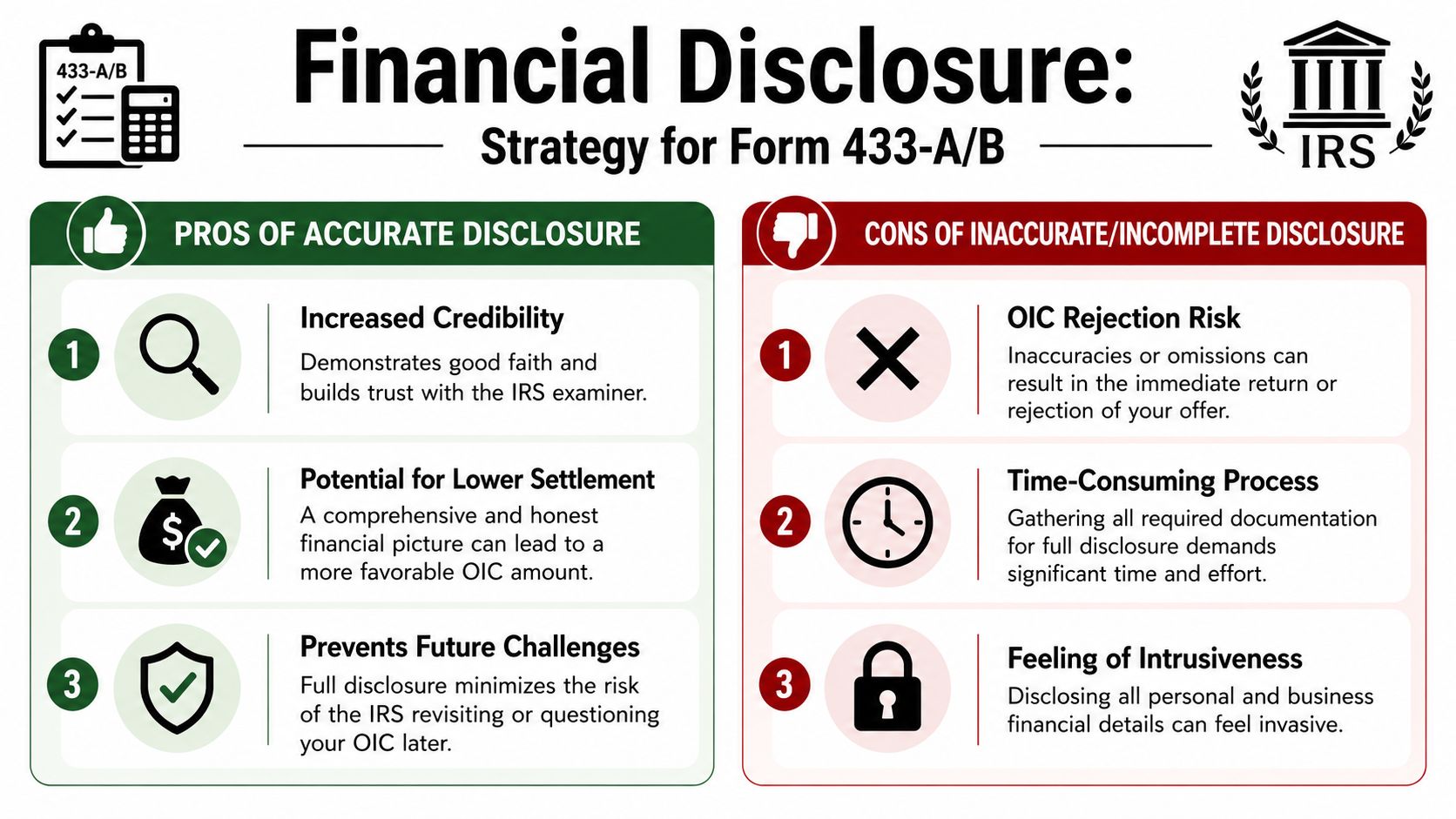
That happens more than people expect. The IRS does not approve an offer because the balance is large or because paying it feels impossible. It approves an offer when the numbers on the financial statement show that the government cannot reasonably collect more. That is why this part of the case deserves more care than the offer amount written on Form 656.
What Reasonable Collection Potential means in practice
Reasonable Collection Potential, or RCP, is the number the IRS believes it can collect from your available equity and future income. If your offer comes in below that number, rejection is the expected result.
Many self-prepared cases often fail because the taxpayer treats the 433 as a hardship narrative, while the IRS views it as an asset and cash flow analysis.
The review usually focuses on:
- Cash on hand and bank balances
- Investment and retirement accounts
- Equity in real estate
- Equity in vehicles and other titled assets
- Business assets and accounts receivable
- Monthly disposable income after the IRS applies its allowable expense rules
Monthly income is often the hardest issue. Clients usually start with what they spend. The examiner starts with what the IRS will allow. If housing, transportation, food, or other categories run above those standards, the excess may be disallowed unless the file supports a valid exception. That one adjustment can change an offer from acceptable to dead on arrival.
Where good cases get rejected
The IRS sees patterns. So do I. Rejected files often have the same problems.
Assets are valued with no backup
A car, rental property, or piece of equipment cannot be assigned a convenient number. Use a defensible source and be ready to show liens or loan balances that reduce net equity.Deposits are disclosed badly
Bank statements tell their own story. If they show transfers between accounts, cash app deposits, family support, merchant processing receipts, or loan proceeds, explain them clearly. If you do not, the examiner may treat them as income.Business and personal finances are mixed
This is a major problem for sole proprietors and owners of closely held companies. Personal living expenses paid from a business account, or business revenue flowing through a personal account, creates distrust and often inflates the IRS view of available income.Expenses are real but not allowable as claimed
Private school tuition, credit card payments, unsecured debts, or high discretionary spending may matter in real life and still carry little weight in an OIC review.Self-employment income is presented without context
Seasonal swings, slow collections, chargebacks, disputed receivables, and one-time large deposits need records and explanation. Otherwise the IRS may use the strongest months against you.
Build the numbers from the documents up
The right order is documents first, form second.
I usually want the bank records, pay information, profit and loss support, loan statements, property values, and proof of recurring expenses before finalizing the 433. That approach exposes inconsistencies early. It also prevents a common mistake. Taxpayers fill out the form from memory, then spend days trying to force the records to match what they already wrote.
For a closer look at how the individual financial statement is assembled, see this guide to Form 433-A for an Offer in Compromise.
If the records are messy, organize them before making judgment calls. For taxpayers dealing with large PDF statements or mixed personal and business records, an AI agent for financial reports can help sort statements, identify recurring transactions, and catch missing pages. It does not replace legal analysis, but it can make the document review faster and cleaner.
The IRS rewards numbers that reconcile.
Accuracy is stronger than exaggeration
Some taxpayers try to make the picture look as bad as possible. That usually backfires. An examiner who sees padded expenses, unsupported valuations, or selective disclosure will scrutinize the rest of the file more aggressively.
A stronger case is complete, supported, and internally consistent. If an account balance was temporarily inflated by a transfer, show the matching withdrawal. If a receivable is stale, disputed, or unlikely to be collected, document why. If an asset is fully encumbered, tie the debt to the asset with current statements.
That is strategy. Present a record the examiner can verify, with as little room for guesswork as possible.
When form preparation becomes legal analysis
Some 433 filings are straightforward. Others are not.
Extra care is required when the case involves payroll taxes, business ownership, nominee issues, mixed-use property, shareholder draws, or liabilities split between the individual and the business. In those files, the question is not just how to fill in a box. The question is how the IRS is likely to characterize the money, the asset, or the expense. One option for taxpayers who need help with the disclosure side is Attorney Stephen A. Weisberg's work with Form 433-A OIC matters, which focuses on assembling and presenting the financial record required by the IRS.
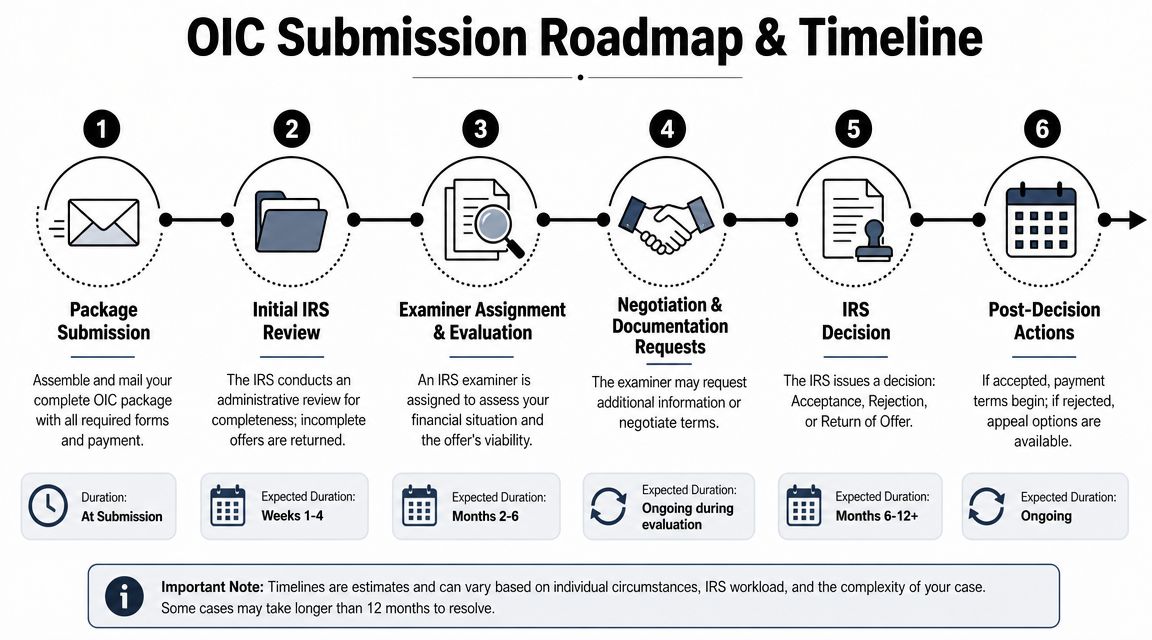
Submitting Your Package and Managing the Timeline
A common failure point comes right before filing. The forms are signed, the numbers look close enough, and the taxpayer sends the package without one last hard review. Then the IRS returns it, or an examiner opens the file and finds a problem that should have been caught at the desk.
What goes in the package
A submission usually includes the signed offer form, the correct financial disclosure, supporting records, the application fee unless an exception applies, and the required initial payment that matches the offer type.
The assembly step is more strategic than it looks. I regularly see offers fail because the taxpayer included the wrong financial form, mixed business and personal liabilities in one package, or sent backup that did not match the numbers on the disclosure. If the liability includes both individual and business exposure, check that each part of the case is documented on the proper form set before anything goes out. That issue alone causes avoidable delays and returns.
Presentation matters, too.
Group records by category. Label bank statements, pay stubs, loan balances, and asset proof so an examiner can tie each document to a line item without guessing. A clean package does not guarantee acceptance, but a disorganized one makes scrutiny more likely.
What happens after submission
The IRS usually starts with a processing review. The question at that stage is simple: is the offer complete enough to work?
If the file clears that screen, it moves to an examiner. That is where weak cases separate from approvable ones. The examiner will test whether your claimed expenses, asset values, and equity calculations support the offer amount, and whether your Reasonable Collection Potential was calculated in a way the IRS can accept.
A typical sequence looks like this:
Initial screening
The IRS checks for signed forms, required payments, filing compliance, and enough documentation to process the offer.Examiner development
The assigned employee may ask for updated statements, explanations for transfers, proof of expenses, or support for asset valuations.RCP review
The IRS compares your offer to what it believes it can collect through equity and future income. If your math is thin, inconsistent, or based on unsupported expenses, the file then weakens.Outcome
The offer may be accepted, rejected, or returned. A return usually points to a threshold defect. A rejection means the IRS considered the merits and concluded the amount was too low or the facts were not persuasive.
That distinction matters because the response is different. A returned offer often calls for fixing compliance or package defects and refiling. A rejected offer calls for a hard review of valuation, income, expenses, and legal posture before deciding whether to appeal.
The timeline is longer than many taxpayers expect
An OIC review usually takes months, not weeks. Build your expectations around a long administrative process with periods of silence followed by short response deadlines.
The practical rule is simple. Answer every IRS request quickly, completely, and in the same organized manner as the original package.
Send exactly what was requested. Include a short cover note that identifies each attachment and explains any item that is not obvious from the face of the record. If an account balance changed because of a transfer, say so and attach both sides of it. If a business expense dropped or rose after the filing date, explain that clearly instead of forcing the examiner to infer it.
Silence hurts a file. So does overproduction. Sending stacks of unrelated records can be almost as unhelpful as sending too little.
If your finances change during review, update the case carefully. A major income increase, asset sale, new financing, or business improvement can affect the IRS's view of collectibility. In some matters, waiting to file until the numbers are stable is the better strategy. In others, filing promptly is worth it because enforced collection risk is rising. That is the trade-off. Timing is part of the case, not just administration.
When an OIC Isnt the Answer and When to Call an Attorney
Some taxpayers should not file an Offer in Compromise. That's not pessimism. It's good triage.
If you can afford to pay over time, an installment agreement may be the cleaner answer. If you can't currently pay anything without losing the ability to cover basic living expenses, currently not collectible status may be the better fit. Those routes don't carry the same burden of proving that a settlement amount reflects the IRS's maximum reasonable recovery.
Signs an OIC may be the wrong tool
A few patterns usually point elsewhere:
Your financials show payment ability
If your disposable income and available equity are meaningful, the IRS may prefer collection over compromise.You're still noncompliant
Missing returns or ongoing payroll issues usually mean the timing is wrong.The core dispute concerns the tax amount itself That may call for a liability challenge, audit reconsideration, or another procedural route rather than a collection settlement.
Signs you should stop doing this yourself
Here, many people lose time they can't afford to lose.
Consider getting counsel when:
- You own a business and have both personal and business liabilities
- Payroll tax debt or Trust Fund Recovery Penalty issues are involved
- Your finances include real estate, loans between related parties, or mixed personal and business accounts
- You already filed and the IRS pushed back
- You can't clearly explain your bank activity
- You're choosing an offer amount based on instinct rather than RCP analysis
The attorney's job isn't just filling in offer in compromise forms. It's deciding whether the offer should be filed at all, how the liabilities should be separated, how the facts should be framed, and when another resolution path is stronger.
A well-advised taxpayer often avoids the wrong submission entirely. That alone can save months of delay, unnecessary fees, and a rejected case that could have been handled differently from the start.
Attorney Stephen A. Weisberg of The W Tax Group represents individuals, business owners, and companies dealing with IRS and state tax problems, including Offer in Compromise cases, installment agreements, audits, and collection disputes. If you're considering an OIC and want to know whether it's the right strategy before you spend time and money on the process, he offers a free Tax Debt Analysis to evaluate whether he can help and how.


