Offer in Compromise for Payroll Taxes: A 2026 Guide
Can you use an Offer in Compromise for payroll taxes? Learn the IRS rules for trust fund debt, eligibility, alternatives, and how to apply in our guide.
In this article
- The Weight of Unpaid Payroll Taxes
- Why this debt feels different
- The real question business owners should ask
- The Hard Truth About Trust Fund Taxes
- Why the IRS treats this portion differently
- What that means in practice
- The personal liability problem
- What usually works, and what usually does not
- Meeting the IRS Eligibility Hurdles
- Current compliance comes first
- The screening questions that matter
- A mistake owners make
- A better order of operations
- How the IRS Calculates Your Offer Amount
- What RCP measures
- Why payroll tax cases get harder
- A practical way to evaluate the number
- Trade-offs worth weighing
- Preparing and Submitting Your OIC Application
- The core forms
- The filing costs and payment structure
- Timing and review issues
- What usually goes wrong
- Comparing OIC Alternatives for Payroll Tax Debt
- Payroll Tax Debt Resolution Options at a Glance
- When alternatives beat an OIC
- The strategic question
- Your Next Move and When to Call an Attorney
- When professional help moves from useful to necessary
An Offer in Compromise for payroll taxes is technically possible, but it usually does not wipe out the part of the debt that hurts most. In 2019, the IRS accepted only 17,890 of 54,225 Offer in Compromise applications, an acceptance rate of about 33%, and payroll tax cases are harder because the trust fund portion generally must be paid first and cannot be compromised away.
If you're reading this, there's a good chance the problem started the way it usually does. A slow month turned into two. Payroll still had to run. Vendors needed paying. Rent was due. The money withheld from employees' checks got used to keep the business alive, with every intention of catching up next quarter.
Then the IRS notices started arriving.
Business owners in that position often search for one phrase: offer in compromise for payroll taxes. They want to know whether the IRS will settle the debt for less than the full balance and let them move on. Sometimes the answer is yes. More often, the right answer is narrower, more conditional, and a lot less marketable than the ads make it sound.
The structural issue is simple. Payroll tax debt isn't one thing. Part of it is the employer's liability. Part of it is money withheld from employees and held for the government. The IRS treats those two pieces very differently, and that difference drives almost every outcome in a payroll tax resolution case.
The Weight of Unpaid Payroll Taxes
A restaurant owner misses a few federal tax deposits during a rough season. An HVAC company lands jobs but waits too long to get paid. A medical practice uses payroll tax money to cover staff and keep the doors open. Different industries, same pattern.
At first, the business owner tells himself it's temporary. File the return now, pay later. Borrow against receivables. Catch up after the busy cycle. But payroll taxes don't sit idly. They bring fast attention from the IRS because the government sees them as money collected on its behalf.
Why this debt feels different
Income tax debt is stressful. Payroll tax debt feels personal.
That's because unpaid payroll taxes can expose both the business and, in the right circumstances, the people behind it. Owners, officers, bookkeepers, and others with control over funds can find themselves under scrutiny. By the time someone starts asking about an Offer in Compromise, they're often not just worried about the company. They're worried about their own bank accounts, wages, and reputation.
Payroll tax debt is one of the few tax problems where trying to “buy time” often makes the legal problem worse, not better.
The real question business owners should ask
The first question usually asked is, "Can I settle this for less?"
The better question is, "Which part of this debt is even legally negotiable?"
That shift matters. An Offer in Compromise is a real IRS program. It can be useful. But in payroll tax cases, it isn't a universal solution and it isn't the first tool I'd evaluate in every case. Sometimes it fits. Sometimes an installment structure, penalty strategy, or defense against personal assessment is the smarter move.
A business owner who understands that early makes better decisions. A business owner who doesn't often spends money on an application that was never viable.
The Hard Truth About Trust Fund Taxes
A business can owe $200,000 in payroll taxes and still have only part of that balance available for settlement discussion. That is the point many owners miss until they are already deep into collections.
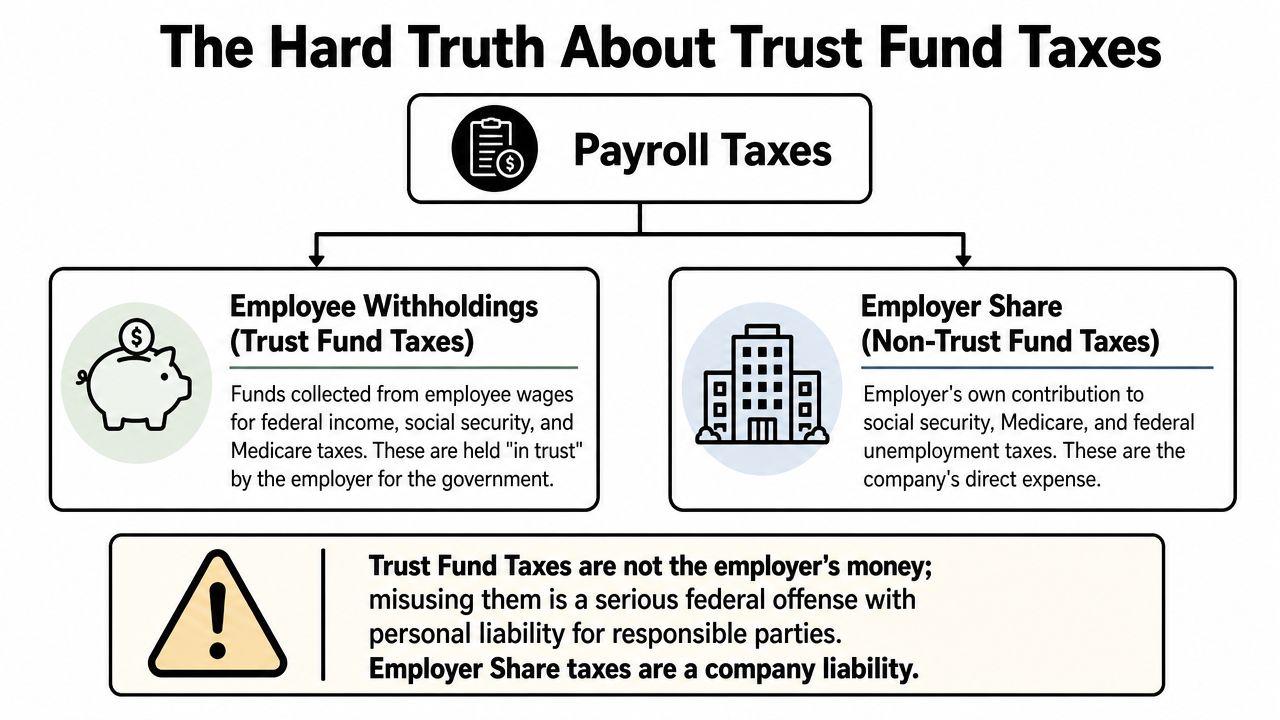
The line that matters is the trust fund portion. This is the money withheld from employees' wages for federal income tax and the employee share of Social Security and Medicare. The company collected it from workers, but the law treats that money as funds held for the government, not as operating cash.
Why the IRS treats this portion differently
Once those amounts are withheld from paychecks, using them for rent, vendors, or net payroll creates a different kind of tax problem. That is why payroll tax cases are structurally different from ordinary income tax debt cases.
In practical terms, an Offer in Compromise usually does not solve unpaid trust fund taxes the way business owners expect. The trust fund portion generally must be paid before an offer can resolve only the remaining employer-side liability. If that breakdown is not clear at the start, the strategy is off course from day one.
What that means in practice
Start by separating the balance into parts, not by looking at one total on an IRS notice.
- Trust fund taxes: Employee federal income tax withholding, plus the employee share of Social Security and Medicare. These amounts usually must be satisfied before a compromise can clear the rest of the payroll tax debt.
- Employer share: The employer's matching portion of payroll taxes. In the right case, this part may be considered in an Offer in Compromise.
- Penalties and interest: These remain part of the collection picture, but they do not change how the trust fund portion is treated.
That distinction is not academic. It determines whether an OIC is a realistic option, a partial option, or a waste of time and application fees.
The personal liability problem
Unpaid trust fund taxes also create exposure beyond the business itself. The IRS can assess responsible individuals personally through the Trust Fund Recovery Penalty if it believes they were responsible for collecting and paying these taxes and willfully failed to do so.
For owners and officers, this is often the turning point in the case. An LLC or corporation may limit many business risks, but it does not automatically block personal assessment for trust fund payroll taxes. I tell clients to treat that issue separately from the company balance, because the IRS does.
Practical rule: Before filing an offer, identify the trust fund amount, the employer amount, and any personal exposure. Without that breakdown, you are not evaluating options. You are guessing.
What usually works, and what usually does not
What usually works is getting the account transcripts, confirming how much of the balance is trust fund, and deciding whether there is a path to pay that piece while keeping current deposits on track.
What usually fails is treating the entire payroll tax debt as one settleable number. It is not. The trust fund piece changes the analysis, the timeline, and often the best resolution method.
That is hard news, but it is useful news. Once the balance is divided correctly, the case becomes easier to assess. Sometimes the right answer is an offer. Sometimes it is a payment plan, a penalty strategy, or a focused defense against personal assessment.
Meeting the IRS Eligibility Hurdles
A business can spend weeks gathering financial records, only to have the IRS reject the offer before it ever reviews ability to pay. In payroll tax cases, that happens often because the account is still out of filing or deposit compliance.

Current compliance comes first
For payroll tax debt, an offer is usually dead on arrival unless the business has already stopped falling behind.
Businesses generally must be current on federal tax deposits for the current quarter and the two preceding quarters. TurboTax notes that many rejected payroll tax offers are filed while the business is still delinquent on recent deposits, which matches what practitioners see in real cases. Filing too early wastes the application fee, delays a workable resolution, and tells the IRS the underlying problem is still active. See TurboTax's discussion of Offer in Compromise eligibility.
That rule matters for a structural reason. Payroll tax debt is different from many other tax balances because the IRS is looking for proof that current withholdings are being handled correctly now, not just promises about old debt.
The screening questions that matter
Before discussing an offer, check these points first:
- All required returns are filed: That includes any missing employment tax returns, especially Form 941.
- Recent federal tax deposits are current: Catching up only on old balances is not enough.
- The business can stay current: If operations still depend on using payroll tax money for cash flow, the offer is usually premature.
- Financial records are organized: Bank statements, payroll reports, profit and loss statements, and asset information need to be ready for review.
If you want a rough sense of whether the numbers support an offer after those threshold issues are fixed, an IRS offer in compromise calculator can help frame the discussion.
A mistake owners make
Owners often believe a partial payment on the old balance shows good faith and improves eligibility. It may help the overall case, but it does not cure ongoing noncompliance. The IRS wants to see that the business has stopped creating new payroll tax exposure.
If the company cannot make current deposits now, the IRS usually will not settle older payroll tax debt on favorable terms.
A better order of operations
The practical sequence is usually straightforward:
- File every missing return.
- Bring required deposits current.
- Confirm the trust fund portion and any personal exposure have been identified.
- Then compare the realistic resolution options.
That approach gives the owner a clearer answer sooner. Sometimes the answer is that an offer is viable. Sometimes the better path is an installment agreement, penalty work, or a plan to contain trust fund exposure while the business stabilizes.
How the IRS Calculates Your Offer Amount
A business owner finally gets current on filings and deposits, then asks the question everyone asks next: "What number will the IRS take?" The answer starts with the IRS's view of collectibility, not the amount that feels manageable month to month.
The formula is reasonable collection potential, or RCP. In practice, RCP is the IRS's estimate of what it could collect from the business, and sometimes from related parties, before the collection statute expires.
What RCP measures
RCP usually has two moving parts:
- Asset value: Cash, bank balances, receivables, equipment, vehicles, real estate equity, and other property the IRS believes has net realizable value.
- Future income: The amount the IRS believes can be paid over time after it applies its expense standards.
That second piece is where many offers go sideways. The IRS does not automatically plug in whatever the business spends each month. For some categories, it uses national and local standards rather than actual spending, as explained in Jackson Hewitt's discussion of IRS Offer in Compromise costs and evaluation standards. If a company or owner spends above those standards, the excess often does not reduce the offer the way they expect.
Why payroll tax cases get harder
In an income tax case, RCP is already the central fight. In a payroll tax case, it is only part of the fight.
The trust fund portion changes the strategic value of the offer from the start. If trust fund taxes can still be assessed personally, settling the business account may not end the owner's exposure. So the right question is not just whether the business can produce an acceptable offer number. It is whether that number solves enough of the problem to justify the cost, disclosure, and risk.
That is why payroll tax OIC analysis has to be more disciplined than "How little can we offer?" The better question is, "After accounting for assets, future income, and trust fund exposure, does an offer produce a better outcome than the alternatives?"
A practical way to evaluate the number
Start with the math before filing anything. If the financials show equity in assets, retained cash, strong receivables, or positive net income after allowable expenses, the offer amount can rise quickly. At that point, an installment agreement or another collection strategy may make more sense.
I usually want clients to test the range before committing to an OIC package. An IRS offer in compromise calculator will not replace legal analysis, but it can show whether the case is even close.
One more point matters here. Many accepted offers are not "small" in any ordinary sense. They are solely the amount the IRS believes reflects collectibility under its formula. That distinction matters because it keeps owners from wasting months on an offer built on hope instead of numbers.
Trade-offs worth weighing
A weak offer creates problems. The filing fee and initial payment cost money. The financial disclosure gives the IRS a detailed map of the business. The review period also consumes time while current compliance still has to remain perfect.
A well-prepared offer can still be the right move. But in payroll tax cases, the offer amount only makes sense if it fits the larger picture, especially the trust fund piece and the realistic alternatives.
Preparing and Submitting Your OIC Application
A viable case can still fail on paper.
In payroll tax matters, the application is not just a form package. It is a documented explanation of why the IRS should accept less than the full balance, despite the trust fund limitations that already make these cases narrower than many owners expect. The filing has to be complete, current, and consistent with the financial story the business is telling.
The core forms
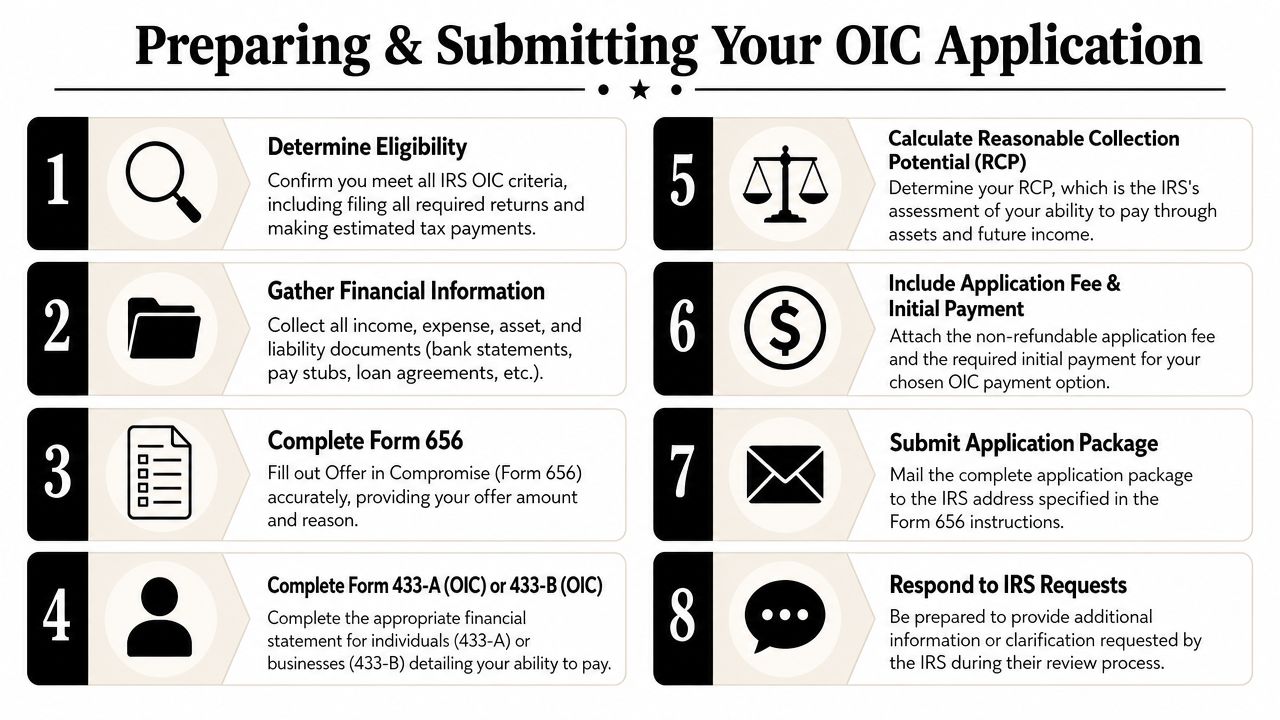
For a business seeking an offer based on collectibility, the starting point is usually Form 656 and Form 433-B (OIC). As summarized in SBKass's overview of payroll tax OIC procedure, those are the standard business forms in this process. If the issue is doubt as to liability instead of collectibility, the form set can change.
Each form has a different job:
- Form 656: The offer itself. It identifies the tax periods, the legal basis for the compromise, and the payment terms.
- Form 433-B (OIC): The business financial statement. It gives the IRS a detailed view of cash, receivables, assets, debts, monthly income, and operating expenses.
Some cases also pull personal finances into the review, especially where the IRS is looking closely at related-party transfers, shareholder distributions, or the ability of principals to inject funds. For background on how the IRS reviews collection disclosures, this guide to IRS Form 433-A (OIC) provides helpful context, even though payroll tax business cases often center on Form 433-B.
The filing costs and payment structure
Many applicants must send money with the package. The application fee is $205. A lump sum offer generally requires an initial 20% payment submitted with the application.
The payment choice matters because it affects cash flow during review:
- Lump sum offer: Paid in five or fewer installments within five months of acceptance.
- Periodic payment offer: Paid in six or more monthly installments within twenty four months.
That choice is not just administrative. A business with unstable revenue may prefer one structure, but the wrong selection can create pressure before the case is even decided. I usually want the payment proposal to match how the business operates, not how the owner hopes the next year will go.
Timing and review issues
IRS review can take months, sometimes longer. During that time, the business must stay fully current with new filing and deposit obligations. That is where many payroll tax offers break down. The numbers may be arguable, but current compliance is usually not.
There is also an important procedural rule. If the IRS does not act within two years of receiving a processable offer, the offer may be deemed accepted by operation of law. That rule helps in some cases, but owners should not rely on delay as a strategy. The IRS can return an offer as incomplete, request more information, or reject it well before that point.
A complete application gets reviewed. An incomplete one often gets returned before the actual merits are considered.
What usually goes wrong
The mistakes are predictable, and expensive:
- Missing backup documents: bank statements, loan records, accounts receivable aging, payroll records, or proof of asset values
- Outdated financial information: numbers that no longer match current operations by the time the IRS reviews the file
- Poor treatment of trust fund issues: presenting the case as if the full payroll tax balance were equally compromiseable
- Current compliance problems: missed deposits or late filed returns during the review period
- An unsupported offer amount: either too low to be credible or too high for the business to perform
Strong submissions are built like a case file, not a mail-in packet. Every figure should tie back to a statement, ledger, valuation, or explanation. In payroll tax cases, that discipline matters even more because the trust fund portion already limits how much room there is to negotiate.
Comparing OIC Alternatives for Payroll Tax Debt
In many payroll tax cases, an OIC is not the first option I'd expect to work. That's not because it never works. It's because the trust fund rules and compliance hurdles narrow the field so much that other tools often fit better.
Payroll Tax Debt Resolution Options at a Glance
| Solution | Best For | Impact on Debt | Key Requirement |
|---|---|---|---|
| Offer in Compromise | Businesses or responsible parties with limited collection potential and a realistic legal basis for compromise | May settle some liabilities for less than full balance, but trust fund limits can sharply reduce usefulness in payroll cases | Full compliance, persuasive financial proof, and a viable compromise structure |
| Installment Agreement | Businesses that can pay over time but can't pay at once | Debt is paid over time rather than reduced | Ongoing current compliance and sustainable monthly payments |
| Partial Pay Installment Agreement | Taxpayers who can't full pay before the collection period ends but can pay something monthly | Some balance may remain unpaid at the end of the collection period | Detailed financial disclosure and a payment amount the IRS will accept |
| Penalty Abatement | Cases where penalties are a major driver of the balance and legal grounds exist for relief | Reduces penalties, not core tax | A valid abatement basis and clean supporting facts |
| Currently Not Collectible | Taxpayers in severe hardship who cannot make payments now | Collection pauses, but the debt is not settled | Strong hardship showing and updated financial disclosure |
When alternatives beat an OIC
An installment agreement often makes more sense when the business is viable and current cash flow is the actual issue. It doesn't promise a discount. It buys order, predictability, and a path out.
A partial pay installment agreement can be especially useful when a taxpayer has some ability to pay, but not enough to full pay before the collection period ends. For many business owners, that middle ground is more realistic than a compromise application. This partial payment installment agreement resource explains how that structure works.
Penalty abatement matters when the tax itself isn't negotiable, but the add ons are. In payroll tax cases, that can still produce meaningful relief.
Currently Not Collectible status can also be the right move when the business or the individual behind the business is under real financial strain. It is not forgiveness. It is breathing room.
The strategic question
The right question isn't "Which program sounds best?"
It's "Which program matches the kind of debt, the current compliance posture, and the actual ability to pay?"
That question leads to better outcomes than chasing the most advertised solution.
Your Next Move and When to Call an Attorney
If you owe payroll taxes, start with three questions.
First, what part of the balance is trust fund tax. If that number hasn't been isolated, you don't yet know whether an Offer in Compromise is even aimed at the right target.
Second, are you fully compliant right now. That means filed returns and current required deposits. Without that, an OIC discussion is usually premature.
Third, do the finances support a compromise. Not emotionally. On paper. With documents.
When professional help moves from useful to necessary
Some payroll tax cases are too exposed to handle casually.
You should strongly consider involving a tax attorney when:
- Personal exposure exists: The IRS is investigating or has assessed liability against owners or other responsible parties.
- The debt is large enough to threaten operations: A wrong move can destabilize the business further.
- An offer was already rejected or returned: The problem may be legal, factual, or procedural, and the fix isn't always obvious.
- More than one path is possible: Choosing between an OIC, installment resolution, penalty strategy, or defense against personal assessment requires comparison, not guesswork.
An experienced attorney can also coordinate with a CPA, payroll provider, bankruptcy counsel, or lender when the tax problem is affecting other decisions.
If you want a legal assessment before committing to one path, Attorney Stephen A Weisberg offers tax debt analysis and representation for IRS collection matters, including payroll tax cases and Trust Fund Recovery Penalty issues.
The main point is simple. An offer in compromise for payroll taxes is one tool. It is not a cure all. When the trust fund portion drives the debt, clarity beats optimism.
If you're dealing with payroll tax debt and need to know whether an Offer in Compromise, an installment strategy, or a defense against personal liability makes sense, Attorney Stephen A. Weisberg can help evaluate the facts before you commit to a plan. Visit Stephen A Weisberg's tax resolution practice to learn more about his free tax debt analysis and IRS representation services.


