Offer in Compromise for Business: A Step-by-Step Guide
Learn how an offer in compromise for business can settle your tax debt for less. Get a clear guide on eligibility, forms, and real-world strategies.

In this article
- What an Offer in Compromise Actually Is for Businesses
- The three legal paths
- Checking Business Eligibility Before You File
- The compliance gate
- Why timing affects the result
- Calculating Reasonable Collection Potential and Required Forms
- Build the asset picture
- Match the forms to the entity
- Reconcile future income
- Choosing the Right Offer Ground, Collectibility, Liability, or Hardship
- Doubt as to collectibility
- Doubt as to liability
- Effective tax administration
- Payroll Tax Traps and Personal Liability Risks
- Separate the entity question from the person question
- Stabilize payroll before proposing a settlement
- Submitting the Offer and Managing Post-Acceptance Compliance
An offer in compromise for business is not a standard percentage discount. The IRS generally expects the proposed amount to equal or exceed the business's reasonable collection potential, based principally on realizable asset equity and future income.
The problem usually arrives before the paperwork does. Payroll taxes are behind, a bank account is nearly empty, customers owe money, and the owner is trying to decide whether to preserve cash for employees, suppliers, or the IRS. A low settlement proposal can look attractive, but an offer filed before the business is compliant may never receive meaningful consideration. Worse, an entity-level settlement may leave an owner or manager exposed personally for trust-fund payroll taxes.
A successful offer is built like an underwriting file, not a bargain request. The IRS wants to understand what the business owns, what it earns, what it can realistically pay, whether the liability is correct, and whether the company will remain compliant after acceptance.
What an Offer in Compromise Actually Is for Businesses
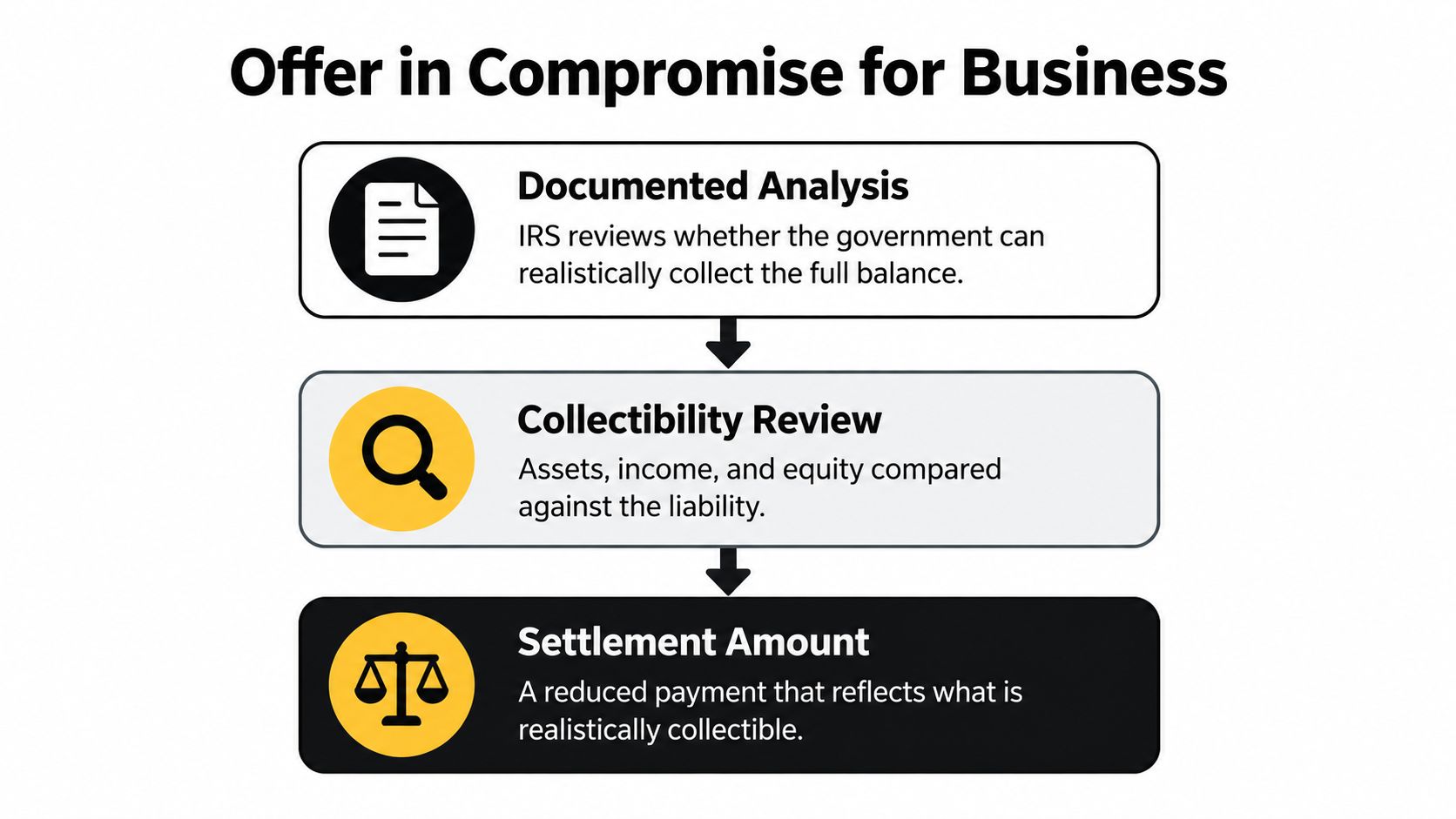
An offer in compromise for business is a formal IRS mechanism that can settle a tax liability for less than the full amount owed when full collection is unlikely or payment in full would create financial hardship. The reduction isn't automatic, and it isn't calculated by applying a standard discount to the balance. The proposed payment must generally reflect what the IRS could realistically collect.
That benchmark is called reasonable collection potential, or RCP. The IRS principally considers realizable equity in business assets and expected future income. A company with valuable equipment, collectible receivables, or stable cash flow may have a higher RCP than its owner expects, even when the tax balance feels impossible. Conversely, a business with little equity and weak future income may have a defensible collectibility case, provided the financial disclosures are complete and credible.
The three legal paths
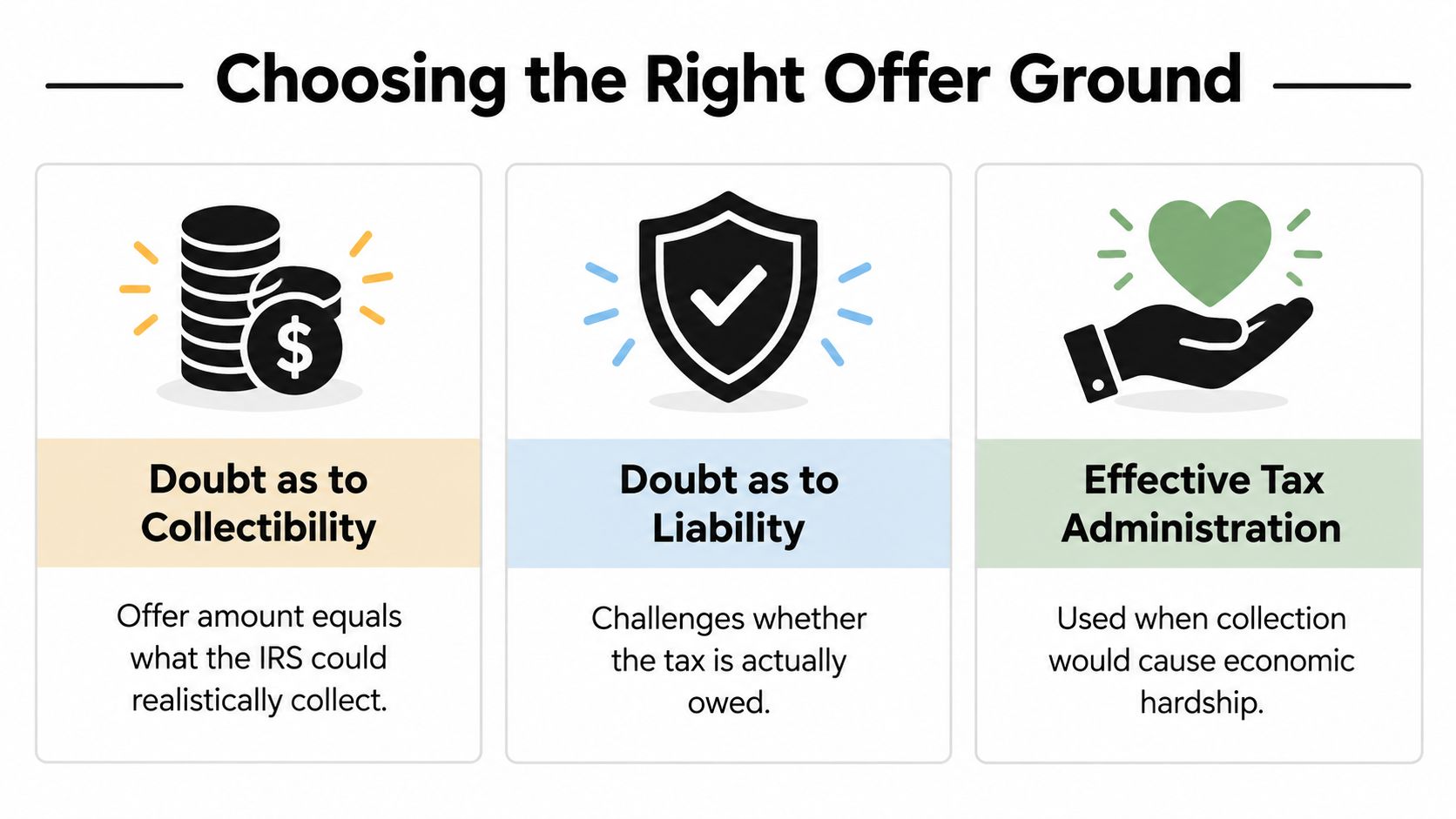
The IRS recognizes three statutory grounds for compromise:
- Doubt as to collectibility: The business doesn't have enough realizable assets and future income to pay the liability in full.
- Doubt as to liability: A genuine legal or factual dispute exists about whether the tax is owed or correctly calculated.
- Effective tax administration: The liability may be fully collectible, but full payment would create economic hardship or would be unfair because of exceptional circumstances.
These grounds require different evidence. A collectibility offer depends on financial records and a defensible RCP calculation. A liability offer focuses on the underlying tax dispute and uses Form 656-L, rather than the standard offer package with business financial statements. Effective tax administration requires a carefully documented hardship or equity argument, not merely a statement that the balance is burdensome.
Practical rule: Don't lead with the amount you hope the IRS will accept. Lead with the statutory ground and the evidence that supports it.
The distinction matters because the IRS isn't negotiating against an arbitrary asking price. It is testing whether the proposed resolution follows an authorized compromise path and reflects the facts. A useful plain-language overview of the broader process is available in this guide to what an offer in compromise is.
Checking Business Eligibility Before You File
A financial hardship argument won't rescue a business that hasn't met the basic compliance requirements. Before the IRS evaluates the substance of a business offer, the company generally must have filed every legally required business tax return, made required estimated payments, and made required federal tax deposits for the current quarter and the two preceding quarters.
That requirement catches businesses that rush to file because collection activity has intensified. A company may have prepared an attractive financial statement, but a missing employment-tax return or an unpaid required deposit can prevent the offer from being properly considered. The filing problem must be fixed first.
The compliance gate
Use a written checklist rather than relying on memory:
- Returns: Confirm that every required business return has been filed, including returns that report little or no tax.
- Estimated payments: Verify that required estimated-tax payments are current.
- Federal tax deposits: Employers must bring required deposits current for the current quarter and the two preceding quarters.
- Entity identity: Match the liability to the correct corporation, partnership, LLC, LLP, or sole proprietorship structure.
- Current operations: Confirm that the business can continue making deposits and filing returns while the offer is pending.
The last point is operational, not merely administrative. An operating business must remain current after submission. The IRS states that failure to meet filing and deposit obligations can cause a processable offer to be returned without appeal rights. A company that cannot maintain payroll compliance may need to stabilize its operations before submitting an aggressive proposal.
Why timing affects the result
Suppose a business has enough cash to cure either old debt or current payroll deposits, but not both. Applying that cash to an offer fee or proposed payment while new trust-fund obligations continue to accumulate usually worsens the case. The business hasn't solved its eligibility problem, and it may have created a new liability.
The better sequence is often to identify the source of the compliance failure, establish a reliable deposit process, and then assemble the offer from clean records. Owners dealing with broader operational distress may also benefit from practical guidance on financial trouble help for MN businesses, particularly when tax debt is tied to cash-flow, staffing, or creditor-payment decisions.
The IRS warns that incomplete required information delays consideration. That makes preparation more valuable than speed. A complete filing submitted after the business is current is generally more useful than a rushed filing that cannot pass the initial compliance screen.
Calculating Reasonable Collection Potential and Required Forms
The financial core of a collectibility offer is the calculation of reasonable collection potential. The IRS generally evaluates realizable asset value plus expected future income after permitted basic living expenses, and an offer normally must meet or exceed that amount. The analysis is not limited to the checking-account balance on the day the forms are signed.
Start with assets. The relevant question isn't just what appears on the balance sheet. It is what the IRS could realistically realize from the asset after considering its condition, marketability, debt, and the business's actual records. That requires support for claimed values and liens.
Build the asset picture
A practical underwriting file should reconcile the following:
- Bank accounts: Include every business account and explain unusual transfers or restricted balances.
- Accounts receivable: Separate collectible invoices from aged, disputed, or uncollectible amounts.
- Inventory: Reconcile quantities and valuation to the general ledger and recent sales activity.
- Equipment: Identify ownership, condition, market value, and secured debt.
- Real estate: Document current value, mortgages, liens, and the business purpose of the property.
- Debt: Support secured obligations rather than relying on unsupported balance-sheet entries.
- Payroll: Reconcile payroll liabilities, deposits, returns, and unpaid amounts.
- Operating cash: Explain reserves needed for ordinary business operations without treating every dollar as unavailable.
The IRS expects a coherent story across bank statements, accounts receivable aging, inventory records, equipment schedules, debt statements, payroll records, tax returns, and the current profit-and-loss statement. A current six-to-twelve-month profit-and-loss statement is particularly useful for showing whether reported future income is realistic when compared with the general ledger and filed returns.
Match the forms to the entity
The forms depend on the taxpayer and the liability. Corporate, partnership, LLC, and LLP liabilities generally require business-specific financial disclosure, including Form 433-B (OIC). The offer itself uses the applicable Form 656 structure. A sole proprietorship linked to the owner's Social Security number may use an individual-business filing structure for both business and personal taxes.
That distinction can change the scope of the analysis. A business-only liability of a separate legal entity is not automatically combined with the owner's personal tax debt. Conversely, a sole proprietor's business and personal obligations may be connected through the owner's taxpayer identification structure. Review the entity before preparing the package, not after the financial statement is complete.
For a focused explanation of the financial statement, see this resource on IRS Form 433-B.
Reconcile future income
Future income is where many offers become unrealistic. The IRS will compare the proposed operating outlook with historical returns, bank activity, payroll, receivables, and the general ledger. A projection that assumes a sudden collapse in revenue without supporting facts may not be persuasive. A projection that ignores known contracts, recurring customers, or scheduled receivable collections creates the opposite problem.
The strongest file explains the business's economics in writing. Identify seasonal patterns, customer concentration, unusual expenses, pending litigation, equipment needs, and changes that affect cash flow. Then tie each material assumption to a document.
Common failure points include omitted accounts, overstated secured debt, unsupported asset discounts, inaccurate cash-flow projections, missing payroll deposits, and obsolete form versions. Those errors don't merely reduce credibility. They can change the RCP calculation and delay consideration.
Current Form 656 materials specify a $205 application fee for applicable business offers, along with an initial payment requirement where applicable. Confirm the current form instructions before filing, because a technically sound financial analysis can still be delayed by an incomplete or outdated submission.
Choosing the Right Offer Ground, Collectibility, Liability, or Hardship
The correct offer ground determines what the IRS needs to see. Treating every case as a financial hardship case is a common mistake, especially when the core issue is an incorrect assessment or a payroll-tax allocation dispute.
Doubt as to collectibility
This is the conventional financial route. The business acknowledges the liability but argues that assets and future income won't produce full payment. The package must show realizable asset equity, credible cash-flow projections, and the amount the business can pay under the IRS's RCP framework.
A low offer unsupported by the financial records doesn't become stronger because the business is under pressure. The pressure must appear in verifiable assets, income, expenses, and payment capacity.
Doubt as to liability
This ground addresses whether the tax is correct. A genuine legal or factual dispute might involve an incorrect assessment, a reporting error, or evidence that the liability was assigned to the wrong taxpayer. It isn't a general objection to taxation or a request to relitigate a settled issue without documentation.
The required form is Form 656-L, rather than the standard Form 656 package with financial statements. The evidence should attack the liability itself, such as corrected records, legal authority, or documents showing how the assessment arose.
Effective tax administration
This path may apply when the liability is fully collectible, but full payment would create economic hardship or would be unfair because of exceptional circumstances. The taxpayer must explain why collecting the full amount would produce an outcome inconsistent with equitable tax administration.
A useful decision test is simple:
| Question | Likely focus |
|---|---|
| Can the IRS collect the full liability from assets and income? | Doubt as to collectibility may not fit |
| Is there a genuine dispute about the assessment? | Consider doubt as to liability |
| Is the liability correct and collectible, but full payment creates exceptional hardship or unfairness? | Consider effective tax administration |
The financial hardship analysis should be specific. A general statement that payment would be difficult doesn't establish the facts needed for this ground. Owners preparing that evidence can review guidance on how to prove financial hardship, then test the argument against the business's records and operating realities.
The IRS identifies these three statutory bases in its tax topic guidance on offers in compromise. Selecting one clear theory is usually more effective than presenting an unfocused request that mixes a disputed liability with unsupported claims about inability to pay.
Payroll Tax Traps and Personal Liability Risks
Payroll tax debt changes the analysis because the business isn't the only potential taxpayer at risk. An entity-level offer may address the company's liability without resolving an owner's or manager's exposure for trust-fund taxes.
IRS procedures state that an employment-tax offer generally won't be investigated until one of several conditions is met. The trust-fund portion may need to be paid, the Trust Fund Recovery Penalty, or TFRP, may need to be assessed against responsible and willful individuals, the TFRP package may need to be sent for assessment, or the IRS may decide not to assert the penalty.

Separate the entity question from the person question
The practical decision tree starts with facts, not titles:
- Who signed checks? Review signature authority, online banking access, and payment approvals.
- Who controlled payroll? Identify who hired the payroll service, reviewed payroll reports, and authorized deposits.
- Who decided which creditors were paid? Payment priorities can help show who exercised control over withheld taxes.
- Who knew about the unpaid deposits? Knowledge and participation matter when the IRS evaluates responsibility and willfulness.
- What portion of the liability is trust fund? Separate withheld employee taxes from other employment-tax components.
An owner may assume that settling the corporation's balance ends the matter. That assumption can strand the individual if the IRS separately pursues responsible and willful people. A business offer should therefore be coordinated with the TFRP investigation and with any personal collection exposure.
Owners and operators who need a plain-language review of payroll controls may find this HireAccountants tax compliance insight useful when documenting how deposits were calculated, approved, and transmitted. The goal isn't to create a favorable narrative after the fact. It is to assemble the records that accurately identify responsibility.
Stabilize payroll before proposing a settlement
An operating company must continue timely federal tax deposits and filing while the offer is pending. The IRS says that failure to remain compliant can cause a processable offer to be returned without appeal rights. This makes current payroll compliance a condition of strategy, not a detail handled after submission.
The aggressive low offer is often less valuable than first stopping the creation of new payroll debt.
Review the separate issues before filing an offer, including what the Trust Fund Recovery Penalty is. If the company can't fund current payroll taxes, the immediate problem may be operational insolvency rather than settlement pricing. Filing first can distract from the liability that continues to grow.
Submitting the Offer and Managing Post-Acceptance Compliance
Submission requires more than Form 656. Assemble the required financial disclosure, supporting records, applicable initial payment, and the $205 application fee specified in current Form 656 materials. Incomplete information delays consideration, while continuing filing and deposit failures can undermine the offer during review.
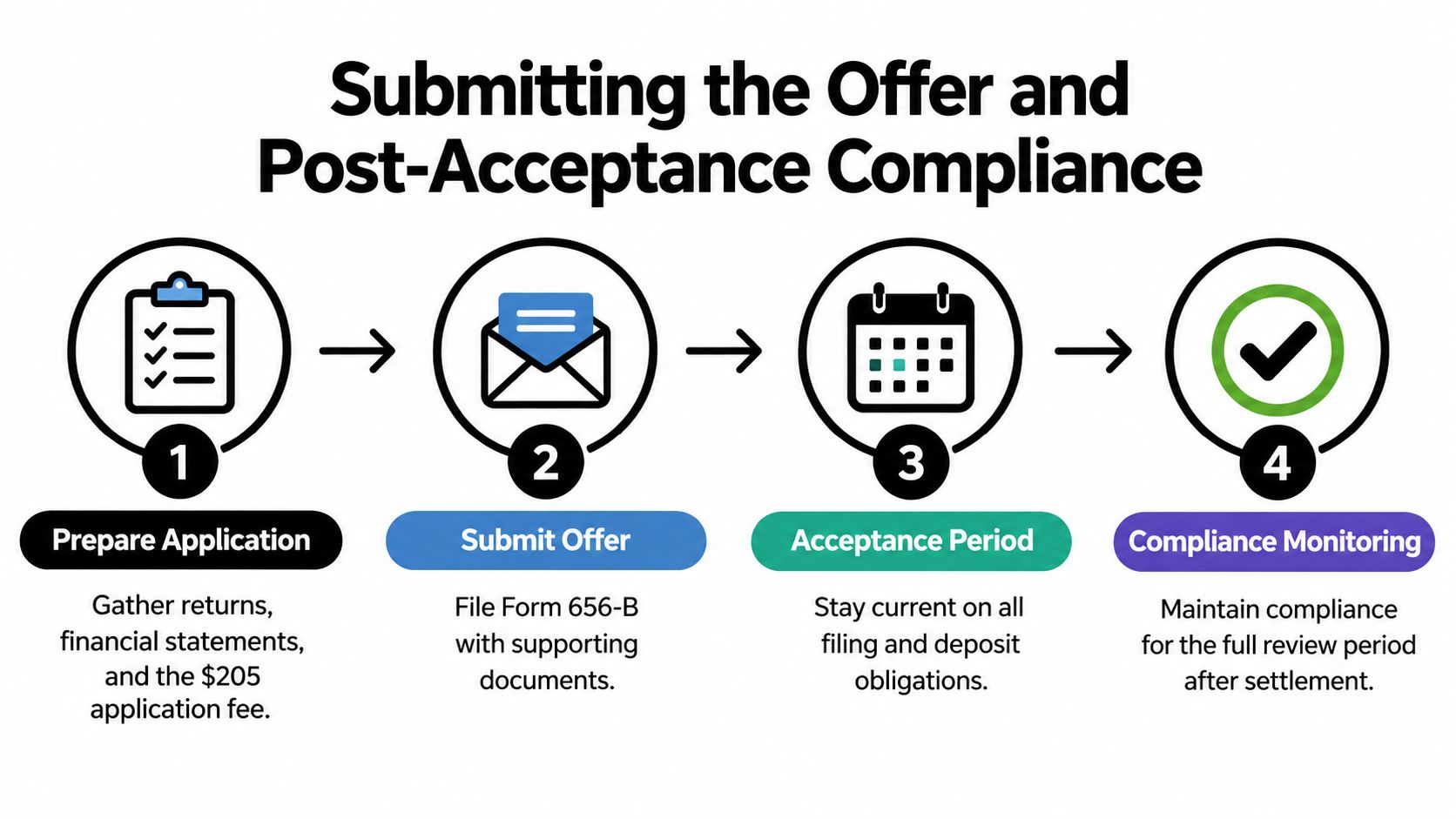
Acceptance isn't a clean reset. The IRS monitors accepted offers for payment of the offered amount, refund recoupment where applicable, lien releases, and a mandatory five-year compliance period, except for doubt-as-to-liability offers, as described in its offer monitoring procedures. The business must keep filing returns, making required deposits, and meeting payment obligations throughout that period.
That ongoing obligation should shape the proposal. A seasonal company needs a cash-management plan that protects required deposits. A newly funded business should document how expansion affects reserves and debt service. An owner planning a sale, refinancing, profit distribution, or restructuring should obtain advice before moving assets or changing the business's financial profile.
Tax Attorney Stephen A Weisberg offers a free tax debt analysis and assistance evaluating business tax-debt options, including offer preparation and IRS representation. If payroll exposure, entity structure, or post-acceptance compliance makes the decision difficult, visit Tax Attorney Stephen A Weisberg to discuss whether an offer in compromise fits the facts.


