Offer in Compromise Eligibility: Settle Tax Debt in 2026
Explore Offer in Compromise eligibility with our 2026 guide. Learn IRS tests, RCP calculation, and pitfalls to settle your tax debt for less.

In this article
- The Reality of Settling with the IRS
- The Three Grounds for an Offer in Compromise
- Doubt as to Collectibility
- Doubt as to Liability
- Effective Tax Administration
- The Four Critical Prerequisites Before You Apply
- The four requirements the IRS checks first
- What taxpayers get wrong
- The real purpose behind these rules
- How the IRS Calculates Your Ability to Pay
- Assets are judged by collection value, not by your attachment to them
- Income is where many offers fall apart
- What the IRS is really testing
- Navigating OIC Forms and Documentation
- What the IRS is really asking for
- Critical Pitfalls and Special Business Considerations
- Special circumstances can change the outcome
- Payroll tax debt is where many businesses fail
- Common errors that sink otherwise plausible offers
- OIC Alternatives and Your Next Steps
- The realistic alternatives
- When professional review stops being optional
Only 17,890 Offer in Compromise applications were accepted out of 54,225 submitted, while roughly 20 million taxpayers owed back taxes in the same period (Jackson Hewitt's discussion of OIC selectivity). That should reset your expectations immediately.
Too many taxpayers hear “settle with the IRS for less” and assume the program is built for anyone who's overwhelmed. It isn't. The Offer in Compromise, or OIC, is a narrow remedy for people who can prove something very specific under IRS standards. If you treat it like a negotiation based on fairness, frustration, or good intentions, you'll likely waste time and money.
The IRS doesn't care that the debt feels impossible. It cares whether you fit within a legal category and whether your financial records support that position. That's the disconnect. Taxpayers focus on how hard the bill feels. The IRS focuses on collectibility, liability, and documented hardship.
The Reality of Settling with the IRS
Roughly one-third of OIC applications were accepted in the year cited earlier. That statistic matters for one reason. It shows how narrow this program is.
An OIC is a collection decision under IRS rules. The IRS accepts an offer when it concludes your offer is the most it can reasonably collect, or when the liability is wrong, or when collection would create a defined unfair result under its standards. Your frustration with the balance does not drive that decision. Your paperwork and your legal fit do.
That is the disconnect I see constantly. Taxpayers focus on the size of the debt, how long they have struggled, or how unfair the bill feels. The IRS focuses on what it could collect through enforced collection, what assets exist, what income is available, whether the returns are filed, and whether the case fits a recognized ground for compromise.
For many taxpayers who owe back taxes, an installment agreement, currently not collectible status, or compliance cleanup is the better first move. Business owners get this wrong more than anyone. They assume uneven cash flow, a bad year, or payroll pressure makes them OIC candidates. Usually it does not. The IRS looks past the story and into the bank statements, receivables, equity, and spending patterns. If the numbers show collection potential, the offer fails.
That does not make the program pointless. It makes the program precise.
I tell clients to stop asking, “Can I settle?” Ask a better question: “Why would the IRS take less from me under its rules?” If you cannot answer that in one clear sentence, you are not ready to file. Start with a grounded overview of how to settle tax debt with the IRS, then decide whether an OIC fits your facts before you spend time and money on the application.
The Three Grounds for an Offer in Compromise
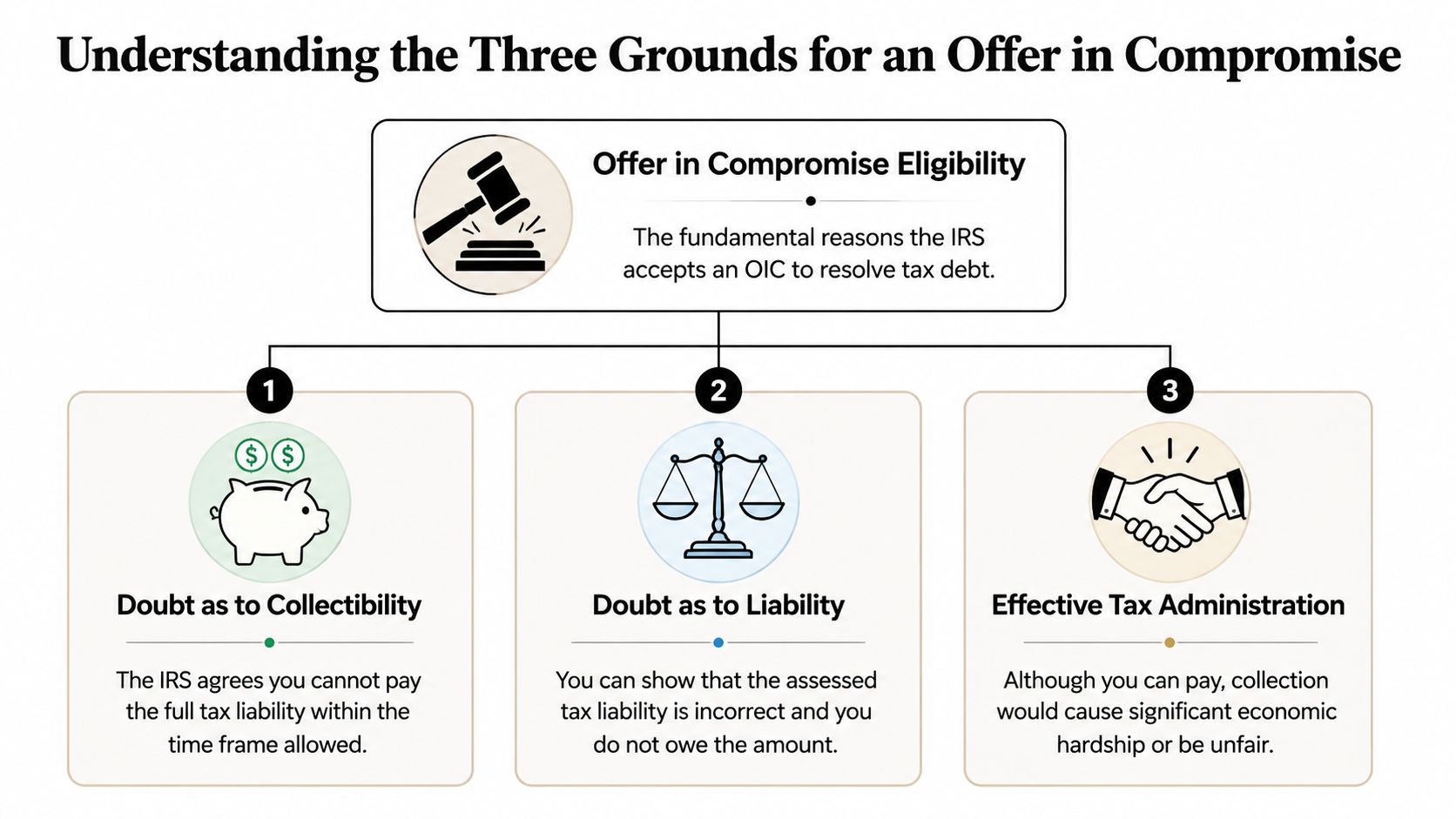
The IRS accepts an offer in compromise on only three legal grounds. Taxpayers often assume a large balance, years of stress, or a sincere hardship story should be enough. It is not. The IRS wants a case that fits one of these categories and documents that prove it.
Doubt as to Collectibility
This is the ground typically understood when individuals express a desire to settle. It means you cannot pay the full tax before the IRS's collection window runs out.
The issue is not whether payment feels impossible. The issue is whether the IRS could reasonably collect more than you are offering by using your available equity and future income. That is why this category turns into a numbers case fast, especially for self-employed taxpayers and business owners. If the records show receivables, retained cash, transferable assets, or personal spending that exceeds IRS standards, the offer usually dies on the math.
The common mistake is assuming low cash flow equals eligibility. It does not. The IRS looks at collection potential, not just monthly strain.
Doubt as to Liability
This ground applies when the tax assessed is wrong.
Use this category if the IRS overstated income, missed deductions or basis, assessed tax from incomplete information, or otherwise got the liability wrong. Do not use it as a fallback because you dislike the balance or cannot afford it. If the tax is incorrect, your strategy is to challenge the liability directly and support that challenge with records, not to make a reduced payment pitch under the wrong theory.
That distinction matters. A weak collectibility case cannot be rescued by calling it a liability case.
Effective Tax Administration
This is the category taxpayers misunderstand most. It applies when you could technically pay, but full collection would create a serious hardship or an unfair result under IRS standards.
Unusual facts become critical in this category. Severe medical needs, advanced age, disability, caregiving demands, or an asset that exists on paper but cannot be tapped without causing real harm can change the analysis. The reason is simple. The IRS built this ground for cases where strict collection would defeat common sense, even though the numbers alone suggest the debt could be paid.
Online calculators miss these cases all the time. They treat every asset as equally available and every future month as predictable. Real cases are messier than that, and the IRS knows it.
Here is the practical summary:
| Ground | Plain English meaning | Core question |
|---|---|---|
| Doubt as to Collectibility | You cannot pay in full | Can the IRS realistically collect the balance before time runs out? |
| Doubt as to Liability | You do not owe the amount assessed | Is the tax bill itself wrong? |
| Effective Tax Administration | Full collection would cause hardship or an unfair result | Should the IRS collect less even though payment may be technically possible? |
If you want the legal framework first, read what an Offer in Compromise is. Then come back to the harder question. Which ground fits your facts, and can you prove it with records the IRS will accept?
The Four Critical Prerequisites Before You Apply
A large share of rejected offers never reach the math stage. They fail at compliance first.
That frustrates taxpayers because they assume eligibility turns on hardship, low income, or a reasonable settlement amount. The IRS starts somewhere else. It asks a simpler question. Are you current enough, right now, to be taken seriously?
If the answer is no, the offer is dead on arrival.
The four requirements the IRS checks first
The IRS will not process an Offer in Compromise unless all required returns are filed, you are not in an open bankruptcy case, current-year estimated tax payments are up to date if they apply to you, and a business with employees is current on federal tax deposits for this quarter and the prior two quarters.
Those rules exist for a reason. The IRS is not interested in settling old debt while new debt is still building. An offer is supposed to resolve a tax problem, not subsidize one that is continuing.
For business owners, this disconnect proves expensive. Many owners believe a struggling business should get more flexibility. The IRS often reaches the opposite conclusion. If payroll deposits are still late, the agency sees an active compliance failure, not a settlement candidate.
What taxpayers get wrong
Taxpayers often fixate on adjusted gross income, monthly bills, or what they believe they can afford. That is premature. Income matters later. Compliance comes first. If you need a refresher on AGI because you are sorting through current-year payment obligations, ReceiptsAI AGI explained.
Another common mistake is treating missing returns as paperwork that can be cleaned up after filing the offer. That approach wastes time and usually the application fee. The IRS reads unfiled returns as a sign that it still does not have the full picture.
Use this checklist without flattering yourself:
- All required returns filed: Every required individual, business, payroll, and information return must be on file.
- No open bankruptcy case: The IRS will not consider an OIC while bankruptcy protection is active.
- Current estimated taxes paid: Self-employed taxpayers and others who must pay quarterly estimates need to be current for this year.
- Payroll deposits current for businesses: If you have employees, federal tax deposits must be current for this quarter and the two prior quarters.
A business owner should read that last point twice. Payroll tax trouble sinks offers fast because the IRS treats trust fund taxes as a priority enforcement issue.
The real purpose behind these rules
These are not technical traps. They are a screening tool.
The IRS wants proof that the liability has stopped growing and that any settlement has a real chance to hold. A taxpayer who is now filing on time and paying current obligations looks like someone solving a problem. A taxpayer who is still behind looks like someone asking for a discount before changing the behavior that created the debt.
That is why I tell clients to clear the compliance screen before they spend energy debating the offer number. If you want to understand how the settlement number is later built, review the IRS offer in compromise formula and calculation rules. But do not start there.
Start with this question instead. If the IRS reviewed your filings and current payments today, would it see containment or chaos? That answer usually determines whether an offer has any chance at all.
How the IRS Calculates Your Ability to Pay
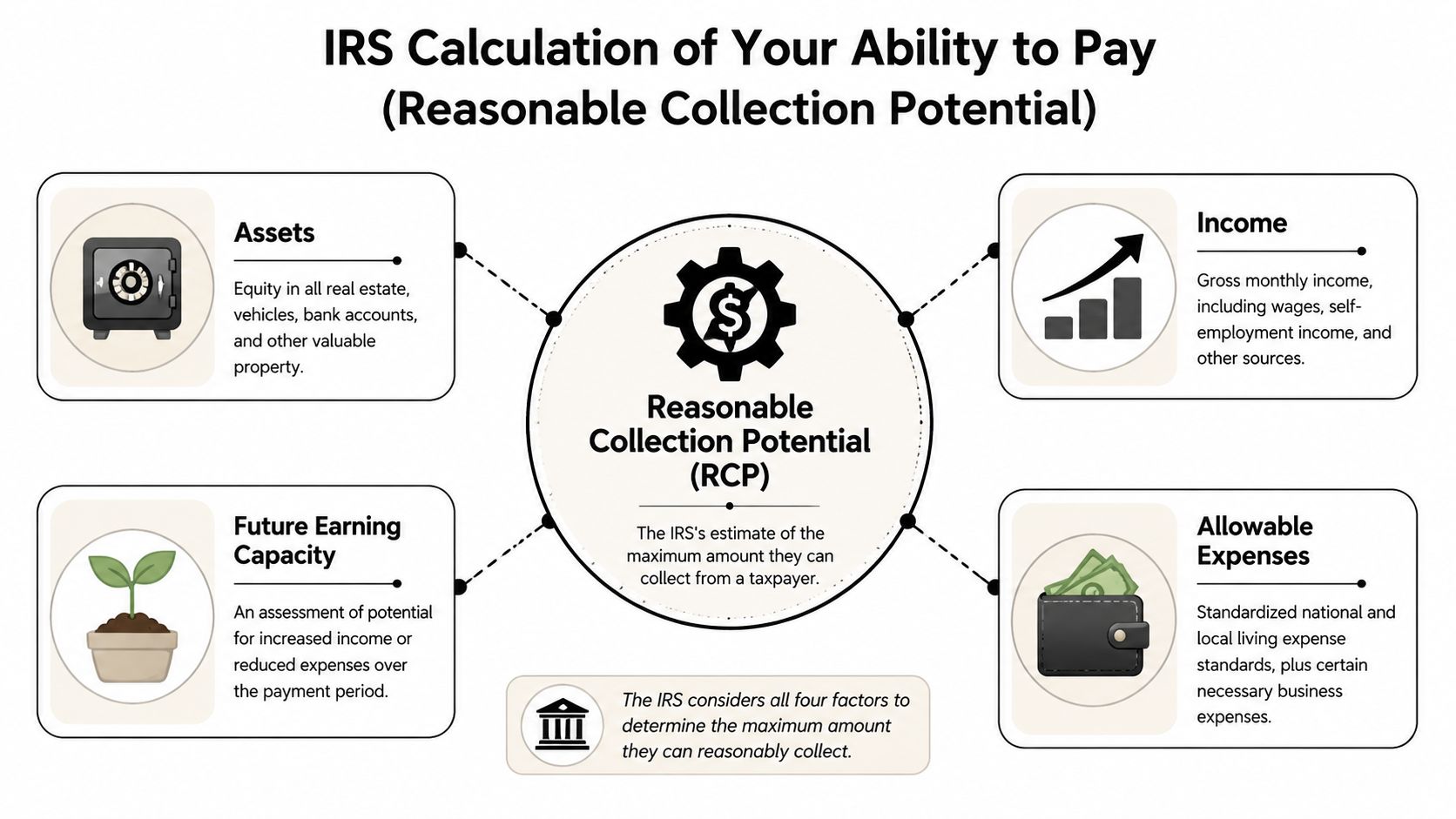
For most offer cases, eligibility turns on one question. What can the IRS collect from you before time runs out?
The IRS answers that question with Reasonable Collection Potential, or RCP. This is the core disconnect that trips people up. Taxpayers often focus on hardship, fairness, or how large the tax bill feels. The IRS focuses on collection math. If it believes it can collect more than your offer through assets, monthly cash flow, or enforced collection over time, your offer is dead on arrival.
The formula has two parts. First, the IRS looks at the net realizable equity in your assets. Then it adds future disposable income. In practice, a cash offer is usually based on a shorter future-income period, while a periodic payment offer uses a longer one. If you want the mechanics laid out line by line, review the IRS offer in compromise formula and how to calculate it.
Assets are judged by collection value, not by your attachment to them
Taxpayers usually look at assets emotionally or historically. The IRS does not care what you paid, what the asset once was worth, or how unfair a sale would feel. It cares about what could be collected from that asset after quick-sale realities, loans, and exemptions are factored in.
That includes more than a home or brokerage account. Cash in the bank, vehicles, retirement funds, real estate, accounts receivable, business interests, and other property can all enter the calculation.
Business owners need to be especially careful here. Many assume business assets are off-limits because the company needs them to operate. Sometimes that is true. Sometimes it is wishful thinking. The IRS will ask whether cash reserves are excessive, whether equipment is necessary, whether receivables can be tapped, and whether the business is paying personal expenses that should be added back as available income.
Income is where many offers fall apart
The second part of RCP is future disposable income. This is not your gut-level sense of being stretched thin. It is your income minus the expenses the IRS is willing to allow.
That distinction matters. The IRS does not approve a lifestyle. It approves necessary expenses under its standards and then tests whether your actual numbers are reasonable. If you spend heavily on categories the IRS sees as optional, your offer number rises even if your checking account feels empty at the end of every month.
Self-employed taxpayers run into this problem all the time. Gross receipts are not the same as usable income, and legitimate business costs must be separated from personal spending with discipline. If your records are messy, the IRS will not give you the benefit of the doubt. If you need a basic refresher before organizing income records, ReceiptsAI AGI explained can help clarify the adjusted gross income concept.
What the IRS is really testing
The IRS is not trying to decide whether you deserve a break. It is deciding whether your offer beats its other collection options.
That is why someone with a very large tax debt can still be ineligible for an offer, while someone with a smaller debt may qualify. The size of the balance matters less than the gap between what you owe and what the IRS believes it can collect. A taxpayer with modest income but substantial home equity may have a weak offer case. A taxpayer with little equity, unstable income, and documented allowable expenses may have a stronger one.
A successful offer is built on proof that the IRS cannot reasonably collect more, not on proof that paying the tax would be frustrating.
That is the strategic point. Before you name an offer amount, pressure-test your asset equity, strip out expenses the IRS will disallow, and explain any unusual income swings clearly. If your file shows hidden equity, personal spending inside the business, or numbers that change from one document to the next, the IRS will assume your offer is too low.
Navigating OIC Forms and Documentation
A weak OIC file usually fails on paper before the IRS ever debates the offer amount.
The forms are not administrative clutter. They are the case. Form 656 states what you are offering and on what tax periods or liabilities. Form 433-A or 433-B shows the IRS whether that number is credible. Individual taxpayers use Form 433-A. Businesses use Form 433-B. If you owe under different legal entities or different liability types, you may need separate forms because the IRS evaluates each obligation through the correct taxpayer and collection path.
That is the disconnect many people miss. They assume the offer wins or loses on hardship. The IRS is looking for a file that is complete, internally consistent, and easy to verify. If your bank statements show transfers you did not explain, if your business books mix personal spending with operating costs, or if an asset value looks convenient rather than supported, the reviewer will not stretch to help you.
What the IRS is really asking for
Form 656 is the proposal. The 433 form is the proof. Your documents need to answer the reviewer's next question before it gets asked.
Expect to gather:
- Income proof: Pay stubs, current profit and loss statements, and other records showing what you earn now.
- Bank statements: Records that match the balances, deposits, and spending reported on the forms.
- Asset documents: Mortgage statements, loan payoff balances, vehicle information, and support for any claimed value discount.
- Business records: General ledgers, receivables, payroll data, and other records that show what cash the business controls.
Business owners need to be especially careful here. The IRS does not accept “the business needs the money” as a complete answer. You need records that show why cash on hand, receivables, or retained earnings are not reasonably available to pay the tax. If your books are sloppy, the IRS will assume the numbers favor you.
The filing cost also forces discipline. An OIC generally requires an application fee and an initial payment with the submission, unless you qualify for the low-income exception. That money should make you pause. Do not file just to see what happens. File when the numbers are defensible and the documents are ready.
Privacy matters too. You will be gathering tax returns, bank statements, payroll records, and account numbers in one place. Review File Studio's privacy for sensitive documents before you start sending files back and forth.
If you want a closer look at how the main financial disclosure form works, read this guide to IRS Form 433-A OIC.
Critical Pitfalls and Special Business Considerations
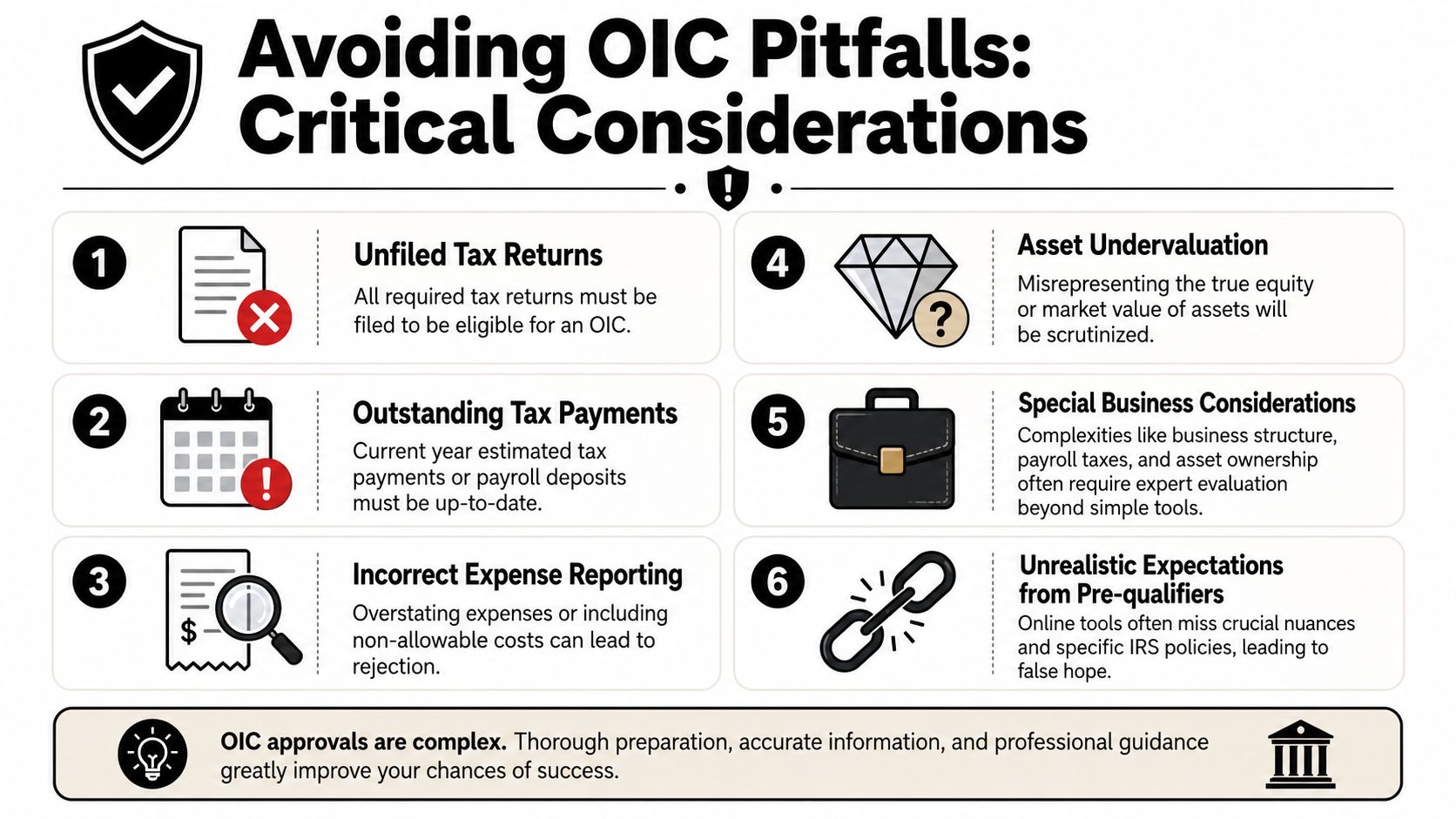
Most bad OIC advice fails in the same way. It treats eligibility like a checklist and ignores how the IRS reviews a file.
That's why taxpayers get false confidence from pre-qualifier tools. Those tools can be useful, but they are not a substitute for judgment. A calculator can sort numbers. It can't reliably evaluate a sudden medical event, a collapsing business, or a temporary income disruption that makes last year's return a poor guide to current ability to pay.
Special circumstances can change the outcome
Taxpayers with special circumstances often give up too early. They assume that if the standard math doesn't work, they're out. That isn't always true.
The IRS allows room for special circumstances that affect whether the standard amount is appropriate. The problem is that many online guides don't explain this gap well, and taxpayers come away thinking a negative result from a pre-screening tool is permanent. It isn't. If your current situation is materially different from the historical numbers, that difference has to be documented and presented intelligently.
Some of the strongest OIC arguments come from facts that a generic tool can't read, such as a recent job loss, a severe medical burden, or abrupt income volatility in a self-employed household.
Payroll tax debt is where many businesses fail
Business owners need to hear this clearly. Payroll tax debt is one of the hardest categories to compromise, not because the debt is large, but because compliance rules are unforgiving.
If a business has employees, it must be current on federal tax deposits for the current quarter and the two preceding quarters. Miss one required deposit, and the entire OIC can be dead on arrival under the eligibility rules already discussed earlier. For many small businesses, that becomes the primary barrier, not the settlement calculation.
This is especially important for sole proprietors, single-member LLCs, and closely held businesses juggling payroll stress and uneven cash flow. They often think the size of the liability is the issue. It usually isn't. The issue is that the business is still out of compliance.
Common errors that sink otherwise plausible offers
Here's where taxpayers and inexperienced preparers often go wrong:
- They undervalue assets. The IRS reviews equity closely.
- They overstate expenses. Not every real-world expense is an IRS-allowable expense.
- They rely on old numbers. Recent hardship needs current proof.
- They mix personal and business finances carelessly. That creates credibility problems.
- They file too soon. An offer submitted before compliance is stabilized is often just expensive delay.
In more complicated cases, a detailed pre-filing review is worth more than a rushed application. That can include working through the numbers yourself, coordinating with a CPA or enrolled agent, or using a structured review such as the free tax debt analysis offered by Attorney Stephen A Weisberg, which is designed to help determine whether an OIC fits before filing.
OIC Alternatives and Your Next Steps
If you're not a good OIC candidate, that doesn't mean you're out of options. It means you need the right option.
Many taxpayers force the Offer in Compromise question because it sounds like the most attractive result. That's a mistake. The best resolution is the one that fits your facts and keeps the IRS from getting worse.
The realistic alternatives
| Option | When it usually fits | Basic outcome |
|---|---|---|
| Offer in Compromise | You meet a valid legal ground and can support it | Resolve for less than full balance |
| Installment Agreement | You can pay over time | Monthly payments toward full debt |
| Partial Pay Installment Agreement | You can pay something, but likely not the full amount before the statute runs | Reduced practical recovery through monthly payments |
| Currently Not Collectible | You can't make payments now | Collections pause due to hardship |
An installment agreement is often the right answer for taxpayers who are compliant and can pay over time. Currently Not Collectible status may fit when any payment would create immediate hardship. A partial pay arrangement can make sense when some payment is possible, but full payoff still isn't realistic.
When professional review stops being optional
You should get serious help if any of these apply:
- Business ownership: Especially where payroll taxes, receivables, or entity issues are involved.
- Mixed personal and business debt: These cases are easy to mishandle.
- Volatile self-employment income: The timing and documentation matter.
- Large asset questions: Real estate, equipment, or disputed equity can change everything.
- Special circumstances: Medical hardship or sudden income collapse needs careful framing.
The OIC process rewards precision, not optimism. If your case is simple, you may be able to evaluate it yourself. If it isn't, trying to save money by guessing can cost more than getting the analysis right the first time.
If you're dealing with IRS debt and need a straight answer on whether an Offer in Compromise makes sense, Attorney Stephen A Weisberg offers a free Tax Debt Analysis to determine whether he can help and how. He works directly with individuals, self-employed taxpayers, business owners, and professionals with clients facing tax debt issues, with a focus on identifying the right resolution before charging for representation.


