How an Offer in Compromise Attorney Can Help
Learn how an offer in compromise attorney evaluates eligibility, prepares forms, negotiates with the IRS, and compares alternatives for tax debt.

In this article
- When Tax Debt Feels Too Large to Manage
- Urgency creates bad decisions
- Start with the decision, not the forms
- What an Offer in Compromise Actually Is
- The collection calculation drives the case
- Settlement doesn't erase every consequence
- Eligibility and Financial Tests
- Collectability requires a financial model
- Liability and hardship are different theories
- Forms, Financial Records, and Filing Structure
- Match the forms to the taxpayer
- Build the evidence before signing
- The OIC Process, Timelines, and Outcomes
- Three outcomes that show the practical risks
- The waiting period affects the strategy
- Alternatives to an OIC
- Payment plans and collection status
- Attorney Strategy, Fees, and Common Pitfalls
- Representation should change the decision quality
- Choosing Counsel and Getting a Tax Debt Analysis
A self-employed contractor can go from a profitable month to an IRS collection notice with alarming speed. Unfiled returns, payroll-tax problems, and a business account that's losing cash create the perfect conditions for an aggressive Offer in Compromise advertisement to sound like an emergency exit. Before you pay anyone to “settle your taxes,” you need a financial analysis that answers a harder question: is an OIC economically realistic for your situation?
An offer in compromise attorney should test that question before preparing forms. The right answer might be a settlement, but it could also be an installment agreement, currently-not-collectible status, penalty relief, bankruptcy analysis, or a coordinated strategy for business and individual liabilities. The IRS generally has up to 24 months from receipt of an offer to accept, reject, return, or receive a withdrawal, according to official IRS collection activity guidance. That makes a poorly prepared filing expensive in both money and time.
When Tax Debt Feels Too Large to Manage
The contractor sits at a kitchen table with three problems competing for attention. Several tax returns haven't been filed. The IRS has sent a notice about payroll taxes. The business account is shrinking because customers are paying late and operating costs keep arriving on schedule.
The tax balance looks impossible, so an advertisement promising to reduce it to a fraction feels less like marketing and more like rescue. That emotional reaction is understandable. It's also when taxpayers make their costliest mistakes. They may send money to a stranger, sign incomplete forms, file an OIC before correcting missing returns, or assume that every tax liability can be handled through the same settlement package.
Urgency creates bad decisions
A legitimate tax professional should explain why an OIC might fit, what facts could defeat it, and which alternatives deserve comparison. Nobody should guarantee acceptance. In FY 2025, taxpayers submitted 38,797 offers in compromise, while the IRS accepted 5,464, totaling $98.1 million, according to the IRS's published collection statistics. The reported acceptance rate was 14.1%, roughly one accepted offer for every seven filed.
Those figures don't determine an individual result, but they do establish the program's character. An OIC is selective and procedural, not an automatic discount program. The IRS expects complete financial disclosure and a proposal that reflects what it can reasonably collect.
Practical rule: Don't pay for OIC preparation until someone has reviewed the tax transcripts, filing status, income, assets, expenses, and business structure.
Start with the decision, not the forms
A sole proprietor may have individual income-tax debt and business-related payroll obligations that require different treatment. An incorporated contractor may need the corporation to address its own liabilities while an owner separately addresses personal assessments. A professional with one unusually large tax year may be able to pay through a manageable arrangement once penalties are reviewed.
The first step is to organize the facts and compare outcomes. An installment agreement may preserve cash flow. Currently-not-collectible status may be appropriate when basic living expenses consume available income. A bankruptcy analysis may address certain tax liabilities that an OIC won't eliminate. Only after those paths are measured should settlement become the central strategy.
What an Offer in Compromise Actually Is
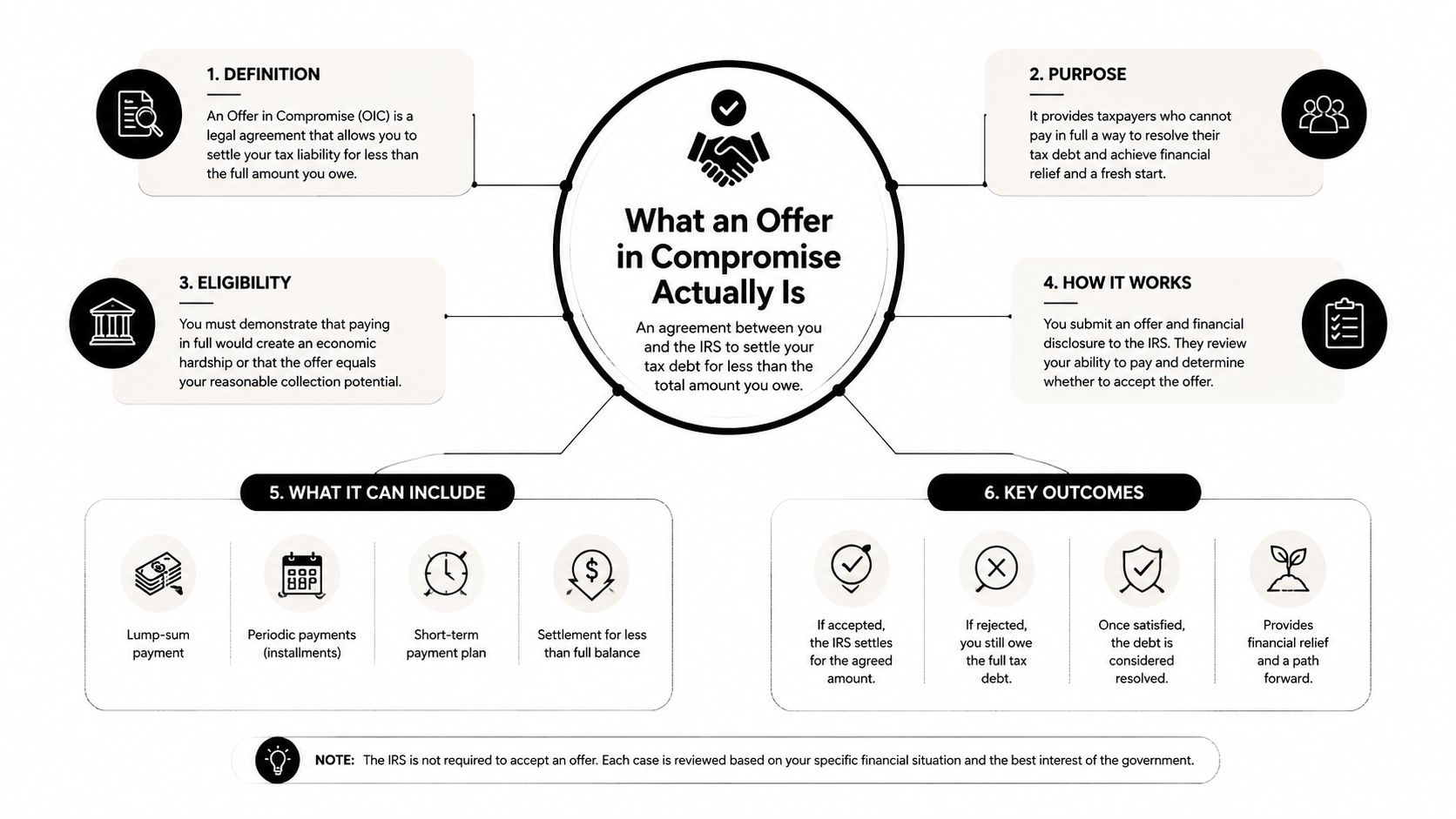
An Offer in Compromise is a settlement mechanism under Internal Revenue Code Section 7122. It can allow a taxpayer to resolve federal tax debt for less than the full amount when there is doubt about the liability, doubt about collectibility, or a qualifying hardship or public-policy basis. The IRS isn't just rewarding a taxpayer for being unable to pay. It's deciding whether the proposed amount represents a reasonable resolution under the taxpayer's facts.
A useful analogy is a bank considering a short sale. The bank compares the likely recovery from accepting the proposed sale with the cost, delay, and uncertainty of forcing a different outcome. The IRS performs a similar economic assessment. It examines available asset equity and the income it can reasonably capture, then compares that potential recovery with the offer.
The collection calculation drives the case
For a collectability-based OIC, the central concept is reasonable collection potential, often called RCP. In practical terms, the analysis considers net equity in assets and future income after the IRS applies its rules for allowable expenses. A taxpayer can't select an attractive offer amount first and then build financial disclosures around it. The financial evidence has to support the proposal.
The IRS Offer in Compromise guidance identifies the package requirements, including Form 656 and the applicable financial statement. Acceptance remains discretionary, and a rejected submission doesn't necessarily return every payment made with the application. Payment treatment also depends on the track selected and the taxpayer's circumstances.
Settlement doesn't erase every consequence
A successful compromise resolves the liabilities included under its terms, but taxpayers must follow the acceptance conditions. Future filing and payment compliance matters. A taxpayer who treats acceptance as a permanent escape from tax obligations can put the agreement at risk.
The practical lesson is simple. An OIC isn't a coupon applied to a balance. It's a negotiated resolution based on verified financial information, statutory rules, and continuing compliance. For a broader explanation of the program and settlement mechanics, see this complete guide to IRS Offers in Compromise.
Eligibility and Financial Tests
An OIC attorney should evaluate eligibility through separate legal and financial pathways. Combining them into a single hardship story usually weakens the analysis. The taxpayer either disputes the liability, demonstrates that full collection isn't realistic, or presents circumstances showing that full enforcement would create a qualifying hardship despite apparent ability to pay.
Collectability requires a financial model
The most common route is doubt as to collectibility. The attorney compares the total liability with the taxpayer's reasonable collection potential, using documented income, allowable expenses, and asset equity. A self-employed contractor may report strong gross receipts but little net cash after legitimate operating costs. The IRS will want to understand that cash flow, not merely accept a statement that business is “struggling.”
A small business adds another layer. The business may have accounts receivable, equipment, inventory, payroll obligations, and continuing revenue. The owner may also have personal assets and income. An analysis that ignores either side can produce an offer the IRS considers incomplete or unrealistic.
Liability and hardship are different theories
Doubt as to liability requires a genuine dispute about the assessment, supported by records. Examples can include a factual reporting error, a legal mistake, or a disagreement about responsibility for a particular tax obligation. General objections to the tax system aren't a substitute for evidence.
Economic hardship is narrower. The taxpayer must show that collection would interfere with basic living expenses under the applicable standards. Attorneys should treat unusual-circumstances arguments as fact-specific exceptions, not as a convenient replacement for a weak collectability calculation.
Procedural issues can stop a filing before the IRS reaches the economics. Required returns must be filed, the taxpayer generally can't be in an open bankruptcy, and current payment obligations must be addressed. An active installment agreement or missed estimated payments can also create a serious eligibility problem. The Taxpayer Advocate Service study of the OIC program illustrates why changing acceptance patterns and taxpayer categories make careful screening important.
| Eligibility Ground | What the IRS Tests | Common Disqualifier |
|---|---|---|
| Doubt as to collectibility | Whether assets and future income produce collection potential below the liability | Unreported assets, unsupported expenses, or enough capacity to pay |
| Doubt as to liability | Whether a genuine factual or legal dispute exists | No supporting evidence or a final determination resolving the issue |
| Economic hardship | Whether full collection would prevent basic living expenses | A stronger ordinary collectability remedy is available |
| Procedural readiness | Filed returns and current payment compliance | Missing returns, open bankruptcy, or delinquent current obligations |
Before recommending an OIC, counsel should reconcile transcripts with filed returns, bank activity, business records, and the taxpayer's actual spending. That work often determines whether the settlement theory is viable at all. Readers assessing their position can also review this guide on how to qualify for an Offer in Compromise.
Forms, Financial Records, and Filing Structure
The IRS expects a complete package, not a persuasive letter attached to one form. The core submission generally includes Form 656, plus Form 433-A (OIC) for an individual or self-employed person, or Form 433-B (OIC) for a business. The package also requires a $205 non-refundable application fee and an initial non-refundable payment for each Form 656, as stated in the IRS's Offer in Compromise instructions.
Match the forms to the taxpayer
A self-employed contractor usually reports personal finances and business cash flow through Form 433-A (OIC). The attorney must separate household expenses from business expenses and show how revenue moves through the operation. Bank deposits, merchant-processing records, bookkeeping reports, and profit and loss statements should tell the same story.
A corporation, partnership, or other business entity generally uses Form 433-B (OIC). The package may need payroll records, accounts payable and receivable schedules, bank statements, business assets, and explanations of related-party transfers. Individual and business debts aren't automatically combined because one person owns the company. Separate liabilities may require separate Form 656 submissions and distinct financial disclosures.
Build the evidence before signing
A practical document file often includes:
- Income records: Recent pay stubs, commission records, benefit statements, and business profit and loss statements.
- Bank evidence: Recent personal and business bank statements, with unusual deposits and transfers explained.
- Asset records: Mortgage statements, vehicle titles, retirement account statements, investment records, and appraisals where valuation is disputed.
- Debt and expense support: Loan statements, medical bills, insurance records, lease documents, and recurring household obligations.
- Tax records: Filed returns, IRS notices, account transcripts, and proof of current filing and payment compliance.
The payment track matters. A Lump Sum Cash offer and a Periodic Payment offer can differ in initial-payment requirements, payment timing, and the collection-statute consequences of remaining under review. The taxpayer and attorney should select the structure based on actual liquidity, not on which label sounds cheaper.
| Form / Document | Used By | Purpose |
|---|---|---|
| Form 656 | Taxpayer or business submitting the offer | States the proposed settlement and payment structure |
| Form 433-A (OIC) | Individuals and self-employed taxpayers | Discloses household finances, assets, income, and business cash flow |
| Form 433-B (OIC) | Businesses | Discloses business assets, liabilities, operations, and financial capacity |
| Application fee and initial payment | Most applicants | Accompanies the submission under the selected payment terms |
| Form 2848 | Authorized attorney or other eligible representative | Gives the representative authority to act before the IRS |
Taxpayers sign the required forms, and a spouse may also need to sign when joint liabilities or joint financial information are involved. Form 2848 is important when an attorney or CPA will communicate with the IRS, receive notices, and handle the case rather than merely help prepare documents. Self-employed readers who need help with the individual financial statement can consult this guide to IRS Form 433-A (OIC).
The OIC Process, Timelines, and Outcomes
A self-employed contractor may submit an offer that looks affordable on paper, yet fail the IRS review because business cash flow cannot support the proposed payment. An attorney should test that fit before filing, then compare settlement with an installment agreement or collection-status option based on actual receipts, expenses, assets, and business structure.
After filing, the IRS acknowledges the submission, processes the fee and initial payment, and checks the package for completeness. The case may go to a field collection group or the Centralized Case Processing Office. An examiner can request clarification, updated records, or additional financial documentation, including through Form 12510 or written correspondence.
The IRS generally has up to 24 months from receipt to accept, reject, return, or receive withdrawal of the offer, according to IRS collection activity guidance. That outer limit does not mean every case takes that long. It does require a plan for operating the household or business during review.
Three outcomes that show the practical risks
A sole proprietor offers $18,000 against $92,000 of trust-fund and individual tax debt. After the IRS verifies the records and the representative explains the business cash flow, the offer is accepted after 12 months. The result rests on the documented financial picture, not on the requested reduction.
An incorporated contractor offers $35,000 against $210,000. The IRS returns the submission without consideration because a lien-withdrawal request was not paired with the filing. The owner loses time because the package failed to address an operational requirement from the start.
A third taxpayer receives a rejection, appeals through the IRS Independent Office of Appeals within 30 days, and obtains a reduced settlement after providing better financial documentation. An appeal cannot guarantee approval, but it can correct an examiner's assumptions when the record supports a different conclusion.
The waiting period affects the strategy
A lump-sum case with clean records may move faster than a periodic-payment case requiring continuing income analysis. Updated bank statements, changing business revenue, or unresolved filing issues can extend review. The taxpayer must preserve records and remain current on new obligations.
The representative should monitor correspondence, answer requests accurately, and reassess whether settlement remains preferable as cash flow changes. A small business with improving receipts may fit a payment plan better, while a household with no capacity to pay may need collection-status analysis before spending more on an OIC.
Alternatives to an OIC
An OIC is only one tool. The sensible choice depends on cash flow, asset equity, liability type, and how long the IRS can legally collect. A taxpayer who can pay over time may spend less overall through an installment agreement than through the cost and risk of pursuing a settlement that the IRS won't accept.
Payment plans and collection status
Installment agreements can spread payments over time, often until the IRS collection statute expiration date. A seasonal self-employed taxpayer whose income has rebounded may fit a payment plan better than an OIC because the taxpayer has recurring capacity but uneven monthly receipts.
Currently-not-collectible status is different. It can pause active collection when the taxpayer can't pay basic living expenses, but interest and penalties continue and the IRS may later review the account. A small business owner rebuilding after a loss may need temporary breathing room while stabilizing operations, not a settlement that demands a payment the business can't fund.
Bankruptcy deserves separate legal analysis. Chapter 7 can discharge certain unsecured tax debts when statutory timing and other requirements are satisfied, while Chapter 13 can provide a structured repayment process. An OIC may be inappropriate if bankruptcy offers a legally stronger resolution, but tax and bankruptcy counsel must examine the specific liabilities.
Penalty abatement can also change the decision. Reasonable-cause relief or first-time administrative relief may reduce the balance enough to make an installment arrangement affordable. Professionals with one unusually large liability year should test that possibility before assuming settlement is necessary.
For business owners who need broader operational context, a resource on how to simplify business taxes can help identify bookkeeping and cash-flow practices that support a more accurate resolution analysis.
| Option | Best Fit Scenario | Key Trade-Off |
|---|---|---|
| OIC | Full payment isn't realistic and documented collection potential supports a lower resolution | Selective, document-heavy, and subject to continuing conditions |
| Installment agreement | Reliable income exists, but immediate payment isn't practical | Interest and penalties continue while payments are made |
| Currently not collectible | Basic living expenses consume available income | Collection can resume if finances improve |
| Bankruptcy | Certain tax debts may meet discharge or restructuring rules | Requires bankruptcy-specific analysis and may not address every liability |
| Penalty abatement | Penalties are a major part of an otherwise manageable balance | Relief depends on the applicable basis and documentation |
Attorney Strategy, Fees, and Common Pitfalls
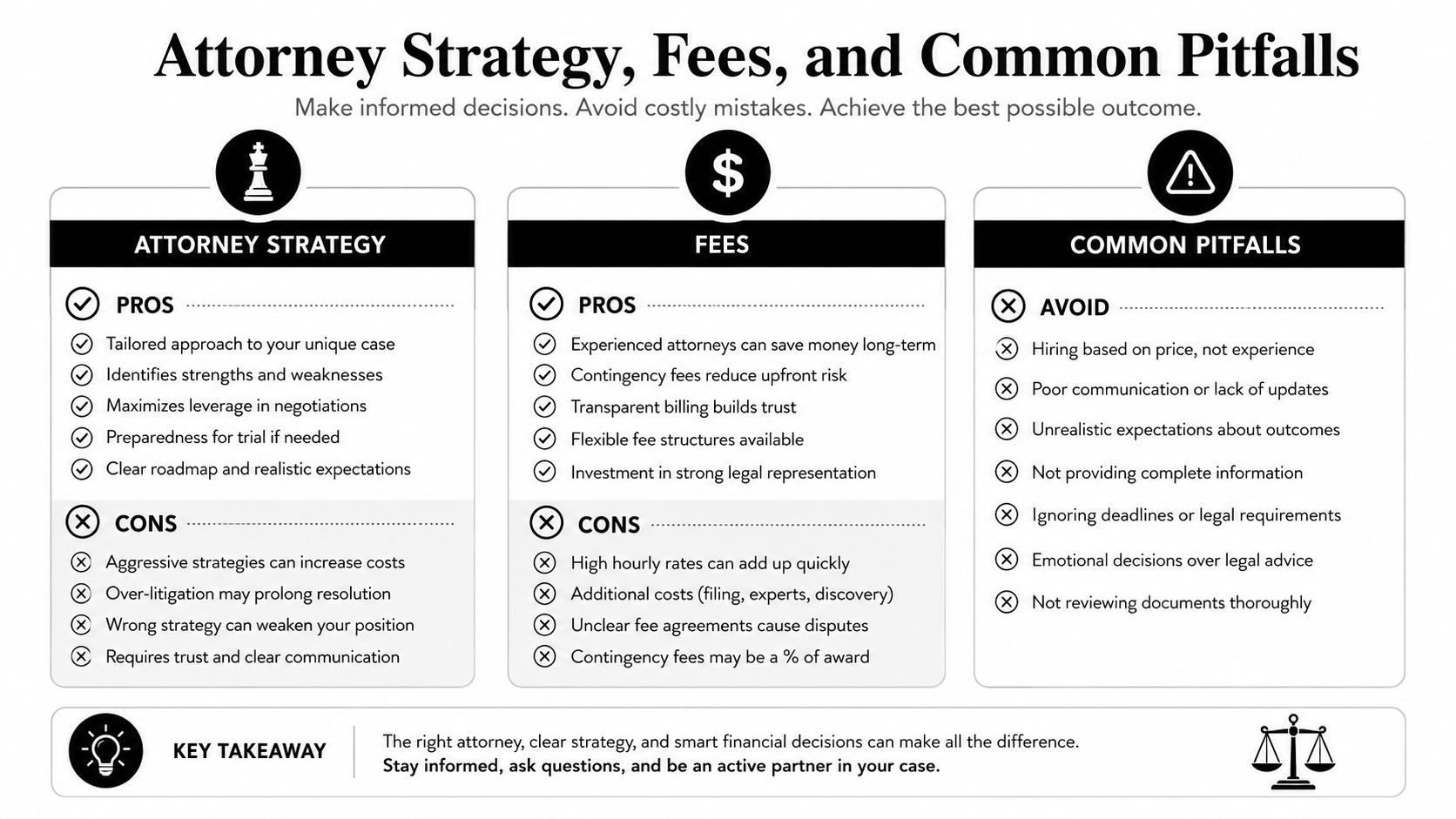
An OIC attorney earns their fee through pre-filing judgment, not by typing numbers into government forms. The work includes stress-testing asset values, separating allowable expenses from discretionary spending, modeling business cash flow, and deciding whether the taxpayer's liquidity supports a lump-sum or periodic structure.
For a self-employed taxpayer, the attorney may need to explain why gross receipts don't equal disposable income. For a small business, the analysis may focus on receivables, payroll obligations, equipment, owner draws, and whether the company can continue operating while addressing tax debt. For trust-fund assessments, personal liability and business liability must be evaluated separately.
Representation should change the decision quality
Negotiation often involves correcting valuation assumptions, explaining a temporary business downturn, documenting medical costs, or presenting reliable future-income projections. If the IRS rejects the offer, counsel may request Appeals consideration, submit supplemental records, or pivot to an installment agreement or currently-not-collectible status.
Fee structures vary. A firm may quote a flat fee for an OIC package, charge hourly for Appeals work, or use a hybrid retainer that defines when additional work becomes billable. Ask what happens if the case is returned, rejected, appealed, or converted to another resolution.
The right question isn't “How much does the attorney charge?” It's “What decision will the analysis help me make before I commit to the larger engagement?”
Common errors include:
- Unsupported expenses: Claiming spending the IRS won't allow can reduce credibility and lower the accepted expense figure.
- Missing assets: Omitting accounts, vehicles, property, or business interests can lead to return, rejection, or more serious consequences.
- Payment mistakes: Failing to include the required application fee or initial payment can derail processing.
- Repeated filings: Resubmitting an identical offer without correcting the reason for rejection rarely improves the outcome.
- Poor authority documents: Without Form 2848, the representative may not be able to handle communications as the taxpayer expects.
Taxpayers comparing professional involvement can review the benefits of hiring a tax attorney, while business owners dealing with broader creditor pressure may find a general overview of debt relief strategies by Business Loan Warrior useful for context. Neither resource replaces an IRS-specific financial analysis.
Choosing Counsel and Getting a Tax Debt Analysis
Before hiring counsel, verify an active JD, CPA, or EA credential, a valid PTIN, and actual experience with OIC and Appeals matters. Ask who will prepare the financial package, whether an attorney reviews it, what the flat fee covers, and when Appeals or alternative-resolution work creates additional charges.
Bring useful records to the first consultation:
- Two years of filed tax returns
- Six months of personal and business bank statements
- A current profit and loss statement
- IRS notices and account transcripts
- A list of assets, debts, payroll issues, and pending collection actions
Ask for a recommendation that compares settlement with payment plans, currently-not-collectible status, penalty relief, and bankruptcy where appropriate. Tax Attorney Stephen A Weisberg offers a complimentary Tax Debt Analysis for self-employed individuals, small businesses, taxpayers, and professional referrers who need to determine whether an OIC fits before committing to paid representation.
Tax Attorney Stephen A Weisberg can review your IRS tax debt, business structure, cash flow, and available resolution paths through a complimentary Tax Debt Analysis. Visit Tax Attorney Stephen A Weisberg before paying for an OIC package, so you can make a realistic decision about settlement, payment, or collection status.


