NYS Sales Tax Deadline 2026: Key Dates & Info
NYS sales tax deadline 2026 insights: filing frequency, due dates, payment options, and late filing consequences. Stay compliant & protect your business.
In this article
- A Business Owners Guide to New York Sales Tax
- Why business owners get tripped up
- Get organized before the deadline owns you
- How Often Must You File NYS Sales Tax
- Think of it like a reporting rhythm
- What this means in practice
- The 2026 NYS Sales Tax Deadline Calendar
- 2026 NYS sales tax filing deadlines
- How to read the calendar correctly
- My recommendation
- E-Filing and Paying Your NYS Sales Tax
- What to have ready before you sign in
- What the process usually feels like
- What Happens If You Miss a Sales Tax Deadline
- The filing problem is real even with zero tax due
- Late returns create leverage for the state
- Why business owners should take this personally
- You Missed the Deadline Now What
- Your first moves in the next day or two
- When you should stop trying to handle it alone
- My blunt advice
You're running the business, covering payroll, answering customers, chasing receivables, and then it hits you. The New York sales tax return is due, or worse, already late. That moment of panic is common. I've seen capable business owners freeze because they aren't sure whether they file monthly, quarterly, or annually, and they're afraid one wrong move will make the problem worse.
The right move is usually simpler than people think. Get clear on your filing cycle, file what's due, and deal with any payment problem separately. Confusion is expensive. Delay is more expensive.
A Business Owners Guide to New York Sales Tax
A lot of New York business owners think of sales tax like income tax. One big filing season. One main deadline. That's the wrong mental model, and it causes problems fast.
Sales tax in New York works like a recurring compliance system. If you sell taxable goods or services, the state expects regular reporting. That matters whether you had a strong sales period, a slow one, or no taxable sales at all. If your records are messy or you've changed bookkeeping tools midyear, the deadline can sneak up on you.
Why business owners get tripped up
The mistake usually starts with assumptions:
- “I already paid something.” Payment and filing are not the same issue.
- “I had no taxable sales.” That doesn't automatically remove the filing obligation.
- “My accountant handles taxes.” Many business owners still need to know the filing frequency and due dates themselves.
If you're self-employed and trying to sort out what tax rules apply across different systems, even internationally, a practical primer like Self-employed VAT threshold can help you think more clearly about when registration and filing obligations attach. Different tax systems work differently, but the underlying lesson is the same. Thresholds and filing rules matter, and guessing is a bad strategy.
Get organized before the deadline owns you
Start with your records, not your anxiety. Pull your gross sales, taxable sales, exempt sales, and the sales tax you collected. Then confirm what filing cycle New York assigned to your business. If you need a broader operational reset, this small business tax checklist is a good place to tighten up the basics.
Practical rule: If you're unsure whether something is due, assume the filing obligation exists until you confirm otherwise.
The business owners who get through this cleanly aren't always the ones with the most complex strategies. They're the ones who act early, stop avoiding the mailbox, and stop telling themselves they'll “catch up next week.”
How Often Must You File NYS Sales Tax
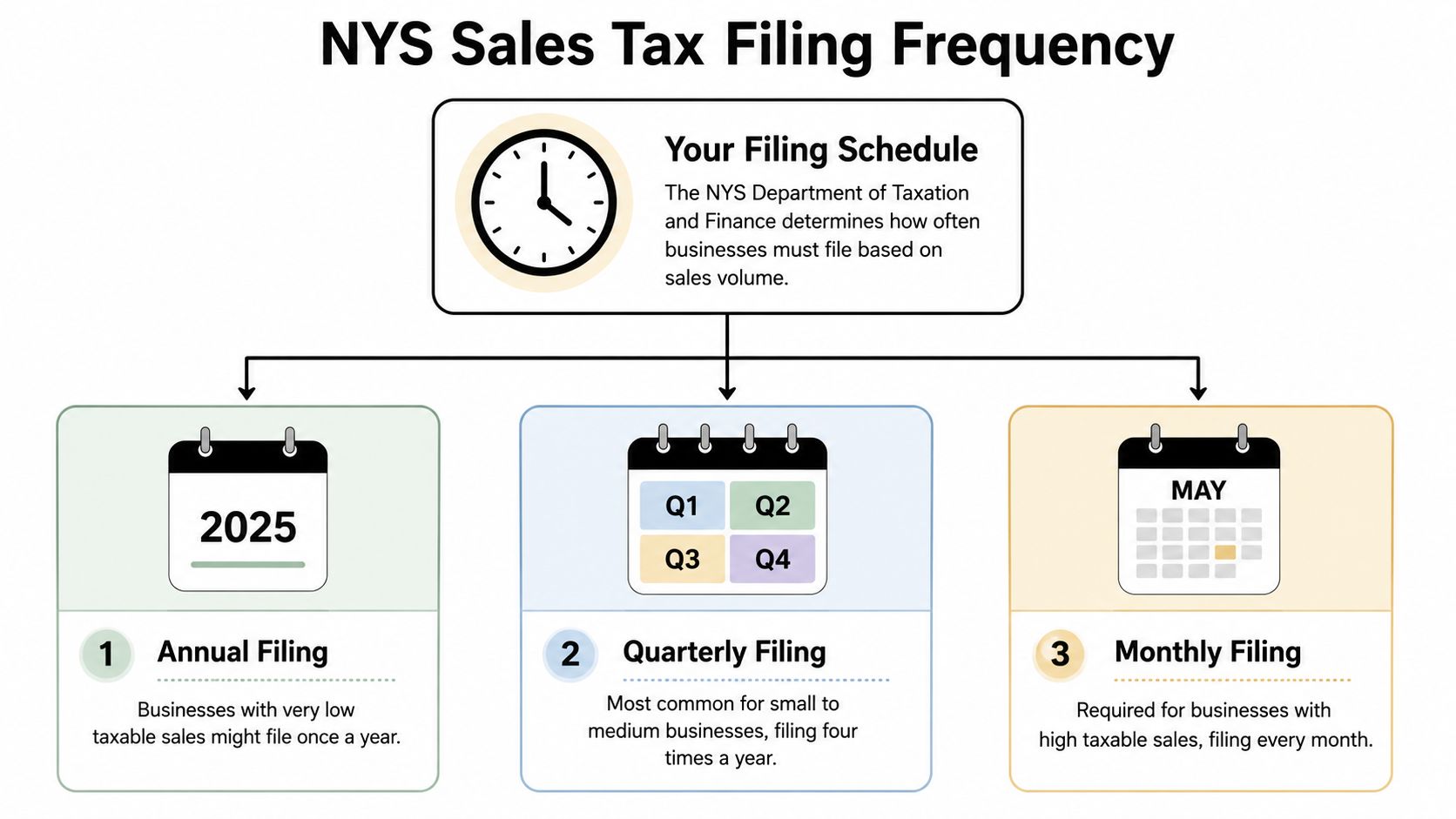
There isn't one single NYS sales tax deadline for every business. New York assigns a filing schedule, and your deadline depends on that schedule. The state's core rule is simple: sales tax returns generally must be filed no later than 20 days after the end of the period to which they relate, according to the New York Department of Taxation and Finance filing guidance.
That one rule explains most of the system.
Think of it like a reporting rhythm
If you fly often, some airports route frequent travelers through different check-in lines. Sales tax works the same way. New York puts businesses on different reporting rhythms, and each rhythm has its own due dates.
The common schedules are:
- Annual filing for businesses on a low-volume cycle
- Quarterly filing for many small and midsize businesses
- Monthly filing for businesses that must report more often
What matters is not what you prefer. It's what New York assigned.
What this means in practice
The phrase “NYS sales tax deadline” is really shorthand for “your next assigned filing deadline.” That's why two businesses can both be compliant for the same year but file on different dates.
Here's the practical way to handle it:
- Check your assigned frequency in your state correspondence or online tax account.
- Match the filing period end date to the due date.
- Treat the due date as a filing deadline first, not just a payment reminder.
That last point matters. The filing obligation exists even if you had no taxable sales or purchases to report. If you also make estimated payments for income taxes, don't let those dates blur together with sales tax deadlines. They are different systems with different risks. If that overlap causes confusion, review these quarterly tax payment deadlines separately so you don't miss one while focusing on the other.
Sales tax compliance gets easier once you stop looking for one master deadline and start following your assigned cycle.
The 2026 NYS Sales Tax Deadline Calendar
Those searching for the NYS sales tax deadline want dates they can put on a calendar today. Fair enough. For New York, the recurring pattern matters as much as the dates themselves.
Annual filers have a fixed March 20 deadline. The Department has also published quarterly schedules with due dates such as June 20, September 20, December 20, and March 20, depending on the quarter, and a department notice reiterated the annual March 20 due date for annual filers. That pattern appears in the New York tax department notice for annual and periodic filing timing.
2026 NYS sales tax filing deadlines
| Filing Period | Period End Date | Return Due Date |
|---|---|---|
| Annual filing period | End of annual filing period | March 20, 2026 |
| Q4 quarterly period | February 2026 | March 20, 2026 |
| Q1 quarterly period | May 2026 | June 20, 2026 |
| Q2 quarterly period | August 2026 | September 20, 2026 |
| Q3 quarterly period | November 2026 | December 20, 2026 |
| Monthly filing period | End of each month | 20th day after the month ends |
How to read the calendar correctly
Don't overcomplicate this. The fastest way to avoid trouble is to tie the deadline to the close of the reporting period.
Use this checklist:
- Annual filer: Put March 20, 2026 on your calendar now.
- Quarterly filer: Watch the quarter-end pattern. Due dates land on June 20, September 20, December 20, and March 20 when those are the reporting deadlines for your assigned periods.
- Monthly filer: Follow the recurring rule. Your return is generally due on the 20th day after the month ends.
My recommendation
Businesses should set internal deadlines earlier than the legal deadline. Don't aim to file on the last possible day. Aim to finish your books, verify sales tax collected, and submit before the state's due date. That buffer matters when your POS export is wrong, your bookkeeper is out, or you realize exempt sales weren't documented properly.
Put the deadline in two places. Your tax calendar and your operating calendar. Compliance fails when it lives in only one person's head.
If you run more than one entity, don't assume every company has the same filing frequency. That shortcut creates avoidable notices.
E-Filing and Paying Your NYS Sales Tax
Once you know the due date, the next problem is execution. Most business owners don't need a lecture on theory here. They need a clean filing routine that doesn't blow up at the last minute.
The easiest path is electronic filing and payment through New York's online system. Before you log in, gather your sales records, taxable sales totals, exempt sales support, and the amount of tax collected. If you're scrambling for numbers while the form is open, you're already behind.

What to have ready before you sign in
Keep these in front of you:
- Sales records: Your gross sales and taxable sales for the filing period.
- Exemption support: Certificates or documentation for sales you did not tax.
- Tax collected totals: What you charged and need to remit.
- Banking access: If you're paying electronically, don't wait to find account details.
If your bookkeeping is spread across a POS system, accounting software, and spreadsheets, reconcile those numbers before filing. The return should reflect your records, not your best guess.
What the process usually feels like
For most small businesses, the online filing process isn't technically difficult. The pressure comes from uncertainty. You're entering numbers under deadline, worried that one mistake will trigger a notice.
That's why I tell clients to slow down and do this in order:
- Review the period covered by the return.
- Confirm your sales figures from your books.
- Enter the numbers carefully and compare them once before submitting.
- Save proof of filing and payment confirmation immediately.
A confirmation page isn't optional. Save it. Download it. Email it to yourself. Put it where your bookkeeper and tax preparer can find it later.
If cash flow is the problem, don't confuse a state sales tax issue with a federal payment arrangement. They're different. Still, business owners who struggle with tax payments often benefit from understanding how payment negotiations work in the broader tax world, and this guide on making payment arrangements with the IRS helps frame that process.
The best filing system is boring. Clean numbers in, confirmation saved, issue closed.
What Happens If You Miss a Sales Tax Deadline
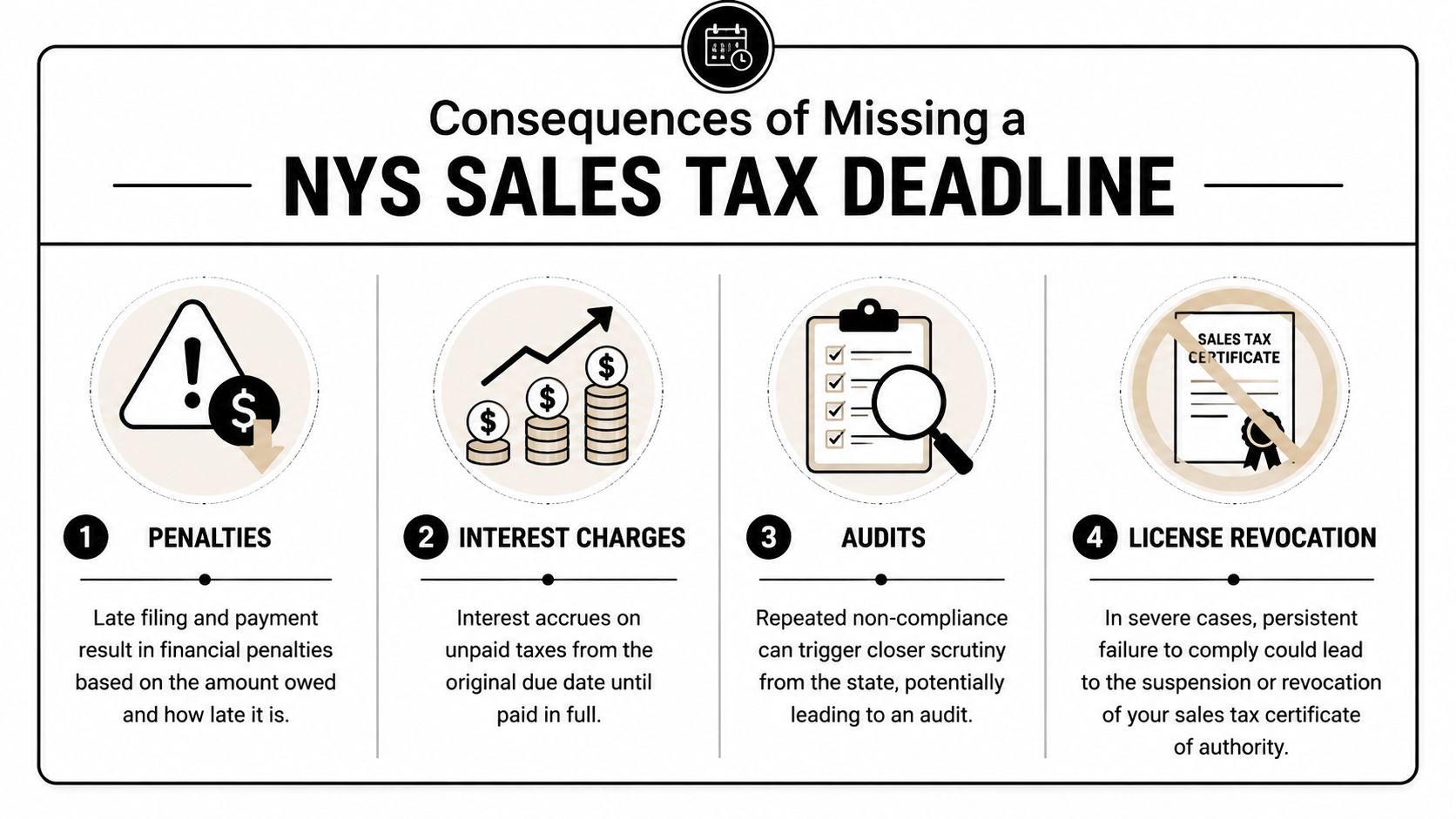
Missing a sales tax deadline creates two separate problems. One is failure to file. The other is failure to pay. Business owners often focus only on the money side and ignore the filing side. That's a mistake.
New York can assess a $50 penalty even when no tax is due if a sales tax return isn't filed on time, as noted in this discussion of New York sales tax filing penalties. That single point catches a lot of seasonal businesses, paused businesses, and owners who assume “zero activity” means “nothing to file.”
The filing problem is real even with zero tax due
A common pitfall is that people get blindsided. They think the state only cares when money is owed. It doesn't. The return itself matters.
That has obvious consequences for:
- Seasonal businesses that go quiet part of the year
- New businesses that registered but haven't ramped up sales
- Owners in transition who paused operations without closing the account
- Businesses with exempt-heavy sales that assume there's nothing meaningful to report
If your business is registered, treat the return as mandatory until the state says otherwise.
Late returns create leverage for the state
Once returns go unfiled, the problem expands. Penalties and interest can attach, notices start arriving, and your ability to explain the issue cleanly gets worse with time. The state will not view repeated nonfiling as a harmless oversight.
Here's the practical damage:
| Problem | Why it matters |
|---|---|
| Late filing | It creates a penalty issue even if no tax is due |
| Unpaid tax | It keeps the account unresolved and invites collection pressure |
| Interest | The balance grows while you wait |
| Multiple missed periods | The case becomes harder to unwind quickly |
A missed return is not an administrative foot fault. It tells the state your account may be unmanaged.
Why business owners should take this personally
Sales tax is not your money. You collected it from customers on the state's behalf. That's why states tend to enforce sales tax more aggressively than many business owners expect.
I'm not saying every late return leads to the worst outcome. I am saying delay weakens your position. If you miss one deadline, fix it. If you miss several, stop improvising and get control of the account before the notices multiply.
You Missed the Deadline Now What
If you already missed the NYS sales tax deadline, stop looking for a perfect solution and take the first correct step. File the overdue return. Do that even if you can't pay in full right now.
That move matters because it separates the filing problem from the payment problem. Business owners often avoid filing because they can't pay. That usually makes the situation worse, not better.

Your first moves in the next day or two
Do these in order:
- File every overdue return you can file now. Don't wait until all records are perfectly polished if the issue is avoidance.
- Gather the notices. Put every letter, email, and account message in one place.
- Map the missing periods. You need to know whether this is one bad quarter or a pattern.
- Separate inability to pay from uncertainty about the numbers. Those are different problems and need different responses.
If you have several old periods open, review a practical guide on how to file back taxes. The mechanics differ by tax type, but the discipline is the same. Identify the missing periods, prepare the returns, and stop the nonfiling cycle.
When you should stop trying to handle it alone
Some cases are still manageable in-house. Some are not.
You likely need professional tax help if:
- You received a formal notice and don't understand the consequences
- You have multiple unfiled returns
- Your records don't match what was reported
- You collected tax but used the cash elsewhere
- The state is questioning your account or increasing scrutiny
File first if you can. But once notices pile up or the numbers stop making sense, the cheapest move is often getting competent help before the state hardens its position.
My blunt advice
Don't let embarrassment run the case. Business owners lose time because they don't want to admit the books fell behind. That's normal. It's also dangerous.
A late sales tax matter can often be stabilized if you act early and deal with the facts directly. It gets much harder when months of silence turn into stacked notices and missing records. If that's where you are, stop trying to “get organized first” and start resolving it.
If you're behind on New York sales tax filings, dealing with notices, or trying to fix multiple periods at once, Attorney Stephen A Weisberg offers a Free Tax Debt Analysis to determine whether he can help and what the best path looks like before you spend money on representation.