NY State Tax Estimated Payment Guide for 2026
Learn how to make your NY state tax estimated payment correctly in 2026, including deadlines, safe harbor rules, payment methods, and how to avoid penalties.
In this article
- Why NY State Estimated Payments Catch People Off Guard
- The five decisions that matter
- Who Actually Has to Pay
- Run this self-check before you pay
- Calculating the Safe Harbor Without a Crystal Ball
- Compare the methods before choosing one
- Use annualization when income arrives unevenly
- 2026 Quarterly Due Dates and the Annualized Shortcut
- Treat the dates as New York deadlines
- How to File and Pay the Right Way
- Rank the payment channels by record quality
- Preserve the evidence
- Penalties, Interest, and the Mistakes That Trigger Them
- The errors I see most often
- Special Rules for Partnerships, S Corps, and Nonresidents
- Match the obligation to the structure
- Why S corporations require a closer review
- Residency and MCTMT change the analysis
You're self-employed in New York, your income changes from month to month, and April has arrived with an unpleasant surprise. You made payments during the year, but they were based on a guess rather than a projection. Now your return shows additional tax, and an underpayment charge appears beside it.
That situation is common among freelancers, contractors, consultants, and owners of pass-through businesses. New York's estimated income tax rules aren't the same as federal self-employment tax, and business owners can face separate entity-level obligations that individual tax guides rarely mention. This guide focuses on New York personal income tax estimated payments and entity-level estimated obligations. Sales tax, MCTMT calculations, withholding mismatches, and investment surtax require separate analysis.
You'll learn how to identify a payment obligation, use the available safe harbors, schedule the 2026 New York estimated tax payments, pay through the right channel, and avoid the partnership and S corporation mistakes that create penalties even when the owners believe their personal payments are sufficient.
Why NY State Estimated Payments Catch People Off Guard
A Brooklyn freelancer can earn well, make several payments, and still receive an underpayment penalty notice. The usual mistake is treating estimated tax like a rough savings plan instead of comparing projected New York liability with withholding, credits, and prior-year tax. Guessing is not a calculation.
New York generally requires calendar-year individuals to make estimated income tax payments in four installments. For 2026, the schedule lists April 15, June 15, September 15, and January 15, 2027. The first payment may be paid in full or divided into four equal installments. January's payment falls after the tax year closes, when business owners are often focused on bookkeeping and year-end reporting.
The timing creates problems because taxpayers often track federal deadlines more closely than New York's schedule. A payment made late, or calculated from incomplete income information, can leave a taxpayer below the protection of the applicable safe harbor.
The five decisions that matter
Answer these questions before sending money:
- Payment trigger: Will withholding, credits, and estimated payments cover enough of your New York liability?
- Calculation method: Is a current-year projection reliable, or does the prior-year safe harbor provide better protection?
- Due dates: Have you recorded all four 2026 dates, including January 15, 2027?
- Payment method: Will you use an electronic account payment or mail an IT-2105 voucher?
- Entity obligation: Are you dealing with an individual return, a partnership, an S corporation, or a nonresident owner?
New York's underpayment standard generally compares withholding and estimated payments with the smaller of 90% of current-year tax or 100% of prior-year tax. A higher 110% prior-year threshold can apply when New York adjusted gross income exceeds the applicable statutory level. The state also identifies a $300 minimum estimated-tax threshold after withholding and credits. Those rules make a year-end projection a compliance decision, not merely a bookkeeping preference. A modest forecasting error can leave an otherwise diligent taxpayer below the applicable protection.
The same calculation does not apply to every business structure. An individual may owe personal estimated tax, while a partnership or S corporation can create a separate entity-level obligation. Owners who pay their personal balance may still miss an entity payment, including the $50-per-owner entity penalty that is easy to overlook. MCTMT exposure and residency status can change the amount that belongs in the payment calculation, so owners of pass-through businesses and nonresidents should not rely on a personal Form IT-2105 calculation alone.
Federal self-employment tax remains separate. Federal estimated payments do not satisfy New York income tax, and New York payments do not cover federal self-employment tax. Keep both calculations separate from the start.
Who Actually Has to Pay
New York estimated payments become relevant when your expected tax remains after accounting for withholding and credits. The practical test is simple: estimate your New York liability, subtract expected withholding and credits, then compare the result with the state's threshold and safe-harbor rules.
The state's underpayment guidance uses the smaller of 90% of current-year tax or 100% of prior-year tax as the principal benchmark. For taxpayers above the applicable prior-year income level, the prior-year comparison can rise to 110%. The New York guidance on interest and penalties explains these standards and the consequences of falling short.
Run this self-check before you pay
Write down three figures:
- Projected New York tax: Estimate the tax your current-year income will generate.
- Expected withholding: Include New York withholding from wages, pensions, or other payers.
- Expected credits: Include credits you reasonably expect to claim.
If the amount left after withholding and credits is below New York's estimated-payment threshold, you may not need to make estimated payments. Don't assume that result without checking whether your income, residency, filing status, or business structure changes the calculation.
Practical rule: A W-2 job doesn't automatically eliminate an estimated-payment obligation created by freelance or business income.
Employees with side income often make the wrong assumption here. They see substantial withholding from a paycheck and conclude that the withholding covers everything. It may help, but the critical question is whether the total withholding and credits cover the required percentage or prior-year benchmark after considering the additional income. If your wages and side-hustle income fluctuate, review the calculation rather than relying on payroll withholding alone.
Self-employed taxpayers should also separate New York income tax from federal self-employment tax. The federal calculation may be driven by net earnings from self-employment, while New York's income tax calculation depends on the broader state return and applicable adjustments. A payment plan for one system doesn't cure a shortfall in the other.
For a practical comparison between federal and state obligations, review this guide to self-employed quarterly taxes. If your quick calculation shows a possible liability, don't wait until the filing deadline to decide how much to send. Gather your prior-year return, current bookkeeping, withholding records, and credit information first.
Calculating the Safe Harbor Without a Crystal Ball
A safe harbor protects you from an estimated-tax underpayment penalty. It does not predict your final tax bill. You can meet the safe-harbor target and still owe money with your annual return.
New York generally compares 90% of current-year tax, 100% of prior-year tax, and, when the applicable income rule applies, 110% of prior-year tax. The state also publishes a $300 minimum threshold after withholding and credits. Confirm the figures against the applicable form instructions and the prior-year safe-harbor table before you calculate the amount to pay.
Compare the methods before choosing one
| Safe Harbor Option | Threshold | Best For | Risk |
|---|---|---|---|
| Current-year method | 90% of current-year New York tax | Taxpayers whose income has fallen or is predictable | A projection error can create a shortfall |
| Prior-year method | 100% of prior-year tax | Taxpayers with comparable or rising income and a reliable prior return | It can require larger payments when current income falls |
| Higher prior-year method | 110% of prior-year tax where the applicable income rule applies | Higher-income taxpayers seeking prior-year certainty | The required target is higher |
| Minimum threshold test | $300 or more due after withholding and credits is the state's published threshold | Taxpayers determining whether estimated payments are required | A small change in income or credits can alter the result |
Consider a freelancer with $120,000 of freelance income, $20,000 of W-2 withholding, and $8,000 of expected New York liability. These figures illustrate the calculation rather than establish a tax result. If the projected New York liability is $8,000 and the $20,000 withholding is New York withholding, the withholding alone exceeds that projected liability on these simplified facts. Additional estimated payments may not be necessary.
The example also shows why gross income does not settle the question. Verify the state withholding amount, other income and taxes, available credits, and prior-year tax. If the prior-year figure is more reliable than an optimistic projection, use that benchmark. For income that remains comparable from year to year, the prior-year method usually produces the cleaner target.
A wrong safe-harbor choice can be expensive for self-employed taxpayers. Review the prior-year return and current books before sending money. If your return includes multiple businesses, significant credits, or uncertain state-source income, have a tax professional calculate the target rather than relying on a rough estimate.
Use annualization when income arrives unevenly
Equal installments can misstate the timing of liability for a contractor who earns most income during one part of the year. New York's annualized income installment method can match payments more closely to when income is received, but it demands organized records and additional form work. Track invoices, deposits, expenses, and withholding by period instead of combining everything at year-end.
Annualization changes the payment schedule, not the underlying tax. The safe harbor helps limit or avoid an underpayment penalty only when both the target and timing rules are satisfied. Any remaining balance is still due with the return, generally by the filing deadline. Sending too little because cash flow is tight leaves you with the tax balance and may add a penalty.
2026 Quarterly Due Dates and the Annualized Shortcut
Calendar-year taxpayers should enter New York's payment dates in the business calendar before the year starts. The 2026 installments are due April 15, June 15, September 15, 2026, and January 15, 2027. Treat those dates as New York deadlines, not as a generic copy of the federal schedule.
| Installment | Due Date 2026 | Income Period Covered |
|---|---|---|
| First installment | April 15, 2026 | Beginning of the 2026 tax year and the first estimated installment |
| Second installment | June 15, 2026 | Ongoing 2026 estimated liability |
| Third installment | September 15, 2026 | Ongoing 2026 estimated liability |
| Fourth installment | January 15, 2027 | Final 2026 estimated installment |
New York permits a calendar-year taxpayer to pay the full estimated amount by the first due date or split it into four equal installments. For equal payments, start with the safe-harbor target, subtract withholding and applicable credits, then divide the remainder across the four due dates. Recheck the calculation against the current instructions before submitting any payment.
Treat the dates as New York deadlines
June 15 is easy to miss when taxpayers follow the federal payment rhythm and overlook New York's separate schedule. January 15 creates another problem because it arrives after the income year ends, while payroll cleanup, bookkeeping, and return preparation are competing for attention.
Set a separate reminder for every New York payment. Each reminder should identify the tax type, payment period, amount requiring review, and confirmation record to retain. Keep the schedule visible to whoever prepares or approves payments.
A seasonal freelancer should not automatically divide the annual target into four equal parts. The annualized method uses income and deductible expenses from each installment period to calculate liability as earnings arrive. Later payments can then reflect the actual timing of income instead of forcing a large early payment before the cash has been received.
Annualization changes payment timing, not the underlying tax. It can reduce an unnecessary early payment, but only if the records support the calculation and the installment rules are followed. If your books are incomplete or income is difficult to assign to specific periods, use the standard safe-harbor schedule or have a tax professional prepare the annualized calculation. Review the detailed estimated tax payment schedule before filing.
How to File and Pay the Right Way
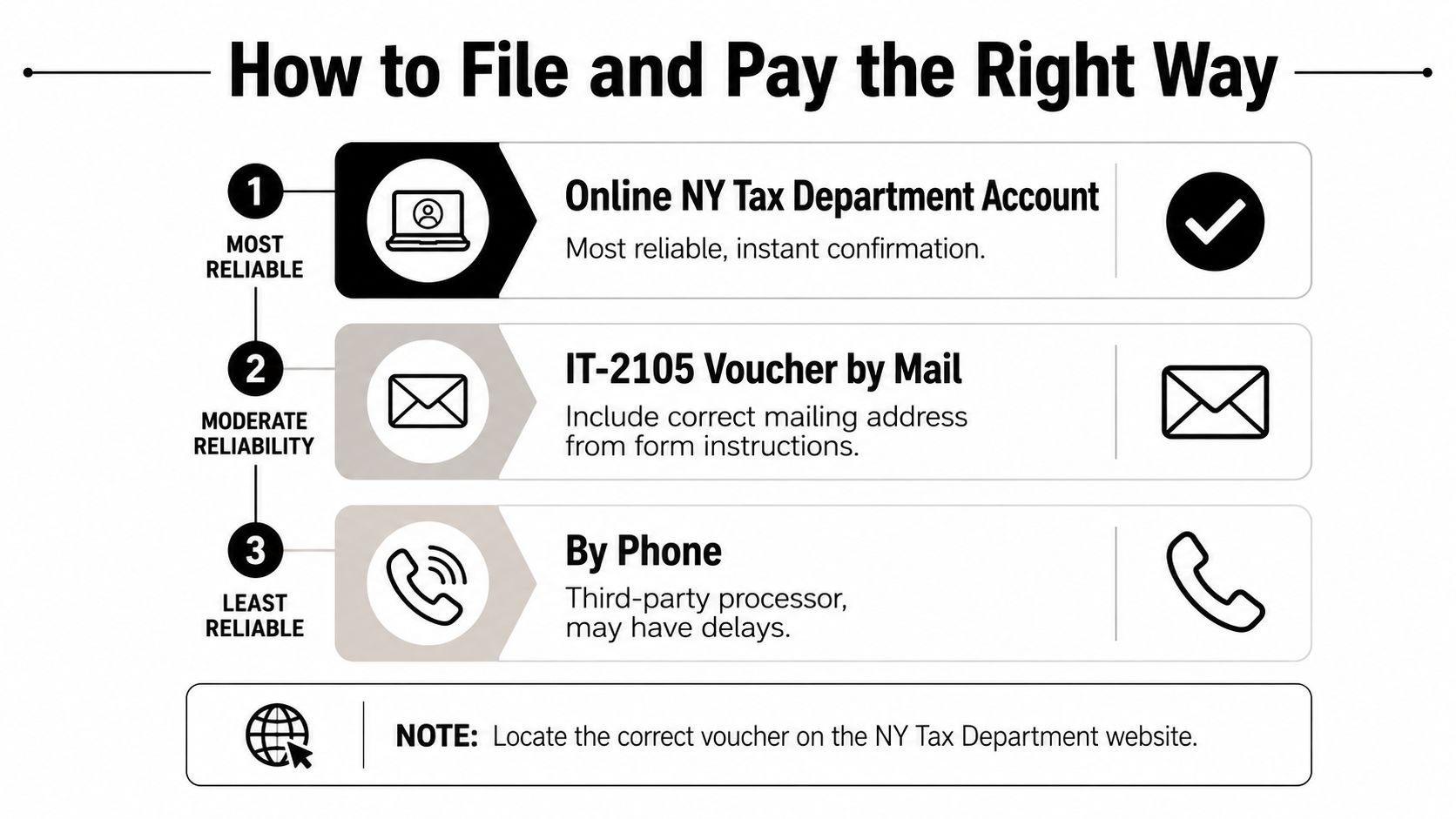
A payment made on time can still create a problem if you cannot prove when, why, or how you submitted it. Use a channel that produces a retrievable confirmation and matches the taxpayer, tax type, and installment period. New York's online Tax Department account is my first choice. It records the electronic submission and gives you documentation to retain. A mailed voucher remains valid, but it leaves more room for address errors, delivery delays, and processing disputes.
Rank the payment channels by record quality
Start with the New York Tax Department online account. Choose the payment type, enter the amount and applicable period, authorize the transaction, and save the confirmation page. Direct debit through the state portal is the better choice near a deadline because electronic submission creates a clearer timestamp than a mailed check.
The IT-2105 voucher is for individual estimated income tax payments. Use the voucher for the correct tax year, verify the mailing address in the current instructions, and make the check payable exactly as directed. Identify the taxpayer, tax type, and period. A generic check invites an application problem.
Entity and surcharge obligations require more care. Individual estimated income tax generally uses IT-2105. An MTA surcharge payment may involve IT-2106, while IT-2658 covers certain partnership and S corporation payments, including MCTMT matters. The correct form depends on the taxpayer and entity facts. Do not select a form merely because its number appears in a search result.
Preserve the evidence
Create the record immediately after submitting payment:
- Confirmation number: Save the electronic confirmation as a PDF and in the tax file.
- Payment date: Record the submission date, not the date you planned to pay.
- Amount: Reconcile the amount with the bank record.
- Quarter applied to: Identify the installment and tax year.
- Bank evidence: Keep the debit or cleared-check record.
A credit-card payment can suit a last-minute filer who needs electronic submission and accepts the processor's convenience fee. Use a mailed check only when the deadline leaves enough time for delivery and processing.
If tax liabilities become difficult to organize or pay, review this guide to setting up a payment plan with the IRS. IRS and New York systems are separate. A confirmation from one does not satisfy the other obligation.
Penalties, Interest, and the Mistakes That Trigger Them
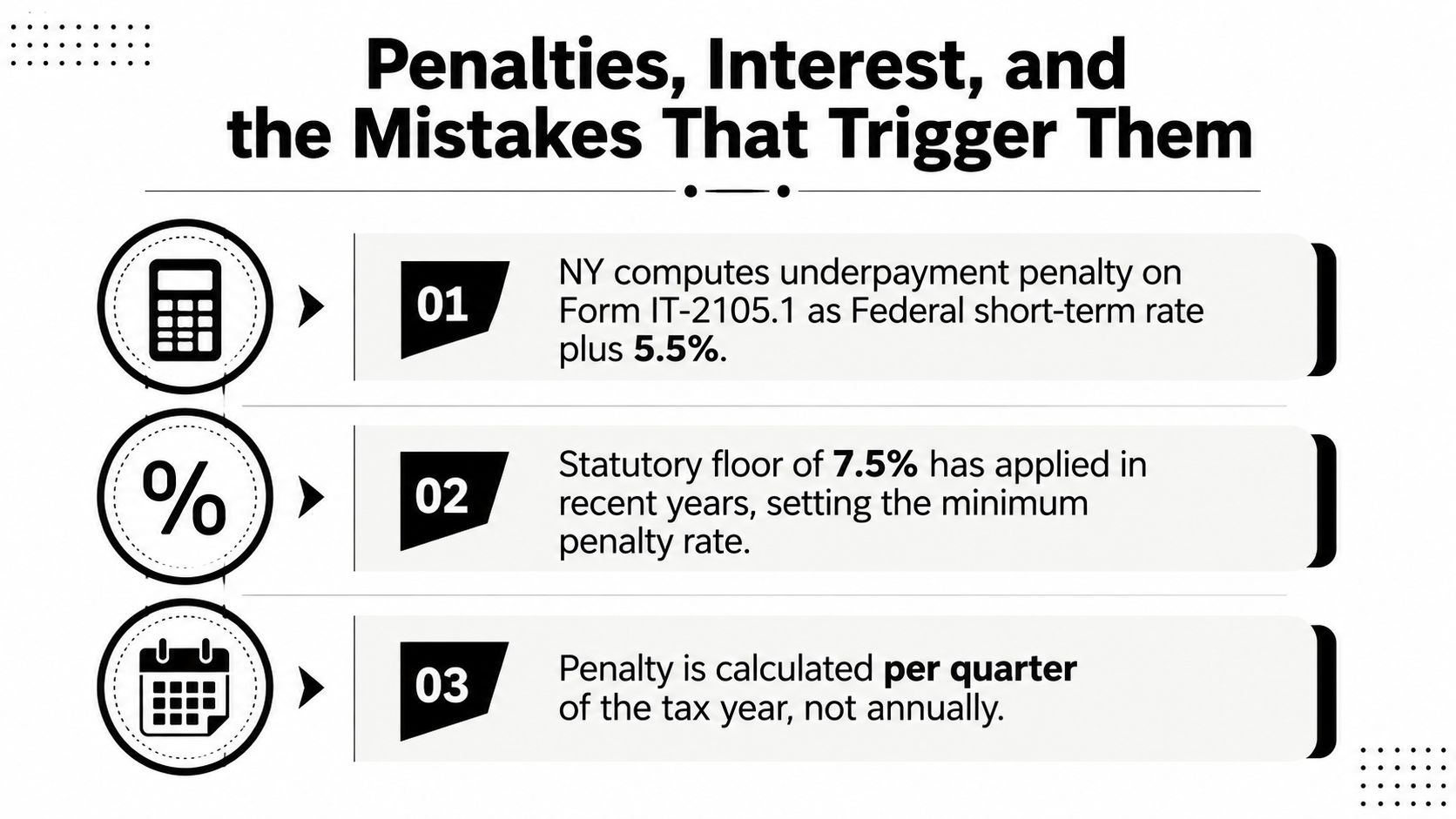
A self-employed New Yorker can pay every quarter and still receive an underpayment notice after relying on a rough estimate. New York calculates the charge by installment, based on the amount underpaid and the period it remained unpaid. The state's New York Tax Department's interest and penalty guidance explains that the rate equals the federal short-term interest rate plus 5.5 percentage points, adjusted quarterly, with a minimum rate of 7.5%.
The rate may change during the year, but your payment record does not. A missed or insufficient installment can affect later calculations until you correct the shortfall. Treat each payment as a separate obligation, not as a year-end total you can settle whenever convenient.
The errors I see most often
Ignoring the prior-year safe harbor creates avoidable exposure. Taxpayers choose a current-year estimate because it appears lower, then business income, investment income, or a missed deduction increases the actual liability. Use the prior-year figure when it provides a reliable safe harbor, and calculate the current year when income has changed materially.
Treating all payments as interchangeable causes application problems. A payment may be assigned to the wrong taxpayer, tax type, or period, especially when spouses, entities, and owners use related accounts. Keep the confirmation and verify the designation before assuming the installment is satisfied.
Missing the minimum threshold test can also trigger trouble. New York identifies $300 or more due after withholding and credits as the estimated-tax threshold. If your projected balance is near that line, calculate it instead of dismissing the obligation.
Confusing federal and New York calendars leads to preventable late payments. A federal reminder does not replace New York's schedule, particularly for the June and January installments. Put both calendars in the same tax file.
Leaving related obligations out of the projection produces an incomplete estimate. MCTMT and other state or metropolitan-area charges require separate review. Residency, income source, and entity structure can change the payment picture, so an individual income-tax estimate may not cover the full obligation.
Interest on an unpaid balance after the return's payment deadline is separate from the estimated-installment penalty. Financial hardship does not automatically erase either calculation. If a notice arrives, compare New York's installment-by-installment computation with your confirmations and bank records. Then determine whether correction, reasonable cause, or penalty abatement relief is available. A tax professional should review the matter when the notice involves MCTMT, entity payments, residency questions, or a disputed application of payments.
Special Rules for Partnerships, S Corps, and Nonresidents
Individual safe harbors don't answer every New York estimated-payment question. Partnerships and S corporations can have obligations connected to their owners, and those rules can apply even when each owner believes personal withholding or individual payments cover the tax.
New York instructions for partnerships and New York S corporations address payments made on behalf of partners or shareholders. In qualifying situations, the entity must calculate and remit amounts for owners rather than leaving every owner to manage the obligation independently. If the entity fails to make a required payment, New York identifies a $50-per-owner penalty for each failure, unless reasonable cause applies, as described in the state's IT-2658 instructions.
Match the obligation to the structure
| Entity Type | Required Form | Estimated Payment Trigger | Key Penalty Exposure |
|---|---|---|---|
| Individual or sole proprietor | IT-2105 for individual estimated income tax | New York tax remains due after withholding and credits, subject to the state's safe-harbor framework | Individual underpayment penalty and interest on unpaid tax |
| Partnership with applicable New York owner obligations | IT-2658 and related filings where required | New York-source income and owner-level payment requirements | $50-per-owner penalty for each failure when applicable |
| New York S corporation | Applicable entity and owner filings, including IT-2658 where required | Nonresident shareholder or other owner obligations may remain even when another entity-level rule changes | Entity and owner payment exposure if required amounts aren't remitted |
| Nonresident individual | Individual estimated-tax forms and any applicable entity forms | New York-source income, including income not fully covered by withholding | Underpayment exposure despite substantial wage withholding |
| Partnership or owner exposed to MCTMT | Applicable MCTMT and estimated-payment filings | Self-employment or partnership activity subject to the metropolitan-area tax rules | Separate MCTMT underpayment or filing exposure |
Why S corporations require a closer review
New York has signaled changes affecting Article 9-A thresholds and has stated that New York S corporations no longer need to make MFI or estimated tax payments in the same way as before. That change doesn't mean every S corporation and shareholder can stop reviewing estimated obligations. Nonresident shareholders with New York-source income may still face payment requirements, and the applicable treatment depends on the entity, the owner, the income source, and the current filing instructions.
Don't apply an old checklist to a current S corporation return. Confirm the current rule, identify whether the corporation has nonresident owners, and determine whether shareholder-level payments, withholding, composite treatment, or another mechanism applies.
Residency and MCTMT change the analysis
A nonresident may have wages that are heavily withheld while also receiving New York-source business income. The wage withholding may reduce the balance, but it doesn't automatically eliminate the need to test estimated payments. Residency status affects which income enters the New York calculation and how credits and source rules operate.
MCTMT requires separate attention for self-employed individuals and partnership members with qualifying activity in the metropolitan area. It isn't safe to fold the issue into a general New York income-tax estimate without checking the applicable rules. A taxpayer can calculate the base estimated payment correctly and still underpay a separate obligation.
Owner-level warning: If a partnership has multiple owners, a missing entity payment can create a separate penalty for each affected owner. Review the entity return before assuming the individual safe harbor solves the problem.
Have a CPA or tax attorney review the structure before year-end if the business has nonresident owners, multi-state income, partnership distributions, S corporation shareholders, or possible MCTMT exposure. The right payment may depend less on the owner's personal return than on what the entity was required to withhold or remit.
Tax Attorney Stephen A Weisberg helps individuals, business owners, and entities analyze New York and IRS tax debt, audits, estimated-payment issues, and collection problems before they become harder to resolve. Visit Tax Attorney Stephen A Weisberg to request a review of your situation and determine what action makes sense.


