NY State Income Tax Rate 2026: Brackets & Local Tax
Understand the 2026 NY state income tax rate, brackets, and local taxes. Learn how to calculate your tax obligations.
In this article
- Navigating New York's Complex Tax Landscape
- Why the wrong question causes expensive mistakes
- What actually drives the real bill
- Understanding NY's Progressive Tax Brackets
- Marginal rate versus effective rate
- A practical way to read brackets
- What people get wrong
- The 2026 New York State Income Tax Rates
- 2026 New York State Income Tax Rates and Brackets
- How to use the table without misreading it
- A planning note for high earners and business owners
- Calculating Your NY State Tax Liability Examples
- Example one for a single filer
- Example two for a married couple filing jointly
- Where estimates fail in real life
- Factors That Change Your NY Tax Bill
- Local taxes change planning, not just the final bill
- Residency rules can create bigger disputes than the rate itself
- Business entity choices affect the owner's tax outcome
- Common Mistakes That Lead to NY Tax Debt
- The mistakes that show up again and again
- Why these aren't minor filing issues
- What works instead
- When to Get Professional Tax Help
If you're trying to budget for next year and you've searched for the NY state income tax rate, you're probably looking for a clean number. Many individuals want a shortcut. They want to know what percentage to set aside, what their move to Manhattan or Westchester means, or whether a new LLC changes anything.
That shortcut usually causes the problem.
A Brooklyn freelancer can have one answer. A Buffalo business owner can have another. A Manhattan consultant with the same state taxable income can owe more because city tax sits on top. A Yonkers resident has a different local issue. A business owner may also need to think about estimated payments, sourcing rules, and whether pass-through income is being handled intelligently or just pushed onto a personal return and ignored until filing season.
Navigating New York's Complex Tax Landscape
The NY state income tax rate isn't a single number. It's a system. State brackets are only one layer, and they don't tell you enough to plan safely.

Take two taxpayers with similar earnings. One lives in New York City and works as an independent contractor. The other lives outside the city, earns through a small S corporation, and has tighter bookkeeping. They might both say, "What's the New York rate?" But that question skips the issues that usually create underpayment, surprise balances, and eventually tax debt.
New York has operated this way for a long time. The state became the eighth state to enact a personal income tax in 1919, and its initial top rate was 3% on taxable income above $50,000, roughly $400,000 in 1995 dollars, according to New York's history of progressive income taxation. That history matters because it shows New York didn't build a flat, simple system and then accidentally make it complicated. Progressivity has been part of the design for more than a century.
Why the wrong question causes expensive mistakes
When someone asks only for the top rate, they're often planning from the most dramatic number instead of the applicable one. That leads to three recurring errors:
- They ignore location: State tax isn't always the final layer. Local tax can materially change the cost of living and working in the same state.
- They confuse income types: Wage income, business income, and income sourced to New York can create different planning issues even when they land on the same return.
- They budget from gross income: Taxable income is what matters for brackets, not the headline revenue number a business owner has in mind.
Practical rule: If you're using one percentage to estimate your entire New York tax burden, you're probably underestimating risk.
A lot of surface-level guidance on state taxes leaves out the planning side. That's where people get hurt. The better approach is to treat New York tax as a layered decision involving rates, residence, work location, and how income flows from the business to the owner. For broader reading on multi-state and local issues, see these state income tax updates and commentary.
What actually drives the real bill
The question isn't "What is the NY state income tax rate?" It's "Which rates apply to my taxable income, where am I treated as a resident, and what other tax layers attach because of where I live and how I earn?"
Once you ask it that way, the planning becomes more realistic. You stop guessing from a headline rate and start measuring the parts that create liability.
Understanding NY's Progressive Tax Brackets
New York uses a progressive income tax with nine brackets, not a flat tax. The top marginal rate is 10.9% for taxable income above $25 million, with prior top brackets of 10.3% above $5 million and 9.65% above about $1.08 million for single filers, as summarized in NerdWallet's New York state tax overview.
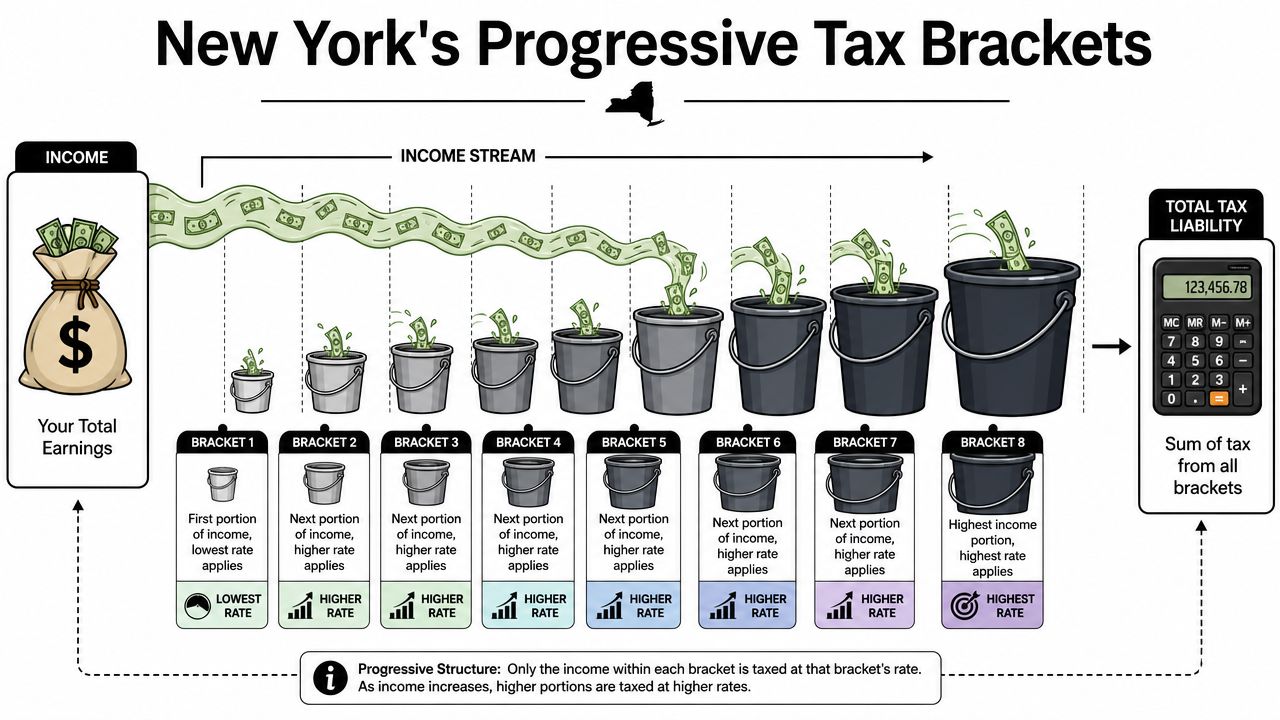
The easiest way to understand this is to think in buckets. Income flows into the first bucket and gets taxed at that bucket's rate. Once that bucket fills, the next portion spills into the next bucket and gets taxed at a higher rate. Your entire income doesn't get taxed at your top bracket.
Marginal rate versus effective rate
This distinction matters because many people panic when they "enter a bracket."
Your marginal rate is the rate applied to your next dollar of taxable income. Your effective rate is the overall share of your taxable income that goes to state tax after the bracket layers are applied.
A simple example makes the point. If someone has taxable income that reaches a higher bracket, only the amount in that top slice gets taxed at the higher rate. The lower slices still use the lower rates. That's why moving into a higher bracket doesn't mean all your income is suddenly taxed at that bracket.
Moving into a higher bracket changes the tax on the top slice of income, not the tax treatment of the dollars below it.
A practical way to read brackets
When clients review New York brackets, I tell them to do this in order:
- Find taxable income, not gross income: Business owners often start with revenue or owner draws. That's the wrong starting point.
- Match the filing status: Single, joint, and head of household thresholds differ.
- Identify the highest bracket reached: That gives you the marginal rate.
- Remember the layers below it: That's what keeps the actual bill from matching the top rate across all income.
If you want a broader refresher on how bracket systems work before applying New York-specific rules, Allied Tax Advisors has a useful guide to how your income is taxed.
What people get wrong
The biggest misunderstanding is emotional, not technical. People hear "top rate" and assume New York takes that percentage from everything they earn. It doesn't. But the opposite mistake is just as dangerous. Some taxpayers focus only on the state bracket chart and ignore city tax, residency treatment, or quarterly payment obligations. That's how a manageable annual tax bill turns into a cash flow problem.
Understanding the staircase is step one. Applying it to your filing status and your actual taxable income is where the main work starts.
The 2026 New York State Income Tax Rates
For fiscal year 2024 to 2025, New York's tax department reported collecting over $61 billion in personal income taxes, making it the state's largest revenue source, according to the Department of Taxation and Finance's personal income tax facts page. That helps explain why rate changes matter so much and why higher-income brackets draw close attention.
The same source states that the higher brackets were enacted to apply between 2021 and 2027 and were later extended to 2032 in the State FY 2026 budget legislation. So if you're planning ahead, don't treat the current upper-end structure as a short-lived anomaly that's about to disappear on its own.
2026 New York State Income Tax Rates and Brackets
The table below gives a practical snapshot of the rates and the high-end thresholds specifically confirmed in the verified data.
| Tax Rate | Single / Married Filing Separately | Married Filing Jointly / Qualified Surviving Spouse | Head of Household |
|---|---|---|---|
| Progressive system with nine brackets | Applies under New York's bracketed system | Applies under New York's bracketed system | Applies under New York's bracketed system |
| 9.65% | Taxable income above $1,077,550 | Taxable income above $2,155,350 | Taxable income above $1,616,450 |
| 10.3% | Taxable income above $5 million | Taxable income above $5 million | Taxable income above $5 million |
| 10.9% | Taxable income above $25 million | Taxable income above $25 million | Taxable income above $25 million |
This is the part many search results don't explain clearly enough. The NY state income tax rate you care about depends first on taxable income and filing status. A single filer and a head of household with the same gross earnings may not land in the same place. A married couple filing jointly may also have more room before reaching a high marginal bracket.
How to use the table without misreading it
Start with your expected New York taxable income. Then line it up with your filing status. If your income doesn't reach one of the high-end thresholds listed above, your return is still taxed under New York's progressive bracket system, but your top marginal rate would be below those upper brackets.
That matters because many taxpayers search for "NY top tax rate" when their own planning issue is much lower on the ladder. The state has a bracketed system. The top figure makes headlines, but your return follows the bracket path that applies to you.
A planning note for high earners and business owners
If your income may cross into the 9.65%, 10.3%, or 10.9% layers, don't wait until filing season to ask what happened. At that point, the tax was already earned, the withholding or estimated payment issue already happened, and a local tax overlay may already have increased the problem.
Use the table as a flag, not just a lookup tool. If your projected taxable income is approaching one of these thresholds, your decisions during the year matter more than the bracket chart itself. Entity elections, estimated tax discipline, and residency facts often matter more than one final percentage point in the abstract.
Calculating Your NY State Tax Liability Examples
A bracket chart helps, but a clear grasp of the mechanics is often required. The useful part isn't memorizing rates. It's understanding how income moves through the system.
Because the verified data here doesn't provide the full lower-bracket threshold table, the safest way to show the calculation is by method, not by inventing bracket cutoffs. That's also how I recommend approaching your own estimate. Start with taxable income, then apply each bracket layer in sequence until all taxable income is accounted for.
Example one for a single filer
Assume a single filer has New York taxable income that falls somewhere within the lower or middle brackets. The correct calculation works like this:
- Apply the lowest New York rate to the first layer of taxable income.
- Apply the next rate only to the portion above the first layer.
- Continue bracket by bracket until you reach the taxpayer's final taxable income.
- Add the tax from each layer to reach total state tax liability.
That structure is why the last bracket reached is only the marginal rate. It isn't the rate for all income.
Here is the clean formula approach:
| Step | What you do |
|---|---|
| 1 | Determine New York taxable income after applicable deductions and adjustments |
| 2 | Identify filing status |
| 3 | Apply each bracket rate only to income inside that bracket |
| 4 | Add each bracket's tax amount |
| 5 | Compare that result to withholding and estimated payments already made |
A lot of self-employed taxpayers skip step five. That's where the debt starts. They may calculate annual liability correctly at filing time but fail to prepay enough during the year.
For a more detailed workflow on turning tax data into an actual estimate, this step-by-step guide to calculate tax liability is a useful reference.
Example two for a married couple filing jointly
Now assume a married couple files jointly and has taxable income that reaches multiple New York brackets.
The method is the same, but the bracket thresholds for joint filers differ from single filers. That means you cannot safely estimate a joint return by using a single-filer chart and "doubling it in your head." New York planning gets messy fast when taxpayers use the wrong filing-status framework.
Working rule: Always build the estimate from the return that will actually be filed, not from a rough mental shortcut.
For a joint return, the practical sequence looks like this:
- First layer: Tax the initial portion of taxable income at the lowest applicable rate.
- Middle layers: Continue stacking tax as income moves upward through the bracket schedule for joint filers.
- Top reached layer: Apply the highest applicable marginal rate only to the final portion that reaches that bracket.
- Final check: Add local taxes, then compare against payments already made.
Where estimates fail in real life
The calculation usually breaks down in one of three places:
- Taxable income was guessed badly: Owners use revenue, distributions, or bank deposits instead of tax figures.
- Payments were ignored: They know the annual liability but don't make quarterly payments.
- Local tax wasn't added: The state estimate looks reasonable until city or Yonkers tax is layered on.
The math itself isn't the hard part. The discipline is. Accurate New York tax planning usually comes from building the estimate early, revising it as income changes, and separating the state calculation from the cash you happen to have left when the return is due.
Factors That Change Your NY Tax Bill
State brackets are only the base layer. The amount you owe can change materially because of where you live, where you work, and how business income reaches your personal return.
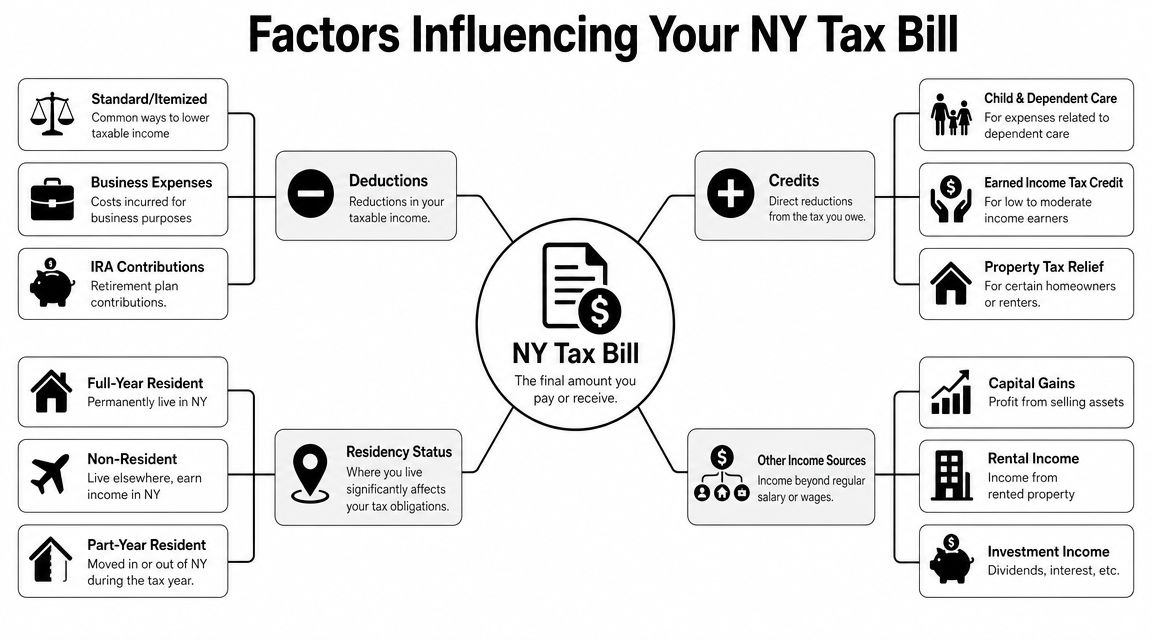
The local tax overlay is the first thing many people miss. New York City's personal income tax applies to NYC taxable income and, by FY 2025, brought in $18.5 billion, or 23.0% of city tax revenues. The same New York City Comptroller report notes that NYC rates reach 3.876%, while Yonkers adds a 16.75% surcharge on net New York State tax, as described in the Comptroller's report on the NYC personal income tax.
Local taxes change planning, not just the final bill
A taxpayer who moves into New York City doesn't just change mailing address. That move can change estimated payment strategy, compensation planning, and how much cash needs to stay in the business for owner taxes.
Yonkers creates a different issue. Because its tax is framed as a surcharge on net New York State tax, taxpayers often miss it when doing rough budgeting. They estimate state tax, stop there, and then discover they never accounted for the local layer.
A practical way to approach this:
| Layer | Why it matters |
|---|---|
| State income tax | The base personal tax system |
| NYC personal income tax | An added city-level liability for NYC residents |
| Yonkers surcharge | An additional local cost tied to net NYS tax for applicable taxpayers |
Residency rules can create bigger disputes than the rate itself
Residency is where many higher-income audits and notices begin. Not because the rate chart is unclear, but because the facts are contested.
If you're a full-year New York resident, New York generally taxes you as a resident. If you're a nonresident, New York may still tax New York-source income. If you're a part-year resident, the year gets split and sourcing matters. For business owners, remote workers, and people who moved mid-year, simple online calculators lose their effectiveness.
Common trouble spots include:
- Moving during the year: People assume changing addresses settles residency. It usually doesn't by itself.
- Working in more than one state: Sourcing issues can affect what New York can tax.
- Owning a business that operates in New York: Even if the owner moved, the income analysis may still involve New York-source questions.
Residency fights are often document fights. Calendars, leases, utility records, payroll records, and business activity can matter more than what the taxpayer intended.
Business entity choices affect the owner's tax outcome
For sole proprietors, single-member LLCs, partnerships, and S corporations, business income often flows through to the individual return. That means the owner's New York personal tax picture may become more complicated as the business grows.
The common mistake is treating the entity as if it solved the owner's tax planning by itself. It doesn't. A new LLC may provide legal or operational benefits, but it doesn't automatically reduce personal state tax exposure. An S corporation may change compensation dynamics, but it also creates compliance choices that need to be handled carefully.
The Pass-Through Entity Tax, often called PTET, can be relevant for some pass-through owners evaluating state tax planning. But this is not a checkbox item. It has to be coordinated with the owner's overall state and local tax situation, estimated payments, and filing profile.
If you're self-employed or own a pass-through entity, use a calendar for tax deposits and not just a filing calendar. This estimated tax payment schedule guide is a good starting point for staying ahead of underpayment problems.
Common Mistakes That Lead to NY Tax Debt
Tax debt in New York rarely starts with one dramatic event. Usually it's a chain of smaller mistakes that looked manageable at the time.
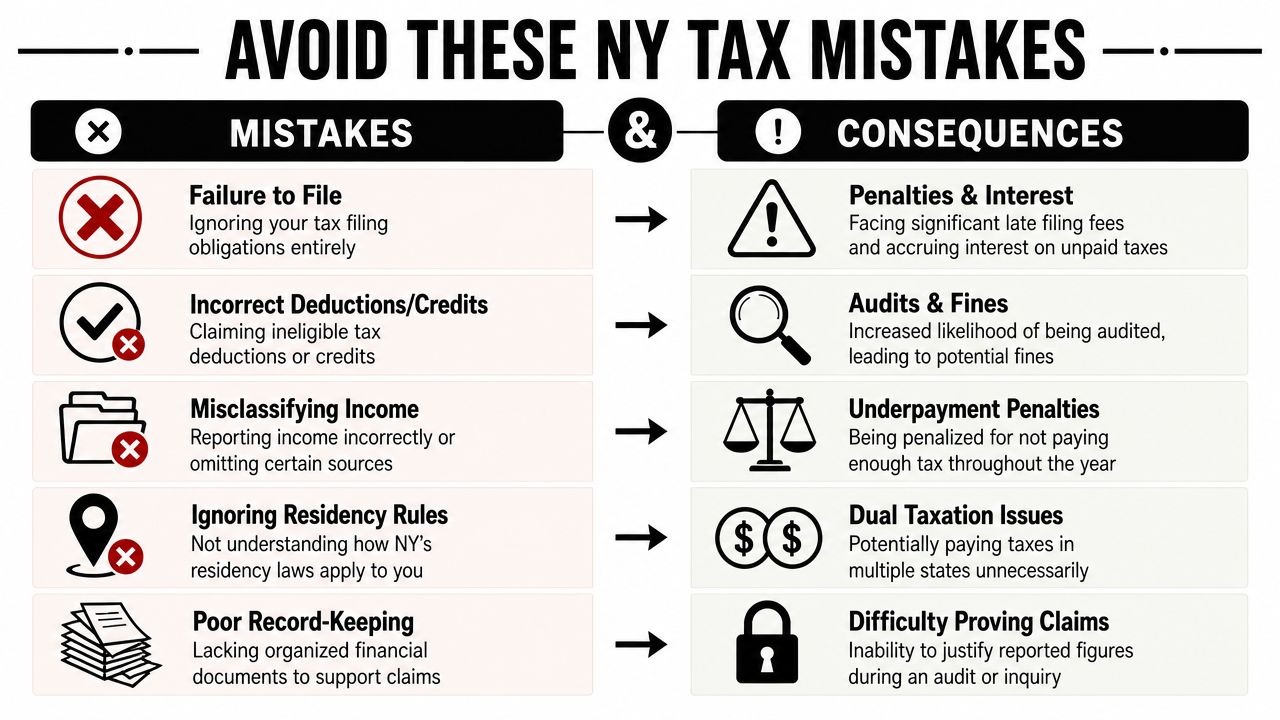
A common misconception is focusing only on the top New York rate. However, the burden is situational because the system is progressive, a small number of high-income taxpayers pay most of the tax, and deductions and credits can materially change the final bill. AARP's New York state tax guide also notes that the NYC "Axe the Tax" program starts in tax year 2025 for filers with dependents below specified poverty-based income thresholds, which is another reminder that taxpayer profile matters.
The mistakes that show up again and again
Some errors are especially likely to lead to balances due, notices, or collection trouble.
- Ignoring residency rules: People move, rent another place, or spend more time outside New York and assume they're done with New York tax. The state may see it differently.
- Leaving out local tax: NYC and Yonkers don't disappear because someone built a state estimate first.
- Using gross income instead of taxable income: This distorts planning from the start.
- Skipping estimated payments: Self-employed taxpayers often wait for the return, then discover the balance is too large to pay comfortably.
- Treating business distributions like tax planning: Taking money from the business doesn't mean enough was reserved for tax.
Why these aren't minor filing issues
These mistakes become expensive because they compound operationally. Once a taxpayer underpays, the next year often starts behind. Then current-year estimates are still due while the prior-year balance remains unpaid. That pressure leads people to delay filing, file without paying, or ignore notices because they don't have a clean answer.
A tax problem gets harder the moment you start financing last year's liability with this year's cash flow.
Poor records make everything worse. If New York questions residency, source income, or deductions, the taxpayer needs documents, not memory. If a business owner can't reconstruct income and expenses cleanly, the state has more room to challenge the filing and the owner has less room to defend it.
What works instead
The taxpayers who avoid debt usually do a few unglamorous things well:
- They separate tax savings from operating cash.
- They revise estimates during the year when income changes.
- They keep records that can survive scrutiny.
- They ask for help early, before notices become collection problems.
What doesn't work is waiting until March or April and hoping the bracket table will somehow solve a year of bad assumptions. By then, the issue usually isn't just the NY state income tax rate. It's the accumulated effect of missed planning.
When to Get Professional Tax Help
There's a point where DIY tax work stops being cost-conscious and starts becoming risky. In New York, that point comes sooner than many people expect because rates, local taxes, residency issues, and pass-through income can interact in ways that don't show up on a simple calculator.
Professional help usually makes sense when any of these are true:
- You received a notice: Once New York contacts you, the issue is no longer just planning.
- You have unpaid balances from prior years: Current compliance and old debt have to be managed together.
- You moved into or out of New York: Residency and source-income questions can become a significant dispute.
- You own a pass-through business: Entity-level decisions and owner-level tax consequences need to align.
- You haven't made estimated payments: Waiting for the return usually means you're already behind.
Good tax software can help organize returns and workflow, especially for professionals comparing systems. If you're evaluating the tools firms use, Cloudvara's tax software analysis is a useful overview. But software doesn't replace judgment when the issue is a residency dispute, tax debt, audit exposure, or a filing position that may need to be defended.
If you're unsure whether your issue is still a compliance matter or has become a legal risk, this guide on when to hire a tax attorney can help you draw that line.
The practical test is simple. If the tax problem affects sleep, cash flow, a pending loan, a business decision, or your ability to file accurately, it's time to stop guessing.
If you're dealing with New York tax debt, audit pressure, unfiled returns, or a tax bill that has grown beyond what you can comfortably manage, Attorney Stephen A Weisberg offers a practical first step. He starts with a FREE Tax Debt Analysis to determine whether he can help and what options may exist before charging for representation. That approach is designed for people who need clarity first, not pressure.


