Notice of Levy IRS: How to Respond and Protect Assets
notice of levy irs: Understand what it means and get clear steps to protect assets and resolve your tax debt.

In this article
- What Happens When You Get a Notice of Levy
- The Immediate Impact of the Notice
- IRS Notice of Levy At a Glance
- Why You Cannot Afford to Ignore It
- Understanding the Path to an IRS Levy
- The Initial Assessment and Demand for Payment
- The Final Warning Before Seizure
- What an IRS Levy Can Actually Target
- Wage Garnishment: The Continuous Squeeze
- Bank Levy: A 21-Day Countdown
- Common IRS Levies Compared
- Retirement Accounts and Social Security
- Physical Property and Other Assets
- How to Stop or Release an IRS Levy
- Negotiate an Installment Agreement
- Pursue an Offer in Compromise
- Apply for Currently Not Collectible Status
- Comparing Your Levy Resolution Options
- The Worst Mistake: Doing Nothing
- Missing Your 30-Day Appeal Window
- Providing Shoddy Financial Information
- Falling for Tax Relief Scams
- Your Rights as a Taxpayer During the Levy Process
- Your Right to Appeal and the CDP Hearing
- Understanding the Taxpayer Bill of Rights
- Key Protections You Need to Know
- Common Questions About IRS Levies
- How Long Does an IRS Levy Last?
- Can the IRS Really Take My House or Car?
- Will I Get a Warning Before My Bank Account Is Levied?
Receiving a letter from the IRS is one thing, but an official notice of levy is something else entirely. This isn't just another bill or a simple reminder. It’s a legal order that gives the IRS the power to seize your property—including your money—to cover a tax debt you owe. Getting a handle on what this document means is the absolute first step toward getting things back on track.
What Happens When You Get a Notice of Levy
An IRS notice of levy is a serious escalation. It’s the agency’s final move after sending multiple warnings that have likely gone unanswered. At this point, the IRS has stopped asking for payment and has started taking legal action to collect it directly from your assets.
This doesn't just happen out of the blue. The IRS has to follow a strict legal process first. They must assess what you owe, send a formal bill (a Notice and Demand for Payment), and then give you a chance to pay up. If you don't, they'll send a "Final Notice of Intent to Levy and Your Right to a Hearing." That letter is your final, 30-day warning before they can legally start seizing your property.
The Immediate Impact of the Notice
Once a levy is in place, the consequences are swift and can hit hard. This isn't a distant threat; it’s a direct action against your finances. The two most common types of levies are incredibly disruptive:
- Bank Levy: The IRS will order your bank to freeze the funds in your account, up to the full amount of your tax debt. Your bank holds that money for 21 days before sending it directly to the IRS. You can’t touch it during that time.
- Wage Garnishment: Your employer will be legally required to withhold a large chunk of your paycheck and send it straight to the IRS. This isn't a one-time event; it happens with every single paycheck until your debt is paid off or you arrange a different solution.
This official IRS document lays out the entire collection process, detailing exactly how things can escalate to a levy.
As the document shows, a levy is the actual seizure of your property. It’s different from a lien, which is just a legal claim against your property. For a deeper dive into the specifics, check out our guide on what is a notice of levy.
Before we go further, here’s a quick breakdown of what this notice really means for you in practical terms.
IRS Notice of Levy At a Glance
| Key Aspect | What It Means for You |
|---|---|
| It’s a Legal Seizure | This is not a request for payment. The IRS is legally taking your assets. |
| Direct Financial Impact | Expect funds to be frozen in your bank account or a portion of your wages to disappear. |
| It’s Not the First Warning | The IRS sent multiple notices before this, including a final 30-day warning. |
| Ignoring It Makes It Worse | The IRS will proceed with the seizure, and penalties and interest will keep growing. |
| Action Is Required | You must respond immediately to have any chance of stopping it and finding a solution. |
This table underscores the urgency: a notice of levy demands your immediate attention and action to prevent serious financial disruption.
Why You Cannot Afford to Ignore It
The absolute worst thing you can do with a notice of levy is ignore it. If you do nothing, the IRS will take your assets. It’s a guarantee. This can lead to immense financial hardship, and all the while, interest and penalties keep piling up, digging you into an even deeper hole.
The most crucial step is to respond immediately. Proactive communication with the IRS is the only way to explore alternatives and halt the collection process before it causes irreversible financial damage.
Failing to act doesn't just mean losing your money or property; it also means you lose the chance to negotiate a better outcome. By getting in touch with the IRS, you can explore options like an Installment Agreement or an Offer in Compromise. But you can't get access to any of those solutions if you just pretend the notice doesn't exist.
Understanding the Path to an IRS Levy
An IRS levy should never come out of the blue. It’s the final stop on a long road of official notices and warnings from the government, and there are several off-ramps you can take long before your assets are at risk. The IRS doesn’t just wake up and decide to seize your property; they have to follow a strict legal process first.
Think of it as a countdown. The clock starts ticking quietly with the first bill, giving you a chance to sort things out. Each letter that follows cranks up the pressure, making it clear that your time to act is running out. Knowing where you are in this sequence is everything—it tells you how serious things have become and what you need to do next.
The Initial Assessment and Demand for Payment
It all begins when the IRS officially records a tax debt in your name and mails you the first bill. This notice, typically a CP14 Notice, does two things: it tells you exactly what the IRS thinks you owe, and it formally demands you pay it.
This first step is the least threatening. It's just a bill. But if you ignore it, you kickstart the entire collections machine, and things can get much more serious from there.
If the bill goes unpaid, you'll start receiving a series of reminder notices. Letters like the CP501 and CP503 will show up in your mailbox, each one a bit more insistent than the last. They might feel like junk mail, but they are crucial, documented steps the IRS must take before it can legally take your property.
The Final Warning Before Seizure
The one letter you absolutely cannot ignore is the Final Notice of Intent to Levy and Your Right to a Hearing. This is the big one—your last official warning. The IRS is required by law to send this notice at least 30 calendar days before they can legally start seizing your assets.
This notice is your final opportunity to stop the levy without a major fight. It lays out the IRS's intentions in no uncertain terms and, just as critically, it informs you of your right to request a Collection Due Process (CDP) hearing.
This 30-day window isn't a suggestion; it's a hard deadline. If you file an appeal for a CDP hearing within that timeframe, the IRS has to legally pause all levy actions. This buys you precious time to negotiate a resolution with the IRS Independent Office of Appeals.
This timeline shows how things escalate from a simple bill to a potential seizure.
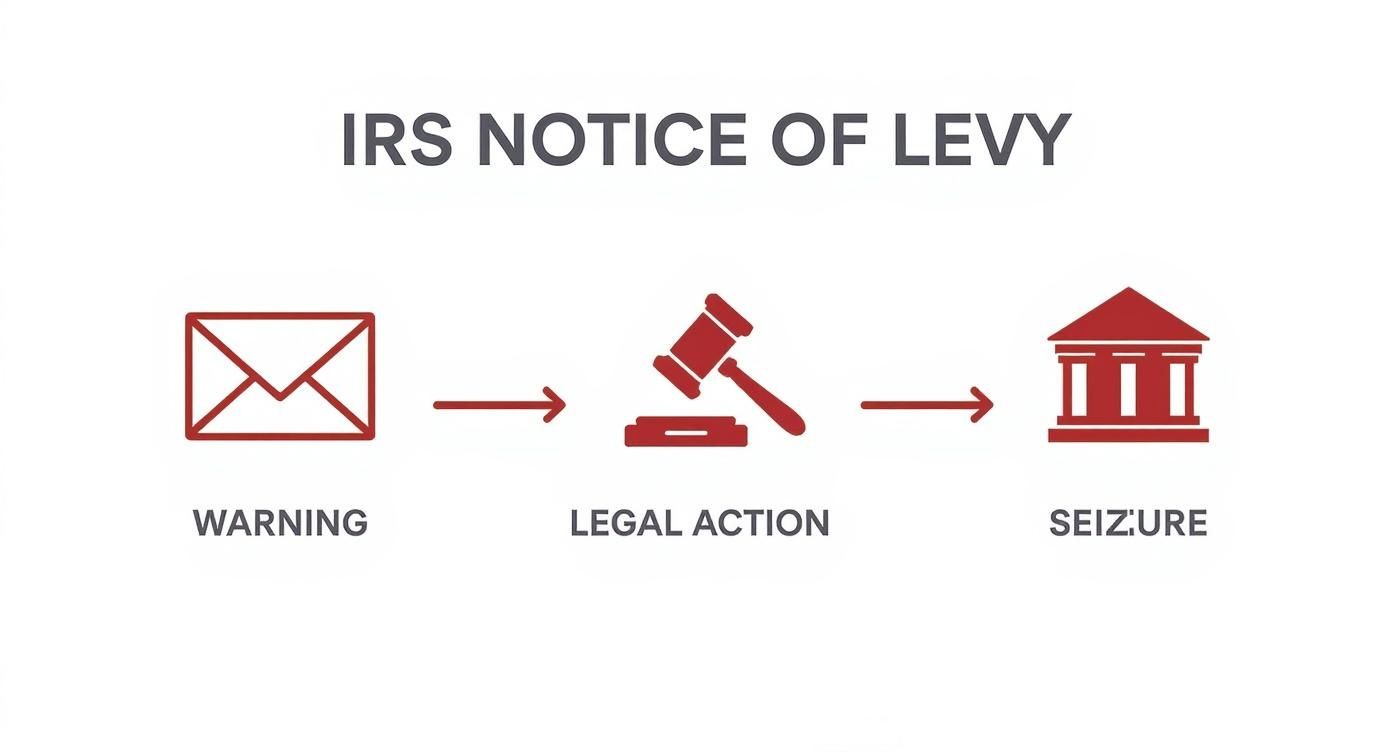
As you can see, every stage provides a clear chance for you to step in and get the problem under control before it escalates to the point of seizure.
It’s also common for the IRS to file a Notice of Federal Tax Lien before they move to a levy. A lien is a public claim against all your property, securing the government's interest in your assets and crushing your credit score. For a deeper dive, it’s worth understanding tax liens and how they work, as they are a clear sign that a levy could be next. While a lien secures the debt, the levy is the actual seizure. In some situations, your case might even be assigned to a specific agent; at that point, you'll need to know what to do when an IRS Revenue Officer gets involved.
What an IRS Levy Can Actually Target
Getting a notice of levy from the IRS immediately raises a scary question: what can they actually take? A levy isn't just one specific action; it’s a broad power that gives the IRS the legal right to seize different kinds of assets to pay off a tax debt. Knowing what's on the table is the first step in figuring out your next move.
The word "levy" might sound like dry legal jargon, but its impact is very real and can throw your life into chaos. Think of it as the IRS getting a master key to your financial world. They can use that key to take a chunk of your wages, clear out your bank account, or even seize your physical property.

Not all levies are the same. Each one works a bit differently and hits your finances in a unique way. Let's walk through the most common types.
Wage Garnishment: The Continuous Squeeze
The most frequent—and frankly, most painful—type of levy is a wage garnishment. This isn't a one-and-done deal. It's a continuous levy. The moment your employer gets the notice, they are legally bound to start withholding a big piece of your paycheck and sending it straight to the IRS.
This keeps happening, paycheck after paycheck, until your entire tax debt is gone, including all the penalties and interest that have piled up. The amount they take is significant, too. The IRS uses a specific formula, leaving many people with barely enough to cover rent and groceries.
An IRS wage garnishment is designed to be relentless, often creating a tough cycle of financial stress. It's built to be so disruptive that it forces you to take action. This is why calling the IRS right away is the only way to stop the bleeding.
Because it’s an ongoing seizure, this kind of levy puts incredible pressure on your daily life, making it one of the most powerful tools the IRS has.
Bank Levy: A 21-Day Countdown
A bank levy is another powerful weapon in the IRS's toolkit, but it works differently than a wage garnishment. This is a one-time seizure that grabs whatever money is in your bank account on the day the bank processes the notice.
When your bank receives the levy, they have to freeze your account for an amount up to what you owe. The money just sits there for 21 days. This 21-day period is a critical, last-chance window for you to contact the IRS and try to get the levy released. If you don't succeed in that timeframe, the bank has no choice but to send the frozen funds to the IRS.
It’s important to understand that a bank levy is just a snapshot in time—it only captures the funds present on that single day. But don't get too comfortable; if the first levy doesn't cover your debt, the IRS can simply issue another one later.
The different types of levies can be confusing, so here’s a quick comparison of the most common ones you might encounter.
Common IRS Levies Compared
| Levy Type | Targeted Asset | Duration | Typical Impact |
|---|---|---|---|
| Wage Garnishment | Your paycheck from an employer | Continuous (every pay period) | Creates ongoing financial hardship by reducing your take-home pay until the debt is fully paid. |
| Bank Levy | Funds in your bank accounts | One-Time (but can be repeated) | Freezes your account for 21 days, after which funds are sent to the IRS. Disrupts your ability to pay bills. |
| Federal Payment Levy | Social Security, retirement benefits | Continuous (up to 15% per payment) | Reduces your fixed income, impacting your ability to cover essential living expenses. |
| Property Seizure | Real estate, vehicles, valuables | One-Time (per asset) | The most severe type, involving the sale of your physical assets. Typically a last resort for the IRS. |
Each of these actions is serious and requires a different strategy to resolve. The key is to act quickly, no matter which type of levy you're facing.
Retirement Accounts and Social Security
A lot of people think their retirement funds are safe, but that’s a dangerous assumption. The IRS absolutely can and will levy retirement accounts like a 401(k) or an IRA. While there are some protections, these funds are not shielded from federal tax debt. For a deeper dive, our article explains if the IRS can take your 401(k) and what your rights are.
Federal benefit payments are also on the chopping block.
- Social Security: The IRS can take up to 15% of your Social Security benefits through what’s called the Federal Payment Levy Program (FPLP).
- Other Federal Payments: This program also gives the IRS the green light to take a piece of other payments, like federal retirement benefits.
Physical Property and Other Assets
Though it happens less often, the IRS does have the power to seize and sell your physical property. This is usually a last-ditch effort when the tax debt is very large or other collection attempts have failed.
Assets they can seize include:
- Vehicles: Your car, truck, or boat isn't off-limits.
- Real Estate: This can be your main home, a vacation house, or undeveloped land. Taking a primary residence is a more involved legal process for the IRS, but it can be done.
- Personal Property: High-value items like jewelry, art, or antiques can also be seized.
The IRS has to follow strict rules to seize physical property, and they usually need a court order to take your primary home. Still, the threat is very real and highlights just how important it is to deal with your tax debt before it ever gets to this point.
How to Stop or Release an IRS Levy

Getting an IRS levy notice feels like hitting a financial brick wall. But this is the exact moment where taking immediate, smart action can change everything. You have more power than you think to stop the process or even get an existing levy released.
The single most important thing you can do is act fast and talk to the IRS. Ignoring the problem all but guarantees they'll seize your assets. On the other hand, proactive engagement opens the door to a real solution.
This isn't about finding some secret loophole. It's about using the official, IRS-approved pathways available to every taxpayer in this situation. From setting up manageable payments to proving you're in a tough spot financially, there’s a playbook for taking back control.
Negotiate an Installment Agreement
One of the most direct ways to stop a levy is to formally agree to pay your tax debt over time. In IRS terms, this is called an Installment Agreement (IA). By setting one up, you commit to making consistent monthly payments until the debt—plus penalties and interest—is paid in full.
Once the IRS green-lights your Installment Agreement, they’ll call off the levy. If they've already started garnishing your wages, they will tell your employer to stop. This gives you immediate relief and a clear, predictable path forward. Whether you're eligible often comes down to how much you owe and your tax compliance history.
Pursue an Offer in Compromise
An Offer in Compromise (OIC) is a powerful tool, but it's not for everyone. It allows certain taxpayers to settle their tax liability with the IRS for less than what they originally owed. Think of it as an option designed for people experiencing truly significant financial difficulty.
To get an OIC, you have to prove to the IRS that you either can't pay the full amount or that doing so would create a severe economic hardship. The application process is intense, requiring a deep dive into your entire financial picture—income, expenses, and assets. If your OIC is accepted, the IRS will halt all collection actions, including levies.
An accepted Offer in Compromise can provide a true fresh start, but the IRS is very selective. In a typical year, they accept fewer than half of the applications they receive, making professional guidance essential for a successful outcome.
IRS enforcement activity has been ramping back up. In one recent fiscal year, the number of levies issued jumped to 314,000, a 13% increase from the year before. The vast majority of these were automated, with only 611 manual levies issued, which shows just how crucial it is to get into a resolution program to avoid the system's automatic reach.
Apply for Currently Not Collectible Status
If you’re facing a severe financial hardship and can't even afford to cover basic living expenses, you might qualify for Currently Not Collectible (CNC) status. This is a temporary pause button. The IRS agrees to stop collection efforts, including levies, because they recognize you simply have no ability to pay right now.
To get CNC status, you'll need to provide detailed financial information that proves your hardship. A comprehensive guide to Form 433-F (https://www.weisberg.tax/articles/form-433-f-guide-resolving-irs-collection-case-yc4z6-kw2re-h8azc) can walk you through the financial disclosures required for resolutions like this. Often, you'll need to send documents quickly, so learning how to send a fax online can be a lifesaver.
It's critical to understand that CNC status isn't a permanent fix. Your tax debt doesn't go away; in fact, interest and penalties keep piling up. The IRS will also check in on your financial situation periodically, and if your income improves, they'll expect you to start paying again.
Comparing Your Levy Resolution Options
Choosing the right path forward depends entirely on your financial reality. Each option has its own requirements, benefits, and trade-offs.
| Resolution Strategy | Who It's For | Key Benefit | Main Consideration |
|---|---|---|---|
| Installment Agreement (IA) | Taxpayers who can afford monthly payments over time. | Stops the levy and provides a predictable payment schedule. | Interest and penalties continue to add up until the debt is fully paid. |
| Offer in Compromise (OIC) | Those with significant financial hardship who cannot pay the full debt. | Allows you to settle your tax debt for less than you owe. | Strict eligibility rules and a low acceptance rate. |
| Currently Not Collectible (CNC) | Individuals facing severe economic hardship with no disposable income. | Temporarily stops all collection actions, providing immediate relief. | The debt continues to grow, and the IRS will resume collections if your finances improve. |
Ultimately, taking any of these actions is far better than doing nothing. The first step is always to assess your situation honestly and contact the IRS or a qualified tax professional to figure out which solution is the right fit for you.
When you get a levy notice from the IRS, what you don't do is just as important as what you do. Getting through this successfully means sidestepping a few common landmines that can turn a serious problem into a financial catastrophe.
The Worst Mistake: Doing Nothing
The single biggest error you can make is also the most tempting: ignoring the notice. It’s easy to feel overwhelmed and just push the envelope aside, but that's a huge mistake.
Think of that notice as a final warning shot. Pretending it didn't happen doesn't make the problem disappear; it just gives the IRS a clear path to seize your property. Inaction is seen as a green light for them to move forward without any further input from you.
Missing Your 30-Day Appeal Window
Your Final Notice of Intent to Levy isn’t just a threat—it's also your last, best chance to officially challenge it. The notice starts a 30-day clock for you to request what's called a Collection Due Process (CDP) hearing.
Missing this deadline is a critical blow to your case. Why? Because filing for a CDP hearing puts an immediate, legal freeze on all collection activities. The IRS has to stop while your case goes to the Independent Office of Appeals. It's your official forum to negotiate a different path. Let those 30 days pass, and you’ve just forfeited your most powerful defensive tool.
Ignoring your appeal rights is like giving up before the game even starts. That 30-day window is a hard deadline, and it’s your primary shield against the IRS taking your assets.
Providing Shoddy Financial Information
When you finally start talking to the IRS about solutions like a payment plan or a settlement, they’re going to ask for a detailed look at your finances. This is no time for guesswork or wishful thinking.
Submitting incomplete or inaccurate financial statements—whether on purpose or by accident—is a fast track to getting your proposal rejected flat-out. The IRS will go over your numbers with a fine-tooth comb. If they find things that don't add up, they'll assume you aren't being straight with them and will likely go right back to collections.
Falling for Tax Relief Scams
Feeling cornered can make you an easy target for "tax relief" companies that prey on fear. You've probably heard the ads promising to settle your tax debt for "pennies on the dollar." Many of these are just scams that charge massive upfront fees for doing next to nothing.
Be on high alert for any company that:
- Guarantees results before they've even seen your financial details.
- Uses high-pressure sales tactics to get you to sign up on the spot.
- Demands huge payments before they’ve lifted a finger to help.
Keep in mind that even the IRS makes mistakes. Not long ago, the agency admitted to sending out a batch of incorrect CP504B levy notices because of a system glitch, forcing them to halt collections for those taxpayers. You can read more about these IRS notice errors and their impact. This is a perfect example of why you need to carefully review every document and, when in doubt, get a professional to verify that the notice is legitimate and help you figure out the best way forward.
Your Rights as a Taxpayer During the Levy Process
Getting a notice of levy from the IRS can make you feel like your back is against the wall, but you’re not powerless here. It's so important to remember that the tax system has built-in legal protections to make sure you're treated fairly, even when you owe back taxes. Knowing your rights is the first step in shifting from a place of fear to a position of strength, allowing you to engage with the IRS proactively and find a real solution.
These aren't just vague ideas; they are solid, legally guaranteed protections. They give you a voice in the process and a clear runway to challenge the IRS’s actions. In fact, your most powerful tool is the right to an appeal—it can completely change the direction of your case.
Your Right to Appeal and the CDP Hearing
When you receive that final warning, officially called the "Final Notice of Intent to Levy and Your Right to a Hearing," a critical clock starts ticking. This notice triggers your most important right: the ability to request a Collection Due Process (CDP) hearing. You have exactly 30 days from the date on that letter to file your request.
Submitting that CDP request on time is a total game-changer. Why? Because it legally forces the IRS to stop all collection actions. The wage garnishment can’t start. The bank levy is put on ice. This pause gives you invaluable breathing room to figure things out without the immediate threat of having your assets seized.
The CDP hearing is your chance to have your case reviewed by the IRS Independent Office of Appeals—a separate division from collections. It's your formal opportunity to propose other ways to resolve the debt, like an Installment Agreement or an Offer in Compromise, and have them seriously considered.
This hearing isn't just a procedural hoop to jump through. It's a real negotiation where you can lay out your financial situation and work toward a payment plan that won't leave you in financial ruin. If you miss that 30-day deadline, you lose this automatic protection, and stopping a levy becomes a much bigger uphill battle.
Understanding the Taxpayer Bill of Rights
Beyond the specific right to a CDP hearing, every single interaction you have with the IRS is guided by the Taxpayer Bill of Rights. Think of these ten fundamental rights as the foundation of the entire U.S. tax system. They apply to everything, from filing your annual return to sorting out a serious collection issue like a levy.
The IRS officially adopted these rights to ensure every taxpayer is treated with basic respect and professionalism. Here’s a quick visual summary of these core protections straight from the IRS website.
This isn't just fluff. It reinforces that you have a right to be informed, to receive quality service, and to challenge the government's position. It confirms you have a legally protected role in this entire process.
Key Protections You Need to Know
Your rights are the framework for navigating this. When you’re dealing with a notice of levy from the IRS, three of the most critical rights to keep in mind are:
The Right to Be Informed: You have a right to know what you need to do to get back on track. The IRS has to explain its decisions and give you clear information about what’s happening, including your rights and what steps you can take.
The Right to Representation: You are absolutely allowed to hire an authorized representative, like a tax attorney or a CPA, to deal with the IRS for you. You don’t have to face them alone. Once you have a pro in your corner, the IRS generally has to work through them instead of contacting you directly.
The Right to Challenge the IRS’s Position and Be Heard: This is the heart of the CDP hearing. You have the right to object to what the IRS is doing, provide more documents to support your case, and expect the IRS to consider your side of the story in a timely manner.
Asserting your rights isn't about being confrontational; it’s about using the system the way it was designed. Whether you're demanding a clear breakdown of the debt, hiring a professional to handle the calls, or formally appealing a levy, you are exercising your legal entitlements. Knowing and using them will help you navigate your IRS notice of levy with confidence and work toward the best possible resolution.
Common Questions About IRS Levies
When you're staring down an IRS notice, your mind is probably racing with questions. Let's cut through the confusion and get you some straight answers to the most common concerns people have when facing a levy.
How Long Does an IRS Levy Last?
The answer really depends on what the IRS is targeting. It's the difference between a one-time withdrawal and a never-ending drip.
A bank levy is a single event. The IRS seizes whatever is in your account on that specific day, and that's it. But a wage levy—what most people call a garnishment—is a completely different beast. It's continuous. The levy stays active, taking a piece of every paycheck until the tax debt is fully paid or you reach a different agreement with the IRS.
Can the IRS Really Take My House or Car?
In short, yes. The IRS has the power to seize and sell your property, including your home, land, or car, to cover your tax debt. This action, known as a seizure, is one of the most serious steps the agency can take.
Thankfully, it's also a last resort. Seizing a person's primary home is a complicated legal process that usually requires a court order, so it doesn't happen nearly as often as a bank or wage levy. The IRS will almost always try to collect the debt through other means first.
A Notice of Federal Tax Lien is simply the government staking its claim on your property. It's a public notice telling other creditors they're first in line. A levy is the actual action of taking that property to pay your debt. A lien secures the right; a levy takes the property.
Will I Get a Warning Before My Bank Account Is Levied?
Yes, you will. The law requires the IRS to give you fair warning before they seize your assets. They must send you a "Final Notice of Intent to Levy and Your Right to a Hearing" in the mail.
This notice officially starts a 30-day countdown, giving you time to appeal the action. But here's the catch: while the IRS gives you a warning period, they won't tell you the exact date the levy will hit. Once those 30 days are up, they can issue the levy to your bank at any moment.
Dealing with an IRS notice of levy can feel overwhelming, and every case has its own unique wrinkles. Attorney Stephen A Weisberg offers a FREE Tax Debt Analysis to see if and how he can help you fix your IRS problems, with no financial commitment upfront. Take the first step by visiting https://weisberg.tax today.


