What to Do After Receiving a Notice of IRS Levy
Received a Notice of IRS Levy? Our guide explains what it means, what your rights are, and the exact steps to take to resolve it and protect your assets.

In this article
- What a Notice of IRS Levy Really Means
- Levy vs. Lien: Knowing the Difference
- IRS Tax Lien vs IRS Tax Levy at a Glance
- The Path from Tax Debt to an IRS Levy
- The Warning Notices Escalate
- The Final Notice of Intent to Levy
- Your Immediate Action Plan After Receiving the Notice
- Step 1: Read and Understand the Notice
- Step 2: Gather Your Financial Documents
- Step 3: Contact the IRS or a Tax Professional Immediately
- What Assets the IRS Can Seize
- Financial Assets at Risk
- Physical Property and Other Valuables
- Federal Payments and Social Security
- What the IRS Can't Take: Legally Protected Assets
- Proven Strategies to Stop an IRS Levy
- Get on a Payment Plan (Installment Agreement)
- Settle for Less (Offer in Compromise)
- Prove You Can't Pay Now (Currently Not Collectible)
- Request a Levy Release and Get an Advocate
- Common Questions About IRS Levies
- How Long Does an IRS Levy Last?
- Can the IRS Take My Social Security Benefits?
- Does a Levy Hurt My Credit Score?
That letter from the IRS in your mailbox? If it says "Notice of Levy," it’s not just another piece of mail. It's a final, urgent warning before the government can legally take your property to settle an unpaid tax bill.
This isn’t the levy itself, but it’s the last stop on the train.
What a Notice of IRS Levy Really Means
Think of an IRS notice of levy as the final, blaring alarm after a series of quieter warnings. It doesn't just show up out of the blue. You’ve likely received several bills and notices before this one, and now the IRS is signaling that its patience has run out.
From the date on that letter, you usually have a critical 30-day window to respond before they start seizing your assets. This notice is a powerful legal document that gives the IRS the green light to take your wages, empty your bank account, or even seize physical property. The worst thing you can do is ignore it. Recognizing it as a final warning is your first step to getting back in control. For a deeper dive, you can learn more about what is a notice of levy in our detailed guide.
Levy vs. Lien: Knowing the Difference
It's incredibly common for people to mix up an IRS levy with a tax lien. They're both serious collection tools, but they work in fundamentally different ways. Simply put, a lien secures the debt, while a levy collects it.
A tax lien is the government placing a public claim on your property, essentially calling "dibs" to secure its interest. A tax levy is the government actually taking that property to pay off what you owe.
Understanding this difference is vital. A lien is a black mark on your credit and public record, but a levy is an immediate financial blow. It's the difference between a warning sign on the road and a tow truck actively hooking up your car. If you need help deciphering the specific language in your notice, tools like a Finance Tax Document Analyzer AI Agent can help clarify the details.
IRS Tax Lien vs IRS Tax Levy at a Glance
This table clarifies the critical differences between a tax lien and a tax levy, helping you understand which stage of the collection process you are in.
| Aspect | Tax Lien | Tax Levy |
|---|---|---|
| Purpose | Secures the government's claim to your property as collateral for a tax debt. | Actively seizes your property or assets to satisfy the tax debt. |
| Action | A legal claim is filed. It doesn't take your property. | Your property is physically or financially taken by the IRS. |
| Impact | Appears on public records and can damage your ability to get credit. | Results in the direct loss of wages, bank funds, or other assets. |
| Timing | Happens earlier in the process, often before a levy. | The final enforcement step after a lien and multiple notices go unanswered. |
Seeing the distinction laid out like this makes it clear: a lien is a serious problem, but a levy is a financial emergency that demands your immediate attention.
The Path from Tax Debt to an IRS Levy
An IRS levy doesn’t just show up out of the blue. Think of it as the final, predictable scene in a long drama that starts with a simple unpaid tax bill. Knowing the sequence of events is your best defense—it shows you all the off-ramps you can take before your assets are ever at risk.
The journey almost always kicks off with a notice that seems manageable enough. After you file a return showing a balance due, or the IRS assesses a tax debt for you, the first letter you'll likely see is a CP14 Notice. This is just the initial bill. It lays out what you owe in tax, penalties, and interest, and gives you a deadline to pay up.
If you don't respond to that first notice, the IRS doesn't immediately move to seize your property. Instead, they ramp things up with a series of letters, each one a bit more serious than the last.
The Warning Notices Escalate
This next phase is like a slow crescendo of warnings. After the initial CP14 bill, the IRS typically sends a couple of follow-up notices, most often the CP501 and CP503. They're still just asking for payment, but the language gets a lot firmer with each one.
- CP501 Notice: This is the first official reminder that your tax bill is past due.
- CP503 Notice: This second reminder usually comes with more urgent wording about what happens if you continue to ignore the debt.
Each of these letters is a checkpoint—a clear opportunity to get in touch with the IRS to work something out, like a payment plan. It’s ignoring them that pushes you further down the road toward a levy.
The Final Notice of Intent to Levy
After those reminders go unanswered, the IRS brings out the big guns: the Final Notice of Intent to Levy and Notice of Your Right to a Hearing. This is the one you absolutely cannot ignore. It usually comes as Letter 1058 or Letter LT11.
This isn't just another bill; it's a legal declaration. The moment you receive it, a 30-day countdown clock starts ticking. If you don't resolve the debt or formally appeal within that window, the IRS gets the legal green light to start taking your wages, bank funds, or other property.
This 30-day period is your last, best chance to stop the process. It's the critical window to request a Collection Due Process (CDP) hearing, negotiate an installment agreement, or explore other ways to settle your account.
This visual really clarifies the difference between a lien (a claim against your property) and a levy (the actual act of taking it).
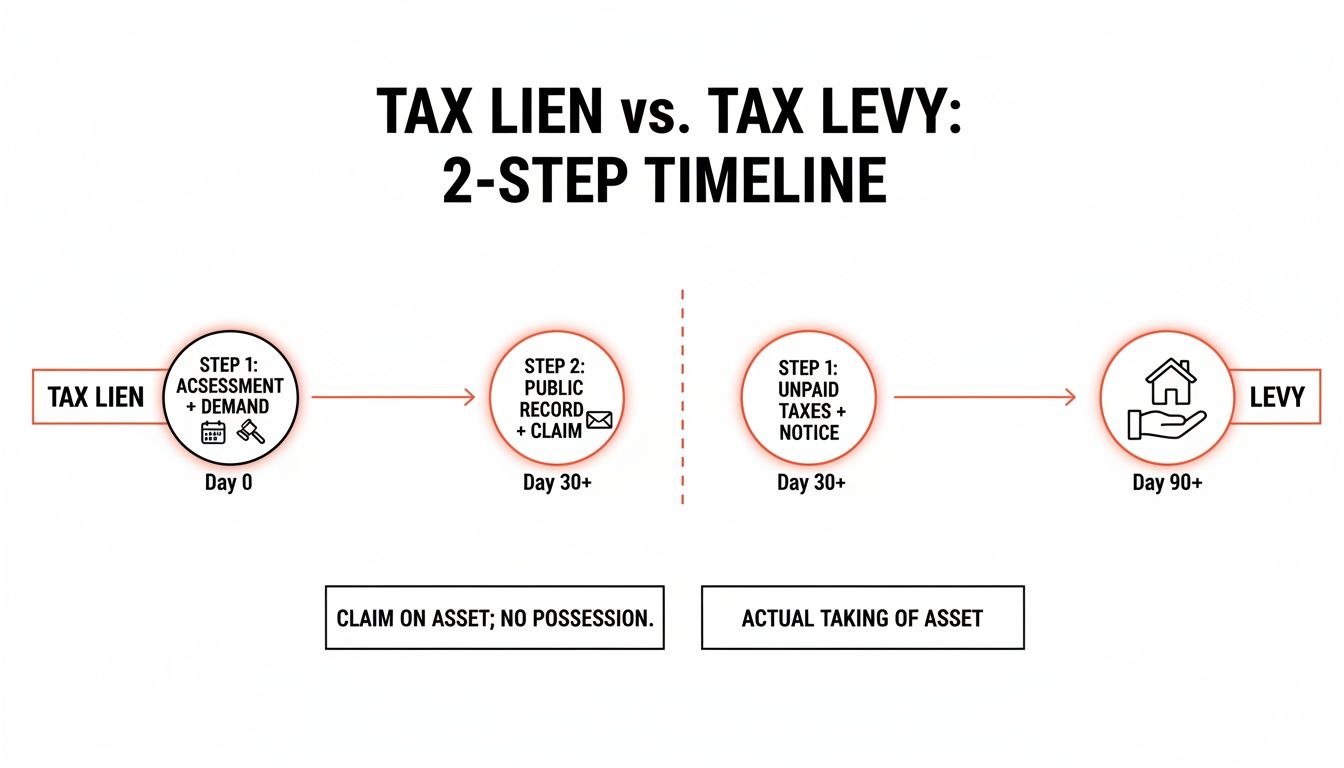
As you can see, a lien is about securing the government's interest in your assets. A levy is the forceful collection that happens when a notice of IRS levy is ignored.
The IRS collection process is methodical, and it works. The agency issued over 1.8 million levy actions nationwide, making it one of the government’s most potent tools for collecting unpaid taxes. With gross tax collections hitting over $5.1 trillion in fiscal year 2024, levies are a key part of that enforcement machine. They’re designed to target wages, bank accounts, and property after that final notice goes out, giving taxpayers that crucial 30 days to respond before the seizure begins. You can read more analysis on these aggressive tax collection tactics and what they mean for taxpayers.
Your Immediate Action Plan After Receiving the Notice
Getting an IRS notice of levy in the mail feels like a gut punch, and for good reason—it’s a financial emergency. But the worst thing you can do is panic. A clear head and immediate, focused action are your best allies right now. Let’s be clear: do not ignore this notice. Tossing it aside is the same as giving the IRS a green light to seize your assets.
The moment you open that letter, a clock starts ticking. Every single day matters. The key is to turn that initial wave of fear into a concrete plan to stop the levy in its tracks. The IRS is giving you one final chance to engage before they take action, and you absolutely must take it.

Step 1: Read and Understand the Notice
Before you pick up the phone or start frantically searching online, take a deep breath and actually read the document. It’s full of dense legal jargon, I know, but you're looking for just a few key details to get your bearings.
Hunt for these critical pieces of information:
- The exact amount owed. This number includes the original tax, plus all the penalties and interest that have piled up.
- The tax periods. Are they coming after you for 2021? Or is it a mix of several years? You need to know.
- The date of the notice. Your deadline to respond, which is typically 30 days, starts from this date.
- Your right to a Collection Due Process (CDP) hearing. The notice has to tell you about your appeal rights, but they are extremely time-sensitive.
Nailing down these facts gives you the basic ammunition you'll need for a productive conversation with the IRS or a tax pro.
Step 2: Gather Your Financial Documents
Okay, you’ve read the notice. Now, you need to pull together a clear picture of your financial life. If you’re going to ask the IRS for any kind of resolution other than paying in full, you have to prove your case with paperwork. Being organized here will save you an incredible amount of time and stress.
Start collecting these documents right away:
- Proof of Income: Grab your most recent pay stubs. If you're self-employed, get your profit and loss statements together. You'll also need bank statements from the last three to six months.
- Proof of Expenses: Pull together records of what it costs you to live—your mortgage or rent statements, utility bills, car payments, and insurance bills.
- Recent Tax Returns: Have your filed tax returns from the past two or three years handy.
Showing up with this information organized tells the IRS you're taking this seriously and are ready to work something out. This paperwork is the foundation for any negotiation, whether it's an installment plan or a claim of financial hardship.
Step 3: Contact the IRS or a Tax Professional Immediately
With your documents in hand, it's time to make the call. You can either call the IRS directly using the number on the notice or hire a qualified tax professional to step in for you. Honestly, while calling the IRS yourself is an option, it can be an incredibly intimidating and frustrating experience.
A tax attorney can speak the IRS's language. They navigate the bureaucracy on your behalf and know how to frame your situation in the best possible light. They understand exactly what it takes to get a levy released or to set up a viable payment alternative. Whether your wages are about to be garnished or your bank account is at risk, professional help is often the smartest move. For example, knowing the very specific rules for challenging IRS levies on bank accounts is critical, especially when you only have a 21-day window to act after the funds are frozen.
The most powerful strategy is acting decisively within the first few days of getting that notice. Quick communication shows you're committed to resolving the debt, dramatically boosting your odds of stopping the IRS from seizing your property.
What Assets the IRS Can Seize
When that IRS levy notice lands in your mailbox, the first question that probably flashes through your mind is: what can they actually take? It's a scary thought, and for good reason. The IRS has incredibly broad authority to seize property, but that power isn't absolute. Knowing what's vulnerable—and what's protected—is crucial to understanding just how serious this is.
Think of an IRS levy less like a surgical strike and more like a wide net. The goal is to collect the tax debt by taking possession of almost anything you own or have an interest in, from the money in your bank account to physical property.

Financial Assets at Risk
Financial assets are almost always the first target. Why? Because they're easy for the IRS to get to. Seizing money electronically is far simpler and faster than dealing with physical property, and the impact on your life can be immediate and devastating.
Here are the most common financial assets the IRS goes after:
- Wages and Salary: This is the classic wage garnishment. It’s a continuous levy, meaning your employer is legally forced to send a chunk of every paycheck to the IRS until your debt is cleared.
- Bank Accounts: A bank levy is a one-time seizure. The day your bank receives the notice, it freezes all funds in your account (up to the amount you owe) and holds them.
- Retirement Accounts: Don't assume your retirement savings are safe. Funds in your 401(k)s and IRAs are absolutely on the table. The IRS can and will levy these accounts to satisfy a tax debt. For a deeper dive, check out our guide on whether the IRS can take your 401(k) and what protections might exist.
- Dividends and Commissions: Any income you get from investments or as part of your sales compensation can be intercepted by the IRS before it ever gets to you.
A bank levy is especially disruptive. Once the levy hits, your bank is required to hold your funds for a full 21 days before sending the money to the IRS. This 21-day window is your last, best chance to negotiate a release and get your money back.
Physical Property and Other Valuables
While it happens less often than financial levies, the IRS absolutely has the power to seize and sell your physical property. This is a more involved process for the agency, but they won't hesitate to use it, especially when the tax debt is significant.
Physical assets that can be seized include:
- Real Estate: This isn't just investment property. Your primary residence, vacation home, or rental units are all fair game.
- Vehicles: Your car, boat, or motorcycle can be towed away and sold at a public auction.
- Personal Property: High-value items like expensive jewelry, art collections, and antiques can also be subject to seizure.
After seizing these assets, the IRS will sell them at an auction. The proceeds are then applied to your tax bill. If the sale brings in more than you owe, the surplus is returned to you.
Federal Payments and Social Security
One of the most powerful tools in the IRS arsenal is the Federal Payment Levy Program (FPLP). This is an automated system that lets the IRS continuously skim from any payments the federal government owes you.
This includes Social Security benefits, federal employee retirement annuities, and even payments to government contractors. Through the FPLP, the IRS can take up to 15% of your Social Security benefits automatically. This program's reach has expanded over the years, making it a highly effective collection tool for the government. You can get more details about how the Federal Payment Levy Program works directly from the IRS.
What the IRS Can't Take: Legally Protected Assets
Thankfully, the law carves out some critical protections. Congress recognized that leaving taxpayers with absolutely nothing would be counterproductive, so Internal Revenue Code (IRC) Section 6334 specifically exempts certain assets and income from levy. The goal is to ensure you have enough to maintain a basic standard of living.
Here are some of the key assets that are legally protected:
- Unemployment benefits
- Certain annuity and pension payments
- Workers' compensation
- A specific amount of your wages and other income (the exempt amount depends on your filing status and number of dependents)
- Certain public assistance payments
- Your main home, but only in very specific and limited circumstances
Knowing exactly what's on the table and what's off-limits is the first step in building a strategy to fight back against an aggressive IRS collection action.
Proven Strategies to Stop an IRS Levy
Getting an IRS notice of levy can feel like the end of the line, but it's not. Think of it as a final, urgent warning—a call to action. The good news is you have several powerful, well-established ways to stop the seizure process in its tracks. The absolute key is to respond immediately and work with the IRS to find a real solution.
Ignoring the notice is the one thing you can't do. That guarantees the levy will move forward. By taking one of the following paths, however, you can get back in the driver's seat and protect your hard-earned assets.
Get on a Payment Plan (Installment Agreement)
The most direct way to stop a levy is to formally agree to pay what you owe over time. This is called an Installment Agreement (IA). It’s essentially a payment plan you set up with the IRS, allowing you to make affordable monthly payments until the debt is paid in full.
As soon as your IA is officially approved, the IRS has to stop all collection activities, including levies. This is a fantastic option if you know you can pay the full debt but just need some breathing room to do it without the shock of a lump-sum payment or having your wages garnished.
Settle for Less (Offer in Compromise)
But what if you genuinely can't afford to pay the entire tax bill? For situations like this, the IRS has a program called an Offer in Compromise (OIC). An OIC allows qualifying taxpayers to settle their tax liability for less than the total amount owed.
This isn't just a casual negotiation. It’s a formal process where you have to open up your books and prove to the IRS that you don't have the income or assets to cover the full debt.
The IRS will look closely at your:
- Ability to pay based on current income
- Monthly living expenses
- Total income from all sources
- Equity in any assets you own (like a home or car)
If your OIC is accepted, the IRS releases any active levies and considers your debt resolved once you complete the terms of the deal. For people buried under an impossible tax bill, it’s a true fresh start.
Prove You Can't Pay Now (Currently Not Collectible)
Sometimes, a person's financial situation is so fragile that even a small payment would make it impossible to cover basic living expenses like rent and food. If this is you, you can ask the IRS to place your account in Currently Not Collectible (CNC) status.
To get CNC status, you have to provide detailed financial proof showing that making any payment would cause you significant economic hardship. This isn't debt forgiveness—penalties and interest will keep adding up—but it is an official pause button. The IRS will stop all collections, including levies, while you're in CNC status. They’ll check in periodically to see if your financial situation has improved. You can explore more options to stop an IRS levy in our comprehensive article.
It's critical to act fast. Once the IRS issues a levy on your wages, their internal rules allow them to take money continuously until the debt is paid. But proving hardship or setting up a payment plan is a proven, recognized way to get a levy released. You can even read the IRS levy procedures from their manual yourself.
Request a Levy Release and Get an Advocate
If a levy is already hitting your bank account or paycheck, you can formally request that the IRS release it. They will typically grant a release if you’ve entered into one of the solutions above (like an IA or OIC) or if you can show the levy is creating an immediate and severe economic hardship.
If you’re facing a crisis and can't get the issue resolved through normal IRS channels, you have another powerful ally: the Taxpayer Advocate Service (TAS). This is an independent organization within the IRS that exists to protect taxpayer rights. By filing Form 911, Request for Taxpayer Advocate Service Assistance, you can ask them to step in and help you find a solution, which often includes getting a damaging levy stopped.
Common Questions About IRS Levies
Getting a notice of IRS levy in the mail can be terrifying, and it's natural for a million questions to start racing through your mind. Let's break down some of the most pressing concerns with straightforward answers.
How Long Does an IRS Levy Last?
The answer really depends on what the IRS is levying. Think of a bank levy as a snapshot in time—it's a one-time event that grabs whatever funds are in your account on the day the bank processes the notice.
A wage levy, on the other hand, is more like a continuous drain. Often called a wage garnishment, it attaches to your income and siphons off a portion of every single paycheck. This continues relentlessly until the tax debt is paid in full, the IRS agrees to release the levy, or the collection statute expires.
Can the IRS Take My Social Security Benefits?
Yes, they absolutely can. The IRS has a powerful tool called the Federal Payment Levy Program (FPLP) that allows them to do this automatically.
Through the FPLP, the IRS can take up to 15% of your monthly Social Security check without ever needing to go to court. This program isn't limited to Social Security; it also targets other federal payments, like retirement benefits for former federal employees.
Does a Levy Hurt My Credit Score?
This is a bit of a "yes and no" answer. The levy itself doesn't get reported to the big three credit bureaus—Equifax, Experian, and TransUnion—so you won't see it listed on your credit report.
However, the real damage often comes from what precedes the levy: a Notice of Federal Tax Lien. Before the IRS can levy your assets, they almost always file a tax lien, which is a public record of your debt. While credit bureaus stopped including tax lien information on reports back in 2018, that doesn't mean it's hidden. Lenders, especially for big-ticket items like a mortgage, will often do a public records search and find it. Seeing that you have an outstanding debt to the government can definitely make them think twice about approving you for a loan.
Trying to navigate an IRS levy on your own is a high-stakes gamble with your financial stability. At Attorney Stephen A Weisberg, we offer a free, no-obligation Tax Debt Analysis to map out the best path forward for your unique circumstances. Don't wait for the IRS to make the next move—visit us at weisberg.tax and start protecting your assets today.


