Notice of Intent to Offset: What It Means and What to Do
A notice of intent to offset warns that your federal payment may be seized for unpaid debt. Learn how the Treasury Offset Program works and what to do next.

In this article
- The Letter You Just Opened and What It Really Means
- What the language means
- How the Treasury Offset Program Actually Works
- The process in sequence
- Federal State and Other Offsets Compared
- Your Legal Rights and the 60 Day Window
- Review the account first
- Challenge enforcement when appropriate
- Why a Payment Plan Does Not Always Stop an Offset
- How to Respond Before the Offset Happens
- Put the right agency in control
- What to Do After Your Refund Has Been Intercepted
- Identify the recovery route
- Watch for secondary problems
- Your Next Steps and When to Bring in a Professional
A notice of intent to offset is a formal pre-offset warning from the Treasury Offset Program, administered by the Bureau of the Fiscal Service, telling you that a federal payment may be intercepted unless you resolve the debt within the stated response window, commonly 60 days. It means the government has identified a debt as delinquent, valid, and legally enforceable, but the offset generally hasn't occurred yet.
You may have opened the envelope while expecting an ordinary tax notice and instead found language about administrative offset, the Bureau of the Fiscal Service, and a creditor agency you've never contacted. The practical message is direct: an agency claims you owe money, has referred or is preparing to refer that debt for collection, and may take some or all of an eligible federal payment, often a tax refund.
The notice matters because it gives you a procedural opportunity to review the debt, challenge it, pay it, or pursue another resolution before money moves between agencies. The exact deadline and available remedies depend on the debt type and the agency named in the letter. Treat the notice as a deadline document, not as routine correspondence.
The Letter You Just Opened and What It Really Means
You tear open the envelope and see the phrase Notice of Intent to Offset. The letter may name the Bureau of the Fiscal Service and describe an administrative offset. In plain English, the government is warning you that a federal payment can be reduced and sent to another government agency to satisfy a claimed debt.
That payment may be a federal tax refund, but the broader Treasury Offset Program can also affect other eligible federal payments. The notice should identify the creditor agency, the amount claimed, the reason for the debt, the payment that may be affected, and your rights to review or dispute the claim. Federal guidance describes this notice as part of a formal process requiring the agency to establish that the debt is valid and legally enforceable before referral. The Treasury Offset Program reference material explains the relationship between the Bureau of the Fiscal Service and agencies submitting delinquent debts.
What the language means
- Creditor agency: The agency that says you owe the money. It might be a state revenue department, a federal non-tax agency, or another qualifying government creditor.
- Administrative offset: The government reduces money otherwise payable to you and applies it to an eligible debt.
- Intent to offset: The interception hasn't necessarily happened. You still have a response opportunity under the notice.
- Case or reference number: Use it whenever you call or write, and compare it with prior agency correspondence.
Legitimate government notices generally arrive through the mail and identify the responsible agency and a reference number. Be cautious with emails or text messages demanding immediate payment through unusual methods. Verify the agency independently, using contact information from its official website or a prior statement rather than relying only on an unfamiliar phone number printed in a suspicious message.
Practical rule: Don't send money until you've matched the notice to the creditor agency's account records and confirmed the deadline.
The rest of the process turns on the response window. Gather the letter, check the debt, contact the named agency, and preserve proof of every submission. Waiting for the refund to arrive is usually the wrong strategy because the important decisions occur before referral or interception.
How the Treasury Offset Program Actually Works
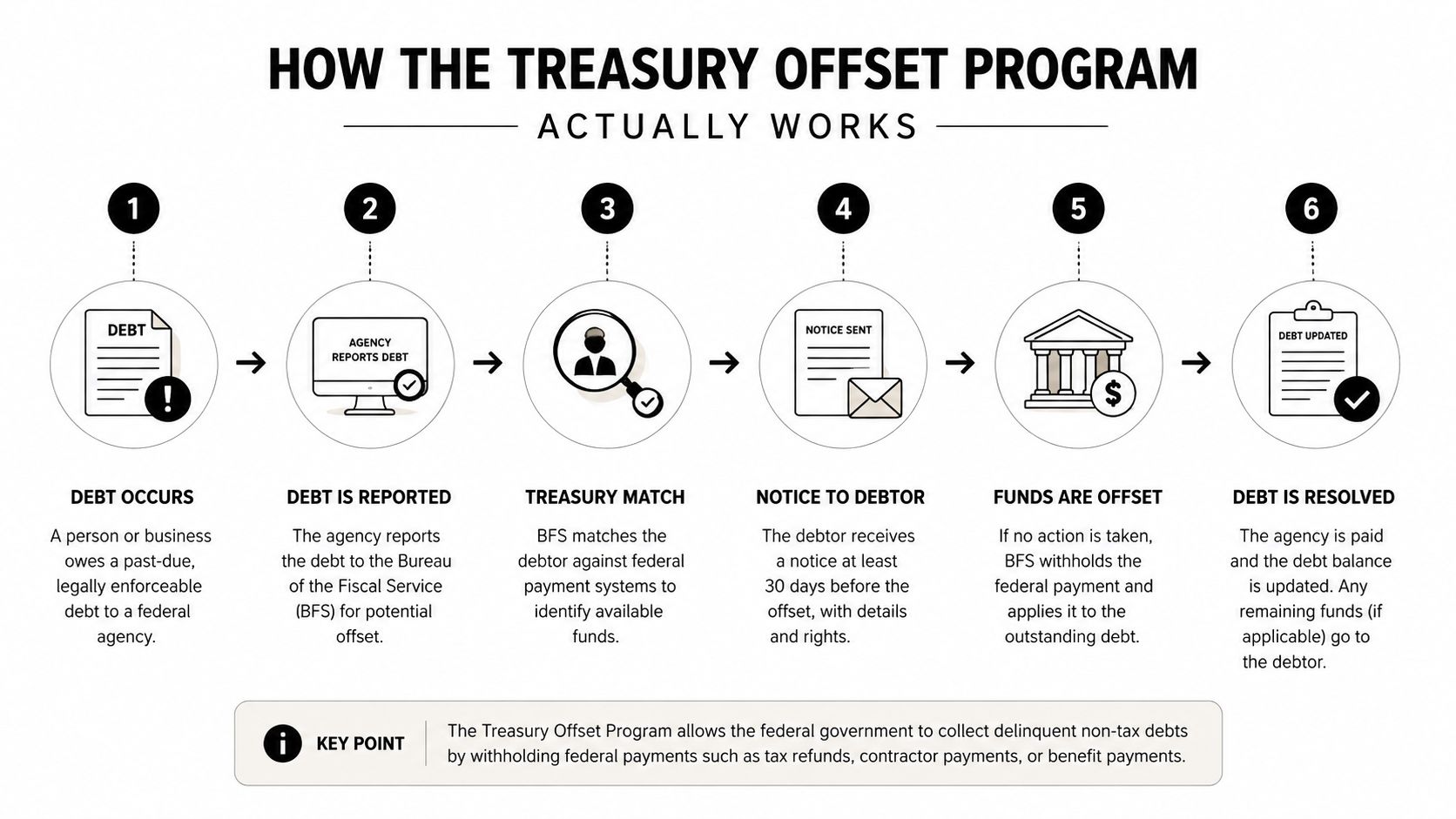
The Treasury Offset Program, or TOP, is a government-wide collection system administered by the Bureau of the Fiscal Service. The creditor agency determines that a debt is delinquent and eligible, then submits information so BFS can match the debt against an eligible federal payment. The Treasury Offset Program process is easier to understand when you separate the agency that owns the debt from the bureau that processes the payment.
The process in sequence
- Internal collection begins. The creditor agency usually sends bills, demands, or other collection notices and gives the debtor an opportunity to resolve the account.
- Referral information is submitted. If the debt remains eligible for collection, the agency refers it to TOP with identifying information and a referral indicator.
- Pre-offset notice is issued. The debtor receives a notice stating what the debt is for, how much is claimed, which payment may be affected, and how to review or dispute the debt.
- The response period runs. Affected debtors must use the deadline in the notice. In many formal state-to-federal programs, that period is 60 days, as stated by Georgia's notice guidance.
- BFS matches an eligible payment. The system can compare the debtor's identifying information with an expected federal payment.
- The payment is reduced. BFS intercepts money up to the amount permitted by the debt and sends it to the creditor agency.
- Any remaining amount is paid. If the eligible payment exceeds the offset, the remainder is forwarded through the normal payment process.
Eligible payment categories can include federal income tax refunds, certain federal benefits, contractor or vendor payments, and specified federal compensation. The important operational distinction is that BFS processes the offset, while the creditor agency controls the underlying debt, its records, and most disputes.
That division explains why calling the IRS may not solve a state tax, child support, student loan, or other federal agency debt. The notice should tell you who received the money or who is preparing to receive it. Start with that agency.
Federal State and Other Offsets Compared
“Tax refund offset” identifies the payment being taken, not necessarily the debt behind it. A federal tax liability, state income tax liability, child support obligation, student loan debt, and vendor-payment debt can follow different rules and appeal routes. Treating them as one process often sends taxpayers to the wrong agency and wastes the response period.
| Offset Type | Creditor Agency | Governing Authority | Appeal Route |
|---|---|---|---|
| Federal tax offset | IRS | Federal tax collection rules and refund-offset authority | IRS account review, collection procedures, or an available hearing route |
| State tax offset | State revenue agency | State collection law and the state's TOP participation rules | The state revenue agency named in the notice |
| Child support offset | State child support agency | Federal and state child support collection rules | The child support or state agency handling the account |
| Federal non-tax debt, including some student loan debts | Federal creditor or loan holder | Treasury offset rules and the creditor's program rules | The referring agency or loan holder |
| Vendor-payment offset | Federal or state creditor agency | Government payment and offset rules | The agency responsible for the debt and payment relationship |
A federal tax debt remains an IRS matter. The IRS may apply a refund to an assessed liability, while the Bureau of the Fiscal Service, or BFS, generally processes the interception and identifies the offset amount and receiving agency. An IRS account transcript can confirm an IRS balance, but it will not necessarily show a state tax, child support, or other agency debt. For a clear explanation of the state-offset explanation, start with the agency named in the notice rather than assuming the IRS controls every offset.
A state tax offset follows state collection law and the state's participation in the Treasury Offset Program. State revenue departments may refer unpaid state income tax liabilities for federal refund interception. The state agency generally controls the balance, payment history, and dispute process. A state tax levy and how it differs from an offset involves related collection concepts, but the government action and available procedures are not automatically the same.
Child support and federal student loan offsets are cross-agency matters. Treasury may process the payment, while the state child support office, Department of Education, or loan holder decides whether the debt is accurate and whether collection should pause. A payment arrangement may therefore stop one type of collection without stopping an offset already referred for processing.
Vendor-payment offsets involve money owed to a contractor or supplier rather than a tax refund. The contract, the paying agency, the creditor agency, and the debt records can all affect the response. Read the notice for the payment source and contact the creditor agency promptly.
Your Legal Rights and the 60 Day Window
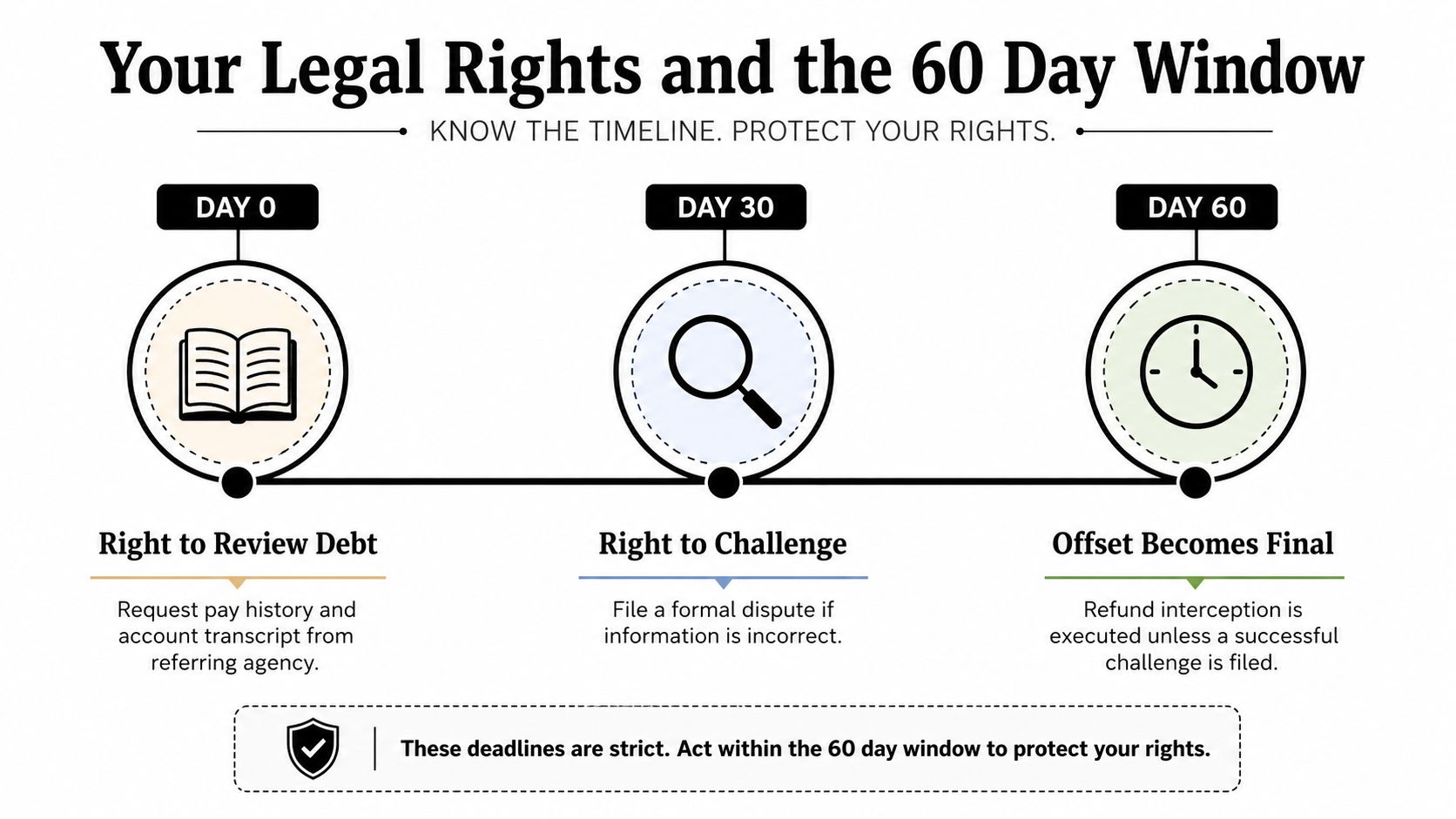
The notice gives you more than a warning. It identifies a due-process opportunity to examine the claimed debt and respond before the government takes an eligible payment. Your first task is to establish exactly what the agency says you owe, how it calculated the balance, and whether it has the right debtor.
Review the account first
Request the creditor agency's payment history, balance calculation, and account records. Ask for the dates of assessments, payments, credits, transfers, and referrals. If the debt is federal tax debt, obtain the relevant IRS account transcript and compare it with your own records. If it belongs to another agency, request that agency's equivalent history.
The notice should identify a response deadline, often 60 days in formal offset programs. Use that period to submit a written review request and preserve delivery evidence. Utah's offset guidance notes that records can take four weeks or more to update after an offset-related transfer, which is why waiting for an electronic account change can leave you behind.
Challenge enforcement when appropriate
You may have grounds to dispute the debt itself or the government's ability to enforce it. Common issues include mistaken identity, a balance already paid, an incorrect calculation, bankruptcy protections, or a debt that isn't legally enforceable. Attach documents, not just conclusions.
You can also request a stay or hold before interception. BFS generally acts on the creditor agency's certification and won't independently decide whether your defense is valid. The referring agency must receive the evidence and, where appropriate, recall or suspend the referral.
If the offset occurs, the dispute usually continues through the creditor agency's administrative process. Missing the deadline may reduce your practical options, but it doesn't automatically prove the debt is correct. Move quickly and keep copies of every letter, fax confirmation, upload receipt, and phone log.
Why a Payment Plan Does Not Always Stop an Offset
An active payment plan and an active TOP referral can exist at the same time. The payment plan governs scheduled payments, while the offset referral can authorize interception of eligible payments until the creditor agency recalls the debt or otherwise updates its status.
The result depends on the debt category and the agency's rules. For some state obligations, an agreement may stop certain collection actions. A federal refund offset may continue, however, even while the taxpayer makes required installment payments. Maryland's official guidance illustrates why taxpayers must ask specifically how an agreement affects each type of offset.
| Debt Type | Payment Plan Active | Offset Continues? | Required Action |
|---|---|---|---|
| Federal tax debt | Yes | It may, depending on the account and referral status | Ask the IRS whether TOP recall or exclusion has been recorded |
| State income tax debt | Yes | It may continue under the state's program | Confirm the agreement's effect with the state revenue agency |
| Defaulted federal student loan | Yes | It may continue if the loan remains in default | Contact the loan holder and request action that removes the referral |
| Child support debt | Yes | It may continue under the child support agency's rules | Obtain written confirmation that the offset referral is suspended |
The common mistake is assuming that making the first payment changes the TOP record automatically. It may not. Ask for a written statement that the creditor agency has recalled the debt, suspended the referral, or placed an exclusion on the relevant payment.
A payment plan also may cover only part of the balance. Until the agency updates the full account status, the offset mechanism can continue. For IRS-specific planning, review how to set up a payment plan with the IRS, then confirm separately whether TOP records have changed.
How to Respond Before the Offset Happens
Start with the notice itself. Make a working file containing the notice, every letter from the creditor agency, account transcripts, payment records, identity documents, and evidence supporting any bankruptcy, waiver, discharge, or prior-satisfaction argument.
Put the right agency in control
The agency named as creditor is usually the correct first contact, not the IRS. Ask the agency to identify:
- The debt basis: What obligation created the balance, and what legal authority supports collection?
- The accounting: How were payments, credits, interest, penalties, and transfers applied?
- The referral status: Has the debt already been referred, or is referral still pending?
- The available remedy: Can the agency place a hold, recall the referral, or accept documentation before the deadline?
Send a written request through the method specified in the notice. Certified mail can help establish delivery, but follow the agency's instructions if it requires an online portal, fax, or specific form.
A concise request might say:
Request for administrative review: I request review of the debt identified in Notice of Intent to Offset, reference number [number]. Please provide the account history and suspend or recall any offset referral while you review the attached records. The notice deadline is [date]. I dispute the balance because [specific reason].
For identity theft, attach identity verification records and explain why the account doesn't belong to you. For a mistaken balance, attach payment confirmations and identify each disputed transaction. For a federal student loan disability discharge issue, attach the discharge submission and ask the loan holder to confirm whether collection has been suspended.
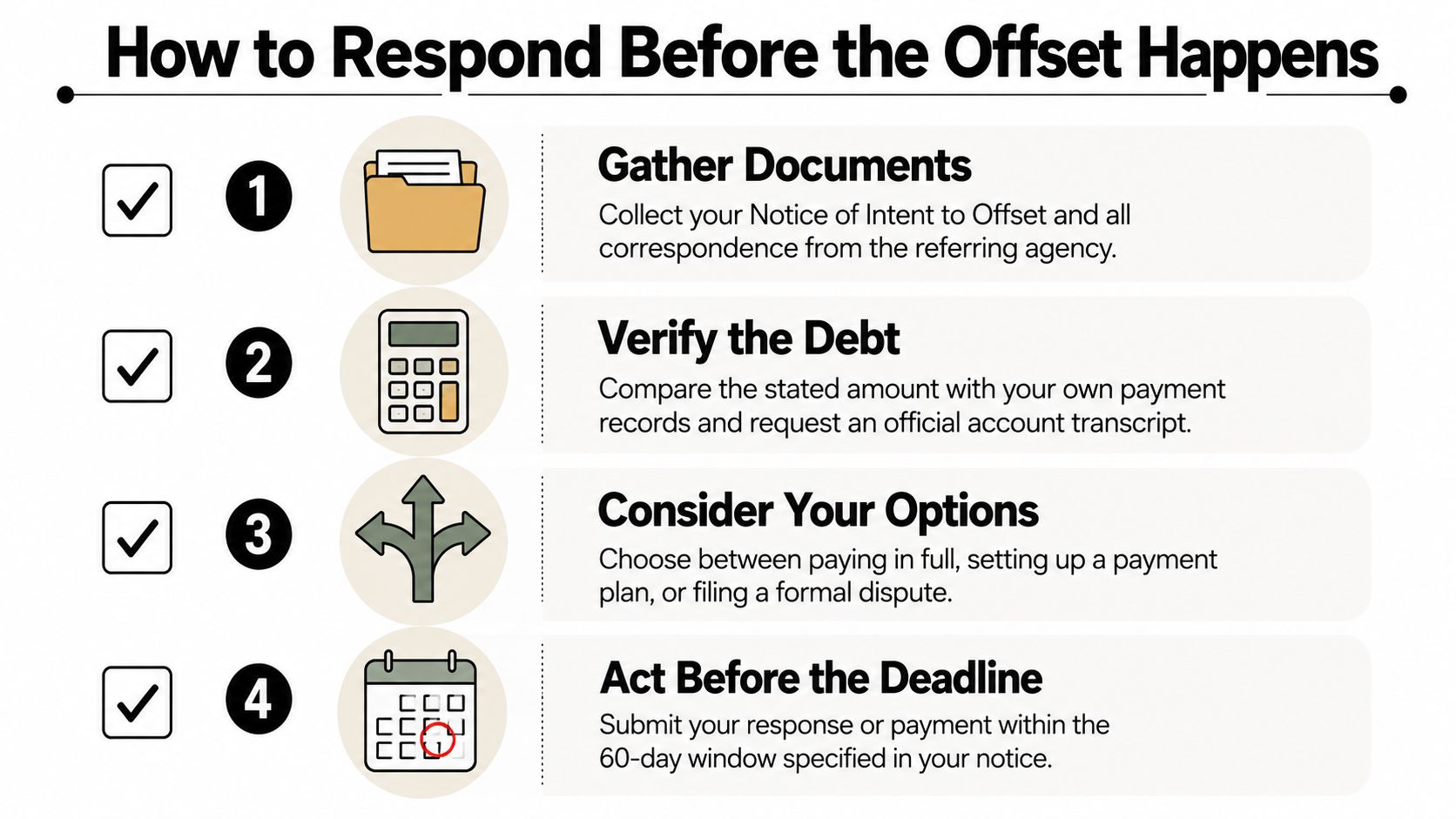
Before the deadline, evaluate practical alternatives. You may be able to pay the debt, document a qualifying arrangement, request a hardship exclusion where available, or file an injured spouse claim for a joint refund. Hardship relief is not universal, and it may apply only to certain federal tax debts. Ask the responsible agency what documentation it requires before assuming hardship will prevent the offset.
What to Do After Your Refund Has Been Intercepted
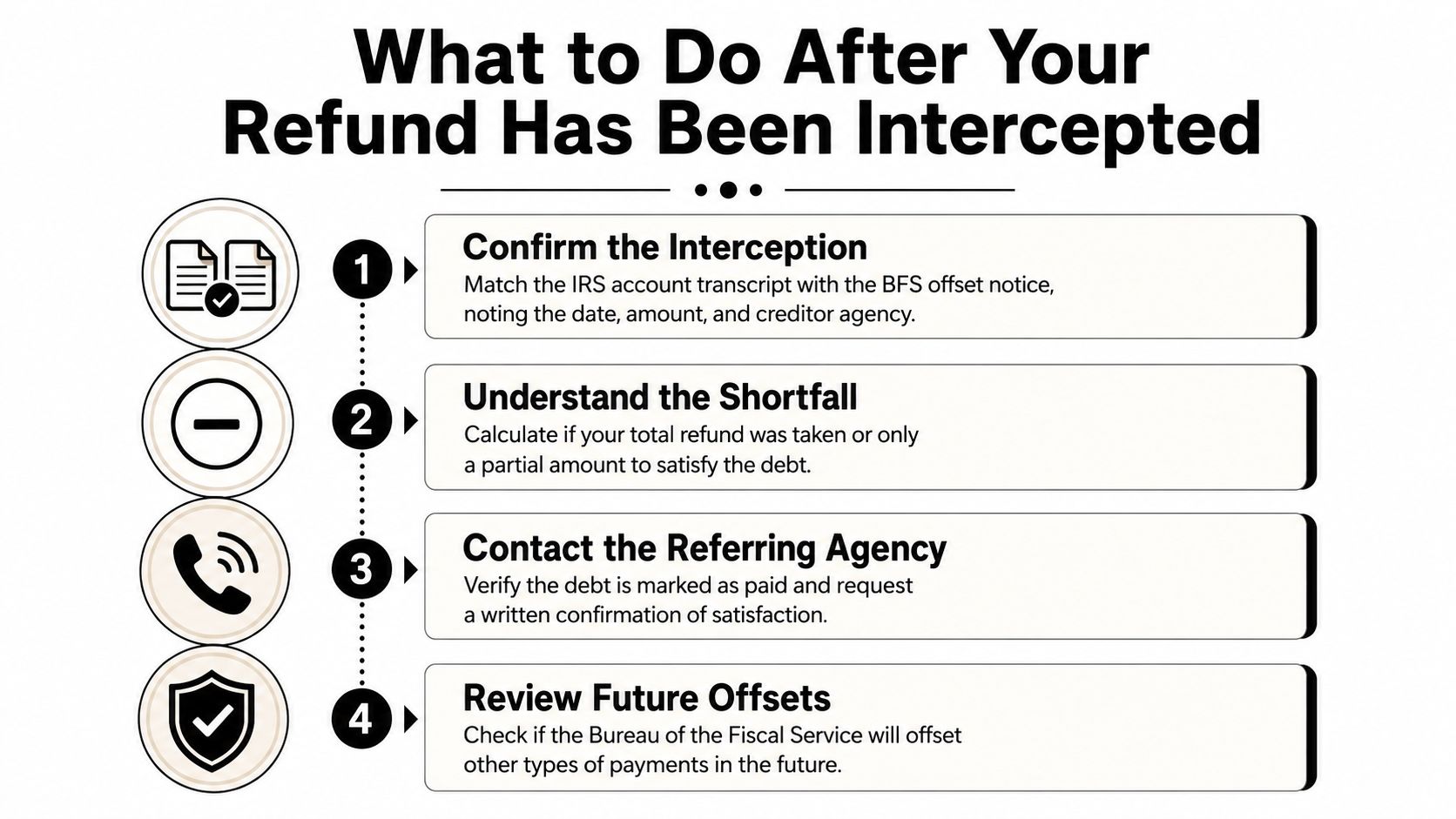
Once the refund is gone, confirm what happened before arguing about recovery. Compare the IRS account transcript with the Bureau of the Fiscal Service notice. The BFS notice should identify the date, offset amount, creditor agency, and contact information for that agency.
Identify the recovery route
If the debt is valid, ask the creditor agency to confirm how the payment was applied and whether the account is now satisfied or reduced. Request written confirmation. If the agency agrees the offset was wrong, ask it to explain the administrative refund or reversal procedure and whether it must instruct BFS to release funds.
BFS processes the payment, but the creditor agency generally controls the underlying determination. The IRS can't correct a state tax debt, child support debt, or federal student loan account merely because the refund originated with an IRS return. For related collection issues, IRS bank-account levy guidance can help distinguish a refund offset from other IRS enforcement actions.
A corrected tax return may be appropriate when the refund itself was calculated incorrectly. It isn't automatically the remedy for a valid offset. If the issue involves an IRS return or assessment, ask whether an amended return, account correction, or administrative claim fits the facts.
Watch for secondary problems
A released refund can be applied again if another valid balance remains on the account or if the agency hasn't updated its records. Ask what future payments may remain subject to offset and whether the referral has been removed.
If losing the refund created immediate hardship, document the consequences, such as housing, utilities, food, or necessary medical expenses. Hardship procedures are fact-specific and often must be pursued before interception, so post-offset relief may be narrower than pre-offset protection.
Your Next Steps and When to Bring in a Professional
The right response depends on whether the money is still available.
Before the offset: verify the debt, request the records, contact the creditor agency, and submit a dispute or payment documentation before the notice deadline. Don't assume a payment plan has changed TOP status. Obtain written confirmation that the referral has been recalled or suspended.
After the offset: preserve the BFS notice, obtain the creditor's accounting, request administrative correction if the debt or amount is wrong, and track every response. If the agency stalls, consider escalation through the Taxpayer Advocate Service where applicable, or obtain legal advice from a tax attorney familiar with interagency offsets.
Professional assistance becomes more valuable when the dispute involves debt ownership, identity theft, bankruptcy protections, a joint return and injured spouse rights, federally held student loans in default, or a balance exceeding $10,000. Those cases often require more than a phone call because the representative must coordinate records, deadlines, and agency-specific procedures.
The practical priority is timing. A carefully supported request sent before referral can preserve options that become harder to use after interception. A professional representative can also file a Power of Attorney with the IRS or state agency, review the account, and direct communications through the appropriate channel. Tax Attorney Stephen A Weisberg offers attorney-led tax debt analysis and representation for IRS and state tax problems, including disputes and collection matters involving offset risk.
Tax Attorney Stephen A Weisberg can review the debt, identify the agency controlling the referral, and help prepare a response before the deadline or pursue administrative remedies after an offset. Visit Tax Attorney Stephen A Weisberg to request a tax debt analysis and discuss the next procedural step.


