What Is a Notice of Deficiency? Your 90-Day IRS Survival Guide
Received a Notice of Deficiency from the IRS? Understand what this 90-day letter means, explore your options, and learn how to respond to protect your rights.

In this article
- Your Guide to an IRS Notice of Deficiency
- Why You Received This Specific Notice
- Decoding the Letter's Key Components
- The Critical 90-Day Timeline and Consequences of Inaction
- What Happens When the Clock Runs Out
- The Domino Effect of Inaction
- The Financial Cost of Delay
- Evaluating Your Three Core Response Strategies
- Strategy 1: Agree and Pay the Deficiency
- Strategy 2: Do Nothing and Accept the Consequences
- Strategy 3: Disagree and Petition the U.S. Tax Court
- Comparing Your Response Strategies to a Notice of Deficiency
- How to Prepare and File Your Tax Court Petition
- Gather Your Essential Documents
- Completing the Petition Form
- Meeting the Critical Filing Deadline
- Challenging the Validity of the Notice Itself
- The Power of the Last Known Address
- Real-World Examples of Invalid Notices
- When to Hire a Tax Attorney for Your 90-Day Letter
- High Stakes and Complex Arguments
- Understanding Your Professional Options
- When an Attorney Is Non-Negotiable
- Common Questions About Notices of Deficiency
- Can I Get an Extension on the 90-Day Deadline?
- Do I Have to Pay Before I Go to Tax Court?
- What Happens After I File My Petition?
- What if I Received the Notice After 90 Days?
Getting a letter from the IRS is enough to make anyone's heart skip a beat. But a Notice of Deficiency is one letter you absolutely cannot ignore. It’s not a bill—at least, not yet. Instead, think of it as the IRS officially putting you on notice that they believe you owe more in taxes. More importantly, it fires the starting pistol on a strict 90-day countdown to fight their claims in U.S. Tax Court.
Your Guide to an IRS Notice of Deficiency
A Notice of Deficiency, which tax pros often call a "90-day letter," is the IRS's final move after an audit or examination. It only shows up after the agency has found a discrepancy—like unreported income or deductions they won't allow—and you haven't been able to settle the matter with them during the earlier stages of the audit. This letter makes their position official and lays out exactly what they think you owe, down to the penny.
This isn't just another routine notice. The IRS is legally required to send this specific letter before they can formally assess the tax and start collection actions. Its arrival is a critical moment. You have a clear path forward, but the deadline is non-negotiable.
Why You Received This Specific Notice
You're probably wondering, "Why me?" The reasons for getting a Notice of Deficiency are usually pretty straightforward. It almost always comes down to a mismatch between what you reported on your tax return and the data the IRS has on file from other sources.
Here are the most common triggers:
- Unreported Income: The classic reason. The IRS got a Form 1099 or W-2 with your name on it, but that income never appeared on your return.
- Disallowed Deductions or Credits: After an audit, the IRS decided that certain deductions or credits you claimed don't actually qualify under the tax code.
- Filing Status Errors: You might have used a filing status (like Head of Household) that the IRS believes you weren't entitled to, which changes your entire tax calculation.
- Math and Clerical Errors: Simple typos are usually handled with a different notice, but bigger mistakes can trigger a full-blown examination that ends with this letter.
For business owners and the self-employed, these notices often pop up after an audit flags aggressive expense claims, missed income from various 1099s, or payroll tax issues. The official name for this document is Letter 3219, and the law (IRC § 6212) requires the IRS to send it via certified or registered mail to your last known address. It will detail the deficiency amount, explain their reasoning, and often includes proposed penalties. Interest, however, usually gets calculated and added to the first bill you receive later.
The single most important thing to remember is this: a Notice of Deficiency is your official "ticket to Tax Court." If you don't have this letter, you can't petition the court to hear your case. Ignoring it means you give up that right completely.
Decoding the Letter's Key Components
The notice itself can look like a wall of confusing government-speak. It’s designed to be legally sound, not user-friendly. But once you know what to look for, you can break it down into manageable pieces. For a broader look, you can also check out our guide on decoding different IRS letters and notices.
To help you get your bearings, let's break down the key parts of the notice you're holding.
Decoding Your Notice of Deficiency At a Glance
This table breaks down the key components you'll find in a Notice of Deficiency and explains what each part means for you.
| Component of the Notice | What It Means | Immediate Action Required |
|---|---|---|
| Notice Date | This is Day 1 of your 90-day (or 150-day if you're abroad) deadline to file a petition with the U.S. Tax Court. | Mark this date on your calendar immediately. The deadline is absolute. |
| Tax Year(s) in Question | Identifies which specific tax year(s) the IRS is adjusting. | Gather all your records—receipts, bank statements, tax returns—for these specific years. |
| Deficiency Amount | The proposed additional tax the IRS claims you owe, before interest and some penalties are added. | Understand this is the core amount in dispute. It's the number you will either agree to or fight. |
| Explanation of Adjustments | This is the "why." It details every change the IRS made to your return, like disallowing a deduction or adding income. | Read this section carefully. This is the foundation of the IRS's case against you and where you'll find grounds to disagree. |
| Response Options | Outlines your three main choices: agree with the changes, disagree and petition the Tax Court, or do nothing. | You must decide on a course of action. Consulting with a tax professional is highly recommended at this stage. |
By focusing on these core elements, the letter becomes much less intimidating and you can start planning your response effectively.
The Critical 90-Day Timeline and Consequences of Inaction
When a Notice of Deficiency lands in your mailbox, a clock starts ticking. This isn't just any old deadline—it's a strict, non-negotiable 90-day countdown set by federal law. Think of it as your one and only ticket to the U.S. Tax Court. Once that gate closes, it’s shut for good.
This timeline is the single most critical detail in the entire process. No one, not even the IRS or the Tax Court itself, can grant you an extension. The date printed on that notice is Day 1, and the clock runs out exactly 90 days later (or 150 days if you're living outside the United States).
To really grasp why this is so serious, it helps to see how you got here. A Notice of Deficiency isn't the beginning of your tax troubles; it's the final stop before things get legal and expensive.
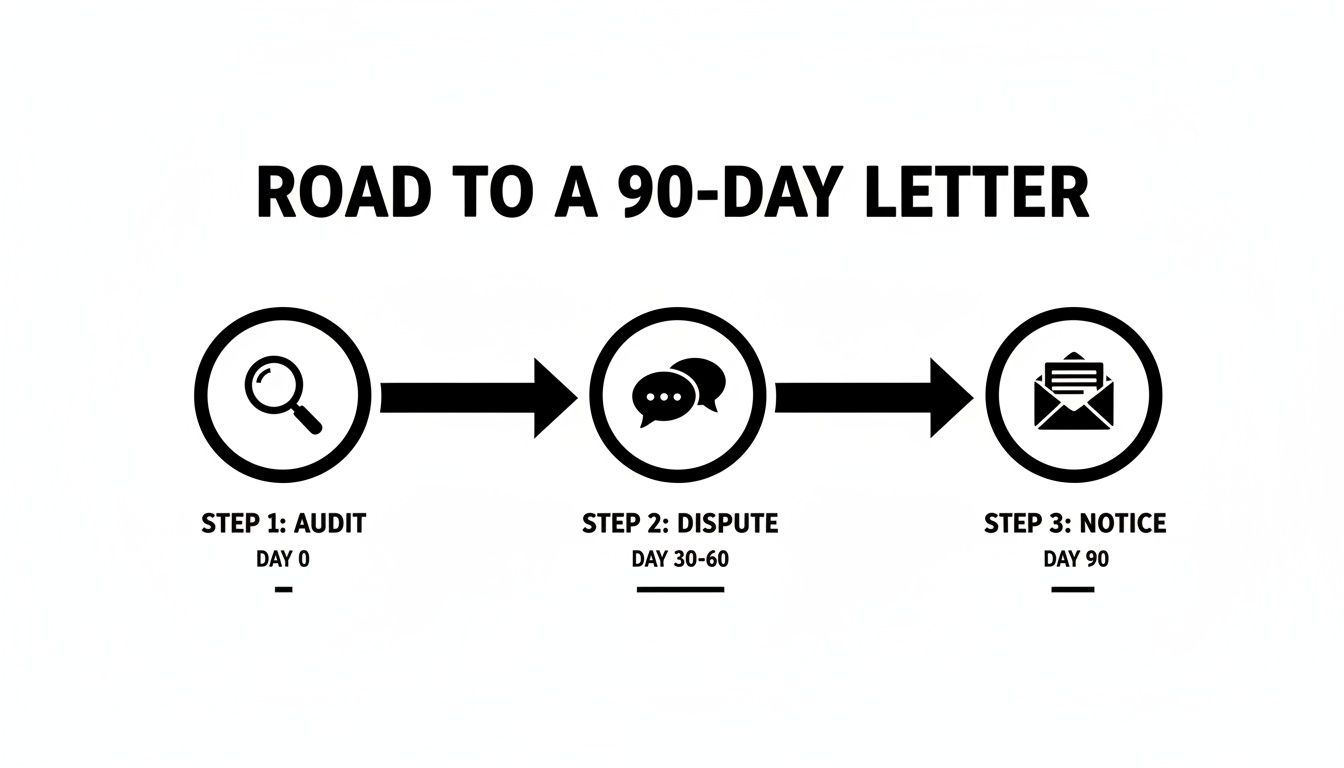
As you can see, this notice is the IRS's last administrative step. What comes next is a whole different ballgame involving the legal system and the full force of IRS collections.
What Happens When the Clock Runs Out
If you let that 90-day window close without filing a petition with the Tax Court, you’ve essentially given up your right to fight the tax before you have to pay it. The second that deadline passes, the IRS gets the legal authority to "assess" the tax. This is the point of no return.
Before the assessment, the amount on your notice is just a proposal. After the assessment, it becomes a real, legally enforceable debt.
That simple change flips a switch, turning on the IRS’s powerful collection machine. Your situation can go from a manageable dispute to a full-blown financial crisis in the blink of an eye.
Key Takeaway: Missing the 90-day deadline transforms a proposed tax adjustment from the IRS into a concrete debt. This single act of inaction gives the IRS the green light to begin enforced collections, significantly raising the stakes.
The Domino Effect of Inaction
Once the tax is on the books, a series of painful consequences can follow, one right after another. This is no longer just about owing money; it's about the IRS actively coming to collect it.
The most common collection weapons in their arsenal include:
- Federal Tax Liens: The IRS can file a public Notice of Federal Tax Lien, staking a claim on all your property. This includes your home, cars, and bank accounts, and it does serious damage to your credit score.
- Bank Account Levies: Without any further warning, the IRS can legally seize funds directly from your checking and savings accounts.
- Wage Garnishment: The agency can order your employer to send a large chunk of every paycheck straight to the IRS until the debt is satisfied.
These aren't empty threats; they are standard operating procedures for the IRS collections division. Deadlines truly define your destiny with a notice of deficiency. If you fail to petition the Tax Court, the IRS assessment becomes final. Interest will start piling up at 5-7% annually, and failure-to-pay penalties can tack on up to another 25% of the unpaid tax. You can learn more about the importance of statutory notice deadlines and how they shape your case.
The Financial Cost of Delay
Beyond the immediate danger of liens and levies, doing nothing carries a heavy price tag. The moment the tax is assessed, interest and penalties start compounding on the whole balance. The interest is calculated daily, and penalties add up every month.
A tax bill that might have seemed manageable can quickly snowball into a much larger, more intimidating debt. This is precisely why a quick, decisive response is so crucial. Every day you wait after the 90-day deadline passes costs you money and shrinks your options for a good outcome. Waiting isn't a strategy—it's a financial liability.
Evaluating Your Three Core Response Strategies

Now that you understand the non-negotiable 90-day deadline, you're standing at a fork in the road. The path you choose in the next three months will determine everything that follows in your tax dispute. You essentially have three ways to play this, and each comes with its own distinct consequences.
This isn't the time for guesswork. It's time to shift from feeling uncertain to thinking strategically. Let's walk through your three core options to see which one makes the most sense for your situation.
Strategy 1: Agree and Pay the Deficiency
The simplest path is to accept the IRS's proposed changes. If you've gone over their explanation and realized they’ve got it right—maybe you forgot about a 1099 or fumbled a calculation—then agreeing is the quickest way to put this behind you.
To do this, you’ll sign the waiver form that came with your notice of deficiency, which is usually Form 4089. Signing it is your official consent. The IRS will follow up with a bill for the tax, penalties, and interest that has piled up. This choice shuts the door on the matter and avoids any further legal wrangling.
But be warned: this decision is final. The moment you agree, you forfeit your right to ever challenge that amount in Tax Court. This option is really only for situations where you are 100% certain the IRS is correct and you can handle the bill.
Strategy 2: Do Nothing and Accept the Consequences
Your second option is to simply do nothing. As we’ve already touched on, this is easily the most damaging choice you can make. Letting the deadline pass without a response isn't passive; it's an active decision to give up all your rights and let the IRS do whatever it wants.
Once those 90 days are up, the IRS will automatically assess the tax they proposed. It instantly becomes a legally collectible debt, and their powerful collections machine kicks into high gear. This is when you start seeing things like tax liens, bank account levies, and wage garnishments. You've lost all your bargaining power and are left to deal with the fallout on their terms.
This strategy is never the right call. It offers zero benefits and exposes you to the full weight of IRS collections, often turning what was a manageable problem into a full-blown financial crisis.
Strategy 3: Disagree and Petition the U.S. Tax Court
If you believe the IRS is wrong, this is your most powerful move. Filing a petition with the U.S. Tax Court is how you formally say, "I disagree," and it completely flips the script. Crucially, it's the only way you can fight a notice of deficiency before you have to pay the amount in dispute.
A lot of people hear "Tax Court" and imagine a dramatic trial scene. That’s not how it works for most people. Filing a petition is really a procedural key that unlocks the next level of negotiation. It moves your case out of the auditor's hands and over to the IRS Independent Office of Appeals.
Think of it less as suing the government and more as forcing a smarter conversation. An IRS Appeals Officer has way more authority and flexibility to settle a case than an auditor ever will. They can consider the "hazards of litigation"—the risk that the IRS might actually lose in court—which opens the door to much more reasonable settlements. The petition makes the IRS take a serious second look at your case in a setting designed for resolution.
This path protects your rights, freezes all collections activity, and gets you a seat at a table where a fair deal is possible—all without having to write a check for the disputed tax first. For anyone with a legitimate argument, this is almost always the best strategic play.
To make the choice even clearer, let's lay out the pros and cons of each path side-by-side.
Comparing Your Response Strategies to a Notice of Deficiency
The table below breaks down the risks and rewards of the three main ways you can respond to the IRS's 90-day letter, helping you see the likely outcome of each decision.
| Response Option | Pros | Cons | Best For... |
|---|---|---|---|
| 1. Agree and Pay | - Resolves the issue quickly and simply. - Stops more interest and penalties from adding up. | - You give up your right to appeal in Tax Court. - You must pay the full amount the IRS proposes. | Taxpayers who confirm the IRS's adjustments are correct and have the means to pay the resulting tax bill. |
| 2. Do Nothing | - Requires no immediate action or paperwork. | - Guarantees the full tax debt will be assessed. - Unleashes aggressive IRS collections (liens, levies). - You lose all rights to dispute the tax before paying. | This option is never recommended and carries no strategic advantage. It's a surrender. |
| 3. Disagree and Petition | - Protects your right to fight the tax before paying. - Moves your case to the more reasonable IRS Appeals office. - Halts all collections while your case is active. | - Requires a properly filed legal petition within the deadline. - The process can be intimidating to handle on your own. | Taxpayers with a solid basis for disputing the IRS's claims who want the best opportunity for a fair settlement. |
Ultimately, choosing to petition Tax Court is often the only move that keeps you in control of the situation.
How to Prepare and File Your Tax Court Petition
So, you've decided to fight the Notice of Deficiency by petitioning the U.S. Tax Court. It sounds intimidating, I know, but this is a major step in the right direction. Think of it less like a dramatic courtroom showdown and more like methodically building a solid case. The process is very precise, and getting the details right from the start is absolutely crucial for protecting your rights.
First things first: you need to gather your ammunition. This means digging up every single piece of paper related to the tax year the IRS is questioning. You're laying the foundation for your argument, so be thorough.
Gather Your Essential Documents
Before you even glance at the petition form, you need to assemble a complete file. A well-organized case file not only makes the process smoother for you but also signals to the IRS that you mean business. Without proper documentation, your arguments are just words. With it, they become indisputable facts.
Start by collecting these critical items:
- The Notice of Deficiency: This is the star of the show. You absolutely must attach a complete copy to your petition.
- The Original Tax Return: Find a clean copy of the tax return you filed for the year (or years) in dispute.
- Supporting Evidence: This is your proof. Receipts, bank statements, mileage logs, invoices—anything that backs up the deductions or income you originally reported. I recommend organizing this evidence by the specific issue the IRS is challenging.
- All Prior IRS Correspondence: Pull together every letter, report, or notice you've received from the IRS during the audit. This helps create a clear timeline of your case.
Once you have all your documents in order, you can finally tackle the petition itself.
Important Takeaway: Filing a petition is your only way to challenge the IRS before you have to pay the disputed tax. It immediately halts all collection activity and, in most cases, moves your case to the IRS Appeals office—a much more settlement-focused environment where the majority of cases get resolved.
Completing the Petition Form
The U.S. Tax Court actually makes this part fairly straightforward by providing a standardized petition form (Form 2). You can download it directly from the court's website. For tax professionals managing more complex cases, robust software like the kind offered by Drake Tax Hosting can be a lifesaver for organizing case files and documentation.
When you're filling out the form, your watchwords are clarity and precision. You’ll need to state exactly which of the IRS's proposed changes you disagree with and offer a brief, clear reason why.
For instance, if the IRS shot down your business meal expenses, you would write something like this:
"I disagree with the disallowance of $5,000 in business meal expenses for the 2023 tax year. These expenses were ordinary and necessary for my consulting business and are substantiated by receipts and records."
See how that works? It’s direct, it points to the specific adjustment, and it gives a clear basis for your dispute. No fluff needed.
Meeting the Critical Filing Deadline
I cannot stress this enough: the 90-day deadline is absolute. Your petition has to be postmarked by the 90th day printed on your Notice of Deficiency. If you miss this deadline, even by a single day, the Tax Court loses its jurisdiction and simply cannot hear your case. The door closes.
To make sure you have solid proof of timely filing, follow these steps to the letter:
- Use Certified or Registered Mail: Send your petition using USPS Certified Mail with a return receipt requested. The post office’s postmark becomes your legal proof of the filing date. This is called the "mailbox rule," and it’s a critical protection for taxpayers.
- Keep Your Receipt: That little green certified mail receipt is your golden ticket. Do not lose it. I always tell my clients to staple it right to their copy of the petition.
- Mail to the Correct Address: The petition must be sent to the U.S. Tax Court in Washington, D.C. The correct address is printed right on the court's petition form, so double-check it.
Filing a petition can feel like a huge undertaking, but it is often the most powerful and strategic move a taxpayer can make. By taking a calm, methodical approach, you can present your case effectively and open the door to a fair resolution. To get a better sense of the bigger picture, you can learn more about how to appeal an IRS decision in our detailed guide.
Challenging the Validity of the Notice Itself

Before you even start pulling together receipts and bank statements, there's a critical first step that many people overlook. It’s a powerful strategy that can stop the IRS cold: challenging the legal validity of the notice of deficiency itself. This isn't about arguing over income or deductions. It’s about whether the IRS followed its own strict rules when it sent you that letter.
Think of it this way: a notice of deficiency is a formal legal document, and it has to be perfect. If there's a major flaw in how it was issued, the whole case can be thrown out, regardless of whether you actually owe the tax. The law doesn't allow the IRS to be sloppy here, and holding them accountable is one of your most fundamental rights as a taxpayer.
The most common—and most powerful—challenge comes down to one simple requirement: the IRS absolutely must send the notice to your “last known address.” This rule, straight from Internal Revenue Code § 6212, isn't just a technicality. It’s the cornerstone of your right to due process, making sure you get a fair warning and a chance to respond.
The Power of the Last Known Address
So, what exactly counts as your "last known address"? For the IRS, it's generally the address on your most recently filed and properly processed tax return. If you've moved and officially notified them of your new address—say, by filing a Form 8822, Change of Address—then that new location becomes the only one they can legally use.
An IRS mistake here can be a silver bullet for your entire case. If they mail that 90-day letter to an old P.O. box or a previous apartment when they had information pointing to your current home, the notice is legally invalid. That means the 90-day clock never officially started ticking, and the IRS loses its authority to assess the tax.
This isn't some obscure loophole; it's a well-established legal defense. Courts have tossed out massive tax deficiency cases based on this one procedural failure. Of course, before you can challenge the IRS on any grounds, your own records must be in order. A solid system for Record Keeping for Small Business is crucial for verifying addresses, dates, and other key details.
A notice of deficiency isn't just another piece of mail; it's the IRS's legal permission slip to assess new taxes. The Taxpayer Advocate Service notes that up to 25% of these notices lead to Tax Court petitions, and taxpayers win 10-15% of those cases outright, often due to procedural mistakes like an incorrect address.
Real-World Examples of Invalid Notices
When the IRS makes a procedural error, the consequences are very real.
Take the 2018 case of Mr. Phillips, who was on the hook for a $75,000 deficiency. The IRS mailed the notice to his old Ohio address, completely ignoring updated information they could have accessed through the USPS National Change of Address database. In 2024, the Tax Court invalidated the notice and dismissed the entire case. The IRS lost its chance to collect, all because of a preventable mailing error.
This is why investigating a potential IRS error should always be your first move. When a tax professional takes on a case like this, the first thing they often check isn't your deductions—it's the postmark date and the address on the envelope. It’s a technical, but incredibly potent, strategy that can end your tax dispute before it even begins.
When to Hire a Tax Attorney for Your 90-Day Letter
Getting a notice of deficiency is a serious moment, and it brings up a tough question: should you handle this yourself or call in a professional? While you might be able to sort out a minor tax mix-up on your own, a 90-day letter completely changes the game. Going it alone is a huge gamble with your financial stability on the line.
There are a few clear signals that tell you it's time to stop guessing and start getting expert help. Think of these as red flags—ignoring them can lead to mistakes that are incredibly expensive to fix later on.
High Stakes and Complex Arguments
The most straightforward reason to hire an expert is when the IRS says you owe a lot of money. If the proposed deficiency is more than you could ever comfortably pay, the cost of a tax professional is no longer an expense—it's an investment in protecting your financial future. A skilled tax attorney can often uncover ways to lower the amount you owe or negotiate a settlement that saves you far more than their fee.
It's not just about the money, though. The complexity of your case matters just as much. If your dispute with the IRS isn't a simple math error but a real disagreement over tax law—like whether you were truly eligible for a major deduction or how income from a specific business deal should be taxed—you've officially stepped into legal territory. You don't want to fight that kind of battle without a legal expert in your corner.
Understanding Your Professional Options
When you start looking for help, you'll see a few titles thrown around. It's critical to understand the differences, because only one type of professional can truly see you through every stage of the process that a notice of deficiency can trigger.
- Certified Public Accountant (CPA): CPAs are your go-to experts for accounting, bookkeeping, and preparing accurate tax returns. They’re fantastic for getting things right from the start.
- Enrolled Agent (EA): EAs are tax specialists licensed directly by the IRS. They are authorized to represent taxpayers in front of the IRS during audits and appeals.
- Tax Attorney: A tax attorney is a lawyer who specializes in tax law. They can do everything a CPA and an EA can, but with one crucial advantage: only an attorney can represent you in U.S. Tax Court.
Since the 90-day letter is your official ticket to Tax Court, hiring a tax attorney is the only move that prepares you for every possible outcome. If negotiations with IRS Appeals fail, an attorney can seamlessly transition your case to litigation without missing a beat.
When an Attorney Is Non-Negotiable
Some situations are so legally tangled that bringing in a tax attorney from day one is the only sensible move. If your notice involves complex business or payroll taxes, especially the Trust Fund Recovery Penalty, the stakes are incredibly high. These cases can get personal, with the IRS trying to hold individuals responsible for a business's tax debt.
Likewise, if you have reason to believe the notice of deficiency is legally invalid—maybe they sent it to an old address or missed a critical deadline—you need a lawyer to argue those points effectively. A tax attorney brings more than just legal knowledge; they also provide attorney-client privilege, which keeps your conversations completely confidential.
To get a better sense of the value they bring, you can learn more about the benefits of hiring a tax attorney for serious IRS problems. The right expert can turn a frightening, confusing situation into a structured process with a clear path forward.
Common Questions About Notices of Deficiency
Getting a 90-day letter in the mail can trigger a wave of questions and a real sense of urgency. When you're staring at that deadline, you need clear, straightforward answers—fast. Let's tackle some of the most common concerns people have when they receive a notice of deficiency.
Think of this as your quick-start guide to understanding the landscape so you can make a smart, informed decision.
Can I Get an Extension on the 90-Day Deadline?
Unfortunately, no. If there’s one thing to take away from this, it's that the 90-day deadline to petition the U.S. Tax Court is absolute. It's written into federal law, and it's not flexible.
Neither the IRS nor even the Tax Court has the power to grant an extension, no matter the reason. This is exactly why we stress the importance of acting immediately. It’s not just a suggestion; it’s the only way to protect your right to challenge the IRS in court.
Do I Have to Pay Before I Go to Tax Court?
No, you don't. This is a huge advantage and a key feature of the Tax Court process. Filing a petition allows you to fight the proposed tax before you've paid a single dollar of it.
This is a fundamental taxpayer right that the notice of deficiency unlocks. It's what separates the Tax Court from other legal routes where you'd have to pay the disputed amount first and then sue the government to try and get your money back.
The ability to challenge a proposed tax liability without prepayment is a cornerstone of taxpayer rights. Filing a petition pauses the entire collection process, giving you the space to negotiate a resolution from a position of strength, not desperation.
What Happens After I File My Petition?
Filing a petition doesn't mean you're immediately prepping for a dramatic courtroom showdown. Actually, it’s quite the opposite. Once your petition is filed, the case is usually sent over to the IRS Independent Office of Appeals.
This is where the real work begins. The vast majority—well over 90%—of Tax Court cases are settled here through negotiations with a highly trained Appeals Officer. The goal of the appeals process is to find common ground and resolve the case without ever needing to see a judge.
What if I Received the Notice After 90 Days?
If the letter arrived after the 90-day window had already closed, you might have a very strong case. The law requires the IRS to send the notice to your "last known address."
If they messed this up—say, by mailing it to an old address even though you filed your most recent tax return with your new one—the notice could be legally invalid. An invalid notice of deficiency means the IRS can't legally assess the tax. This is a tricky area, and you should have a tax professional review the details immediately to see if the IRS made a critical error.
Don't try to navigate the complexities of an IRS notice on your own. Attorney Stephen A. Weisberg offers a free, no-obligation Tax Debt Analysis to go over your situation and identify the best path forward. We skip the high-pressure sales pitch and give you clear, honest guidance. Find out how we can help before you commit. Schedule your free analysis today.