What to Do After Receiving a notice cp14 irs: Quick Guide to Avoid Penalties
Understand what a notice cp14 irs means, why you received it, and your next steps to resolve unpaid taxes and penalties.
In this article
- Why You Received a CP14 Notice from the IRS
- Common Triggers for a CP14 Notice
- Why You Cannot Afford to Ignore It
- How to Read and Understand Your CP14 Notice
- Key Information and Where to Find It
- Decoding the Summary of Your Account
- How to Confirm the Notice is Legitimate
- Your Action Plan for Responding to the Notice
- Option 1: Pay the Balance in Full
- Option 2: Set Up a Payment Plan
- Option 3: Dispute the Amount
- The Consequences of Ignoring a CP14 Notice
- The Escalation From Notices to Enforcement
- IRS Collection Timeline After an Unanswered CP14 Notice
- Understanding The Difference Between a Lien and a Levy
- The Real-World Impact of Tax Liens and Levies
- When You Truly Can't Afford to Pay: Advanced IRS Relief Options
- The Offer in Compromise (OIC): Settling for Less
- Currently Not Collectible (CNC) Status: Hitting the Pause Button
- Penalty Abatement: Wiping Penalties Off the Bill
- Common Questions (and Straight Answers) About the CP14 Notice
- Is There Any Way to Get Penalties and Interest Removed?
- Will a CP14 Notice Tank My Credit Score?
- What if I Already Paid the Bill on This Notice?
- My Spouse Is the One Who Messed Up Our Joint Return. Am I Still on the Hook?
Receiving a notice CP14 from the IRS is often the first official "bill" you'll get if you have an outstanding tax balance. Let's be clear: this isn't an audit or a sign you've done something terribly wrong. It's simply the IRS's formal way of saying their records show you owe a certain amount, and they're requesting payment.
Why You Received a CP14 Notice from the IRS
Any envelope from the IRS can make your heart skip a beat, but the CP14 is one of the most common letters they send out. In fact, the IRS mails millions of them every year. It’s best to think of it less like an accusation and more like a standard invoice, kind of like getting a bill from your utility company when you've underpaid.
This notice is the official starting pistol for the IRS collection process. It establishes that a tax debt has been formally assessed against you and that the agency is now asking for the money. The single best thing you can do is take it seriously right from the start to keep things from getting worse.
Common Triggers for a CP14 Notice
A CP14 notice might seem like it appeared out of thin air, but there's always a specific reason behind it. Usually, the balance due is the result of a simple, everyday tax situation, not some massive error. Figuring out what triggered it is the first step in verifying the notice and deciding how to respond.
Here are the most common reasons taxpayers find a CP14 in their mailbox:
- A Simple Math Error: It happens. You might have just made a small miscalculation when preparing your tax return.
- Underpayment of Taxes: The total amount you paid—throughout the year via withholdings or when you filed—wasn't quite enough to cover your final tax bill.
- Incorrectly Claimed Credits or Deductions: The IRS may have reviewed your return and disallowed a credit or deduction you took, which in turn increased the tax you owe.
- Misapplied Payments: Sometimes a payment you sent doesn't get credited to the right account or tax year, or a requested overpayment from a prior year wasn't applied correctly.
The key takeaway is that a CP14 notice is not an unsolvable problem—it's a starting point. It's the IRS's way of opening a dialogue about a balance due. Your prompt action determines whether that dialogue is simple and quick or complex and stressful.
Why You Cannot Afford to Ignore It
Ignoring this first notice is a huge mistake. Doing so kicks off a very predictable chain of events that only get more serious and more expensive. The balance shown on the CP14 will immediately start growing as interest and late-payment penalties pile on every single day.
If you don't respond, the IRS will follow up with a series of increasingly stern letters. Eventually, this can lead to enforced collection actions, like filing a federal tax lien against your property or issuing a levy on your bank accounts and wages. By addressing the notice CP14 from the IRS right away, you stay in control and keep your options open before the IRS decides to escalate its efforts.
How to Read and Understand Your CP14 Notice
Getting a letter from the IRS can be nerve-wracking. When you open that envelope and see a CP14, it’s easy to feel overwhelmed by all the codes, dates, and numbers. But don't panic. Think of this as your guide to decoding that notice, helping you zero in on what truly matters.
This notice isn't just a bill; it's a snapshot of your tax account for a specific year. Once you know your way around its standardized layout, the whole thing becomes much less intimidating and you can plan your next move with confidence.
Key Information and Where to Find It
When you unfold your notice CP14 from the IRS, your eyes should go to the top right-hand corner first. This little section holds the most critical details about your case.
Here’s what to look for:
- Notice Date: This is a big one. This date officially starts the clock on all your response deadlines.
- Tax Year: The notice will clearly identify the specific tax year in question, with language like "Form 1040 for tax period ending Dec. 31, 2023."
- Social Security Number: Quickly check that the last four digits match yours. This confirms the notice is actually for you.
With those details confirmed, your attention should move to the main body of the letter. This is where the IRS lays out a summary of charges, explaining exactly how they calculated the total amount you owe. You'll see the original tax amount plus any penalties and interest that have piled on.
Decoding the Summary of Your Account
The summary section is the real heart of the CP14. It breaks down the total balance into its individual parts, almost like an itemized receipt. This is where you can see firsthand how a smaller initial tax bill can balloon over time.
Typically, the breakdown will include these four components:
- Original Tax Due: The starting point—the unpaid tax from your return.
- Penalties: This often includes a failure-to-pay penalty, which can be 0.5% of the unpaid taxes for each month they go unpaid, maxing out at 25%.
- Interest: The IRS charges interest on what you owe, and it compounds daily, so the amount is constantly ticking upward.
- Total Amount Due: This is the bottom line, the final figure you need to resolve.
It is absolutely vital to double-check that any payments you’ve already made have been properly credited. The IRS can sometimes have processing delays, meaning a check you mailed a few weeks ago might not be reflected on your account just yet.
Always compare this summary to your own tax records. If the numbers don't match up, it could point to a simple IRS error or a misapplied payment—both of which are legitimate reasons to contact them. For more context on what this letter means for you, we explore the CP14 letter meaning in more detail on our blog.
How to Confirm the Notice is Legitimate
Unfortunately, tax scams are a constant threat, with criminals getting better and better at mimicking official IRS documents. A real CP14 will never come with a threatening phone call demanding immediate payment, and the IRS will never ask you to pay using gift cards, cryptocurrency, or a wire transfer.
To make sure your notice is the real deal, look for these tell-tale signs:
- It arrives via U.S. Mail. The IRS always initiates contact about a balance due through the postal service, not through a surprise email, text, or social media message.
- It provides clear payment options. A legitimate notice will guide you to pay online at IRS.gov/payments or give you a formal payment voucher and mailing address for sending a check.
- It includes your rights as a taxpayer. The document should mention your right to question the balance or appeal the assessment.
If you still have a shred of doubt, the best thing to do is go directly to the source. You can create an online account on the official IRS website to view your tax records and confirm whether you actually have a balance due. Never call a phone number from a suspicious email or text; only use the contact information printed on the notice you've verified or listed on the official IRS.gov website.
Your Action Plan for Responding to the Notice
Getting an IRS notice in the mail can be stressful, but seeing a CP14 means it's time to make a decision. The one thing you can't do is ignore it. The good news is you have several clear paths forward, and your choice will hinge on two simple things: whether you agree with the balance and what your financial situation looks like right now. Let's walk through your roadmap for getting this sorted out.
Think of the CP14 as the IRS's first official knock on your door for unpaid taxes. It’s the starting pistol for their collection process. The IRS sends this out when you owe $5 or more after they’ve calculated your tax, penalties, and interest. The notice gives you 21 days to pay up before things start to get more serious. It's a critical early warning, and how you respond matters.
Option 1: Pay the Balance in Full
Let’s start with the simplest solution. If you’ve looked over the notice, the numbers match your records, and you have the cash on hand, paying the full amount is the quickest way to put this behind you. It immediately stops the clock on any more penalties and interest, and you can consider the case closed for that tax year.
The IRS makes it pretty easy to pay:
- IRS Direct Pay: This is usually the best option. You can pay for free directly from your checking or savings account on the IRS website.
- Debit/Credit Card or Digital Wallet: You can also pay online or by phone using a card, but keep in mind that a third-party processor handles this and they'll charge you a fee.
- Check or Money Order: If you're more old-school, you can mail a payment. Just be sure to use the payment voucher (CP14-V) that came with your notice, make the check out to the "U.S. Treasury," and jot down your Social Security number and the tax year on the check itself.
Paying it all off brings instant peace of mind and gets the IRS off your back for good.
Option 2: Set Up a Payment Plan
What if you agree you owe the money but just can't write a check for the full amount today? That’s a very common situation, and the IRS has systems in place to help. They’d much rather get a steady stream of payments from you than have to take more drastic measures.
Key Insight: The IRS is generally more interested in establishing a reliable payment stream than in seizing assets. Setting up a payment plan is a proactive step that shows your intent to comply, which can halt more severe collection actions.
You have two main routes here:
- Short-Term Payment Plan: Need a little more time to get the funds together? You can ask for up to 180 extra days to pay the balance in full. Penalties and interest will keep adding up, but it gives you some valuable breathing room without a lot of formal paperwork.
- Offer in Compromise (OIC): If your total bill—tax, penalties, and interest combined—is under $50,000, you might be able to set up a long-term installment agreement. This lets you make smaller monthly payments for up to 72 months. You can even apply for this online.
These payment plans are great tools for tackling tax debt without sinking your finances. For a deeper dive into the specifics, our guide on how to make payment arrangements with the IRS can walk you through the details.
Option 3: Dispute the Amount
Hold on—what if the IRS is just plain wrong? Never pay a bill you don't believe you owe. If your records show you've already paid, that a credit wasn't applied correctly, or the total is just off, your next move is to formally dispute the notice. It’s your right as a taxpayer.
To do this, you need to respond in writing and explain exactly why you disagree.
- First, pull together all your proof. This could be canceled checks, bank statements, or a copy of the tax return you filed.
- Next, write a clear, simple letter that points out the specific errors you found.
- Mail your letter and a copy of your documents to the address on the CP14. I always tell my clients to send something this important via certified mail with a return receipt. That way, you have undeniable proof that the IRS received it.
When it comes to sending documents, you don't have to rely on the post office. Learning how to send a fax online can be a fast, secure, and trackable alternative. No matter which path you take, the most important thing is to take action.
The Consequences of Ignoring a CP14 Notice
Getting a CP14 notice from the IRS is a serious matter, and treating it like junk mail is one of the worst financial mistakes you can make. It’s a call to action, not a gentle suggestion. While it's tempting to put that envelope aside and hope it goes away, ignoring it only starts the clock on a predictable and increasingly severe IRS collection process.
Think of the CP14 as the first, relatively polite knock on your door. If you don't answer, the knocks will get much louder and far more insistent. This first notice is your best chance to fix the problem on your own terms, with the most flexibility and the fewest headaches.
The diagram below maps out your initial choices.
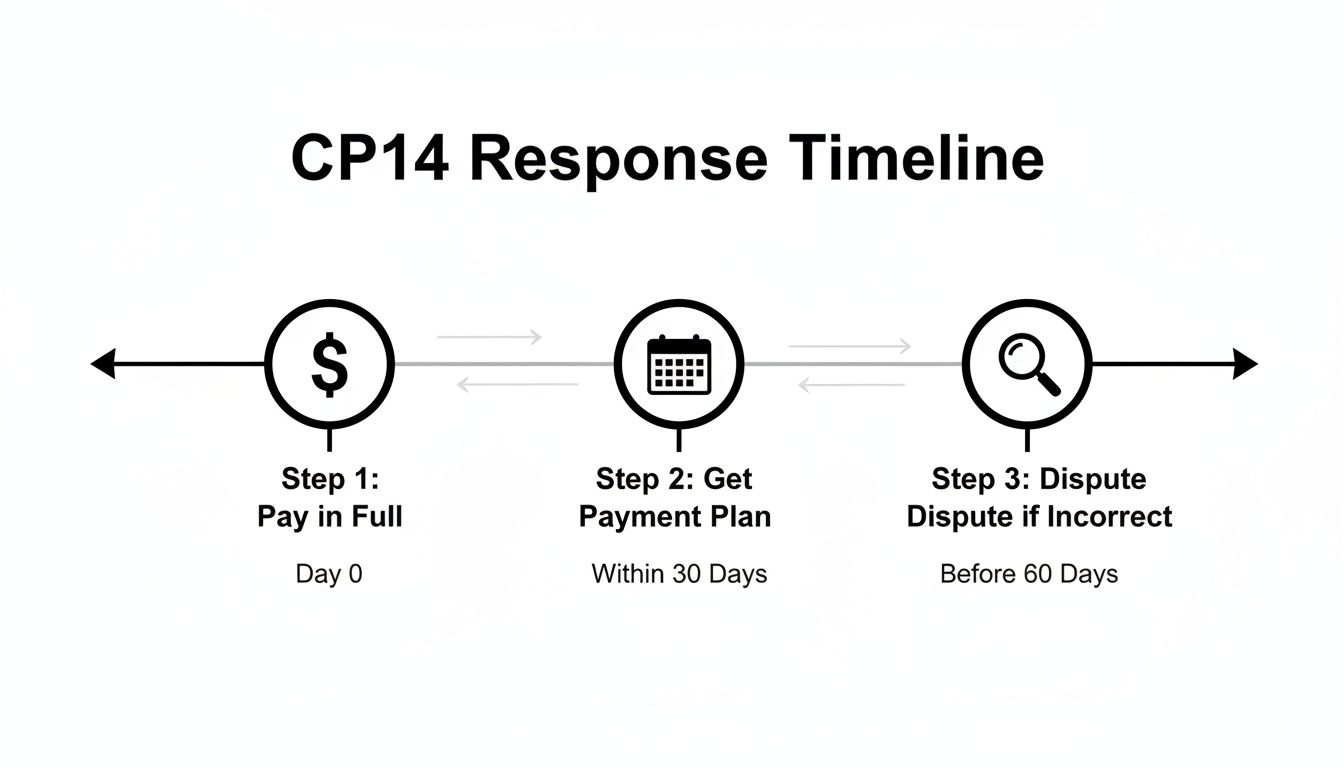
As you can see, being proactive is key. Paying what you owe, setting up a payment plan, or formally disputing the balance are your best moves right out of the gate.
The Escalation From Notices to Enforcement
If you miss the 21-day response deadline on the CP14, the IRS’s automated collection system kicks into gear. It will begin sending a series of follow-up notices, each one more serious than the last, signaling that the agency is getting closer to taking your assets.
This progression usually follows a standard script:
- CP501 Notice (Reminder): This is the second letter you’ll get. It's basically a firm reminder that your balance is still outstanding.
- CP503 Notice (Urgent Reminder): The tone gets more serious here. The letter stresses the need for immediate payment to head off further collection action.
- CP504 Notice (Final Notice of Intent to Levy): This one is a critical warning. It officially informs you that the IRS can legally seize—or levy—your state tax refund and apply it to your federal debt.
- LT11 or Letter 1058 (Final Notice of Intent to Levy and Notice of Your Right to a Hearing): This is the last and most severe warning you will receive. It gives you 30 days to either pay up or file a formal appeal before the IRS can start seizing your property, garnishing your wages, or cleaning out your bank accounts.
To give you a clearer picture of how quickly things can escalate, here's a typical timeline of what happens when a CP14 notice goes unanswered.
IRS Collection Timeline After an Unanswered CP14 Notice
| Timeframe After CP14 | Potential IRS Notice | Description of Action | Potential Consequence |
|---|---|---|---|
| 0-30 Days | CP14 (First Notice) | Initial bill for unpaid taxes, penalties, and interest. | Initial balance is established; penalties and interest begin to accrue daily. |
| 30-60 Days | CP501 (Reminder Notice) | Second request for payment with an updated balance. | Continued accrual of interest and penalties; increased pressure to respond. |
| 60-90 Days | CP503 (Urgent Notice) | A more forceful letter demanding immediate payment. | Your account is flagged for more serious action; the IRS is preparing for enforcement. |
| 90-120 Days | CP504 (Intent to Levy) | Official notice that the IRS can seize state tax refunds and other federal payments. | Loss of state tax refund; the IRS is now legally permitted to take certain assets. |
| 120-180 Days | Letter 1058/LT11 (Final Notice) | Final warning with a 30-day deadline to appeal before enforcement begins. | Imminent risk of bank levies, wage garnishments, and property seizures. |
| 180+ Days | Notice of Federal Tax Lien | A public legal claim against all your current and future property. | Severe credit damage; inability to sell property or obtain new loans. |
| 180+ Days | Levy (Form 668-A/W) | Active seizure of assets like bank accounts, wages, or property. | Loss of funds from your bank account, a portion of your paycheck, or physical assets. |
As the table shows, the path from a simple notice to aggressive collection is swift and well-defined. Unresolved balances push 35% of recipients toward a final notice like the LT11 within just six months. Understanding this timeline is crucial, and you can learn more by reading our guide on what happens when the IRS levies bank accounts.
Understanding The Difference Between a Lien and a Levy
As the IRS collection process moves forward, two words often cause a lot of confusion: lien and levy. They sound similar, but in the world of tax enforcement, they mean very different things. Getting this distinction right is key to understanding just how serious the consequences of inaction can be.
A tax lien is a claim, while a tax levy is an action. The lien secures the government's interest in your property, and the levy is the actual seizure of that property to satisfy the tax debt.
Here's an analogy. Think about the mortgage on your house. The bank has a lien on your property—it’s a legal claim that says they get paid first if you ever sell it. They don't own your house, but they have a secured interest in it. A federal tax lien works the same way; it’s a public notice to other creditors that the IRS gets first dibs on your assets.
A levy, on the other hand, is like the bank foreclosing. It's no longer just a claim; it's the active seizure of your property. The IRS isn't just standing in line anymore—they are taking your assets to pay off what you owe.
The Real-World Impact of Tax Liens and Levies
The consequences of a tax lien or levy are far from theoretical. They can have a direct, and often devastating, impact on your personal and financial life.
A federal tax lien becomes a public record that can torpedo your creditworthiness. While liens no longer appear on consumer credit reports, lenders for mortgages, car loans, and business financing will find them during public record searches. This makes it nearly impossible to get new credit.
An IRS levy is much more immediate—it's the direct seizure of your assets. The IRS has the legal authority to take money straight from your bank accounts, garnish a huge chunk of your wages, or even seize and sell your physical property, like your car or home.
These aren't empty threats. The IRS uses levies to seize approximately $15 billion from taxpayers every single year. These powerful enforcement tools are exactly why addressing a CP14 notice isn’t just a good idea—it’s absolutely essential for protecting your financial future.
When You Truly Can't Afford to Pay: Advanced IRS Relief Options
Sometimes, setting up an installment plan just isn't in the cards. When you're staring at a CP14 notice and know that paying the IRS would mean forgoing rent, groceries, or other basic necessities, you've entered the realm of true financial hardship.
The good news is, the IRS has programs for exactly these kinds of situations. These aren't easy routes—they require a thorough look at your finances—but they can be a lifeline when it feels like you're out of options.
The Offer in Compromise (OIC): Settling for Less
Think of an Offer in Compromise (OIC) as a formal settlement with the IRS. It’s a program that allows you to resolve your tax bill for less than the full amount you owe. This isn't a free-for-all, though. It's specifically for taxpayers who face such a significant financial burden that there's serious doubt they could ever pay the full debt.
To even be considered, you have to open up your books. The IRS will scrutinize your:
- Ability to pay: What's left after you cover necessary living expenses?
- Income: Both what you make now and what you could realistically make in the future.
- Asset equity: The value of everything you own—your house, car, savings, and other assets.
Essentially, the IRS will only agree to an OIC if the amount you offer is the most they could ever hope to get from you. For those who genuinely can't cover their tax bill, understanding an Offer in Compromise is a critical first step.
Heads Up: The OIC application is notoriously complex. A huge number of applications are rejected right off the bat for simple paperwork errors or because the filer doesn't meet the strict financial criteria. This is one area where professional help is almost always a good idea.
Currently Not Collectible (CNC) Status: Hitting the Pause Button
But what if even a reduced settlement is out of reach? That's where Currently Not Collectible, or CNC status, comes into play. CNC isn't a get-out-of-debt-free card; it's a temporary halt to all IRS collection activity.
If you can prove to the IRS that your income doesn't even cover your basic living costs, they can place your account in CNC status. This means the threatening letters, bank levies, and wage garnishments will stop. It’s a moment to breathe.
However, the debt doesn't disappear. Penalties and interest keep piling up on the original amount. The IRS will also check in on you periodically, usually every year or two. If your financial situation improves, they'll take you out of CNC status and start collections again. Still, for someone in a dire financial crisis, that pause can make all the difference.
Penalty Abatement: Wiping Penalties Off the Bill
Take a close look at your CP14 notice. Often, a hefty chunk of what you owe isn't the tax itself, but the penalties tacked on. Under the right circumstances, the IRS might agree to remove—or "abate"—those penalties, which can slash your total bill.
There are generally two ways to get penalties removed:
- First-Time Abate (FTA): This is your one-time "mulligan." If you've had a perfect record of filing and paying for the three years before the tax year in question, the IRS will often waive the penalties as a courtesy. You just have to ask.
- Reasonable Cause: This is a tougher argument to win. You have to prove that you had a legitimate, unavoidable reason for not filing or paying on time. Think major life events like a severe illness, a death in the family, a natural disaster destroying your records, or getting demonstrably bad advice from a tax pro.
To get penalties waived for reasonable cause, you need to build a solid case with documentation to back it up. It’s about telling a convincing story supported by facts. Exploring all the different tax debt relief options will help you figure out which strategy, from penalty abatement to an OIC, is the right fit for you.
Common Questions (and Straight Answers) About the CP14 Notice
Getting an IRS notice in the mail is guaranteed to spark a few questions. Once the initial shock wears off, you're left wondering what this really means for your finances, your credit, and your future.
Let’s cut through the confusion. Here are direct answers to the most pressing questions we hear from taxpayers who have just received a CP14 notice.
Is There Any Way to Get Penalties and Interest Removed?
Yes, getting penalties waived is often a real possibility, and it's called penalty abatement. The easiest route is the IRS’s First-Time Abate (FTA) program. Think of it as a one-time courtesy. If you’ve kept a clean slate with the IRS for the three years before the tax year in question, they’ll often agree to wipe out the penalties.
If that doesn't apply, you can argue for abatement based on "Reasonable Cause." This is for situations where life genuinely got in the way and you couldn't pay on time due to circumstances completely out of your control. Some common examples include:
- A debilitating illness or a death in your immediate family.
- Your home or financial records being destroyed in a fire, flood, or another disaster.
- You received provably wrong advice from a qualified tax professional.
Be warned, though—proving Reasonable Cause isn't easy and requires solid documentation. As for interest? That's a much tougher battle. The IRS rarely removes interest unless they themselves made a significant error that caused a delay.
Will a CP14 Notice Tank My Credit Score?
A CP14 notice itself won't show up on your credit report. The IRS doesn't report tax debts to Equifax, Experian, or TransUnion, so receiving this letter won't directly ding your score.
The real threat to your credit comes down the road if the debt goes unpaid. If the IRS can't collect the money, they might file a Notice of Federal Tax Lien. This is a public legal claim against your property. While these liens don't appear on your consumer credit report anymore, they are still very public records. Lenders for mortgages, car loans, or business financing will absolutely find them during a background check, which can stop a loan application in its tracks.
The bottom line: Dealing with your CP14 notice quickly is the best way to safeguard your financial health and avoid the serious credit problems a tax lien can cause.
What if I Already Paid the Bill on This Notice?
Even if you’re positive you’ve already paid, do not just toss the notice in the trash. This kind of mix-up happens more often than you'd think.
There are a few likely culprits:
- A Simple Processing Lag: The IRS is notoriously backlogged. Your payment might just be sitting in a queue, waiting to be posted to your account.
- A Misapplied Payment: It's possible your payment was mistakenly applied to the wrong tax year or, in rare cases, the wrong Social Security number.
- An Unexpected IRS Adjustment: The IRS may have changed something on your return, creating a new balance you weren't aware of.
Your first step is to track down your proof of payment—a copy of the canceled check (front and back) or a bank statement clearly showing the cleared transaction. With that in hand, call the IRS at the number listed on your CP14 to help them trace your payment and get things sorted out.
My Spouse Is the One Who Messed Up Our Joint Return. Am I Still on the Hook?
Unfortunately, when you sign a joint tax return, the IRS views you and your spouse as a single financial unit. The legal term for this is "joint and several liability," and it’s a big one. It means the IRS has the right to collect the entire tax debt from you, your spouse, or both of you, no matter who earned the income or made the mistake.
However, there is a potential way out called Innocent Spouse Relief. To qualify, you have to prove that you didn't know (and had no reason to know) about the error on the tax return and that holding you responsible for the debt would be fundamentally unfair. This requires filing a detailed Form 8857 and building a very convincing case, so getting professional tax advice is almost always a necessity.
Trying to figure out everything from penalty abatement to spouse liability on your own can feel like you're in over your head. Instead of guessing, get a clear, honest assessment of your options. The W Tax Group starts every case with a FREE Tax Debt Analysis, so you'll know exactly how we can resolve your IRS problems before you ever pay a fee. Contact us today to find your path to resolution.


