New York State Withholding Allowances: The Complete 2026
Learn how new york state withholding allowances work, how to claim them on IT-2104, and avoid costly mistakes in 2026 withholding calculations.
In this article
- Why Your New York Paycheck Is Withholding More Than You Expected
- The form that actually matters
- What a New York State Withholding Allowance Actually Is
- Allowances are estimates, not guarantees
- How Federal W-4 and New York IT-2104 Diverge in 2026
- What zero really means
- How to Complete Form IT-2104 the Right Way
- Use this filing sequence
- Nonresidents need more than an allowance count
- Calculating the Dollar Impact of Each Allowance
- How payroll applies the value
- The Multi-Jurisdiction Trap for Remote and Hybrid Workers
- Remote work requires a location review
- What New York Employers Must Do With Each Employee's Allowances
- Keep the file defensible
- Your Final Checklist to Avoid an April Surprise
- Employee review
- Employer review
For 2026, one New York State, New York City, and Yonkers withholding allowance is still worth $1,000, and employees subject to New York withholding must file Form IT-2104 because the federal W-4 no longer reports allowances. That state form, not a zero-allowance federal W-4, controls the New York calculation.
You may have discovered the problem by opening a paycheck that looks smaller than expected, or by receiving a tax bill after assuming your payroll department had everything covered. A federal W-4 and a New York IT-2104 serve different systems. Treating them as interchangeable is one of the fastest ways to create inaccurate withholding.
For employees, the fix starts with identifying the correct New York form, allowance count, residency status, and work-location allocation. For employers, the job is to collect the right certificate, apply the current New York tables, and update payroll when an employee's facts change.
Why Your New York Paycheck Is Withholding More Than You Expected
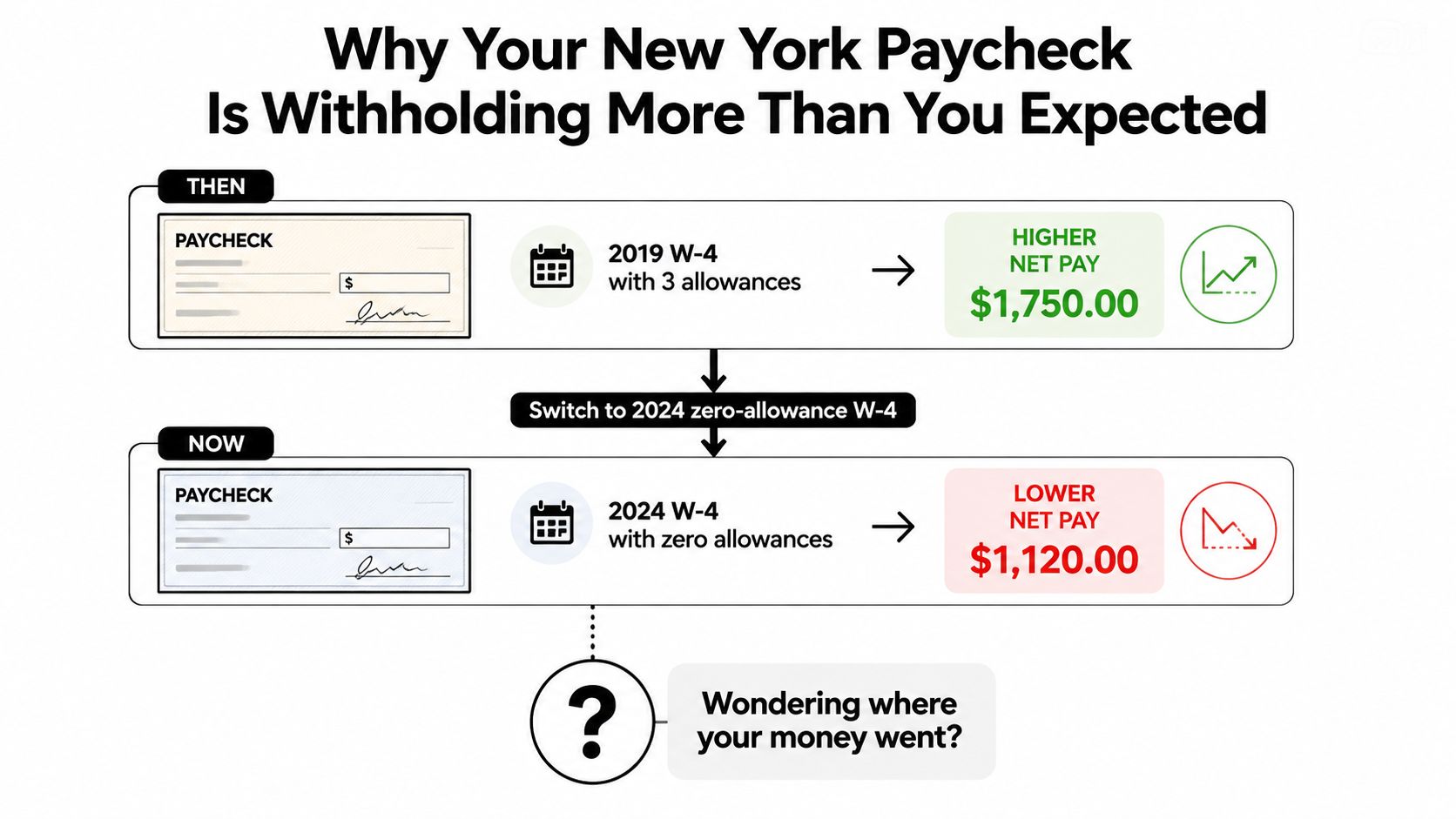
Suppose you earn $75,000 in New York and moved from a 2019 federal W-4 showing three allowances to a modern federal W-4 showing zero. Your federal form no longer displays the old allowance count, but that doesn't mean New York has abandoned its own allowance system. New York uses Form IT-2104 to determine state, New York City, and Yonkers withholding, as explained in the New York IT-2104 instructions.
The confusion starts when payroll staff or employees assume the federal zero on the W-4 automatically means zero allowances for New York. If no IT-2104 is filed after an employee submits a federal W-4 for 2020 or later, New York allows the employer to use zero as the New York allowance count. That default can increase withholding, but it still might not produce the right result for a worker with multiple jobs, bonuses, changing dependents, or income connected to more than one jurisdiction.
The form that actually matters
New York treats the state certificate separately. An employee subject to New York State, New York City, or Yonkers withholding should complete IT-2104 and give it to the employer. A prior federal W-4 can sometimes be carried forward when it was filed for 2019 or earlier, but New York warns that this may create incorrect withholding because federal and state tax rules differ.
Practical rule: A zero on the federal W-4 isn't a New York tax strategy. It's only a federal payroll instruction unless the employee separately completes the New York certificate.
Your practical sequence is straightforward:
- Review the state form: Confirm that an IT-2104 is on file, rather than assuming the W-4 covers both taxes.
- Check the allowance count: Make sure the number reflects the employee's current household and filing circumstances.
- Review work location: A nonresident or hybrid employee may need allocation information even when the allowance count appears correct.
- Revisit changes: Marriage, divorce, a second job, a new dependent, or a move can make an old certificate unreliable.
The paycheck problem isn't always “too much tax.” It may be a mismatch between the employee's actual New York tax situation and the payroll assumptions used to calculate withholding.
What a New York State Withholding Allowance Actually Is
A New York withholding allowance is a payroll calculation amount, not a tax exemption. New York's materials identify the value of one New York State, New York City, and Yonkers allowance as $1,000. The employer uses the employee's allowance count with the applicable withholding tables to estimate how much tax to hold from wages.
That distinction matters. Claiming an allowance doesn't remove $1,000 from your final New York tax bill, and it doesn't create a separate deduction on the New York return. It changes the wage amount used during payroll calculations, so the employer withholds less throughout the year when the employee claims qualifying allowances.
Employees generally use IT-2104 to report the relevant household information and allowances. Depending on the employee's circumstances, the calculation can account for the employee, a spouse on a joint return, and dependents the employee expects to claim on the New York return. The form is therefore an estimate of the employee's anticipated tax situation, not a permanent declaration.
Allowances are estimates, not guarantees
An allowance count can be reasonable and still produce an imperfect result. Payroll withholding depends on wages, pay frequency, supplemental compensation, other employment, and the applicable jurisdiction. A bonus or second job can change the annual picture even when the IT-2104 has not changed.
Employees often need help separating withholding accuracy from ultimate tax liability. The first concerns the amount held from each paycheck. The second is determined when the tax return is prepared. For a broader explanation of how allowances work as payroll estimates, see this guide to the definition of tax allowances.
The correct objective isn't to claim the maximum number or automatically claim zero. It's to provide a certificate that matches the facts and to update it when those facts change.
How Federal W-4 and New York IT-2104 Diverge in 2026
The federal W-4 and New York IT-2104 are separate forms with separate mechanics. The federal form no longer reports withholding allowances for tax years 2020 or later. New York, however, continues to use a numerical allowance system for state and local payroll withholding, with the state allowance value remaining $1,000 in the 2026 materials (New York withholding forms and instructions).
The difference becomes clearer when you compare the two systems directly.
| Feature | Federal W-4 (2026) | New York IT-2104 (2026) |
|---|---|---|
| Primary method | Uses filing information, dependents, other jobs, deductions, and extra withholding instructions | Uses a numerical allowance count for New York withholding |
| Allowance reporting | Federal Form W-4 no longer reports allowances for tax years 2020 or later | IT-2104 remains the state withholding certificate |
| Allowance value | The federal figure used in New York's comparison method is $4,300 | One New York State, New York City, and Yonkers allowance is $1,000 |
| Payroll use | Determines federal income tax withholding | Determines New York State, New York City, and Yonkers withholding |
| Employer treatment | Calculated under federal payroll rules | Calculated separately under New York withholding tables |
The federal $4,300 figure and the New York $1,000 figure aren't interchangeable. New York's tables require a correction to the federal method because the state allowance value is lower. The state instructs payroll to multiply the per-allowance adjustment by the number of claimed allowances and add that amount to federally calculated wages after allowances, as described in the 2026 New York withholding tables.
What zero really means
A federal W-4 showing zero doesn't tell the New York payroll system how many state allowances belong on IT-2104. If the employee doesn't submit the state form, the employer may use zero under New York's instructions. That may be appropriate for some workers, but it can be wrong for others, particularly when residency, allocation, or multiple-job factors affect the state calculation.
Employers should calculate federal and New York withholding independently. Employees should complete both forms independently. The IRS withholding tips archive can help with the federal side, but it doesn't replace the New York certificate.
How to Complete Form IT-2104 the Right Way
Start with the employee's New York connection, not the federal W-4. Form IT-2104 is the state withholding allowance certificate, and the employee should provide it to the employer when beginning employment or when a material change makes the existing form inaccurate.
Use this filing sequence
Identify the employee's status. Determine whether the employee is a New York State resident, New York City resident, Yonkers resident, or a nonresident whose wages require allocation analysis.
Complete the personal information. The employee provides identifying information and the applicable residency details requested on the form.
Calculate the allowance count. The employee claims the New York allowances supported by expected filing circumstances, including applicable spouse and dependent information.
Address additional withholding carefully. Extra withholding can help when the employee has other income, but it shouldn't compensate for a wrong residency or allocation analysis.
Sign and submit the form. Payroll should use the signed certificate for New York withholding and replace the prior form when the employee submits an updated version.
An employee should update IT-2104 after a marriage, divorce, new dependent, second job, or significant change in wages. The federal W-4 redesign didn't eliminate that responsibility for New York employees.
Nonresidents need more than an allowance count
A nonresident employee may need Form IT-2104.1, the New York State, New York City, and Yonkers Certificate of Nonresidence and Allocation of Withholding Tax. New York's withholding guidance also identifies a separate form for applicable Yonkers residency situations. These forms address where wages are subject to withholding, which is a different question from how many allowances the employee may claim.
One IT-2104 should be on file for each employee subject to New York withholding, but that certificate may need to be accompanied by allocation documentation. Don't ask a nonresident to solve a location problem by selecting zero allowances. Zero allowances increase withholding, but they don't determine whether the wages were allocated to the correct jurisdiction.
Calculating the Dollar Impact of Each Allowance
New York's allowance value gives payroll a clear starting point. One allowance equals $1,000 for New York State, New York City, and Yonkers purposes under the state's payroll materials.
One allowance adjusts the withholding base by $1,000 annually. The actual paycheck reduction depends on the employee's wages, pay frequency, filing information, tax rate, and jurisdiction. Payroll should calculate the result through the applicable New York tables, rather than treating the allowance as a direct tax credit.
| Jurisdiction | Annual value per allowance | Weekly reduction | Biweekly reduction |
|---|---|---|---|
| New York State | $1,000 | Must be calculated from the applicable tables | Must be calculated from the applicable tables |
| New York City | $1,000 | Must be calculated from the applicable tables | Must be calculated from the applicable tables |
| Yonkers | $1,000 | Must be calculated from the applicable tables | Must be calculated from the applicable tables |
The annual figure does not produce one fixed weekly or biweekly reduction. New York's payroll tables determine the withholding for each pay period, and employees with the same allowance count can see different results because their wages and tax circumstances differ.
How payroll applies the value
An employee claiming one allowance generally gives payroll a different withholding base from an otherwise similar employee claiming zero allowances. The employer then applies the appropriate New York tables to determine the amount withheld for that payroll period.
For a Manhattan employee earning $75,000, the useful comparison is the withholding calculated with one allowance versus the amount calculated with zero. The allowance itself is not a $1,000 paycheck reduction.
A Yonkers employee requires separate review of New York State, Yonkers, and potentially New York City treatment. One state allowance count does not automatically resolve every local withholding question.
Use the current payroll tables instead of a rough percentage or a spreadsheet copied from an earlier year. New York states that its 2026 withholding tables apply to payrolls made on or after January 1, 2026, while the allowance value remains $1,000. For a structured explanation of the calculation process, review this step-by-step tax liability guide. That approach helps separate the allowance adjustment from the employee's actual liability and prevents federal W-4 figures from being applied mechanically to New York withholding.
The Multi-Jurisdiction Trap for Remote and Hybrid Workers
The most dangerous mistake isn't always claiming too few allowances. It's assuming that a correct allowance count fixes an incorrect work-location analysis.
A Connecticut resident who works remotely for a Manhattan employer may think zero allowances are the safest option. They may still have the wrong New York withholding if the wages should be analyzed under New York's nonresident allocation rules. The allowance count estimates the amount withheld. It doesn't decide where the income is sourced.
Remote work requires a location review
New York's guidance directs employees to use Form IT-2104.1 when applicable. That form addresses nonresidency and allocation, which can matter for employees who work partly inside and partly outside New York or who live outside the state.
New York's convenience-of-the-employer rule can also affect nonresident employees working outside New York for a New York-based employer. Working from home in another state doesn't automatically remove the income from New York withholding. The relevant analysis can turn on the employer's business needs and the facts supporting the out-of-state work arrangement.
That is why a hybrid employee should maintain records supporting work location and allocation. The employee should also consider whether another state will tax the same income and whether a credit mechanism may address double taxation. Reciprocal arrangements and resident-credit rules require fact-specific review, so don't treat a neighboring state relationship as an automatic exemption.
The wrong allocation cannot be repaired by adding extra withholding. More tax withheld from the wrong jurisdiction is still a payroll error.
New York's 2026 rate materials emphasize that withholding methods changed while the allowance value remained stable (New York withholding tax rates and tables). For a remote worker, that means the payroll team must review both the calculation method and the employee's residency and allocation forms. If the employee's wages require allocation, Form IT-2104.1 should support the payroll treatment instead of relying on a zero-allowance default.
What New York Employers Must Do With Each Employee's Allowances
New York employers should treat IT-2104 as a core payroll record, not an optional administrative detail. The federal W-4 doesn't replace it, and a payroll system that stores only the federal election is missing information needed for New York withholding.
Use this employer checklist:
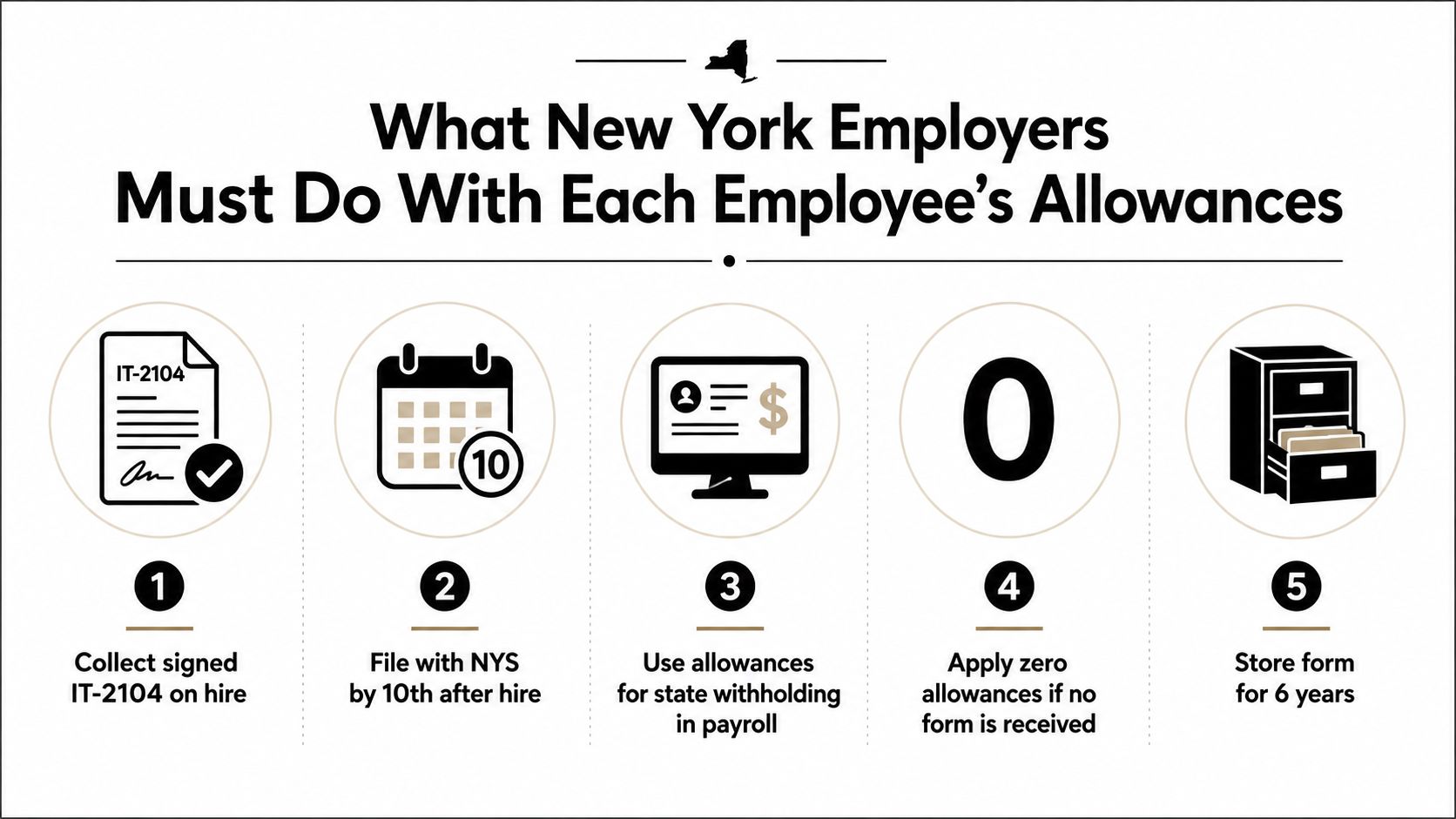
- Collect the state certificate: Obtain a completed IT-2104 from each employee subject to New York withholding. Request IT-2104.1 when nonresidency or wage allocation applies.
- Apply the default correctly: If an employee subject to New York withholding doesn't provide the state form, New York's instructions permit the employer to use zero as the allowance count in the relevant circumstances.
- Separate the calculations: Process federal withholding from Form W-4 and New York withholding from IT-2104 and any required allocation certificate.
- Use the current tables: Apply the New York State, New York City, and Yonkers tables that correspond to the payroll date and employee's tax connection.
- Update payroll promptly: Replace the prior certificate when an employee submits a revised IT-2104.
- Review mobile workers: Confirm that remote and hybrid employees have residency and allocation information supporting the withholding treatment.
Keep the file defensible
Payroll should preserve the signed state forms and the records supporting nonresident allocation. A revised form shouldn't sit in an email inbox while the payroll system continues using the old election. Employers also need a process for reconciling wage and withholding information reported through required New York filings and year-end wage statements.
Don't invent a local withholding line or manually override the tables without documenting why. A small business that uses a payroll provider still needs someone internally to verify that the provider received the correct forms and applied the correct jurisdictions.
Businesses building a broader compliance process can review these small business payroll tax resources. The main operational point is simple: collect, classify, calculate, update, and retain.
Your Final Checklist to Avoid an April Surprise
Employees and employers share the responsibility for accurate withholding, but they control different parts of the process. Employees control the information. Employers control how the information enters payroll.
Employee review
- Recheck IT-2104: Update it after a marriage, divorce, new dependent, second job, or move into or out of New York City or Yonkers.
- Separate federal and state forms: Confirm that the federal W-4 and New York IT-2104 each reflect their own rules.
- Review nonresident status: If you live outside New York or work across state lines, determine whether IT-2104.1 and allocation records are needed.
- Compare withholding to reality: Use New York's withholding resources during the year and after year-end instead of waiting for the tax return to reveal a problem.
Employer review
- Audit every employee file: Verify that each New York employee has the appropriate state certificate or that the zero-allowance default was applied correctly.
- Check mobile workers: Confirm that nonresident employees have allocation information supporting their payroll treatment.
- Reconcile payroll reporting: Compare payroll records with New York filings and year-end wage statements.
- Close the year carefully: Review the final payroll before year-end so updated allowance elections are reflected accurately.
A focused review in November can expose a missing IT-2104, an outdated allowance count, or a remote-work allocation problem before it becomes a balance due. Employers who want practical payroll administration guidance can also browse payroll resources for help organizing recurring compliance tasks.
Tax Attorney Stephen A Weisberg helps employees and small businesses analyze New York withholding problems, including missing IT-2104 forms, inaccurate allowance elections, and multistate payroll issues. Visit Tax Attorney Stephen A Weisberg to request a focused review of your withholding and determine the next step before a payroll mistake becomes an April tax problem.


