New York State Taxes Payment Plan: Your Guide
Explore the new york state taxes payment plan and see how it helps you set up an affordable payment schedule, reduce penalties, and stay compliant. Learn more.
In this article
- Facing a NY Tax Bill You Cannot Pay
- Why an Installment Payment Agreement Is Your Best First Step
- Do You Qualify for a NYS Tax Payment Plan? Let's Find Out
- The Number One Requirement You Can't Ignore
- The Quick Eligibility Checklist
- What if You Owe More Than $20,000?
- Getting Your Payment Plan Set Up Online
- Finding the Payment Options Menu
- Finalizing the Agreement
- What Happens After Your Plan Is Approved
- Your Ongoing Responsibilities as a Taxpayer
- Understanding the Terms of Your Agreement
- How to Manage or Modify Your Tax Agreement
- What Happens if You Default
- Requesting a Change to Your Agreement
- Common Questions About NYS Payment Plans
- Will Interest and Penalties Keep Growing?
- Can I Pay Off My NYS Payment Plan Early?
- What Happens if I Miss a Payment?
- How Is a Payment Plan Different From an Offer in Compromise?
That letter from the New York State Department of Taxation and Finance is in your hand, and your stomach drops. The amount owed is more than you can possibly pay right now. It's a tough spot to be in, but the most important thing to know is that you have options.
The best first step for most people is setting up a New York State taxes payment plan, which the state officially calls an Installment Payment Agreement (IPA). This is a formal deal that lets you chip away at your tax debt with manageable monthly payments.
Facing a NY Tax Bill You Cannot Pay

It’s easy to feel overwhelmed by a big tax bill, especially in New York. We live in a notoriously high-tax state. Back in 2019, for instance, New Yorkers paid an average of $13,336 per person in federal taxes alone, which was miles above the national average. A detailed report on New York's federal tax contributions really puts into perspective how quickly state tax issues can add up.
Whatever you do, don't just ignore the notice. That's the absolute worst-case scenario. The state won't forget, and they have serious collection powers, like garnishing your wages or levying your bank account. An Installment Payment Agreement is your way to get ahead of that and take back control.
Why an Installment Payment Agreement Is Your Best First Step
An IPA is a straightforward contract with the state. You agree to make monthly payments for a specific period—usually up to 36 months—until the debt is cleared. It’s not a way to reduce what you owe, but it's an incredibly powerful tool for managing the liability without the state coming after your assets.
Here’s why it’s such a lifeline:
- It stops collection actions. As soon as your IPA is approved, the aggressive collection efforts stop. No more worrying about threatening letters.
- It gives you breathing room. That huge, scary number is broken down into predictable monthly amounts that you can actually budget for.
- It keeps things from getting worse. By showing you're willing to pay, you can often prevent the state from filing a tax warrant against you.
Key Takeaway: The single biggest reason to get on a New York State taxes payment plan is that it immediately halts collection activity. This gives you the peace of mind to tackle the debt systematically, free from the constant threat of a frozen bank account or a chunk of your paycheck disappearing.
Of course, an IPA isn't the only solution out there. If you're dealing with a true financial crisis and paying the full amount—even over time—just isn't realistic, other paths might be better. It's worth knowing about all the tools available, like the federal option for Currently Not Collectible status, to see if a different approach fits your circumstances.
However, for most people who can eventually pay the full amount, the IPA is the perfect lifeline when you just can't pay it all at once.
Do You Qualify for a NYS Tax Payment Plan? Let's Find Out
Not everyone can just hop online and set up a payment plan for their New York State taxes. The NYS Department of Taxation and Finance has specific rules in place, and knowing them upfront can save you a lot of time and frustration. It's all about making sure your situation fits what their system is designed for.
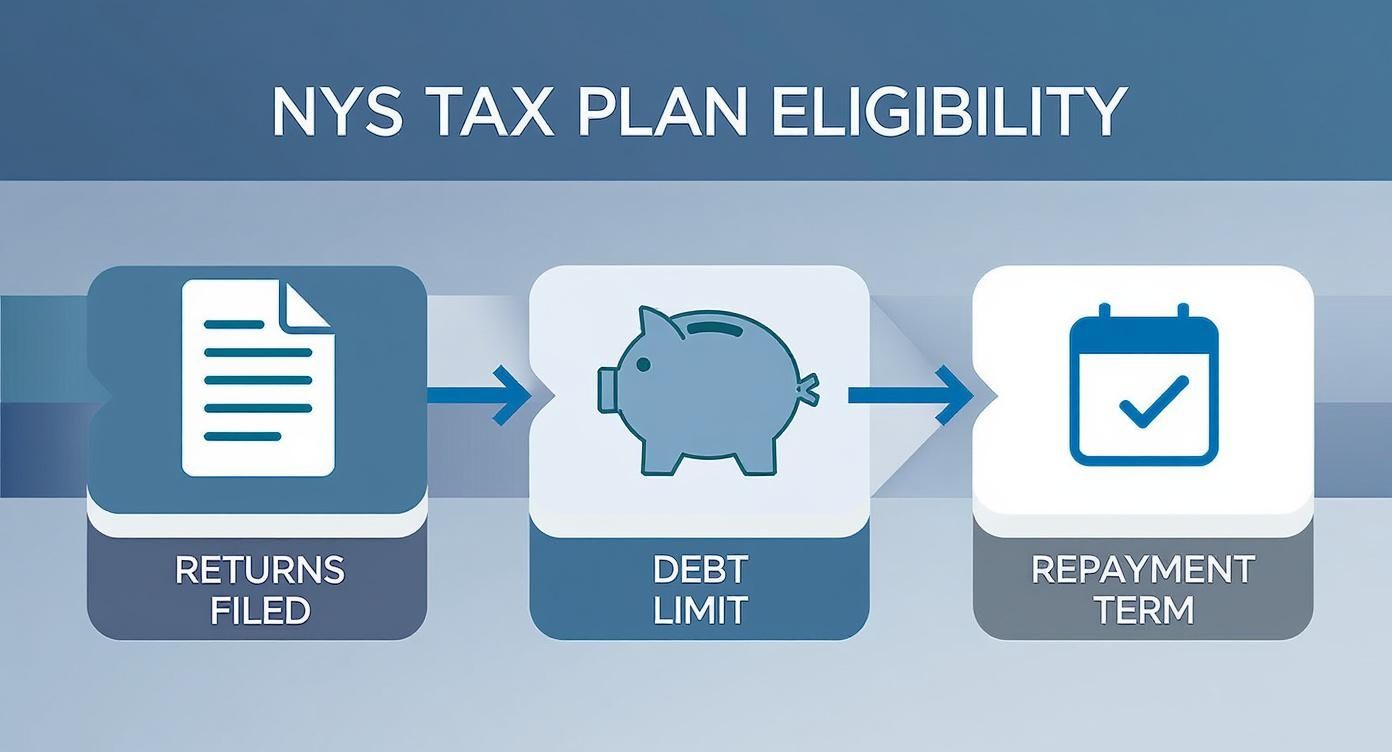
The state’s online portal is really built for people with relatively straightforward tax debts. If you owe $20,000 or less—and that total includes all the penalties and interest—and you’re confident you can pay it all off within 36 months, you’re in the sweet spot. The online application will be your quickest route to getting this sorted out.
But there’s one big catch that trips people up all the time.
The Number One Requirement You Can't Ignore
Before New York will even entertain the idea of an Installment Payment Agreement (IPA), you have to be completely up to date with your filings. That means every single required tax return must be filed. The state simply won't negotiate a payment plan for one year if they're still waiting on a return from another.
This is non-negotiable. For instance, say you owe taxes for 2022 and want to set up payments, but you never got around to filing your 2021 return. Your IPA application will be dead on arrival until that 2021 return is officially submitted.
The Quick Eligibility Checklist
To make it even clearer, here’s a simple table to see if the online payment plan is the right fit for you.
Quick Eligibility Checklist for an Online NYS Payment Plan
| Requirement | Details | What It Means for You |
|---|---|---|
| Total Debt Amount | Must be $20,000 or less (tax, penalties, and interest combined). | If you owe more, you'll need to pursue a manual application with more financial details. |
| Repayment Term | You must be able to pay the full balance within 36 months. | The system won't allow you to stretch payments beyond this three-year window. |
| Filing Compliance | All required tax returns must be filed. | Check your records. If any years are missing, file them immediately before applying. |
If you can check off all three boxes, you're in a great position to use the state's online system. If not, don't worry—you still have options.
What if You Owe More Than $20,000?
If your tax bill is north of the $20,000 online limit, or if there's no way you can clear the debt in three years, you aren't out of luck. It just means you have to go a different route. You'll need to file a manual application, which is a more involved process requiring a deeper dive into your finances.
In this situation, you’ll need to assemble a complete picture of your financial health. Tools like an AI Agent - Finance Tax Document Analyzer can be helpful here, allowing you to quickly scan and pull key figures from your existing financial documents to prepare your application.
This manual process usually means submitting a detailed financial statement—think income, assets, monthly expenses, the whole nine yards. It’s very similar to the federal process. If you’ve ever seen an IRS Form 433-F (Collection Information Statement), you’ll have a good idea of the kind of financial transparency New York will be looking for.
Key Insight: For larger debts or longer payment terms, the state needs to understand why you need the arrangement you're proposing. They want to see your full financial picture to confirm you can't pay the debt faster. Being prepared to document your income, rent, car payments, and other obligations is the key to getting a more complex agreement approved.
Getting Your Payment Plan Set Up Online
Alright, you've figured out you're eligible for a payment plan. Now comes the part where you actually make it happen. The fastest way to lock in your Installment Payment Agreement (IPA) is through the New York State Department of Taxation and Finance's online portal. It's a secure system, but knowing the lay of the land before you dive in will save you a lot of headaches.
First things first, this whole process lives inside your Online Services account. If you've ever filed your state taxes or checked a refund status online, you’re already set. If not, your first task is to create an account. It’s a mandatory step.
The image above is what you'll see on the main login page—this is your starting point for handling just about anything related to your NYS taxes. Once you're in, you'll land on a personalized dashboard that shows your accounts.
Finding the Payment Options Menu
After you log in, you'll be at your account summary page. From here, you need to find the menu item labeled "Payments, bills and notices." This is the central hub for anything involving money you owe the state. Once you click that, look for the option to "Request an Installment Payment Agreement."
This will pull up a list of your outstanding tax bills. You'll need to select the specific bill—or bills—you want to wrap into the payment plan. If you owe for multiple years, this is where you’ll typically bundle them all together into one manageable agreement.
To make the application fly by, I always tell my clients to gather a few key pieces of information before they even log in:
- Your Notice Number: Grab the tax bill you received in the mail. The notice number is usually printed clearly on the top right corner.
- Bank Details: You'll need your bank's routing number and your account number to set up the required automatic payments.
- Your Proposed Payment Amount: Know what you can realistically afford to pay each month. It's also smart to think about a potential down payment.
A Quick Pro Tip: Offering a reasonable down payment can go a long way. It shows the tax department you're serious about clearing the debt and can make them more likely to accept your proposed monthly payment without any pushback. Even a small initial payment helps build goodwill.
Finalizing the Agreement
The online portal does a good job of walking you through the final steps. You’ll be prompted to enter your proposed down payment (if you're making one) and the monthly payment amount you've decided on.
The system will then calculate the full term of your agreement. Keep in mind, any plan you set up online is capped at a maximum of 36 months.
Once you've looked over all the terms and feel confident you can manage the payments, you'll electronically sign the agreement. That's it. This final click officially submits your request to the NYS Tax Department, and you should get an instant confirmation that it's been received.
While the New York process is its own beast, the core idea of figuring out a sustainable payment is the same whether you're dealing with state or federal taxes. For more perspective on how to crunch the numbers and find a payment that fits your budget, check out our IRS payment plan calculator guide. The strategies there can absolutely be applied to your New York tax situation.
What Happens After Your Plan Is Approved
You’ve submitted your payment plan request to the New York State Tax Department. That’s a huge step, and you can finally take a breath. The immediate pressure of potential levies or wage garnishments starts to lift, but it’s crucial to remember this isn't the finish line. It's the start of a new commitment, and staying on top of it is everything.
If you applied online, you probably got an instant confirmation that your request was received. That’s great, but the official approval notice is what really matters. Expect that to arrive by mail within a few weeks. This letter is your official green light from the NYS Tax Department.
This confirmation is the most important piece of paper in the whole process. It lays out all the terms you agreed to in black and white: your official start date, the exact monthly payment, and the total amount you’ll be paying off. And yes, that total will include all the penalties and interest that have built up so far.
Your Ongoing Responsibilities as a Taxpayer
Getting an Installment Payment Agreement (IPA) approved means you have to hold up your end of the deal. The state is giving you a structured way to get back on track, and they have very clear expectations. Think of it as an active responsibility, not a one-time fix.
Your core duties are simple, but they are non-negotiable:
- Pay on time, every time. Your full payment must be made by the due date each month. There's really no wiggle room or grace period here.
- Stay current on all new taxes. This is the one that trips people up. You have to file all future tax returns on schedule and pay any new tax bills in full. If you fall behind on a new tax year, the state can, and often will, void your existing payment plan.
Key Takeaway: An approved New York State taxes payment plan isn't a "set it and forget it" deal. It requires you to be proactive. One missed payment or a late tax filing can put you in default, and the state will pick up its collection efforts right where it left off.
Understanding the Terms of Your Agreement
That approval letter is your roadmap. It will spell out exactly how to make your payments, which is usually through the automatic bank withdrawal you authorized when you applied. I always tell my clients to set a calendar reminder for a couple of days before each payment hits. It's a simple way to make sure the funds are ready and waiting in your account.
Also, remember that interest and penalties don't just vanish because you're on a plan. They will keep accumulating on your outstanding balance until the debt is paid in full. This is why sticking to the schedule is so vital. If you find yourself with a little extra cash, consider making an additional payment. It will help clear the debt faster and save you a significant amount in interest over the life of the agreement.
How to Manage or Modify Your Tax Agreement
Life has a way of throwing curveballs. A sudden job loss, an unexpected medical emergency, or a significant drop in your income can completely derail your financial plans. If you've got an approved payment plan with the New York State Tax Department and find yourself unable to keep up, it's easy to feel overwhelmed.
But here’s the most important piece of advice I can give you: don’t bury your head in the sand. Be proactive. The absolute worst thing you can do is ignore the problem and hope it goes away.
If you think you're going to miss a payment, your very first call should be to the NYS Tax Department. The key is to get in touch with them before the due date passes. From my experience, the state is far more willing to work with taxpayers who are upfront and honest about their financial struggles. Once you miss a payment and go into default, your options shrink dramatically, and you’re right back on their aggressive collections radar.
What Happens if You Default
Let's be clear: defaulting on your Installment Payment Agreement (IPA) is a big deal. It essentially voids the deal you made, and the state can immediately bring out the heavy-duty collection tools.
This isn’t just a strongly worded letter. We're talking about serious actions like:
- Issuing a tax warrant. This is a public record that acts as a lien against your real and personal property.
- Levying your bank accounts. They can freeze and seize the funds right out of your checking or savings account, often without any prior warning.
- Garnishing your wages. The state can order your employer to send a chunk of your paycheck directly to them before you even see it.
Climbing out of a default is tough. It's not impossible, but you'll have to start the negotiation process all over again, and you can bet the terms won't be as favorable the second time around.
Requesting a Change to Your Agreement
If your financial situation has taken a significant, long-term hit, you can formally request to modify your payment plan. This isn't for a one-off tight month; it's for situations like a permanent pay cut or a long-term disability.
Be ready to back up your story with proof. Gather documents like layoff notices, new pay stubs showing reduced income, or medical bills. When you reach out, have your facts straight. Clearly explain what’s changed and propose a new, realistic monthly payment you know you can handle. Honesty and organization go a long way in these conversations.
It helps to remember the scale of this operation. For the 2025 fiscal year, New York City's cash receipts reached a staggering $143.607 billion. Personal income tax alone accounted for $18.412 billion of that amount. The state wants its money, and they’d much rather get a steady, modified payment from you than nothing at all from a defaulted account.
If your situation is particularly complex and you can't pay the full amount owed over time, you might need to look into other avenues. For some, a Partial Pay Installment Agreement is a viable path forward. You can learn more in our guide to the Partial Pay Installment Agreement.
While you're getting your tax affairs in order, it can also be helpful to understand how other legal agreements work. Resources for general New York legal document templates like Non-Disclosure Agreements can provide a broader context for managing official commitments.
Common Questions About NYS Payment Plans
Setting up a New York State taxes payment plan is a huge step, but it often brings up more questions. What happens after the agreement is in place? What's the fine print?
Let's break down the most common questions people have. Getting clear, direct answers will help you manage your tax debt confidently and avoid any surprises down the road.
Will Interest and Penalties Keep Growing?
Unfortunately, yes. An Installment Payment Agreement (IPA) is incredibly helpful for stopping aggressive collection actions like wage garnishments, but it doesn't hit the pause button on your balance.
Interest and penalties will continue to pile up on your unpaid tax bill until it's completely paid off. This means the final amount you pay will be more than the original debt. The absolute best strategy is always to pay your balance off as quickly as your budget allows to keep those extra costs to a minimum.
Can I Pay Off My NYS Payment Plan Early?
You absolutely can, and you should if you're able. There are no prepayment penalties for paying off your New York State tax debt ahead of schedule.
Think about it this way: since interest and penalties are adding up every day, any extra payment you make saves you real money. You can chip away at the principal by making additional payments or pay it all off with a lump sum anytime through your Online Services account. This is the fastest way to stop the interest clock and get the debt behind you.
Expert Insight: I always tell my clients to treat their tax debt like a high-interest credit card. The longer you let that balance sit there, the more it costs you. Getting it paid off early is one of the smartest financial moves you can make once you're back on your feet.
What Happens if I Miss a Payment?
This is a big one. Missing a payment is a serious problem that can unravel all your hard work and put you right back in the state's crosshairs.
If you miss a scheduled payment, the state can immediately default your agreement. As soon as that happens, the NYS Tax Department is free to restart aggressive collection actions. We're talking about things like issuing a tax warrant, levying your bank account, or garnishing your wages.
If you know you're going to have trouble making a payment, you need to contact the Tax Department before it's due. Being proactive is your only real defense here.
How Is a Payment Plan Different From an Offer in Compromise?
People mix these two up all the time, but they are fundamentally different solutions for very different situations. Grasping this distinction is crucial for picking the right strategy.
Installment Payment Agreement (IPA): This is a plan to pay your full tax debt over an extended period. It’s for people who can afford to pay what they owe, but just need more time to do it.
Offer in Compromise (OIC): An OIC is a proposal to the state to settle your tax debt for less than the full amount owed.
Getting an OIC approved is a much higher hurdle. The state reserves it for taxpayers in severe financial distress who have no reasonable way to ever pay their entire debt. For most people, a New York State taxes payment plan is the far more practical and achievable solution.
At the law office of Attorney Stephen A Weisberg, we know how stressful facing tax debt can be. We offer a FREE Tax Debt Analysis to help you find the best path forward. If you need an expert in your corner, visit us at weisberg.tax to see how we can help.


