Mastering the W-4 Multiple Jobs Worksheet 2026
Use the W-4 Multiple Jobs Worksheet correctly in 2026 to prevent a surprise tax bill. Our guide offers clear examples and expert tips for accurate withholding.

In this article
- The High Cost of a Simple Withholding Mistake
- Why standard withholding misses the mark
- Why this matters beyond a refund
- Do You Need the Multiple Jobs Worksheet
- Use it if your situation looks like this
- Don't use it as a cure-all for every kind of income
- Completing the Worksheet for Two Jobs A Walkthrough
- The clean way to do it
- The mistake that keeps causing trouble
- Handling Three or More Jobs and Complex Pay
- How the worksheet handles three or more jobs
- Why the order matters
- When the worksheet starts to feel too narrow
- Worksheet Alternatives and Common Mistakes
- The Step 2(c) checkbox
- A side-by-side view
- The mistakes I'd tell you to avoid first
- Your Next Steps for Tax Peace of Mind
- When a W-4 update isn't enough
You picked up a second job, or your spouse started working again, and the paychecks look fine. Nothing feels wrong. Then tax season arrives and the refund you expected turns into a balance due.
That surprise usually starts with one quiet assumption inside payroll. Each employer withholds as if that paycheck is your only paycheck. If your household has more than one stream of W-2 income, that assumption can break your withholding fast.
I've seen the aftermath often enough to be blunt about it. The Multiple Jobs Worksheet isn't just another IRS worksheet. It's one of the clearest tools available to stop a preventable tax bill before it starts.
The High Cost of a Simple Withholding Mistake
A common version of this problem looks like this. Someone works a main job, picks up a second W-2 job, fills out the hiring paperwork quickly, and checks whatever seems reasonable on the W-4. Months later, they learn the hard way that “reasonable” and “accurate” aren't the same thing.
The trouble is mechanical, not moral. Your first employer withholds based on that wage alone. Your second employer does the same. Neither payroll department knows, or should know, the full tax picture for your household unless you tell the system how to account for it on Form W-4.
Why standard withholding misses the mark
Federal withholding tables work tolerably well when there's one job and one paycheck driving the return. They become much less reliable when two jobs stack on top of each other, because the tax due on combined income can be higher than the amount withheld separately from each paycheck.
That's why the Multiple Jobs Worksheet exists. The IRS redesigned Form W-4 in 2020 and made the worksheet on page 3 part of the new system for handling households with multiple income sources, replacing the older Two-Earners/Multiple Jobs Worksheet with a more simplified matrix approach using fixed income thresholds and standard pay period entries like 52 for weekly, 26 for biweekly, and 12 for monthly pay. The IRS also urged workers with summer jobs or multiple jobs to do a “Paycheck Checkup” to avoid year-end deficiencies, as reflected in the official Form W-4 materials.
Under-withholding usually doesn't announce itself while you're getting paid. It shows up later, when the IRS expects the difference.
People tend to focus on the April bill. They should also focus on the year they just spent withholding too little. By then, the fix is no longer a W-4 issue. It becomes a cash flow problem.
Why this matters beyond a refund
If you routinely count on a large refund, it's worth reviewing how withholding works and whether you're using your money efficiently. A practical starting point is this discussion of why a refund over $1000 can signal poor withholding setup.
The actual goal isn't a dramatic refund or a dramatic balance due. It's accuracy. The worksheet gives you a disciplined way to get there before a manageable payroll issue turns into tax debt.
Do You Need the Multiple Jobs Worksheet
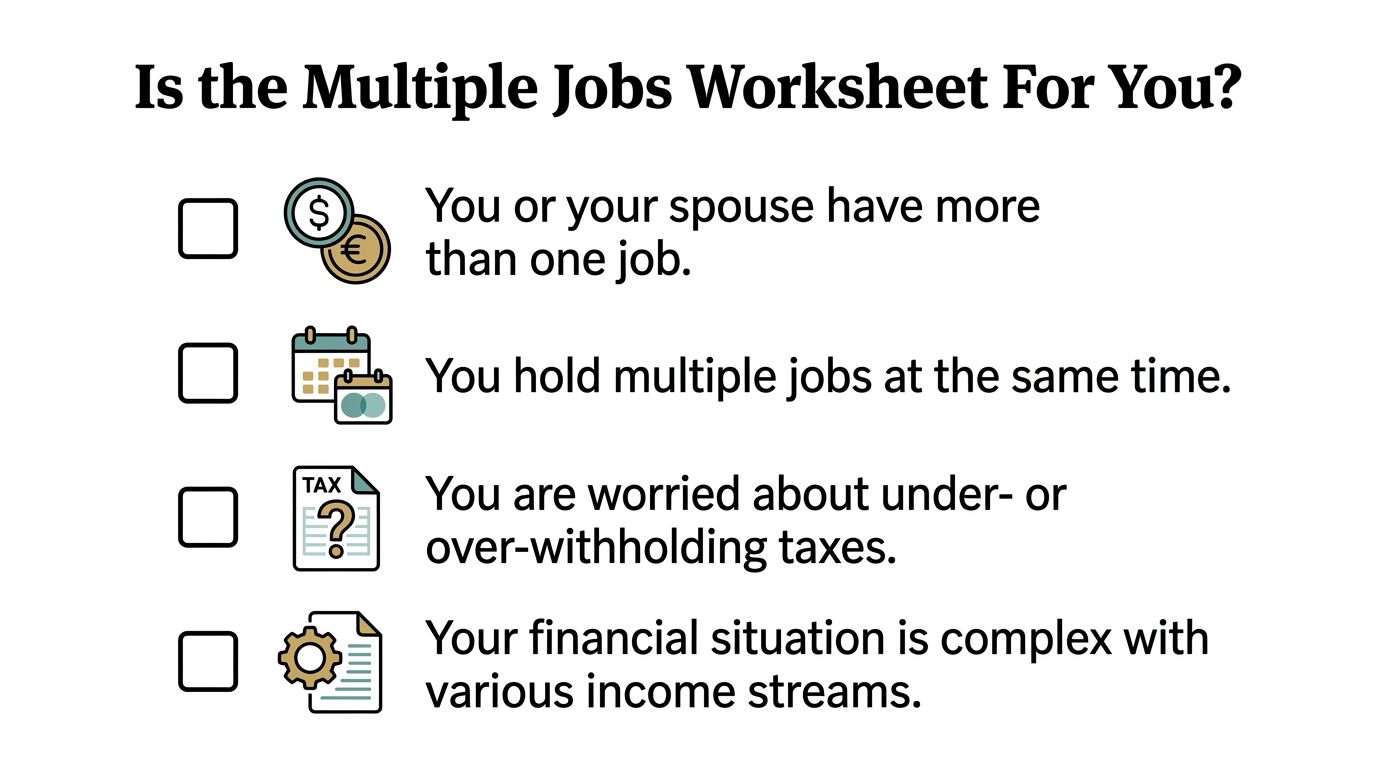
You don't need this worksheet because the IRS likes paperwork. You need it when your household's wage income comes from more than one place and ordinary payroll withholding won't reliably capture the full tax picture.
The current worksheet has been in place since January 1, 2020, replacing the older version that many people found cumbersome. The IRS specifically urged people with summer employment or multiple jobs to do a “Paycheck Checkup” and use the updated approach to avoid year-end tax deficiencies, according to the Form W-4 guidance.
Use it if your situation looks like this
- You have two W-2 jobs at the same time. One full-time and one part-time still counts.
- You're married filing jointly and both spouses work. The worksheet is built for that exact problem.
- You've changed jobs mid-year and now have overlapping wage income. Even temporary overlap can distort withholding.
- You know your withholding has been off before. If you owed tax after adding another job, don't guess your way through the next year.
Don't use it as a cure-all for every kind of income
The Multiple Jobs Worksheet is for W-2 wage withholding. It is not the right tool for every side-income situation.
- Freelance or 1099 income. That usually points toward estimated tax payments, not just a worksheet on Form W-4.
- Business income from a sole proprietorship or LLC. Same issue. You may need a broader tax payment plan.
- Investment income or more layered tax issues. A simple wage worksheet may not be enough.
Practical rule: If the issue is payroll withholding across jobs, the worksheet is a strong fit. If the issue is income with no withholding built in, you usually need a different strategy.
If you want a broader withholding framework, this guide to allowance for taxes and smarter tax planning gives useful context.
For readers with income that crosses borders or who compare systems, it can also help to see how another system treats secondary employment. This overview of UK tax rules for multiple jobs 2026 gives that contrast.
Completing the Worksheet for Two Jobs A Walkthrough
For many, this is the only part that matters. Two jobs. One worksheet. One corrected W-4.

The worksheet on page 3 of Form W-4 tells you to identify the Higher Paying Job and the Lower Paying Job, then use the table to find an annual extra withholding amount. A concrete example from the official explanation is this: if the higher-paying job earns $60,000 and the lower-paying job earns $20,000, the table produces $3,420 of additional withholding. If the higher-paying job is paid biweekly, you divide by 26, which gives $132 to enter in Step 4(c). The IRS also says this worksheet should be completed on only one Form W-4. See the walkthrough in this IRS-focused explanation of the worksheet example.
The clean way to do it
Follow this sequence:
- Identify the higher-paying job. Use annual wages, not hourly rates.
- Identify the lower-paying job. Again, use annual wages.
- Find the intersection in the table. That gives the annual extra tax amount.
- Divide by the pay periods for the higher-paying job. If that job pays biweekly, divide by 26.
- Enter the result in Step 4(c). Put that amount on the W-4 for the higher-paying job.
That's the mechanics. The discipline is just as important.
Put the extra withholding on the W-4 for the highest-paying job only. If you spread the same calculation across multiple forms, you distort the result.
The mistake that keeps causing trouble
People often think, “I have two jobs, so I should put part of this on each job.” That instinct is understandable and wrong. The form is designed to centralize the adjustment on one W-4 so the added withholding is calculated once, not duplicated.
Here's the logic in a simple table:
| Step | What you do | Where it goes |
|---|---|---|
| Identify wages | Higher-paying job and lower-paying job | Worksheet |
| Find extra annual tax | Use the table intersection | Worksheet line result |
| Convert to per-paycheck amount | Divide by pay periods of the higher-paying job | Worksheet |
| Enter withholding | Use Step 4(c) | Highest-paying job's W-4 only |
If you want more practical withholding guidance tied to IRS payroll issues, this collection of IRS withholding tips is worth keeping handy.
The worksheet isn't hard once you stop improvising. The expensive part is usually not the math. It's the assumption that payroll will figure it out for you.
Handling Three or More Jobs and Complex Pay
Once there are three or more W-2 jobs in the household, people tend to abandon the worksheet and start guessing. That's where errors multiply.
The form gives a structured method. It does not ask you to treat all jobs as equal or to throw one rough extra amount onto every W-4. It tells you to work in stages.
How the worksheet handles three or more jobs
For three or more jobs, the method works like this: Line 2a calculates extra tax for the two highest-paying jobs using the table intersection. Line 2b adds the wages of those top two jobs together and intersects that combined amount with the third job's wage. Line 2c is the sum of 2a and 2b, and that total is then used to determine the per-paycheck withholding for the highest-paying job's W-4. That framework is laid out in this guide to completing the W-4 for multiple jobs.
Why the order matters
This isn't random sequencing. The worksheet starts with the two highest-paying jobs because that pair usually drives the biggest withholding gap. Then it layers the third job into the combined wage picture.
Use this mental model:
- First pairing. Compare the top two jobs and get the first extra-tax amount.
- Second pairing. Add those top two wages together, then compare that sum to the third job.
- Final step. Add the two worksheet results together, then convert to a per-paycheck figure for the highest-paying job.
Don't average the jobs. Don't split the adjustment across forms. Follow the lines in order.
When the worksheet starts to feel too narrow
Three jobs often signal a broader issue. Maybe one spouse changes schedules, one job is seasonal, or wages fluctuate enough that the paper worksheet feels stale halfway through the year. In that case, you may need to combine W-4 planning with estimated payments, especially if some of the income doesn't come through payroll withholding at all.
This guide to estimated tax payment schedules is useful when your income mix goes beyond straightforward W-2 wages.
And if you're comparing withholding and payroll-related rules across systems, this piece on Stewart Accounting advice on second job NI offers helpful context from the UK side.
Worksheet Alternatives and Common Mistakes
The Multiple Jobs Worksheet is a solid tool. It is not the only tool on the W-4, and it is not always the best one. But some alternatives are much better than others.
The Step 2(c) checkbox
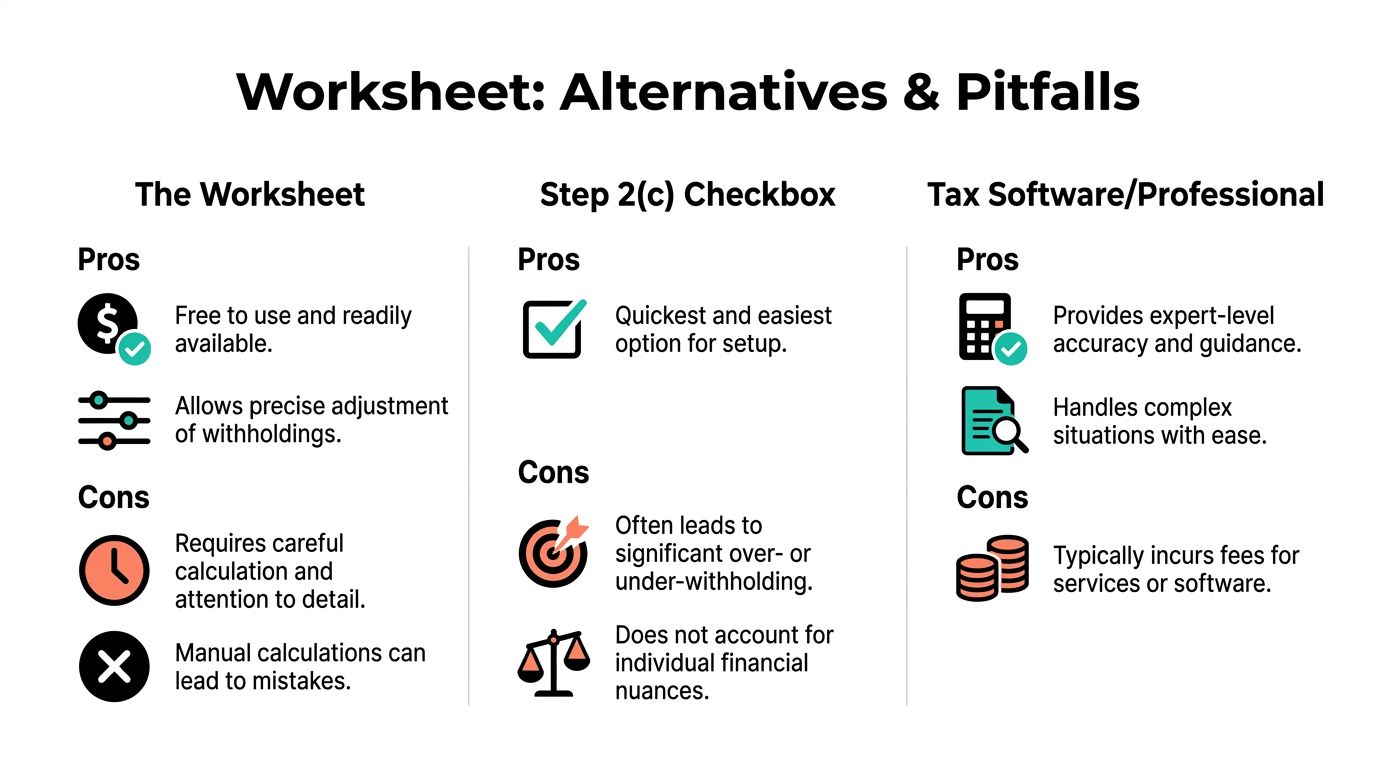
This is the tempting shortcut. It feels easy because it is easy. The problem is that it's a blunt instrument.
The IRS has warned that many taxpayers incorrectly check the Step 2(c) box on both W-4s, which can lead to under-withholding when pay differs significantly. The IRS also says its Tax Withholding Estimator at IRS.gov/W4app provides maximum accuracy by guiding users to enter a specific additional amount for Step 4(c) on only one form. That FAQ is the best direct explanation of why the checkbox isn't the right choice for many households with uneven pay, and it notes that this issue affects approximately 30% of multi-job households where pay differs significantly in the context provided by the IRS FAQ on the 2020 Form W-4.
A side-by-side view
| Option | Best use | Main weakness |
|---|---|---|
| Multiple Jobs Worksheet | Straightforward W-2 households that want a manual calculation | You have to follow the steps carefully |
| Step 2(c) checkbox | Only when there are two jobs with similar pay | It can miss the mark when wages differ |
| IRS Tax Withholding Estimator | Households that want the most accurate setup | It takes more input and attention |
The mistakes I'd tell you to avoid first
- Checking the box on both forms without comparing pay. That's the classic shortcut that backfires.
- Putting the extra withholding on more than one W-4. The form isn't built for duplicate adjustments.
- Forgetting to update after a raise or a new job. A worksheet isn't “set it and forget it.”
- Using the worksheet for income it wasn't designed to handle. W-2 withholding and self-employment tax are not the same problem.
The best W-4 method is the one that matches how you actually earn money, not the one that takes the least time to fill out.
If your pay is uneven, your household has several jobs, or you value precision over speed, use the IRS estimator. If your situation is simpler and wage-based, the worksheet is often enough. What you shouldn't do is default to the checkbox because it looks convenient.
Your Next Steps for Tax Peace of Mind
If you've run the worksheet, the next move is simple. Submit the updated Form W-4 to the payroll department for your highest-paying job.
Then monitor your paystubs. Make sure the additional withholding appears. A correct worksheet that never reaches payroll doesn't fix anything.
When a W-4 update isn't enough
Sometimes the worksheet solves the forward-looking problem but not the one already sitting on your desk. If you already owe the IRS, received a notice, have business income mixed in with wages, or your income changes often, a W-4 adjustment is only part of the answer.
Use this rule of thumb:
- Future withholding issue only. Update the W-4 and review it again after any job or pay change.
- Past-due balance, audit, or complex income mix. Get real tax advice. You're beyond basic form-filling at that point.
A properly completed Multiple Jobs Worksheet can prevent future tax debt. It cannot erase tax debt that already exists. Know the difference, and you'll save yourself time, money, and stress.
If you're dealing with more than a simple W-4 update, Attorney Stephen A Weisberg offers a FREE Tax Debt Analysis to determine whether he can help and what the right strategy looks like before charging you to resolve IRS or state tax issues.


