A Guide to Multi Member LLC Tax Filing
Master multi member LLC tax filing with our guide. We cover Form 1065, Schedule K-1s, corporate elections, and deadlines to ensure accurate filing.
In this article
- Your Multi-Member LLC's Tax Status
- The Power of Pass-Through Taxation
- LLC Tax Status vs Corporate Elections At a Glance
- Key Forms in the Filing Process
- Choosing a Different Tax Classification
- When an S Corp Election Makes Sense
- The C Corp Election: A Strategic Choice for Growth
- Understanding Form 1065 and Schedule K-1
- The Foundation: Form 1065, U.S. Return of Partnership Income
- Why Separately Stated Items Matter
- The Personal Piece: Schedule K-1
- Navigating Special Allocations and Guaranteed Payments
- Managing Payroll and Contractor Payments
- Handling Employee Payroll Correctly
- Managing Independent Contractors and Form 1099-NEC
- Estimated Taxes and State Filings: A Practical Guide
- Getting a Grip on Federal Estimated Tax Payments
- Navigating the Maze of State Filing Requirements
- Answering Your Top Questions About Multi-Member LLC Taxes
- Can We Deduct Our Health Insurance Premiums?
- What Happens if a New Member Joins Mid-Year?
- How Do We Handle Business Losses?
When you have a multi-member LLC, you're usually filing taxes as a partnership. This means the LLC itself doesn't write a check to the IRS for income taxes. Instead, all the profits and losses are passed through to the owners, who then report everything on their personal returns. The LLC just files an informational return, Form 1065, to tell the IRS what happened.
Your Multi-Member LLC's Tax Status
The moment you create a multi-member LLC, the IRS assigns it a default tax status. Getting a firm grip on this classification is job number one. It dictates every form you'll file and exactly how your business profits get taxed.

Out of the box, the IRS treats your multi-member LLC as a partnership. This makes it a "pass-through entity," a core concept you absolutely need to understand.
The Power of Pass-Through Taxation
So, what does "pass-through" really mean for your bottom line? Unlike a C corporation that pays its own taxes, a partnership's income isn't taxed at the business level. The profits and losses literally "pass through" the business and land directly on each member's personal tax return.
This setup is great because it helps you sidestep the notorious "double taxation" that hits C corps, where profits get taxed once at the corporate level and then again when paid out to shareholders as dividends.
Here's how this plays out for you and your partners:
- No Tax Bill for the LLC: Your business files an informational return to show its numbers, but it doesn’t pay income tax.
- You Pay the Tax Man: Each member is on the hook for paying income tax on their share of the profits.
- The Self-Employment Tax Hit: Be ready for this one. The profits passed through to you are typically subject to self-employment taxes for Social Security and Medicare. We cover some ways to handle this in our guide on LLC self-employment tax strategies.
The best way to think about it is this: your LLC is a financial pipeline, not a taxpayer. The business reports the income, but you and your partners are the ones who actually pay the tax.
LLC Tax Status vs Corporate Elections At a Glance
While partnership is the default, you can choose to be taxed as a corporation. This quick table breaks down the main differences.
| Tax Aspect | Partnership (Default) | S Corporation Election | C Corporation Election |
|---|---|---|---|
| Primary Tax Form | Form 1065 | Form 1120-S | Form 1120 |
| Taxation Level | Profits pass-through to members | Profits pass-through to shareholders | Corporation pays its own tax |
| Double Taxation | No | No | Yes (corporate tax + dividend tax) |
| Self-Employment Tax | Applies to all member profits | Applies only to reasonable salary | N/A (paid via payroll tax on salary) |
| Member-Level Reporting | Schedule K-1 | Schedule K-1 | Form 1099-DIV for dividends |
This is a high-level overview, and the right choice really depends on your specific financial situation and long-term business goals.
Key Forms in the Filing Process
Under the default partnership status, two forms are non-negotiable. First is IRS Form 1065, the U.S. Return of Partnership Income. This is the LLC's main report to the IRS.
From that Form 1065, the LLC prepares and sends a Schedule K-1 to each member. This little document is crucial—it breaks down your individual share of the profits, losses, and other tax items that you'll need to complete your personal tax return.
One of the most important things you can do to make this process smoother is separating business and personal finances. Seriously. It's foundational for protecting your personal assets and keeping your bookkeeping clean, which in turn makes filling out Form 1065 far less of a headache. Mixing funds just invites trouble and could even jeopardize the liability protection your LLC provides.
Choosing a Different Tax Classification
Your LLC's default partnership tax status is a solid starting point, but it's far from your only option. One of the best things about the LLC structure is its flexibility—you can tell the IRS you want to be taxed differently without having to legally dissolve your company and start over.
Making a strategic switch to an S Corp or C Corp can unlock significant tax savings, but it's a decision that has to be weighed carefully against your profits, long-term goals, and how you plan to pay yourselves.
When an S Corp Election Makes Sense
For many profitable multi-member LLCs, the S Corp election is a game-changer. Why? It all comes down to cutting down on self-employment taxes.
In a standard partnership, all net profits that pass through to the members are hit with the 15.3% self-employment tax. For a business that’s doing well, that number can really sting.
When you elect to be taxed as an S Corporation, you create a powerful distinction between a member's salary and their share of the profits.
- Reasonable Salary: First, you have to pay any member who works in the business a "reasonable salary" for their role. This income gets hit with standard payroll taxes (FICA), which are split between the employee and the business, just like any other job.
- Profit Distributions: Here's the magic. Any profit left over after salaries and expenses can be paid out as distributions. These distributions are not subject to that 15.3% self-employment tax.
Let’s look at a real-world example: A Thriving Consulting Firm Imagine a two-member consulting LLC that clears $250,000 in net profit. As a partnership, that entire $250,000 is subject to self-employment tax, which works out to a hefty $38,250 tax bill.
Now, let's say they make the S Corp election. They determine that a reasonable salary for each partner is $75,000 (for a total of $150,000 in payroll). Only that $150,000 is subject to FICA taxes. The remaining $100,000 in profit can be taken as a distribution, completely sidestepping that 15.3% tax.
In this scenario, that one move just saved the members over $15,000 for the year.
Ready to make the switch? You’ll need to file Form 2553, Election by a Small Business Corporation. It's a critical form with strict deadlines, so for a detailed walkthrough, you can learn more about how to convert an LLC to an S Corp to make sure you get it right.
The C Corp Election: A Strategic Choice for Growth
The C Corp election is less common for your typical small business LLC, but it can be an incredibly powerful tool for companies with big ambitions. A C Corp is its own taxpayer—it files its own return (Form 1120) and pays its own corporate income tax.
This path is often chosen by startups and other companies planning for aggressive growth and looking to bring on outside investors.
Here’s why it might make sense:
- Reinvesting Earnings: C Corps can keep profits inside the company and reinvest them for growth. This is often done at a corporate tax rate that can be much lower than the members' personal income tax rates, freeing up more capital to pour back into the business.
- Attracting Venture Capital: Most VCs and angel investors are set up to invest in C Corps. It's the structure they know and prefer. Electing this status can make your LLC a much more appealing target for that kind of funding.
- Expanded Benefits: C Corps often have access to a wider range of tax-deductible fringe benefits for employees, like more robust health insurance plans.
You make this election by filing Form 8832, Entity Classification Election. Be warned, though: C Corps come with the infamous "double taxation." Profits are taxed once at the corporate level, and then again when they are paid out to shareholders as dividends. This is the main reason most LLCs stick with pass-through taxation.
Ultimately, choosing the right tax classification is a crucial part of your multi member llc tax filing strategy. It's a decision that needs to align with where you see your business heading over the next five years.
Understanding Form 1065 and Schedule K-1
When it comes to your multi-member LLC's tax filing, everything hinges on two documents: Form 1065 and Schedule K-1. Think of Form 1065 as the main tax return for the business itself. It’s the complete financial story of your LLC's year, telling the IRS about your income, expenses, and ultimate profit or loss.
The Schedule K-1, on the other hand, is what translates that business-level story into individual terms for each owner. It breaks down the LLC's financial results and allocates the correct portion to each member.
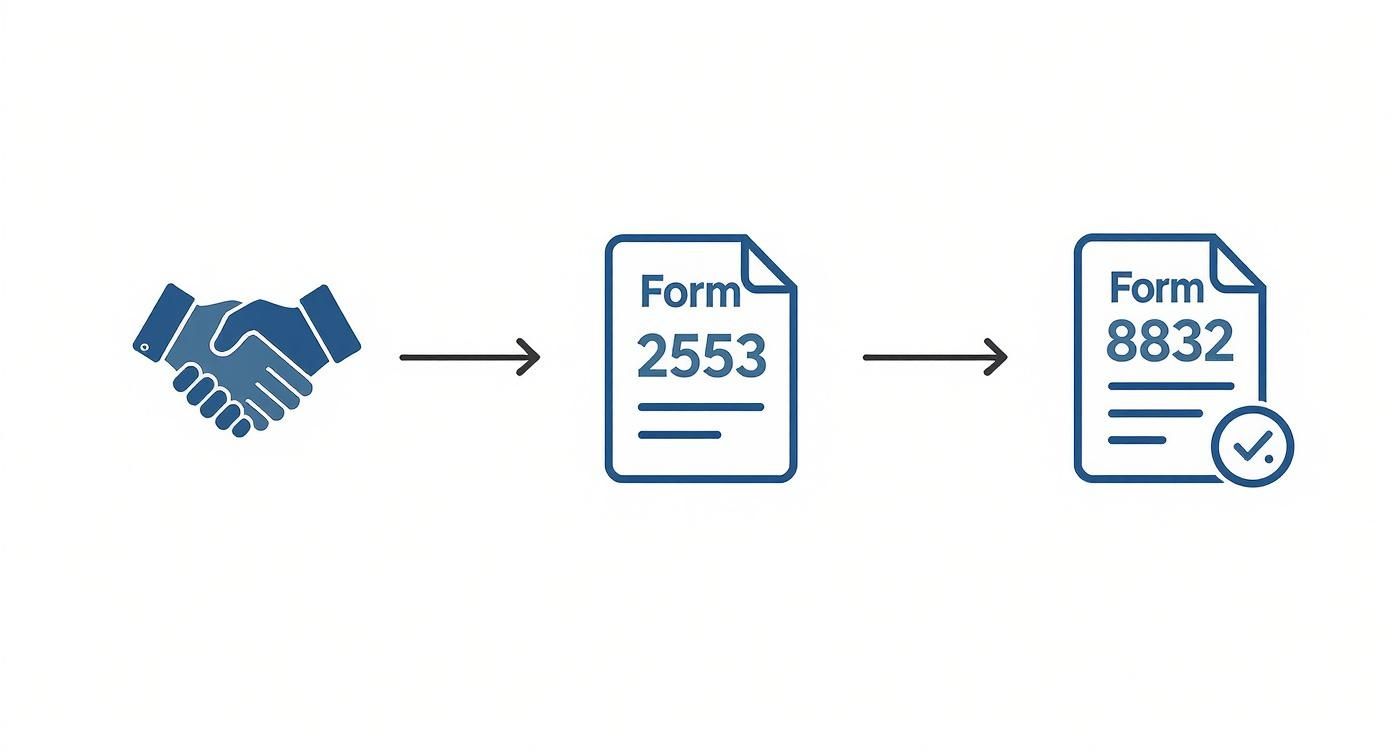
This workflow shows just how flexible an LLC can be. You aren't stuck with the default partnership status; you can elect to be taxed as an S Corp or C Corp by filing the right forms with the IRS.
The Foundation: Form 1065, U.S. Return of Partnership Income
Form 1065 is an informational return, which means the LLC itself doesn't pay income tax on its profits. Instead, it reports the full financial picture so the IRS can see how profits and losses are passed through to the members.
The first page of the form gives a high-level summary of your operations. You’ll report things like:
- Gross Receipts or Sales: The total amount of money your LLC brought in before a single expense is subtracted.
- Cost of Goods Sold (COGS): For businesses selling products, this is where you account for the direct costs of creating or acquiring the things you sold.
- Business Deductions: This covers all the ordinary and necessary expenses of running the business—think rent, marketing, utilities, and wages for non-member employees.
Once you subtract all the deductions from your income, you get to the Ordinary Business Income (or Loss). This is a crucial number because it’s the primary profit figure that gets divided up among the members. But it's not the whole story.
Why Separately Stated Items Matter
Certain types of income and expenses can't just be lumped into that main profit calculation. They have special tax characteristics and must be "separately stated" on Form 1065 and then passed through to the members on their K-1s.
Why the special treatment? Because the tax impact of these items can be completely different for each partner based on their personal financial situation.
Common separately stated items include:
- Capital gains and losses
- Section 179 depreciation deductions
- Charitable contributions
- Interest and dividend income
- Income or loss from rental real estate activities
For instance, a long-term capital gain might be taxed at a favorable rate for one member but could be offset by capital losses for another. By keeping it separate, the tax code can be applied correctly on each member's individual return.
Getting Form 1065 right is non-negotiable. Every number on this form is the source of truth for your LLC's tax year. A single mistake will cascade down to every member's Schedule K-1, potentially causing a chain reaction of audits and penalties.
The Personal Piece: Schedule K-1
After Form 1065 is finalized, the LLC has to issue a Schedule K-1 to every single person who was a member during the year. This form provides an itemized breakdown of each member’s share of the income, deductions, credits, and other financial items from the LLC.
Your operating agreement is the rulebook for how these numbers get allocated. If the agreement says profits are split 50/50, that’s exactly how the K-1s should reflect the ordinary business income. But things can get more complicated.
Navigating Special Allocations and Guaranteed Payments
This is where many business owners get tripped up. Your operating agreement might include provisions for special allocations, which means certain items are divided up differently than the standard ownership percentages.
Real-World Scenario: The Equipment Investment Imagine Member A contributes an extra $30,000 in cash so the LLC can buy a new piece of machinery. To recognize this extra contribution, the operating agreement might state that the entire depreciation deduction from that machine is specially allocated to Member A. This specific allocation must be clearly documented on their Schedule K-1.
Another critical concept is guaranteed payments. These are payments to a member for their services or for the use of their capital, and they're paid out regardless of whether the LLC made a profit. On the business side, these are treated as a regular expense. For the member receiving them, it's self-employment income.
For example, if the managing member is paid a $60,000 salary for running the day-to-day operations, that's not a profit distribution—it’s a guaranteed payment. The LLC deducts it on Form 1065, and it’s reported on that member’s K-1 so they can pay the appropriate self-employment taxes.
For a deeper look at the entire process, our guide on how to file LLC taxes can walk you through it from start to finish.
Managing Payroll and Contractor Payments
Once you've got your annual income tax return figured out, you're not quite done. Your responsibilities as a multi-member LLC owner also dive into the tricky waters of payroll and contractor payments. This is an area I see business owners stumble over all the time, and unfortunately, it can lead to some pretty hefty IRS penalties.

One of the first points of confusion is how to pay yourselves—the members. It's critical to know the difference between a profit distribution and a guaranteed payment.
Distributions are just what they sound like: a member's slice of the LLC's profits. These aren't subject to payroll taxes. Guaranteed payments, on the other hand, are paid to a member for services they provide to the business, and they get paid whether the LLC is profitable or not. For the member receiving them, these are treated as self-employment income.
Handling Employee Payroll Correctly
The moment your LLC hires its first non-member employee, you've officially become an employer. That role comes with a whole new set of federal and state responsibilities. You'll need to withhold taxes from employee paychecks, pay the employer's share of taxes, and get on a schedule of filing regular payroll tax returns.
Here’s a quick rundown of your main payroll tax duties:
- FICA Taxes: This covers Social Security and Medicare. You’ll withhold the employee's share from their pay and pay a matching amount from the company's funds.
- FUTA Tax: The Federal Unemployment Tax Act (FUTA) tax is paid entirely by you, the employer. It helps fund state unemployment agencies.
- Federal Income Tax Withholding: Based on the Form W-4 each employee fills out, you are responsible for withholding the correct amount of federal income tax from their wages.
You'll report and pay these taxes, usually quarterly, on Form 941 (Employer's QUARTERLY Federal Tax Return). You'll also file an annual Form 940 (Employer's Annual Federal Unemployment (FUTA) Tax Return). It can feel like a lot to track, which is why we created a comprehensive guide on small business payroll taxes that breaks it down even further.
A quick but serious note: The IRS does not mess around with payroll tax failures. This money is considered "trust fund taxes"—meaning you're holding it in trust for your employees and the government. The penalties for non-compliance are severe and can even pierce the corporate veil, making business owners personally liable.
Managing Independent Contractors and Form 1099-NEC
Many LLCs lean on independent contractors for everything from marketing help to IT support. It’s a flexible way to get work done, but it comes with a strict reporting rule. If you pay an unincorporated independent contractor $600 or more for services in a calendar year, you have to send them a Form 1099-NEC (Nonemployee Compensation).
You need to get a copy to the contractor and file another with the IRS by January 31 of the next year. That deadline is not flexible, and missing it will trigger penalties.
The biggest landmine here is worker misclassification. It can be tempting to classify someone as a contractor to avoid payroll taxes, but this is a massive audit trigger. The IRS looks closely at factors like behavioral control, financial control, and the overall relationship to decide if someone is truly a contractor or should be an employee. Getting this wrong can mean a nasty bill for back taxes, interest, and painful penalties. Always be sure before you classify.
Estimated Taxes and State Filings: A Practical Guide
When you're a member of an LLC, one of the biggest mental shifts is realizing your tax duties aren't a once-a-year event. Because the LLC itself doesn't pay income tax, that responsibility flows directly to you and the other members. If you just wait until April to figure it all out, you're setting yourself up for a nasty surprise in the form of underpayment penalties.
Think of it this way: you have to stay ahead of the game on two fronts. First, there are the federal estimated taxes. Second, you have to navigate the often-confusing world of state-specific filings. Getting a handle on both is non-negotiable for keeping your business healthy and compliant.
Getting a Grip on Federal Estimated Tax Payments
Since you're not getting a regular paycheck with taxes automatically taken out, the IRS requires you to pay in as you go. This means making quarterly estimated tax payments to cover your share of the LLC's income and your self-employment taxes.
You'll use Form 1040-ES, Estimated Tax for Individuals, to make these payments. The trick is forecasting what you'll owe for the whole year and then dividing that number by four. To get to that number, you'll need to project a few things:
- Your slice of the LLC’s net income: This is your best guess at what the business will earn and what your portion of that profit will be.
- Your total income picture (AGI): Remember to include your LLC profits alongside any other income you have, like a spouse's salary or investment gains.
- Deductions and credits: Factor in all the tax breaks you expect to take, whether it's the standard deduction or a list of itemized deductions.
A Pro Tip to Avoid Penalties: The IRS has a "safe harbor" rule. To stay in the clear, you generally need to pay at least 90% of what you'll owe for the current year, or 100% of the tax you paid last year. If your adjusted gross income (AGI) is over $150,000, that second number jumps to 110%. It’s always smarter to overpay a little and get a refund than to underpay and write a check to the IRS for penalties.
As you're planning these payments, don't forget to account for every legitimate business expense. For example, many owners can claim the self-employed health insurance deduction, which can make a real dent in your taxable income and, by extension, your quarterly tax bill.
Navigating the Maze of State Filing Requirements
If only the federal rules were all you had to worry about! State tax laws are a completely different animal, and they can vary wildly from one state to the next. This adds a whole other layer of complexity—and cost—to your annual compliance checklist.
Most states with an income tax will want your LLC to file a state partnership return, which usually just echoes the information on your federal Form 1065. But the obligations rarely stop there. Many states have their own unique taxes and fees aimed directly at LLCs.
You'll likely run into some of these:
- Franchise Taxes: States like Texas and California charge a tax just for the privilege of existing and doing business there. This isn't based on your profit; it's often calculated on your revenue or net worth.
- Annual Report Fees: Just about every state requires you to file an annual report to keep your LLC in good standing, and there's always a fee attached.
- Local and City Taxes: Your tax journey might not even end at the state capitol. Some cities and counties have their own business taxes and registration fees you need to be aware of.
This patchwork of state rules has a direct impact on your budget. The cost of just getting your multi-member LLC taxes prepared can swing wildly depending on where you operate. In fact, there's a 42% cost spread between the most and least expensive states. For example, the average prep cost in Massachusetts is $1,076 (22% above the national average), while in Texas, it's closer to $945 (7% above average). You can dig into more of these business tax rates for LLCs to see how your location stacks up. Knowing these local nuances ahead of time is absolutely critical for smart financial planning.
Answering Your Top Questions About Multi-Member LLC Taxes
The tax rules for multi-member LLCs can feel like a maze. It’s totally normal for questions to pop up, especially when your business changes. Maybe a member leaves, or you have a year that doesn't go as planned. Let's tackle some of the most common questions we hear from business owners navigating this process.
Can We Deduct Our Health Insurance Premiums?
Yes, and this is a big one for many business owners. When an LLC is taxed as a partnership, the premiums it pays for its members' health insurance are usually treated as guaranteed payments.
Here’s how that works in practice: The LLC deducts the premium costs on its Form 1065, just like any other business expense. That same amount then gets reported as income on each member's Schedule K-1. It might sound like you’re just moving money from one pocket to another, but here's the key: the member can then typically take the self-employed health insurance deduction on their personal Form 1040.
The end result? The premiums become tax-deductible. The critical piece of this puzzle is that the LLC has to be the one paying the premiums directly, or at least have a formal plan to reimburse members for them. You can't just pay them personally and expect the deduction.
What Happens if a New Member Joins Mid-Year?
Bringing on a new partner is a great sign of growth, but it does add a wrinkle to your tax filing. You can’t simply split the year's total profit using the new ownership percentages. The LLC’s income and deductions have to be carefully allocated based on the exact date the new member joined.
You generally have two ways to approach this:
- The Interim Closing Method: Think of this as closing your books on the day the new partner joins. You essentially create two distinct accounting periods for the tax year—one before the change and one after. It’s more work, but it's also the most precise method.
- The Proration Method: This is a simpler route. You take the entire year's income and expenses and allocate them on a pro-rata basis. For instance, if someone joins exactly on July 1st, they would be allocated their share of the business activity for the second half of the year.
Your operating agreement should ideally dictate which method you'll use. If it’s silent on the matter, all the partners need to agree on an approach. This decision is important because it directly affects the taxable income reported on every member's K-1 for that year.
The day a new member comes on board or an old one departs is a major event for tax purposes. Keeping meticulous records around this date isn't just a good idea—it's absolutely essential for correctly allocating profit and loss and keeping your tax filings compliant.
How Do We Handle Business Losses?
Hitting a rough patch or having a loss, particularly in the early stages, is a normal part of the business lifecycle. For an LLC taxed as a partnership, those losses "pass through" to the members, just like profits do. Each member will see their share of the loss on their Schedule K-1, which they then report on their personal tax return.
This can actually be a silver lining. That business loss can often offset other income you might have, like a spouse's salary or gains from investments, which could lower your family's overall tax bill for the year.
But there are rules, of course. Your ability to deduct these losses is limited by your basis in the LLC. Think of your basis as your total financial investment in the company—it starts with your capital contributions, goes up with your share of profits, and goes down with distributions and your share of losses. You can't deduct losses that are greater than your basis.
Don't worry, any losses you can't take in one year aren't lost forever. They get suspended and carried forward, waiting for a future year when you have enough basis to deduct them. This is precisely why tracking your basis accurately isn't a one-time task; it's a critical, ongoing responsibility for every single member.
Dealing with IRS controversies or state tax debt can be incredibly stressful, pulling your focus away from what you do best: running your business. At Attorney Stephen A Weisberg, we specialize in representing businesses and their owners in front of the IRS. Before you commit to anything, start with our FREE Tax Debt Analysis to see exactly how we can help. Contact us today to get started.


