Mortgage Loan Without Tax Returns A Guide for Entrepreneurs
Learn to secure a mortgage loan without tax returns. This guide details bank statement loans, asset-based options, and how to navigate lender requirements.
In this article
- Why Smart Tax Planning Can Complicate Your Mortgage
- The Self-Employment Income Gap
- You're Being Penalized for Being a Good Business Owner
- Bank Statement Loans: The Entrepreneur's Choice
- Asset-Based Loans: For High-Net-Worth Individuals
- DSCR Loans: The Real Estate Investor's Tool
- Comparison Of No Tax Return Mortgage Options
- The Underwriting Playbook For No Tax Return Loans
- Assembling Your Underwriting Story
- The Critical Role of Cash Reserves
- Understanding the Interest Rate Premium
- How Unresolved Tax Issues Can Derail Your Loan
- The Lender’s Secret Weapons: The 4506-C and Public Record Searches
- The Impact of Unfiled Returns
- The Loan-Killing Power of a Federal Tax Lien
- Resolve Your Tax Issues Before You Apply
- Your Homebuying Action Plan Checklist
- First, Get Your Financial House in Order
- Next, Assemble Your Documentation
- Perform a Critical Tax Health Check
- Build Your Professional Team
- Your Top Questions Answered
- Can I Still Qualify for a No-Tax-Return Mortgage with Bad Credit?
- Are These Loans Just for Self-Employed Borrowers?
- How Will an IRS Payment Plan Affect My Mortgage Application?
- Why Are the Interest Rates Higher on These Loans?
Yes, you absolutely can get a mortgage loan without tax returns. For self-employed borrowers and business owners, it’s a surprisingly common scenario. The key is using alternative documentation—like 12 to 24 months of bank statements—to prove your income instead of relying on traditional W-2s or tax filings.
Why Smart Tax Planning Can Complicate Your Mortgage
As an entrepreneur, you work hard with your accountant every year to find every legitimate deduction and business expense. From your home office and marketing costs to travel and supplies, this is just smart financial management. It’s how you minimize your tax bill and keep more capital in your business to fuel growth.
But here’s the problem: that very same strategy can become a huge obstacle when you try to buy a home.
Traditional mortgage lenders are obsessed with one number on your tax return: your Adjusted Gross Income (AGI). That’s the figure left after you’ve taken all those savvy business write-offs. While a low AGI is fantastic for your tax liability, it rarely reflects the actual cash flowing through your business.
The Self-Employment Income Gap
This disconnect between your real-world cash flow and your on-paper taxable income creates a frustrating "income gap" for self-employed individuals. Your bank accounts show healthy, consistent deposits, but your tax return tells a completely different, much poorer story.
This often leads to lenders approving you for a loan that’s just a fraction of what you can genuinely afford.
I see this all the time. A consultant might generate $180,000 in gross revenue, but after working with their CPA, their net taxable income is only $75,000. A conventional lender, fixated on that $75,000 figure, might only qualify them for a $300,000 mortgage. That’s nowhere near enough for the $600,000 home their actual cash flow can easily support.
This is a common nightmare for the growing gig and entrepreneurial workforce, which some reports on no-income verification lending from platforms like BlueRate.ai suggest could make up 15% of all workers by 2026.
You're Being Penalized for Being a Good Business Owner
If this sounds familiar, it's because countless successful entrepreneurs get penalized by a rigid mortgage system that wasn't designed for them. You have the income and the financial stability, but the standard qualification process just can't see past the tax return. It’s a discouraging hurdle that leaves many wondering if they’re locked out of homeownership.
The real issue isn't a lack of income. It's a lack of understanding from lenders who are stuck on outdated verification methods built for salaried, W-2 employees.
Thankfully, the lending world has started to catch up. A whole category of loans, known as Non-Qualified Mortgages (Non-QM), was created for this exact situation. These alternative loans give lenders the flexibility to look beyond your tax returns and evaluate your financial health based on what really matters: your actual cash flow.
This guide will give you a clear roadmap to securing a mortgage loan without tax returns. We'll demystify these options and show you exactly how to get the financing your business success truly deserves. For those also focused on optimizing their finances from the start, you might find our guide on business tax planning strategies to be a helpful resource.
So, your tax returns don’t quite tell the whole story about your income. You’re not alone. For entrepreneurs, real estate investors, and anyone with a non-traditional financial profile, this is a common hurdle.
The good news is that lenders have created a whole playbook of alternative mortgages for exactly this situation. These loans side-step your tax returns and focus on what really matters: your genuine ability to make the payments. Let’s walk through the most common options so you can find the right fit.
This flowchart lays it out perfectly. It shows the two main paths a self-employed borrower can take—the traditional route with tax returns, or the alternative path using bank statements, which often opens the door to a much larger loan.
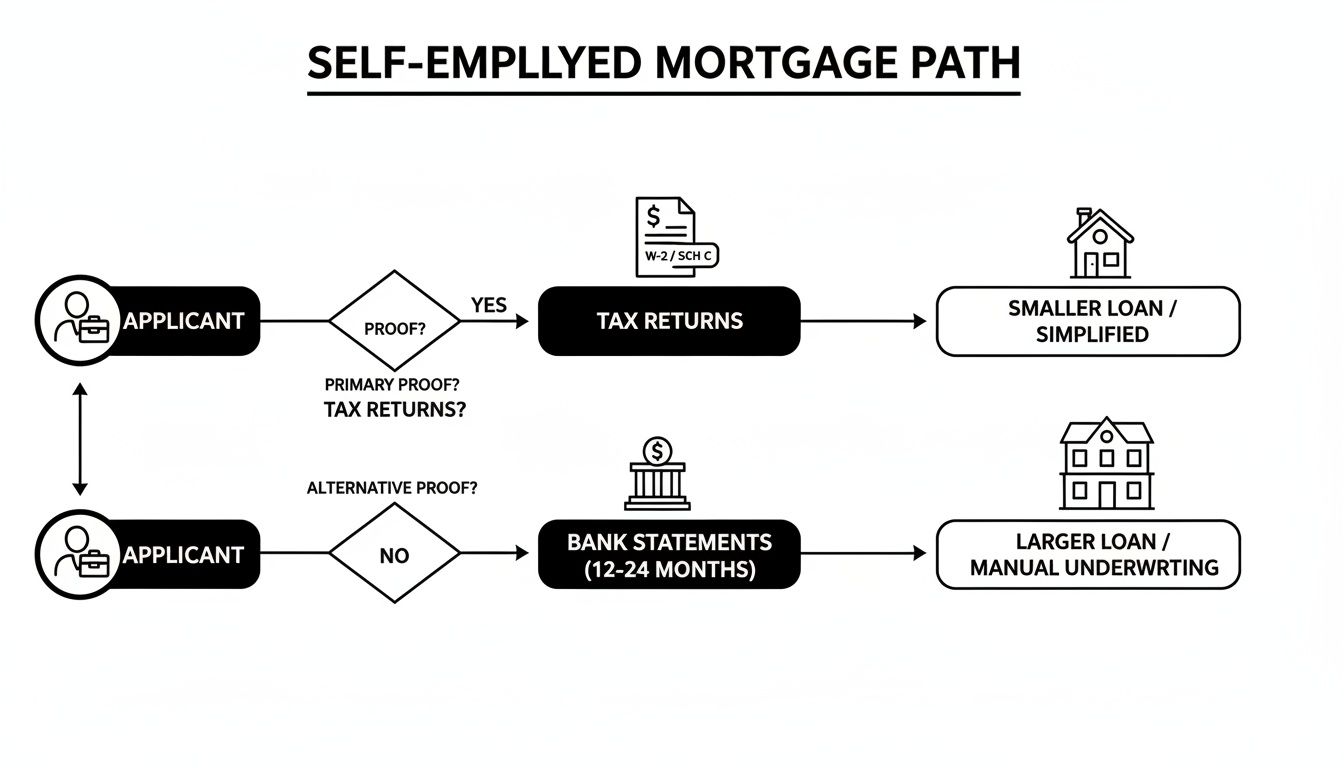
The key takeaway here is powerful. For business owners who are smart about maximizing tax deductions, the bank statement loan can unlock significantly more buying power by aligning the loan with your real cash flow, not just your taxable income.
Bank Statement Loans: The Entrepreneur's Choice
The bank statement loan is, without a doubt, the most popular mortgage loan without tax returns. It’s the go-to for self-employed borrowers and small business owners. Instead of getting hung up on your tax documents, lenders analyze your cash flow straight from your bank statements.
They’ll want to see 12 to 24 months of statements, either personal or business, to get a clear picture of your income. From there, they calculate what you can afford.
Lenders have a few different methods for this:
- Averaging Deposits: This is the most straightforward approach. They simply add up all your deposits over the specified period and calculate a monthly average.
- Applying an Expense Factor: When looking at a business account, an underwriter will often apply a standard expense ratio—say, 30% to 50%—to your gross deposits to arrive at an estimated net income. It’s their way of acknowledging that revenue isn’t the same as profit.
- Using a CPA-Prepared P&L: Some lenders will accept a Profit & Loss (P&L) statement from your CPA to supplement the bank statements, allowing for a more nuanced and often more favorable income calculation.
Who is this for? You’re a consultant, freelancer, or business owner with at least two years of solid, consistent revenue. Your bank statements show reliable deposits, even if your tax returns show a modest net income after all those business write-offs.
Getting familiar with a complete bank statement example can help you see exactly what lenders are looking for and prepare your documents accordingly.
Asset-Based Loans: For High-Net-Worth Individuals
What if your financial strength isn't in monthly income but in a hefty investment portfolio? That’s where asset-based loans—sometimes called asset depletion or asset utilization loans—are a perfect fit.
With this loan, you don't have to prove you have a job or a monthly paycheck. Instead, you prove you have enough liquid assets to cover the mortgage.
Lenders will look at your portfolio of verifiable assets, including:
- Stocks and bonds
- Mutual funds
- Vested retirement accounts (like 401(k)s and IRAs)
- Money market accounts
The underwriter then uses a formula to "deplete" or spread out the value of those assets over a set term (often 360 months for a 30-year loan) to create a qualifying monthly income. For instance, a $2.5 million portfolio could translate into $6,944 in qualifying monthly income without a single tax return or pay stub in sight.
Who is this for? This is ideal if you’re retired, semi-retired, or have recently sold a business. You’re sitting on substantial liquid wealth but have little to no traditional earned income.
DSCR Loans: The Real Estate Investor's Tool
For anyone buying or refinancing investment properties, the Debt-Service Coverage Ratio (DSCR) loan is a true game-changer. What makes it so special? It completely ignores your personal income. The property qualifies for the loan based on its own financial performance.
The lender calculates the DSCR with one simple formula:
DSCR = Gross Rental Income / PITI (Principal, Interest, Taxes, and Insurance)
A DSCR of 1.0 means the rental income is just enough to cover the property's expenses. Most lenders, however, are looking for a DSCR of 1.25 or more. That tells them the property brings in 25% more than its monthly obligations, making it a much safer bet. A stronger DSCR can also land you a better interest rate.
Who is this for? You're a real estate investor—brand new or seasoned—who wants to qualify for a loan based on the property’s cash flow, not your personal finances. It's the perfect tool for scaling a rental portfolio quickly.
Comparison Of No Tax Return Mortgage Options
To help you see how these options stack up, here’s a quick comparison of the most common no-tax-return mortgage products.
| Loan Type | How Income Is Verified | Ideal Borrower | Typical Down Payment | Common FICO Range |
|---|---|---|---|---|
| Bank Statement | 12-24 months of deposits from personal or business bank statements | Self-employed, freelancer, business owner | 10% - 25% | 660+ |
| Asset-Based | Calculation based on a percentage of total liquid assets (stocks, bonds, 401k) | Retiree, high-net-worth individual with low monthly income | 20% - 30% | 700+ |
| DSCR | Property's rental income compared to its total monthly payment (PITI) | Real estate investor (new or experienced) | 20% - 25% | 680+ |
Each of these loans serves a specific purpose, providing a clear path to homeownership or investment for borrowers who don't fit into the traditional W-2 box. The right choice ultimately depends on your unique financial situation—whether your strength lies in your business cash flow, your accumulated assets, or your property's income potential.
The Underwriting Playbook For No Tax Return Loans
When you apply for a mortgage without tax returns, you’re asking the underwriter to look beyond the usual playbook. This doesn't mean it’s an easier process—in fact, the scrutiny just shifts. Instead of your IRS filings, the focus moves to other financial documents that tell the story of your ability to repay the loan.
Knowing exactly what they’re looking for is the single most important factor for a smooth approval.
Think of the underwriter as a financial investigator building a case for your loan. Without tax returns, they need a different set of clues to piece together your business's stability and true cash flow. Your job is to provide them with a rock-solid file.
Assembling Your Underwriting Story
Simply handing over a stack of bank statements won’t cut it. You need to build a compelling narrative about your financial health, and that requires a few key pieces of supporting evidence to give the numbers context and credibility.
Here’s what underwriters absolutely need to see:
- A CPA Letter: This isn't just a suggestion; it's a must-have. A formal letter from your accountant provides crucial third-party validation. It confirms your business is a real, operating entity and, critically, has been for at least two years.
- Profit and Loss (P&L) Statement: Even without tax returns, a professionally prepared P&L demonstrates that you have a firm grasp on your business finances. Expect to provide a year-to-date P&L to show your company's current performance.
- Valid Business License: This is simple but essential. It’s the official proof that your business is registered and legally allowed to operate.
These documents work in tandem to establish trust. They show you're a serious business owner with a verifiable history, not just someone with sporadic income.
An underwriter's job is to minimize risk for the lender. A clean file with a strong CPA letter, a clear P&L, and proof of business longevity makes their decision easy—and your approval far more likely.
The Critical Role of Cash Reserves
After proving your income, the next thing an underwriter will zero in on is your cash reserves. These are the liquid funds you have left after your down payment and closing costs are paid. Why the intense focus? Because reserves are your financial safety net.
Lenders need assurance that if your business hits a rough patch, you can still make your mortgage payments without breaking a sweat. For a self-employed borrower, this cushion is non-negotiable. It proves you're a responsible financial planner.
Typically, you'll need to show 3-6 months of the total proposed mortgage payment (PITI: principal, interest, taxes, and insurance) sitting in a verifiable account. If your new mortgage payment is $5,000 a month, that means having $15,000 to $30,000 in reserves. Honestly, the more you have, the stronger your application becomes.
Understanding the Interest Rate Premium
Let's be direct about the cost. A mortgage loan without tax returns will almost always have a higher interest rate than a conventional loan. This isn’t a punishment; it’s the lender's way of pricing in additional risk.
Conventional loans are usually backed by government-sponsored entities like Fannie Mae and Freddie Mac. That guarantee protects the original lender from loss if the borrower defaults. Non-QM loans, like bank statement loans, don't have that safety net. The lender holds the loan on its own books, which means they are shouldering 100% of the risk.
That extra 1% to 3% on your interest rate is the price for that risk. You are paying for the flexibility to use alternative income proof to buy a home. For many entrepreneurs, it's a smart trade-off that opens the door to homeownership when tax returns would have closed it.
One final point: even though the lender isn't analyzing your recent tax returns, they often still run a check to see if you've filed them. Being behind with the IRS can be a dealbreaker. You can learn more about the serious consequences in our guide to dealing with unfiled tax returns.
How Unresolved Tax Issues Can Derail Your Loan
It’s a common misconception among self-employed borrowers: if you’re applying for a mortgage that doesn’t require tax returns, your tax history doesn't matter. This is a dangerous—and often costly—assumption.
While a bank statement or asset-based loan gives you incredible flexibility, it isn't a "get out of jail free" card for other tax problems. Lenders still have ways to look into your standing with the IRS, and what they find can stop your loan application dead in its tracks.
The Lender’s Secret Weapons: The 4506-C and Public Record Searches
Even on a non-QM loan, you'll almost certainly be asked to sign IRS Form 4506-C. This form is the lender’s golden ticket, giving them direct permission to pull your tax transcripts from the IRS.
They might not use the transcript to calculate your income, but they absolutely use it for due diligence. This check accomplishes two critical things for the lender:
- Confirms You've Filed: The transcript immediately shows whether you actually filed returns for the past few years. A stack of unfiled returns is an enormous red flag.
- Uncovers Hidden Debt: It also reveals any outstanding tax liabilities, penalties, or active liens against you.
At the same time, the title company is running its own background check through a public records search. If the IRS has filed a Notice of Federal Tax Lien on your property or business, it will absolutely show up. A tax lien is a public claim on your assets, and no lender wants to be second in line behind the government.
The bottom line is that you can't hide from major tax issues. Lenders have multiple ways to find unfiled returns and tax liens, and these discoveries can bring your mortgage application to a screeching halt right before closing.
The Impact of Unfiled Returns
For a business owner, failing to file your taxes isn’t just a simple oversight; it’s a ticking time bomb of financial and legal risk. The IRS can hit you with a failure-to-file penalty that climbs as high as 25% of what you owe, not to mention the interest that accrues daily.
Lenders see unfiled returns as a clear sign of financial distress. They know it's only a matter of time before the IRS catches up with you, and the resulting financial chaos could easily put your ability to pay the mortgage at risk. Understanding what happens if you don't file taxes is crucial; it’s an active liability, not a forgotten piece of paperwork.
The Loan-Killing Power of a Federal Tax Lien
I've seen it happen time and again: an unresolved federal tax lien is the fastest way to kill a mortgage deal. From the lender’s point of view, the IRS’s claim on your property takes priority over their mortgage. If you default, the IRS gets paid from the sale of the home before the mortgage company sees a dime.
That’s a risk virtually no lender is willing to take.
Imagine you're a week from closing when the title report comes back with a $40,000 federal tax lien you thought was buried. That's a deal-killer. The lender will immediately put your file on hold, and the entire transaction will be in jeopardy until that lien is handled. You can learn more about how to handle this specific problem in our guide on resolving a federal tax lien.
Resolve Your Tax Issues Before You Apply
The takeaway here is simple: you must clean up any outstanding tax problems before you even think about applying for a mortgage. Trying to fix these issues under the intense pressure of a closing deadline is a recipe for failure and heartbreak.
Start with a professional tax debt analysis. An experienced tax attorney can pull your complete IRS record, show you exactly what you're up against, and build a clear strategy to get you back in compliance.
This strategy might include one of several proven resolution paths:
- Offer in Compromise (OIC): Negotiating with the IRS to settle your tax debt for less than the full amount.
- Installment Agreement: Setting up a formal, structured payment plan to pay off the debt over time.
- Penalty Abatement: Requesting to have penalties waived if you can show you had a reasonable cause for the tax issue.
Getting into compliance and having a formal resolution plan in place—like an established Installment Agreement with a solid payment history—completely changes the game. You go from being a high-risk applicant to a responsible borrower in the underwriter's eyes, clearing the path for your loan to close without any last-minute tax drama.
Your Homebuying Action Plan Checklist
Alright, let's turn all this information into a concrete plan. This is where the rubber meets the road on your homebuying journey. Think of this as your personal roadmap for getting a mortgage loan without tax returns, designed to take you from day one to closing day with confidence.

First, Get Your Financial House in Order
Before you even think about talking to a lender, you need to know your numbers cold. This prep work is non-negotiable, and trust me, it makes the entire process run so much smoother.
- Gather Your Bank Statements: Pull together a complete set of 12 to 24 consecutive months of bank statements. When I say complete, I mean every single page—don't just grab the summaries.
- Do a Quick Income Calculation: Add up all the business-related deposits across those statements. Divide that total by the number of months (12 or 24) to get your average monthly income. This is the rough figure a lender will start with.
- Know Your Credit Score: Check your credit reports with all three main bureaus (Experian, Equifax, and TransUnion). Most non-QM lenders are looking for a score of at least 660, but the best rates and terms really open up once you’re above 720.
Next, Assemble Your Documentation
With your finances assessed, it's time to build the file that proves your case to an underwriter. Having these documents ready to go shows you’re an organized, serious buyer. Your main job here is to paint a clear picture of stable, consistent cash flow.
Your Non-QM Application Packet Should Include:
- Full Bank Statements: The 12-24 months of personal or business statements you just gathered, all pages included.
- A CPA Letter: A formal letter from your accountant simply stating your business has been operational for at least two years.
- Profit & Loss (P&L) Statement: A professionally prepared P&L, including one that is current for the year-to-date.
- Business Formation Documents: Your articles of incorporation, business license, or other official proof of your business's legal status.
- Photo ID: A clear copy of your driver’s license or passport.
- Proof of Funds: Bank or investment statements showing you have the cash for the down payment, closing costs, and the required post-closing reserves (usually 3-6 months of mortgage payments).
I always tell my clients to put all these documents into a single, clearly labeled digital folder. When your lender asks for something, you can send it over instantly. This small step can shave days, even weeks, off your timeline.
Perform a Critical Tax Health Check
Even though you aren't qualifying with tax returns, your overall tax situation is still a big deal. Lenders absolutely will check your standing with the IRS before they fund a loan.
- Confirm All Returns Are Filed: First, make sure you don't have any unfiled federal or state tax returns from prior years. This is an immediate deal-killer for underwriters. Our small business tax checklist is a great resource to help you stay on track here.
- Search for Tax Liens or Debts: Do you have any outstanding balances with the IRS or state tax agencies? These have to be resolved before you can close on a home.
- Review Any IRS Payment Plans: If you're on an IRS Installment Agreement, that's often okay, but lenders will want to see a solid track record of at least 3-6 months of on-time payments.
Build Your Professional Team
This isn't a journey you should take alone. The right experts in your corner can make all the difference, especially in the specialized world of non-QM lending.
- Find a Specialist Mortgage Broker: Don't waste your time at a big national bank. You need to find a mortgage broker or loan officer who specifically advertises experience with non-QM, bank statement, or self-employed loans. These pros already have relationships with the niche lenders who offer these programs.
- Know When to Call a Tax Attorney: If your tax health check turned up any red flags—unfiled returns, a tax lien, or a major debt—your next call should be to a tax attorney. Stop the mortgage process and get that handled first. A tax pro can negotiate a formal resolution with the IRS, clearing the path for your loan approval. Trying to fix complex tax problems while under a home-buying deadline is a recipe for failure.
Follow this plan, and you'll go from being just a hopeful buyer to a prepared applicant who is ready to get to the closing table.
Your Top Questions Answered
When you're exploring mortgages that don't rely on tax returns, a lot of questions come up. Here are some straightforward answers to the things we get asked most often.
Can I Still Qualify for a No-Tax-Return Mortgage with Bad Credit?
It’s tougher, for sure, but a lower credit score isn't an automatic "no." Most non-QM lenders really want to see a FICO score of 620 or higher, and the best terms are almost always reserved for borrowers north of 700. If your score is below that mark, you need to set your expectations accordingly.
Be prepared for higher interest rates and a larger down payment, often in the 30% range. But lenders aren't just looking at one number. Some will absolutely show flexibility if you have other compensating factors.
For instance, if you’re applying for an asset-based loan and have significant liquid reserves, or your investment property generates massive cash flow for a DSCR loan, an underwriter might be willing to overlook a weaker credit history. That said, your best move is always to work on boosting your score before you even start looking for a loan.
Are These Loans Just for Self-Employed Borrowers?
Not at all. While they’re a lifeline for entrepreneurs, freelancers, and investors whose tax returns don't reflect their true cash flow, their flexibility helps a much wider group of people.
We see them used by:
- Retirees who have plenty of assets in retirement accounts but show very little taxable income. An asset-depletion loan works perfectly for them.
- Foreign Nationals who don't have a U.S. credit file or American tax documents but are looking to invest in U.S. real estate.
- Gig Economy Workers and anyone with fluctuating income from multiple sources. A bank statement loan is a great way to demonstrate consistent deposits and ability to pay.
The common thread isn't the type of job you have. It's about proving you can handle the mortgage payments through other verifiable means, whether that’s business revenue, investment returns, or a healthy asset portfolio.
How Will an IRS Payment Plan Affect My Mortgage Application?
Having an official IRS Installment Agreement is a night-and-day difference compared to having an ignored tax lien. Lenders see it as a huge positive. If you can show a history of making consistent, on-time payments, most will have no problem moving forward with your application.
From an underwriter's perspective, a documented IRS payment plan shows you're proactively managing your financial obligations. They will typically require proof of at least 3-6 consecutive on-time payments before giving the green light.
The key is that the plan must be formally documented and in good standing. Your lender will simply factor the monthly IRS payment into your debt-to-income (DTI) ratio, treating it just like a car loan or any other monthly debt. Having a tax attorney negotiate the agreement can ensure its terms are favorable, making you a much stronger candidate for a mortgage.
Why Are the Interest Rates Higher on These Loans?
It all comes down to risk. Rates for mortgages without tax returns are usually 1-3% higher because the lender is taking on more risk than they would with a conventional loan.
Conventional mortgages are backed by government-sponsored entities like Fannie Mae and Freddie Mac. This gives lenders a safety net if a borrower defaults. Non-QM (Non-Qualified Mortgage) loans, on the other hand, don't have that government guarantee. The lender keeps the loan on their own books, which means they are shouldering 100% of the risk.
They price that added risk directly into the interest rate. In reality, you're paying a premium for the flexibility to use alternative documentation—flexibility that lets you get financing you otherwise couldn't.
If you're facing unresolved tax issues that are standing in the way of your mortgage, it's time to take action. At Attorney Stephen A Weisberg, we start with a free tax debt analysis to understand your situation and build a clear path forward. Don't let IRS problems derail your dream of homeownership. Visit us at weisberg.tax to get started today.


