Master the Mortgage Interest Tax Deduction in 2026
Unlock the secrets of the mortgage interest tax deduction. This guide explains how to qualify, what the limits are, and how to maximize your tax savings.

In this article
- What Is the Mortgage Interest Tax Deduction, Anyway?
- Quick Guide to the Mortgage Interest Deduction
- Itemized vs. Standard Deduction
- Do You Qualify for the Deduction?
- The Qualified Home Rule
- Understanding Your Mortgage Debt
- How the TCJA Reshaped This Major Tax Break
- The New Lower Debt Limit
- The Standard Deduction Game Changer
- What This Means for You Through 2025
- How to Claim the Deduction Step by Step
- Decoding Your Form 1098
- Itemizing on Schedule A
- The Importance of Meticulous Record-Keeping
- Navigating Special Scenarios and Common Mistakes
- Handling Different Property Uses
- How Interest Deduction Rules Vary by Property Use
- Common Pitfalls That Trigger IRS Audits
- When to Call a Tax Professional for Help
- Red Flags That Signal You Need an Expert
- Frequently Asked Questions
- Can I Deduct Mortgage Interest if I Take the Standard Deduction?
- Are Mortgage Points Deductible?
- My Lender Sold My Mortgage What Do I Do?
- What if I Have a Home Office?
For many people, the mortgage interest tax deduction is one of the biggest financial perks of owning a home. It’s a powerful tool that allows you to lower your taxable income by subtracting the interest you’ve paid on your home loan throughout the year.
Essentially, the IRS gives you a break on the cost of borrowing the money to buy your house. But getting this tax break isn’t automatic—you need to understand the rules and make a conscious choice when you file.
What Is the Mortgage Interest Tax Deduction, Anyway?
The "American Dream" of homeownership has long been supported by the U.S. tax code, and the mortgage interest tax deduction is probably the most famous benefit of them all. Still, many homeowners are fuzzy on the details of how it actually works.
When you make a mortgage payment, it’s split into two main buckets: principal and interest. The principal is what you pay down on the actual loan amount. The interest is the lender’s fee for loaning you the money in the first place. The deduction lets you subtract that interest cost directly from your income.
Let’s say you earned $80,000 last year and paid $10,000 in mortgage interest. By taking the deduction, the IRS only taxes you on $70,000 of income instead of the full $80,000, which can make a real difference in how much you owe.
Before we dive into the nitty-gritty, here’s a quick overview of the key pieces you need to know.
Quick Guide to the Mortgage Interest Deduction
This table breaks down the core concepts we'll be exploring, giving you a simple reference point as we go.
| Component | Simple Explanation | What This Means for You |
|---|---|---|
| Deductible Interest | The portion of your mortgage payment that goes to the lender as a fee, not toward paying off your loan. | You can subtract this amount from your taxable income, lowering your tax bill. |
| Itemized Deductions | A list of specific expenses (like mortgage interest, state taxes, and charity) you claim on Schedule A. | You must itemize to claim the mortgage interest deduction. |
| Standard Deduction | A fixed dollar amount you can deduct without having to track any specific expenses. | If your standard deduction is higher than your total itemized deductions, you won't benefit from itemizing. |
| Loan Limits | The IRS caps the total amount of mortgage debt on which you can deduct interest. | Your deduction might be limited depending on when you took out your mortgage and how large it is. |
This table gives you the 30,000-foot view. Now, let's zoom in on that critical choice between itemizing and taking the standard deduction.
Itemized vs. Standard Deduction
Here’s the first major hurdle: to actually use the mortgage interest deduction, you have to itemize your deductions on Schedule A of your tax return.
Itemizing means you're creating a detailed list of all your eligible expenses for the IRS. This typically includes:
- Mortgage interest
- State and local taxes (often called SALT), though these are capped
- Charitable donations
- Certain large medical expenses
You'll add all these up and compare the total to the standard deduction—a no-questions-asked amount that the government lets everyone take. For 2025, the standard deduction is set at $15,000 for single filers and $30,000 for married couples filing jointly.
You only come out ahead by itemizing if your total itemized deductions are greater than the standard deduction. If not, you’re better off just taking the standard amount.
Recent tax laws dramatically increased the standard deduction, which means far fewer people benefit from itemizing today than in the past. That makes it more important than ever to be strategic. If you're on the fence, learning how to maximize your mortgage interest deduction can help you figure out which path saves you the most money.
Grasping this fundamental choice is the key that unlocks everything else we're about to cover.
Do You Qualify for the Deduction?
Just because you pay mortgage interest doesn't automatically mean you get to deduct it. The IRS has a clear set of hurdles you have to clear first. Think of it less as a given and more as a specific tax benefit with its own rulebook.
The very first question you have to answer is whether you’ll be itemizing your deductions or taking the standard deduction. If your total itemized deductions (including mortgage interest, state and local taxes, and charitable gifts) are less than the standard deduction, you’ll save more money by taking the standard route. In that case, the mortgage interest deduction won't come into play for you at all.
This decision is the fork in the road.
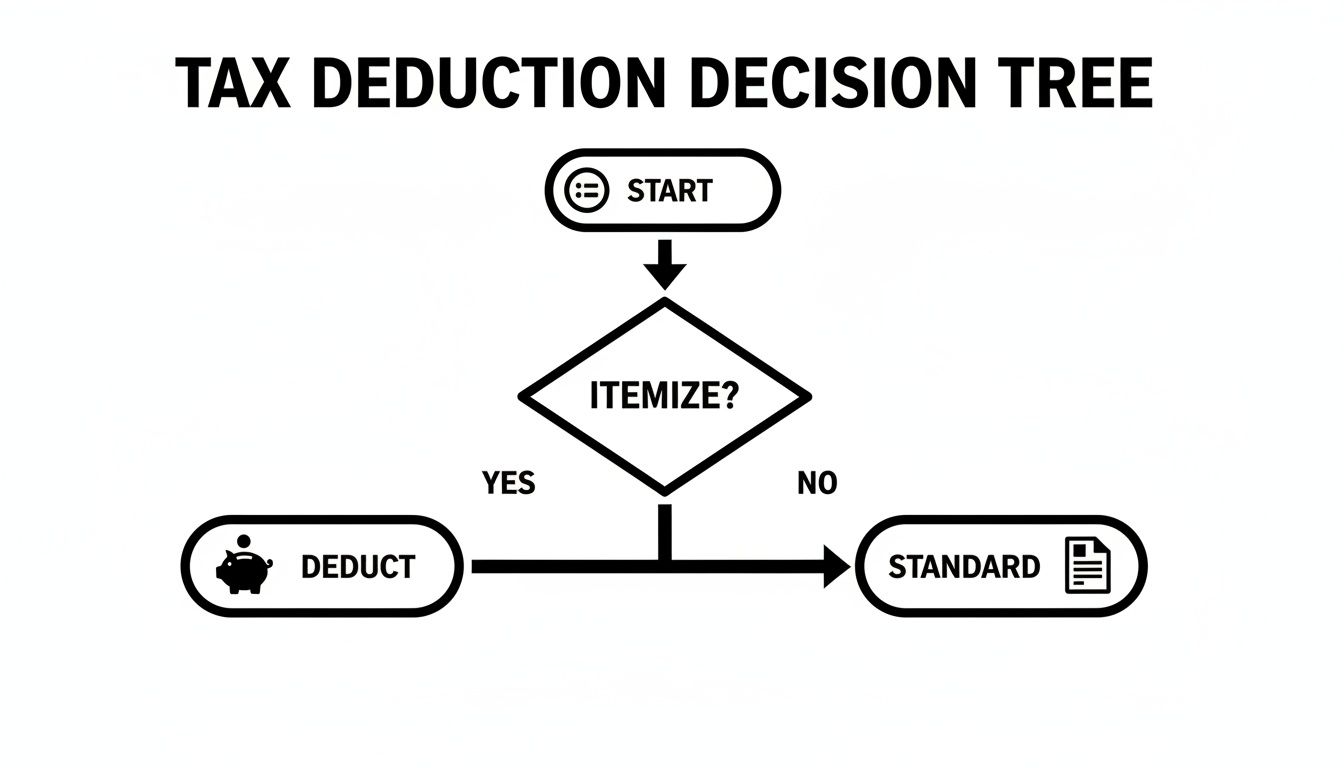
As you can see, the path to claiming this deduction begins and ends with that choice. If the standard deduction is the better financial move, your journey ends there for the year.
The Qualified Home Rule
Okay, let's say itemizing makes sense for you. The next step is making sure the loan is tied to a qualified home. This sounds straightforward, but the definition is more flexible than most people realize. A qualified home can be your primary residence or a second home.
- Main Home: This is simply the house, apartment, or co-op where you live most of the year. You can only have one main home at a time.
- Second Home: You can also deduct interest on one other property. This could be a vacation cabin or a city condo. Believe it or not, it can even be a boat or an RV, as long as it has basic living facilities like a sleeping area, a toilet, and a kitchen.
There's a catch if you rent out that second home. To qualify, you must personally use it for more than 14 days or more than 10% of the days it was rented out to others, whichever is longer.
Understanding Your Mortgage Debt
Here’s where many taxpayers get tripped up. The IRS cares deeply about why you have the debt in the first place. The interest you deduct must come from a loan used for a specific purpose.
Key Takeaway: The loan proceeds must have been used to buy, build, or substantially improve your home. The tax code calls this acquisition indebtedness.
This means if you take out a cash-out refinance or a home equity loan and use the cash for something else—like paying off credit cards, buying a car, or funding a vacation—the interest on that portion of the loan is not deductible.
Finally, a simple but crucial point: you must be legally on the hook for the loan. Your name has to be on the mortgage documents. Even if you live in the home and make every single payment, you can’t deduct the interest if the loan isn’t legally in your name.
For business owners, keeping these interest expenses separate is even more critical, especially when a portion of the home is used as an office. You can dig into the specific rules for that in our detailed guide on the home office deduction. The same principles of careful tracking apply, ensuring you claim every dollar you're entitled to without crossing any lines.
How the TCJA Reshaped This Major Tax Break
If you’re a homeowner, you've probably heard about the mortgage interest deduction. For decades, it was one of the most reliable and popular tax breaks on the books. But in 2017, the Tax Cuts and Jobs Act (TCJA) completely rewrote the rulebook, and its impact is still felt by millions of homeowners today.
Understanding these changes isn't just a history lesson—it's critical for your financial strategy right now. The TCJA didn't just tweak the deduction; it fundamentally changed who can claim it and how much it's worth. Let's break down the two major shifts that happened.
The New Lower Debt Limit
First, the law took direct aim at the amount of mortgage debt that qualifies for the deduction.
For anyone with a mortgage that originated on or before December 15, 2017, the old rules are "grandfathered" in. You can still deduct the interest on up to $1 million in home acquisition debt.
But for home loans taken out after that date, the TCJA lowered the ceiling significantly.
Key Change: The new deductible mortgage debt limit is $750,000 for single filers and married couples filing jointly. For married couples filing separately, it's $375,000.
So, what does this look like in practice? Imagine you bought a home in 2022 with a $900,000 mortgage. Under the current rules, you can only deduct the interest on the first $750,000 of that loan. The interest you pay on the remaining $150,000 provides no tax benefit. This change has a real impact, especially for those living in high-cost housing markets where mortgages often exceed that limit.
The Standard Deduction Game Changer
While the lower debt limit was a direct hit, the second change was more subtle—and arguably had an even bigger effect. The TCJA nearly doubled the standard deduction.
This was a game-changer. Suddenly, the simple act of taking the standard deduction was a better deal for millions of Americans than going through the hassle of itemizing.
- Before the TCJA, the standard deduction was low enough that many homeowners easily surpassed it by adding up their mortgage interest, property taxes, and charitable donations. Itemizing was the obvious choice.
- After the TCJA, the math flipped. With a much higher standard deduction to beat, many taxpayers found their itemized deductions just didn't add up anymore.
This single move caused the number of people claiming the mortgage interest deduction to plummet. One analysis revealed that claims fell from around 34 million taxpayers before the law to just 14 million by 2018.
Of course, this deduction doesn't exist in a vacuum. It’s also important for homeowners to understand the rules around other expenses, like the deductibility of property taxes, which were also affected by tax reform. The TCJA capped the state and local tax (SALT) deduction at $10,000, which gave people yet another reason not to itemize.
When you combine the higher standard deduction with the SALT cap, you can see why the mortgage interest deduction lost its status as a universal benefit for homeowners.
What This Means for You Through 2025
These are the rules we're living with for now. However, a big question mark is looming on the horizon.
It's crucial to remember that most of the TCJA's individual tax provisions, including these, are temporary. They are set to expire at the end of 2025. This creates a lot of uncertainty and makes forward-looking financial planning essential. If you want to stay on top of the conversation, keep an eye on discussions around the upcoming TCJA expiration.
For today, the TCJA has turned the mortgage interest deduction into a more strategic tool. It’s no longer a given. It's now mainly for those whose total itemized deductions—interest, SALT, and charitable giving—are large enough to clear that high standard deduction hurdle.
How to Claim the Deduction Step by Step
Ready to actually claim your mortgage interest deduction? At first glance, the paperwork can seem a little intimidating, but it's a pretty straightforward process once you know which forms to look for and where the numbers go. Let's walk through it together.
Your journey begins with a key piece of mail you'll receive from your lender: Form 1098, the Mortgage Interest Statement.

Think of this one-page document as your official cheat sheet. Lenders are required to send you one by January 31 if you paid $600 or more in mortgage interest over the year. It neatly summarizes the exact amount you paid, so there's no need to dig through statements or do the math yourself.
Decoding Your Form 1098
When you get Form 1098 in the mail, you'll see a few numbered boxes. For the purpose of this deduction, only a couple of them really matter.
- Box 1: This is the big one. It shows the total mortgage interest you paid for the year and is the primary figure you'll need for your tax return.
- Box 2: You'll see your outstanding mortgage principal here from the start of the year. It’s useful information for your own records but doesn't factor into the deduction calculation itself.
- Box 6: This box lists any "points" you paid when you got your loan. Points are a form of prepaid interest and can often be deducted, though the rules around them have some nuances.
And don't worry if your mortgage was sold to a different company mid-year. You'll just get a Form 1098 from both the old and new lender. Simply add the amounts from Box 1 on each form to get your total interest paid.
Itemizing on Schedule A
With your total interest figure from Form 1098 in hand, the next stop is your tax return. Crucially, you can only claim the mortgage interest deduction if you itemize your deductions using Schedule A (Form 1040).
This brings you to a critical decision point: should you itemize or just take the standard deduction? The answer is simple math. You should only itemize if the sum of all your itemizable expenses—like mortgage interest, state and local taxes (up to the $10,000 SALT cap), and charitable donations—is greater than your standard deduction amount.
The deduction has always been a significant tax benefit for those who can claim it. Back in 2012, for example, the average tax savings per claimant was $1,906. As you can imagine, this benefit tends to be more valuable for higher-income homeowners, especially in areas with high property values. For a deeper dive, you can explore this thorough research paper on the mortgage interest deduction and its economic effects.
On Schedule A, you will enter the total from Box 1 (and potentially Box 6 for points) of your Form 1098 on the line designated for "Home mortgage interest and points."
The Importance of Meticulous Record-Keeping
For most homeowners, Form 1098 is all the proof you’ll need. But if you’re self-employed, own a business, or have a more complex financial picture, solid record-keeping is absolutely non-negotiable.
Good records not only make tax time easier but also give you the confidence that you can substantiate your claims if the IRS ever comes knocking with questions.
Essential Documents to Keep:
- Form 1098: Save a copy from every lender, for every tax year.
- Closing Documents: Your settlement statement (usually a Closing Disclosure or HUD-1) is vital, as it details things like points you paid at closing.
- Proof of Payment: Bank statements or canceled checks provide excellent backup evidence that you made your mortgage payments.
- Home Improvement Records: Keep all receipts and contracts for major home improvements. These help prove that a cash-out refinance or home equity loan was used for "acquisition debt."
By gathering these documents and understanding the path from Form 1098 to Schedule A, you'll be well-equipped to claim your mortgage interest deduction accurately and with total confidence.
Navigating Special Scenarios and Common Mistakes

The general rules for the mortgage interest tax deduction are straightforward enough, but real-life property ownership rarely fits into a neat little box. Things get complicated fast, and a single wrong move can mean a smaller deduction—or worse, an unwelcome letter from the IRS.
This is where I see taxpayers get tripped up most often. To stay compliant and get the full tax benefit you're entitled to, you have to understand how the rules bend for special situations like a home office, a rental property, or a cash-out refinance. Let's walk through the trickiest scenarios and the mistakes you need to sidestep.
Handling Different Property Uses
The IRS cares deeply about how you use your property. Is it your home, a vacation spot, a rental, or a place of business? The answer completely changes how—and if—you can deduct your mortgage interest.
Take the home office, for example. It’s a classic hybrid situation. You can't just write off all your mortgage interest on Schedule A. You have to do the math. You’ll need to figure out the business-use percentage of your home (usually based on square footage) and deduct that portion of the interest as a business expense. This gets reported on Form 8829, which then carries over to your Schedule C.
The rest of the interest—the personal part—can still go on Schedule A, but you absolutely must separate the two.
Pro Tip: Always remember this: the purpose of the loan and the use of the property determine where you deduct the interest. When you start mixing personal, business, and rental activities in one property, you have to split the interest expense across different tax forms.
Here's a clearer picture of how dramatically the rules shift depending on what you're doing with the property.
How Interest Deduction Rules Vary by Property Use
The moment a property starts earning you money, whether as a rental or a home office, the mortgage interest rules change. This table breaks down the essentials you need to know.
| Property Type | Deductible Debt Limit | Where to Report | Crucial Detail to Remember |
|---|---|---|---|
| Primary Home | $750,000 | Schedule A (Form 1040) | This must be your main residence, where you live most of the year. |
| Second Home | Combined with primary home under the $750,000 limit | Schedule A (Form 1040) | You must use it personally for more than 14 days or 10% of the days it was rented out, whichever is greater. |
| Rental Property | No specific limit; treated as a business expense | Schedule E (Form 1040) | All interest is generally deductible, but it only offsets rental income, not your regular salary. |
| Home Office | Business portion is a business expense; personal portion falls under the $750,000 limit | Schedule C (via Form 8829) and Schedule A | You must be able to prove the percentage of your home used exclusively for business. |
As you can see, keeping these uses straight is fundamental to getting your deduction right.
Common Pitfalls That Trigger IRS Audits
Some mistakes are more likely to get an auditor’s attention than others. If you know what the common red flags are, you can make sure your tax return is accurate and, most importantly, defensible.
1. Messing Up Cash-Out Refinance Rules: This is a huge one. When you refinance and pull cash out, you can only deduct interest on that extra cash if you use it to buy, build, or substantially improve your home. If you use the money to pay off credit cards, buy a boat, or go on vacation, the interest on that portion of the loan is not deductible. Period.
2. Exceeding the $750,000 Debt Limit: It’s easy to do if you aren't paying attention. Homeowners with large mortgages or multiple properties must be vigilant about not deducting interest on total home-related debt over the $750,000 limit (for loans originated after December 15, 2017). This cap applies to the combined debt on your primary and second homes.
3. Having Shoddy Records: If you claim you used cash-out funds for a home improvement, you’d better have the receipts and contractor invoices to prove it. If you claim a home office, your calculation of the business-use percentage needs to be clear and documented. An unsubstantiated deduction is an audit waiting to happen. These complexities become even more critical when other tax issues are at play; for instance, you can read more on what to do when selling a home with an IRS lien.
When to Call a Tax Professional for Help
Figuring out your mortgage interest deduction can feel like a major win. But that confidence can quickly evaporate when your tax situation gets complicated. Knowing the difference between a DIY task and a moment that requires a professional is a skill that can save you a world of financial trouble.
Frankly, some scenarios are just too risky to handle on your own. Let’s talk about the clear warning signs that tell you it’s time to step back and call in an expert. This isn't about scaring you—it's about protecting you from costly mistakes when the stakes get high.
Red Flags That Signal You Need an Expert
If any of these situations sound familiar, it's a good idea to seek professional advice. Trying to push through on your own could lead to penalties, missed deductions, or a lengthy back-and-forth with the IRS.
- You Receive an IRS Audit Notice: This is the most obvious signal. An audit letter, especially one that questions your Schedule A deductions, means it's time to stop what you're doing and get help. A tax professional can represent you, handle all communication with the IRS, and make sure the process is handled correctly from start to finish.
- You Have Complex Property Scenarios: Do you have a primary home, a vacation home you rent out occasionally, and a home office? Allocating interest between personal use, rental activity, and business use is a real headache. An expert ensures every piece of interest is calculated correctly and reported on the right form (Schedule A, E, or C).
- You're Dealing with Past-Due Tax Debt: If you're already behind with the IRS, your current tax return is under a microscope. A tax pro can help you file this year's return perfectly, claiming every deduction you're entitled to, while also helping you navigate your existing tax debt.
- You Used a Cash-Out Refinance for Multiple Purposes: Did you pull cash from your home to renovate the kitchen, pay off credit cards, and buy a car? Tracing those funds to calculate the deductible portion of the interest is a massive audit trigger. A professional knows exactly how to document this to satisfy the IRS.
Think of hiring a professional as a form of risk management. When things get complex, a tax expert isn't just a number-cruncher; they're your guide and advocate, making sure you stay compliant while getting every deduction you legally deserve.
At the end of the day, tax software is a fantastic tool, but it's not a strategist. It can't ask you probing questions about your life circumstances or defend your choices in an audit. For anything beyond a straightforward return, it's worth learning how to find a good tax attorney who can offer advice tailored to your specific situation. That investment can provide invaluable peace of mind.
Frequently Asked Questions
When it comes to taxes and your mortgage, the big picture is important, but it's often the specific, practical questions that trip people up. Let's tackle some of the most common ones I hear from homeowners, especially as tax season gets closer.
Can I Deduct Mortgage Interest if I Take the Standard Deduction?
Great question, and the answer is a firm no. Think of it as a fork in the road: you can either take the standard deduction or you can itemize. You can't do both.
The mortgage interest deduction lives on the itemized path, specifically on Schedule A. If your total itemized deductions—mortgage interest, state and local taxes, charity, etc.—don't add up to more than the standard deduction amount for your filing status, you'll almost always be better off taking the standard deduction. It's the simpler route and saves you more money.
Are Mortgage Points Deductible?
Yes, they usually are. Mortgage points are really just prepaid interest you pay upfront to secure a lower rate. The IRS sees it this way, too, but how you deduct them is key.
- Buying or Building a Home: When you pay points on a loan to buy or build your main home, you can typically deduct the full amount in the year you paid them. It’s a nice, immediate tax benefit.
- Refinancing: For a refinance, the rules are different. You have to spread the deduction out over the entire life of the new loan. So, if you paid $3,000 in points on a 30-year refinance, that works out to a $100 deduction each year.
Key Takeaway: Just remember that points are prepaid interest. The IRS just changes the timing of the deduction depending on whether it’s for a brand-new purchase or a refinance.
My Lender Sold My Mortgage What Do I Do?
Don't worry, this happens all the time and the tax side is straightforward. When your mortgage is sold, you'll end up with two (or more!) Form 1098s at the end of the year—one from your old lender and one from the new one.
Each form will show the interest you paid to that specific lender. To get your full deduction, just add the amounts from Box 1 of all the 1098s you received and enter the grand total on your Schedule A. A classic mistake is to only use the form from your current lender, which means leaving a big chunk of your deduction on the table.
What if I Have a Home Office?
Having a dedicated home office opens up another layer of tax savings. If you use part of your home exclusively and regularly for your business, you can write off a portion of your mortgage interest as a business expense.
You’ll first need to figure out the business-use percentage of your home, which is usually just the square footage of your office divided by your home's total square footage. That percentage of your mortgage interest gets deducted on Form 8829 as a business expense, which then carries over to your Schedule C. The rest of the interest—the personal portion—can still be claimed on Schedule A. Be warned: the IRS looks closely at this, so precise records are non-negotiable.


