Missouri State Taxes Payment Plan: How to Apply in 2026
Missouri state taxes payment plan guide: check eligibility, apply online or by paper, gather documents, and see what interest still costs.

In this article
- Missouri Payment Plan Terms at a Glance
- Check Eligibility Before You Apply
- Run This Checklist First
- Documents to Gather and How to Organize Them
- Build One Clean Folder
- How to Apply Online or by Paper
- Apply Online
- Apply by Paper
- Hardship, Penalties and Better Alternatives
- What a Lower Payment Really Costs
- How Hardship Changes the Terms
- Negotiate or Appeal, Then Choose Your Path
- If DOR Says No
- Apply a Simple Decision Rule
You've got a Missouri Department of Revenue notice on the counter, a balance you can't pay this month, and a payroll or rent payment competing for the same account. That's the normal starting point, not a failure. A Missouri State Taxes Payment Plan can give you structured time to pay, but it won't reduce the tax or stop interest from building while you pay it. That distinction decides whether the plan helps or slowly becomes more expensive. File first, price the full cost, then choose between the standard terms and hardship. If you can't carry the payment after accruals, don't sign up for a number that fails three months later.
Missouri Payment Plan Terms at a Glance
A Missouri State Taxes Payment Plan spreads an existing tax debt over time; it does not settle or reduce the amount owed. The Missouri Department of Revenue's Form 4338 guidance on installment terms sets the standard agreement at no more than 36 months, with monthly payments of at least $50. Interest continues while you pay, so a longer term can ease the monthly burden while increasing the total cost.
Form 4338 also states that you must file all required tax returns and include all delinquencies on the account. It lists motor-vehicle sales taxes, motor-vehicle fees, and driver-license fees as excluded from the standard agreement. Those balances need separate handling.
| Term | Standard plan | Hardship plan | What it means for you |
|---|---|---|---|
| Maximum length | 36 months under Form 4338 | DOR sets the terms based on your financial circumstances | A longer term may reduce the monthly payment, but interest keeps accruing |
| Minimum monthly payment | $50 under Form 4338 | DOR determines an affordable payment from the financial information provided | A lower payment can extend repayment and increase total interest |
| Application form | Form 4338 | Form 5708 | The hardship request requires financial details |
| Application channel | Online application is available for individuals and businesses | Submit Form 5708 by paper; online availability is not confirmed | The application channel depends on the type of request |
| Covered balances | All delinquencies on the account | DOR determines which balances the approved arrangement covers | Confirm the account balances included before agreeing |
| Excluded taxes | Motor-vehicle sales taxes, motor-vehicle fees, driver-license fees | DOR determines how excluded balances are handled | Plan to address these separately unless DOR confirms otherwise |
The minimum payment matters on smaller balances. Divide the balance by your proposed monthly payment, then account for ongoing interest before assuming the standard maximum term will fit. A hardship payment may be lower, but that can mean paying for longer and spending more overall.
Practical rule: Confirm filing compliance and identify which balances the requested agreement covers before comparing monthly payments. A payment amount cannot fix missing returns or balances outside the agreement.
Unresolved debt can progress from notices to collection action. Knowing how a state tax levy works helps put the trade-off in context: a formal agreement can address collection pressure, while interest still adds to the cost as payments continue.
Check Eligibility Before You Apply
One unfiled return can stop the whole request. Missouri generally won't consider an agreement until you're in filing compliance, so eligibility starts with returns, not with the monthly amount you want to offer.
Don't guess from memory. Work from your latest notice, your filed copies, and the account as DOR sees it.
Run This Checklist First
- Every required return filed: Confirm no year or period is missing, even if you expect little or no tax for that period.
- Every delinquent period included: List each balance the notice shows, because a request that omits one period invites a correction or denial.
- No excluded balance driving the request: Separate motor-vehicle sales taxes, motor-vehicle fees, and driver-license fees, since you'll need to handle those outside the plan.
- Account type confirmed: Note whether you're applying as an individual, sole proprietor, single-member LLC, multi-member LLC, or another business entity, because the online path differs by account type.
- Notice, PIN, and bank account ready: Have your latest DOR notice and PIN in hand and confirm the checking or savings account you'll pay from is open and correctly numbered.
Take a sole proprietor with an assessed balance from an earlier year and one later return still unfiled. She may be ready to pay monthly, but she's not eligible yet. She files the missing return first, lets DOR post it, then requests one plan covering the assessed balance shown on her account. The order matters.
If every item checks, move to the application. If one fails, fix that item first. A missing return is the most common reason a request stalls, and no well-chosen payment amount fixes it.
Documents to Gather and How to Organize Them
A hardship request can stall when the paperwork tells conflicting stories. Make sure the income on the application aligns with filed returns, and explain large deposits in the bank records so the reviewer can identify their source.
| Document | Plan type | Where it comes from | Common mistake |
|---|---|---|---|
| Latest DOR notice and PIN | Standard and hardship | Most recent DOR letter | Using an old notice with a stale balance |
| Identifying information (name, SSN or FEIN, address) | Standard and hardship | Tax returns, business registration | Details that differ from the returns on file |
| Payment account information | Standard and hardship | Checking or savings statement | An account that is closed or misnumbered |
| Filed returns for each covered period | Standard and hardship | Your copies of filed returns | An unfiled period that blocks the request |
| Bank statements for the period DOR requests, if required | Hardship only | Each relevant bank or card institution | Missing requested statements or unexplained deposits |
| Household income and expense figures | Hardship only | Pay stubs, bills, lease or mortgage | Figures that do not reconcile with the returns |
The notice page explains income tax notices and hardship documentation, but it does not establish a fixed bank-statement period or say that statements from every household member are always required. Check the current hardship form or confirm with DOR which accounts, household members, and statement months apply to your case. Include the documents requested for your situation rather than assuming a specific period.
A persuasive hardship request connects income, expenses, assets, and bank activity into a consistent account of what you can pay. Use this guide to learn how to prove financial hardship. A low proposed payment needs cash-flow records to show why it is affordable; otherwise, the request may lack support.
Build One Clean Folder
Scan the records into a folder organized by tax period and person. Label each statement with the account holder and month, then compare its deposits and balances with pay stubs and filed returns before submitting the packet.
Identify transfers between your own accounts so they are not mistaken for income. For a one-time deposit, such as a refund or family loan repayment, add a brief explanation and keep the supporting record with it.
Check for missing requested statements, unexplained transfers or deposits, and figures that differ between the form and the return. Correct discrepancies and attach explanations before submission. Clear, organized records help DOR review the request without having to guess what a deposit represents or why the numbers differ.
How to Apply Online or by Paper
Use the online route if your account type allows it and you can enter the information exactly as it appears on your notice. Use paper when you need the form in front of you or when you're submitting a hardship packet with statements attached.
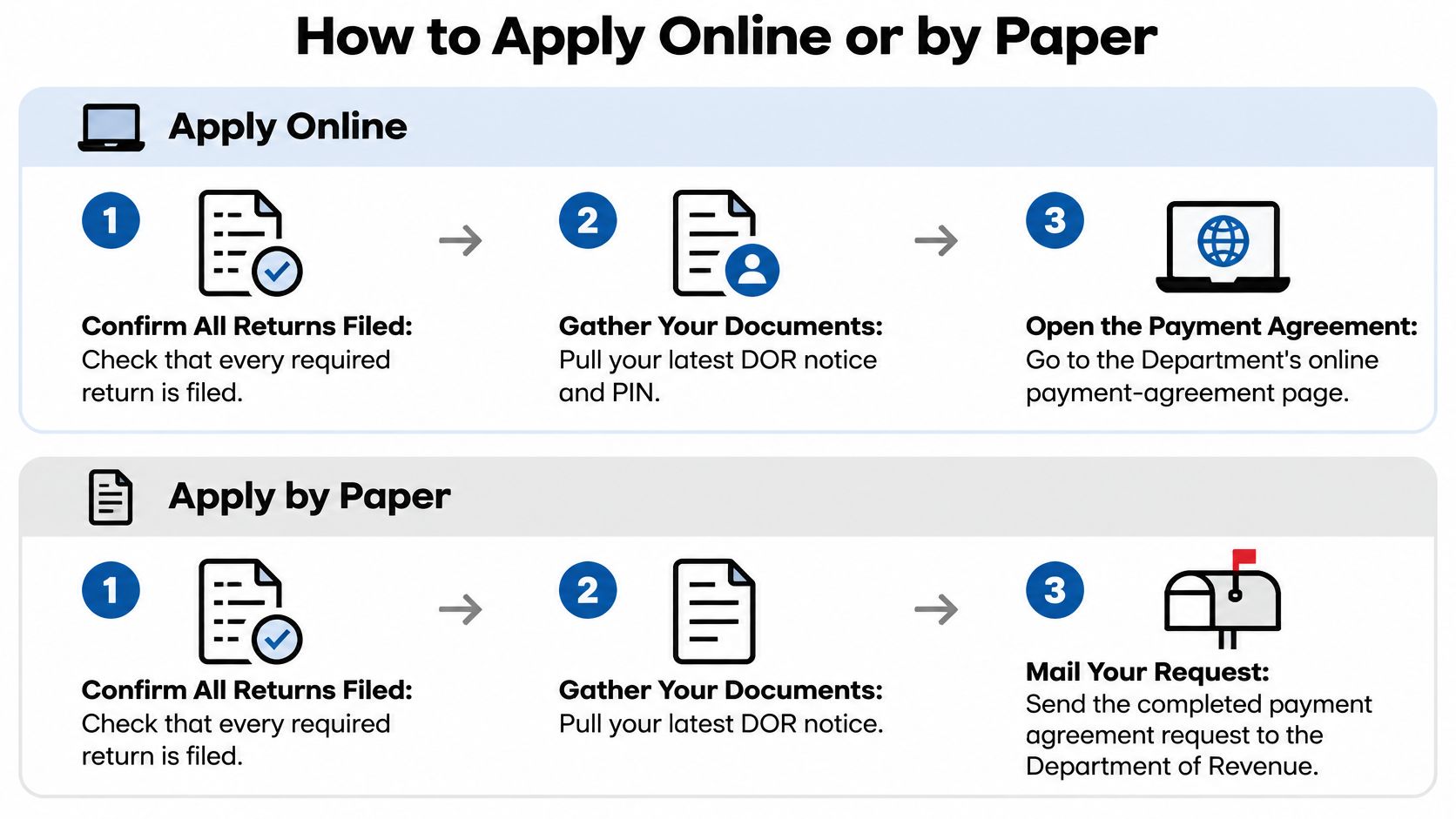
Apply Online
- Confirm all required returns are filed: Don't open the application until filing compliance is handled, as covered in the eligibility section above.
- Pull your latest notice and PIN: Use the most recent letter so the identifiers and balance match DOR's current record.
- Open the online payment-agreement option: Choose the individual or business path that matches your account type.
- Enter identifying information exactly as shown: Copy names, numbers, and addresses from the notice rather than typing from memory.
- Select the full balance and propose a payment: Use the standard minimum and maximum term covered above, and make sure the amount clears the balance within that term before interest.
- Choose the payment account: Enter checking or savings details carefully and confirm the account will stay open.
- Review, submit, and save confirmation: Keep the confirmation with your notice so you can prove what you submitted and when.
Apply by Paper
- Download Form 4338: Get the current form from DOR rather than reusing an old copy from a prior year.
- Complete identifiers and balances by period: List the full account balance, not only the period you want to pay.
- State your proposed monthly amount: Check it against the standard limits before you sign.
- Attach requested documents: For hardship, use Form 5708 instead and add the household bank statements from the documents table above.
- Mail and keep a copy: Send it to the address on the form or notice and retain the complete packet, including attachments.
Don't stop paying attention after you submit. Confirm status with DOR and stay current until you have a decision in hand.
DOR guidance doesn't give you a processing timeline you can bank on, so confirm receipt and status directly with the Department. Keep making scheduled payments if you've already begun, and don't assume silence means approval.
Three errors cause most rejections. You'll run into trouble with a proposed payment below the standard floor, a requested term beyond the standard maximum, or a balance that omits a delinquent period. Check those three lines before you submit either version, because they're cheaper to fix on your screen than after a denial.
Hardship, Penalties and Better Alternatives
A payment plan can ease collection pressure, but it does not stop additions or interest from accruing. For individual income tax, Missouri DOR lists a failure-to-file addition of 5% of the unpaid balance per month, capped at 25%, a separate failure-to-pay addition of 5%, and simple interest on delinquent tax. The Missouri DOR guidance on individual tax additions and interest describes these charges.
Consider a $2,000 unpaid balance. The failure-to-pay addition alone would be $100. A late return could add up to $500 under the cap, with interest on top. Paying part of the tax before the due date reduces the balance those charges apply to, so an early partial payment can help even when you cannot pay in full.

What a Lower Payment Really Costs
Compare the full repayment term, not just the monthly amount. A $4,800 balance paid at $200 a month takes about 24 months to clear before interest. At $110 a month, it takes roughly 44 months. Interest then accrues for about twenty additional months while the unpaid balance declines.
A smaller payment may still be the sound choice if the larger one would strain your household budget or lead to default. Set an amount you can sustain, then pay extra in stronger months when possible to shorten the term and reduce further accruals. If you are considering whether penalties can be reduced separately, review what penalty abatement involves. An installment agreement by itself does not erase additions that have already accrued.
How Hardship Changes the Terms
Missouri Form 5708 says a hardship agreement can extend the repayment period and may lower the monthly payment, according to DOR's hardship installment agreement guidance. Approval is not automatic. DOR reviews the completed application and supporting documents. If approved, the Department may contact you to discuss terms; if denied, it will contact you.
Hardship requests depend on household-wide evidence, as described in the documents section. Figures that conflict with filed returns, unexplained deposits, or incomplete statements can leave the reviewer without a clear basis to approve a longer term. Check that the amounts in your request reconcile with the records you provide.
A hardship agreement does not end the debt early or resolve collection consequences before payoff. Interest continues during the agreement. Confirm directly with DOR how a lien affects your account and when it may be released, rather than budgeting around an assumption. Measure the proposed payment against your household's ability to afford it while interest continues, not just whether the first payment looks manageable.
Confirm the hardship term limit with DOR before building your budget around it. Keep up with new returns and tax obligations as well. A plan for an old balance does not address a new delinquency.
| Route | Best when | Main tradeoff |
|---|---|---|
| Full payment | You can pay the balance now | Requires available cash and stops further charges on the amount paid |
| Standard installment plan | You can clear the balance within the standard term and meet the minimum | Interest continues during the repayment term |
| Hardship installment plan | The standard payment is unaffordable after necessary living costs | Approval is discretionary, documentation is extensive, and the longer term allows more accruals |
| Partial payment with later balance | You can pay part now and need to arrange the rest | The unpaid balance continues to accrue charges; confirm terms with DOR |
| Offer in Compromise | You cannot realistically repay the balance through a plan | Eligibility and terms require a separate review |
An Offer in Compromise may be worth examining if repayment through an installment agreement is not realistic. Compare that option with a payment plan using the amount you can actually afford and the ongoing accruals. Confirm the available routes and requirements with DOR before deciding.
Negotiate or Appeal, Then Choose Your Path
Negotiation starts with a clear written request. State the monthly amount, length, and start date you want, tie the amount to your actual cash flow, and send complete documents the first time so the reviewer has no reason to ask for the same records twice.
Don't inflate expenses or hide deposits to force a lower number. Reviewers compare forms, returns, and bank records. A modest request that reconciles cleanly is stronger than an aggressive request that falls apart on cross-checking.
If DOR Says No
Ask for the reason in writing and ask whether a corrected resubmission is allowed. A denial tied to a missing return, missing statement, or omitted period is often fixable by completing the file. A denial tied to affordability needs better evidence or a different route, not the same packet sent again.
Confirm any appeal procedure and deadline directly with DOR before relying on one. Don't assume a formal appeal path or timeline exists for your situation, and don't let a hoped-for appeal stop you from addressing new notices.
Apply a Simple Decision Rule
- Choose the standard plan if the required payment fits your budget after interest and your returns are current.
- Choose hardship if the standard payment doesn't fit and your household records cleanly prove it.
- Pay part now if you can reduce the base today and realistically arrange the rest without creating a new shortfall.
- Consider an Offer in Compromise or professional review if the balance can't be repaid within the available term, several tax types overlap, or payroll trust-fund and IRS problems sit on top of the Missouri debt.
That last category deserves careful sorting, because tax debt settlements involve different standards than a straightforward installment request. Guessing wrong can waste months while interest keeps running.
Do this week's work in order. Choose your route, gather the documents for that route, and submit before the next notice arrives. A filed, complete request gives you a position to negotiate from. Waiting gives you only a larger balance.
If your Missouri balance won't fit inside a standard plan, or hardship, an Offer in Compromise, payroll tax exposure, and IRS debt are overlapping, get the numbers reviewed before you commit to a payment you can't sustain. Tax Attorney Stephen A Weisberg offers a free tax debt analysis to assess your state and IRS options and identify the route most likely to hold up. Visit the site to request your analysis and bring your latest DOR notice so the conversation starts with your actual account, not estimates.


