Maryland Tax Withholding: A Complete Guide for 2026
Navigate Maryland tax withholding with confidence. Our 2026 guide explains calculations, filing, and how to fix common payroll tax issues for MD businesses.
In this article
- The Maryland Withholding Challenge for Business Owners
- Why these notices matter fast
- Personal liability is the issue owners underestimate
- Understanding Maryland's Dual Withholding System
- What the employer is really withholding
- Who has to care about this
- Why the dual system matters in practice
- How to Register for a Maryland Withholding Account
- What to gather before you register
- Why the CRN matters more than owners expect
- What works and what doesn’t
- Calculating Maryland Withholding Correctly
- Start with the employee’s MW507
- The percentage method in plain English
- Why annualization matters
- A practical example without fake precision
- What high earners and owners often miss
- What works in the real world
- A short diagnostic for owners
- Filing and Remitting Withholding Taxes to the Comptroller
- Maryland Withholding Deposit Schedules 2026
- The business trade-off owners actually face
- What bFile and annual reconciliation mean in practice
- Federal and state timing need to work together
- What works and what fails
- Navigating Common Withholding Problems and Special Cases
- Teleworking and nonresident confusion
- Independent contractors and owner distributions
- Nonresident sellers of Maryland real property
- Where planning actually helps
- A quick risk screen
- What to Do When You Have a Withholding Problem
- The first decisions to make
- Don’t underestimate personal exposure
- What usually works
You open a letter from the Maryland Comptroller, scan the first paragraph, and feel your stomach drop. The notice says your payroll withholding doesn’t match what the state expected. You thought your payroll company handled this. Your bookkeeper thought the same. Now you’re looking at a tax issue that can turn into penalties, interest, and a much larger fight if it sits too long.
That reaction is normal. Maryland tax withholding is not a simple single-rate system, and business owners often find out that “mostly right” payroll compliance still creates very real problems. The mistake may be a bad MW507 on file, the wrong local rate, missed deposits, a worker classified the wrong way, or a filing frequency the business never properly followed.
What makes this worse is that payroll withholding money is not the business’s money. Once you withhold it, the state expects it to be remitted. If it isn’t, the problem can move past the entity and toward the people who controlled payroll decisions. That’s where state collection pressure starts to look a lot like federal trust fund exposure.
The Maryland Withholding Challenge for Business Owners
A common version of this problem starts subtly. A business hires its first employee, runs payroll, and sees one line on the pay stub for tax withholding. Everyone assumes that line reflects the full Maryland requirement. Months later, a notice arrives saying the deposits were short, the returns don’t reconcile, or the employee’s residence-based local tax wasn’t handled correctly.

That’s not unusual for small businesses, S corporations, family-run companies, and owners who moved from contractor payments to W-2 payroll without tightening their process. The stress gets worse when the business already has uneven cash flow, because payroll tax notices rarely arrive at a convenient time.
Why these notices matter fast
Maryland withholding issues don’t usually stay small if ignored. A late response can lead to more notices, account holds, enforced collection, and closer review of payroll records. If the business has been using withheld funds to cover rent, vendors, or owner draws, the exposure becomes much more serious.
For owners who also handle estimated income taxes, the cash flow strain can overlap with other tax deadlines. A practical companion resource is this Quarterly Estimated Taxes Small Business Guide, because many businesses get into trouble when they treat payroll obligations and owner tax obligations as interchangeable. They are not.
Practical rule: If you receive a Maryland withholding notice, don’t assume it’s a clerical nuisance. Treat it as a signal to verify registration, payroll coding, deposit timing, and who inside the business had authority over payroll funds.
Personal liability is the issue owners underestimate
Many owners think the corporation or LLC shields them from payroll tax trouble. That assumption fails quickly in withholding cases. If you had enough control over who got paid and when taxes were or weren’t remitted, your risk can become personal. This discussion of https://www.weisberg.tax/newsletter/liability-for-payroll-taxes-are-not-limited-to-the-business-ctp7e-w943y-hwcwg explains why owners, officers, and other responsible parties can’t safely rely on the entity alone.
The better approach is simple. Understand how maryland tax withholding works before the problem matures into debt collection.
Understanding Maryland's Dual Withholding System
Maryland withholding works like a recipe with two required ingredients. The first is the state income tax. The second is the local income tax, often called the piggyback tax. You don’t get to choose one or the other. Employers withhold both together.

That structure trips up employers because the local piece is tied to where the employee lives, not where the employee works. In other words, a business in one Maryland county can still owe withholding at another county’s local rate if the employee resides there.
Maryland also changed its withholding structure in 2025, raising the highest marginal tax rate to 6.50% and introducing new high-earner brackets, while local piggyback taxes withheld by residence range from 2.25% to 3.20% across Maryland’s counties and Baltimore City, according to the Maryland payroll announcement at this Maryland withholding update.
What the employer is really withholding
For most businesses, the key point is that Maryland tax withholding is not just a rough estimate. It is a combined payroll tax process administered through employee wage withholding, based on state rules, employee form data, and county residence data.
Here’s where employers usually go wrong:
- They use the work address instead of the home address. That produces the wrong local tax.
- They rely on old payroll settings. Maryland changed important withholding rules, and stale settings create avoidable errors.
- They assume one tax line means one tax. On many pay stubs, the withholding appears as a single state tax line even though it blends state and local amounts.
Who has to care about this
If you pay wages, you need to care. That includes:
- New employers: The issue starts with the first payroll, not when the business becomes “large enough.”
- Closely held entities: Owner-employees often create extra confusion because owners assume they can fix withholding later through the return.
- Businesses using third-party processors: A payroll company can help with mechanics, but the employer remains responsible for getting withholding and remittance right.
Maryland’s combined withholding model is manageable once the inputs are right. It becomes expensive when the residence code, employee form, or deposit schedule is wrong from the start.
Why the dual system matters in practice
The local layer isn’t an administrative footnote. It changes the amount withheld every pay period and affects whether an employee ends up underwithheld, overwithheld, or matched properly by year-end. It also creates audit issues when employer records, employee addresses, and payroll system settings don’t line up.
For business owners dealing with payroll debt, the danger is operational. A business can believe it is compliant because payroll is “running,” while the actual state-local calculation has been wrong for months. By the time the Comptroller sends a notice, the fix is no longer just updating a setting. It may involve amended filings, reconciliations, and payment arrangements.
How to Register for a Maryland Withholding Account
The first compliance step is getting properly registered before payroll starts. If you skip that step, every later fix becomes harder. Payments may not post correctly, returns may not match, and notices start arriving under the wrong assumptions.
Maryland employers use an 8-digit Central Registration Number, or CRN, tied to the business’s FEIN for withholding filing and payment. That CRN is the identifier the state uses to connect the employer to returns, deposits, and annual reconciliation.
What to gather before you register
Have your core business information ready before you begin. Registration usually goes more smoothly when the legal and payroll details already match across your records.
Use this checklist:
- Entity information: Legal business name, FEIN, and business structure.
- Responsible party details: The person the state can contact about tax matters.
- Payroll start information: The date wages will begin and basic payroll expectations.
- Address records: Mailing address and business address should be current and consistent.
If those items don’t match what the IRS or your formation documents show, fix that first. In tax administration, mismatched identity data causes needless friction.
Why the CRN matters more than owners expect
The CRN is not just an account number. It’s the backbone of Maryland withholding compliance. Employers use it for electronic filing, payment posting, and reconciling what was withheld against what was reported.
Problems often start when a business opens, gets a FEIN, and assumes that’s enough. It isn’t. Federal payroll registration and Maryland withholding registration are separate steps, even though they connect in practice.
For owners already juggling online tax systems, this discussion of https://www.weisberg.tax/newsletter/the-new-and-improved-business-tax-account-making-things-easier-for-business-owners-x5e4t-tct4j-2etzy is useful because account access and identity setup mistakes often delay problem-solving after notices arrive.
What works and what doesn’t
What works is a clean setup before the first paycheck goes out. The business registers, confirms its identifiers, retains payroll setup records, and makes sure the payroll provider is using the correct state account information.
What doesn’t work is waiting until after the first quarter to sort it out. By then, you may have wages paid, no proper account linkage, and a backlog of filing or payment corrections.
A sound registration process usually includes these habits:
- Confirm the business is registered before payroll runs.
- Store the CRN with the FEIN and payroll login credentials.
- Verify that your processor, bookkeeper, and internal finance contact are using the same account data.
- Retain copies of setup confirmations and state correspondence.
If you’re already receiving notices and aren’t sure whether the account was set up correctly, start there. Many withholding problems don’t begin with tax law. They begin with bad account administration.
Calculating Maryland Withholding Correctly
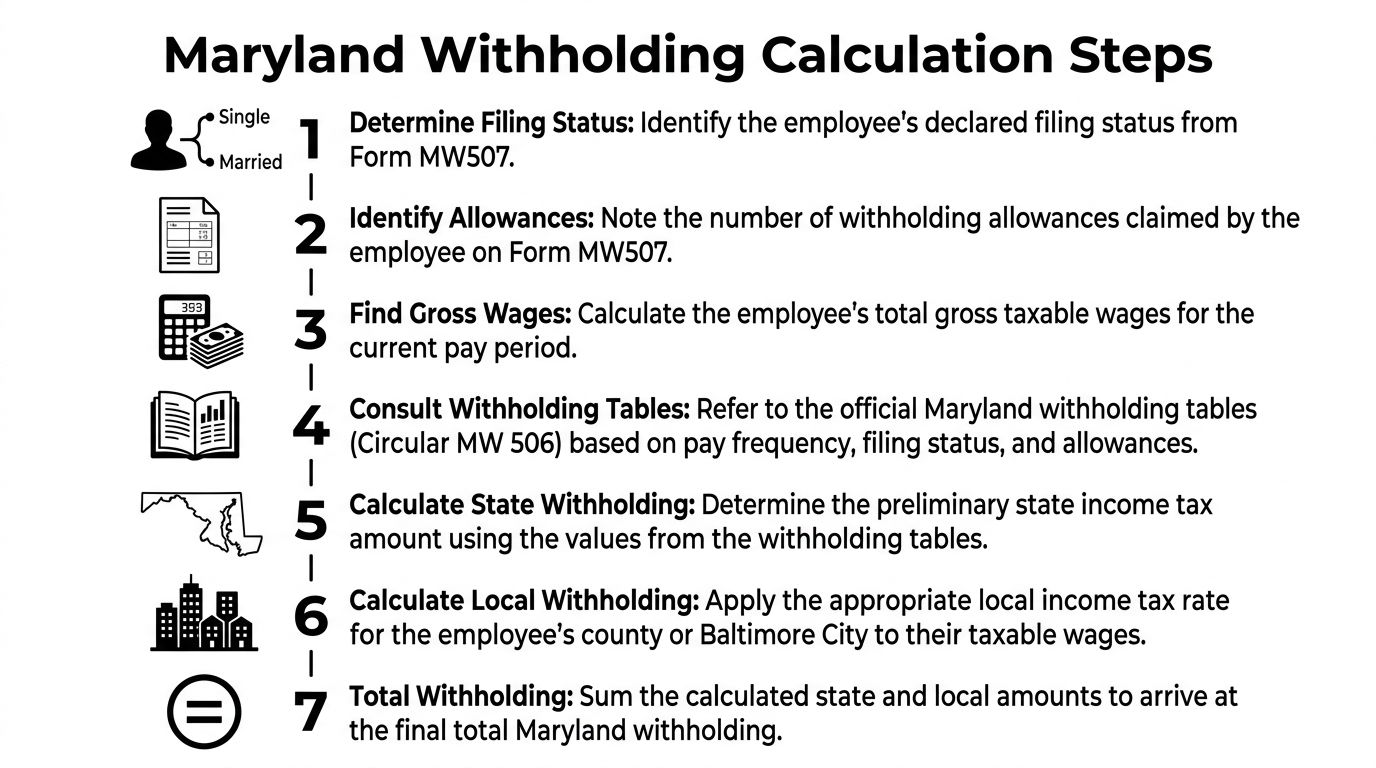
Employers often think withholding errors come from bad math. Usually, the math is not the first problem. The first problem is bad inputs. If the employee’s MW507 is incomplete, the filing status is wrong, or the residence code is off, the calculation will be wrong even if the payroll software does exactly what it was told to do.
For 2026, Maryland withholding uses a progressive state scale running from 2% on the first $1,000 to 6.50% on income over $1,000,000 for single filers, with a flat $3,350 standard deduction for single individuals, and local tax rates added on top that can progress up to 3.20% depending on county and income level, as shown in the Comptroller’s 2026 Maryland state and local withholding information.
Start with the employee’s MW507
Form MW507 is the Maryland form that drives withholding status and exemptions. Employers should not treat it as a one-time HR form that gets dropped into a file drawer. It directly affects how much tax comes out of each paycheck.
The form matters because Maryland’s withholding method uses employee-specific inputs. If no valid form is on file, the employer may default to less favorable withholding assumptions. That can create employee frustration at year-end and collection risk for the employer during the year.
A practical payroll review should confirm:
- The form is signed and current
- The filing status entered in payroll matches the form
- Any exemption claim is supported
- Special forms are used where required, such as military spouse situations
The percentage method in plain English
Maryland’s employer withholding method is a sequence, not a guess. The state’s percentage method generally works through these technical steps:
- Subtract the flat standard deduction from wages.
- Multiply the per-period withholding exemption amount by the number of exemptions claimed.
- Subtract that amount from adjusted wages.
- Apply the correct state bracket and local rate based on the employee’s residence code.
That framework is what payroll systems should be following. If you’re reviewing payroll manually, the goal is not to recreate every formula from scratch. The goal is to verify that the software had the correct employee data and county data before it ran.
Why annualization matters
Withholding is not calculated as though each paycheck exists alone. Employers annualize wages, apply the state method, then prorate back to the pay period. That’s why odd results can appear for bonuses, fluctuating pay, commissions, or employees who start midyear.
This is also why one payroll error can repeat cleanly and consistently. Once the wrong assumptions are in the system, each pay period can reproduce the same mistake without anyone noticing until a notice or employee complaint surfaces.
Key takeaway: A clean Maryland withholding result depends less on hand calculation skill than on disciplined payroll inputs, especially MW507 data and the employee’s residence-based local code.
A practical example without fake precision
Take a common scenario. An employee is paid regular wages each pay period. The employer has the employee marked as single. The employee moved during the year, but payroll never updated the residence county. The state bracket might still be applied correctly, yet the local portion can be wrong from the date of the move forward.
That creates several possible outcomes:
- The employee had too little local tax withheld and will owe more on the return.
- The employee had too much withheld and expects the employer to explain why.
- The employer’s payroll records no longer line up with the employee’s actual residence history.
The solution is not to “true it up later” with hope. The better fix is immediate correction in payroll, retention of the updated address and form support, and a review of whether prior periods need adjustment.
What high earners and owners often miss
Maryland’s progressive structure means the state piece changes at higher wage levels. Owners who take payroll through an S corporation often assume a simple flat mental model. That assumption breaks down when wages rise, supplemental wages are paid, or withholding defaults were never customized.
For businesses that want a better grounding in the payroll side generally, https://www.weisberg.tax/articles/small-business-payroll-taxes is a useful reference point because Maryland mistakes often sit on top of broader payroll process weaknesses.
What works in the real world
The employers who avoid withholding trouble usually do a few unglamorous things well:
- They collect MW507 forms before the first payroll.
- They verify county of residence, not just work location.
- They review payroll changes when an employee moves, changes status, or claims an exemption.
- They don’t assume the processor is catching everything automatically.
What doesn’t work is a once-a-year review after W-2 season. By then, the problem is already baked into multiple returns and payment periods.
A short diagnostic for owners
If you want to test whether your maryland tax withholding setup is reliable, ask these questions:
| Review point | Why it matters |
|---|---|
| Do you have a current MW507 for each employee? | Without it, payroll may default to unfavorable settings |
| Do payroll records show the employee’s residence county? | Local withholding depends on residence |
| Has anyone reviewed paystub withholding after major pay changes? | Annualization can change withholding results |
| Do owner-employees follow the same documentation rules? | Informal handling creates audit exposure |
If you can’t answer those confidently, the calculation process needs attention. Most withholding problems are fixable early. They become expensive when a business waits for the state to identify them first.
Filing and Remitting Withholding Taxes to the Comptroller
Correct calculation is only half the job. The other half is getting the money to the Comptroller on the right schedule and filing the required returns. Many businesses fail here because they think remittance timing is flexible. It isn’t.
Maryland assigns employer filing frequency based on withholding volume. Employers classified as Accelerated because they had more than $15k withheld in the prior year must remit within 3 business days after the pay date when the threshold is met, while other employers file Monthly if withholding is over $700 per quarter or Quarterly if withholding is under $700 per quarter. Employers must use bFile for electronic submission and complete annual reconciliation on Form MW508, according to Maryland payroll setup guidance in this employer withholding filing reference.
Maryland Withholding Deposit Schedules 2026
| Filing Frequency | Lookback Period Withholding Amount | Deposit Deadline |
|---|---|---|
| Accelerated | Over $15k withheld in the prior year | Within 3 business days after the pay date when the applicable threshold is met |
| Monthly | Over $700 per quarter | Monthly |
| Quarterly | Under $700 per quarter | Quarterly |
The business trade-off owners actually face
A quarterly filer has fewer filing events to manage. That reduces administrative friction. An accelerated filer has tighter cash handling discipline forced on the business. That can expose weak bookkeeping quickly.
Neither category is “better.” The issue is whether your internal process matches your assigned schedule.
Consider the practical differences:
- Accelerated filers: Cash leaves the business fast. If the business uses payroll taxes as a short-term float, this category exposes that behavior immediately.
- Monthly filers: Easier to manage than accelerated, but still dangerous for businesses with weak month-end close practices.
- Quarterly filers: Simpler administratively, but owners sometimes get comfortable and miss that even small balances can compound into notices when returns aren’t filed on time.
What bFile and annual reconciliation mean in practice
Maryland expects electronic submission through bFile. That means the filing side should be organized, not improvised. Login access, CRN records, and role assignments matter. If only one person in the company knows the credentials and that person leaves, compliance can break down overnight.
Annual reconciliation with Form MW508 is where the state compares the year’s story. The deposits, payroll reporting, and wage statements have to align. If they don’t, the business may get notices even if taxes were mostly paid.
A business can remit real money all year and still trigger notices if the state can’t reconcile what was paid with what was reported.
Federal and state timing need to work together
Maryland withholding doesn’t exist in a vacuum. Employers are already dealing with federal payroll deposits and federal payroll returns. If your internal payroll calendar treats Maryland as an afterthought, you create unnecessary mismatch risk.
A helpful operational companion is this guide to electronic filing of Form 941, because businesses that tighten federal payroll filing habits usually handle Maryland remittance more reliably too.
What works and what fails
What works:
- One payroll calendar that includes Maryland deposit dates, return due dates, and annual reconciliation tasks
- Controlled access to bFile and payroll records
- Monthly internal review even if the business files quarterly
- Fast escalation when a payment rejects or posts incorrectly
What fails:
- Letting the payroll provider operate without oversight
- Assuming a missed deposit can be “caught up later” without consequence
- Discovering at year-end that no one handled MW508 properly
- Treating payroll taxes as a cash flow buffer
If you’re behind, the first task is to identify your actual filing category and compare it against what the business has been doing. Many liability cases start with that mismatch.
Navigating Common Withholding Problems and Special Cases
The hardest maryland tax withholding issues usually don’t come from ordinary payroll. They come from edge cases that business owners assume are outside the withholding system. They aren’t.
Remote work, worker classification, and real estate transactions can all create withholding obligations or withholding-related disputes. The common thread is this: a business makes a practical decision first, then discovers the tax consequences later.
Teleworking and nonresident confusion
Remote work created lasting confusion, especially for businesses with employees crossing state lines. Maryland guidance states that compensation for Maryland services remains Maryland-sourced for teleworking nonresidents and stays subject to withholding regardless of location, while Maryland employees teleworking out of state still face full withholding under the state’s approach, as described in the Maryland 2024 Withholding Guide.
That means a business can’t safely assume that work performed from a home office outside Maryland automatically shuts off Maryland withholding.
The practical risk points are familiar:
- An employee moved out of Maryland, but payroll kept old assumptions
- A nonresident works for a Maryland employer and thinks no Maryland return will be needed
- The business has remote workers in multiple states and no one has mapped the withholding consequences
This area gets especially messy when a company relies on casual HR updates. If the employee tells a supervisor they moved, but payroll never receives updated documentation, the tax file remains wrong.
Remote work didn’t simplify withholding. It moved the confusion from office location to sourcing, residency, and refund claims.
Independent contractors and owner distributions
Another common problem is calling someone a contractor because it feels simpler. That approach can backfire when the worker should have been on payroll. Once the state or IRS reclassifies the worker, the business can face withholding exposure, payroll tax assessments, and a much larger records problem.
This is not limited to rank-and-file workers. It also shows up when S corporation owners underpay wages and over-rely on distributions. If wages should have been run through payroll, withholding issues follow.
Watch for these patterns:
- Long-term contractors who function like employees
- Owner-employees taking money without disciplined payroll processing
- Businesses that switched people from W-2 to 1099 with no legal review
- Payroll providers processing only what management tells them, without classification analysis
The tax system won’t respect labels if the underlying facts point the other way.
Nonresident sellers of Maryland real property
A different kind of withholding issue appears when a nonresident sells Maryland real estate. Settlement agents generally must withhold 7.5% of net sales proceeds from nonresident individuals and 8.25% for entities on Maryland real property sales unless an exemption applies, and exemption requests should be handled in advance with supporting documentation, as outlined in this discussion of Maryland real property withholding requirements.
This matters for business owners because asset sales are often tied to debt cleanup, refinancing, divorce, or business wind-down. If withholding is overlooked until the closing table, funds can be trapped when the seller expected to use them immediately.
Where planning actually helps
The best results come when the issue is identified before the event, not after.
For telework cases, that means confirming where the employee lives, where the services are sourced, and what payroll is doing right now.
For contractor issues, it means reviewing the relationship before a disgruntled worker or agency examiner does it for you.
For property sales, it means dealing with exemption or refund mechanics before settlement if possible, not after money has already been withheld.
A quick risk screen
If any of these are true, your withholding exposure deserves a closer look:
| Situation | Why it creates trouble |
|---|---|
| Employees changed residence or began teleworking | Residence and sourcing issues can make payroll settings stale |
| The business pays people on 1099 who function like staff | Reclassification can create back withholding exposure |
| An owner is drawing money without structured payroll | Wage treatment may not be defensible |
| A nonresident owner is selling Maryland property | Separate withholding rules may affect closing proceeds |
Business owners often separate these issues mentally. Maryland doesn’t. They all connect back to whether tax that should have been withheld, remitted, or reserved was handled correctly.
What to Do When You Have a Withholding Problem
If you think your business has a withholding problem, speed matters more than perfection. Don’t wait until you have every answer before you act. Start by stopping the drift.
The first move is practical. Gather payroll reports, MW507 forms, employee address history, notices from the Comptroller, proof of deposits, and any filing confirmations. You need the paper trail before you can judge whether the issue is bad calculation, missed remittance, bad registration, or all three.
The first decisions to make
Some actions help immediately:
- Open every notice and match it to a period. Don’t stack letters in a folder and hope they’re duplicates.
- Find out whether returns were filed, payments were made, or both failed. Those are different problems with different solutions.
- Identify who controlled payroll. If the state sees trust fund exposure, responsibility becomes a central issue.
- Correct current payroll first. You can’t resolve the past while the same error keeps repeating.
A lot of owners make one damaging choice at this stage. They focus only on the amount due and ignore the procedural defects. That rarely works. If the filings, reconciliations, or responsible-party facts are still wrong, the problem keeps regenerating.
Don’t underestimate personal exposure
When withheld taxes weren’t remitted, the business entity may not be the end of the story. Owners, officers, payroll managers, and others with control over payroll decisions can face personal exposure in trust fund cases. This discussion of https://www.weisberg.tax/newsletter/the-trust-fund-recovery-penalty-when-youre-personally-liable-for-business-payroll-taxes-swebj-x8jtg-3mb29 is worth reading if you’re assuming the LLC or corporation automatically absorbs the entire risk.
The worst withholding cases are rarely the ones with the biggest original error. They’re the ones where the business kept operating as if nothing was wrong after the first warning sign.
What usually works
Good outcomes usually come from a measured response:
- Stabilize current compliance
- Reconstruct the account history
- Separate calculation errors from payment failures
- Address notices before enforcement accelerates
- Evaluate personal liability early, not after assessments expand
If you’re already behind, this is not the time for guesswork. Withholding problems can often be resolved, but only after the records are organized and the risk is framed correctly.
If you're dealing with Maryland withholding problems, payroll tax debt, audits, or possible personal liability, Attorney Stephen A Weisberg offers a free Tax Debt Analysis to determine whether he can help and what a resolution path may look like before charging for representation.


