Mailing Address for 1040es: 2026 State-by-State Guide
Find the correct 2026 mailing address for 1040es payments. Our guide offers a state-by-state list, mailing tips, and how to avoid costly IRS mistakes.
In this article
- Sending Your Estimated Tax Payment Starts Here
- What usually goes wrong
- What works in practice
- 2026 IRS Mailing Addresses for Form 1040-ES by State
- Form 1040-ES mailing address by state for 2026
- Two details that matter
- Special Mailing Address for International Filers
- Who should pay attention to this
- The practical problem
- How to Prepare Your 1040-ES Payment for Mailing
- Use a clean assembly process
- What not to include
- Mailing method matters
- Why You Must Verify the Address Before Every Payment
- Why stale instructions are dangerous
- A verification habit that takes very little time
- What works and what doesn't
- Smarter Alternatives to Mailing a Check
- Mailing a check versus paying electronically
- Why electronic options are often better
- When paper still makes sense
- Common Mistakes When Filing Form 1040-ES
- The errors that cause the most trouble
- Simple corrections that prevent repeat mistakes
- When Payment Problems Signal a Need for Help
- Red flags that shouldn't be ignored
You've calculated your quarterly estimate, printed the voucher, signed the check, and now you're stuck on the part that seems like it should be easy: the mailing address for 1040-ES. That's where a lot of avoidable trouble starts.
For self-employed taxpayers, freelancers, and small business owners, the biggest mistake usually isn't the math. It's assuming the IRS mailing address is static. It isn't. If you mail a payment using an old voucher, a saved PDF, or a stale search result, your payment can end up taking the scenic route through IRS processing.
The practical fix is simple. Use the current IRS mailing table for your state every time you mail a payment. Then package the payment correctly, keep proof of mailing, and seriously consider using an electronic option instead of paper if you want less friction.
Sending Your Estimated Tax Payment Starts Here
If you're mailing a quarterly payment, you need more than a check and good intentions. You need the right voucher, the right address, and the right process. Missing any one of those can create processing delays and unnecessary correspondence with the IRS.
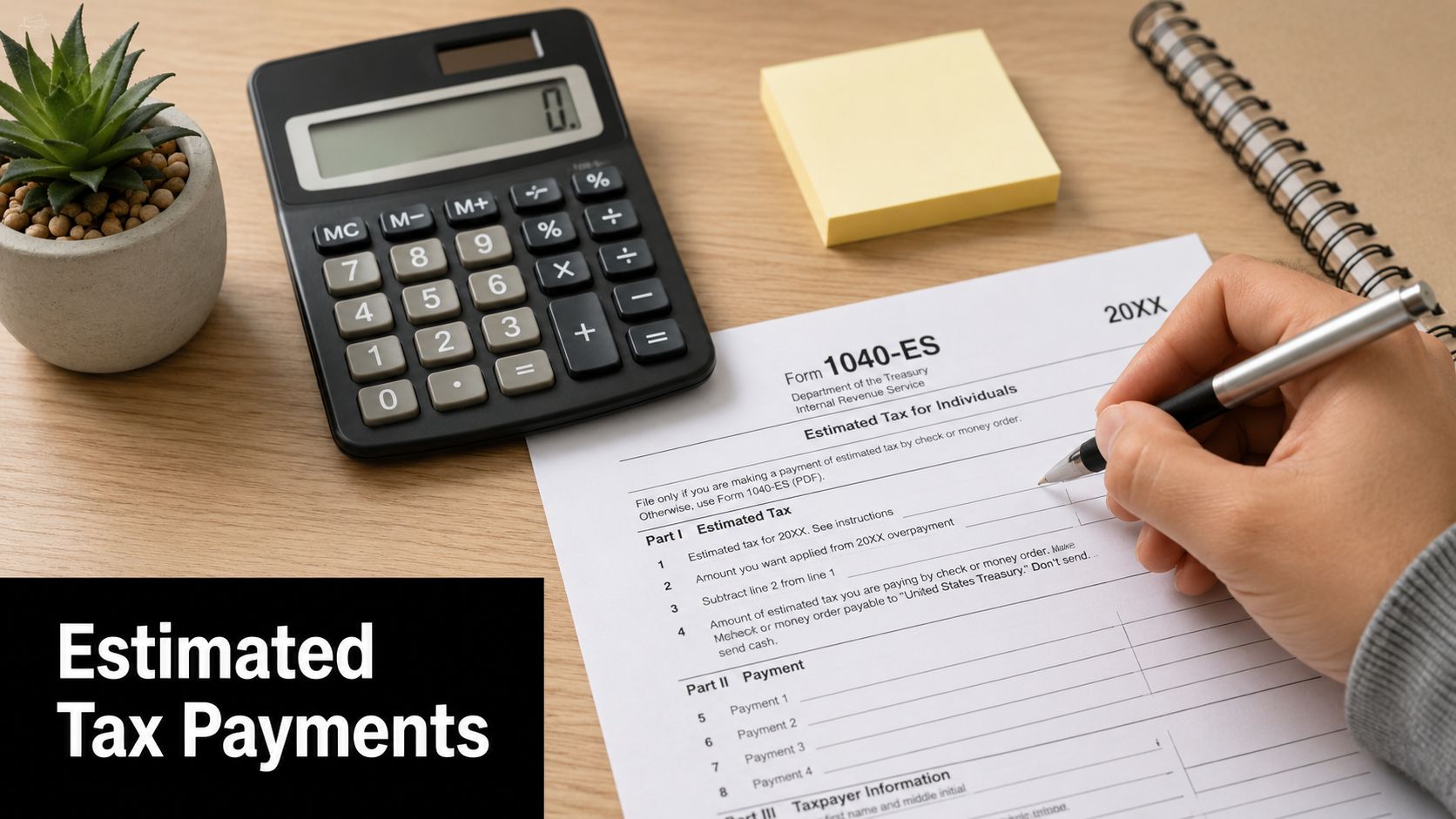
Most self-employed clients already understand the basic reason estimated payments exist. If you want a clear refresher on how estimated tax works, that overview is useful before you decide whether to mail a payment or pay electronically. The timing also matters, so it helps to keep current quarterly tax payment deadlines in front of you instead of relying on memory.
What usually goes wrong
The common assumption is that the IRS has one national payment address for everyone. It doesn't. Your mailing address for Form 1040-ES depends on where you live, and the IRS has used different lockbox locations for different states.
The second problem is older guidance. A taxpayer might reuse last quarter's envelope, last year's instructions, or a downloaded form sitting in a desktop folder. That's efficient until the IRS changes a processing address.
Practical rule: Treat the mailing address as a current-year item, not a permanent one.
What works in practice
The cleanest routine is:
- Pull the current IRS address table before each payment.
- Use the voucher for the correct tax year.
- Write a complete check memo so the payment is easier to identify.
- Mail with tracking if you use paper.
- Keep a copy of everything you send.
That approach won't eliminate every IRS processing issue, but it reduces the errors I see most often when self-employed taxpayers handle estimated payments themselves.
2026 IRS Mailing Addresses for Form 1040-ES by State
For calendar year 2026, the IRS uses two main domestic payment destinations for Form 1040-ES, and the correct address depends on your state of residence, according to the IRS Where to File page for Form 1040-ES.
Form 1040-ES mailing address by state for 2026
| If you live in... | Mail your payment voucher to... |
|---|---|
| Alabama | P.O. Box 1300, Charlotte, NC 28201-1300 |
| Alaska | P.O. Box 1300, Charlotte, NC 28201-1300 |
| Arizona | P.O. Box 1300, Charlotte, NC 28201-1300 |
| Arkansas | P.O. Box 931100, Louisville, KY 40293-1100 |
| California | P.O. Box 1300, Charlotte, NC 28201-1300 |
| Colorado | P.O. Box 1300, Charlotte, NC 28201-1300 |
| Connecticut | P.O. Box 931100, Louisville, KY 40293-1100 |
| Delaware | P.O. Box 931100, Louisville, KY 40293-1100 |
| District of Columbia | P.O. Box 931100, Louisville, KY 40293-1100 |
| Florida | P.O. Box 1300, Charlotte, NC 28201-1300 |
| Georgia | P.O. Box 1300, Charlotte, NC 28201-1300 |
| Hawaii | P.O. Box 1300, Charlotte, NC 28201-1300 |
| Idaho | P.O. Box 1300, Charlotte, NC 28201-1300 |
| Illinois | P.O. Box 931100, Louisville, KY 40293-1100 |
| Indiana | P.O. Box 931100, Louisville, KY 40293-1100 |
| Iowa | P.O. Box 931100, Louisville, KY 40293-1100 |
| Kansas | P.O. Box 1300, Charlotte, NC 28201-1300 |
| Kentucky | P.O. Box 931100, Louisville, KY 40293-1100 |
| Louisiana | P.O. Box 1300, Charlotte, NC 28201-1300 |
| Maine | P.O. Box 931100, Louisville, KY 40293-1100 |
| Maryland | P.O. Box 931100, Louisville, KY 40293-1100 |
| Massachusetts | P.O. Box 931100, Louisville, KY 40293-1100 |
| Michigan | P.O. Box 1300, Charlotte, NC 28201-1300 |
| Minnesota | P.O. Box 931100, Louisville, KY 40293-1100 |
| Mississippi | P.O. Box 1300, Charlotte, NC 28201-1300 |
| Missouri | P.O. Box 931100, Louisville, KY 40293-1100 |
| Montana | P.O. Box 1300, Charlotte, NC 28201-1300 |
| Nebraska | P.O. Box 1300, Charlotte, NC 28201-1300 |
| Nevada | P.O. Box 1300, Charlotte, NC 28201-1300 |
| New Hampshire | P.O. Box 931100, Louisville, KY 40293-1100 |
| New Jersey | P.O. Box 931100, Louisville, KY 40293-1100 |
| New Mexico | P.O. Box 1300, Charlotte, NC 28201-1300 |
| New York | P.O. Box 931100, Louisville, KY 40293-1100 |
| North Carolina | P.O. Box 1300, Charlotte, NC 28201-1300 |
| North Dakota | P.O. Box 1300, Charlotte, NC 28201-1300 |
| Ohio | P.O. Box 1300, Charlotte, NC 28201-1300 |
| Oklahoma | P.O. Box 931100, Louisville, KY 40293-1100 |
| Oregon | P.O. Box 1300, Charlotte, NC 28201-1300 |
| Pennsylvania | P.O. Box 1300, Charlotte, NC 28201-1300 |
| Rhode Island | P.O. Box 931100, Louisville, KY 40293-1100 |
| South Carolina | P.O. Box 1300, Charlotte, NC 28201-1300 |
| South Dakota | P.O. Box 1300, Charlotte, NC 28201-1300 |
| Tennessee | P.O. Box 1300, Charlotte, NC 28201-1300 |
| Texas | P.O. Box 1300, Charlotte, NC 28201-1300 |
| Utah | P.O. Box 1300, Charlotte, NC 28201-1300 |
| Vermont | P.O. Box 931100, Louisville, KY 40293-1100 |
| Virginia | P.O. Box 931100, Louisville, KY 40293-1100 |
| Washington | P.O. Box 1300, Charlotte, NC 28201-1300 |
| West Virginia | P.O. Box 931100, Louisville, KY 40293-1100 |
| Wisconsin | P.O. Box 931100, Louisville, KY 40293-1100 |
| Wyoming | P.O. Box 1300, Charlotte, NC 28201-1300 |
Two details that matter
First, use the full address exactly as listed, including the ZIP+4. That's not busywork. Lockbox processing is built around precise routing.
Second, this table answers where to send a domestic individual estimated payment. It does not mean the same address applies to your annual Form 1040, an extension payment, or another IRS form. Taxpayers often mix those up.
Special Mailing Address for International Filers
If you live abroad, use an APO or FPO address, or fall into one of the special address categories reflected in the Form 1040-ES instructions, you should not use the domestic state table. The IRS maintains a separate mailing address for those payments.
According to the IRS Form 1040-ES instructions, the international mailing address for taxpayers living abroad is P.O. Box 1303, Charlotte, NC 28201-1303. The same IRS instructions also warn taxpayers not to mail estimated tax payments to the address shown in the standard Form 1040 instructions.
Who should pay attention to this
This comes up often with:
- U.S. citizens working overseas
- Taxpayers using APO or FPO mailing addresses
- People who move between countries and keep reusing old tax paperwork
- Filers who assume the annual return address and estimated tax address are interchangeable
They aren't interchangeable.
Mail your estimated payment based on the 1040-ES instructions for where you live, not the mailing address shown for your regular Form 1040 return.
The practical problem
When someone is abroad, they often work from downloaded forms and saved PDFs because access is convenient. That's understandable, but it increases the risk of using the wrong destination. International filers should be especially careful about matching the current 1040-ES instructions to their status before mailing anything.
If you're outside the 50 states, slow down and confirm you are looking at estimated payment instructions, not return-filing instructions. That one distinction solves a surprising number of payment-posting problems.
How to Prepare Your 1040-ES Payment for Mailing
Getting the address right is only half the job. The other half is assembling the payment packet so the IRS can process and credit it without unnecessary guesswork.
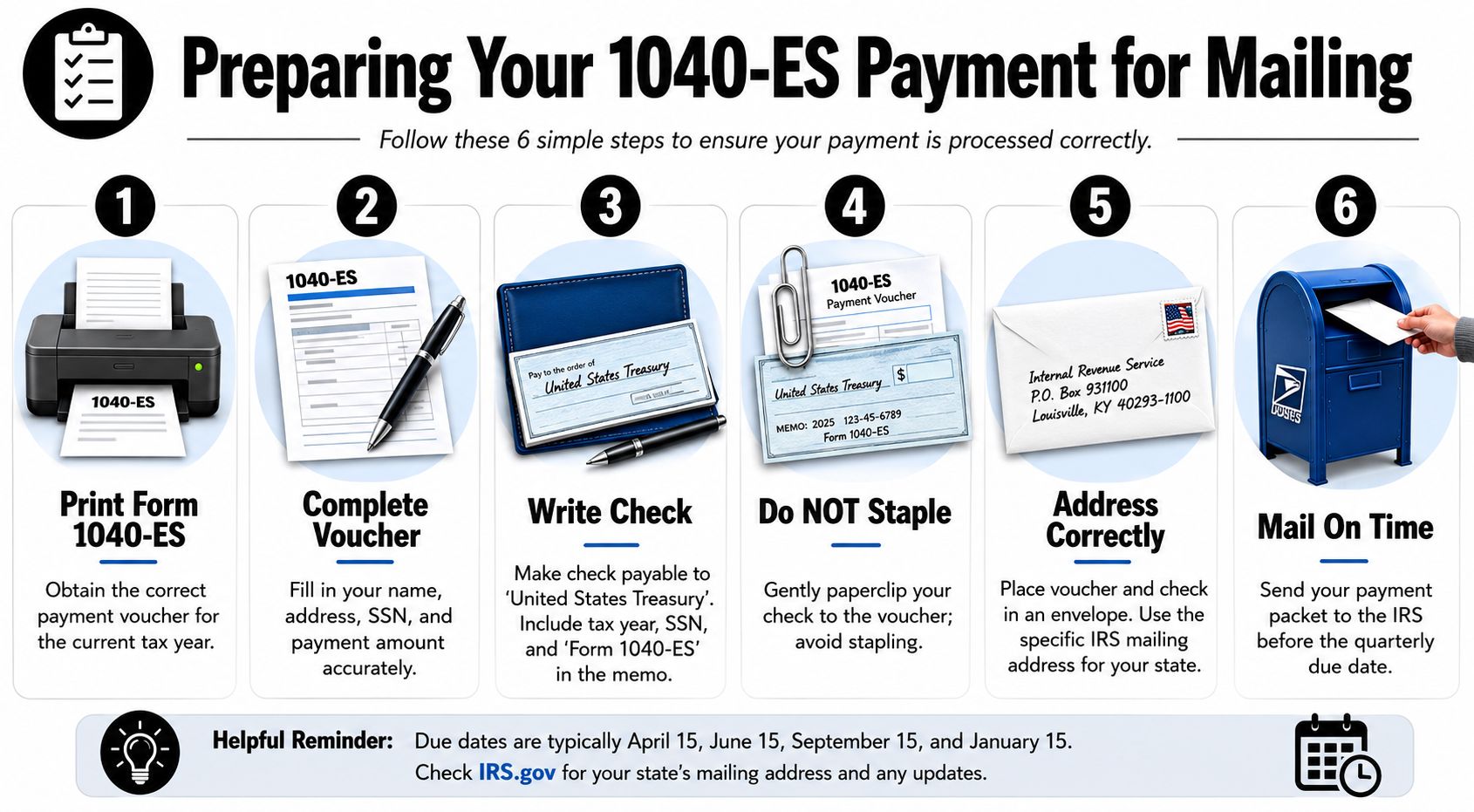
If you want a second reference point for timing your payments while you prepare the mailing, keep the current estimated tax payment schedule handy. The mechanics of mailing matter, but mailing on time still matters more.
Use a clean assembly process
I recommend a plain, repeatable checklist.
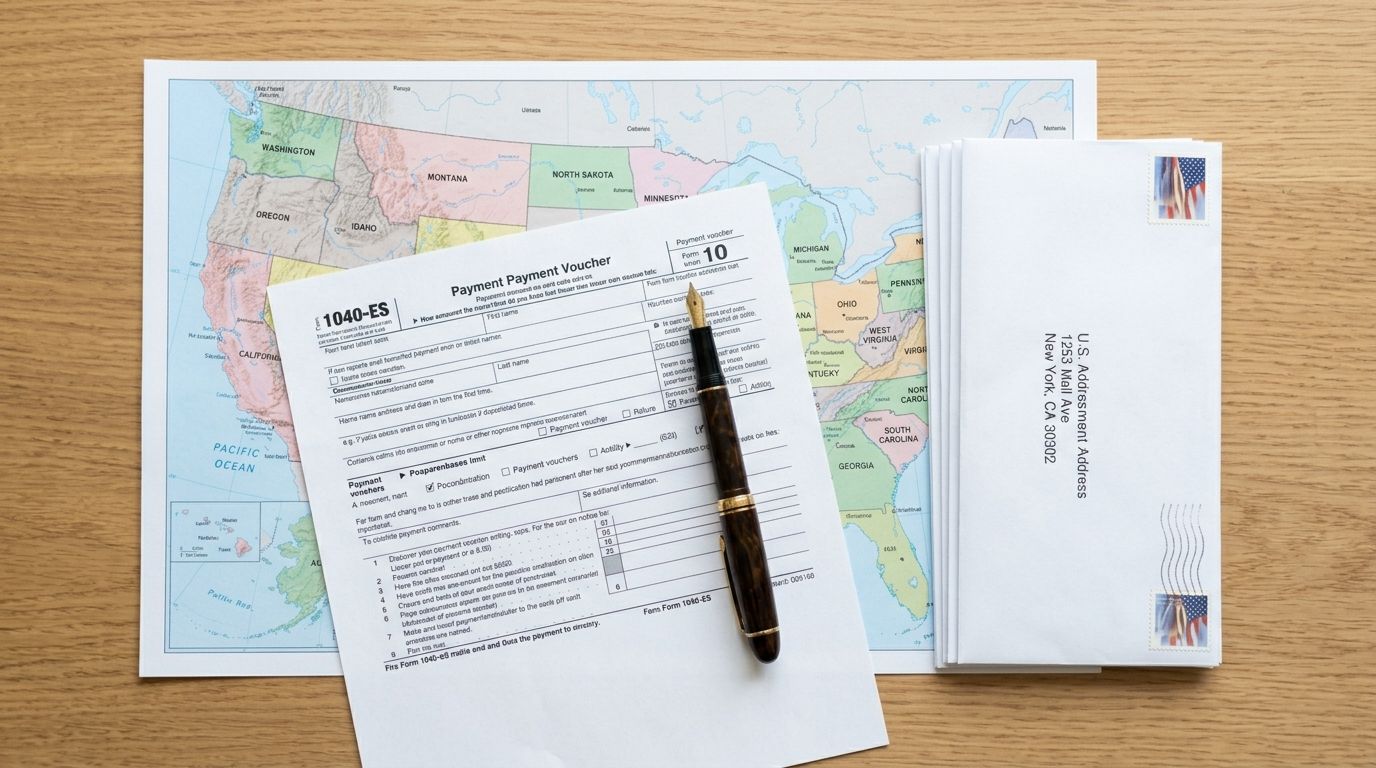
- Print the current-year Form 1040-ES voucher. Don't pull a voucher from an old desktop folder unless you've confirmed it matches the current tax year.
- Fill out the voucher completely. Use your name, address, taxpayer identification information, and payment amount carefully.
- Write the check to United States Treasury. Don't abbreviate the payee in a casual way if you can avoid it.
- Add identifying details on the memo line. Include the tax year, your Social Security number, and “Form 1040-ES.”
- Paperclip the check to the voucher. Don't staple it.
- Mail only the voucher and payment. Keep copies for yourself.
What not to include
Taxpayers sometimes overstuff the envelope. That creates confusion.
- Don't include a full tax return unless the IRS instructions for that filing specifically call for it.
- Don't include unrelated correspondence about another tax year or another issue.
- Don't toss in state payment materials with a federal estimated payment.
- Don't mail cash.
Mailing method matters
If you're going to use paper, use a mailing method that gives you a record. USPS Certified Mail is a common choice because it creates a paper trail. A private delivery option may also make sense depending on your circumstances, but the point is the same: keep proof that you mailed it and when.
Office habit that helps: scan the signed voucher, the check, and the addressed envelope before you mail them.
That record can save a lot of time if a payment is later misapplied, delayed, or questioned. For self-employed taxpayers who make repeated quarterly payments, a simple digital folder with copies of each submission is one of the easiest compliance habits to build.
Why You Must Verify the Address Before Every Payment
This is the part most online guides skip. They give you an address list as if that solves the problem permanently. It doesn't.
The risk is address volatility. The IRS has already shown that mailing information for estimated payments can change, and relying on a printed form or an older PDF can leave you using the wrong lockbox. The IRS issued a correction notice for the 2026 Form 1040-ES mailing addresses, which is exactly why taxpayers should verify the current address on the IRS website before mailing.
Why stale instructions are dangerous
A lot of taxpayers do the same thing each quarter. They pull the last voucher, change the amount, and mail it to the same place. That routine feels efficient. It also creates an obvious failure point.
A saved PDF isn't a live source. A bookmarked search result isn't a live source either. If the IRS updates a mailing address after you downloaded the form, your version may already be outdated.
A verification habit that takes very little time
Before each quarterly payment:
- Check the current IRS Where to File page for Form 1040-ES.
- Confirm your state rather than assuming it stayed in the same processing group.
- Match the tax year on the voucher to the address guidance you're using.
- Keep proof of mailing in case a payment has to be traced later. This is one reason many practitioners recommend sending IRS mail by certified mail.
What works and what doesn't
What works is treating each mailing as a fresh compliance task. Check current instructions, prepare the payment packet carefully, and create a mailing record.
What doesn't work is trusting old paper. It also doesn't work to assume the IRS will always sort it out quickly if a payment lands at the wrong service center. Sometimes it gets corrected. Sometimes it takes longer than you'd like, and then you're spending time proving what you mailed and when.
The safest approach for any mailed estimated payment is simple: verify the address right before the envelope goes out.
Smarter Alternatives to Mailing a Check
Mailing a check still works. It's just rarely the cleanest option anymore.
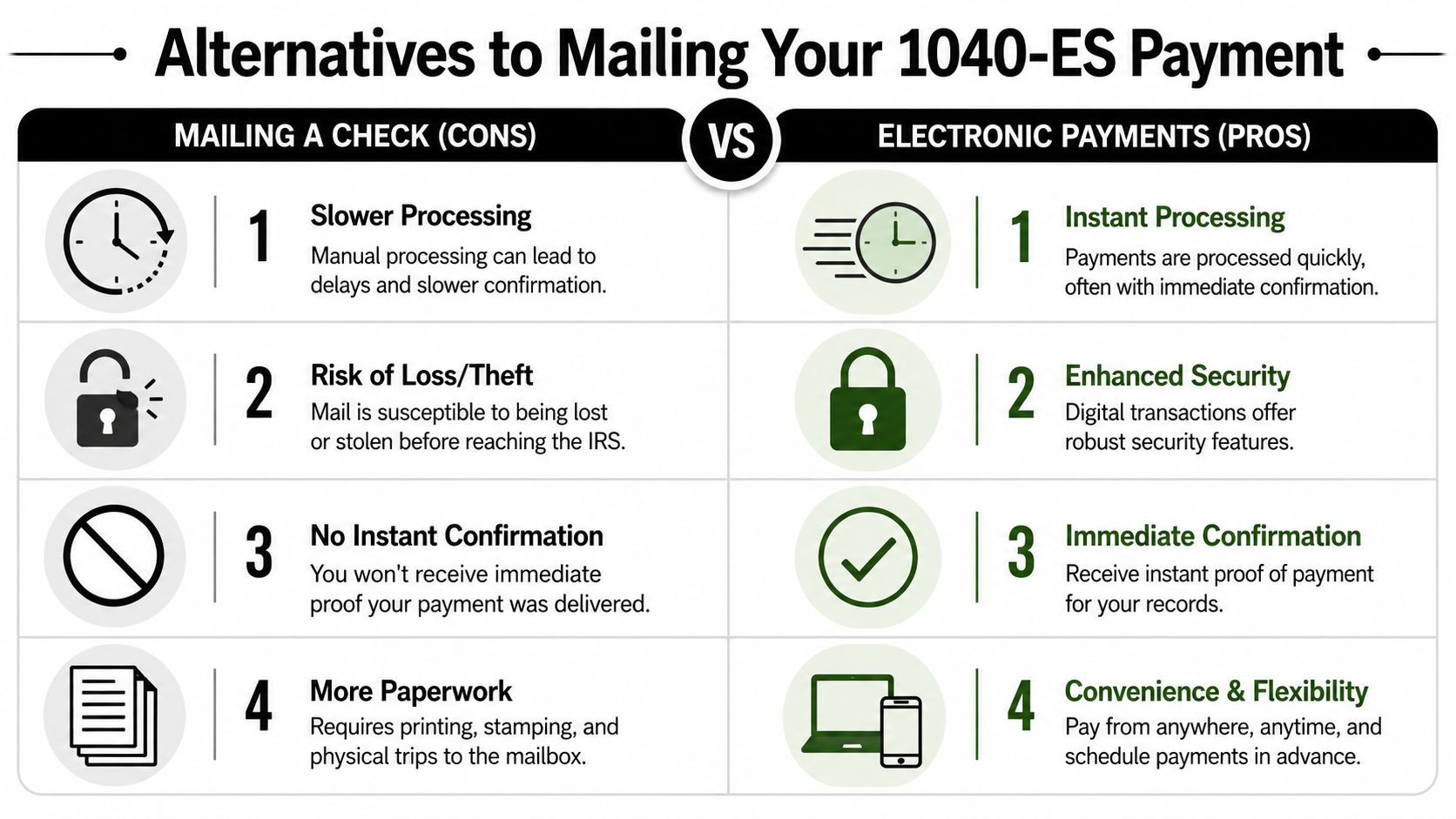
Paper payments create more points of failure. You have to print the voucher, prepare the check, use the right envelope, rely on delivery, and wait for posting. Electronic payments remove several of those steps and usually make your records easier to maintain.
Mailing a check versus paying electronically
| Method | Main benefit | Main drawback | Best fit |
|---|---|---|---|
| Mailing a check with Form 1040-ES | Familiar process and paper trail if mailed properly | More manual steps and more room for address or delivery issues | Taxpayers who strongly prefer paper |
| IRS Direct Pay | Convenient online payment without mailing forms | Requires careful entry of payment details online | Individuals who want a simpler one-time payment process |
| EFTPS | Useful for taxpayers who want a structured federal payment system | Setup can feel less intuitive at first | People making recurring payments and business owners who value scheduling |
Why electronic options are often better
For self-employed clients, the biggest advantages are practical:
- Less address risk: you don't have to worry about the current mailing address for 1040-ES every quarter.
- Better confirmation: electronic systems typically give you a direct confirmation record.
- Less paper handling: no check, stamp, voucher assembly, or trip to the mailbox.
- Easier scheduling: many taxpayers prefer setting future payments in advance rather than remembering each one manually.
A related benefit is flexibility. If cash flow is tight, you still need to make careful decisions about timing and amount, but electronic systems can make those decisions easier to execute accurately. If you're already trying to organize broader IRS obligations, it may also help to understand when taxpayers use IRS payment arrangements for larger balances that can't be paid in one shot.
When paper still makes sense
Some taxpayers prefer paper because they trust a physical check more than an online system. That's a reasonable preference. If that's you, use the paper process carefully and document every step.
But if your real goal is fewer mailing issues, fewer address mistakes, and easier proof of payment, electronic payment is usually the better tool.
Common Mistakes When Filing Form 1040-ES
Most 1040-ES problems aren't exotic. They're small execution errors that snowball. I see them most often with busy self-employed taxpayers who are juggling invoicing, payroll, bookkeeping, and tax compliance at the same time.
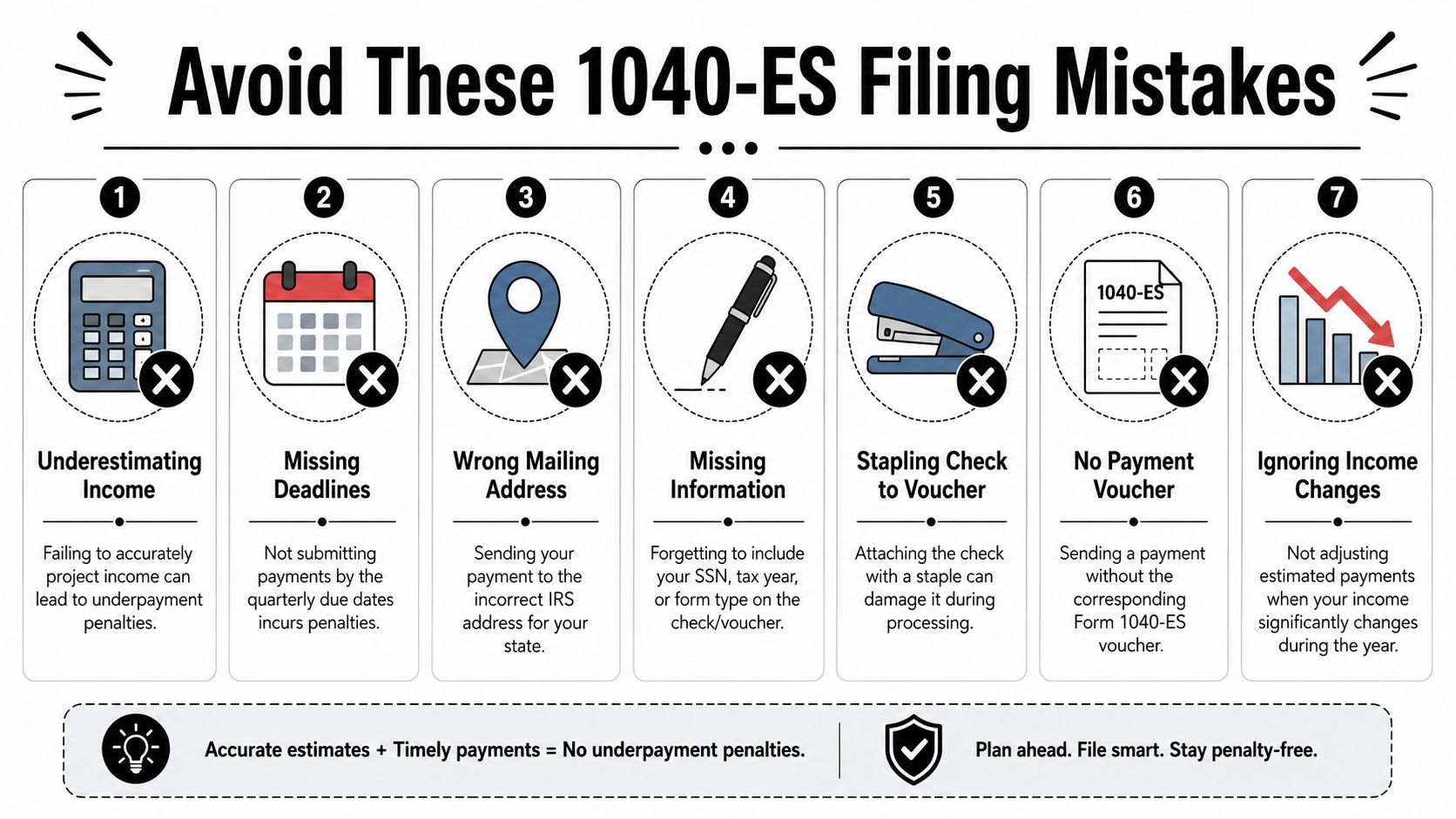
For taxpayers trying to tighten up their overall process, practical recordkeeping habits and calendar systems matter. This roundup of effective tax preparation advice is useful because better filing habits tend to reduce estimated payment mistakes too.
The errors that cause the most trouble
- Using the wrong mailing address: This is the issue many people underestimate. An old address on a saved voucher can create avoidable processing delay.
- Mailing a payment without the voucher: The IRS instructions for Form 1040-ES warn taxpayers not to mail estimated tax payments without a payment voucher, as covered earlier.
- Making the check payable incorrectly: Use United States Treasury.
- Leaving out identifying details: If your check or voucher doesn't clearly identify you, the tax year, and the form, posting gets harder.
- Stapling the check to the voucher: Paperclips are safer for processing.
- Sending the wrong year's voucher: This happens more often than people admit, especially early in the year.
- Ignoring income changes: If your income rises or falls during the year, your estimates may need adjustment.
Simple corrections that prevent repeat mistakes
A lot of taxpayers don't need a complex system. They need a short routine they'll follow.
Create one folder for each tax year. Save the current IRS instructions, your payment records, copies of checks or confirmations, and due-date reminders in that folder. Before you mail anything, compare the voucher year, the address, and the payment amount one last time.
A consistent checklist beats a good memory every time.
That's especially true for sole proprietors and independent contractors. When tax compliance depends on memory alone, deadlines and details tend to slip.
When Payment Problems Signal a Need for Help
Sometimes a mailing question is just a mailing question. Sometimes it's a sign of a larger tax problem.
If you can't afford your estimated payment, have missed multiple quarters, are using one credit source to pay another, or have started receiving IRS notices, the issue usually goes beyond finding the right mailing address for 1040-ES. At that point, the primary question is whether you're underwithholding, underestimating income, dealing with cash flow instability, or sliding into tax debt.
Red flags that shouldn't be ignored
- You're consistently behind on quarterly payments
- You don't know how much to pay and are guessing each quarter
- You've received IRS notices about unpaid tax or penalties
- You're considering skipping payments because cash flow is too tight
- Your business income changed and your estimates no longer match reality
A tax attorney or other qualified tax professional can help sort out whether the problem is compliance, collection, or both. That can include reviewing prior payments, determining what the IRS has posted, and evaluating whether you need a forward-looking estimate plan or a formal resolution path.
If your estimated tax payments have turned into a broader IRS problem, Attorney Stephen A Weisberg offers a free Tax Debt Analysis to determine whether he can help and what options may fit your situation. He represents individuals, businesses, and business owners dealing with IRS and state tax issues, including tax debt, audits, and payment problems.