Understanding levy notice from irs: What to Do Next
Facing a levy notice from irs? Learn the steps to respond, minimize penalties, and stop asset seizure with our expert guidance.
In this article
- What a Levy Notice From the IRS Actually Means
- Why the IRS Sends This Notice
- The Urgency Behind the Notice
- Your First Steps After Receiving the Notice
- 1. First, Make Sure the Notice Is Real
- 2. Find Your Deadline—Immediately
- 3. Review the Debt They Claim You Owe
- 4. Understand Your Right to Appeal
- How to Stop an IRS Levy in Its Tracks
- Immediately File a Collection Due Process Appeal
- Request a Levy Release Due to Economic Hardship
- Set Up an Installment Agreement
- Propose an Offer in Compromise
- Choosing Your Best Levy Resolution Path
- Understanding the Different Types of IRS Levies
- The Continuous Sting of a Wage Garnishment
- The One-Time Seizure of a Bank Levy
- Levies on Accounts Receivable for Businesses and Freelancers
- When It's Time to Call a Tax Pro to Fight an IRS Levy
- High-Stakes Financial Situations
- When You Disagree with the IRS
- Negotiating Complex Resolutions
- Your Questions About IRS Levies Answered
- Can the IRS Really Take My House or Car?
- How Long Does an IRS Levy Last?
- What if I Genuinely Cannot Afford to Pay?
- Does Filing for Bankruptcy Stop an IRS Levy?
Receiving a levy notice from the IRS isn't the levy itself—it's the final, official warning shot. This is the government formally stating its intent to seize your assets to cover a tax debt, and it's your last real chance to get things sorted out before that happens.
What a Levy Notice From the IRS Actually Means

Think of this notice as the final stop before serious enforcement begins, like wage garnishments or the IRS cleaning out your bank account. It’s the IRS’s way of saying, “We’ve sent other letters, and now we’re preparing to take direct action.” Its entire purpose is to grab your attention and force a response.
This official letter, usually titled "Final Notice of Intent to Levy and Notice of Your Right to a Hearing," is your best and final opportunity to stop the government from taking your property. This isn't a scare tactic; it's a legally required step the IRS must complete before it can start seizing what's yours. For a deeper dive, you can learn more about what is a levy notice in our detailed guide.
Why the IRS Sends This Notice
The IRS doesn’t just send a levy notice out of the blue. It’s the last step in a long process that usually starts with a series of other letters (like the CP501, CP503, and CP504) asking for payment on a tax bill. You only get a Final Notice of Intent to Levy after those earlier attempts to contact you have failed to resolve the debt.
Essentially, you'll receive this notice if these three things are true:
- You have an unpaid tax liability.
- The IRS has already sent you a formal bill (a Notice and Demand for Payment).
- You have ignored the bill or refused to pay the tax.
Receiving this notice means your case has officially been escalated from a simple billing issue to a high-priority collection matter. The IRS has the legal authority to collect what it's owed, and this letter is the final checkbox they need to tick before they start.
The Urgency Behind the Notice
This is not just another bill in the mail. A levy notice is a serious legal document with a hard deadline, typically giving you just 30 days to respond before the IRS can start taking your property. This is why it’s a more common problem than you might think, especially for small business owners and self-employed individuals who manage their own tax affairs.
For perspective, back in fiscal year 2009, the IRS filed an incredible 965,618 Notices of Federal Tax Lien—a different but related action that often comes before a levy. It's a clear sign of how aggressive their collection strategies can be.
Key Takeaway: A levy notice isn't the end of the road, but it is a critical fork. Your immediate action will decide whether you find a resolution or face asset seizure. Ignoring it all but guarantees the IRS will move forward.
Your First Steps After Receiving the Notice
When that official IRS envelope with a levy notice lands in your mailbox, it’s easy to feel a jolt of panic. But letting it sit on your counter is the absolute worst thing you can do. The IRS gives you a strict 30-day window to respond, and what you do in those first few days can make all the difference.
Think of this notice not as a final judgment, but as a starting gun. It’s your cue to get proactive and take back control. Here’s a clear, step-by-step plan from our experts.
1. First, Make Sure the Notice Is Real
Before your mind starts racing, your very first job is to confirm the notice is legitimate. Tax scams have gotten incredibly sophisticated, and criminals prey on the fear these letters cause. A real IRS agent will never call you demanding immediate payment with a gift card, wire transfer, or cryptocurrency.
A genuine levy notice, like a Letter 1058 or LT11, will always:
- Arrive via certified mail, requiring your signature.
- Clearly detail the amount owed and the specific tax years.
- Explain your legal rights to appeal the levy.
If anything feels off, don't call the number printed on the letter. Go directly to the source. Look up the official IRS phone number or log into your account on IRS.gov to verify the debt is real.
2. Find Your Deadline—Immediately
Find the date printed on the notice. By law, the IRS must give you 30 days from that date before they can legally start seizing your assets. This deadline is everything. It dictates your ability to appeal and negotiate.
Get a marker and circle that date on your calendar. Missing it means you lose your automatic right to a Collection Due Process (CDP) hearing, which is the single most powerful tool you have to stop a levy in its tracks.
As long as you act within that 30-day window, the IRS has to pause all collection activity while your case is under review. That gives you the time and space you need to work out a solution.
3. Review the Debt They Claim You Owe
Now, look closely at the numbers. The notice should give you a full breakdown of the tax, penalties, and interest for each tax year in question. Does this match your records? Does the total amount make sense to you?
Mistakes happen. The IRS might have failed to credit a payment you made or assessed a tax liability incorrectly. This is where you put on your detective hat. If you dispute the amount, start gathering your proof now—old tax returns, canceled checks, and bank statements are your best friends.
4. Understand Your Right to Appeal
Buried in the legal language of the notice is the most important part: your right to a "Collection Due Process" (CDP) hearing. This isn't just bureaucratic fluff; it's a powerful legal right that lets you formally challenge the IRS's plan to take your property.
To do this, you must file Form 12153, Request for a Collection Due Process or Equivalent Hearing.
Filing this form within the 30-day deadline is non-negotiable if you want to fight back. The moment the IRS receives it, they are legally required to stop the levy until your appeal is heard. This protects your wages, your savings, and your peace of mind. For taxpayers worried about their bank accounts, our detailed guide explains more about how the IRS levies bank accounts and what you can do to protect them. This appeal kicks open the door to negotiating other solutions, like an installment agreement or Offer in Compromise, giving you a formal stage to make your case.
How to Stop an IRS Levy in Its Tracks
Getting a levy notice from the IRS can make your stomach drop. It feels like a timer has been set, and in a way, it has. But this isn't the moment to panic—it's the time for a clear, strategic response. You have powerful legal options to stop the IRS collection machine in its tracks, but you have to act fast within the strict timeframes.
The most important thing to remember is that you are not powerless here. There are several well-established paths you can take to halt a levy, get seized funds back, and finally put your tax debt issues behind you for good.
First things first: when a notice arrives, you need a plan. This flowchart can help you navigate the initial steps and determine what kind of notice you're really dealing with.
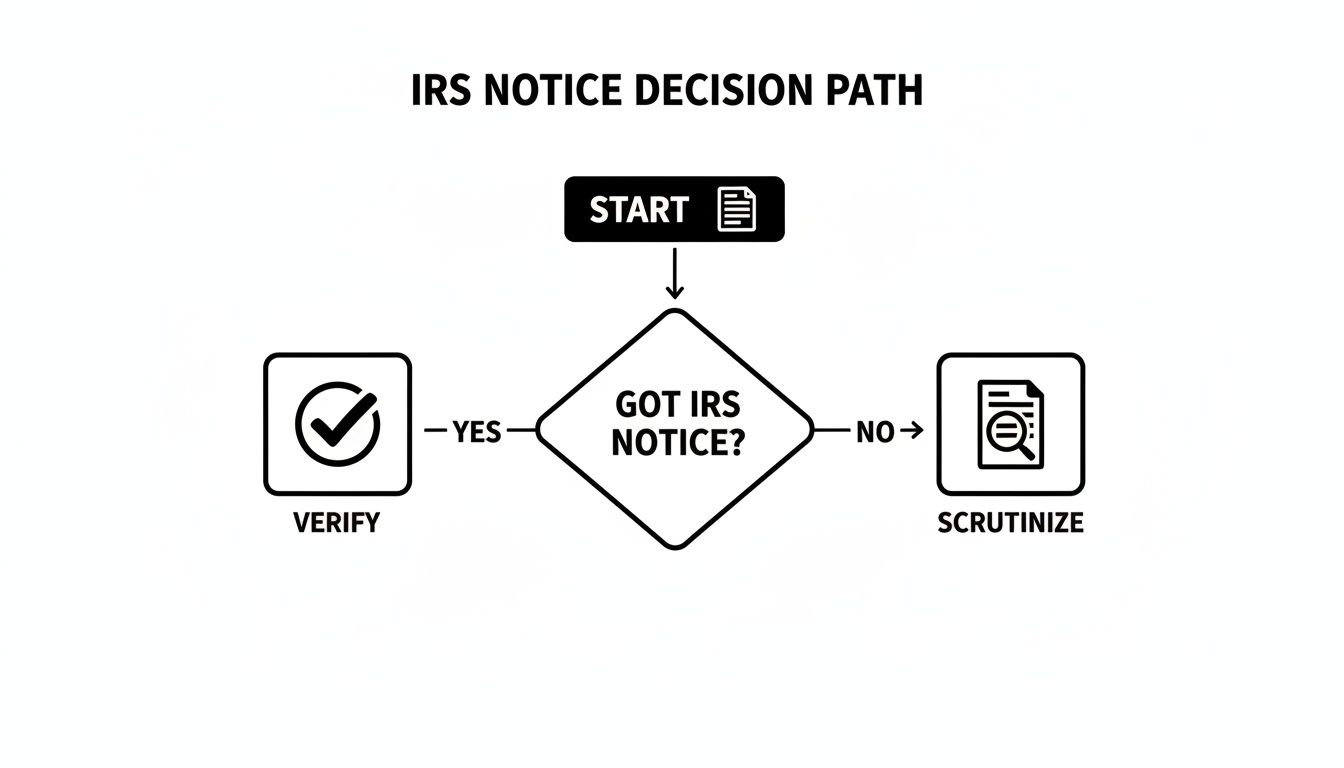
As the chart shows, your first move should always be to verify that the communication is legitimate. Tax scams are rampant, and you don't want to take action based on a fraudulent letter.
Immediately File a Collection Due Process Appeal
Your single most powerful tool is the Collection Due Process (CDP) appeal. This isn't just a suggestion; it's a legal right granted to you by law, and using it is the quickest way to stop a levy cold. Once you receive the "Final Notice of Intent to Levy," you have exactly 30 days to file Form 12153, "Request for a Collection Due Process or Equivalent Hearing."
The moment the IRS gets your timely request, they are legally required to stop all collection activities. That means no wage garnishments and no bank account seizures while your appeal is pending. This buys you invaluable breathing room to negotiate a resolution without the immediate threat of your assets being taken.
During the CDP hearing, which is usually held with an impartial IRS Appeals Officer, you have the chance to:
- Challenge whether the levy is appropriate in the first place.
- Dispute the amount of tax you actually owe (if you haven't had a prior opportunity).
- Propose alternative ways to resolve the debt.
This formal process is your best shot at presenting your side of the story. To get a better handle on the specifics, you can dig deeper into our guide on how to stop an IRS levy.
Request a Levy Release Due to Economic Hardship
What if a levy is already active and your bank account is frozen? You can still fight to get it released. The most common reason the IRS will agree to release a levy is if you can prove it's causing an immediate economic hardship.
This is more than just an inconvenience. You have to demonstrate that the levy is preventing you from paying for basic, reasonable living expenses. This could mean you can't cover:
- Rent or mortgage payments
- Food and utilities
- Essential medical care
- Transportation to and from work
To make this argument, you have to contact the IRS right away. They'll ask for detailed financial information, typically on Form 433-F, "Collection Information Statement." Get ready to show bank statements, bills, and pay stubs to prove the levy is leaving you without enough money to get by.
If the IRS agrees with your case, they will issue a levy release to your employer or bank. This solves the immediate crisis, but remember, it doesn't make the tax debt disappear. You'll still need to figure out a plan for that.
Set Up an Installment Agreement
For many people, the most straightforward solution is an Installment Agreement. If you know you owe the money but just can't pay it all at once, setting up a formal payment plan with the IRS is a great way to prevent a levy from ever happening.
If your total tax bill (including penalties and interest) is under $50,000, you can often apply for a streamlined agreement right on the IRS website. Once your plan is approved, it’s like a contract. As long as you make your monthly payments on time, the IRS will not levy your assets.
This option gives you predictability and puts you back in control. It allows you to pay down your debt over time—often up to 72 months—without constantly looking over your shoulder for aggressive collection actions.
Propose an Offer in Compromise
An Offer in Compromise (OIC) is a potential game-changer, but it's reserved for taxpayers who truly cannot afford to pay their full tax liability. An OIC allows you to permanently settle your tax debt for less than the total amount you owe.
The IRS only accepts an OIC if they determine it’s the most they can realistically expect to collect from you. The application process is tough and requires you to fully disclose your financial life on Form 433-A (OIC) for individuals or Form 433-B (OIC) for businesses.
While your OIC application is under review, the IRS will hold off on any new levies. If your offer is accepted and you pay the settled amount, the rest of your tax debt is wiped clean. It’s a true fresh start, but eligibility is strict and depends entirely on your ability to pay, your income, expenses, and the value of your assets.
Choosing Your Best Levy Resolution Path
With several options on the table, it can be tough to know which path is right for your specific situation. This table breaks down the most common strategies to help you see which one fits best.
| Strategy | Best For Taxpayers Who | Key Requirement | Potential Outcome |
|---|---|---|---|
| CDP Appeal | Just received a "Final Notice of Intent to Levy" and need to stop immediate collection. | File Form 12153 within 30 days of the notice date. | Halts all levy actions while you negotiate an alternative resolution. |
| Levy Release | Already have a levy in place that is causing severe financial difficulty. | Prove to the IRS that the levy prevents you from meeting basic living expenses. | The immediate levy is removed, but the underlying debt remains. |
| Installment Agreement | Can afford to make consistent monthly payments to clear their debt over time. | Owe less than $50,000 for streamlined approval; must be current on tax filings. | A predictable payment plan is established, and no levies will be issued. |
| Offer in Compromise | Cannot pay their full tax debt now or in the foreseeable future due to limited income/assets. | Prove inability to pay based on a strict IRS formula (income, expenses, assets). | The tax debt is settled for a lower amount, providing a "fresh start." |
Each of these avenues requires a different approach and set of documentation. The key is to match your financial reality to the right IRS program.
Understanding the Different Types of IRS Levies
When an IRS levy notice lands in your mailbox, it’s easy to panic. But the first thing to know is that not all levies are created equal. The IRS has a whole toolkit for seizing assets, and the tool they pick depends entirely on where your money is.
Think of it like this: the IRS is a creditor, and the levy is their way of collecting. Just like a carpenter has different saws for different cuts, the IRS uses specific types of levies to go after specific assets—from the cash in your checking account to your weekly paycheck. Knowing which one they're using helps you figure out their next move and protect what’s most important.
The Continuous Sting of a Wage Garnishment
One of the most common and painful collection actions is the wage garnishment. The IRS formally calls this a "Continuous Levy on Wages and Other Income," and it starts when they send a Form 668-W directly to your employer. This isn't a one-time hit; it's a constant financial drain.
Once your employer receives that notice, they are legally obligated to slice off a hefty portion of your paycheck and send it straight to the IRS. This happens every single payday until the debt is gone, you convince the IRS to release the levy, or you get an alternative plan in place, like an Installment Agreement.
So, how much do they actually take? Not much is left for you. The IRS leaves you with a legally required minimum amount to live on, but it’s often shockingly small. This exemption, outlined in IRC 6334(a)(9), is based on your filing status and the number of dependents you claim. For example, if you don't submit your Statement of Dependents quickly, your employer might have to use a default calculation based on figures like $4,300 per dependent (a number adjusted for inflation). You can dig into the nitty-gritty of these calculations in the IRS's official guidelines.
A wage garnishment is so damaging because it attacks your primary source of income. All of a sudden, you can find yourself without enough money for rent, groceries, or the electric bill, pushing you into an immediate financial crisis.
The One-Time Seizure of a Bank Levy
Another powerful tool in the IRS's arsenal is the bank levy. Unlike a wage garnishment that chips away at your income over time, a bank levy is a single, swift event. It targets whatever cash is sitting in your bank account on the very day your bank gets the notice.
The moment the levy notice arrives, your bank is required to freeze your funds. They hold that money for 21 days. This 21-day holding period is your critical window of opportunity. It's the time you have to call the IRS (or have a tax professional do it for you) and fight to get the levy released. If you don't act, on day 22, the bank sends the money to the IRS. And if that amount doesn’t clear your debt? The IRS can, and often will, do it all over again.
Levies on Accounts Receivable for Businesses and Freelancers
If you're a small business owner, independent contractor, or freelancer, the IRS has a levy just for you: a levy on your accounts receivable. This means they can step in and take payments that your clients or customers owe you, which can be absolutely devastating to your cash flow.
The process is simple and direct. The IRS sends a levy notice straight to your clients, instructing them to divert any money they owe you to the government instead. This not only chokes off your income but can seriously damage your business reputation by broadcasting your tax troubles to your entire client base.
Beyond these common types, the IRS has the authority to go after other assets as well:
- Retirement Accounts: Yes, they can levy the funds in your 401(k) or IRA.
- Social Security Benefits: Through the Treasury Offset Program (TOP), the IRS can take up to 15% of your monthly Social Security payments.
- Physical Property: In more serious, long-standing cases, the IRS can seize and sell physical property, including your home, car, or other valuable assets.
Knowing exactly what's at risk is the first and most critical step in putting together a solid plan to defend yourself.
When It's Time to Call a Tax Pro to Fight an IRS Levy

It’s natural to want to handle an IRS problem yourself, but a levy notice changes the game entirely. This isn't just another letter; it’s a serious escalation that signals the IRS is done waiting. One wrong move at this point could mean your bank account gets emptied or your paycheck shrinks.
Knowing when to bring in an expert is one of the smartest decisions you can make. If the financial stakes are high, the rules get confusing, or your financial future is at risk, trying to face the IRS alone is a gamble you don't want to take.
High-Stakes Financial Situations
The sheer size of your tax debt is often the first sign you need backup. If you owe more than $50,000 (including all the penalties and interest), the IRS will likely assign a Revenue Officer to your case. These agents are far more aggressive and have more power than the automated collection system.
Certain debts also ring the alarm bells immediately and require an expert's touch.
- Business Payroll Taxes: Falling behind on payroll taxes (Form 941) is a huge red flag for the IRS. They can—and will—pierce the corporate veil and hold business owners and other key people personally liable through the Trust Fund Recovery Penalty. This is one of their top enforcement priorities.
- Complex Assets are at Risk: Do you own multiple properties, investments, or a business? Protecting these assets from seizure demands a solid legal strategy, not a DIY approach.
When You Disagree with the IRS
Another clear signal to hire a professional is when you genuinely believe the IRS is wrong. If the tax bill they've sent you is incorrect, you have to prove it. That means digging into complex tax laws and procedural rules that can trip up even the most careful person.
A seasoned tax attorney knows how to build a strong case, gather the right evidence, and argue on your behalf in a Collection Due Process hearing or even in Tax Court.
A tax professional is your advocate and your shield. As Justice Gorsuch once noted in a dissent, the IRS can have a "roadmap for evading Tax Court review," a stark reminder of how challenging the system can be for taxpayers without representation.
Negotiating Complex Resolutions
Finally, if you’re aiming for a complex solution, you need a guide. An Offer in Compromise (OIC), for example, sounds great—settling your debt for less than you owe—but the IRS rejects most applications filed by individuals.
An attorney understands exactly how to frame your financial situation to meet the strict criteria for approval. They know the right forms, the right language, and the right way to negotiate.
When you're facing a levy, it's crucial to explore all the tax debt relief options available, and an expert can show you the best path forward. Choosing the right representative is often the single most important step you can take. To help you navigate that choice, check out our guide on finding a good tax attorney.
Your Questions About IRS Levies Answered
Getting a levy notice from the IRS throws most people into a panic. A thousand questions start racing through your mind. What can they really take? How long does this go on? What on earth do you do if you just can't pay? Let's cut through the noise and get you some straight answers to the most pressing questions we hear every day.
Knowing where you stand is the first, most critical step to getting this sorted out.
Can the IRS Really Take My House or Car?
This is usually the first question people ask, and for good reason. The honest answer is yes, the IRS does have the legal power to seize your physical property—including your home and your car—to settle a tax debt.
But here’s the crucial context: this is an absolute last resort.
Seizing a primary residence is a drastic step reserved for major tax delinquencies, often after years of non-communication and ignored warnings. The IRS can't just show up and padlock your door. They have to jump through significant legal hoops, including getting a court order, before they can even think about it.
In reality, the IRS always goes for the low-hanging fruit first. Their collection playbook usually starts with much easier targets, like:
- The money sitting in your bank accounts.
- Your paycheck, through a wage garnishment.
- Payments from your clients if you’re a freelancer or contractor.
So while the threat to your home is technically real, it's not the immediate danger. That levy notice from the IRS is a serious warning shot, designed to get you to engage and resolve the issue before things ever get that far.
How Long Does an IRS Levy Last?
This completely depends on the type of levy, and the difference between them is massive. Some are a one-time hit, while others can become a relentless drain on your finances.
A bank levy, for instance, is a one-and-done event. The IRS notifies your bank, and the bank freezes whatever funds are in your account on that specific day. They hold that money for 21 days before sending it to the IRS. After that, the levy is over. The IRS might issue another one later if the debt isn't paid, but that specific action is complete.
A wage garnishment is the complete opposite—it’s continuous. Once the IRS sends a Form 668-W to your employer, it latches onto your income and doesn't let go. A piece of every single paycheck you earn gets sent directly to the IRS until one of three things happens:
- The tax debt is paid off in full.
- You get the IRS to formally release the levy.
- You negotiate a formal resolution, like an Installment Agreement.
This is exactly why wage garnishments are so financially crippling. They don’t just stop on their own; you have to take direct action.
What if I Genuinely Cannot Afford to Pay?
The IRS knows that sometimes, people truly can't pay. If a levy would leave you unable to cover basic, necessary living expenses like rent, utilities, and food, you might qualify for Currently Not Collectible (CNC) status.
Think of CNC as hitting the pause button on collections. To get this status, you have to open up your books and prove to the IRS that you don’t have the disposable income or assets to pay them. This usually means filling out a detailed financial statement (Form 433-F) that spells out your entire financial picture.
Important Takeaway: While you're in CNC status, the IRS will back off. No more threatening letters, and no new levies. But—and this is a big but—the debt doesn't disappear. Penalties and interest keep piling up, and the IRS will check in on you periodically to see if your financial situation has improved enough to start paying again.
For people whose financial hardship is more long-term, an Offer in Compromise (OIC) might be another route, allowing you to settle the debt for less than you originally owed.
Does Filing for Bankruptcy Stop an IRS Levy?
Yes, it does. Filing for bankruptcy is a powerful move that can bring an IRS levy to a screeching halt. The moment you file, the court issues an "automatic stay," which is essentially a legal injunction that forces most creditors, including the IRS, to immediately stop all collection efforts.
This means any active wage garnishment or bank levy is frozen in its tracks. The automatic stay gives you immediate relief and some much-needed breathing room to work out a long-term solution.
However, bankruptcy isn't a silver bullet for tax debt. The rules about which tax debts can be wiped out (discharged) are incredibly complicated. It all depends on factors like:
- The type of tax (income vs. payroll, for example).
- How old the tax debt is.
- Whether you filed your returns on time.
Because of this complexity, you absolutely should not go it alone. It's vital to speak with both a qualified tax attorney and a bankruptcy lawyer. They can analyze your specific circumstances and tell you if bankruptcy is the right move and what it will actually accomplish for your tax liability.
Dealing with an IRS levy notice is all about having a clear strategy. At The W Tax Group, we start with a FREE Tax Debt Analysis to map out exactly how we can help you solve your IRS problems, all before you ever pay us a dime. Contact us today to find your best path forward.


