A Letter From The IRS What It Means and Your Next Steps
Received a letter from the IRS? Don't panic. Our guide explains what IRS notices mean, how to respond, and when you need to hire a professional for tax help.

In this article
- What an IRS Letter Really Means (and Why You Shouldn't Panic)
- Your First Steps After Receiving an IRS Letter
- Your First Steps After Receiving an IRS Letter
- You're Not Alone: Understanding the Scale of IRS Communications
- Decoding the Most Common IRS Notices
- The Low-Stakes Notices: Balance Due and Simple Adjustments
- The Mid-Level Alerts: Proposed Changes and Missing Income
- The High-Alert Notices: Audits and Aggressive Collections
- Your Step-By-Step Action Plan for Responding
- Step 1: Gather Your Evidence
- Step 2: Manage Your Deadlines
- Step 3: Decide Whether to Dispute or Pay
- Special Tax Issues for Business Owners and the Self-Employed
- The Dangers of Payroll Tax Debt and the TFRP
- Common Audit Triggers for Businesses and Freelancers
- When to Hire a Tax Attorney Versus Handling It Yourself
- When You Can Likely Handle It Yourself
- Red Flags That Signal You Need an Attorney
- Take Control of Your IRS Problem Today
- Get a No-Obligation Tax Debt Analysis
- Frequently Asked Questions
- How Can I Tell if a Letter From the IRS Is Real or a Scam?
- What Happens if I Ignore an IRS Letter?
- Can I Get Penalties Removed From My IRS Debt?
- My IRS Letter Says I Am Being Audited. What Should I Do First?
Few things can make your heart sink quite like seeing that official IRS envelope in your mailbox. It’s designed to look serious, and that immediate jolt of anxiety is completely normal.
But here’s the thing: not every letter from the IRS spells disaster. Many are simple requests for information, notifications about a change to your refund, or just a routine update on your account. The key is to stay calm and take action.
What an IRS Letter Really Means (and Why You Shouldn't Panic)

That stark, official envelope is meant to get your attention, and for a good reason. It’s a message that requires a response, but it’s not automatically a sign that you’re in deep trouble. Think of it less as a personal attack and more as a formal—and often automated—piece of communication.
The absolute worst thing you can do is ignore it. Shoving it in a drawer and hoping it goes away only allows interest and penalties to snowball, turning what might have been a small, manageable issue into a significant financial headache. A calm, methodical approach is always your best bet.
Your First Steps After Receiving an IRS Letter
The moments after you open that letter are critical. This is your chance to shift from feeling anxious to having a clear plan. Your first job is simple: read the notice from top to bottom.
Do not throw it away or let it sit on your desk for weeks. The single most important factor in successfully resolving an IRS issue is responding in a timely and strategic manner.
To get your bearings, you'll need to immediately locate a few key pieces of information printed right on the notice.
- The Notice Number: Check the top right corner for a code like CP2000, CP504, or LT11. This number tells you exactly what kind of letter it is and what it's about.
- The Response Deadline: This is non-negotiable. Missing this date can trigger automatic penalties or kickstart collection activities, so circle it on your calendar.
- The Tax Year in Question: The notice will specify which tax year is under review, which helps you focus on gathering the right documents.
The table below breaks down these initial actions into a simple, quick-reference guide.
Your First Steps After Receiving an IRS Letter
| Action Step | Why It Is Important | What to Avoid Doing |
|---|---|---|
| Don't Panic and Read the Letter | Most notices are not about audits. Understanding the actual issue prevents unnecessary stress. | Tossing the letter aside or assuming the worst without reading it. |
| Identify Key Information | Finding the Notice Number, Tax Year, and Deadline gives you context and a clear timeline for your response. | Ignoring the deadline—this is the fastest way to escalate the problem. |
| Gather Relevant Documents | Having your tax returns, W-2s, 1099s, and receipts ready makes it easier to verify the IRS's claims. | Contacting the IRS without having any of your documents on hand. |
Following these steps methodically will put you back in control of the situation.
You're Not Alone: Understanding the Scale of IRS Communications
It might feel personal, but you are far from the only person getting mail from the IRS. The agency communicates with millions of taxpayers every single year.
In fiscal year 2024 alone, the agency closed 505,514 tax return audits and proposed over $29.0 billion in additional taxes. Your letter is just one drop in a massive ocean of automated tax administration.
By figuring out what type of notice you've received, you can prepare for what comes next. Our detailed guide breaks down the different IRS letters and notices to help you identify what your specific letter means. Taking this proactive step is your greatest asset in taking control of the situation.
Decoding the Most Common IRS Notices
That envelope from the IRS sitting in your mailbox can make your heart skip a beat. But here’s the thing: not every letter carries the same weight. The first, and most important, step is to figure out exactly what you're dealing with before you panic.
I like to compare IRS notices to the warning lights on your car's dashboard. A simple informational request is like the 'low washer fluid' light—you need to take care of it, but it’s not an emergency. A notice of intent to levy, on the other hand, is that terrifying, flashing 'engine failure' light that requires you to pull over immediately.
Let's walk through the common notices, from the minor stuff to the major alarms, so you can quickly get your bearings.
The Low-Stakes Notices: Balance Due and Simple Adjustments
These are by far the most common letters the IRS sends out, and thankfully, they are usually the least alarming. They often just point out a simple math error on your return or let you know you have a small balance due based on the numbers you already filed.
- CP14 Notice of Unpaid Tax: This is the classic first bill. It simply says you owe money on unpaid taxes and breaks down the tax, penalties, and interest. It’s a straightforward heads-up that you have a balance due. We have a whole guide on how to handle a CP14 IRS notice that dives into the specific steps.
- CP11/CP12/CP13 Notices: Think of these as adjustment letters. A CP12 is good news—the IRS corrected your return and you're getting a bigger refund. A CP11 or CP13, however, means their correction resulted in you owing more money.
For the most part, these notices are just corrective. While you absolutely need to respond (either by paying or asking for clarification), they don't usually mean the IRS is starting a deeper investigation.
The Mid-Level Alerts: Proposed Changes and Missing Income
Okay, now we're moving up a level. This next group of notices is more serious because the IRS believes there’s a mismatch between what you reported and the data they have from third parties (like your employer or a bank). A timely and careful response here is key.
The most common notice in this category is the CP2000. It's crucial to understand that this is not a bill or an audit. It's a proposal from the IRS to adjust your return because their records don't line up with yours.
A classic example is forgetting to report income from a freelance gig where you received a 1099-NEC. The client sent a copy to the IRS, and their automated system flagged that the income was missing from your tax return.
How you handle a CP2000 is critical. You can either agree with the changes and pay up, or you can disagree and send documentation proving your original return was correct. If you ignore it, the IRS will just assume they're right and automatically assess the tax, turning their proposal into a very real bill.
The High-Alert Notices: Audits and Aggressive Collections
This is the red-alert category. These letters signal that the IRS is either launching a formal audit of your return or is getting ready to use its significant power to collect a debt.
- Audit Notices (Letter 2205-A, Letter 566): An official audit notice means your return has been selected for a full examination. The letter will state the tax year in question and what the IRS wants to see. This could be a correspondence audit (handled entirely by mail) or a more intensive in-person office or field audit. This is a serious legal process.
- CP504 Notice of Intent to Levy: This is your final warning shot. The CP504 clearly states the IRS's intent to seize your assets—levy bank accounts, garnish your wages, take your state tax refund—if you don't pay what you owe.
- LT11 or Letter 1058 Final Notice of Intent to Levy: This is it. This is the last stop before the train leaves the station and enforced collection begins. This letter officially informs you of your right to a Collection Due Process (CDP) hearing. You have only 30 days from the date on this letter to request that hearing and pause collection action.
When one of these high-alert notices shows up, it's a clear sign that you should not go it alone. The stakes are incredibly high, the rules are complex, and one wrong move can have devastating financial consequences.
Your Step-By-Step Action Plan for Responding
Getting a letter from the IRS can send your stomach into knots, but the worst thing you can do is ignore it. Having a clear plan is the best way to regain control. Think of this as your playbook for turning a stressful moment into a series of manageable steps.
We're going to walk through the exact process for responding to almost any IRS notice. The goal here is simple: tackle the issue directly and stop it from snowballing into something bigger.
Step 1: Gather Your Evidence
Before you even think about picking up the phone or writing a response, you need to get your paperwork in order. When it comes to the IRS, it’s all about proof. Your word alone won't cut it. Your documentation is the foundation of your entire response.
Start by pulling the tax return for the year mentioned in the notice. From there, find every supporting document related to the issue they're flagging.
- For Income Discrepancies: This means gathering all your W-2s, 1099s (NEC, MISC, K, etc.), and any bank statements that show deposits.
- For Expense or Deduction Questions: You'll need the receipts, invoices, canceled checks, and mileage logs that prove your claims.
- For General Account Issues: Find copies of any previous letters you've exchanged with the IRS and proof of payments you’ve already made.
Laying everything out like this does more than just prepare you for a response—it helps you see clearly whether the IRS has a point or if they’ve made a mistake. It’s your first line of defense.
This flowchart shows just how quickly a simple information request can escalate if you don't handle it properly.
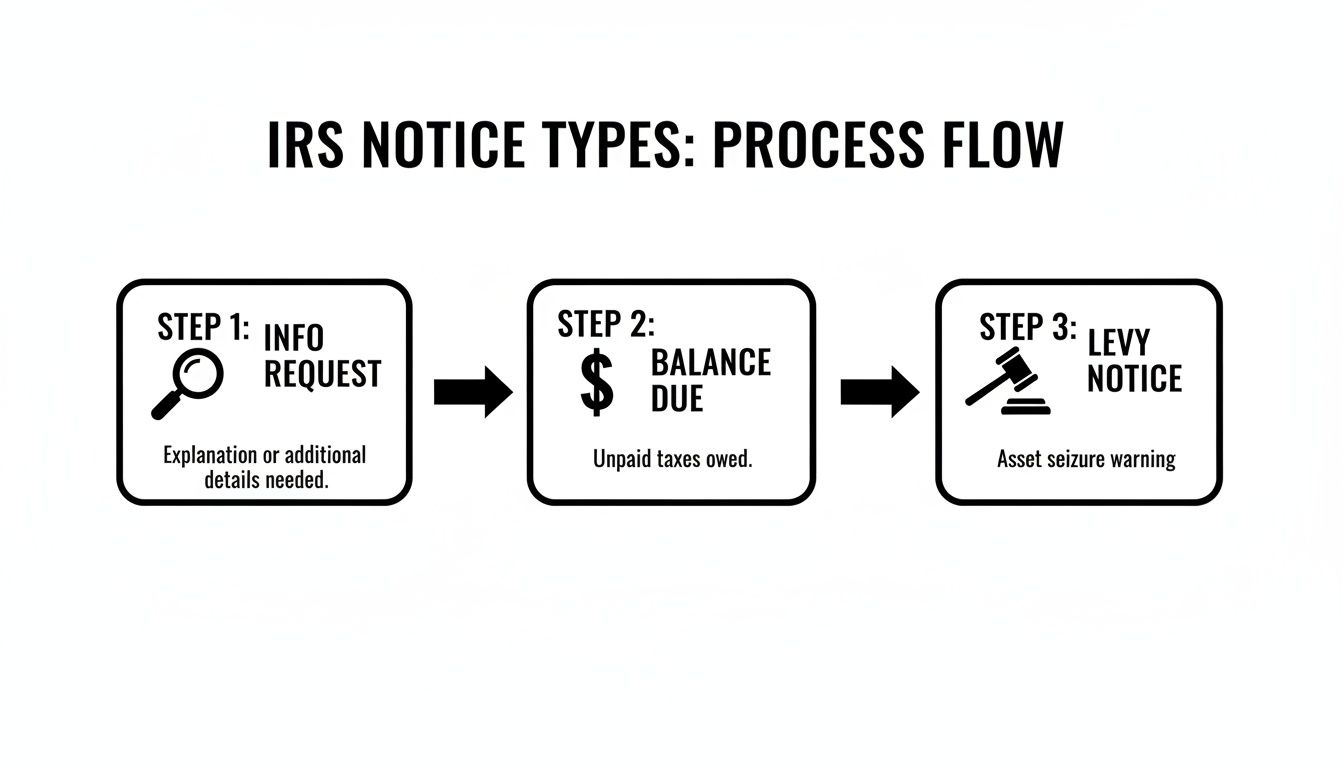
As you can see, what starts as a basic question can lead all the way to a levy. That’s why a timely, accurate response at every stage is so critical.
Step 2: Manage Your Deadlines
That response date printed on your letter from the IRS isn't a suggestion—it's a hard deadline. Missing it is a big mistake. The IRS can automatically rule in its favor, slap on more tax, and add failure-to-respond penalties just for being late.
Pro Tip: Always, and I mean always, send your response via USPS Certified Mail with a return receipt. This gives you undeniable legal proof that you mailed your response on time and that the IRS received it. If your letter ever gets lost in their vast system, that little green card is your golden ticket.
If you legitimately need more time to get your documents together or to talk with a tax pro, you can usually get an extension. A quick phone call to the number on the notice often does the trick. Just be sure to write down the date, time, and the name and ID number of the IRS agent you speak with.
Step 3: Decide Whether to Dispute or Pay
With your documents in hand and the deadline noted, you've reached a fork in the road. Do you agree with the IRS and pay up, or do you have the evidence to fight back?
- Agree and Pay: If, after reviewing your records, you realize the IRS is right (maybe you did forget to report a 1099), the path of least resistance is often to agree. You can either pay the full balance or, if that’s not feasible, you can look into options for how to set up an IRS payment plan to handle the debt over time.
- Disagree and Dispute: If your documents prove your original tax return was correct, you need to formally dispute the notice. This requires writing a detailed letter explaining precisely why you disagree and attaching copies (never send your originals!) of all your supporting evidence.
Your dispute letter needs to be clear, professional, and stick to the facts. Be sure to reference the notice number and tax year, then address each point of disagreement one by one, citing your proof. Leave emotion out of it. A calm, evidence-based argument is infinitely more effective.
Special Tax Issues for Business Owners and the Self-Employed
Getting a letter from the IRS is nerve-wracking for anybody. But when you’re a business owner or self-employed, the stakes feel a whole lot higher. Your business is your livelihood, and a tax problem can threaten everything you’ve worked so hard to build.
Two issues in particular should set off immediate alarm bells: payroll tax problems and income reporting mismatches. These aren’t simple bookkeeping mistakes; the IRS sees them as major red flags that can lead to aggressive collections and painful audits.
The Dangers of Payroll Tax Debt and the TFRP
If you have employees, you have a non-negotiable duty to handle their payroll taxes correctly. The income tax, Social Security, and Medicare you withhold from their paychecks isn't your money to use.
Think of it this way: you are simply holding that money "in trust" for the U.S. Treasury. That's why they're called trust fund taxes. The second you dip into those funds to cover other business expenses—whether it's paying rent, buying inventory, or just making payroll for another week—you've crossed a very dangerous line.
When a business falls behind on paying these taxes, the IRS can unleash one of its most formidable weapons: the Trust Fund Recovery Penalty (TFRP).
The TFRP gives the IRS the power to pierce the corporate veil and hold individuals personally liable for the unpaid trust fund taxes. This means the IRS can seize the personal assets of owners, directors, and even bookkeepers—anyone deemed a "responsible person" for the failure to pay.
This penalty isn't something you can just wipe away in bankruptcy; it can follow you for years. It's the IRS's direct response to businesses misusing funds that legally belong to their employees and the government.
Common Audit Triggers for Businesses and Freelancers
Beyond payroll trouble, a handful of other common mistakes can easily draw the attention of the IRS, especially for sole proprietors and small businesses. The agency's automated systems are incredibly good at flagging numbers that just don't add up.
Here are some of the most common triggers I see:
- 1099 Discrepancies: This is a big one. If a client issues you a 1099-NEC for $20,000 but you only report $15,000 of that income, you can bet an automated CP2000 notice is heading your way. The IRS gets a copy of every 1099 issued, making this mismatch a simple thing for their computers to catch.
- Unusually High Business Expenses: Let's say the average profit margin in your industry is 20%, but your tax return shows you spent 95% of your gross income on expenses. That's going to raise questions about whether all those deductions are legitimate. Writing off large, round numbers for expenses also looks suspicious to an auditor.
- Worker Misclassification: Calling your employees "independent contractors" to dodge payroll taxes is a huge compliance risk. If you get it wrong, you could be on the hook for a massive bill covering back taxes, steep penalties, and interest.
- Heavy Cash Transactions: Businesses that handle a lot of cash—like restaurants, bars, or laundromats—are naturally under a microscope. The potential for underreporting income is higher, and the IRS knows it.
For business owners and freelancers, staying on top of specific reporting rules, like the requirements for a 1099 for attorney fees, is absolutely critical for avoiding these exact pitfalls.
This level of scrutiny is only going to intensify. The IRS is making a major shift in its enforcement priorities, targeting high-income individuals and businesses starting in 2026. As you can see in this overview of the new IRS audit priorities, the agency plans to nearly triple audit rates for large corporations. For complex partnerships with over $10 million in assets, they're boosting audit rates ten-fold to 1%. This signals a new era of enforcement that will undoubtedly trickle down and affect businesses of all sizes.
When to Hire a Tax Attorney Versus Handling It Yourself
Getting a letter from the IRS always feels serious, but knowing how serious is the real challenge. It’s one of the most critical judgment calls you’ll have to make. Think of it like a home repair: you can probably fix a leaky faucet yourself, but you’d call a professional for a burst pipe flooding your kitchen. Some IRS issues are just like that leaky faucet—manageable. Others are a five-alarm fire.
Not every notice requires an all-hands-on-deck response. If the IRS is simply pointing out a small, obvious mistake—like a math error on your tax return or a missing W-2 that you have in your files—you can likely handle it. A quick, clear response with the right documents is often all it takes to put the matter to rest.
When You Can Likely Handle It Yourself
You can probably go it alone if the IRS notice is about:
- A small math error they’ve already corrected for you.
- A missing W-2 or 1099 that you simply forgot to include with your return.
- A small balance due that you agree with and can easily pay or set up a payment plan for.
But the moment things feel complicated or the numbers start getting big, the DIY approach becomes a real gamble. The line between a simple correction and a serious problem is thinner than most people think.
Red Flags That Signal You Need an Attorney
Some IRS notices are more than just letters; they are legal challenges with the power to disrupt your life and finances. These are the immediate red flags that mean it's time to bring in a tax attorney.
A specialized tax resolution attorney isn't just another advisor; they are your strategic partner. Unlike the big, impersonal "tax relief" factories you see on TV, a dedicated attorney acts as your personal advocate, negotiator, and legal shield. They know the complex rules and will work to protect your rights and your assets.
Don't hesitate to hire an attorney if you get a notice involving any of these situations:
- A Formal Audit: An audit notice puts your financial life for an entire year under a microscope. An attorney will manage every conversation with the auditor, preventing you from making an innocent comment that turns into a costly mistake.
- A Large Tax Debt: If you owe a substantial amount and have no realistic way to pay it back, an attorney can negotiate for you, exploring powerful solutions like an Offer in Compromise.
- Threats of Liens or Levies: A notice like a CP504 or LT11 is the IRS’s final warning before they start seizing bank accounts, paychecks, or property. An attorney can step in immediately to halt collections and work out a resolution.
- A Trust Fund Recovery Penalty (TFRP): For business owners, this is one of the most dangerous situations. It makes you personally liable for the business's unpaid payroll taxes.
- Accusations of Tax Fraud: Even a hint of a criminal investigation is a serious threat to your freedom. You need an experienced legal professional on your side from day one. Our guide on how to find a good tax attorney can point you in the right direction.
For small businesses, the stakes are even higher now that IRS audits are often triggered by AI algorithms flagging anything that looks unusual. With the IRS projected to process over 165 million returns by 2026, service delays will hit taxpayers with complex problems the hardest, leaving those without expert help at a major disadvantage. You can learn more about how Maryland businesses and high-income residents face increased IRS audit risk in 2025 and 2026.
When you're handing over sensitive financial data, you also want to be sure your information is safe. It’s worth taking a moment to understand the standards for cyber security for law firms to get that extra peace of mind.
Take Control of Your IRS Problem Today

That letter from the IRS sitting on your counter feels heavy for a reason. It's a serious financial issue, and the absolute worst thing you can do is slide it back in the envelope and hope it goes away. Trust me, it won’t. It will only get bigger and more complicated.
Every day you wait, penalties and interest are quietly piling up, turning a manageable problem into a mountain of debt. The IRS has a methodical process that ramps up over time, moving from letters to more aggressive actions like Federal Tax Liens, bank account levies, and wage garnishments. The longer you put it off, the fewer moves you have left to make.
Get a No-Obligation Tax Debt Analysis
Instead of letting anxiety call the shots, you can take one simple, proactive step to understand exactly what you're up against. Before you spend a dime or commit to any specific path, you need a clear picture of your situation and your real options. That's why we offer a completely free, no-obligation Tax Debt Analysis.
This isn't a high-pressure sales pitch. It’s a straightforward conversation with a tax professional to evaluate your specific case. Here’s what we’ll do:
- Break Down Your IRS Letter: We’ll look at the notice you received to figure out what the IRS is actually saying, how urgent it is, and what deadlines are in play.
- Understand Your Situation: We'll listen to you. We need to hear the whole story to get the context behind the tax problem.
- Outline Your Potential Options: Based on what we find, we’ll tell you honestly if we can help and explain the strategies we would use to start resolving your case.
You will leave this analysis with a clear understanding of your tax situation and a potential game plan for what to do next—all without any cost or commitment.
This evaluation is all about giving you clarity and putting you back in control. It's a risk-free way to see how an experienced professional can help you navigate the IRS, protect your assets, and finally get your peace of mind back.
Don’t let that letter define your financial future. Take the first step and get the expert insight you need today. Contact us now to schedule your free Tax Debt Analysis and start the process of putting this issue behind you for good.
Frequently Asked Questions
Even after going through a guide, getting a notice from the government can leave you with a lot of "what ifs." We get it. Here are some of the most common questions we hear from people in your exact situation, with straight answers to help you regain your footing.
How Can I Tell if a Letter From the IRS Is Real or a Scam?
Here’s the golden rule: the IRS always makes its first contact with you through the U.S. Mail. They will never text you, email you, or message you on social media to ask for your personal or financial details.
Scammers, on the other hand, love to create a false sense of urgency. They'll demand immediate payment via gift cards, wire transfers, or even cryptocurrency. A real letter from the IRS won't do that. It will have official markings, a notice number (like CP2000), the tax year in question, and clear instructions on how to respond.
If a letter feels off, trust your gut. Don't call the number on the notice itself. Instead, go directly to the official IRS.gov website to find a legitimate contact number, or better yet, ask a tax professional to verify it for you.
What Happens if I Ignore an IRS Letter?
Frankly, ignoring it is the worst thing you can do. The problem won’t just disappear—it will get bigger, more complicated, and more expensive. The IRS simply moves on to the next step outlined in their notice.
- If they proposed a tax increase, they’ll make it official and assess the tax against you.
- If it was a collection notice, they’ll escalate to enforced collections.
- This can lead to a Federal Tax Lien on your property, a levy on your bank accounts, or even wage garnishment.
All the while, the meter is running. Penalties and interest rack up every single day, turning what might have been a manageable issue into a much larger debt. A small tax problem left ignored can quickly spiral into a full-blown financial crisis.
Can I Get Penalties Removed From My IRS Debt?
Yes, it’s often possible to get penalties waived through a process called penalty abatement. The most common reason the IRS grants this is for "reasonable cause." This is where you show that you tried to do the right thing but were blocked by circumstances you couldn't control.
Think of things like a sudden, serious illness, a house fire or natural disaster, or even relying on bad advice from a tax preparer. Another option is the First-Time Abatement (FTA) waiver, which is a fantastic olive branch for taxpayers who have a clean compliance record for the past three years. But be warned: proving reasonable cause isn't a simple form. It requires building a compelling case, and this is where having a professional in your corner can make all the difference.
My IRS Letter Says I Am Being Audited. What Should I Do First?
Take a deep breath. Your first move is the most important one. Read the notice carefully to see which tax year and what specific items they're questioning. But whatever you do, do not pick up the phone and call the auditor or start sending them documents.
Your very first call should be to an experienced tax attorney. They immediately create a protective shield between you and the IRS, managing all communication and document submissions. This is crucial because it stops you from accidentally saying something or handing over a document that expands the audit's scope or creates new liabilities. When you're facing an audit, professional representation isn't a luxury—it's your best defense.
Don't let an IRS letter control your life. Attorney Stephen A. Weisberg offers a free, no-obligation Tax Debt Analysis to give you a clear understanding of your situation and outline a strategic path forward. Take the first step toward resolving your tax issue by visiting https://weisberg.tax to schedule your analysis today.


