Your Guide to KY State Taxes in 2026
Navigate KY state taxes with confidence. Our 2026 guide covers individual rates, business obligations, debt solutions, and audit risks. Get clarity now.

In this article
- Navigating the Kentucky Tax Landscape
- Understanding Kentucky's Flat Income Tax for Individuals
- Why Modified Gross Income matters
- What the lower rate changes and what it does not
- A cleaner way to think about deductions and credits
- Key Taxes for Kentucky Businesses
- The overlooked business tax that hits even when profit is thin
- Why the LLE Tax causes cash flow stress
- Sales and use tax is simple at the rate level, tricky at the base level
- Where small businesses get into trouble
- What works in practice
- The business owner’s real problem
- Employer Payroll Taxes and Personal Liability Risks
- Why owners get exposed personally
- Warning signs businesses ignore
- What to do first if payroll taxes are already behind
- Common Kentucky State Tax Audit Triggers
- The trigger many self-employed taxpayers miss
- Red flags that deserve a self-audit
- What auditors usually want to see
- What doesn’t work during an audit
- How to Resolve Your Kentucky Tax Debt
- Installment agreements
- Offers in compromise
- Strategy matters more now than many people realize
- A practical first step
- Take Control of Your KY Tax Situation Today
The envelope from the Kentucky Department of Revenue usually lands on a bad day.
A contractor opens it after a long week and sees language about filing requirements, unpaid balances, or missing returns. An LLC owner who barely broke even wonders why the state thinks money is owed at all. A business with employees realizes too late that payroll withholdings were used to cover short-term cash flow. None of that feels unusual when you work with ky state taxes long enough.
Most tax articles stop at rates and definitions. That’s useful, but it doesn’t help much when the problem is already sitting on your desk. What matters then is understanding where the risk came from, what the state will focus on, and what improves your position.
Kentucky has changed a lot in a short period. Those changes affect individual returns, self-employed filing triggers, sales tax treatment, entity-level obligations, and debt resolution strategy. The practical issue isn’t just compliance. It’s that a rule that looks simple on paper can create a messy result when income is inconsistent, records are incomplete, or a business has been operating under pressure.
This guide is written from that real-world angle. It’s for the person trying to keep a business moving while dealing with tax notices, old balances, audit concerns, or filing gaps. It’s also for the professionals around them who need a clear picture of what’s at stake.
Navigating the Kentucky Tax Landscape
A small business owner in Kentucky can do almost everything right operationally and still walk into a tax problem.
Take a common pattern. The owner formed an LLC, hired a bookkeeper late, paid contractors from one account and personal bills from another, and assumed low profit meant low tax exposure. Then a notice arrives. It mentions missing filings or a liability that doesn’t match what the owner thought the business earned.
That disconnect happens because ky state taxes don’t always follow the logic people expect.
A return may be required even when net income looks modest. A business entity may owe a tax tied to gross receipts rather than profit. Sales tax issues can grow when purchases or transactions were coded the wrong way. Payroll tax problems can turn into personal exposure for the people running the company.
Practical rule: Tax trouble usually gets more expensive when you treat a notice as a billing mistake instead of a legal issue that needs a documented response.
Kentucky’s system also shifts the planning conversation. Some rules have become simpler on the surface. Others have become more important because the margin for error is thinner. If you’re self-employed, own an LLC, run payroll, or collect sales tax, the risky part is rarely the headline rate. It’s the trigger you didn’t realize applied.
The right approach starts with three questions:
- What type of tax is involved: Individual income tax, sales tax, payroll withholding, and entity-level taxes behave differently.
- Is the problem current or historical: A current filing issue calls for one strategy. Old assessed debt calls for another.
- Do the records support your position: If they don’t, the first job is often rebuilding the file before arguing with the state.
That’s the mindset that works. Not panic. Not guesswork. A clean identification of the tax, the period, and the records.
Understanding Kentucky's Flat Income Tax for Individuals
A common problem looks like this. A Kentucky resident has wage income, some 1099 work on the side, and a state balance due that seems too high for a state with a low flat rate. The rate is rarely the issue. The problem is usually how Kentucky measures income, whether estimates were paid on time, and whether the return can be defended if the Department of Revenue asks questions later.
For tax year 2026, Kentucky’s individual income tax drops to a flat 3.5%, a 30% cut since 2022, and the state is among only 15 states with a single-rate income tax according to the AARP Kentucky state tax guide. That lower rate helps with planning, but it also causes some taxpayers to underestimate risk. A smaller rate does not prevent underpayment notices, collection action on older years, or an audit tied to income that was reported incompletely.

Kentucky uses one rate for taxable income instead of the federal bracket system. That part is easier. Getting to the correct Kentucky taxable income is where mistakes start.
Why Modified Gross Income matters
Kentucky filing requirements turn on Modified Gross Income, or MGI. In practice, business owners, contractors, retirees, and taxpayers with mixed income sources can encounter difficulties. A federal return may look straightforward while the Kentucky filing analysis points in a different direction.
The practical point is simple. Do not assume the federal adjusted gross income number answers the Kentucky question by itself.
A sound review usually includes:
Starting with the federal return Federal figures still drive much of the analysis.
Checking Kentucky-specific additions or adjustments State treatment does not always track federal treatment perfectly.
Confirming which income measure controls Filing exposure often comes from using the wrong starting point, not from applying the wrong rate.
That matters most for taxpayers who have side income, pass-through income, or a year with unusual transactions. In my experience, those are the files where a low tax rate creates false confidence and a notice arrives months later.
What the lower rate changes and what it does not
The lower flat rate can reduce future tax cost. It does not fix old compliance problems.
If Kentucky has already assessed tax, the newer rate does not rewrite that liability. If estimated payments were missed, the state can still assess additions to tax. If income was reported loosely because a taxpayer expected deductions to cover everything, the lower rate does not make the records problem disappear.
| Issue | Common assumption | Practical reality |
|---|---|---|
| Current withholding | A lower rate means payroll withholding is probably enough | Withholding still needs to match actual income, especially if you also have 1099 or business income |
| Old balances | A new lower rate should reduce prior debt | Prior assessed periods usually stay assessed unless you have a legal basis to amend or challenge them |
| Self-employed income | A modest profit means the state will not care much | Filing duties, estimated tax rules, and documentation still drive exposure |
For self-employed taxpayers, timing matters as much as the rate. If income comes in without withholding, missed estimates can create a problem even in a relatively low-tax state. This guide on quarterly tax payment deadlines is a useful reset if estimated payments have been handled inconsistently.
A cleaner way to think about deductions and credits
A common question I receive is about finding a single deduction to solve a tax problem. That is usually the wrong objective.
Deductions and credits can reduce the bill. They do not repair poor bookkeeping, missing income records, or unsupported adjustments. If the file is weak, the taxpayer is arguing from a bad position before the state even reviews the numbers.
The return is only as strong as the paper trail behind it.
A better approach is operational:
Separate business and personal spending Use dedicated accounts from now on, even if prior years are mixed.
Reconcile income before arguing deductions Unreported or mismatched income creates the larger risk in most Kentucky disputes.
Collect support before filing or amending If the Department of Revenue questions the return later, estimates and memory will not carry much weight.
Kentucky’s flat tax makes the rate easier to understand. It does not make individual tax problems harmless. Financial risk usually comes from underpaid estimates, income classification mistakes, and weak records that turn a manageable issue into an assessed debt.
Key Taxes for Kentucky Businesses
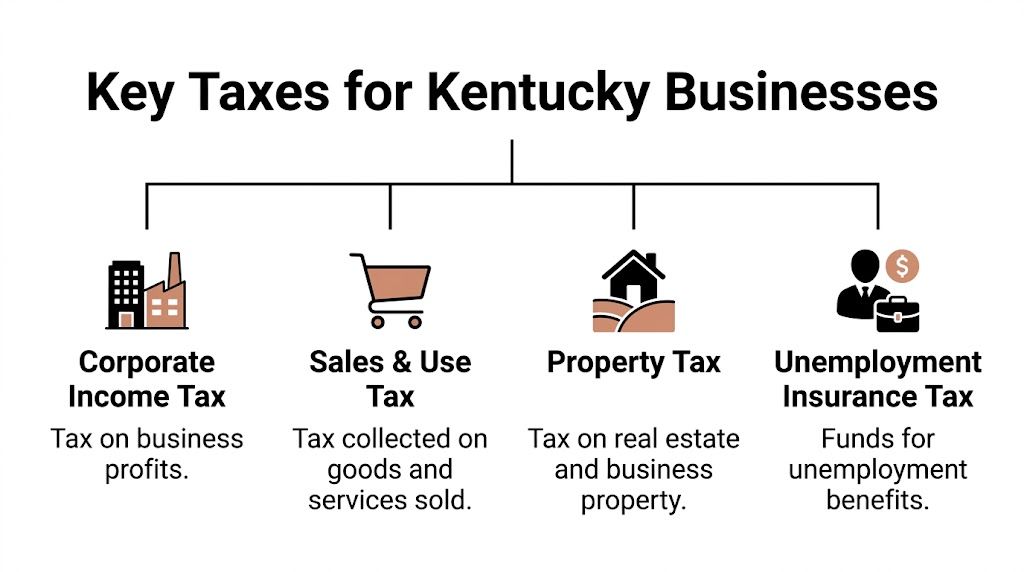
Many Kentucky business owners focus on income tax and miss the taxes that create the most operational friction.
That’s where ky state taxes become expensive. The issue often isn’t one giant bill. It’s several different obligations, each triggered by different facts, each enforced in a different way.
The overlooked business tax that hits even when profit is thin
For LLCs and partnerships, the Limited Liability Entity Tax deserves close attention. As explained in this analysis of big Kentucky tax issues facing businesses, the LLE Tax imposes a 0.095% gross receipts tax with a $175 minimum on LLCs and partnerships regardless of profitability.
That last part is the practical trap. Regardless of profitability.
A lot of owners think in net terms. They know what was left after payroll, materials, rent, fuel, and debt service. The LLE Tax forces you to think in gross receipts first. If revenue came in, the entity can have a state-level obligation even when the year felt bad financially.
Why the LLE Tax causes cash flow stress
This tax often catches:
- Single-member LLCs that were treated casually because the owner saw the business as an extension of themselves
- Multi-member LLCs where partners tracked distributions but not state entity filings
- Service businesses with decent top-line revenue but volatile margins
- Businesses in turnaround mode that were paying old debts and assumed no profit meant no entity tax
That’s why this issue matters more in tax controversy than in ordinary tax prep. When a business is short on cash, taxes tied to gross receipts can feel disconnected from reality. But the state’s position is still the state’s position.
If your entity tax is based on gross receipts, “we didn’t make money” may explain the hardship. It usually doesn’t eliminate the liability.
Sales and use tax is simple at the rate level, tricky at the base level
Kentucky’s sales tax structure looks straightforward because the state sales tax applies at 6% with no local variations, but the more important issue for many businesses is how the tax base is defined and applied, especially after sales tax modernization described by the Kentucky Chamber’s sales tax modernization paper.pdf).
The state’s modernization effort focused on removing business inputs and limiting tax pyramiding. In practice, that means a business has to distinguish carefully between:
- Final personal consumption, which is generally taxable
- Business inputs, which may be treated differently
That sounds technical until an audit starts. Then it becomes a records problem.
Where small businesses get into trouble
The common sales tax mistakes are rarely dramatic. They are repetitive.
A contractor buys materials and doesn’t maintain clear support for how those purchases were used. A retailer expands into online sales and doesn’t update procedures. A service provider assumes a transaction is outside the taxable base because “it’s business related.”
The risk usually comes from classification.
Here’s a useful way to evaluate transactions:
| Transaction type | Better question to ask |
|---|---|
| Sale to a customer | Is this a final taxable sale under current Kentucky rules? |
| Purchase by the business | Is this a true business input, and do the records prove it? |
| Out-of-state activity | Did the business create a filing or collection obligation through its activity? |
| Mixed-use expense | Can you show what portion was business versus personal or taxable versus exempt? |
What works in practice
Good compliance here is less about memorizing tax theory and more about building a defendable file.
The strongest businesses usually do a few things consistently:
They code transactions with purpose Not just “supplies” or “miscellaneous,” but categories that match the tax treatment they’re claiming.
They keep invoice-level support Especially where purchases may qualify as business inputs.
They review changes in operations New services, new sales channels, or new locations often change tax treatment before anyone notices.
They don’t let the sales tax account become a borrowing source Once collected, those funds shouldn’t be used to float operations.
The business owner’s real problem
A tax article can make all of this sound administrative. It isn’t. These issues affect borrowing, closings, partner disputes, and owner compensation.
The legal form matters too. Sole proprietors, S corporation owners, single-member LLCs, and multi-member LLCs each run into different pressure points. But the recurring theme is the same. The tax issue gets worse when the books were built for operations only, not for scrutiny.
That’s why a business under stress should review all state tax categories together instead of fixing one in isolation. An owner might solve an income tax question and still have unresolved sales tax exposure or an unaddressed entity-level balance waiting in the background.
Employer Payroll Taxes and Personal Liability Risks
A business can survive a lot of mistakes. Mishandling payroll taxes is not one of them.
When you withhold tax from an employee’s paycheck, that money doesn’t belong to the business. The business is holding it temporarily and is legally required to turn it over. It is like being the custodian of someone else’s funds. If you use that money for rent, vendors, or payroll itself, the state and the IRS don’t treat it as a normal unpaid bill. They treat it as money that was held in trust and not delivered.

That’s why payroll tax cases move differently from ordinary income tax debt.
Why owners get exposed personally
Owners often believe the entity will shield them. Sometimes it does for ordinary trade debt. Payroll withholding is different.
If you had control over who got paid, signed checks, directed payroll, or decided to use withheld funds elsewhere, you can become the focus. The federal version of this concept is the Trust Fund Recovery Penalty. If you need a grounded explanation of how that works, this article on the Trust Fund Recovery Penalty lays out the core mechanics.
The same practical lesson applies at the state level. Kentucky can pursue responsible people, not just the company, when withholding taxes weren’t remitted.
Pay vendors late before you pay trust fund taxes late. Vendors may sue the business. Payroll tax agencies may pursue the people behind it.
Warning signs businesses ignore
The payroll problem usually starts with a short-term decision:
- Using withheld taxes to cover payroll itself
- Filing payroll reports without sending full payment
- Turning payroll over to a service and assuming that ends the owner’s responsibility
- Keeping employees on staff after the business no longer has stable cash flow
None of those choices stay small for long.
A payroll service can help process filings. It does not transfer legal responsibility away from the employer. If the money wasn’t paid over, the question becomes who had duty and control.
What to do first if payroll taxes are already behind
Don’t shut down communication and hope the issue sorts itself out.
Start here instead:
Pull every payroll filing and payment record You need dates, amounts, and filing periods.
Identify what was withheld versus what was paid That distinction matters more than broad bookkeeping categories.
Stop adding to the problem If current payroll can’t be funded and remitted properly, that has to be addressed immediately.
Document decision-making authority In multi-owner businesses, the state and IRS will care who controlled the funds.
Payroll tax trouble is one of the fastest ways for a business problem to become a personal one.
Common Kentucky State Tax Audit Triggers
A Kentucky audit often starts the same way. A business owner receives a notice, assumes it is random, and only then realizes the return was built from incomplete records, inconsistent reporting, or guesses made under cash pressure.
In my practice, many business owners view audit triggers as punishments. Kentucky usually treats them more like indicators that something in the file deserves a closer look. The risk is not the notice itself. The risk is that an ordinary inquiry exposes unpaid tax, weak documentation, or reporting positions that were never going to hold up.
The trigger many self-employed taxpayers miss
Self-employed Kentuckians often focus on profit and overlook filing exposure tied to gross receipts. I see this mistake regularly with sole proprietors who say the business barely made money after expenses, so they assume the state will not care.
That assumption creates problems fast.
Gross receipts and net income answer different questions. Low profit does not erase the fact that the business handled meaningful top-line revenue. Once Kentucky starts asking how the numbers were reported, the audit can expand into deductions, sales tax treatment, and whether personal and business transactions were separated at all.
Red flags that deserve a self-audit
Before responding to a notice, review the return the way an auditor will review it.
Federal and state mismatch Differences in reported income, entity treatment, or business activity invite questions.
Large deductions with poor backup The amount is not always the issue. Missing receipts, vague ledger entries, and reconstructed numbers are.
Worker classification problems Paying someone as a contractor does not settle the issue if the facts show employee control.
Sales tax collection gaps If taxable sales occurred and the collection or remittance trail is incomplete, Kentucky may examine more than one filing period.
Mixed personal and business activity Commingled accounts make it harder to defend deductions and easier for the state to challenge the return as a whole.
What auditors usually want to see
Auditors want records that tie the return to actual transactions. Clean summaries help, but source documents carry the weight.
A practical audit file often includes:
| Record | Why it matters |
|---|---|
| Bank statements | Confirms deposits and payment patterns |
| Invoices and receipts | Supports classification and deductions |
| Sales records | Ties reported revenue to taxable transactions |
| Payroll reports | Shows withholding and remittance history |
| General ledger detail | Explains how the return was built |
If the records are scattered across exports, point-of-sale systems, and bookkeeping files, organize them before producing anything. For businesses doing forensic cleanup, a guide on converting data from tax systems for analysis can be useful when transaction history needs to be reviewed outside the original software.
What doesn’t work during an audit
Casual responses create expensive problems.
These approaches usually make the case worse:
Sending documents without checking for inconsistencies Contradictory records give the auditor more issues to pursue.
Making legal arguments before rebuilding the file If the books are incomplete, fix the factual record first.
Ignoring deadlines because the notice seems unclear Kentucky does not need your confusion to slow down its process.
A weak audit response usually fails because the records do not support a clear story of what happened, what was reported, and why. If you want a broader checklist on risk points, this discussion of what triggers tax audit scrutiny is a helpful companion.
How to Resolve Your Kentucky Tax Debt
Kentucky tax debt usually becomes overwhelming for one reason. The taxpayer starts reacting to notices instead of working a plan.
That’s understandable. People are busy, embarrassed, or unsure whether the balance is correct. But once the debt is assessed, delay limits your options.
A realistic view matters here. Kentucky’s tax code has been described as the 17th most regressive in the nation, with low and middle-income families paying effective rates of 10.9% to 12.4%, according to the source material discussed in this Kentucky tax policy video. For many households and small businesses, that pressure is part of why state tax debt builds in the first place.
Installment agreements
An installment agreement is usually the first structured option to evaluate.
This is the right starting point when the debt is real, the filings are substantially in place, and the taxpayer has income to make regular payments over time. The state will want to know whether the amount proposed is realistic and whether you’re staying current going forward.
What tends to help:
Current compliance If new returns are still being missed, payment plan requests lose credibility.
A workable budget An amount that sounds good on paper but collapses after the first payment doesn’t solve much.
Clear period-by-period understanding You need to know what years and tax types are included.
Offers in compromise
An offer in compromise, or OIC, is different. It asks the state to accept less than the full amount owed based on the taxpayer’s actual ability to pay or other qualifying circumstances.
This is not a shortcut and it’s not available just because paying in full would be inconvenient. It usually requires a detailed presentation of finances, assets, liabilities, income, and expenses. The quality of that presentation matters.
A strong OIC analysis asks:
- Can the taxpayer pay in full now
- Can the taxpayer pay over time
- Do the records support the hardship claim
- Are all filing obligations current
If the answer to the filing question is no, resolve that first. Settlement discussions are harder when the file is still open and incomplete.
Strategy matters more now than many people realize
Kentucky’s declining income tax rate can matter strategically in some cases. The practical reason is simple. Lower future tax burdens can improve projected cash flow for some taxpayers, which may affect payment planning and negotiation posture. That doesn’t automatically produce a better settlement, but it can change what a feasible monthly amount looks like over time.
That’s why debt resolution should never be handled as “just call and ask for mercy.”
You need to know:
- Whether the assessment is correct
- Whether penalties should be challenged
- Whether a payment plan or compromise fits the facts
- Whether state and federal liabilities need to be coordinated together
A practical first step
Before you ask for relief, build the file.
Gather notices, transcripts or account statements if available, proof of income, bank records, prior returns, and a current financial snapshot. Then sort the issue into one of three buckets:
| Situation | Better path |
|---|---|
| You agree with the debt and can pay over time | Installment agreement analysis |
| You can’t realistically pay the full balance | Offer in compromise review |
| You’re not sure the balance is right | Liability verification before negotiation |
If you want a general overview of how firms think through state tax resolution, that resource gives a useful comparison between state and federal approaches.
When collection pressure has already escalated, wage garnishment or levy concerns need immediate attention. This article on how to stop state tax garnishment is worth reviewing if the debt has moved beyond notices and into enforcement.
Take Control of Your KY Tax Situation Today
The hardest part of ky state taxes usually isn’t the form. It’s the hesitation that comes after the problem becomes obvious.
A lot of taxpayers wait because they’re hoping the notice is minor, the balance is wrong, or the next month will be better. Sometimes that happens. More often, the problem gets more expensive, the records get harder to rebuild, and the available solutions narrow.
The good news is that most tax problems become more manageable once they are properly identified. That means knowing which tax is involved, which periods are open, whether the amount is valid, and what path fits the facts. An LLC gross-receipts issue is not handled the same way as a payroll withholding case. A filing gap is not handled the same way as an assessed balance that’s already in collections.
The practical move is to stop guessing.
If you’re a business owner, self-employed professional, or individual dealing with Kentucky tax notices, unfiled returns, audits, or debt, get the file organized and get a real analysis before you commit to any strategy. The same goes for professionals helping clients through transactions, divorces, bankruptcies, or financing issues where tax debt is blocking progress.
Large tax resolution companies often lead with pressure and big upfront fees. That model works for them. It doesn’t always work for the taxpayer. A better approach starts with determining whether there is a viable solution and what that solution is before anyone is asked to spend serious money.
That’s how control comes back. Not by ignoring the issue. Not by hoping a call center has the answer. By getting a careful review of the facts and a plan built for your actual situation.
Attorney Stephen A Weisberg of The W Tax Group offers a free, no-obligation Tax Debt Analysis for individuals and businesses dealing with IRS or state tax problems. Instead of demanding a large upfront payment just to get started, he begins by determining if he can help and how. If you’re facing Kentucky tax debt, audits, payroll tax issues, or filing problems, request that analysis first. It’s the clearest way to understand your options before making any financial commitment.


