Is Overtime Taxed at a Higher Rate? Your 2026 Guide
Is overtime taxed at a higher rate? We debunk the myth and explain how payroll withholding and tax brackets really affect your paycheck in 2026.
In this article
- The Myth and Reality of Overtime Taxes
- Overtime Tax Myth vs Reality
- Why Overtime Pay Feels More Heavily Taxed
- How Payroll Withholding Works
- How Overtime Interacts with Your Tax Brackets
- A Concrete Example of Tax Brackets in Action
- Federal, State, and Local Tax Considerations
- State and Local Tax Variations
- Practical Steps for Employees and Business Owners
- How Employees Can Adjust Withholding
- Actions for Business Owners
- Will Working Overtime Make Me More Likely to Get Audited?
- What Happens to That Extra Tax Money Taken From My Overtime Check?
- Do Companies Have to Use a Special Tax Rate for Overtime?
Let’s get straight to the point: No, the IRS does not tax your overtime pay at a higher rate. That’s a myth. Your overtime pay is considered ordinary income, just like your regular wages.
So, why does it feel like you’re losing a huge chunk of your overtime to taxes? The confusion comes from how payroll systems handle withholding for that specific, larger paycheck.
The Myth and Reality of Overtime Taxes
It's one of the most stubborn misconceptions out there. You hear it all the time: "I don't want to work extra hours because the government will just take it all." It definitely feels that way when you peek at your payslip after a long week, but the truth is much better for your bank account.
The U.S. has a progressive tax system, which simply means you pay a higher rate on dollars earned in higher income brackets. The key thing to remember is that this applies to your total income for the year, not just your overtime pay.
The real culprit behind the confusion is payroll withholding, not the tax code itself. When you get a big overtime check, your employer's payroll software often makes a simple, short-sighted calculation. It looks at that one large paycheck, assumes you'll earn that amount every pay period for the rest of the year, and withholds taxes at a temporarily inflated rate.
Overtime Tax Myth vs Reality
Let's put this common myth side-by-side with the reality to make it crystal clear.
| Common Myth | Tax Reality |
|---|---|
| The government has a special, higher tax rate just for overtime hours. | Overtime is taxed the same as regular income. There is no special overtime tax rate. |
| Earning overtime pushes all my income into a higher tax bracket for the whole year. | Only the dollars that actually fall into a higher bracket are taxed at that higher rate, not your entire income. |
| The extra tax money taken out of my overtime check is gone forever. | Any excess money your employer withholds is simply returned to you as a tax refund when you file your return. |
Essentially, the bigger withholding is just a temporary bump—a case of your payroll system playing it safe.
This distinction is crucial. At the end of the day, your overtime pay is not punished with a higher statutory tax rate. In the United States, that extra pay shows up as regular wage income on your Form W-2 and is taxed using the same progressive federal brackets as everything else.
In fact, the Yale Budget Lab projects that FLSA-qualified overtime pay will hit $335 billion in 2025. The average effective income tax rate on that massive sum? Just 19%. You can dig deeper into these numbers by exploring the full analysis and policy implications they've laid out.
Why Overtime Pay Feels More Heavily Taxed
If overtime isn't taxed at a special, higher rate, why does your paycheck feel so much lighter after putting in those extra hours? The culprit isn't the tax code itself, but rather the way your employer’s payroll system withholds taxes. It's a common and frustrating experience that leaves many people scratching their heads.
Think of it this way: imagine your payroll system is like a GPS. If you suddenly punch the gas on a short stretch of road, the GPS might mistakenly think you'll keep that speed for the entire trip and recalculate your arrival time based on that brief burst of speed. Your payroll software does something similar. When it sees a bigger check from overtime, it often projects that higher income out for the entire year and withholds taxes based on that inflated annual estimate.
This is where the confusion really takes root.
How Payroll Withholding Works
Payroll systems often categorize overtime as supplemental wages, which are handled a bit differently from your regular salary. Many employers use what's called the "aggregate method."
Here, they lump your overtime pay in with your regular wages for that pay period. The system then figures out the tax withholding based on the annualized total of that bigger, combined check. For that one paycheck, this can temporarily bump your projected annual earnings into a higher tax bracket, causing more money to be withheld.
The Key Takeaway: The extra money withheld from an overtime check is just an automated payroll calculation assuming you earn that much every single pay period. It's a temporary over-withholding, not a permanent tax hike.
Another common method is the "percentage method." With this approach, the employer withholds a flat 22% for federal taxes on your supplemental pay, completely separate from your regular paycheck's withholding. For a lot of middle-income workers, that 22% is higher than their usual effective tax rate, making the tax bite feel much larger.
The flowchart below cuts through the noise and shows how the IRS actually sees your earnings.
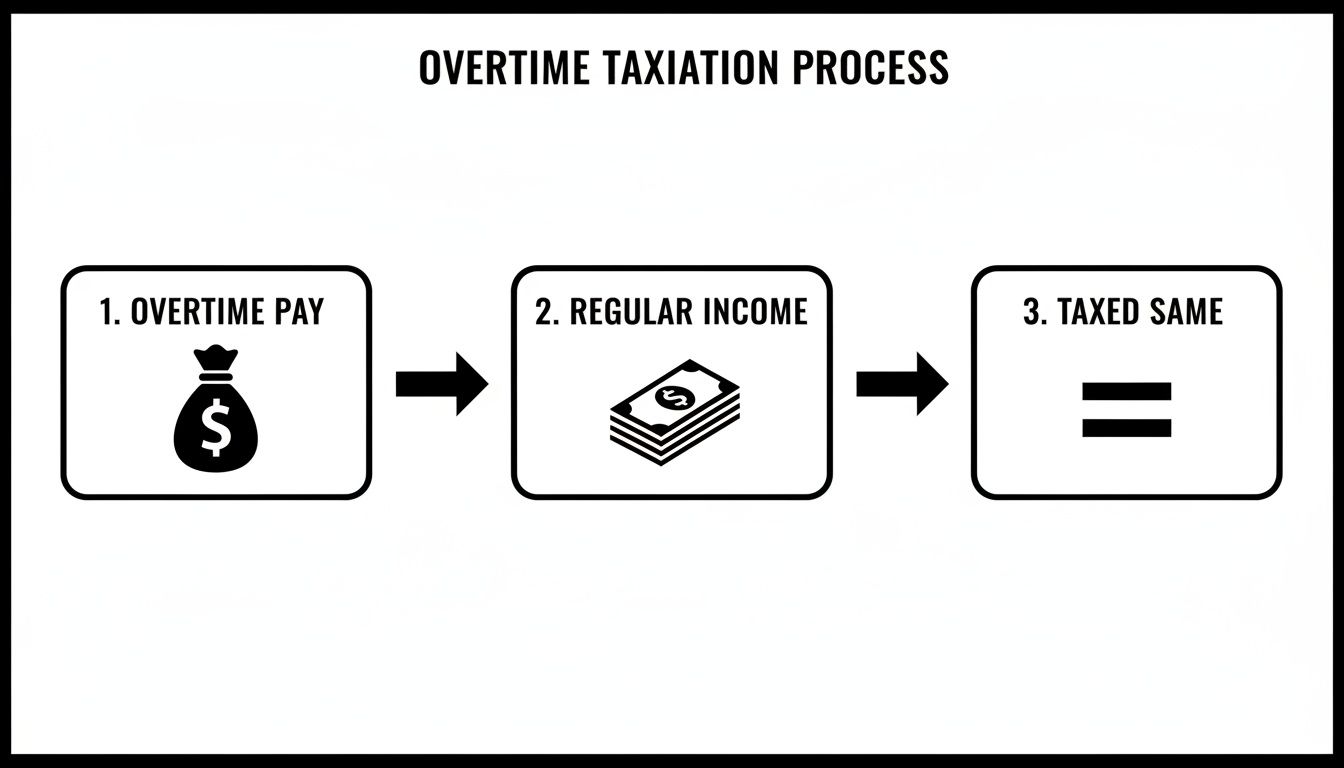
Ultimately, both your regular and overtime pay are added together into one big pot called "ordinary income." When you file your taxes, it's all treated the same. For more on this, understanding your W4 status and taxes is a great resource.
The good news? Any extra money that was withheld is just an interest-free loan to the government. You'll get it back in the form of a tax refund. You can also learn how to avoid this common https://www.weisberg.tax/newsletter/the-payroll-tax-trap-2ftdk-3xjkz-dky3x and keep more of your money with each check.
How Overtime Interacts with Your Tax Brackets
To really get a handle on how overtime impacts your taxes, we first need to talk about progressive tax brackets. This is where the whole myth about overtime being taxed at a higher rate comes from. While there's no special "overtime tax," the extra money you earn can push some of your income into a higher marginal tax bracket.
I like to think of your income as filling up a series of buckets. The first dollars you make go into the first bucket, which is taxed at the lowest rate (say, 10%). Once that bucket is full, your earnings start spilling into the next one, which has a slightly higher tax rate (like 12%), and this continues up the line.

Here’s the most important part: only the money that spills into a higher bucket is taxed at that higher rate. Your entire income doesn't suddenly get taxed more. Your overtime pay might just be the dollars that start filling a new, higher-rate bucket. It's not that overtime itself is special; it's just that your total income has now crossed a new threshold.
A Concrete Example of Tax Brackets in Action
Let's walk through a quick scenario. We'll use a single filer named Alex who normally earns $45,000 a year.
Based on the 2024 tax brackets for single filers, here's how that income is taxed:
- 10% on income up to $11,600
- 12% on income between $11,601 and $47,150
Without any overtime, all of Alex's $45,000 income fits neatly within these first two brackets.
Now, imagine Alex picks up some extra shifts and earns $3,000 in overtime. This boosts their total income for the year to $48,000. That extra cash pushes them just over the $47,150 threshold and into the next bracket, which is 22%.
This is the key takeaway: Only the portion of income above $47,150 gets taxed at that 22% rate. For Alex, that's just $850 of their income ($48,000 - $47,150). The rest of their pay is still taxed at the much lower 10% and 12% rates.
This principle is the same for all types of income, not just wages. For a more detailed walkthrough, our guide can help you calculate your tax liability step-by-step.
Getting a grip on how different income streams affect your tax situation is crucial. If you have mixed income sources or are self-employed, making sure you’re using all available self-employed tax deductions is a smart way to manage your overall tax bill.
Federal, State, and Local Tax Considerations
It's easy to focus just on federal income tax, but that's only part of the story. To really understand what happens to your overtime pay, we have to look at FICA taxes (Social Security and Medicare) and, of course, any state and local income taxes you might owe. These are crucial pieces that determine how much of that extra pay you actually take home.
Unlike the progressive brackets of federal income tax, FICA taxes are flat-rate taxes. This is a key difference. Every dollar you earn from wages—whether from your regular 40 hours or a long week of overtime—gets hit with a 6.2% Social Security tax and a 1.45% Medicare tax. That adds up to a combined 7.65% taken from every single dollar.
There is one important exception: the Social Security wage cap. For 2024, once your total earnings for the year hit $168,600, you stop paying the 6.2% Social Security tax on any income above that. The Medicare tax, however, continues to apply no matter how much you earn. For a deeper dive into these payroll taxes, our guide to navigating FICA taxes breaks down all the details.
State and Local Tax Variations
Most states mirror the federal government's approach, treating overtime pay just like any other income. So, if your state has a progressive tax system, that extra overtime income can absolutely push you into a higher state tax bracket, the same way it can at the federal level.
However, state tax laws are all over the map, and where you live can dramatically change how your overtime is taxed.
- No Income Tax States: If you're lucky enough to live in a state like Texas, Florida, or Washington, you won't owe a dime of state income tax on your overtime earnings. Simple as that.
- Flat Tax States: Some states, including Illinois and Pennsylvania, use a flat income tax. In these states, every dollar of overtime is taxed at the very same rate as your first dollar of income. There's no "bracket creep" to worry about here.
- Progressive Tax States: States like California and New York use a series of tax brackets. More total income, including overtime, means you could cross a threshold into a higher marginal tax rate for those top dollars.
International tax data confirms that while overtime rarely has its own special, higher tax rate, it frequently pushes earners into higher marginal brackets. In the U.S. alone, an estimated $335 billion in overtime for 2025 will face an average effective tax of 19%, largely due to this bracket creep. If you're curious about the bigger picture, you can explore how different countries handle personal income taxes with these insightful summaries from PwC.
Practical Steps for Employees and Business Owners
Okay, so we've untangled the myth about overtime tax rates. Now, let's talk about what you can actually do with this information. Whether you're an employee trying to make sense of your paycheck or a business owner running payroll, you have moves to make.

If you're an employee, seeing a big chunk of your overtime pay disappear to withholding can be frustrating. Remember, you're essentially giving the IRS an interest-free loan until tax season. You can put that money back in your pocket right now instead of waiting for a refund.
How Employees Can Adjust Withholding
To get a better handle on this, it's smart to do a "paycheck checkup." The IRS has an official Tax Withholding Estimator tool that does exactly this—it helps you forecast whether you're on track to overpay, underpay, or hit the sweet spot by year's end.
If the tool shows you're having too much tax taken out, the fix is simple. You can submit a new Form W-4 to your employer. A few adjustments can lower your withholding on each paycheck, giving you more of your hard-earned money when you actually earn it.
Actions for Business Owners
For my fellow business owners, payroll is where the rubber meets the road. Getting this wrong isn't just an administrative headache; it can snowball into serious trouble with the IRS. We're talking about payroll tax debt and the dreaded Trust Fund Recovery Penalty, which are situations you definitely want to avoid.
Key Takeaway for Businesses: Think of proactive payroll management as a core part of your risk management strategy. It’s not just about paying your team correctly—it’s about protecting your entire business from severe financial and legal penalties.
To keep your payroll compliant and accurate, here are a few things to keep on your radar:
- Audit Your Payroll Regularly: Don't just set it and forget it. Periodically double-check that your system is correctly calculating withholdings, especially for supplemental pay like overtime.
- Stay on Top of Rule Changes: Tax laws never sit still for long. Make sure you're up-to-date on both federal and state wage and tax reporting requirements.
- Don't Be Afraid to Ask for Help: If you're wrestling with a complex payroll question, getting advice from a tax professional is an investment that can save you a fortune in penalties down the line.
Properly managing your payroll is a huge piece of the puzzle. For sole proprietors and other business owners, staying on top of your own tax obligations is just as critical. You can explore our guide on creating an estimated tax payment schedule for more detailed strategies on that front.
It's completely normal to have a few lingering questions about how overtime pay and taxes really work. Let's clear up some of the most common ones.
Will Working Overtime Make Me More Likely to Get Audited?
Nope, you can breathe a sigh of relief on this one. Simply earning overtime pay won't put you on the IRS's radar for an audit.
Audits are usually triggered by red flags like unreported income, claiming unusually large deductions, or other major inconsistencies on your tax return. As long as your employer correctly reports all your earnings (including overtime) on your W-2 and you file an accurate return, you have nothing to fear.
What Happens to That Extra Tax Money Taken From My Overtime Check?
It might feel like that money vanishes into thin air, but it doesn't. That extra withholding is just a prepayment toward your total annual tax bill.
When you file your tax return, the IRS calculates the tax you actually owe based on your total income for the entire year.
The Bottom Line: If your withholding was too high throughout the year (which often happens with overtime), the IRS sends the extra amount back to you as a tax refund. You can also adjust your W-4 at work to prevent so much from being taken out in the first place.
Do Companies Have to Use a Special Tax Rate for Overtime?
No, the IRS doesn't force employers into using one specific method, but they do provide a couple of approved options for handling supplemental wages like overtime.
Most businesses use one of two approaches:
- The Aggregate Method: They simply lump your overtime pay in with your regular wages for that pay period and calculate the withholding on the combined total.
- The Percentage Method: They can opt to withhold a flat 22% federal tax rate specifically on the overtime portion of your check.
The method your employer uses usually just comes down to how their payroll software is set up.
If you're facing payroll tax issues or have questions about IRS problems, Attorney Stephen A Weisberg can help. Start with a free tax debt analysis to understand your options before you commit. Learn more at the Weisberg, PC website.